INTRODUCTION
Kawasaki disease (KD) is a systemic vasculitis which pre- dominantly affects children under the age of 4 yr. It was first described by Kawasaki in 1967 (1). Afterward the disease has been reported worldwide, especially with a high prevalence in Asian countries including Japan and Korea.
It has been difficult to obtain reliable data on the nation- wide incidence of KD in Korea. The first series of epidemi- ologic surveys were performed by Lee in the 1980s (2, 3). The nationwide multicenter study during 1991-1993 was started by Yun and his colleages of Korean Pediatric Cardiology Soci- ety (4). After that, similar studies (5), including this one, have been continued on a 3-yr basis to determine the epidemiol- ogy and rate of cardiac sequelae of KD in Korea.
MATERIALS AND METHODS Study design
For the epidemiologic study of KD in Korea as a task of
Korean Pediatric Cardiology, data were collected for KD pa- tients diagnosed from January 1997 to December 1999 by a questionnaire. A questionnaire was sent to 111 training hos- pitals and the data from 50 hospitals were analyzed.
The items in the questionnaire included age, sex, age at onset, sibling case, recurrent case, geographical incidence and number of KD patients among total hospitalized pediatric patients, findings of echocardiography, findings of coronary angiography, myocardial infarction case, and death case.
Diagnosis of Kawasaki disease
Diagnosis of KD was based on clinical features, which in- cluded fever for at least 5 days and four of the following five signs: bilateral conjunctival injections; oral mucosal changes, such as injected pharynx, dry cracked lips, or strawberry ton- gue; changes of hands and feet, such as redness and swelling in the acute phase, and periungual desquamation in the sub- acute phase; rash, primarily on the trunk, that may be mac- ulopapular, erythema multiforme, or scarlatiniform; cervical lymph node greater than 1.5 cm in diameter (6).
Also included were the patients with dilatation or aneurysm Yong-Won Park, In-Sook Park*,
Chang-Hwi Kim�, Jae-Suk Ma�, Sang-Bum Lee�, Chul-Ho Kim‖, Yong-Soo Yun¶, Heung-Jae Lee**, Sung-Kyu Lee��, Young-Chang Tockgo��
Department of Pediatrics: Inje University Seoul Paik Hospital, University of Ulsan*, Soonchunhyang University�, Chonnam National University�, Kyungpook National University�, Inje University Pusan Paik Hospital‖, Seoul National University¶, Sungkyunkwan University**, Yonsei University��, Korea University��, Korea
Address for correspondence Yong-Won Park, M.D.
Department of Pediatrics, Inje University, School of Medicine, Seoul Paik Hospital, 85, 2-ga, Jur-dong, Jung-gu, Seoul 100-032, Korea
Tel : +82.2-2270-0059, Fax : +82.2-2270-0264 E-mail : [email protected]
*This article was presented at the 3rd World Congress of Pediatric Cardiology and Cardiac Surgery on May 27-31, 2001.
453 J Korean Med Sci 2002; 17: 453-6
ISSN 1011-8934
Copyright � The Korean Academy of Medical Sciences
Epidemiologic Study of Kawasaki Disease in Korea, 1997-1999:
Comparison with Previous Studies During 1991-1996
We performed a retrospective epidemiologic survey on Kawasaki disease (KD) from 1997 to 1999 in Korea. We sent a questionnaire to 111 training hospitals, and summarized the data from 50 hospitals that responded. Data from a total of 3,862 cases were collected, which showed no difference in annual incidence and a seasonal predilection for summer. The male-to-female ratio was 1.51:1, and the mean age was 29.7 months. The prevalence of sibling cases was 0.26%, and the rate of recurrent cases was 2.3%. The proportion of patients with KD among total hospitalized pediatric patients was 1.19% in average, showing a significant difference according to the regions. Coronary arterial (CA) abnormalities were detected by echocardiography in 19.8% of cases (737/3,723) including dilatations in 601 cases (16.1%) and aneurysms in 191 cases (5.1%). Data from total 8,251 cases in the 1990s including the cases in the present study, in Korea showed a mean age of patients 28.9 months, male-to-female ratio 1.6:1, seasonal predilec- tion for summer, prevalence of sibling cases 0.24%, rate of recurrent cases 2.3%, incidence of CA abnormalities 21.0%, and incidence of CA aneurysms 5.2%, with statistically significant decreasing trends in the male-to-female ratio and the rate of CA abnormalities.
Key Words : Coronary Aneurysm; Epidemiology; Mucocutaneous Lymph Node Syndrome; Prevalence
Received : 17 December 2001 Accepted : 2 April 2002
454 Y.-W. Park, I.-S. Park, C.-H. Kim, et al.
of the coronary artery (CA) on echocardiography, even if the aforementioned clinical criteria were not satisfied.
Diagnostic criteria of Coronary Artery abnormalities
Normal ranges for CA size defined according to the body weight or age were used. In 3 groups of children, that is, those weighing less than 12.5 kg, 12.5-27.5 kg, and more than 27.5 kg, normal ranges of internal lumen diameter (ILD) were 2.5 mm or less, 2.5-3.0 mm, and 3.0-5.0 mm, respec- tively (7). In children younger than 5 yr, ILD of 3.0 mm or less is considered normal, and in children aged 5 yr or older, ILD of 4.0 mm or less is considered normal (8). If the ILD of CA segment is enlarged less than 1.5 times of the upper nor- mal limit, it is defined as dilatation, and if the ILD is enlarged 1.5 times or more, it is defined as aneurysm.
Statistical analysis
To evaluate the trends of data in the 1990s, we analyzed data of three studies by using chi-square for trend (Mantel- Haenszel chi-square) in the SAS System for Windows, Release 6.12. A p-value of <0.05 was considered to indicate a signif- icant trend for decrease or increase.
RESULTS Yearly and monthly distribution
The total number of patients with KD during the study period was 3,862. The subtotals of patients in 1997, 1998, and 1999 were 1,143, 1,419, and 1,300, respectively, which showed no difference in annual incidence. Monthly distribu- tion of cases showed a high incidence from May to August (Fig. 1).
Age and sex
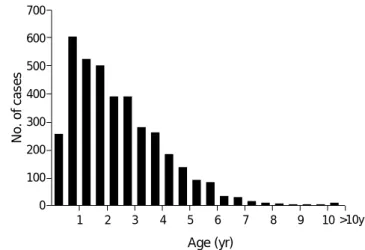
The mean age at diagnosis was 29.7±16.2 months, and the median age was 25 months with an age range from 1 month to 17.8 yr (Fig. 2). The disease occurred most com- monly in children aged 4 yr or younger with an incidence of 83.4% (3,221/3,862). The male-to-female ratio was 1.51:1 showing a predilection for males (2,321/1,541).
Sibling cases and recurrent cases
The prevalence of sibling cases was 0.26% (10/3,862). The total number of recurrent cases was 90 (2.3%), including 85 cases with a single event recurrence, 4 cases with 2 events recur- rence, and 1 case with 3 events recurrence.
Geographical incidence and number of Kawasaki dis- ease patients among total hospitalized pediatric pa- tients
The proportion of patients with KD among total hospital- ized pediatric patients except patients in nursery was 1.19%
in average (Table 1), and showed a significant difference accord- ing to regions with the highest incidence in Chungbuk area and the lowest incidence in Kwangju and Chonnam areas (Table 2).
1997 1,143 116,639 0.98
1998 1,419 103,069 1.38
1999 1,300 104,359 1.25
Total 3,862 324,067 1.19
Year %
Table 1. Yearly proportion of patients with Kawasaki disease among total hospitalized pediatric patients
No. of patients
KD Total
No. of cases
450 400 350 300 250 200 150 100 50 0
J F M A M J J A S O N D
Fig. 1. Monthly distribution of cases with Kawasaki disease.
Months
No. of cases
700 600 500 400 300 200 100 0
1 2 3 4 5 6 7 8 9 10 >10y
Fig. 2. Distribution of age at onset.
Age (yr)
Epidemiology of Kawasaki Disease in Korea 455
Findings of echocardiography
Echocardiography was done in 97.4% of patients (3,723/
3,862), and CA abnormalities were found in 19.8% of cases (737/3,723) including dilatations in 601 cases (16.1%) and aneurysms in 191 cases (5.1%). Categorization of these 737 cases in detail showed 546 cases (14.7%) with pure dilatation, 136 cases (3.6%) with aneurysm only, and 55 cases (1.5%) with dilatation and aneurysm. Morphologic classification of total aneurysms by echocardiography revealed 68 cases with saccular aneurysm, 61 cases with fusiform, and 62 cases with- out description.
Findings of coronary angiography
Coronary angiography was performed in 0.7% (27/3,862) of patients, and abnormal findings of CA were found in 81.5%
(22/27) of cases. Total abnormal lesions included 16 dilata- tions, 15 aneurysms, 3 stenoses, and 1 occlusion.
Myocardial infarction and death
There was no case with myocardial infarction. Death was reported in one case, however, the cause of the death seemed to be unrelated to the KD.
Comparison with previous studies during 1991-1996
These epidemiologic studies have been done every 3 yr from 1991. Adding 1,709 cases of the 1st study (4) during 1991- 1993 and 2,680 cases of the 2nd study (5) during 1994-1996, to the 3,862 cases of the present study, the cumulative num- ber of patients was 8,251.
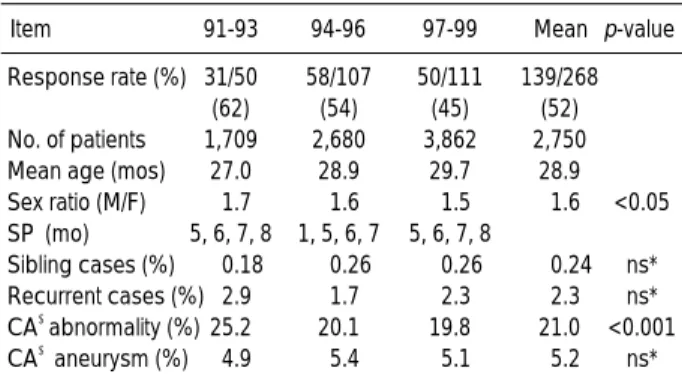
Data of the total 8,251 cases in the 1990s in Korea showed a mean age of patients of 28.9 months, the male-to-female ratio of 1.6:1, a seasonal predilection for summer, the prevalence of sibling cases 0.24%, the rate of recurrence 2.3%, the inci- dence of CA abnormalities 21.0%, and the incidence of CA aneurysms 5.2% (Table 3). Among these data, the male-to-
female ratio and the rate of CA abnormalities showed statis- tically significant decreasing trends. However, the rate of sib- ling cases, rate of recurrent cases, and incidence of CA aneurysms showed no significant increasing or decreasing trend.
DISCUSSION
KD, also known as mucocutaneous lymph node syndrome, is an acute febrile, multisystemic vasculitis of unknown eti- ology, which almost exclusively affects young children. The peak incidence of KD usually falls between 1 and 2 yr of age, compared with the peak incidence between 6 months and 1 yr of age in the present study, and 80% of cases occur in children aged 4 yr or younger (9), in accordance with the incidence of 83.4% in the present study. Race-specific incidence rates de- monstrate that the children of Japanese and Korean ancestry are of greatest risk. In Japan, the yearly incidence per 100,000 children under 5 yr of age was around 90 in both 1991 and 1992 (10), which were more than 10 times higher than the rates reported in Western countries. Boys are affected more often than girls with ratio of 1.3-1.5 to 1 (6, 9, 11), which is sim- ilar to the ratio of 1.51 in the present study. The rate in the present study showed a statistically significant decreasing trend, meaning of which is not yet clear. The recurrence rate of KD is 1-3%, and the prevalence of KD among siblings of patients was reported to be about 2% (6, 11).
KD is known to be a major cause of acquired heart disease in children nowadays, because of its prolonged and significant cardiac involvement, especially the development of coronary aneurysms that might lead to a myocardial infarction and sud- den death. Thus all patients with KD should have an echocar- diographic evaluation. Echocardiography exhibits mild diffuse dilation of CA during the acute phase in 30-50% of patients.
If not treated, or treated by only aspirin, CA aneurysms develop in 20-25% of patients. However, the incidence of coronary aneurysms has been lowered to 3-5% with intravenous gamma- globulin treatment (6, 9, 11). The statistically significant decreasing trend of CA abnormalities in the present study is
Seoul 922 97,149 0.95 18
Incheon, Kyonggi 535 34,083 1.57 5
Taejon, Chungnam 104 7,736 1.34 1
Chungbuk 208 9,323 2.23 2
Chonbuk 120 9,842 1.22 1
Kwangju, Chonnam 319 34,155 0.93 5
Taegu, Kyongbuk 849 73,589 1.15 8
Busan, Kyongnam 627 46,599 1.35 8
Kangwon 178 11,593 1.54 2
Total 3,862 324,067 1.19 50
Region % Hospitals
(No.) Table 2. Geographical incidence and number of patients with Kawasaki disease among total hospitalized pediatric patients
No. of patients
KD Total
Response rate (%) 31/50 58/107 50/111 139/268
(62) (54) (45) (52)
No. of patients 1,709 2,680 3,862 2,750
Mean age (mos) 27.0 28.9 29.7 28.9
Sex ratio (M/F) 1.7 1.6 1.5 1.6 <0.05
SP�(mo) 5, 6, 7, 8 1, 5, 6, 7 5, 6, 7, 8
Sibling cases (%) 0.18 0.26 0.26 0.24 ns*
Recurrent cases (%) 2.9 1.7 2.3 2.3 ns*
CA�abnormality (%) 25.2 20.1 19.8 21.0 <0.001
CA�aneurysm (%) 4.9 5.4 5.1 5.2 ns*
Table 3. Comparison of three epidemiologic studies
Item 91-93 94-96 97-99 Mean p-value
*ns, not significant (p-value >0.05); �SP, seasonal predilection; �CA, coro- nary artery.
456 Y.-W. Park, I.-S. Park, C.-H. Kim, et al.
thought to be related to the increasing usage of intravenous gamma-globulin in the 1990s.
A mortality rate of about 1-2% was reported in patients with KD in the mid-1970s. But the mortality rate in Japan has declined to approximately 0.04%, with improved recog- nition and appropriate treatment of the disease (6, 9, 11).
There are some limitations in this kind of survey, such as a retrospective nature of the investigation and low response rate to the questionnaire. However, we believe that the data from this study reflect the nationwide trend and change in the incidence of KD in Korea.
ACKNOWLEDGMENTS
The authors would like to appreciate all the contributors and hospitals to this study. The names of the contributing hospitals and pediatricians are as follows:
Anyang Jungang General Hospital, Min-Shik Kim; Ca- tholic University of Taegu-Hyosung Hospital, Chang-Ho Han; Catholic University Our Lady of Mercy Hospital, Gin- Han Kang; Catholic University St. Paul's Hospital, Chang- Kyu Oh; Catholic University St. Vincent's Hospital, Jin-Hee Oh; Chonbuk National University Hospital, Chan-Uhng Joo; Chonnam National University Hospital, Jae-Suk Ma;
Chosun University Hospital, Yeung-Bong Park; Chungbuk National University Hospital, Heon-Seok Han; Chungnam National University Hospital, Hong-Ryang Kil; Daegu Fati- ma Hospital, Seong-Tae Kim; Daerim St. Mary's Hospital, Soo-Young Kwan; Dong-A University Hospital, Hyoung-Doo Lee; Dongguk University Hospital, Kyungju, Sung-Min Cho;
Dongguk University Hospital, Pohang, Dong-Seok Lee;
Dongkang General Hospital, Ulsan, Dong-Jin Lee; Ewha Womans University Tongdaemun Hospital, Young-Mi Hong;
Gachon University Gil Medical Center, Mi-Jin Jung; Gyeong- sang National University Hospital, Hyang-Ok Woo; Hallym University Chunchon Sacred Heart Hospital, June Huh; Hal- lym University Kangdong Sacred Heart Hospital, Chong- Young Park; Handong University Sunlin Hospital, Jong- Soo Lee; Hanil Hospital, Jin-Keun Chang; Hanyang Univer- sity Hospital, Nam-Su Kim; Inje University Busan Paik Hos- pital, Chul-Ho Kim; Inje University Seoul Paik Hospital, Yong-Won Park; Chung-Ang University Yongsan Hospital, Byoung-Hoon Yoo; Kangnam General Hospital, Young-Min Ahn; Kangnung Hospital, Yu-In Park; Keimyoung Univer- sity Dongsan Medical Center, Tae-Chan Kwon; Korea Cancer Center Hospital, Sang-Wook Choi; Korea University Hos- pital, Chang-Sung Son; Konkuk University Hospital, Kee- Hyuck Kim; Kwangju Christian Hospital, Yong-Wook Kim;
Kwangmyung Sungae Hospital, Won-Uk Lee; Kyungpook National University Hospital, Sang-Bum Lee; National Med- ical Center, Don-Hee Ahn; Busan Maryknoll Hospital, Jin- Wha Jang; Samsun Hospital, Sung-Mi Kim; Seigang Hos- pital, Jae-Won Huh; Seoul Municipal Boramae Hospital, Ho- Sung Kim; St. Francisco's Hospital, Ghee-Young Jung; Sun- gae General Hospital, Ji-Sook Kim; Sungkyunkwan Univer- sity Masan Samsung Hospital, Un-Seok Nho; Sungkyunkwan University Samsung Cheil Hospital, Mi-Na Lee; Seoul Nation- al University Hospital, Yong-Soo Yun; St. Columban Hos- pital, Hyone-Tae Kim; University of Ulsan, Asan Medical Center, In-Sook Park; Yeungnam University Hospital, Young- Hwan Lee; Yosu Chonnam Hospital, Gyung-Won Kang.
REFERENCES
1. Kawasaki T. Acute febrile mucocutaneous lymph node syndrome with lymphoid involvement with specific desquamation of the fingers and toes in children. Jpn J Allergy 1967; 16: 178-222.
2. Lee DB, Lee KS, Lee BC, Lee IJ. Epidemiologic and clinical study of mucocutaneous lymph node syndrome in Korea. J Korean Pedi- atr Soc 1982; 25: 977-93.
3. Lee DB. Epidemiologic survey of Kawasaki syndrome in Korea (1976-1984). J Catholic Med Coll 1985; 38: 13-9.
4. Yun YS, Kim CH, Kim CH, Tockgo YC, Lee SK, Hong CY. Kawa- saki disease in Korea. Proceedings of the 5th International Kawasa- ki Disease Symposium; 1995 May 22-25; Fukuoka (Japan): Kawasa- ki Foundation, 1985: 30-3.
5. Park YW, Kim CH, Park IS, Ma JS, Lee SB, Kim CH, Yun YS, Lee KS, Lee SK, Tockgo YC. Epidemiologic study of Kawasaki disease in Korea, 1994-1996: comparison of previous study in 1991-1993. J Korean Pediatr Soc 1999; 42: 1255-60.
6. Rowley AH, Shulman ST. Kawasaki syndrome. Pediatr Cardiol 1999;
46: 313-29.
7. Nakano H, Ueda K, Saito A, Nojima K. Repeated quantitative angio- grams in coronary arterial aneurysms in Kawasaki disease. Am J Car- diol 1985; 56: 846-51.
8. Research Committee on Kawasaki disease. Report of subcommittee on standardization of diagnostic criteria and reporting of coronary artery lesions in Kawasaki disease. Tokyo, Japan: Ministry of Health and Welfare; 1984.
9. Melish ME. Kawasaki syndrome. In: Pediatrics in Review 1996;
17: 153-62.
10. Yanagawa H, Yashiro M, Nakamura Y, Kawasaki T, Kato H. Epi- demiologic pictures of Kawasaki disease in Japan: from the nation- wide incidence survey in 1991 and 1992. Pediatrics 1995; 95: 475-9.
11. Chung CJ, Stein L. Kawasaki disease: a review. Radiology 1998; 208:
25-33.