교육과정평가연구
The Journal of Curriculum & Evaluation
2003, Vol. 6, No. 1, pp. 331 〜 346ESL Learners’ Responses to Errors in ESL W ritten Discourse*
K y u n g -S u k Kim(Kyonggi University)
I. Introduction
There are several studies which examined native speaker(NS)s' (particularly, university professors) reactions to the instances of incorrect language use in English as a second language(ESL) learners’ written works in order to determine the relative seriousness of error categories. In their study, Vann, Lorenz, & Meyer (1984) asked university faculty to rank the relative gravity of 12 typical ESL written error categories at the sentence level. The categories were selected by surveying ESL instructors with regard to the most frequent errors and sample sentences containing errors were taken out of ESL compositions. The results showed the following continuum of increasing seriousness of errors: (the least serious) spelling-1 >
article > comma splice > spelling-2 > prepositions > pronoun agreement > subject-verb agreement > word choice > relative clauses > tense > It-deletion > word order (the most serious)* 1). In a replication study, Janopoulos (1992) used the same sentences as Vann et al.
employed. The two studies had commonality in that spelling errors were on the top of the scale of seriousness. But the relative seriousness of the other errors did not match in the two studies.
Among the studies investigating professors' judgments of errors in ESL writing, some collected data by using texts instead of sentences (e.g., Santos, 1988; Tomiyama, 1980; Vann, Lorenz & Meyer, 1991). Just as the studies which used sentences taken from texts did not take into consideration the context beyond the sentence level in which the errors occurred, those studies which used full texts did not examine the subjects’ judgments in the original discourse.
The originality of the texts was not preserved in that they were modified to include only the
* This study was supported by Kyonggi University research grant in 2002.
1) Spelling-1 error refers to the use of spelling varieties deferent from American spelling.
Spelling-2 error has to do with deletion or substitution.
교육과정 평 가연구 세6 권 세 1 호(2003)
target, errors, that is, they excluded the non-target errors. The researchers pre-sorted the target errors a打cr consulting with the literature of error analysis and conducting surveys of ESL instructors. Because the researchers selected target errors according to their own criteria and they turned out to be different from study to study, it is impossible to have a set of comparable data. However, the researchers acknowledge that the use of texts is a better approach than that of sentences taken out of context on condition that the texts arc not altered.
The studies using texts modified them for the purpose of casing the task of getting data on some error types. Regarding the problem of altering texts in the studies of error judgment, Santos (1988) states-
Artificially prepared passages allow for maximum control of the variables by the researcher, but they also sacrifice the natural quality of unaltered connected discourse .... Finally,selectively inserted errors give equal weight to each error type by representing them only once each, an unrealistic condition that ignores the frequent recurrence of certain error types and the relatively infrequent occurrence of others, (pp. 74-75)
Janopoulos (1992), who took the sentence-level approach, defends
the use of decontextualized
errors but at the same time presents his attitude toward the discourse-level approach as follows-Sentence-level errors allow 「or greater ease of execution and control of such variables as error Prequency. Granted, ^iven the current orientation in
KSI.
composition toward discourse-level research, such an approach is not optimal. Still, it must be remembered that even discourse-level research usually attempts to extrapolate generalizations based upon analysis of a single piece of writing and often involves artiTicial manipulation of elements within a text. (p. I l l )
The insight lhaL we can gel from Lhe l\vo types of studies cited above (those w ilh a sentence-level approach and those with a discourse-level approach) is lhat, lhe besl approach in studying subj eels' reaclions Lo incorrect language use is Lo use Lexis with no pre-modificalion. Turning our aLLention from N S s; reactions
lo E S L wrillen works Lo
non-nalive speaker(NNS)s; judgments o士 fellow N N S s,f writings, there is no research which has examined N N S s7 reaclionslo E SL wnLLen texts all of whose elements are kepi
untouched. No research has addressed Lhe issues o士 how seriously they I上ink iheir fellow N N S s,f composition errors are and how accurately they judge the errors. These issues, which are significant, in light of Lhe influence of con Lex L on the learners' perceplion of errors, are the foci of this article.E SL Learners' Responses to Errors in E SL W ritten Discourse
I I . The Study
The purpose of the study was to investigate ESL learners' reactions to text-level errors in an ESL composition. The following research questions were posed: (a) Is learners’
grammaticality judgment of errors correlated with their tolerance for them in understanding the text? ; (b) Are the learners more accurate in judging certain types of errors than they are of other types? ; (c) Do the learners' levels of proficiency in the target language have an effect on their grammaticality judgment and their tolerance? Grammaticality judgment can be defined as the learners' ability to judge w hat's wrong with an instance of incorrect use and find a correct expression for it (Vann et al” 1991). Tolerance refers to the degree to which the respondents are bothered by the incorrect use in understanding the text (Janopoulos, 1992). If they are less bothered by an error, they are more tolerant of it and can process the flow of information regardless of the error. A close examination of the relationship between grammaticality judgment and tolerance will show whether the more they are accurate in judging the grammaticality of errors, the more tolerant they are for the errors in processing the text.
1. Subjects
The subjects of the study are non-native speaker students taking ESL classes at two American institutions. A total of 92 learners answered the questionnaire. Fifteen of them were taking ESL classes at Northern Virginia Community College (Annandale campus) and the rest were enrolled in the Intensive English Program at George Mason University. Their first language backgrounds were very diverse- Korean (27 subjects), Japanese (30), Arabic (13), Chinese (10), Thai (4), Spanish (3), Vietnamese (2), Russian (1), Indonesian (1), and Polish (1). They were aged from 17 to 56. Although the range is very broad, they were clustered around the age of 20. The gender ratio is in favor of females: 52 females and 40 males. In order to get information about their English proficiency as measured by a standardized test, the respondents were asked to provide their T O EFL scores if they had taken it. However, quite a few, one third of them, reported that they had not taken the test yet. The average scores of those who had taken the T O EFL in the paper-based format and the computer-based format were 521 and 1822),respectively. If the scores of the computer-based test are converted into those of the paper-based one according to a concordance table provided by English Testing Service (2002), the average score of the whole group who took the T O EFL is 516.
2) This can be converted into the score of 512 on the paper-based format.
교육과정평가연구 제6권 제1호(2003)
2. The Material
The composition used in the study was written by a non-native speaker taking an ESL writing class at Georgetown University in 2000. He was from Cameroon and placed at a high -intermediate level. The composition was a first draft with the title of
"A Traditional
Ceremony of Wedding in Cameroon." He wrote two more drafts after the first one. All three drafts were provided to the researcher by the teacher. O f the three drafts, the first one was selected for the study because the others were longer and contained more tokens of errors than the first one. The errors in the first draft are representative of the types of errors which have been shown to be most common among ESL students in the literature of error analysis (e.g., Tomiyama (1980) and Sheorey and W ard (1984)). In order to keep its originality, the composition was kept intact.The composition contained 237 words in 12 sentences, which included 14 errors. Out of 12 sentences, eight sentences had a single error each and three sentences two errors. There was one sentence containing three errors. The remaining two sentences were error-free. In order to decide whether a certain word or expression is wrongly used, the text was read by five faculty members teaching in the field of linguistics or ESL at Georgetown University. They were personally seen by the researcher and were told that they should consider the composition as a piece of pre-academic work by an ESL learner who wanted to advance to a post-graduate institution in America. Only those items which were judged incorrect by more than four native speakers were selected as target expressions to be judged by the non-native speaker subjects of the study.
There were six categories of errors in the text. The error category that most frequently troubled the writer was word choice, which appeared four times (#s 1, 2, 6, 9). A nd possessive pronouns (#s 11, 14) and logical connectors (#s 3, 5, 13) were wrongly used twice and three times, respectively. There was only one error regarding each of verb form (# 4), there-structure (# 10), and subject—verb agreement (# 12). In presenting the text to the respondents, errors were highlighted and underlined in the text. In the case of # 11, where a possessive pronoun is omitted, an underlined blank was provided.
3. The Questionnaire and Data Collection Procedure
The questionnaire was three pages long. The first page asked for background information of the respondents. The questions were concerned about their native language, gender, age, and T O EFL score. The composition was given on the second page. For each error in the text, there was a multiple-choice question seeking the most appropriate expression for the error. The third page asked the respondents to rank each error on a 5-point tolerance scale with 1 being not bothersome at all and 5 being very bothersome.
E SL Learners' Responses to Errors in E SL W ritten Discourse
A couple of weeks prior to the date of data collection, the researcher visited the two institutions and put notices recruiting volunteers for the study under the sponsorship of the institutions. On the date of data collection, the subjects assembled in a classroom or an auditorium at each institution. Before distributing the questionnaires, the researcher explained how to respond to the errors in the text and to the tolerance scale. There was no time limit.
Only a few subjects asked questions during the session and they were concerned about the way of marking the degree of tolerance on the scale.
M. Results
The first research question asked whether grammaticality judgment of errors was correlated with tolerance for them in understanding the text. A Pearson product-moment correlation was computed using the Statistical Packages for the Social Sciences (SPSS). As shown in Table 1, the result shows that there was a statistically significant relationship between ESL learners' grammaticality judgment of errors and their tolerance for them; the correlation was significant at the 0.05 level.
〈Table 1〉 Correlation Between G ram m aticality Judgm ent and Tolerance
Tolerance Grammaticality judgment
Pearson Correlation - .223
Sig. (2-tailed) .033
Sum of Squares and Cross-products -722.217
Covariance -7.936
N 92
Two points of caution in interpreting the statistics should be noted here. The fact that the two characteristics were negatively correlated comes from the design of the 5-point Likert scale used for estimating tolerance. In the scale (see page 3 of the appendix), point 1 means the respondent was not bothered at all by an error and point 5 indicates the opposite. Because the respondents who made a correct judgment of an error correction would likely have more tolerance and choose the low-end of the scale (this will be explained later), there was a negative correlation. Another point to be mentioned is that although the p —value was statistically significant, the correlation coefficient was rather low. But if we look at how the respondents performed on each item (see Table 2), we can have a better understanding of the
교육과정평가연구 세6권 세 1 호(2003)
relationship bctwccti the two characteristics. Table 2 shows how the respondents who correctly chose the most appropriate expressions for the errors distributed the ratings for the tolerance r〇r the errors.
In order to find out whether or not their distribution on the Likert scale was statistically significant, Clii-square analyses were carried o u t The overall Chi-square was 76.02, dT = 52, p < .05, indicating that the distribution 〔>「 the tolerance ratings lias a statistically significant relationship with the respondents' ^ram m aticality judgm ent. As a whole, the respondents' distribution of ratings 「rom the middle to the lower end 〇「tlie scale (1 and 2) was more dom inant than from the middle to the higher end with the exception oT items 3 and 5,whose ratings oil the tolerance scale were quite evenly dispersed- Tliis means that the correct respondents in general were not inucli bothered by the errors when processing the text.
< Table 2> Chi-square S tatistics for the Tolerance of the Errors
\ Tolerance
Item \ (number
\
of correct
\
responses)\
1 (Not. al all
Ijolhered)
2 3 ,1
5 (BoQiered
very much)
P
1 (42) 13 9 15 11 4 8.250 .083
2 (53) 16 12 13 6 6 4.58(5 .332
3 ((34) 17 8 11 7 21 i3 .m .011
A (57)
20 13 13 7 4 13/139 .0095 (;56) 10 11 11 9 15 1. 紋 7 ,762
6 (28)
8 5 66
3 2.:J57 .6707 (58) 18 13 14
6
7 8.724 .◦燃8 (54) 18 16 10 9 16.556 .002
9 (50) 15 7 11 9 5 7.600 107
10 (75) 24 17 15 10 9 9.733 .045
11 (70) 21 17 16 6 10 10.113 .038
12 (25) n 8 4 1 15.600 .004
13 (42) 10 12 6 8 6 3.328 .519
14 (48) 15 10 14 5 4 10.542 .032
ᄌ2 = 76.02, df = 52, p < .05
ESL
Learners' lie^ponse^ lo Errors in ESL W riiien DiscourseAs presented in Tabic 2, the results of chi-square analyses for individual items show that the distribution of responses on the tolerance scale by correct respondents arc statistically significant for seven items (#s 3,
4,
8T 10, 11, 12, 14) out of 14. For these items, points 1 and 2 on the scale arc heavily favored over the others, mcatling that the correct respondents did not have much trouble in understanding the text regardless of the incorrect uses. O f the six items,#s 3, 10, and 11 arc the top three easiest ones in the overall order of difficulty on the grammaticality judgment test as shown in Table 3. A nd #s 4 and 8 arc located in the middle of the order. Responses on the scale of tolerance for item 12, which is the most difficult one in the order (only 25 out of 92 respondents chose the correct answer), and item 14, which is the fifth most difficult one, particularly shows that as far as the correct respondents were concerned, they were not much bothered by the incorrect use regardless of their overall difficulty.
The second research question was to find out whether the respondents were more accurate in jud요in요 certain types of errors than they were of other types. In other words, it dealt with the issue of the order oT dilTiculty of the errors in the composition. Table 3 shows the mean scores and standard delations
r〇 r
the errors in the 片rammaticalily jud^inerit test. In interpreting the mean scores, .60, for example, means that 60 percent of 92 respondents provided the correct answer. Item 10 was the easiest item and item 12, which had a far lower mean score than any other item, was the most difficult one. There is a very little increase in dilTiculty amon요 the items in the middle of the bierarcliy (Prom 7 to 2, 2 to 4,4 to 5,and 5 to 8). However,「rom the two easiest items (#s 10 and 11) to the middle 푠roup items, and also from the middle group items to the three most difficult items (#s 13, 6, 12) there is a sharp increase in difficulty.〈Table 3〉 Order of D ifficulty of the Errors
10 11 3 7
l
4 5 8 9 11 1 13 6 12Mean .815 .761 .6 紋 .630 .(330 .620 .609 .587 .543 .522 .520 .457 .304 .272 s n .390 .429 .467 .485 .485 .488 .491 .495 .501 .502 .500 .501 .463 .447
Figure 1 is an alternative form of the order of difficulty arranged according to the error type묘. The analyses of the order of difficulty exhibit word choice was the most difficult category; tlircc out of five word choice errors (#s 12, 6, 1) belonged to the top five most difficult items. Paiticularly, the most difficult item and the second most difficult one were both the same type. The easiest type
was
the thcrc-stnicturc (# 10) with the mean score of .815. In the ease of possessive pronoun, which had two itistanccs of incorrect use, one item was rather difficult (# 14) and the other (# 11) was located towards the easier end. The two items of the tense category (#s 7, 8) stayed dose to the middle of the order.There werc three logical connector items (#s
3,
5, 13) and they were distributed in the order of difficulty at intervals keeping a similar distance among them; there were three items between #s3
and 5, and four between #s 5 and Ki교육과정평가연구 세6권 세 1 호(2003)
[Figure 1]
Order of Difficulty 〇「the Krror Categories Easy
# 10: thcrc-fttructurc
# 11: possessive pronoun
# logical connector
# 7: tense
#
2 :
word choice#
4 :
verb foriri# 5- logical connector
# 8- tense
# 9: word choice
# 14- possessive pronoun
# 1- word choice
# 13- logical connector
# 分 word choice
” # 12* word choice Difficulty
In order Lo examine il' there is any relationship between the order of difficulty and the order of Lolerance, Lhe means and standard deviaLions for the Lolerance o士 the items were computed.
In Table 4, Lhe lefl mosl item was the leasL tolerable one (lhe score 5 is Lhe maximum level of intolerability) and lhe right, mosL ilem was lhe most tolerable one. According to the mean scores, with lhe exceplion ol' ilem 3? there is a very much gradual decrease from one item Lo another in Lhe conlinuum of Lolerance; lhe largest mean difference beLween Lwo items (#s 13 and 11) is .11. The mean scores of seven items (#s 11, 6, 2,9,7,14, 10) are clustered around 2.65, which means LhaL they have a similar level af Lolerance and lhaL Lhe level is in almost Lhe middle of the scale of tolerance.
〈Table 4〉 Order of Tolerance
3 5 13 11 6 2 1 7 11 10 1 12
公
,1Mean 3.19 2.89 2.79 2. 燃 2.67 2.(36 2.66 2.65 2.(33 2.61 2.55 2.52 2.46 2.44 SI) 1.47 1.37 1.25 1.39 1.29 1.28 1.31 1.29 1.34 1.38 1.27 U 8 1.15 1.26
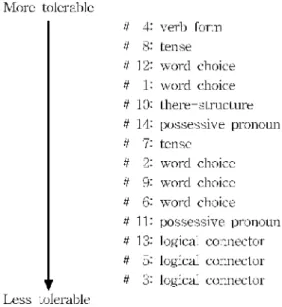
The order of tolerance in accordance with the error types is figuratively shown in Figure 2.
Compared widi the order of difficulty, the order oT tolerance has a major difference in that although the three logical connector items were dispersed on the order of difficulty scale, all of them came together at the low end 〇「the tolerance scale. In addition to this, there are a lot of mismatches between items in the order of difficulty and those in the order of tolerance. The
ESL
Learners' lie^ponse^ lo Errors in ESL W riiien Discoursemost difficult item (# 12) was the third most tolerable oncT and the fourth most difficult one (#
1) had a reverse position in the order of tolerance, that is, the fourth most tolerable one.
Thcrc-structurc was the easiest error type in the order of difficulty hut it was located in the middle of the order of tolerance.
[Figure 2] Order of Tolerance
More tolerable#
4#
8# 12
#
1#
10# M
#
if 7
if 9
#
9#
6#
11#
13#
5i r #
3v e r b 「〇 Tin tense word choice word choice Lhere-sLrucLure possessive pronoun tense
word choice word choice word choice possessive pronoun logical connector logical connector logical connector Less tolerable
The third research question was to examine whether the learners' levels of proficiency had an effect on the grammaticality judgment and the tolerance. The respondents were grouped into three in accordance with their TO EFL scores. Those with scores lower than 500 were placed in the upper-beginning group and those whose scores were between 5(]〇 and 550 in the intermediate group. The upper-intermediate group respondents had scores of 550 or above.
Table 5 shows that the mean scores of the grammaticality judgment test increased as the respondent.?/ levels of proficiency advanced. The upper-beginning group on average correctly judged 6 items out of 14 whereas the upper-intermediate group correctly chose 3 items more than the upper-beginning group. W ith regard to the scale of tolerance, there seems to be not much difference in the mean scores amon^ the groups.
In order to Hncl out whether the mean scores of the two sections by the group are s ta tistic a lly 〔HITerent from one another, a one-way A NOVA for each dependent variable was carried o u t The results of the analyses as ^iven in Table 6 show that the three groups are si^nificantly di fferent from one another in the mean scores of the grammaticality judgment test.
This means that the respondent's level of proficiency can be an indicator of his/her performance on the grammaticality judgment test. In other words, the higher the learners' level of proficiency is, the better they judge the graminaticality of incorrect language use. On the other hand, as there was a minimal difference among the mean scores for tolerance, the
교육과정평가연구 제6권 제1호(2003)
statistical analysis of the comparison of the means shows that there is no statistically significant difference.
〈Table 5> Mean Scores of the Grammaticality Judgment and Tolerance by Group
Groups
Upper-beginning Intermediate Upper-intermediate
(N=27) (N=34) (N=31)
Grammaticality
judgment 6.16 8.61 9.18
Tolerance 38.16 37.38 36.70
〈Table 6〉 The Results of A N O V A
Sum of
squares df Mean
square F Sig
Grammaticality
judgment 10.709 .000
Between groups 155.529 2 77.765
W ithin groups 646.297 89 7.262
Total 801.826 91
Tolerance .1 燃 .901
Between groups 30.876 2 15.438
W ithin groups 13105.853 89 147.257
Total 13136.728 91
IV. Discussion and Directions for Further Research
To summarize, this study yielded the following results' 1) there was a correlation between E SL learners' grammaticality judgment of errors and their tolerance for them. The learners who made correct responses in the grammaticality judgment test were in general not much bothered by the incorrect use in processing the written text; 2) according to the order of difficulty, word choice was the most difficulty type of error; 3) there was a large gap between the order of difficulty and the order of tolerance; 4) ESL learners' level of proficiency had an influence on their grammaticality judgment but not on their tolerance for the errors.
ESL
Learners' lie^ponse^ lo Errors in ESL W riiien DiscourseThe finding that the group of learners who provided correct answers could understand the text regardless of the errors may lead to an assumption which can not be inferred from the studies of learner reaction at the sentence level. That is, if they reach a certain ]cvd of grammaticality judgment, they can process the text as a whole without being stuck by an error at the sentence level, i.c., there will be a smooth transitional process of information. In a sentence- lcvd studyT because each sentence under examination has no textual relationship with other sentences, it is impossible to investigate how some sentences each of which contains an error have
a
coherent relationship with regard to the grammaticality judgment and the tolerance and the correlation between the two.W ith regard to the order of difficulty, a major finding that word choice is the most difficult error has an important pedagogical implication. That is, sections on vocabulary building and lexical selection should be incorporated into KSL/KF1, writing courses, [kiilding up the vocabulary repertoire lias tended to be a neglected part in most academic classes and instead it has been understood as a personal task, which is mostly true in
KFL
instruction in Korea. But the results of this study indicate that this is a focal area which needs closer attention. There are so many ways of enhancing learners' vocabulary. A few of them are- through keeping a vocabularylo묘
based on the readings and lectures; through vocabulary exercises such as cloze and word origin exercises; through the elicitation of synonymous or antonymous forms of expression; and most of all, through extensive reading, that is, reading all kinds of written materials.A close look at the mismatch hctwccti the order of difficulty and the order of tolerance indicates that the order of difficulty was strongly affected by single sentence-level processing but the order of tolerance by the processing of pretty long sentences or beyond the singlc- scTitcncc level. The most difficult error category was word choice as mentioned above. The three instances of word choice topped the order of difficulty. In the ease of word choice, the learnersr attention in choosing the correct answer could he confined to the sentence which contained it. For example,in the following incorrect use of word choice, the learners didn't have to go beyond the sentence or even the clause in search of an appropriate expression:
Cameroon is a counfry with big (P 1) cultural diversity, depending on where you are.
l lie order of tolerance, on the other h and was affected by the amount of inrorination to be processed. That is, the more inforination there was to be processed, the less tolerable the incorrect use of language was. The three instances of the error category which were located at the least tolerable end, i.e., logical connector, were all concerned
w\th
the connection of some piece of infonnation with another, For instance, item 5 in the 「ollowins sentence requires understandiiiR Uie connection withthe
previous sentence: ...in Cameroon, weddings are celebrate (rt 4) on Saturday only. So (ft
5人Lhe Iradilional wedding happens the day before^ on Friday.
The facl lhaL the learners/ level of proficiency had an impact on ihe grammaUcalily judgmenl of the errors means lhaL the level af proficiency can be used as a reliable indicaLor of Lheir judgment abouL language use in wrillen discourse. Accordingly, in future research, ihe level of
교육과정평가연구 제6권 제1호(2003)
proficiency can be used effectively in designing the methodology. For instance, if the researcher wants to know in advance the most critical errors on the part of the learners in a composition mainly for the development of a test (e.g., cloze test), he/she can give the composition to the learners of various levels to pre-sort the errors.
Further research is needed in the area which tests the conformity between gram m atically judgment and real production. The questionnaire of the study raised the level of self
consciousness of the subjects with regard to errors, but they might not apply that when they are assigned to write a composition. That is, it is certain that we cannot be assured of identical patterns of practice in the perceptive and productive situations. Some learners may do well in grammaticality judgment but not so in actual writing tasks while others may have the same level of accuracy both in perception and production. While in this study only the level of proficiency was taken as a variable and it had a statistically significant relationship with grammaticality judgment, it is expected that a variety of variables such as learners' first languages, the genres of texts, the previous exposure to written texts, and many others would have an effect in shaping the learners' responses to written texts. W ith a larger group of subjects and several written texts, many learner factors can be taken into consideration in the methodology of future studies and insight into E SL learners' error responses in connected discourse will be much more enhanced.
References
English Testing Service. (2002). T O EFL total scaled scores, www.toefl.org/educator /edcncrd4..htrril.
Janopoulos, M. (1992). University Faculty Tolerance of NS and NNS W riting Errors: A comparison.
Journal of Second Language W riting, 1(2 ),109-121.
Santos, T. (1988). Professors' Reactions to the Academic W riting of Nonnative-speaking Students.
T E SO L Quarterly, 22(1),
69-90.Sheorey, R., & Ward, M. (1984). Using Non-ESL Teachers' Perceptions of Error Gravity in Correcting ESL Compositions. Paper presented at the 18th Annual T ESOL Convention, Houston.
Tomiyama, M. (1980). Grammatical Errors and Communication Breakdown.
T E SO L Quarterly, 14,
71-79.Vann, R., Meyer, D., & Lorenz, F. (1984). Error Gravity: A Study of Faculty Opinion of ESL errors.
T E SO L Quarterly, 18(3),
427-440.Vann, R., Meyer, D., & Lorenz, F. (1991). Error Gravity: Faculty Response to Errors in the Written Discourse of Nonnative Speakers of English. In L. Hamp-Lyons (Ed.),
A ssessing Second Language W riting in A cadem ic Contexts
(pp. 181-195). Norwood, N J: Ablex.* 논문접수 : 2003 년 4 월 2 일 / 수정본 접수 : 2003 년 5 월 12 일 / 게재승인 : 2003 년 5 월 3 0 일
E SL Learners' Responses to Errors in E SL W ritten Discourse
Appendix: The questionnaire
Page 1:
This survey is a part of research on error recognition by language learners. A ll the information from this survey will be kept confidential and used solely for research purposes.
Before you go on to the next page, please answer the following questions.
1. W hat is your native language? _____________
2. W hat is your gender? male, female 3. How old are you? ______________
4. W hat is your T O EFL score? ____________
Page 2 :
The following passage is an ESL student’s composition. Each underlined part in the passage contains an instance of incorrect language use. Please choose the most appropriate expression for each one. When you are finished, please go on to the next page.
Cameroon is a country with
b ig (# l)
cultural diversity, depending on where you are.Today,
I
would like to talk about a traditional wedding ceremony in the part of the country whereI originate(#2)
from: western Cameroon.First
avoid(#3). I
would like to mention that usually, in Cameroon, weddings areceleb rate(#4)
on Saturday only.So(#5),
the traditional wedding happens the day before, on Friday. Secondly, it is between therepresenting (#6)
of the two families such as the father, mother, grandparents and so on. The ceremonyis taking (#7)
place in the bride's house and her familyis coo k in g (#8)
toreceive(#9)
the guests. When the groom's family arrives, the bride is in a bedroom and she has to stay out of sight.While there
is(#10)
a lot of negotiations, she can only be assisted by some close friends of her or 0 _(#11) sister.W hen the bride at the end comes out, everybody is singing, dancing, and the groom family must present some gifts. As an example, the clothes she is wearing that day
com es(#12)
from the groomtogether(#13)
some other items such as jewelry, watches, shoes, clothes, and other expensive things. She must leave her house for herhusband one(#14)
and usually, the separation goes on with a lot of crying, but also with a lot of joy because it ’s a new life which begins for her. Finally, it is like a big game that everybody enjoys- old and young people._______________________________________________________# l: @ broad ® few © small @ widely
# 2: ® originated © am © arrive ® 0
# 3: @ place ® thing © off @ of all
# 4: ® celebrating © celebrates © celebrated @ celebrations
교육과정평가연구 제6권 제1호(2003)
# 5 @ However ® Therefore © Nevertheless ® Still
# 6 ® representations © representatives © represents @ represent
# 7 @ took ® has taken © takes @ will take
# 8 ® will cook © cooks © cooked @ was cooking
# 9 @ meet ® have © invite @ serve
# 10 ® seems © goes © have @ are
# 11 @ her ® hers © their © friend^
# 12 ® came © come © coming @ is coming
# 13 @ along ® but also © like @ as well as
# 14 ® husband house © husband one's © husband's ④ husband
Page 3:
Now for each underlined part, please answer the following question by circling a number in each scale: How much does the incorrect language use bother you in understanding the text?
# 1 1 --- 2 Not at all
# 2 1 --- 2
Not at all# 3 1 --- 2 Not at all
# 4 1 --- 2 Not at all
# 5 1 --- 2 Not at all
# 6 1 --- 2
Not at all# 7 1 --- 2 Not at all
# 8 1 --- 2
Not at all# 9 1 --- 2 Not at all
#10 1 ---2
Not at all#11 1 --- 2
Not at all
#12 1
---2
3 --- --- 4 —— --- 5 Very much 3 --- --- 4 —— --- 5
Very much 3 --- --- 4 —— --- 5
Very much 3 --- --- 4 —— --- 5
Very much 3 --- --- 4 —— --- 5
Very much 3 --- --- 4 —— --- 5
Very much 3 --- --- 4 —— --- 5
Very much 3 --- --- 4 —— --- 5
Very much 3 --- --- 4 —— --- 5
Very much 3 --- --- 4 —— --- 5
Very much 3 --- --- 4 —— --- 5
Very much 3 --- --- 4 —— --- 5
ESL
Learners' lie^ponse^ lo Errors in ESL W riiien DiscourseNot at all Very much
#13 4 5
NoL aL all Very much
#14 1 ---2 --- 3 --- 4 --- 5
NoL aL all Very much
T H A N K YOU
YFMY VIUCH
卜OK YOUR HKLF WTTH THIS RKSKAKCK PROJECT!교육과정평가연구 제6권 제1호(2003)
조
로
ESL 작 문 상 의 오류에 대한 ESL 학 습 자 들 의 반응 연구
김경석 (경기대학교)
이 연구는 어느 ESL 학습자의 작문에 주어진 오류에 대한 92명의 동료 ESL 학습자들 의 반응을 분석하였다. 다음 세 가지가 연구문제이었다: 1) 오류에 대한 ESL 학습자들의 문법성 판단력은 글을 이해하는데 있어 그 오류에 대한 인내력과 상관관계를 지니는가?;
2) ESL 학습자들은 특정 유형의 오류를 다른 유형의 것들보다 더 정확하게 판단하는가?;
3) ESL 학습자들의 영어 능숙도가 문법성 판단력과 인내력에 영향을 미치는가?
자료분석에서 나타난 연구결과를 요약하면 다음과 같다: 1) ESL 학습자들의 오류에 대 한 문법성 판단력과 인내력은 서로 상관관계를 지니고 있다; 2) 오류에 대한 문법성 평가 결과 나타난 난이도 순서에 의하면, 단어선택 (word choice) 이 가장 어려운 유형의 오류 이었다; 3) 오류들의 난이도 순서와 그들에 대한 인내력의 순서간에는 많은 차이가 있다;
4) 학습자들의 영어 능숙도가 오류에 대한 문법성 평가에는 영향을 끼 치지 만,인내력에는 별 영향을 끼치지 않는 것으로 나타났다.
Key Words : ESL written discourse, grammaticality judgment, tolerance, sentence-level approach, discourse-level approach