Received: December 19, 2018 Revised: February 19, 2019 Accepted: March 15, 2019
Correspondence to: Jacob Lee, Division of Infectious Disease, Hallym University Kangnam Sacred Heart Hospital, College of Medicine, Hallym University, 1 Singil-ro, Yeongdeungpo-gu, Seoul 07441, Korea
Tel: 02-829-5107, Fax: 02-6918-4222 E-mail: [email protected]
300병상 이하 병원에서의 카테터 연관 요로감염의 발생률
박진주1ㆍ서유빈2ㆍ김성란3ㆍ박혜진4ㆍ엄중식5ㆍ유현미6ㆍ천희경7ㆍ최재필8ㆍ이재갑2
한림대학교부속 한강성심병원 감염내과1, 한림대학교부속 강남성심병원 감염내과2, 고려대학교 구로병원 감염관리실3,
한림대학교부속 강동성심병원 감염관리실4, 가천의대 길병원 감염내과5, 인제대학교 상계백병원 감염관리실6,
경희의료원 감염관리실7, 서울의료원 감염내과8
Incidence of Catheter-associated Urinary Tract Infection in Hospitals with Less than 300 Beds
Jin Ju Park1, Yu Bin Seo2, Sung Ran Kim3, Hye Jin Park4, Joong Sik Eom5, Hyeonmi Yoo6, Hee Kyung Chun7, Jae-Phil Choi8, Jacob Lee2
Division of Infectious Disease, Hallym University Hangang Sacred Heart Hospital1, Seoul, Division of Infectious Disease, Hallym University Kangnam Sacred Heart Hospital2, Seoul, Infection Control Office, Korea University Guro Hospital3, Seoul, Infection Control Office, Hallym University Kangdong Sacred Heart Hospital4, Seoul, Division of Infectious Disease, Gachon University Gil Hospital5, Incheon, Infection
Control Office, Inje University Sanggye Paik Hospital6, Seoul, Infection Control Office, Kyung Hee University Medical Center7, Seoul, Division of Infectious Disease, Seoul Medical Center8, Seoul, Korea
Background: Catheter-associated urinary tract infection is a major infection in healthcare facilities. We investigated the urinary catheter utilization ratio and incidence of catheter-associated urinary tract infections in small-sized hospitals with ≤300 beds.
Methods: We recruited hospitals via a web-based survey from July 2016 to September 2016. Infection control practitioners provided data about catheter-associated urinary tract infections on the website according to the prescribed form. The urinary catheter utilization ratio was calculated by dividing the number of device-days by the number of patient-days. The incidence of catheter-associated urinary tract infections per 1,000 device-days was calculated by dividing the number of urinary tract infections in patients with indwelling urinary catheter by the number of indwelling device-days and multiplying by 1000. The urinary catheter utilization ratio and incidence of catheter-associated urinary tract infections were compared between hospitals with >200 beds and ≤200 beds.
Results: Twenty-seven hospitals were included. The average urinary catheter utilization ratio was 0.4 (0.47 in hospitals with >200 beds and 0.38 in hospitals with ≤200 beds; P=0.1). The incidence of catheter-associated urinary tract infections was 1.59 per 1,000 device-days. There was no significant difference in the incidence of infections according to the number of beds (1.53 in hospitals with >200 beds vs 1.9 in hospitals with ≤200 beds, P=0.421).
Conclusion: The incidence of catheter-associated urinary tract infections in small-sized hospitals was considerably high.
Efforts must be made to attenuate the infection rates through proper infection control and monitoring.
Keywords: Catheter-associated urinary tract infection, Incidence, Infection control
Introduction
Catheter-associated urinary tract infection (CAUTI) is one of the major infections in healthcare facilities [1,2]. Urinary catheter is the most common in- dwelling device [3]. With this device, approximately
3-10% of bacteriuria occur per day of catheter- ization, and among these bacteria, around 10-24%
cause symptoms of urinary tract infection (UTI) [4-7]. This infection leads to significant burden in morbidity and health care expenditure [1,2].
In South Korea, the Korean National Healthcare- associated Infections Surveillance System (KONIS) has been established to identify the actual incidence of CAUTI, and they targeted domestic hospitals that voluntarily participated and were being funded by the Korean Centers for Disease Control (KCDC) since 2006 [8]. KONIS reported that among hospi- tals which had over 300 beds, even urinary catheter utilization ratio (UCR) was low in smaller-sized hospital, the rate of CAUTI was not significantly different from that of larger-sized hospital [9]. This phenomenon is attributable to the limitations in in- fection control and surveillance of CAUTI due to the lack of knowledge, support resources, and time in small-sized hospitals. Infection control and sur- veillance are more challenging in small-sized hospi- tals, which increases the risk of CAUTI among patients.
Although the KONIS collected data from hospi- tals with >200 beds, the surveillance data obtained from small-sized hospitals in Korea was still limited. Thus, in this study, we further expanded the surveillance on small-sized hospitals with <200 beds. This study investigated the UCR and in- cidence of CAUTI in small-sized hospitals with ≤300 beds using a web-based surveillance system.
Materials and Methods
1. Study design and data collection
We prospectively conducted a web-based surveil- lance study to improve the project funded by the KCDC. Twenty-seven hospitals with ≤300 beds in Korea voluntarily participated in this study from July 2016 to September 2016.
During the study period, infection control practi- tioners at each hospital were trained three times
about diagnostic criteria, data input method, and in- fection monitoring method. The infection control practitioners filled out the characteristics of the hos- pital (location, bed size, monitored department, and availability of microbiological examination) and da- ta on CAUTI (use of indwelling urinary catheter;
clinical symptoms, such as fever ≥38°C, urgency, frequency, dysuria, suprapubic tenderness, and cost- overtebral angle pain or tenderness; insertion date of urinary catheter; date of CAUTI occurrence;
causative pathogen; and antimicrobial susceptibility) on the website according to the prescribed form.
Etiologic pathogens and antimicrobial suscepti- bility were determined according to each hospital’s and entrusted institution’s microbial identification methods.
2. Definition
The definition of CAUTI was based on the 2016 KONIS manual [10]. In all patients with urinary catheter, including those whose urinary catheters were removed within 48 hours, CAUTI was defined as follows: presence of at least one of the following signs or symptoms that could not be explained by other causes (fever ≥38°C, urgency, frequency, dysuria, suprapubic tenderness, and costovertebral angle pain or tenderness) along with a positive urine culture (≥105 CFUs/mL) with ≤2 bacterial species or at least one positive outcome in the dip- stick test, presence of pyuria, and positive gram stain. Indwelling urinary catheter only included Foley catheter via the urethra.
3. Data analysis
The UCR was calculated by dividing the number of device-days by the number of patient-days. The incidence of CAUTI per 1000 device-days was cal- culated by dividing the number of UTIs in patients with indwelling urinary catheter by the number of indwelling device-days and multiplying by 1000.
The UCR and incidence of CAUTI were compared between hospitals with >200 beds and ≤200 beds.
Table 1. Characteristics of the participating hospitals
Variables N (%)
Area
Seoul 5 (18.5)
Gyeonggi-do 7 (25.9)
Chungcheong-do 6 (22.2)
Gyeongsang-do 4 (14.8)
Jeolla-do 3 (11.1)
Gangwon-do 1 (3.7)
Jeju Island 1 (3.7)
Bed size
201-300 16 (59.3)
101-200 10 (37.0)
≤100 1 (3.7)
Monitoring department
Intensive care units 26 (96.3)
General ward 1 (3.7)
Number of monitored beds
Median (range) 12 (9-86)
Methods of microbiological test
In-hospital 9 (33.3)
External 18 (66.7)
Entrustment
Table 2. Urinary catheter utilization ratio during the study period
Variables Device-days Patient-days Pooled mean 95% CI 10% 25% 50% 75% 90% P-value UCR*
Overall 17,564 44,422 0.4 0.39-0.4 0.11 0.32 0.79 0.90 0.92
≤200 beds 4,180 8,940 0.38 0.29-0.77 0.05 0.17 0.56 0.91 0.93 0.1
>200 beds 13,384 35,482 0.47 0.62-0.88 0.21 0.67 0.83 0.91 0.94
*No. of device-days/No. of patient-days.
Abbreviation: UCR, urinary catheter utilization ratio.
The duration from the insertion of indwelling uri- nary catheter (IUC) to the occurrence of CAUTI was calculated. Based on the report that prolonged urinary catheterization, particularly >6 days, was a risk factor of CAUTI, the proportion of patients with such infection was analyzed by classifying them according to the duration of urinary catheter as ≤6 and >6 days with the day of urinary cathe- ter insertion set as day 1 [11-15].
Statistical significance was assessed via the chi-square test or Fisher’s exact test for categorical variables. Continuous variables were analyzed using independent t-test or the Mann–Whitney U test. A P-value <0.05 was considered statistically significant.
Statistical analysis was performed using the Statistical Package for the Social Sciences software version 20 (IBM SPSS Inc., Armonk, NY, the USA).
Results
1. Characteristics of the hospitals
Table 1 shows the characteristics of the partic- ipating hospitals. A total of 27 hospitals were in- cluded in this study. Based on bed size, 16 (59.3%) hospitals had 201-300 beds, 10 (37.0%) had 101-200 beds, and one (3.7%) had ≤100 beds. The median bed size was 223 beds. The intensive care units (ICU) (n=26, 96.3%) were mostly monitored and one (3.7%) general ward was also monitored.
The median number of monitored beds was 12 (range: 9-86). Microbiological results could be ac- quired by external entrustment (n=18, 66.7%) and in-hospital examination (n=9, 33.3%).
2. UCR and incidence of CAUTI
The UCR was 0.4 in this study (Table 2). The UCR in hospitals with >200 beds and ≤200 beds was 0.47 and 0.38, respectively. The result was not statistically significant (P=0.1).
During the study period, a total of 28 CAUTI were identified. The incidence of CAUTI was 1.59 per 1,000 device-days (Table 3). In hospitals with
>200 beds, the incidence of CAUTI was 1.53 (n=20), and in hospitals with ≤200 beds, the in- cidence was 1.9 (n=8) without significance (P=0.421).
The median duration from the insertion of IUC to the occurrence of CAUTI was 12 days. In total,
Table 3. Incidence of catheter-associated urinary tract infection during the study period
Variables No. of
infection
Device-
days Incidence* 95% CI 10% 25% 50% 75% 90% P-value CAUTI per 1,000 device-days
Overall 28 17,564 1.59 1.1-2.31 1.06 1.56 1.97 3.28 4.26
≤200 beds 8 4,180 1.9 0.86-4.24 1.9 2.41 3.27 3.79 4.1 0.421
>200 beds 20 13,384 1.53 1.01-2.32 1.05 1.56 1.95 3.15 4.19
*(No. of catheter-associated urinary tract infection/No. of device-days)×1,000.
Abbreviation: CAUTI, Catheter-associated urinary tract infection.
Table 4. Causative organisms of catheter-associated uri- nary tract infection
Organisms N (%)
Enterobacteriaceae 13 (46.4) Klebsiella pneumoniae 7 (25.0) Escherichia coli 4 (14.3) Proteus mirabilis 2 (7.1) Pseudomonas aeruginosa 2 (7.1) Acinetobacter baumannii 1 (3.6) Enterococcus faecium 6 (21.4) Enterococcus faecalis 2 (7.1)
Candida albicans 2 (7.1)
Corynebacterium species 1 (3.6) Trichosporon asahii 1 (3.6)
Total 28 (100)
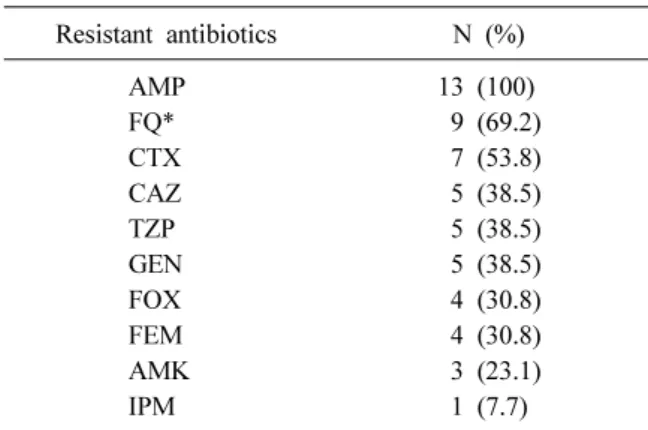
Table 5. Antimicrobial resistance to Enterobacteriaceae (n=13)
Resistant antibiotics N (%)
AMP 13 (100)
FQ* 9 (69.2)
CTX 7 (53.8)
CAZ 5 (38.5)
TZP 5 (38.5)
GEN 5 (38.5)
FOX 4 (30.8)
FEM 4 (30.8)
AMK 3 (23.1)
IPM 1 (7.7)
*Levofloxacin and ciprofloxacin.
Abbreviations: AMP, ampicillin; FO, fluoroquinolone;
CTX, cefotaxime; CAZ, ceftazidime; TZP, piper- acillin/tazobactam; GEN, gentamicin; FOX, cefoxitin;
FEM, cefepime; AMK, amikacin; IPM, imipenem.
21 (75.0%) CAUTI occurred after 6 days of cathe- terization, and 7 (25.0%) CAUTI occurred within 6 days of catheterization.
3. Causative pathogens of CAUTI and antimicrobial susceptibility
The main causative pathogens of CAUTI are shown in Table 4. Klebsiella pneumoniae (n=7, 25.0%) is the leading cause of infections, followed by Enterococcus faecium (n=6, 21.4%) and Escherichia coli (E.coli; n=4, 14.3%). Data on anti- microbial susceptibility was obtained only from 13 CAUTI, which were all caused by Enterobacter- iaceae (Table 5). All Enterobacteriaceae were re- sistant to ampicillin. Approximately 69.2% (n=9) and 53.8% (n=7) of bacteria were resistant to fluo- roquinolone and cefotaxime, respectively. One CAUTI (7.7%) was resistant to imipenem.
Discussion
In this study, we examined the UCR and in- cidence of CAUTI in small-sized hospitals with
≤300 beds. We further compared the differences according to the number of hospital beds.
Data that focused on small-sized hospitals were limited. During the same study period, the incidence of CAUTI was 0.93 per 1,000 device-days in hospi- tals with 200-299 beds based on the KONIS data [16]. The present study showed that the incidence of CAUTI was 1.59 per 1,000 device-days in hospi- tals with ≤300 beds and in hospitals with only 201-300 beds, the incidence was 1.53 per 1,000 de- vice-days. These findings suggested that the in- cidence of CAUTI in small-sized hospitals was higher than estimated with hospitals registered to
the KONIS. In the United States, the overall in- cidence of CAUTI was 1.62 per 1,000 device-days in the ICUs of hospitals with 50-457 beds from 2010 to 2011 [17]. Although direct comparisons are challenging because that study included hospitals with >300 beds, this result showed that the in- cidence of CAUTI was lower than the United States. However, data on the incidence of CAUTI in the United States was from 2010 and 2011, and considering the decreasing trend of CAUTI via sur- veillance, the incidence was likely similar to that of the United States [2].
The KONIS data showed that the rate of CAUTI was not significantly different between small- and large-sized hospitals, although the UCR was low in small-sized hospitals [9]. Although the result was not statistically significant, hospitals with ≤200 beds had tendency of lower UCR (0.38 in hospitals with ≤200 beds and 0.47 in hospitals with >200, respectively) and higher incidence of CAUTI (1.9 in hospitals with ≤200 beds and 1.53 in hospitals with >200, respectively) that of hospitals with >200.
Our result was consistent with that of a previous re- port [9].
In this study, the major pathogen that causes CAUTI was Enterobacteriaceae. Approximately 69.2% and 53.8% of bacteria were resistant to fluo- roquinolone and cefotaxime, respectively. Of the Enterobacteriaceae, 38.5% were resistant to ceftazi- dime and 30.5% to cefepime. In hospitals with >300 beds in Korea, 64.9% and 47.4% of E.coli isolated from CAUTI were resistant to ciprofloxacin and ce- fotaxime in 2013, respectively [18]. Of the E.coli isolated from CAUTI that was reported by the United States National Healthcare Safety Network in 2014, 35% and 16% were resistant to fluo- roquinolone and anti-pseudomonal cephalosporins, respectively [19]. The rate of resistance to anti- biotics in CAUTI was higher in Korea than in the United States. In addition, compared with commun- ity-onset acute pyelonephritis, which was 9.3% and 21.3% resistant to cefotaxime and fluoroquinolone,
respectively, antibiotic resistance in CAUTI is considerable. Thus, efforts must be exerted in pre- venting CAUTI.
The prolonged use of urinary catheter is the most important risk factor of CAUTI, particularly >6 days of catheterization [11-15]. In this study, 75%
of CAUTI occurred after 6 days of catheterization.
For the prevention of CAUTI, the use and duration of urinary catheterization must be reduced [20].
Medical staff often did not recognize the presence of IUC [21]. A systematic review has presented that the mean duration of catheterization decreased by 37% and that the rate of CAUTI was reduced by 52% with the use of a reminder or stop order for IUC [22]. The monitoring system used in determin- ing whether a catheter can be removed would be efficient in reducing the incidence of CAUTI.
In small-sized hospitals, the number of infection control practitioners is low. In South Korea, one in- fection control doctor per 300 beds and one in- fection control nurse per 200 beds were recom- mended by appropriating the infection prevention control charge [23]. This law applies only to hospi- tals with >150 beds. In addition, it is difficult to obtain such personnel at small-sized hospitals due to the lack of infection control specialist. In hospi- tals participated in this study, 7 (63.6%) hospitals let infection control practitioner have other tasks be- sides infection control work and all of them were hospitals with ≤200. Furthermore, infection control practitioners monitored average 26.9 beds in hospi- tals with ≤200 beds and 12.8 beds with >200 beds. Even if the ward was excluded, monitored beds were higher as 19.5 in hospitals with ≤200 beds. This lack of workforce and work overload makes infection control more challenging, which likely leads to an increase in infection rates. Since CAUTI had decreased since the introduction of the infection surveillance and education program of KONIS, it is believed that the infection rate might be reduced through opportunities for active infection surveillance and education even in small-sized hos-
pitals [9]. With the recruitment of manpower, the scope of surveillance in small-sized hospitals must be gradually expanded. To achieve this, a system- atic program must be established to increase the number of infection control practitioners and strengthen their capacity.
During the study period, education about in- fection control targeting infection control practi- tioners was conducted three times. After education, we collected the opinions of infection control prac- titioners about education and the limitation of the infection monitoring system via an anonymous, self-administered, structured questionnaire prepared in Korean. Through education, 79.1% of infection control practitioners responded that they can learn more about UTI and apply this theorical knowledge in clinical practice. This result suggested that edu- cation program was relatively effective in improving the quality of infection control. Some pointed out that the application of their knowledge to clinical practice was challenging due to the lack of man- power and laboratory examinations and limitation in obtaining clinical data. This showed the importance of increasing educational opportunities. Moreover, without manpower and computerized system as back-up, there will be limitations in improvements.
The present study had several limitations. First, most of the departments included in this study were ICUs. However, one (3.7%) general ward was in- cluded, and it was difficult to generalize the results to all hospital departments. Second, the infection data might be missing or misidentified because all data were collected by infection control practitioners. Although the infection control practi- tioners were taught about the selection and input of infection cases, the infection rates might be in- accurate because not all infection control practi- tioners were fluent.
The incidence of CAUTI in small-sized hospitals was substantial high. Efforts must be exerted in lowering infection rates through proper infection control and monitoring. In addition, measures in im-
proving manpower and education on infection con- trol should be implemented.
Summary
배경: 카테터 연관 요로감염은 의료기관에서
발생하는 주된 감염 중 하나로 이 연구에서 우리 는 300병상 이하의 작은 규모의 병원에서 발생한 요로 카테터 사용률(urinary catheter utilization ra-
tio)와 카테터 연관 요로감염의 발생률을 조사하
였다.
방법: 웹을 기반으로 하여 2016년 7월부터 9월 까지 자발적으로 병원을 모집하였고 각 병원의 감염관리자들이 카테터 연관 요로감염과 관련된 항목들은 웹에 미리 정해진 양식대로 작성하였 다. 요로 카테터 사용률은 기구 사용일을 총 재 원일로 나누어 계산하였고 1000일당 카테터 연 관 요로감염의 발생률은 요로카테터를 갖고 있 는 환자 중 발생한 요로감염 건수를 총 기구 사 용일로 나누고 1000을 곱하여 계산하였다. 각각 의 값은 200 병상 초과와 200병상 이하로 나누어 비교하였다.
결과: 총 27개의 병원이 참여하였고 총 요로 카테터 사용률은 0.4로 나타났으며 이중 200병상 초과에서는 0.47, 200병상 미만에서는 0.38 로 나 타났다 (P=0.1). 총 카테터 연관 요로감염 발생률 은 1000 기구일당 1.59이었으며 200병상 이하의 병원에서 1.9, 200병상 초과 병원에서 1.53이었으 며 통계적인 의미는 없었다(P=0.421).
결론: 300 병상 이하의 작은 규모의 병원에서
발생한 카테터 연관 요로감염의 비율은 높은 편 이었다. 따라서 적절한 감염관리와 모니터링을 통해 감염을 낮추려는 노력이 필요하다.
Acknowledgements
This research was supported by a fund from the research of the Korea Centers for Disease Control and Prevention.
The authors have no potential conflicts of interest to disclose.
References
1. Magill SS, Edwards JR, Bamberg W, Beldavs ZG, Dumyati G, Kainer MA, et al.; Emerging Infections Program Healthcare-Associated Infections and Antimicrobial Use Prevalence Survey Team.
Multistate point-prevalence survey of health care-associated infections. N Engl J Med 2014;
370:1198-208.
2. Nicolle LE. Catheter associated urinary tract infections. Antimicrob Resist Infect Control 2014;3:23.
3. Centers for Disease Control and Prevention.
Healthcare-associated infections. https://www.cdc.
gov/hai/ca_uti/uti.html (Updated on 16 October 2015).
4. Warren JW, Platt R, Thomas RJ, Rosner B, Kass EH. Antibiotic irrigation and catheter-associated urinary-tract infections. N Engl J Med 1978;299:
570-3.
5. Leuck AM, Wright D, Ellingson L, Kraemer L, Kuskowski MA, Johnson JR. Complications of Foley catheters--is infection the greatest risk? J Urol 2012;187:1662-6.
6. Saint S. Clinical and economic consequences of nosocomial catheter-related bacteriuria. Am J Infect Control 2000;28:68-75.
7. Tambyah PA, Maki DG. Catheter-associated uri- nary tract infection is rarely symptomatic: a pro- spective study of 1,497 catheterized patients.
Arch Intern Med 2000;160:678-82.
8. Lee SO, Kim S, Lee J, Kim KM, Kim BH, Kim ES, et al. Korean Nosocomial Infections Surveillance System (KONIS) report: data sum- mary from july through september 2006. Korean J Nosocomial Infect Control 2006;11:113-28.
9. Kwak YG, Choi JY, Yoo H, Lee SO, Kim HB, Han SH, et al. Korean National Healthcare-asso- ciated Infections Surveillance System, intensive care unit module report: summary of data from July 2014 through June 2015. Korean J Healthc Assoc Infect Control Prev 2016;21:37-49.
10. KONIS system. KONIS 2018 ICU manual.
http://konis.cafe24.com/xe/index.php?mid=manual&
category=251 (Updated on 27 July 2018).
11. Leone M, Albanèse J, Garnier F, Sapin C, Barrau K, Bimar MC, et al. Risk factors of no- socomial catheter-associated urinary tract in- fection in a polyvalent intensive care unit.
Intensive Care Med 2003;29:1077-80.
12. Leelakrishna P, Karthik Rao B. A study of risk factors for catheter associated urinary tract infection. Int J Adv Med 2018;5:334-9.
13. Talaat M, Hafez S, Saied T, Elfeky R, El-Shoubary W, Pimentel G. Surveillance of catheter-associated urinary tract infection in 4 intensive care units at Alexandria university hospitals in Egypt. Am J Infect Control 2010;
38:222-8.
14. Warren JW. Catheter-associated urinary tract infections. Infect Dis Clin North Am 1997;11:
609-22.
15. Stark RP, Maki DG. Bacteriuria in the cathe- terized patient. What quantitative level of bac- teriuria is relevant? N Engl J Med 1984;311:
560-4.
16. KONIS system. ICU reports. http://konis.
cafe24.com/xe/reports_icu_y (Updated on 9 August 2018).
17. Lewis SS, Knelson LP, Moehring RW, Chen LF, Sexton DJ, Anderson DJ. Comparison of non-intensive care unit (ICU) versus ICU rates of catheter-associated urinary tract infection in community hospitals. Infect Control Hosp Epidemiol 2013;34:744-7.
18. Choi JY, Kwak YG, Yoo H, Lee SO, Kim HB, Han SH, et al.; Korean Nosocomial Infections Surveillance System. Trends in the distribution and antimicrobial susceptibility of causative pathogens of device-associated infection in Korean intensive care units from 2006 to 2013:
results from the Korean Nosocomial Infections Surveillance System (KONIS). J Hosp Infect 2016;92:363-71.
19. Weiner LM, Webb AK, Limbago B, Dudeck MA, Patel J, Kallen AJ, et al. Antimicrobial-re- sistant pathogens associated with health- care-associated infections: summary of data re- ported to the National Healthcare Safety Network at the Centers for Disease Control and Prevention, 2011-2014. Infect Control Hosp Epidemiol 2016;37:1288-301.
20. Gould CV, Umscheid CA, Agarwal RK, Kuntz G, Pegues DA; Healthcare Infection Control Practices Advisory Committee. Guideline for prevention of catheter-associated urinary tract infections 2009. Infect Control Hosp Epidemiol 2010;31:319-26.
21. Saint S, Wiese J, Amory JK, Bernstein ML, Patel UD, Zemencuk JK, et al. Are physicians aware of which of their patients have in- dwelling urinary catheters? Am J Med 2000;
109:476-80.
22. Meddings J, Rogers MA, Macy M, Saint S.
Systematic review and meta-analysis: reminder systems to reduce catheter-associated urinary tract infections and urinary catheter use in hos- pitalized patients. Clin Infect Dis 2010;51:
550-60.
23. Ministry of Healthcare and Welfare. http://www.
mohw.go.kr/react/index.jsp (Updated on 30 March 2018).