© 2011 Korean Breast Cancer Society http://ejbc.kr | pISSN 1738-6756
INTRODUCTION
Neoadjuvant chemotherapy (NC) was firstly introduced to downsize the locally advanced inoperable breast cancer [1].
NC is, now, widely accepted as a treatment for most primary breast cancer since its safety and therapeutic efficacy were con- firmed by prospective randomized studies [2]. A higher rate of breast conservation after NC contributed to rapid acceptance of NC in operable breast cancer albeit no survival benefit of NC was observed over adjuvant chemotherapy [3].
Ultimate aim of most clinical trials is to increase the com-
plete pathologic response (pCR) either by extending the cycles of NC or by integrating a novel agent, since a pCR after NC has been confirmed as a surrogate marker for improved long-term survival [4,5]. Anthracycline-based regimen has been a stan- dard modality for NC and reported overall response rates of 69-82% [2,6,7]. Addition of taxane to anthracycline-based reg- imen further increased the pCR rate as well as overall response rate [8,9], but the finding was not uniformly reproduced by other studies [10,11]. Integration of taxane was superior to anthracycline-based treatment in terms of pCR rate when taxane was added in sequential method [8,12], whereas addition of taxane into anthracycline concurrently was equivalent with anthracycline-based regimens [11]. A result of a recent large volume trial indicates that sequential docetaxel-containing regimen has no survival benefit over standard anthracycline- containing regimen in the adjuvant setting in 4,162 women [13]. It is not clear whether an increased pCR rate by incorpo- ration of taxane is the result of its superior therapeutic efficacy
Comparison of Doxorubicin Plus Docetaxel Neoadjuvant Chemotherapy with Doxorubicin Plus Vinorelbine in Primary Breast Cancer
Geumhee Gwak, Ji-Young Kim1, Keongmee Park2, Young Joo Shin3, Hyunjin Cho, Sung Jin Park4, Geun Ho Yang, Byung Noe Bae, Ki Whan Kim, Sehwan Han
Departments of Surgery, 1Radiology, 2Pathology, and 3Radiation Oncology, Inje University Sanggye Paik Hospital, Inje University College of Medicine, Seoul; 4Department of Surgery, Inje University Haeundae Paik Hospital, Inje University College of Medicine, Busan, Korea
ORIGINAL ARTICLE
Purpose: This study was performed to compare the therapeutic efficacy and toxicity of doxorubicin plus docetaxel neoadjuvant chemotherapy (NC) with doxorubicin plus vinorelbine NC. Meth- ods: Fifty-three patients underwent 4 cycles of NC consisted of intravenous injection of doxorubicin (50 mg/m2) plus docetaxel (75 mg/m2) administered every 3 weeks (AD), while 49 patients underwent 4 cycles of NC consisted of intravenous injection of doxorubicin (50 mg/m2) and vinorelbine (25 mg/m2) administered every 3 weeks (AN). Response rate and treatment-related toxici- ties were analyzed by administered chemotherapeutics. Re- sponse to NC was also analyzed according to clinicobiological characteristics of the primary tumors. Results: Clinical response was observed in 66% with AN and 81.6% with AD chemother- apy. A complete pathologic response (pCR) was confirmed in 6 patients (11.3%) with AN and in 7 patients (14.3%) with AD after the surgery. Response rate was significantly higher in AD com- pared with AN (p=0.038), but there was no significant difference between the two group regard to pCR rate. Breast conserving
surgery (BCS) was performed in 35.8% of AN group, whereas 20 patients (40.8%) of AD group underwent BCS. The patients with HER2-amplified tumor showed significantly increased response to both types of NC. Pathologic complete response was confirmed in 9 (39.1%) out of 23 HER2-amplified tumors, whereas only 4 (5.1%) of 79 HER2-nonamplified tumors showed pathologic com- plete response. Febrile neutropenia occurred in 22.6% of total 212 cycles in AN and 38.8% of total 196 cycles in AD. Grade 3/4 neu- tropenia was observed in 39.6% in AN and 43.9% in AD. Grade 3 mucositis was observed in 26.4% with AN and in 40.8% with AD. Conclusion: There was no significant increase of pCR by AD compared with AN. Long-term follow-up results of our study in- dicate that clinical outcome after NC was significantly associated with initial response to NC regardless of therapeutic regimens.
Key Words: Breast neoplasms, Docetaxel, Doxorubicin, Neoadjuvant chemotherapy, Toxicity
Correspondence: Sehwan Han
Department of Surgery, Inje University Sanggye Paik Hospital, 761-1 Sanggye 7-dong, Nowon-gu, Seoul 139-707, Korea Tel: +82-2-950-1022, Fax: +82-2-933-9389
E-mail: [email protected]
This work was supported by 2008 Inje University Research Grant.
Received: October 4, 2010 Accepted: March 24, 2011
Cancer
over other chemotherapeutic agents or the result of extended chemotherapy cycles.
We described the results of comparing the therapeutic effi- cacy of taxane plus anthracycline NC with anthracycline-based NC in this report.
METHODS
Eligibility criteria
Women aged between 30-58 years with previously untreat- ed stage II and III breast cancer according to American Joint Committee on Cancer (AJCC) 6th edition were eligible for the study. The Institutional Review Board approved the study (98- 06), and all patients provided written informed consent. All patients were required to have adequate performance status (Eastern Cooperative Oncology Group [ECOG] performance status ≤1); adequate hematologic (hemoglobin ≥10 g/dL; ab- solute neutrophil count ≥1.0×10⁹/L; and platelets ≥100×109/ L), renal (serum creatinine within normal limits), and liver functions (ALT, AST, and alkaline phosphatase all ≤1.5×up- per limit of normal and bilirubin within normal limits); and have no evidence of metastatic disease. Patients were excluded from the study if there was any evidence of active cardiac dis- ease and prior history of malignancy at another site.
Treatment
NC consisted of intravenous injection of doxorubicin (50 mg/m2) and docetaxel (75 mg/m2) administered every 3 weeks for a total of 4 cycles (AD) with dexamethasone premedication given as 8 mg twice daily beginning 24 hours prior to treatment.
Antiemetics were administered on the day of NC.
NC consisted of intravenous injection of doxorubicin (50 mg/m2) and vinorelbine (25 mg/m2) administered every 3 weeks for a total of 4 cycles (AN). Antiemetics were adminis- tered on the day of NC.
Chemotherapy was delayed for 1 week if the absolute neutro- phil count was less than 1.0×10⁹/L or if the platelet count was less than 100×109/L on the day of planned chemotherapy ad- ministration. Prophylactic use of the granulocyte colony-stim- ulating factor was not permitted. In the event of febrile neutro- penia or nonhematologic National Cancer Institute Common Toxicity Criteria (NCI-CTC version 2) grade 3/4 toxicity ex- cluding alopecia, subsequent chemotherapy was administered at a 25% dose reduction of both chemotherapeutics in each group. Complete blood count was monitored every week for the 1st cycle, thereafter every 3 weeks unless the patient expe- rienced fever.
All patients underwent curative surgery within 30 days after the completion of NC. Operative specimens were reviewed by
the pathologist for nodal status and pathologic response. The same regimen of chemotherapy was administered for 2 cycles after the operation if the primary tumor responded to the NC (PR and pCR). In cases with stable disease (SD), 4 cycles of pa- clitaxel (225 mg/m2) was administered every 3 weeks postop- eratively for node-positive patients whereas 6 cycles of cyclo- phosphamide (600 mg/m2 intravenously on day 1), methotrex- ate (40 mg/m2 intravenously on day 1) and 5FU (600 mg/m2 intravenously on day 1) was administered every 3 weeks for node-negative patients. Radiation therapy to the entire chest wall and supraclavicular area began within 4 weeks after the last cycles of postoperative chemotherapy if indicated. The breast was treated to 5,000 cGy with conventional fraction of 180-200 cGy/day. A boost was administered to the tumor excision site to bring the total dose to 6,050 cGy. Clinical evaluations were performed every 3 months for 1 year and every 6 months there- after.
Response evaluation
The primary end point of this study was the response rates to the each NC. Patients were evaluable for tumor response if they received the planned 4 cycles of chemotherapy. Tumor response was determined by clinical assessment of bidimen- sionally measurable disease using standard response criteria.
Pretreatment tumor assessment, including a physical examina- tion, mammography and ultrasonography, was obtained be- fore the beginning of the NC. Clinical tumor response was as- sessed by palpation prior to each cycle and by imaging study at every 2 cycles of NC measuring maximum perpendicular diameter of primary tumor. The clinical response of bidimen- sionally measurable lesion was classified according to World Health Organization criteria. The cCR was defined as the dis- appearance of all known disease and a clinical partial response (cPR) was defined as a 50% or greater decrease in size of the primary lesion. Progressive disease was defined as a 25% or greater increase in size of the primary tumor. Stable disease rep- resented a less than 50% decrease or a less than 25% increase in size of the primary tumor. The pCR was defined as no resid- ual tumor cells in the breast, and no nodal involvement by in- vasive cancer in surgically removed specimens. The cases with in situ cancer component without viable invasive cancer cells were regarded as a pCR.
Statistical evaluation
This study is non-inferiority clinical trials comparing of pri- mary endpoint which is overall response rate of each group. We used optimal two-stage design with 80% power (20% alpha error) and 10% expected dropout rate for calculation of sam- ple size. We hypothesized that AN group is non-inferior than
AD group when the difference of overall response rate is less than 20%. We expected the pathologic complete response (pCR) rate of both AD and AN neoadjuvant chemotherapy as 15%
(5-15%) and overall response rate (pCR+PR) of both arms as 70% (range, 60-80%).
Around 95 subjects per each group were needed to evaluate the equivalent therapeutic efficacy of AN chemotherapy to AD chemotherapy. Statistical comparison of efficacy and safety be- tween two groups was performed by chi-square test or Fisher’s exact test. Survival analysis was performed by Kaplan-Meier method. We used SPSS software (SPSS Inc., Chicago, USA) ver- sion 15.0 for statistical analysis.
RESULTS
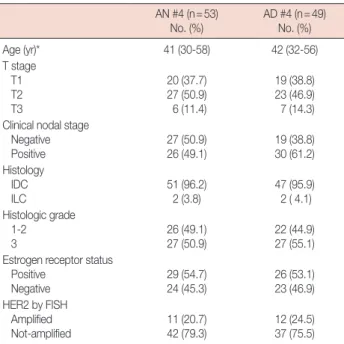
Between January 1998 and December 2005, total of 102 pa- tients were enrolled to the study. The study was closed at De- cember 2005 because of slow enrollment although the planned number of patients had not been enrolled. The median age was 41 years for AN and 43 for AD patients (range, 30-58). Medi- an pretreatment tumor size was 6 cm (range, 3-11 cm). Per- formance score of the patients was 0 in 81% and 1 in 19% by ECOG criteria. Forty-six patients (45.1%) had clinically nega- tive axillary lymph node while 56 patients (54.9%) had clini- cally positive node before NC (Table 1). Most of patients had invasive ductal carcinoma while 4 patients had invasive lobu-
lar carcinoma. Estrogen receptor was positive in 55 patients (53.9%). HER2 was amplified in 23 (22.5%). All patients were assessable for both toxicity and efficacy.
Toxicity and compliance to chemotherapy
All the patients underwent the planned cycles of AD or AN neoadjuvant chemotherapy. Febrile neutropenia occurred in 22.6% (48 events) of total 212 cycles in AN and 38.8% (76 events) of total 196 cycles in AD. Grade 3/4 neutropenia was observed in 39.6% of total 212 cycles in AN and 43.9% of total 196 in AD (Table 2). No grade 3/4 anemia or thrombocytope- nia was observed in both groups. Hematologic toxicities had a tendency to be increased in AD chemotherapy. Incidence of febrile neutropenia was significantly increased in AD com- pared with AN (p=0.047). Grade 3 mucositis was observed in 14 patients (26.4%) with AN and in 20 patients (40.8%) with AD (Table 2). No clinical cardiac toxicity was observed in both groups. Reversible alopecia was observed in all patients.
Other observed toxicities were grade 3 abdominal pain (4 with AN4, 5 with AD4). Less frequent toxicities were diarrhea, skin eruption and ALT/AST elevation but all were within grade 1/2 in both groups by NCI-CTC criteria. Mean relative dose intensity was 0.76 for AD and 0.84 for AN. Some patients re- fused to reduce subsequent dose reduction after febrile neutro- penia, thus delayed administration of NC was done in these cases.
Efficacy
Pathologic response was assessable for all patients. Clinical Table 1. Clinical characteristics of studied patients
AN #4 (n=53)
No. (%) AD #4 (n=49)
No. (%)
Age (yr)* 41 (30-58) 42 (32-56)
T stage T1 T2 T3
20 (37.7) 27 (50.9) 6 (11.4)
19 (38.8) 23 (46.9) 7 (14.3) Clinical nodal stage
Negative
Positive 27 (50.9)
26 (49.1) 19 (38.8)
30 (61.2) Histology
IDC
ILC 51 (96.2)
2 (3.8) 47 (95.9)
2 ( 4.1) Histologic grade
1-2 3
26 (49.1) 27 (50.9)
22 (44.9) 27 (55.1) Estrogen receptor status
Positive Negative
29 (54.7) 24 (45.3)
26 (53.1) 23 (46.9) HER2 by FISH
Amplified Not-amplified
11 (20.7) 42 (79.3)
12 (24.5) 37 (75.5) AN=doxorubicin plus vinorelbine; AD=doxorubicin plus docetaxel; IDC=
invasive ductal carcinoma; ILC=invasive lobular carcinoma; FISH=fluo- rescence in situ hybridization.
*Median (range).
Table 2. Toxicity profiles
AN #4 (n=53) No. (%)
AD #4 (n=49) No. (%) p-value
Total cycles #212 #196
Neutropenia (Grade 3/4)
at any cycle 84 (39.6) 90 (45.9) 0.068
Febrile neutropenia at any cycle 48 (22.6) 76 (38.8) 0.047
Mucositis (G 3) 14 (26.4) 20 (40.8) 0.058
AN=doxorubicin plus vinorelbine; AD=doxorubicin plus docetaxel.
Table 3. Response rates to AN #4 or AD #4 AN #4 (n=53)
No. (%)
AD #4 (n=49)
No. (%) p-value
pCR 6 (11.3) 7 (14.3) 0.159
PR 29 (54.7) 33 (67.3) 0.076
SD 18 (34.0) 9 (18.4) 0.038
Breast conservation 19 (35.8) 20 (40.8) 0.472
AN =doxorubicin plus vinorelbine; AD =doxorubicin plus docetaxel;
pCR=complete pathologic response; PR=partial response; SD=stable disease.
response was assessed before surgery after the completion of the last NC by physical examination, mammography, and ul- trasonography.
Clinical response was observed in 66% with AN and 81.6%
with AD chemotherapy (Table 3). A complete disappearance of primary tumor with negative axillary lymph node was con- firmed in 6 patients (11.3%) with AN and in 7 patients (14.3%) with AD after the surgery. Overall response rate was signifi- cantly higher in AD compared with AN (p=0.038), but there was no significant difference between the two group regard to pathologic complete response rate.
Nineteen patients (35.8%) of AN group underwent breast conserving surgery (BCS) whereas 20 patients (40.8%) of AD group underwent BCS.
Relationship between response to chemotherapy and biologic variables
The data from the 2 groups were merged and analyzed to as- sess the predictive factors to NC. The patients with HER2-am-
plified tumor showed significantly increased response to both type of NC. Pathologic complete response was confirmed in 9 (39.1%) out of 23 HER2-amplified tumors, whereas only 4 (5.1%) of 79 HER2-nonamplified tumors showed pathologic com- plete response (Table 4). Response rate was also significantly increased in node-negative tumors. Hormone receptor status or histologic grade was not associated with tumor response to NC. There was a tendency that pCR rate increased in smaller tumors.
Clinical outcome according to the response to NC
During the median follow-up period of 38 months (range, 8-70 months), 39 patients (38.2%) had systemic recurrence.
Only one patient with pCR had systemic recurrence whereas 30.7% of PR and 70.4% of SD had systemic recurrence (Table 5). Patients who had pCR after NC showed significantly higher disease free survival rate compared to the patients with resid- ual disease after NC (p<0.001) (Figure 1).
DISCUSSION
Integration of docetaxel into anthracycline-based chemo- therapy showed a promising result in the management of met- astatic breast cancer [14]. However, most of neoadjuvant trial incorporating docetaxel into anthracycline-based regimen did not significantly improve clinical outcome despite their increased clinical response rate compared with anthracycline-based reg- imens [10,12]. In our study, overall response rate to AD was superior to AN but pCR rate was not different between the two Table 4. Response to chemotherapy according to clinical-biological
characteristics
pCR No. (%) PR
No. (%) SD No. (%) Total
No. p-value T stage
T1 T2 T3
10 (25.6) 3 (11.3) 0 (18.7)
28 (71.8) 32 (60.4) 2 (12.5)
1 (2.6) 15 (28.3) 11 (68.8)
39 50 13
0.064
Clinical nodal stage Negative
Positive 10 (21.7)
3 (5.3) 32 (69.5) 30 (53.6) 4 (8.8)
23 (41.1) 46 56
0.014
Histologic grade 1-2
3 3 (6.3)
10 (18.5) 30 (62.5) 32 (59.3) 15 (31.2)
12 (22.2) 48 54
0.332
Estrogen receptor status Positive
Negative 6 (10.9)
7 (14.9) 35 (63.6) 27 (57.4) 14 (25.5)
13 (27.7) 55 47
0.446
HER2 by FISH Amplified Not-amplified Total
9 (39.1) 4 (5.1) 13 (12.7)
11 (47.8) 51 (64.5) 62 (60.8)
3 (13.1) 24 (30.4) 27 (26.5)
23 79 102
0.007
pCR=complete pathologic response; PR=partial response; SD=stable disease; FISH=fluorescence in situ hybridization.
Table 5. Distant disease-free survival according to the response to neo- adjuvant chemotherapy
Distant DFS* No. (%) Total No. (%) p-value
pCR 12 (92.3) 13 <0.001
PR 43 (69.3) 62
SD 8 (29.6) 27
DFS=disease-free survival; pCR=complete pathologic response; PR=
partial response; SD=stable disease.
*Median follow-up period of 38 months (range, 8-70 months).
Cum survival
Months Disease-free survival
0.00 10.00 20.00 30.00 40.00 50.00 60.00 70.00 80.00 1.0
0.8 0.6 0.4 0.2 0.0
Figure 1. Disease-free survivals according to response to doxorubicin and vinorelbine neoadjuvant chemotherapy.
SD=stable disease; PR=partial response; pCR=complete pathologic response.
Response SD PR pCR
groups. A recent report of clinical trial with longer follow-up supports the no relative benefit of AD over doxorubicin plus cyclophosphamide NC in respect of pCR rate and overall sur- vival [11]. Our result well coincides with aforementioned oth- er large volume studies. In contrast, sequential use of docetax- el after doxorubicin plus cyclophosphamide NC significantly increased pCR rate in NSABP B27 trial [12]. Longer duration of NC might affect the increase of pCR but results of other stud- ies support the additional effect of sequential docetaxel [8,15].
It is not clear at this stage whether increased pCR rate is a result of docetaxel effect or extended duration of NC.
Primary goal of NC is to achieve pCR since patients achiev- ing pCR NC have better long-term survival than others who failed to respond to NC irrespective of chemotherapeutic agents [4,12]. The patients achieving pCR showed far better clinical outcome in our study. However, a recent retrospective analysis reported that clinical outcome is variable even among the pa- tients who had pCR to NC [16]. The investigators suggested that a non-negligible risk of relapse remains even after pCR to NC in patients with large tumor size and clinical nodal involve- ment at baseline. Late analysis of NSABP B27 identified that clinical outcome of patients with residual disease after NC is heterogeneous and patients with negative lymph node have 8-year disease-free survival of 70% compared 40% of patients with positive lymph node [12]. Long-term results of the two large volume clinical trials suggest that it would be more im- portant to discriminate the poor prognostic patients who need more aggressive systemic treatment after NC.
Response to the NC was significantly associated with HER2 status and initial nodal status in our study regardless of chemo- therapy regimens. We already reported that response to anthra- cycline-based NC is significantly associated with HER2 ampli- fication [17]. Remarkable association between anthracycline sensitivity and HER2 amplification have been investigated by many studies [18-20]. In our study, response to NC was better in smaller tumors although the association was not statistically significant. The finding together with increased response rate in node-negative patients indicates that NC is more effective in early stage rather than advanced breast cancers.
One of merits of NC is an increased opportunity for breast preservation. There was no difference in breast conserving rate between the two groups in our study. Breast conserving rate was less than 40% in our study albeit the overall response rate to NC was 70%. Large proportion of advanced disease might contribute to the lower rate of breast conservation in our study.
In NSABP B27 trial, 68% of patients who underwent NC had BCS whereas 60% of control group had BCS [12]. If the study population was well balanced, significant proportion of indi- viduals who underwent NC might be a candidate for BCS at
initial stage in NSABP B27 trial. It seems to be reasonable to recommend NC mostly for the individuals who seem to be im- possible to preserve their breast at initial presentation.
In summary, there was no significant increase of pCR by AD compared with AN. Long-term follow-up results of our study indicated that clinical outcome after NC was significantly as- sociated with initial response to NC regardless of therapeutic regimens.
CONFLICT OF INTEREST
The authors report no conflicts of interest.
REFERENCES
1. Bonadonna G. Evolving concepts in the systemic adjuvant treatment of breast cancer. Cancer Res 1992;52:2127-37.
2. Kaufmann M, Hortobagyi GN, Goldhirsch A, Scholl S, Makris A, Vala- gussa P, et al. Recommendations from an international expert panel on the use of neoadjuvant (primary) systemic treatment of operable breast cancer: an update. J Clin Oncol 2006;24:1940-9.
3. Mauri D, Pavlidis N, Ioannidis JP. Neoadjuvant versus adjuvant system- ic treatment in breast cancer: a meta-analysis. J Natl Cancer Inst 2005;
97:188-94.
4. Kuerer HM, Newman LA, Smith TL, Ames FC, Hunt KK, Dhingra K, et al. Clinical course of breast cancer patients with complete pathologic primary tumor and axillary lymph node response to doxorubicin-based neoadjuvant chemotherapy. J Clin Oncol 1999;17:460-9.
5. Bear HD, Anderson S, Brown A, Smith R, Mamounas EP, Fisher B, et al.
The effect on tumor response of adding sequential preoperative docetax- el to preoperative doxorubicin and cyclophosphamide: preliminary re- sults from National Surgical Adjuvant Breast and Bowel Project Proto- col B-27. J Clin Oncol 2003;21:4165-74.
6. Fisher B, Bryant J, Wolmark N, Mamounas E, Brown A, Fisher ER, et al.
Effect of preoperative chemotherapy on the outcome of women with operable breast cancer. J Clin Oncol 1998;16:2672-85.
7. van der Hage JA, van de Velde CJ, Julien JP, Tubiana-Hulin M, Vander- velden C, Duchateau L. Preoperative chemotherapy in primary opera- ble breast cancer: results from the European Organization for Research and Treatment of Cancer trial 10902. J Clin Oncol 2001;19:4224-37.
8. Smith IC, Heys SD, Hutcheon AW, Miller ID, Payne S, Gilbert FJ, et al.
Neoadjuvant chemotherapy in breast cancer: significantly enhanced re- sponse with docetaxel. J Clin Oncol 2002;20:1456-66.
9. Bear HD, Anderson S, Smith RE, Geyer CE Jr, Mamounas EP, Fisher B, et al. Sequential preoperative or postoperative docetaxel added to pre- operative doxorubicin plus cyclophosphamide for operable breast cancer:
National Surgical Adjuvant Breast and Bowel Project Protocol B-27. J Clin Oncol 2006;24:2019-27.
10. De Laurentiis M, Cancello G, D’Agostino D, Giuliano M, Giordano A, Montagna E, et al. Taxane-based combinations as adjuvant chemother- apy of early breast cancer: a meta-analysis of randomized trials. J Clin Oncol 2008;26:44-53.
11. Mansi JL, Yellowlees A, Lipscombe J, Earl HM, Cameron DA, Coleman
RE, et al. Five-year outcome for women randomised in a phase III trial comparing doxorubicin and cyclophosphamide with doxorubicin and docetaxel as primary medical therapy in early breast cancer: an Anglo- Celtic Cooperative Oncology Group study. Breast Cancer Res Treat 2010;122:787-94.
12. Rastogi P, Anderson SJ, Bear HD, Geyer CE, Kahlenberg MS, Robidoux A, et al. Preoperative chemotherapy: updates of National Surgical Adju- vant Breast and Bowel Project Protocols B-18 and B-27. J Clin Oncol 2008;26:778-85.
13. Ellis P, Barrett-Lee P, Johnson L, Cameron D, Wardley A, O’Reilly S, et al.
Sequential docetaxel as adjuvant chemotherapy for early breast cancer (TACT): an open-label, phase III, randomised controlled trial. Lancet 2009;373:1681-92.
14. Palmeri S, Leonardi V, Tamburo De Bella M, Morabito A, Vaglica M, Accurso V, et al. Doxorubicin-docetaxel sequential schedule: results of front-line treatment in advanced breast cancer. Oncology 2002;63:205-12.
15. Steger GG, Galid A, Gnant M, Mlineritsch B, Lang A, Tausch C, et al.
Pathologic complete response with six compared with three cycles of neoadjuvant epirubicin plus docetaxel and granulocyte colony-stimu-
lating factor in operable breast cancer: results of ABCSG-14. J Clin On- col 2007;25:2012-8.
16. Montagna E, Bagnardi V, Rotmensz N, Viale G, Pruneri G, Veronesi P, et al. Pathological complete response after preoperative systemic thera- py and outcome: relevance of clinical and biologic baseline features. Breast Cancer Res Treat 2010;124:689-99.
17. Park K, Kim J, Lim S, Han S. Topoisomerase II-alpha (topoII) and HER2 amplification in breast cancers and response to preoperative doxorubi- cin chemotherapy. Eur J Cancer 2003;39:631-4.
18. Thor AD, Berry DA, Budman DR, Muss HB, Kute T, Henderson IC, et al. erbB-2, p53, and efficacy of adjuvant therapy in lymph node-positive breast cancer. J Natl Cancer Inst 1998;90:1346-60.
19. Paik S, Bryant J, Park C, Fisher B, Tan-Chiu E, Hyams D, et al. erbB-2 and response to doxorubicin in patients with axillary lymph node-posi- tive, hormone receptor-negative breast cancer. J Natl Cancer Inst 1998;
90:1361-70.
20. Pritchard KI, Shepherd LE, O’Malley FP, Andrulis IL, Tu D, Bramwell VH, et al. HER2 and responsiveness of breast cancer to adjuvant chemo- therapy. N Engl J Med 2006;354:2103-11.