Received: June 13, 2017 Revised: July 22, 2017 Accepted: August 19, 2017
Address for Correspondence: Kawsar Ahmed, Department of Information and Communication Technology, Mawlana Bhashani Science and Technology University, Santosh, Tangail-1902, Bangladesh
Tel: +880-15-5851-4862, Fax: +880-15-5851-4862, E-mail: [email protected]; [email protected]; [email protected]
Original Article
pISSN: 2288-6478, eISSN: 2288-6761 https://doi.org/10.6118/jmm.2017.23.3.172 Journal of Menopausal Medicine 2017;23:172-181
J MM
Introduction
The quality of life (QOL) based on health-related issues is a multidimensional health concept that includes social, physical, and mental day-to-day functional areas of life.1,2
Besides, it encompasses several significant domains like subjective well-being role disability and psychological func- tions. Every woman has a significant experience of QOL after menopause. In menopause, a woman passes about a third of her own life with the heightening life expectancy.3
Depression and Quality of Life among Postmenopausal Women in Bangladesh: A Cross-sectional Study
Mamun Ibn Bashar1,2, Kawsar Ahmed2,3, Muhammad Shahin Uddin2,3, Farzana Ahmed4,5, Abdullah-Al-Emran6,7, Aditi Chakraborty1
1Department of Statistics, Mawlana Bhashani Science and Technology University, Tangail, Bangladesh, 2Group of Bio-photomatiχ, Tangail, Bangladesh, 3Department of Information and Communication Technology, Mawlana Bhashani Science and Technology University, Tangail, Bangladesh, 4Department of Mathematics and Natural Science, BRAC University, Dhaka, Bangladesh, 5University of Queensland Diamantina Institute, Translational Research Institute, University of Queensland, Queensland, Australia, 6Department of Biotechnology and Genetic Engineering, Mawlana Bhashani Science and Technology University, Tangail, Bangladesh, 7Dermatology Research Center, University of Queensland Diamantina Institute, Translational Research Institute, University of Queensland, Queensland, Australia
Objectives: The aims of the research are to examine the problems of abnormal menopausal women: the relationship between depression and menopausal-specific quality of life (MENQOL)-symptoms among postmenopausal women; the association of MENQOL-symptoms between pre- and postmenopausal female society in Bangladeshi real community.
Methods: This cross sectional study was conducted on 435 women of Tangail, aged (≥ 17) years, using a structured questionnaire where is inaacluded the information of MENQOL and one of the main outcomes “depression” is measured by beck depression inventory.
Results: Menopausal status and MENQOL symptoms (except pain) are significantly (P < 0.05) associated. By using post-hoc analysis, the proportion of menopausal women, classified as having a depressive mood of early menopause is significantly higher than natural-menopause. Among postmenopausal women, there is a significant correlation between “concentration problem”
and “depression”. Here mean depression score (29.40 ± 6.42) of menopausal women who have any difficulty in concentrating is higher than mean depression score (20.89 ± 6.64) of menopausal women who have no difficulty in concentrating. Another six factors (osteoporosis, heart-beating, fatigue, pressure, tingling, headaches) of MENQOL-symptoms were significantly correlated with depression and P-values are 0.000, 0.000, 0.000, 0.033, 0.006, and 0.002, respectively. Finally the presence of “difficulty in concentrating” and “fatigue” are strongly associated factors with depression score (P < 0.001).
Conclusions: The early postmenopausal women have to face more psychological problems (e.g., depression) compare to others.
Among postmenopausal women, there is no significant relation between depression and vasomotor symptom (e.g., hot-flashes) perspective to menopausal female society of Bangladesh. (J Menopausal Med 2017;23:172-181)
Key Words: Bangladesh · Depression · Menopause · Quality of life
Mamun Ibn Bashar, et al. Depression and QOL among Postmenopausal Women
All women recognize the term menopause in their life when their regular menstrual cycle has stopped for one year. So, menopause is a reproductive phenomenon.3 If menopause has happened in abnormal time then every women have to face much difficulties in QOL. It is also well known that every menopausal symptom have effect on QOL of pre and postmenopausal women. But it varies according to life style;
vasomotor symptoms have lower impact on QOL of Asian menopausal women compare to western.4,5 In addition, North American and European menopausal women show higher rates of symptoms than Asian menopausal women.6 It is nicely showed that the reasons behind those differences were possibly cultural or genetically.6~8
The impact of menopause on QOL is a consequence of social, physical and mental changes. It is highly visible that socio-economic and cultural factors influence the meno- pausal transition.7 But it varies from region to region, coun- try to country according to their culture. Like, in western countries, night sweating, hot flushes are the major meno- pausal symptoms of women but not in Asia.5 So the vaso- motor symptoms as well as natural menopausal time have been varied from one cultural region to another. The 45 to 55 years range is called natural menopausal time of a wom- en.9 But perspective to Bangladesh, 40 to 50 years range is treated as natural menopausal time.10 In the research work, before 45 years of a menopausal women treated as early postmenopausal candidate and after 50 years of a meno- pausal women is treated as late postmenopausal candidate.
Every menopausal woman faces many psychological as well as physical problems.3 But premenopausal or postmeno- pausal women may be facing more or less difficulties of QOL. For menopause, postmenopausal women have to face indicative impacts on her social, daily and sexual life.11,12 Several health criteria like insomnia, tiredness, hot flashes, sweats, hair loss etc. are changed significantly in her body.
Besides, having depressive mood among postmenopausal women is a subject of debate for decades. Postmenopausal women have more depressive mood which was found in earlier clinic based study.13 On the other hand, different community based study shows that depression is not more frequent in peri- or postmenopausal women.14,15
Actually, depression is a crippling condition leads to in- dicative societal, personal and economic costs.16 A several
number of both prospective and cross-sectional studies have inquired a potential affiliation between the risks for de- pressive symptoms or major depressive disorder (MDD; new onset or recurrent) and distinguishable menopause staging.17 Bromberger et al.18 concluded in their study that transition of menopause considered as a vulnerable period to MDD recurrence, while two important risk factors (health fac- tors and vasomotor symptoms) should be considered first lifetime-onset of MDD during midlife. Juang et al.19 also concluded that post- and perimenopausal women with hot flashes were affiliated with depressive and anxious symp- toms in East Asian population.
But there are published very few articles by indicating QOL of menopausal women. In Southeast Asia20 menopausal symp- toms have not been excessively studied like Western countries.
Perspective to developing country like Bangladesh, the docu- mentations about menopausal women are very poor. In 2016, Ahmed et al.10 provided the information about QOL of menopausal women in Bangladesh. But they did not work on premenopausal women and there was not shown the rela tionship between pre- and postmenopausal women’s altitude and QOL.
Though this research is an advancement of Ahmed’s work, the aim of this research is to examine the problems of abnormal menopausal women in a Bangladeshi real community and also investigate the relationship between pre and postmeno- pausal women’s altitude and QOL. In addition, another major purpose of the present study was to examine whether the relationship between depression and menopausal-specific QOL (MENQOL) symptoms (vasomotor, psychological and physical) exists or not among postmenopausal women in Bangladesh.
Materials and Methods
1. Subjects and sample design
This cross-sectional study was conducted among rural women in Tangail district in Bangladesh. On the basis of area, Tangail district is the greatest district of Dhaka divi- sion and one of the central regions of Bangladesh. Also it is the second greatest district of Dhaka division by popula- tion. The study mainly adopted cluster sampling procedure in which villages were to be counted as a cluster. A total of
Journal of Menopausal Medicine 2017;23:172-181
J MM
10 clusters were proposed for the survey. The clusters were selected using systematic probability proportionate to size sampling procedure. A total of 435 responders aged (≥ 17) years were collected. Actually sample size was determined by using,
n = z2 [p(1-p)/d2]
Where, n = sample size
z = two-sided normal variate at 95% confidence level (1.96) P = indicator percentage
d = precision.
By applying this formula the minimum required sample was 384. In this study, data were collected from 435 women by face to face interview method on the basis of a structured questionnaire. Interviews were conducted between partici- pant and well-trained interviewer. Classification and meno- pausal definition of the data: In first stage of this study, we classified the total completed participants into two groups such as “premenopausal women” and “postmenopausal women”. This classification is defined according to other study conducted on women in Bangladesh.21 Premenopausal women indicated those women who had regular menstrual bleeding during last one year and postmenopausal women were defined as those who had ascertained that their last menstrual bleeding happened at least 1 year previously.
Women were defined as perimenopausal if they had expe- rienced irregular menstrual cycles within last 1 year or last menses to be 3 months previously but less than 12 months.
In second stage, postmenopausal women were classified in three groups concerning to our objectives. These were “Early postmenopausal women”, “Natural postmenopausal women”,
“Late postmenopausal women”. Women were included in early postmenopausal group whose menstruation cycles stopped before 45 years old, whose cycles were stopped be- tween 45 to 50 years old they were included in natural post- menopausal group and late postmenopausal women were indicated those women whose cycles were stopped after 50 years old. The classifications we made according to several studies.3,9,22
Instruments and assessment of depression: The structured questionnaire was developed in 3 steps. In first step, the
study was included the information of the participants on the basis of socio-economic characteristics; in second step, we included the information of MENQOL;23 in third step the information of depression were collected according to Beck depression inventory.24 MENQOL consists of four domains i.e vasomotor, physical, psychological and sexual. It was ap- plied in several worldwide studies like Thailand,25 Europe,26 Asian women.27 Here we ignored sexual domain in our study because of reluctance of participants about these types of questions.
In Beck depression inventory, there were 21 questions. On the basis of these questions, four categories were developed (such as “no depression”, “mild depression”, “moderate de- pression” and “severe depression”). For our convenience, we made two categories (depressed and mild depressed). “Mod- erate depression” and “severe depression” were included in depressed group. “No depression” and “mild depression” were included in mild depressed group. Beck depression scale was converted in Bangla language which was approved by the doctor of Bangabandhu Sheikh Mujib Medical University (BSMMU). The study was approved by the local committees at the participating centers and “Bio-photomatiχ” Research and Ethics Committee, Mawlana Bhashani Science and Technology University.
2. Data cleaning
Data is inconsistent, noisy and incomplete in the existed world.28,29 Raw data is highly susceptible to missing values or inconsistency and affected the result analysis process. So, data cleaning is a mandatory step for mining or statistical analysis.30,31 At the primary stage we collected information from 435 women for the study. Then we excluded 23 data because of missing values. Also we ignored the data of peri- menopausal women, divorced women and those women who had history of hysterectomy. We didn’t get those women who had the case of surgical menopause during our data collec- tion time. So our final participants were 346 women.
3. Statistical Analysis
For statistical analysis we have used SPSS for windows version 20 (SPSS Inc., Chicago, IL, USA). In this study, first descriptive results and χ2 test for (2 × 2) table for the com- pleted data were determined where all categorical variables
Journal of Menopausal Medicine 2017;23:172-181 Mamun Ibn Bashar, et al. Depression and QOL among Postmenopausal Women
were dichotomous. Then we used χ2 test of homogeneity and post-hoc test (also known as pairwise comparisons).
Furthermore, bonferroni adjustment to correct multiple comparisons was included. We have also used point-biserial correlation and hierarchical regression in this research. All required assumptions were checked before and we considered P < 0.05 value as statistically significant result.
Results
1. Characteristics of the study population
The age range of total postmenopausal women was 40 to 90 years where the mean ± standard deviation (SD) age was 60.78 ± 10.24 years and the age range of premeno- pausal women was 19 to 25 years with mean ± SD age was 22.83 ± 1.12. Among 206 postmenopausal women, 69 women had knowledge about menopause. Mean ± SD age difference from their husband was 12.27 ± 4.17 which is not shown in the Table.
2. MENQOL symptoms
Table 1 represents frequencies of the menopausal symp- toms and χ2 value that represents the association of the symptoms between two groups (premenopausal women and postmenopausal women). Here 69.3% women are abided by muscle and joint pain among premenopausal women and 64.1% women are abided among postmenopausal women.
Individual measures of association between menopausal sta- tus and all other symptoms except muscle and joint pain are significantly (P < 0.05) associated.
3. Depression in early (< 45) menopausal women Table 2 shows the result of χ2 test of homogeneity. It is explored that the proportional differences lie between three menopausal age groups i.e., early menopausal women (< 45 years), natural menopausal women (45-50 years), late menopausal women (> 50 years). On the basis of post-hoc analysis, the proportion of menopausal women classified as having depressive mood of early age at menopause was sig- nificantly higher than normal age at menopause, P < 0.05.
Table 1. Frequency distribution and association about menopause-specific quality of life questionnaire symptoms between pre- menopausal and post-menopausal women
Premenopausal women
(n = 140) Postmenopausal women
(n = 206) χ2
Depressive mood 35 (25.0) 168 (81.6) 109.94
Feeling tired 119 (85.0) 168 (81.6) 0.70
Feeling tensed or nervous 47 (33.6) 162 (78.6) 70.79
Difficulty in concentrating 77 (55.0) 153 (74.3) 13.89
Headache 47 (33.6) 140 (68.0) 39.69
Tingling 12 (8.6) 146 (70.9) 130.39
Hot flashes 11 (7.9) 138 (67.0) 118.87
Pressure or tightness in head 48 (34.3) 138 (67.0) 35.86
Heart discomfort 6 (4.3) 136 (66.0) 131.28
Sweating at night 10 (7.1) 132 (64.1) 111.66
Muscle and joint pain 97 (69.3) 132 (64.1) 0.355
Irritability 102 (72.9) 124 (60.2) 5.90
Sleeping problem 44 (31.4) 122 (59.2) 25.80
Excitable 51 (36.4) 122 (59.2) 17.324
Breathing difficulties 3 (2.1) 60 (29.1) 40.75
The data is presented as n (%)
Journal of Menopausal Medicine 2017;23:172-181
J MM
The proportion of women classified as having depressive mood at normal age of menopause was not significantly dif- ferent with the late age at menopause, P > 0.05. Again the proportion of menopausal women classified as having muscle and joint pain of early age at menopause was significantly higher than late age at menopause, P < 0.05 and there was no significant proportional different between early age at menopause and normal age at menopause, P > 0.05.
4. Depressive mood effect on QOL among postmenopausal women
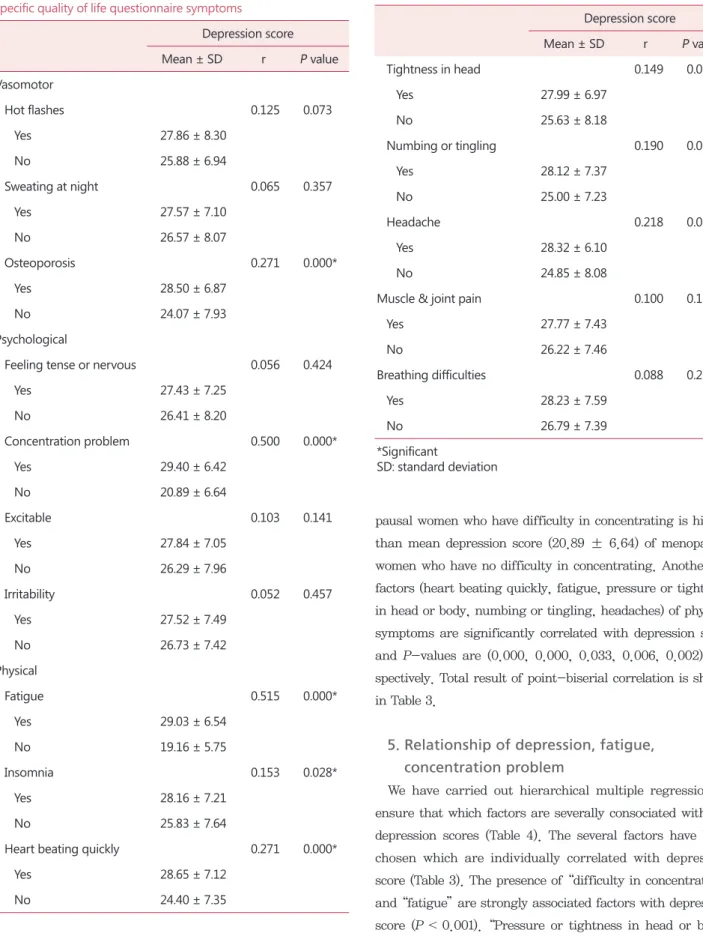
A point-biserial correlation has been run individually between Beck depression score and MENQOL symptoms of
menopausal women in Bangladesh. There are eight factors significantly (P < 0.05) correlated with depression which is shown in Table 3. Among them one factor is in vasomotor symptoms, one factor is in psychological symptoms and six factors are in physical symptoms. In vasomotor symptoms only osteoporosis is significantly (P = 0.000, P < 0.05) cor- related with depression score. There were 146 women who have osteoporosis and their mean depression score (28.50 ± 6.87) was higher than mean depression score (24.07 ± 7.93) of 60 women who didn’t have osteoporosis. In psychological symptoms, there was significant correlation between “di fficulty in concentrating” and “depression”, P-value is 0.000 (P <
0.05). Here mean depression score (29.40 ± 6.42) of meno- Table 2. Comparisons about menopause-specific quality of life questionnaire symptoms among three groups of post-menopausal women
Postmenopausal status
Early postmenopausal Natural postmenopausal Late postmenopausal Vasomotor
Hot flashes 41 (69.5) 52 (59.1) 45 (76.3)
Osteoporosis 42 (71.2) 61 (69.3) 43 (72.9)
Sweating at night 41 (69.5) 54 (61.4) 37 (62.7)
Psychological
Depressive mood 54 (91.5)* 66 (75.0)* 48 (81.4)
Feeling tense or nervous 44 (74.6) 68 (77.3) 50 (84.7)
Concentration problem 48 (81.4) 63 (71.6) 42 (71.2)
Excitable 31 (52.5) 61 (69.3) 30 (50.8)
Irritability 35 (59.3) 58 (65.9) 31 (52.5)
Physical
Fatigue 46 (78.0) 72 (81.8) 50 (84.7)
Insomnia 36 (61.0) 54 (61.4) 32 (54.2)
Heart beating quickly 35 (59.3) 60 (68.2) 41 (69.5)
Tightness in head 42 (71.2) 56 (63.6) 40 (67.8)
Numbing or tingling 40 (67.8) 58 (65.9) 48 (81.4)
Headache 43 (72.9) 58 (65.9) 39 (66.1)
Muscle & joint pain 44 (74.6)† 57 (64.8) 31 (52.5)†
Breathing difficulties 20 (33.9) 26 (29.5) 14 (23.7)
The data is presented as n (%)
*Significant difference P < 0.05 between early and natural postmenopausal
†Significant difference P < 0.05 between early and late postmenopausal
Journal of Menopausal Medicine 2017;23:172-181 Mamun Ibn Bashar, et al. Depression and QOL among Postmenopausal Women
pausal women who have difficulty in concentrating is higher than mean depression score (20.89 ± 6.64) of menopausal women who have no difficulty in concentrating. Another six factors (heart beating quickly, fatigue, pressure or tightness in head or body, numbing or tingling, headaches) of physical symptoms are significantly correlated with depression score and P-values are (0.000, 0.000, 0.033, 0.006, 0.002) re- spectively. Total result of point-biserial correlation is shown in Table 3.
5. Relationship of depression, fatigue, concentration problem
We have carried out hierarchical multiple regression to ensure that which factors are severally consociated with the depression scores (Table 4). The several factors have been chosen which are individually correlated with depression score (Table 3). The presence of “difficulty in concentrating”
and “fatigue” are strongly associated factors with depression score (P < 0.001). “Pressure or tightness in head or body”
Table 3. Correlation between depression score and menopause- specific quality of life questionnaire symptoms
Depression score
Mean ± SD r P value
Vasomotor
Hot flashes 0.125 0.073
Yes 27.86 ± 8.30
No 25.88 ± 6.94
Sweating at night 0.065 0.357
Yes 27.57 ± 7.10
No 26.57 ± 8.07
Osteoporosis 0.271 0.000*
Yes 28.50 ± 6.87
No 24.07 ± 7.93
Psychological
Feeling tense or nervous 0.056 0.424
Yes 27.43 ± 7.25
No 26.41 ± 8.20
Concentration problem 0.500 0.000*
Yes 29.40 ± 6.42
No 20.89 ± 6.64
Excitable 0.103 0.141
Yes 27.84 ± 7.05
No 26.29 ± 7.96
Irritability 0.052 0.457
Yes 27.52 ± 7.49
No 26.73 ± 7.42
Physical
Fatigue 0.515 0.000*
Yes 29.03 ± 6.54
No 19.16 ± 5.75
Insomnia 0.153 0.028*
Yes 28.16 ± 7.21
No 25.83 ± 7.64
Heart beating quickly 0.271 0.000*
Yes 28.65 ± 7.12
No 24.40 ± 7.35
Table 3. Continued
Depression score
Mean ± SD r P value
Tightness in head 0.149 0.033*
Yes 27.99 ± 6.97
No 25.63 ± 8.18
Numbing or tingling 0.190 0.006*
Yes 28.12 ± 7.37
No 25.00 ± 7.23
Headache 0.218 0.002*
Yes 28.32 ± 6.10
No 24.85 ± 8.08
Muscle & joint pain 0.100 0.153
Yes 27.77 ± 7.43
No 26.22 ± 7.46
Breathing difficulties 0.088 0.207
Yes 28.23 ± 7.59
No 26.79 ± 7.39
*Significant
SD: standard deviation
Journal of Menopausal Medicine 2017;23:172-181
J MM
is also an associated factor with depression score. It is the result of model 1 in Table 4. In model 2 of Table 4, we have included only three factors which show significant associa- tion in model 1. The results are explored that two factors are strongly associated with depression score except “pressure or tightness in head or body”. Model 1 and Model 2 both are statistically significantly predicts the depression score (For model 1, F = 12.390; P = 0.000 and for model 2, F = 14.592;
P = 0.000). The analysis of variance Table is not shown here.
Discussion
In this study, the mean ages of the early menopausal women, natural menopausal women and late menopausal women were 55.37 years, 62.75 years and 63.25 years re- spectively and the overall mean ± SD age of total meno- pausal women was 60.78 ±10.24 years which is greater
than the other studies in other places21,32,33 across Ban- gladesh, in British women (50 ± 4.9 years),34 and the age range of premenopausal women was 19 to 25 years with mean ± SD age was 22.83 ± 1.12. It is lower than other study conducted on rural women in Bangladesh (31.36 years).21 There are three groups of postmenopausal women in this study. Among them 59 women are in early (< 45 years) postmenopausal group, 88 women are in normal (45- 50 years) postmenopausal group, 59 women are in late (> 50 years) menopausal group. Comparatively it is higher than the study of urban women of extreme northern India.3
From Table 1 we have got that postmenopausal women are more depressed than premenopausal women perspective to Bangladeshi women. This result is different from the study of Juang et al.19 as they revealed that depression is not as- sociated with menopausal status and the study of Cheng et al.1 found that fewer postmenopausal women had depression because of menopause and both study were conducted on middle aged women of Taiwan. On the other hand our find- Table 4. Hierarchical regression model of variables and their association with depression score of beck depression scale
Variable
Depression score
Model 1 Model 2
B β B β
Constant 5.058 9.087†
Osteoporosis 1.687 0.103
Difficulty in concentrating 5.042† 0.296 5.212† 0.306
Insomnia 0.325 0.021
Fatigue 5.594† 0.292 6.768† 0.353
Heart beating quickly 1.260 0.080
Pressure or tightness in head or body -3.076* -0.194 -1.946 -0.123
Numbing or tingling 0.589 0.036
Headaches 1.099 0.069
R2 0.344 0.317
Adjusted R2 0.318 0.306
F 12.390† 14.592
ΔF 12.390† 1.662
*P < 0.05
†P < 0.001
B: unstandardized regression coefficient, β: standardized regression coefficient, R2: squared multiple correlation coefficient, F: Fisher ratio
Journal of Menopausal Medicine 2017;23:172-181 Mamun Ibn Bashar, et al. Depression and QOL among Postmenopausal Women
ings are also similar to other studies carried on in Bangla- desh33 and also other worldwide studies.16,18,35 So, depressive mood is a significant symptom for postmenopausal women compared to premenopausal women in case of women in Bangladesh.
On the other hand, no significant results have found in case of muscle and joint pain among menopausal symp- toms perspective to Bangladeshi postmenopausal women compared to premenopausal women. In the study, the in- formation of perimenopausal women was not included. But Islam et al.36 included perimenopausal women in their study which was conducted on Bangladeshi women, got joint pain as significant symptoms for both perimenopausal and post- menopausal women compared to premenopausal women. In our study, we have got that 35.9% postmenopausal women and 21.4% premenopausal women have faced muscle and joint pain. But there was no significant proportional differ- ence between two groups. Except muscle and joint pain, all other symptoms (vasomotor, psychological and physical) of QOL are significant for postmenopausal women compared to premenopausal women. This result shows similarity to other study of Asian countries like.3,7,33
The study has determined proportional differences among three postmenopausal groups (early postmenopausal, natu- ral postmenopausal and late postmenopausal) in case of MENQOL symptoms. Hence, the result also shows that early postmenopausal group has more depressed than natural postmenopausal group. With our best knowledge, this is the meaningful unique outcome and comparison among early three postmenopausal groups perspective to menopausal female society of Bangladesh. So, early postmenopausal women have to face so many difficulties in psychological (e.g., depressive mood) perspective. There is another significant proportional difference exist between early and late post- menopausal group with respect to muscle and joint pain.
In addition, it is also investigated that how depressive mood influence the QOL among postmenopausal women in the study. Juang et al.19 showed in their study that there is a significant relation between vasomotor symptoms and depressive mood. They seemed that night sweating may be caused of insomnia. That’s why they confounded night sweating with insomnia in their analysis. In the study, we have used χ2 test between insomnia and sweating at night
and have got insignificant (P > 0.05) result between them.
So, sweating at night with insomnia is not confounded in our analysis. From Table 3 it can be said that there is no significant relationship between vasomotor symptoms (hot flashes, night sweating) and depressive mood. Though Juang et al.19 used hospital anxiety and depression scale (HADS) for measuring anxiety and depression score, while we have used Beck depression inventory for measuring de- pression of the participants. Another study said that there is strong positive relationship between depression and os- teoporosis.37 Any significant (P = 0.073) relationship bet- ween “hot flashes” and “depression” among postmenopausal women are not found in this research. Meanwhile, we have obtained significant relationship between osteoporosis and depression. So, perspective to Bangladeshi women, there is no significant relationship between “hot flashes” and “de- pression” among postmenopausal women.
The result of hierarchical regression have showed that fa- tigue and concentration problem are associated significantly with depression among postmenopausal women even after controlling all other factors (those were individually corre- lated with depression). In psychological point of view, there is relation between fatigue and depression;38,39 between con- centration problem and depression.40 Finally it can be con- cluded that there is strong association between fatigue and depressed postmenopausal women; between concentration problem and depressed postmenopausal women perspective Bangladesh. The findings show the similarities among the women of Kinmen island,2 European women,41 Ecuador- ian women,42 Italian women,43 Canadian women,44 Iranian women.45
This study has some limitations like other cross sectional studies. Comparatively a small number of data were col- lected for the study. For large number of data from differ- ent places the frequency of QOL symptoms of menopausal women might be changed. The age range of premenopausal women was 19 to 25. Results might be changed for large age range of premenopausal women. The information about osteoporosis was not collected from premenopausal women.
Journal of Menopausal Medicine 2017;23:172-181
J MM
Conclusion
On the basis of the study, it can be concluded that early postmenopausal women faced so many difficulties psycho- logically (e.g., depression). Among postmenopausal women depression is associated with fatigue and concentration problem. But there is no significant relation between va- somotor symptom (e.g., hot flashes) and depression per- spective to rural postmenopausal women in Tangail district in Bangladesh. In addition, the final result suggested that psychological symptoms are strongly correlated with meno- pausal women and have significant impact on QOL of early postmenopausal women than late postmenopausal women perspective to Bangladesh.
Acknowledgement
The authors are grateful to the participants who contrib- uted to this research.
Conflict of Interest
No potential conflict of interest relevant to this article was reported.
References
1. Cheng MH, Lee SJ, Wang SJ, Wang PH, Fuh JL. Does menopausal transition affect the quality of life? A longitu- dinal study of middle-aged women in Kinmen. Menopause 2007; 14: 885-90.
2. Fuh JL, Wang SJ, Lee SJ, Lu SR, Juang KD. Quality of life and menopausal transition for middle-aged women on Kinmen island. Qual Life Res 2003; 12: 53-61.
3. Sharma S, Tandon VR, Mahajan A. Menopausal symptoms in urban women. JK Sci 2007; 9: 13-7.
4. Tang GW. The climacteric of Chinese factory workers. Ma- turitas 1994; 19: 177-82.
5. Boulet MJ, Oddens BJ, Lehert P, Vemer HM, Visser A. Cli- macteric and menopause in seven South-east Asian coun- tries. Maturitas 1994; 19: 157-76.
6. Dennerstein L. Well-being, symptoms and the menopausal transition. Maturitas 1996; 23: 147-57.
7. Ayranci U, Orsal O, Orsal O, Arslan G, Emeksiz DF.
Menopause status and attitudes in a Turkish midlife female population: an epidemiological study. BMC Womens Health 2010; 10: 1.
8. Brown DE, Sievert LL, Morrison LA, Reza AM, Mills PS.
Do Japanese American women really have fewer hot flashes than European Americans? The Hilo Women’s Health Study.
Menopause 2009; 16: 870-6.
9. World Health Organization. Research on the menopause in the 1990s: Report of a WHO scientific group. Geneva, CH:
World Health Organization; 1994.
10. Ahmed K, Jahan P, Nadia I, Ahmed F, Abdullah Al E. As- sessment of menopausal symptoms among early and late menopausal midlife Bangladeshi women and their impact on the quality of life. J Menopausal Med 2016; 22: 39-46.
11. Kwak EK, Park HS, Kang NM. Menopause knowledge, at- titude, symptom and management among midlife employed women. J Menopausal Med 2014; 20: 118-25.
12. Kim HK, Kang SY, Chung YJ, Kim JH, Kim MR. The re- cent review of the genitourinary syndrome of menopause. J Menopausal Med 2015; 21: 65-71.
13. Ihezue UH, Kumaraswamy N. Prevalence of depressive symptoms among patients attending a general outpatient clinic. Acta Psychiatr Scand 1986; 73: 395-8.
14. Matthews KA, Wing RR, Kuller LH, Meilahn EN, Kelsey SF, Costello EJ, et al. Influences of natural menopause on psychological characteristics and symptoms of middle-aged healthy women. J Consult Clin Psychol 1990; 58: 345-51.
15. Mitchell ES, Woods NF. Symptom experiences of midlife women: observations from the Seattle Midlife Women’s Health Study. Maturitas 1996; 25: 1-10.
16. Soares CN. Depression and menopause: Current knowledge and clinical recommendations for a critical window. Psychi- atr Clin North Am 2017; 40: 239-54.
17. Bromberger JT, Kravitz HM, Chang YF, Cyranowski JM, Brown C, Matthews KA. Major depression during and after the menopausal transition: Study of Women’s Health Across the Nation (SWAN). Psychol Med 2011; 41: 1879-88.
18. Bromberger JT, Schott L, Kravitz HM, Joffe H. Risk factors for major depression during midlife among a community sample of women with and without prior major depres- sion: are they the same or different? Psychol Med 2015; 45:
1653-64.
19. Juang KD, Wang SJ, Lu SR, Lee SJ, Fuh JL. Hot flashes are associated with psychological symptoms of anxiety and depression in peri- and post- but not premenopausal women. Maturitas 2005; 52: 119-26.
Journal of Menopausal Medicine 2017;23:172-181 Mamun Ibn Bashar, et al. Depression and QOL among Postmenopausal Women
20. Rahman SA, Zainudin SR, Mun VL. Assessment of meno- pausal symptoms using modified Menopause Rating Scale (MRS) among middle age women in Kuching, Sarawak, Malaysia. Asia Pac Fam Med 2010; 9: 5.
21. Jesmin S, Islam AM, Akter S, Islam MM, Sultana SN, Yamaguchi N, et al. Metabolic syndrome among pre- and post-menopausal rural women in Bangladesh: result from a population-based study. BMC Res Notes 2013; 6: 157.
22. Panay N. Menopause and the postmenopausal women. In:
Edmonds DK, editor. Dewhurst’s textbook of obstetrics and gynaecology. 7th ed. London, UK: Blackwell Publishing;
2007. pp.479-94.
23. Nisar N, Sohoo NA. Frequency of menopausal symptoms and their impact on the quality of life of women: a hospital based survey. J Pak Med Assoc 2009; 59: 752-6.
24. Beck AT, Steer RA, Brown GK. Beck depression inventory- II. San Antonio, TX: The Psychological Corporation; 1996.
25. Peeyananjarassri K, Cheewadhanaraks S, Hubbard M, Zoa Manga R, Manocha R, Eden J. Menopausal symptoms in a hospital-based sample of women in southern Thailand.
Climacteric 2006; 9: 23-9.
26. Dodin S, Lemay A, Jacques H, Légaré F, Forest JC, Mâsse B. The effects of flaxseed dietary supplement on lipid pro- file, bone mineral density, and symptoms in menopausal women: a randomized, double-blind, wheat germ placebo- controlled clinical trial. J Clin Endocrinol Metab 2005; 90:
1390-7.
27. Limpaphayom KK, Darmasetiawan MS, Hussain RI, Burriss SW, Holinka CF, Ausmanas MK. Differential prevalence of quality-of-life categories (domains) in Asian women and changes after therapy with three doses of conjugated estrogens/medroxyprogesterone acetate: the Pan-Asia Menopause (PAM) study. Climacteric 2006; 9: 204-14.
28. Ahmed K, Emran AA, Jesmin T, Mukti RF, Rahman MZ, Ahmed F. Early detection of lung cancer risk using data mining. Asian Pac J Cancer Prev 2013; 14: 595-8.
29. Ahmed K, Jesmin T, Rahman MZ. Early prevention and detection of skin cancer risk using data mining. Int J Com- put Appl 2013 http://dx.doi.org/10.5120/10065-4662 30. Asaduzzaman S, Chakraborty S, Hossain MG, Bashar MI,
Bhuiyan T, Paul BK, et al. Hazardous consequences of po- lygamy, contraceptives and number of childs on cervical cancer in a low incoming country: Bangladesh. Cumhuriyet Univ Fac Sci 2016; 37: 74-84.
31. Ahmed K, Asaduzzaman S, Bashar MI, Hossain G, Bhuiyan T. Association assessment among risk factors and breast cancer in a low income country: Bangladesh. Asian Pac J Cancer Prev 2015; 16: 7507-12.
32. Rahman S, Salehin F, Iqbal A. Menopausal symptoms as-
sessment among middle age women in Kushtia, Bangla- desh. BMC Res Notes 2011; 4: 188.
33. Tanira S, Wazed F, Sultana A, Amin R, Sultana K, Ahmad S.
Knowledge, attitude and experience of menopause an urban based study in Bangladesh. J Dhaka Med Coll 2009; 18:
33-6.
34. Lawlor DA, Ebrahim S, Smith GD. The association of socio- economic position across the life course and age at meno- pause: the British Women’s Heart and Health Study. BJOG 2003; 110: 1078-87.
35. Freeman EW, Sammel MD, Lin H, Nelson DB. Associations of hormones and menopausal status with depressed mood in women with no history of depression. Arch Gen Psychia- try 2006; 63: 375-82.
36. Islam RM, Bell RJ, Billah B, Hossain MB, Davis SR. Preva- lence and severity of vasomotor symptoms and joint pain in women at midlife in Bangladesh: a population-based sur- vey. Menopause 2016; 23: 731-9.
37. Gold DT, Solimeo S. Osteoporosis and depression: a his- torical perspective. Curr Osteoporos Rep 2006; 4: 134-9.
38. Janardhan V, Bakshi R. Quality of life in patients with multiple sclerosis: the impact of fatigue and depression. J Neurol Sci 2002; 205: 51-8.
39. Roscoe JA, Morrow GR, Hickok JT, Mustian KM, Griggs JJ, Matteson SE, et al. Effect of paroxetine hydrochloride (Paxil) on fatigue and depression in breast cancer patients receiving chemotherapy. Breast Cancer Res Treat 2005; 89:
243-9.
40. Arnau RC, Meagher MW, Norris MP, Bramson R. Psychomet- ric evaluation of the Beck Depression Inventory-II with pri- mary care medical patients. Health Psychol 2001; 20: 112-9.
41. Glaus A, Boehme C, Thurlimann B, Ruhstaller T, Hsu Schmitz SF, Morant R, et al. Fatigue and menopausal symptoms in women with breast cancer undergoing hor- monal cancer treatment. Ann Oncol 2006; 17: 801-6.
42. Chedraui P, Hidalgo L, Chavez D, Morocho N, Alvarado M, Huc A. Quality of life among postmenopausal Ecuadorian women participating in a metabolic syndrome screening program. Maturitas 2007; 56: 45-53.
43. Genazzani AR, Nicolucci A, Campagnoli C, Crosignani P, Nappi C, Serra GB, et al. Assessment of the QoL in Italian menopausal women: comparison between HRT users and non-users. Maturitas 2002; 42: 267-80.
44. Blumel JE, Castelo-Branco C, Binfa L, Gramegna G, Tacla X, Aracena B, et al. Quality of life after the menopause: a population study. Maturitas 2000; 34: 17-23.
45. Shobeiri F, Jenabi E, Hazavehei SM, Roshanaei G. Qual- ity of life in postmenopausal women in Iran: A population- based study. J Menopausal Med 2016; 22: 31-8.