The Association between Inappropriate Weight Control Behaviors and Suicide Ideation and Attempt among Korean Adolescents
Suicide is a leading cause of death among adolescents globally, with body weight one recognized reason for adolescent suicide. Therefore, we investigated the association between weight control behaviors (WCB) and suicide ideation and attempt, focusing on inappropriate weight control measures. We used data from the 2014 Korea Youth Risk Behavior Web-based Survey, representing a total of 35,224 boys and 34,361 girls aged 12 to 18 years. Adolescents were classified into groups based on WCB: appropriate WCB, inappropriate WCB, and no WCB. We performed logistic regression models to examine associations between WCB and suicide ideation and attempt, controlling for covariates.
Both boys and girls with inappropriate WCB were more likely to report suicide ideation and attempt. Underweight and normal weight boys with inappropriate WCB were more likely to think or attempt suicide, and underweight girls with inappropriate WCB were also more likely to attempt suicide. Among five common WCB combinations, the combination of
“regular exercise, fasting, eating less” was highly associated with suicide ideation and attempt. We confirmed that inappropriate WCB are associated with suicide ideation and attempt among Korean adolescents. Given the high incidence rate of suicide among adolescents and the adverse effect of inappropriate WCB, encouraging adolescents to control their weight in healthy ways is imperative.
Keywords: Adolescent; Weight Perception; Body Weight Changes; Suicide Sang Ah Lee,1,2 Suk-Yong Jang,2,3
JaeYong Shin,2,3 Yeong Jun Ju,1,2 Jin Young Nam,1,2 and Eun-Cheol Park2,3
1Department of Public Health, Graduate School, Yonsei University, Seoul, Korea; 2Institute of Health Services Research, Yonsei University, Seoul, Korea;
3Department of Preventive Medicine, Yonsei University College of Medicine, Seoul, Korea Received: 11 March 2016
Accepted: 29 June 2016 Address for Correspondence:
Eun-Cheol Park, MD
Department of Preventive Medicine and Institute of Health Services Research, Yonsei University College of Medicine, 50 Yonsei-ro, Seodaemun-gu, Seoul 03722, Korea E-mail: [email protected]
http://dx.doi.org/10.3346/jkms.2016.31.10.1529 • J Korean Med Sci 2016; 31: 1529-1537
INTRODUCTION
Suicide is a leading cause of death among adolescents and has become a significant public health issue globally (1). Statistics Korea report 2014 showed that suicide is the cause of 28.4% of adolescent deaths in 2013, and it was the number one cause of death among adolescents (2). Furthermore, suicide is the sec- ond to third cause of mortality among adolescents in the West- ern world and is an important concern in developing countries (3). Numerous causes of suicidal behavior during adolescence have been reported, including mental disorders, peer affilia- tions, and level of achievement in school (4). Additionally, weight- related concerns are a common cause of suicidal behaviors (5,6).
Adolescents experience rapid changes as they develop from children into adults. This transition often leads to confusion about personal identity, especially in the context of enduring developments in identity and cognition as well as physical growth (7). Adolescents typically enter a period of a high level of self- consciousness about their body shape and size (8). They have a greater tendency to consider how they look to others at this life stage than during any other period of life (9). These weight-re- lated issues are influenced by many factors including friends,
peers, social norms, and media (10). The media is a particularly strong influence because it has become a general source of in- formation and adolescents are easily exposed to it (11). The media encourages as “ideal” slim and thin body shapes for girls and muscular bodies for boys (12,13), and provides abundant information on the newest diet methods and quick fixes for weight control (14). This may induce adolescents, who have a particularly keen interest in their figure, to distort their body image and to engage in unneeded or inappropriate weight con- trol behaviors (WCB) (15).
Many adolescents engage in inappropriate WCB such as vomiting, taking nonprescription diet pills, and taking laxatives or diuretics. Among Korean adolescents engaging in WCB, 13.4%
of boys and 18.8% of girls took inappropriate methods to con- trol their weight (16). According to a study using data from na- tional surveys, similar rates were also observed in the United States, with 10% of boys and 21.3% of girls conducting at least one inappropriate WCB (17).
Inappropriate WCB are a harmful influence on adolescents’
physical and psychological development (12). For instance, a 5-year longitudinal study reported that engagement in inappro- priate WCB can be a predictor of obesity and eating disorders
(18). Moreover, adverse outcomes of inappropriate WCB also include the onset of depression (19) and suicide ideation (20).
Due to the high prevalence of and the possible negative side ef- fects associated with inappropriate WCB, it is a growing serious public health concern. Therefore, the prevention of inappropri- ate WCB among adolescents is imperative to protect them from negative physical and psychosocial consequences.
To date, studies about inappropriate WCB merely suggest the association between inappropriate WCB and negative psycho- social consequences (21-23). In the present study, we investi- gate not only the association between inappropriate WCB and suicide ideation and attempt, but also the difference in this as- sociation with body mass index, body weight perception, and body shape misperception. Moreover, we investigate the top five WCB combinations used by Korean adolescents and exam- ine the association between these five WCB combinations and suicide ideation and attempt. We used a cross-sectional design;
thus, the results should be interpreted with caution due to pos- sibility of a bi-directional effect.
MATERIALS AND METHODS Data and participants
We used data from the 2014 Korea Youth Risk Behavior Web- based Survey (KYRBS). The KYRBS has been conducted annu- ally since 2005 by the Korean Centers for Disease Control and Prevention (KCDC), the Korea Ministry of Education, Science and Technology, and The Korea Health and Human Services.
The data were collected via an ongoing, anonymous web-based survey in a self-reporting format that was conducted on a na- tionally representative sample of middle- and high-school stu- dents. It aimed to plan and assess the Korean adolescent health promotion policies by investigating health-related behaviors and status. In the 2014 survey, 799 middle and high schools were selected, including 72,060 students in grades 7 to 12 (strat- ified) on a national scale. However, we excluded 2,334 individu- als due to missing data for variables used in this study; therefore, our cohort ultimately comprised 69,726 adolescents (35,224 boys and 34,361 girls).
Variables
The dependent variables used in this study include suicide ide- ation and suicide attempt. Suicide ideation and attempt were measured via responses to the following questions: “Have you seriously considered suicide during the past 12 months?” and
“Have you tried suicide during the past 12 months?” The possi- ble responses to both questions were “yes” or “no.”
The key independent variable of interest was weight control behavior (WCB). We characterized WCB via responses to the following multi-part question: “Have you experienced the fol- lowing weight control methods during the past 30 days, with
the following activities listed: 1) did regular exercise, 2) fasted at least 24 hours, 3) ate less, 4) took prescription diet pills, 5) took nonprescription diet pills, 6) took laxatives or diuretics, 7) vom- ited, 8) ate only one food, 9) took oriental medicine, and 10) ate diet food.” The possible responses to all questions were “yes” or
“no.” If participants responded ‘yes’ to at least one of 2), 5), 6), 7), and 8), we classified them into the “inappropriate WCB” group (16). If participants responded ‘no’ at all of 2), 5)-8), we classi- fied them into the “appropriate WCB” group. If participants re- sponded ‘no’ to all activity choices, we classified them into the
“nothing” group. Body mass index (BMI) was calculated by self- reported height and weight. BMI percentiles for age and gender were calculated according to the 2007 standard growth charts for Korean children and adolescents by the Korean Pediatric Society (24), and four categories were created: underweight (≤ 15th percentile), normal weight (16th to 84th percentile), over- weight (85th to 95th percentile), and obese (≥ 95th percentile or BMI ≥ 25). We further grouped overweight and obese groups into a single overweight group, thus using three BMI categories Body weight perception (BWP) was split into five categories:
very underweight, underweight, normal weight, overweight, and very overweight. We further grouped these categories into three groups: thin, normal, and obese. Body shape mispercep- tion (BSM) was determined by an agreement between BMI and BWP categories. Participants perceiving their weight at least one category below their actual BMI categories were designat- ed part of the “underestimate” group, while those perceiving their weight at least one category above their actual BMI were designated part of the “overestimate” group (i.e., if participants whose BMI was a normal weight perceived their body weight as obese, they were placed in the “overestimate” group) (25).
Control variables included age, household economic status, parents’ presence, residential area, school level, academic achi- evement in school, subjective health status, sleep satisfaction, physical activity, current alcohol consumption, current smoker, stress level, and depression.
Statistical analyses
We performed statistical analyses of the survey data using SAS version 9.4 (SAS Inc., Cary, NC, USA). The relevant primary sam- pling units, sample weights, and stratification were considered in the analysis given that the KYRBS was designed as a complex sample. A Pearson’s χ2 test was used to determine significant differences in the distribution of each variable. Next, a logistic regression analysis was conducted to determine the association between WCB and suicide ideation and attempt. Separate anal- yses were conducted by gender to address differences in asso- ciation with gender. Additionally, we performed a set of sub- group analyses using BWP, BMI, and BSM to determine wheth- er body related variables led to differences in the association between WCB and suicide ideation and attempt. Results were
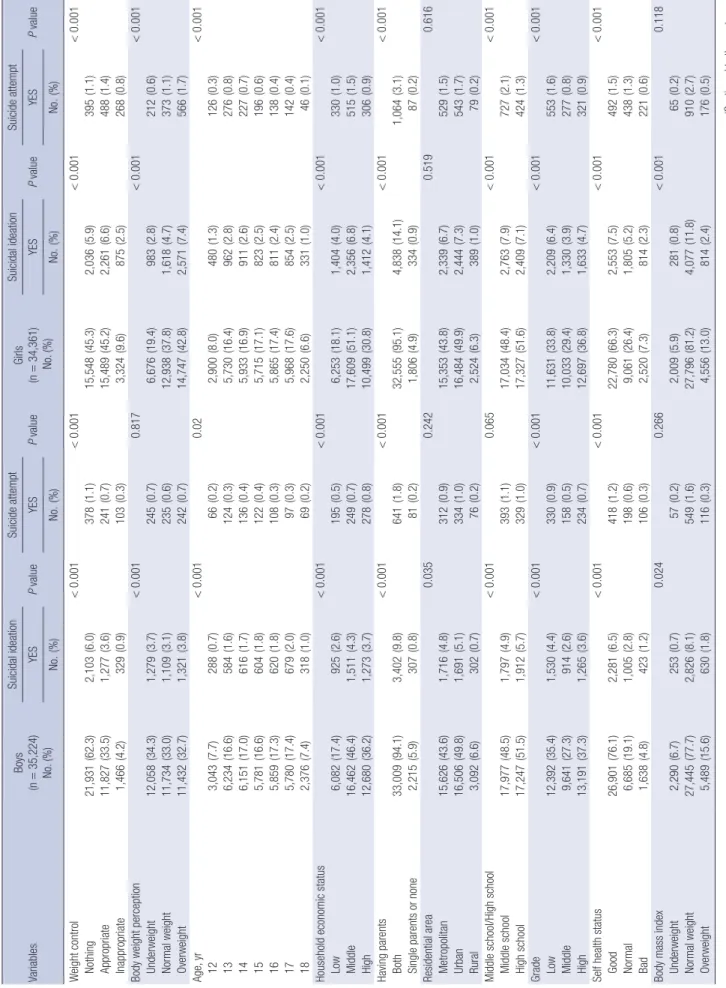
Table 1. General characteristics of the study population VariablesBoys (n=35,224) No. (%) Suicidal ideation P value Suicide attempt P valueGirls (n=34,361) No. (%) Suicidal ideation P value
Suicide attempt P valueYESYESYESYES No. (%) No. (%) No. (%) No. (%) Weight control<0.001<0.001<0.001<0.001 Nothing21,931(62.3)2,103(6.0)378(1.1)15,548(45.3)2,036(5.9)395(1.1) Appropriate11,827(33.5)1,277(3.6)241(0.7)15,489(45.2)2,261(6.6)488(1.4) Inappropriate1,466(4.2)329(0.9)103(0.3)3,324(9.6)875(2.5)268(0.8) Body weight perception<0.0010.817<0.001<0.001 Underweight12,058(34.3)1,279(3.7)245(0.7)6,676(19.4)983(2.8)212(0.6) Normal weight11,734(33.0)1,109(3.1)235(0.6)12,938(37.8)1,618(4.7)373(1.1) Overweight11,432(32.7)1,321(3.8)242(0.7)14,747(42.8)2,571(7.4)566(1.7) Age, yr<0.0010.02<0.001 123,043(7.7)288(0.7)66(0.2)2,900(8.0)480(1.3)126(0.3) 136,234(16.6)584(1.6)124(0.3)5,730(16.4)962(2.8)276(0.8) 146,151(17.0)616(1.7)136(0.4)5,933(16.9)911(2.6)227(0.7) 155,781(16.6)604(1.8)122(0.4)5,715(17.1)823(2.5)196(0.6) 165,859(17.3)620(1.8)108(0.3)5,865(17.4)811(2.4)138(0.4) 175,780(17.4)679(2.0)97(0.3)5,968(17.6)854(2.5)142(0.4) 182,376(7.4)318(1.0)69(0.2)2,250(6.6)331(1.0)46(0.1) Household economic status<0.001<0.001<0.001<0.001 Low6,082(17.4)925(2.6)195(0.5)6,253(18.1)1,404(4.0)330(1.0) Middle16,462(46.4)1,511(4.3)249(0.7)17,609(51.1)2,356(6.8)515(1.5) High12,680(36.2)1,273(3.7)278(0.8)10,499(30.8)1,412(4.1)306(0.9) Having parents<0.001<0.001<0.001<0.001 Both33,009(94.1)3,402(9.8)641(1.8)32,555(95.1)4,838(14.1)1,064(3.1) Single parents or none2,215(5.9)307(0.8)81(0.2)1,806(4.9)334(0.9)87(0.2) Residential area0.0350.2420.5190.616 Metropolitan15,626(43.6)1,716(4.8)312(0.9)15,353(43.8)2,339(6.7)529(1.5) Urban16,506(49.8)1,691(5.1)334(1.0)16,484(49.9)2,444(7.3)543(1.7) Rural3,092(6.6)302(0.7)76(0.2)2,524(6.3)389(1.0)79(0.2) Middle school/High school<0.0010.065<0.001<0.001 Middle school17,977(48.5)1,797(4.9)393(1.1)17,034(48.4)2,763(7.9)727(2.1) High school17,247(51.5)1,912(5.7)329(1.0)17,327(51.6)2,409(7.1)424(1.3) Grade<0.001<0.001<0.001<0.001 Low12,392(35.4)1,530(4.4)330(0.9)11,631(33.8)2,209(6.4)553(1.6) Middle9,641(27.3)914(2.6)158(0.5)10,033(29.4)1,330(3.9)277(0.8) High13,191(37.3)1,265(3.6)234(0.7)12,697(36.8)1,633(4.7)321(0.9) Self health status<0.001<0.001<0.001<0.001 Good26,901(76.1)2,281(6.5)418(1.2)22,780(66.3)2,553(7.5)492(1.5) Normal6,685(19.1)1,005(2.8)198(0.6)9,061(26.4)1,805(5.2)438(1.3) Bad1,638(4.8)423(1.2)106(0.3)2,520(7.3)814(2.3)221(0.6) Body mass index0.0240.266<0.0010.118 Underweight2,290(6.7)253(0.7)57(0.2)2,009(5.9)281(0.8)65(0.2) Normal weight27,445(77.7)2,826(8.1)549(1.6)27,796(81.2)4,077(11.8)910(2.7) Overweight5,489(15.6)630(1.8)116(0.3)4,556(13.0)814(2.4)176(0.5) (Continued to the next page)
presented as adjusted odds ratios (ORs) with 95% con- fidence intervals (95% CIs).
Ethics statement
The ethics approval for the publicly open KYRBS data was waived by the institutional review board (IRB). Af- ter the purpose of the survey was fully explained to the students, written informed consent was provided. Stu- dents were assured that they could refuse or withdraw from the research at any stage (16). The KY RBS did not collect any personal identifiable information and guar- anteed anonymity and confidentiality.
RESULTS
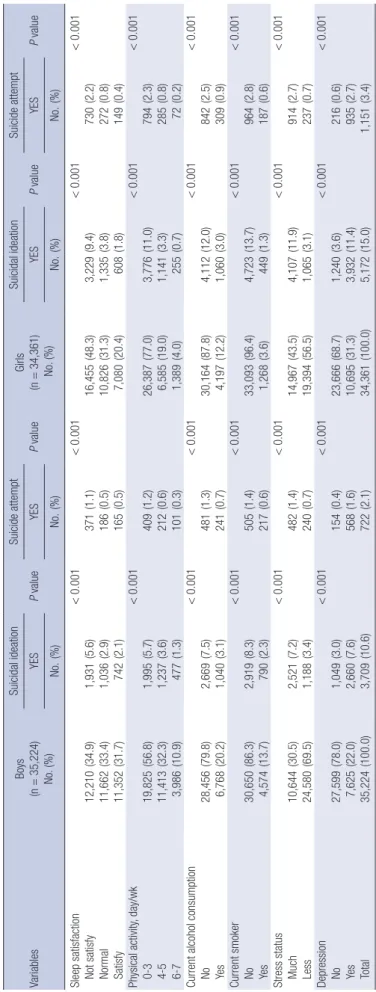
The demographics of the 35,224 boys and 34,361 girls in this study are listed in Table 1. Of the participants, 10.6% (n = 3,709) of boys and 15.0% (n = 5,172) of girls reported that they experienced suicide ideation, while 2.1% (n = 722) of boys and 3.4% (n = 1,151) of girls re- ported attempting suicide. Of the participants, 33.5%
(n = 11,827) of boys and 45.2% (n = 15,489) of girls re- ported that they engaged in appropriate WCB, and 4.2%
of boys (n = 1,466) and 9.6% of girls (n = 3,324) report- ed that they engaged in inappropriate WCB.
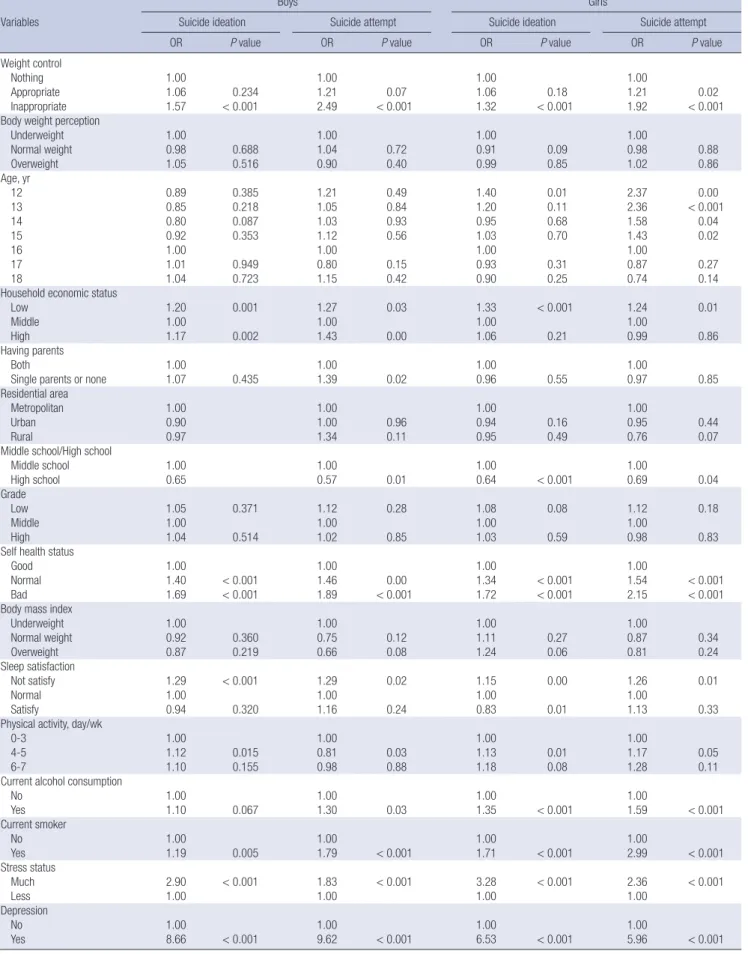
The odds ratios of factors associated with suicide be- haviors are listed in Table 2. Boys who had engaged in inappropriate WCB were more likely to report suicide ideation than those not engaging in WCB group (OR, 1.57, P < 0.001). Girls engaging in inappropriate WCB also had a high suicide ideation rate (OR, 1.32, P < 0.001).
Boys engaging in inappropriate WCB were also more likely to attempt suicide than those not engaging in WCB (OR, 2.49, P < 0.001). Girls engaging in appropri- ate WCB (OR, 1.21, P = 0.02) or inappropriate WCB (OR, 1.92, P < 0.001) were more likely to attempt sui- cide than girls not engaging in WCB at all, and the as- sociation was stronger among the latter comparison group.
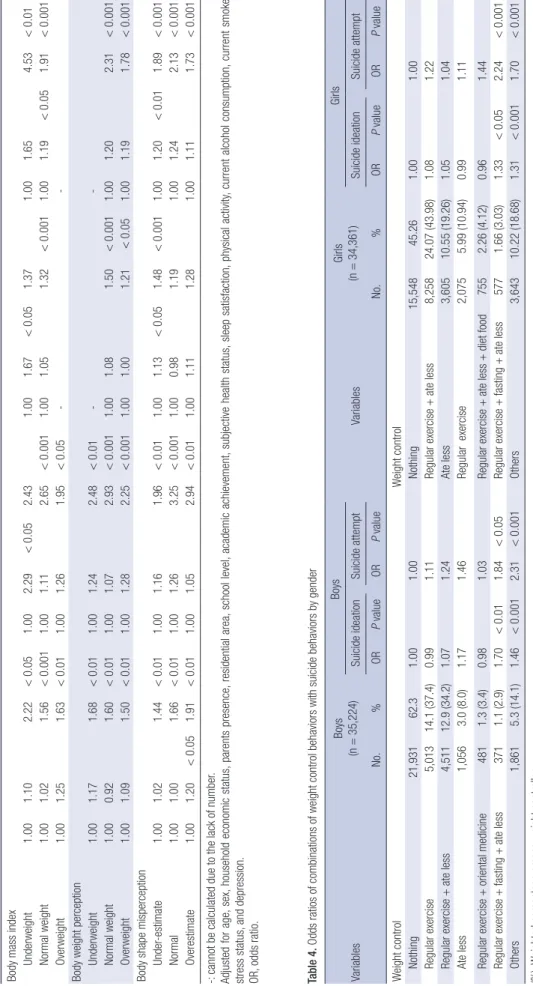
The association between suicidal behavior and WCB stratified by BMI, BWP, and BSM is shown in Table 3.
Boys with an underweight BMI and that engaged in in- appropriate WCB experienced the highest rate of sui- cide ideation (OR, 2.22, P < 0.05) compared to other BMI groups. Girls with an underweight BMI and that engaged in inappropriate WCB were 4.53 times more likely to attempt suicide than girls who did not engage in WCB. Girls who perceived their weight as normal and engaged in inappropriate WCB were more likely to experience suicide ideation (OR, 1.50, P < 0.001) and attempt (OR, 2.31, P < 0.001) than girls who did not en- VariablesBoys (n=35,224) No. (%)
Suicidal ideation P valueSuicide attempt P valueGirls (n=34,361) No. (%)
Suicidal ideation P valueSuicide attempt P valueYESYESYESYES No. (%) No. (%) No. (%) No. (%) Sleep satisfaction<0.001<0.001<0.001<0.001 Not satisfy12,210(34.9)1,931(5.6)371(1.1)16,455(48.3)3,229(9.4)730(2.2) Normal11,662(33.4)1,036(2.9)186(0.5)10,826(31.3)1,335(3.8)272(0.8) Satisfy11,352(31.7)742(2.1)165(0.5)7,080(20.4)608(1.8)149(0.4) Physical activity, day/wk<0.001<0.001<0.001 0-319,825(56.8)1,995(5.7)409(1.2)26,387(77.0)3,776(11.0)794(2.3) 4-511,413(32.3)1,237(3.6)212(0.6)6,585(19.0)1,141(3.3)285(0.8) 6-73,986(10.9)477(1.3)101(0.3)1,389(4.0)255(0.7)72(0.2) Current alcohol consumption<0.001<0.001<0.001<0.001 No28,456(79.8)2,669(7.5)481(1.3)30,164(87.8)4,112(12.0)842(2.5) Yes6,768(20.2)1,040(3.1)241(0.7)4,197(12.2)1,060(3.0)309(0.9) Current smoker<0.001<0.001<0.001<0.001 No30,650(86.3)2,919(8.3)505(1.4)33,093(96.4)4,723(13.7)964(2.8) Yes4,574(13.7)790(2.3)217(0.6)1,268(3.6)449(1.3)187(0.6) Stress status<0.001<0.001<0.001<0.001 Much10,644(30.5)2,521(7.2)482(1.4)14,967(43.5)4,107(11.9)914(2.7) Less24,580(69.5)1,188(3.4)240(0.7)19,394(56.5)1,065(3.1)237(0.7) Depression<0.001<0.001<0.001<0.001 No27,599(78.0)1,049(3.0)154(0.4)23,666(68.7)1,240(3.6)216(0.6) Yes7,625(22.0)2,660(7.6)568(1.6)10,695(31.3)3,932(11.4)935(2.7) Total35,224(100.0)3,709(10.6)722(2.1)34,361(100.0)5,172(15.0)1,151(3.4) (%): weighted percentage.
Table 1. Continued
Table 2. Factors associated with suicide ideation and attempt by gender Variables
Boys Girls
Suicide ideation Suicide attempt Suicide ideation Suicide attempt
OR P value OR P value OR P value OR P value
Weight control
Nothing 1.00 1.00 1.00 1.00
Appropriate 1.06 0.234 1.21 0.07 1.06 0.18 1.21 0.02
Inappropriate 1.57 < 0.001 2.49 < 0.001 1.32 < 0.001 1.92 < 0.001
Body weight perception
Underweight 1.00 1.00 1.00 1.00
Normal weight 0.98 0.688 1.04 0.72 0.91 0.09 0.98 0.88
Overweight 1.05 0.516 0.90 0.40 0.99 0.85 1.02 0.86
Age, yr
12 0.89 0.385 1.21 0.49 1.40 0.01 2.37 0.00
13 0.85 0.218 1.05 0.84 1.20 0.11 2.36 < 0.001
14 0.80 0.087 1.03 0.93 0.95 0.68 1.58 0.04
15 0.92 0.353 1.12 0.56 1.03 0.70 1.43 0.02
16 1.00 1.00 1.00 1.00
17 1.01 0.949 0.80 0.15 0.93 0.31 0.87 0.27
18 1.04 0.723 1.15 0.42 0.90 0.25 0.74 0.14
Household economic status
Low 1.20 0.001 1.27 0.03 1.33 < 0.001 1.24 0.01
Middle 1.00 1.00 1.00 1.00
High 1.17 0.002 1.43 0.00 1.06 0.21 0.99 0.86
Having parents
Both 1.00 1.00 1.00 1.00
Single parents or none 1.07 0.435 1.39 0.02 0.96 0.55 0.97 0.85
Residential area
Metropolitan 1.00 1.00 1.00 1.00
Urban 0.90 1.00 0.96 0.94 0.16 0.95 0.44
Rural 0.97 1.34 0.11 0.95 0.49 0.76 0.07
Middle school/High school
Middle school 1.00 1.00 1.00 1.00
High school 0.65 0.57 0.01 0.64 < 0.001 0.69 0.04
Grade
Low 1.05 0.371 1.12 0.28 1.08 0.08 1.12 0.18
Middle 1.00 1.00 1.00 1.00
High 1.04 0.514 1.02 0.85 1.03 0.59 0.98 0.83
Self health status
Good 1.00 1.00 1.00 1.00
Normal 1.40 < 0.001 1.46 0.00 1.34 < 0.001 1.54 < 0.001
Bad 1.69 < 0.001 1.89 < 0.001 1.72 < 0.001 2.15 < 0.001
Body mass index
Underweight 1.00 1.00 1.00 1.00
Normal weight 0.92 0.360 0.75 0.12 1.11 0.27 0.87 0.34
Overweight 0.87 0.219 0.66 0.08 1.24 0.06 0.81 0.24
Sleep satisfaction
Not satisfy 1.29 < 0.001 1.29 0.02 1.15 0.00 1.26 0.01
Normal 1.00 1.00 1.00 1.00
Satisfy 0.94 0.320 1.16 0.24 0.83 0.01 1.13 0.33
Physical activity, day/wk
0-3 1.00 1.00 1.00 1.00
4-5 1.12 0.015 0.81 0.03 1.13 0.01 1.17 0.05
6-7 1.10 0.155 0.98 0.88 1.18 0.08 1.28 0.11
Current alcohol consumption
No 1.00 1.00 1.00 1.00
Yes 1.10 0.067 1.30 0.03 1.35 < 0.001 1.59 < 0.001
Current smoker
No 1.00 1.00 1.00 1.00
Yes 1.19 0.005 1.79 < 0.001 1.71 < 0.001 2.99 < 0.001
Stress status
Much 2.90 < 0.001 1.83 < 0.001 3.28 < 0.001 2.36 < 0.001
Less 1.00 1.00 1.00 1.00
Depression
No 1.00 1.00 1.00 1.00
Yes 8.66 < 0.001 9.62 < 0.001 6.53 < 0.001 5.96 < 0.001
OR, odds ratio.
Table 3. Subgroup analysis of the association between weight control behavior and suicide behaviors stratified by body mass index, body weight perception, and body shape misperception Variables
BoysGirls Suicide ideationSuicide attemptSuicide ideationSuicide attempt NothingAppropriateInappropriateNothingAppropriateInappropriateNothingAppropriateInappropriateNothingAppropriateInappropriate ORORPORPORORPORPORORPORPORORPORP Body mass index Underweight1.001.102.22<0.051.002.29<0.052.431.001.67<0.051.371.001.654.53<0.01 Normal weight1.001.021.56<0.001 1.001.112.65<0.001 1.001.051.32<0.0011.001.19<0.051.91<0.001 Overweight1.001.251.63<0.011.001.261.95<0.05-- Body weight perception Underweight1.001.171.68<0.011.001.242.48<0.01-- Normal weight1.000.921.60<0.011.001.072.93<0.001 1.001.081.50<0.0011.001.202.31<0.001 Overweight1.001.091.50<0.011.001.282.25<0.0011.001.001.21<0.051.001.191.78<0.001 Body shape misperception Under-estimate1.001.021.44<0.011.001.161.96<0.011.001.13<0.051.48<0.0011.001.20<0.011.89<0.001 Normal1.001.001.66<0.011.001.263.25<0.0011.000.981.191.001.242.13<0.001 Overestimate1.001.20<0.051.91<0.011.001.052.94<0.011.001.111.281.001.111.73<0.001 -: cannot be calculated due to the lack of number. Adjusted for age, sex, household economic status, parents presence, residential area, school level, academic achievement, subjective health status, sleep satisfaction, physical activity, current alcohol consumption, current smoker, stress status, and depression. OR, odds ratio. Table 4. Odds ratios of combinations of weight control behaviors with suicide behaviors by gender VariablesBoys (n=35,224)Boys VariablesGirls (n=34,361)Girls Suicide ideationSuicide attemptSuicide ideationSuicide attempt No.%ORP valueORP valueNo.%ORP valueORP value Weight controlWeight control Nothing21,93162.31.001.00Nothing15,54845.261.001.00 Regular exercise5,01314.1 (37.4)0.991.11Regular exercise + ate less8,25824.07 (43.98)1.081.22 Regular exercise + ate less4,51112.9 (34.2)1.071.24Ate less3,60510.55 (19.26)1.051.04 Ate less1,0563.0 (8.0)1.171.46Regular exercise2,0755.99 (10.94)0.991.11 Regular exercise + oriental medicine4811.3 (3.4)0.981.03Regular exercise + ate less + diet food7552.26 (4.12)0.961.44 Regular exercise + fasting + ate less3711.1 (2.9)1.70<0.011.84<0.05Regular exercise + fasting + ate less5771.66 (3.03)1.33<0.052.24<0.001 Others1,8615.3 (14.1)1.46<0.0012.31<0.001Others3,64310.22 (18.68)1.31<0.0011.70<0.001 (%): Weighted percentage among weight controller. Adjusted for age, sex, household economic status, parents presence, residential area, school level, academic achievement, subjective health status, sleep satisfaction, physical activity, current alcohol consumption, current smoker, stress status, and depression. OR, odds ratio.
WCB (7). Therefore, it is possible that boys who consider con- trolling their weight in inappropriate ways may already be suf- fering from severe psychological distress due to experiencing immense trauma from teasing or other adverse events.
We investigated differences in association between suicide ideation and attempt and WCB by conducting subgroup analy- ses using BMI, BWP, and BSM. In the context of BMI, under- weight boys engaged in inappropriate WCB experienced the highest rate of suicide ideation and attempt than other BMI groups, and underweight girls were considerably more likely to attempt suicide. Additionally, suicidal behavior was also associ- ated with boys and girls of a normal weight engaged in inap- propriate WCB. This suggests that adolescents who do not need to control their weight but engage in unnecessary WCB none- theless are at higher risk for experienced adverse consequences (12). With regards to BSM, the results of this study showed that misperception of body shape is also associated with suicide ideation and attempt. The media continues to portray slender bodies for girls and muscular bodies for boys as ideal body sha- pes, and this could have an effect on body shape misperception among adolescents (33). This mismatch contributes to adoles- cent depression, which in turn increases the risk of suicide among youth (34). Moreover, this mismatch could be related to adoles- cents’ unnecessary weight control behaviors to obtain the ideal body shape. Eventually, the effect of inappropriate WCB aggra- vates adverse effects from a distorted body image, and it seems that this psychological burden causes adolescents to think about or attempt suicide.
We also extracted the five most common combinations of weight control methods used by Korean adolescents and inves- tigated the association between these WCB and suicidal behav- iors. Only conducting regular exercise was the most frequent WCB among boys and the third most common among girls. How- ever, this combination was not significantly associated with sui- cidal behaviors in boys or girls. The most common WCB engag- ed in by girls was ‘regular exercise and eating less’, and it also did not show any significant association with suicidal behav- iors. Interestingly, both boys and girls engaging in ‘regular exer- cise, fasting, and eating less’ were more likely to experience sui- cidal behaviors compared to those who did not conduct any WCB. Although regular exercise and eating less are both appro- priate WCBs, when fasting, which is classified as an inappropri- ate WCB, is added, this combination could contribute to ado- lescents’ suicidal behaviors. According to a previous study, fast- ing for weight control showed an association with depression when compared with other WCBs (35). In practice, fasting causes the blood glucose concentration to fall below normal, and this status releases the hormone cortisol, which is associated with anxiety and negative feelings (36). Therefore, it seems that this combination influences suicidal behaviors due to the strong in- fluence of fasting on depressive symptoms.
gage in WCB. Considering BSM, boys who distorted their body shape and who engaged in inappropriate WCB were more likely to experience suicide ideation (underestimate: OR, 1.44, P < 0.01, overestimate: OR, 1.91, P < 0.01) and attempt (underestimate:
OR, 1.96, P < 0.01, overestimate: OR, 2.94, P < 0.01) than boys who do not engaged in WCB. Girls who underestimated or over- estimated their body shape and engaged in inappropriate WCB showed significant association with suicide attempt (underesti- mate: OR, 1.89, P < 0.001, overestimate: OR, 1.73, P < 0.001) com- pared to girls who do not engaged in WCB.
Table 4 lists the odds ratios of the top five WCB combinations engaged in by Korean adolescents and their association with suicide behaviors. Conducting regular exercise and eating less together with fasting was significantly associated with suicidal ideation (Boys: OR, 1.70, P < 0.01, Girls: OR, 1.33, P < 0.05) and attempt (Boys: OR, 1.84, P < 0.05, Girls: OR, 2.24, P < 0.001) among both boys and girls, and girls had higher rates of attempt- ed suicide.
DISCUSSION
In the present study, we investigated association between inap- propriate WCB and suicide ideation and attempt by Korean ad- olescent by using nationally represented data. Inappropriate WCB was significantly associated with suicidal behaviors in both boys and girls, and with a higher rate in boys.
Our study findings of a higher likelihood of suicidal behav- iors among adolescents engaging in WCB (especially inappro- priate WCB), confirm results described in previous studies. Ad- olescents using inappropriate methods to control weight are highly likely to experience psychological symptoms including anxiety, fatigue, and impaired concentration (26). Additionally, there is a prospective association between WCB and depres- sion (27). Depression in adolescence is a serious public health concern due to the increased risk of suicide among depressed youth (28). Moreover, WCB can cause eating disorders, with fasting an especially high risk factor for development of eating disorders (29). Another study among adolescents and with a 5 year follow up reported that unhealthy WCB were the most powerful predictors of eating disorders (18). Eating disorders have adverse consequences on adolescents’ physical and men- tal health (30), and can cause suicide ideation and attempt (31).
Therefore, one possible interpretation of this finding is that WCB represent a risk factor for suicide ideation and attempt by causing depression or eating disorders, both of which have seri- ous consequences on adolescents’ mental health. Furthermore, our study demonstrated stronger associations among boys than girls, which is corroborated by other studies (6,23). Girls are more sensitive to their weight and easily engage in inappropri- ate WCB (32), whereas boys are not as sensitive about their wei- ght and have a lower likelihood of engaging in inappropriate
The results of this study should be interpreted with caution due to several limitations. This study was designed as cross-sec- tional study; therefore, we could not exclude the potential bi- directional effect. In addition, the time frames of WCB (within the past 30 days) and suicide ideation and attempt (within the past 12 months) differed. Therefore, a reverse-time order could not be clearly excluded (6). Moreover, responses from the KYRBS represent self-reported data, and therefore may be inaccurate.
Additionally, we could not obtain detailed descriptions of each WCB including frequency or amount. However, despite the limitations, this study can be generalized by using nationally representative data. Additionally, compared to previous studies that only reported associations between WCB and suicidal be- havior, we further investigated differences in this association in the context of BMI, BWP, and BSM. Moreover, this is the first study to investigate common WCB combinations and to deter- mine the association between the top five such combinations and suicide ideation and attempt. Considering that the high in- cidence of suicide and the severe negative impact of adoles- cents’ inappropriate WCB on their health, our findings repre- sent an important motivation for health policy makers to iden- tify solutions for controlling adolescents’ suicide problem.
Inappropriate WCB among adolescents is a serious public health concern considering its widespread prevalence and harm- ful influence on growth, physical health, and psychosocial growth.
Additionally, as shown here, WCB can be associated with health compromising behaviors including suicide ideation and attempt.
Therefore, to protect adolescents’ healthy psychological status in the context of weight concerns, policy makers and health professionals must endeavor to correct the distorted body per- ception experienced by adolescents. Additionally, they should help adolescents develop skills for avoiding inappropriate WCB, and encourage appropriate methods of weight control such as physical activity, fruit and vegetable consumption, and the avoi- dance of fatty and sweet foods. Future studies should be de- signed regardless of gender or weight status because boys and normal or underweight adolescents are currently low priority even though they are also at risk for adverse effects due to WCB according to the present study. Therefore, broader viewpoints and approaches are needed when considering adolescents’
weight-related behaviors.
ACKNOWLEDGMENT
Several colleagues from the Department of Public Health and the Graduate School of Yonsei University provided advice for manuscript preparation.
DISCLOSURE
The authors have no potential conflicts of interest to disclose.
AUTHOR CONTRIBUTION
Research conception and design: Lee SA, Ju YJ, Park EC. Data analysis and interpretation: Lee SA, Nam JY, Shin JY. Statistical analysis: Lee SA, Jang SY. Drafting of the manuscript: Lee SA, Ju YJ. Critical revision of the manuscript: Park EC, Nam JY. Approv- al of final manuscript: all authors.
ORCID
Sang Ah Lee http://orcid.org/0000-0001-5415-0141 Suk-Yong Jang http://orcid.org/0000-0003-0558-1505 JaeYong Shin http://orcid.org/0000-0002-2955-6382 Yeong Jun Ju http://orcid.org/0000-0003-4891-0524 Jin Young Nam http://orcid.org/0000-0003-0540-8753 Eun-Cheol Park http://orcid.org/0000-0002-2306-5398 REFERENCES
1. Patton GC, Coffey C, Sawyer SM, Viner RM, Haller DM, Bose K, Vos T, Ferguson J, Mathers CD. Global patterns of mortality in young people: a systematic analysis of population health data. Lancet 2009; 374: 881-92.
2. Statistics Korea.Death and Cause of Death in Korea: 2013. Daejeon: Sta- tistics Korea, 2014.
3. Hawton K, Saunders KE, O’Connor RC. Self-harm and suicide in adoles- cents. Lancet 2012; 379: 2373-82.
4. Fergusson DM, Beautrais AL, Horwood LJ. Vulnerability and resiliency to suicidal behaviours in young people. Psychol Med 2003; 33: 61-73.
5. Eaton DK, Lowry R, Brener ND, Galuska DA, Crosby AE. Associations of body mass index and perceived weight with suicide ideation and suicide attempts among US high school students. Arch Pediatr Adolesc Med 2005;
159: 513-9.
6. Kim DS, Cho Y, Cho SI, Lim IS. Body weight perception, unhealthy weight control behaviors, and suicidal ideation among Korean adolescents. J Sch Health 2009; 79: 585-92.
7. Cheung PC, Ip PL, Lam ST, Bibby H. A study on body weight perception and weight control behaviours among adolescents in Hong Kong. Hong Kong Med J 2007; 13: 16-21.
8. Phelps L, Johnston LS, Jimenez DP, Wilczenski FL, Andrea RK, Healy RW.
Figure preference, body dissatisfaction, and body distortion in adoles- cence. J Adolesc Res 1993; 8: 297-310.
9. ter Bogt TF, van Dorsselaer SA, Monshouwer K, Verdurmen JE, Engels RC, Vollebergh WA. Body mass index and body weight perception as risk factors for internalizing and externalizing problem behavior among ado- lescents. J Adolesc Health 2006; 39: 27-34.
10. Eisenberg ME, Neumark-Sztainer D, Story M, Perry C. The role of social norms and friends’ influences on unhealthy weight-control behaviors among adolescent girls. Soc Sci Med 2005; 60: 1165-73.
11. Lim H, Wang Y. Body weight misperception patterns and their associa- tion with health-related factors among adolescents in South Korea. Obe- sity (Silver Spring) 2013; 21: 2596-603.
12. Talamayan KS, Springer AE, Kelder SH, Gorospe EC, Joye KA. Prevalence of overweight misperception and weight control behaviors among nor-
mal weight adolescents in the United States. ScientificWorldJournal 2006;
6: 365-73.
13. Field AE, Camargo CA Jr, Taylor CB, Berkey CS, Roberts SB, Colditz GA.
Peer, parent, and media influences on the development of weight con- cerns and frequent dieting among preadolescent and adolescent girls and boys. Pediatrics 2001; 107: 54-60.
14. Neumark-Sztainer D, Wall M, Story M, Standish AR. Dieting and unhealthy weight control behaviors during adolescence: associations with 10-year changes in body mass index. J Adolesc Health 2012; 50: 80-6.
15. Kim MH. Eating habit, body image, and weight control behavior by BMI in Korean female high school students: using Korea youth risk behavior web-based survey 2010 data. Korean J Food Nutr 2012; 25: 579-89.
16. Ministry of Health and Welfare, Korea Centers for Disease Control and Prevention. The Tenth Korea Youth Risk Behavior Web-based Survey.
Cheongju: Korea Centers for Disease Control and Prevention, 2014.
17. Wheaton AG, Perry GS, Chapman DP, Croft JB. Self-reported sleep dura- tion and weight-control strategies among U.S. high school students. Sleep 2013; 36: 1139-45.
18. Neumark-Sztainer D, Wall M, Guo J, Story M, Haines J, Eisenberg M. Obe- sity, disordered eating, and eating disorders in a longitudinal study of ad- olescents: how do dieters fare 5 years later? J Am Diet Assoc 2006; 106:
559-68.
19. Stice E, Bearman SK. Body-image and eating disturbances prospectively predict increases in depressive symptoms in adolescent girls: a growth curve analysis. Dev Psychol 2001; 37: 597-607.
20. Cook SJ, MacPherson K, Langille DB. Far from ideal: weight perception, weight control, and associated risky behaviour of adolescent girls in Nova Scotia. Can Fam Physician 2007; 53: 678-84.
21. Neumark-Sztainer D, Story M, Dixon LB, Murray DM. Adolescents en- gaging in unhealthy weight control behaviors: are they at risk for other health-compromising behaviors? Am J Public Health 1998; 88: 952-5.
22. Neumark-Sztainer D, Hannan PJ. Weight-related behaviors among ado- lescent girls and boys: results from a national survey. Arch Pediatr Ado- lesc Med 2000; 154: 569-77.
23. Crow S, Eisenberg ME, Story M, Neumark-Sztainer D. Suicidal behavior in adolescents: relationship to weight status, weight control behaviors, and body dissatisfaction. Int J Eat Disord 2008; 41: 82-7.
24. Moon JS, Lee SY, Nam CM, Choi JM, Choe BK, Seo JW, Oh K, Jang MJ, Hwang SS, Yoo MH, et al. 2007 Korean National Growth Charts: review of developmental process and an outlook. Korean J Pediatr 2008; 51: 1-25.
25. Shin J, Choi Y, Han KT, Cheon SY, Kim JH, Lee SG, Park EC. The combined effect of subjective body image and body mass index (distorted body wei- ght perception) on suicidal ideation. J Prev Med Public Health 2015; 48:
94-104.
26. Nylander I. The feeling of being fat and dieting in a school population. An epidemiologic interview investigation. Acta Sociomed Scand 1971; 3: 17- 26.
27. Santos M, Richards CS, Bleckley MK. Comorbidity between depression and disordered eating in adolescents. Eat Behav 2007; 8: 440-9.
28. Birmaher B, Brent DA, Benson RS; American Academy of Child and Ado- lescent Psychiatry. Summary of the practice parameters for the assess- ment and treatment of children and adolescents with depressive disor- ders. J Am Acad Child Adolesc Psychiatry 1998; 37: 1234-8.
29. Stice E, Davis K, Miller NP, Marti CN. Fasting increases risk for onset of binge eating and bulimic pathology: a 5-year prospective study. J Abnorm Psychol 2008; 117: 941-6.
30. Golden NH, Katzman DK, Kreipe RE, Stevens SL, Sawyer SM, Rees J, Nich- olls D, Rome ES; Society For Adolescent Medicine. Eating disorders in adolescents: position paper of the Society for Adolescent Medicine. J Ad- olesc Health 2003; 33: 496-503.
31. Milos G, Spindler A, Hepp U, Schnyder U. Suicide attempts and suicidal ideation: links with psychiatric comorbidity in eating disorder subjects.
Gen Hosp Psychiatry 2004; 26: 129-35.
32. Neumark-Sztainer D, Story M, Hannan PJ, Perry CL, Irving LM. Weight- related concerns and behaviors among overweight and nonoverweight adolescents: implications for preventing weight-related disorders. Arch Pediatr Adolesc Med 2002; 156: 171-8.
33. Whetstone LM, Morrissey SL, Cummings DM. Children at risk: the asso- ciation between perceived weight status and suicidal thoughts and attempts in middle school youth. J Sch Health 2007; 77: 59-66.
34. United States Public Health Service, Office of the Surgeon General; Cen- ter for Mental Health Services (US); National Institute of Mental Health (US). Mental Health: a Report of the Surgeon General. Rockville, MD: De- partment of Health and Human Services, 1999.
35. Daniels J. Weight and weight concerns: are they associated with reported depressive symptoms in adolescents? J Pediatr Health Care 2005; 19: 33- 41.
36. Fishbein D, Pease SE. Diet, nutrition, and aggression. J Offender Rehabil 1994; 21: 117-44.