Vol. 18, No. 10 pp. 448-453, 2017
CAD/CAM System을 활용하여 제작된 Coping Crown의 제작방식 및 재료에 따른 변연 적합도에 관한 연구
이희성1, 신성훈2, 송준기3*
1경북대학교 치의과학과, 2대성산업(주) 기계사업부, 3단국대학교 치의학과
The Study on Marginal discrepancy of Manufactured Coping Crown according to Production method and materials
by using CAD/CAM System
Hee-Sung Lee
1, Seong-Hun Shin
2, Joon-Ki Song
3*1
Department of Dental Science, Graduate School, Kyungpook National University
2
Daesung Industrial Co., Ltd.
3
Department of Prosthodontics, Graduate School, Dankook University
요 약 본 연구는 CAD/CAM 시스템을 활용하여 제작방식 및 재료에 따른 Coping crown의 변연 적합도를 비교하여 최적의 제작방식 및 재료를 비교하고자 하였다. 제작방식 및 재료에 따른 코핑 크라운을 제작하였고, 리플리카 테크닉을 사용하여 변연적합도 측정을 실시하였다. 제작법과 재료에 따른 비교분석을 위해 이원배치분산 분석을 실시하였으며 서로 다른 평균 값들의 비교 분석을 위해서 일원배치분산분석을 실시하였다. 연구결과 합금을 Milling법으로 제작한 MM군은 114.6, MS군은 111.4 값을 나타냈고, Milling/Sintering 법으로 제작한 MSC군은 67.2, MSS군은 50.9값을 나타냈고, Printing 법으로 제작한 SLME군은 100.5, SLMR군은 113.2값을 나타냈고, 세라믹의 Milling/Sintering 법으로 제작한 MSZ군은 35.6, MSC군은 36.3값 을 나타냈고, 제작방식과 재료에 따른 이원배치분산분석 결과는 제작방식에에 따른 유의한 차이는 보이지 않았으나, 재료에 따른 유의한 차이는 나타내었다. 가장 높은 변연적합도를 보인 군은 세라믹 재료의 Milling/sintering 법이 가장 낮은 값을 보이며 최적의 방법으로 검증이 되었다. 그러나 CAD/CAM 시스템을 활용하여 제작된 Coping crown의 변연 적합도는 임상에 서 허용이 가능한 수치값에 해당하므로 임상에 적용이 가능한 것으로 나타났다.
Abstract
The purpose of this study wasto compare the marginal discrepancy of coping crowns according to manufacturing method and materials by using the CAD/CAM system to compare the optimum manufacturing method and materials. The coping crowns were fabricated by using manufacturing methods and materials, and marginal fit was measured using the replica technique. For comparative analysis of manufacturing methods and materials, analysis of variance was performed. One-way ANOVA was performed to compare and analyze different mean values. For the milling method of the alloy, 114.6 was obtained for the MM group, 111.4 forthe MS group, 67.2 forthe MSC group, and 50.9 forthe MSS group, respectively, using the milling/sintering method. In the milling/sintering method of ceramic, 35.6 and 36.3, respectively, were obtained for the SLME group and SLMR group, respectively.However,there was a significant difference according to the material. The milling/sintering method of the ceramic material gavethe lowest value, and it was verified by the optimal method. However, marginal discrepancy of coping crowns fabricated using the CAD/CAM system is applicable to the clinic sinceit corresponds to acceptable numerical values in clinical practice.
Keywords :
CAD/CAM, Coping crown, Co-Cr, Zirconia, Marginal discrepancy이 논문은 정부(미래창조과학부)의 재원으로 정보통신기술진흥센터의 지원을 받아 수행된 연구임.(2014-0-00230, ICT 기반의 의료용 3D프린팅 응용SW플랫폼 및 서비스 기술개발)
*Corresponding Author : Joon-Ki Song(Dankook Univ.) Tel: +82-53-782-0022 email: [email protected] Received August 8, 2017
Accepted October 13, 2017
Revised (1st September 14, 2017, 2nd September 19, 2017) Published October 31, 2017
1. 서론
과거에는 Coping crown을 제작하기 위해서는 lost wax법을 활용하여 합금을 불대에 녹이는 주조방식으로 제작이 되어왔다. 그렇기 때문에 숙련자의 정도에 차이 에 따라 보철물의 품질에 많은 차이를 나타내었다. 이를 극복하기 위해 치과분야에서도 CAD/CAM(Computer Aided Design/Computer Aided Manufacturing) 시스템 이 도입되어 많은 변화를 이끌었다[1, 2].
CAD/CAM 시스템이 도입되어지고 나서는 metal 뿐 만 아니라 지르코니아 세라믹 재료까지 사용할 수 있게 되었다. 과거 MAD/MAM 시스템을 이용하여 지르코니 아를 가공하였지만, 정밀도가 떨어지고 많은 시간이 소 요되었기 때문에 CAD/CAM 방식 이전에는 지르코니아 를 가공하는데에는 한계가 있는 제작방식이었다[3]. 또 한 제작방식 또한 milling법, additive manufacturing법, milling/sinterig법 등 다양한 방법에 의하여 coping crown을 제작할 수 있게 되었다. milling 방식은 절삭공 구를 활용하여 가공하는 방식으로 후에 열처리를 하지 않기 때문에 1:1 방식으로 가공하여 적합도를 높일 수 있지만 합금의 강도가 높기 때문에 가공하는데 많은 절 삭공구의 소모 및 대형장비에서 가공해야하는 단점이 있 다[4]. printing 방식은 다양한 방법이 있지만, metal coping crown을 제작하는 방법으로는 SLM(selective laser melting) 방식으로 레이저를 선택적으로 조사하여 합금을 녹이는 방식으로 임상에서 적용되어지고 있다 [5]. milling/sintering방법은 절삭공구를 활용하여 가공 한 후에, 열처리를 통해 보철물의 강도를 높이는 방식으 로 낮은 강도인 상태에서 가공을 하기 때문에 절삭공구 의 소모량이 적고 소형장비에서 가공한다는 장점이 있지 만, 열처리 후에 수축하기 때문에 변연 적합도가 낮아 질 수 있는 제작방법이다. 치과보철물에 있어서 변연 적합 도는 성공을 단락짓는 중요한 요소중에 하나로 손꼽히며 그 중요성은 더 높아지고 있다[6]. 변연적합도가 기준치 에 적합하지 않을 경우 2차 우식증을 야기시켜 보철물의 수명을 단축시킬 수 있다. CAD/CAM 시스템을 활용하 여 다양한 방법과 재료가 개발되어 활발하게 사용되어지 고 있으며, 제품의 수준 또한 수작업에 비해 일률적으로 제작이 되어지고 있다. 그러나 현재 Coping crown을 제 작할 수 있는 모든 제작방식과 재료를 모두 고려하여 변 연 적합도를 비교한 논문은 거의 보고된 바가 없기 때문
에 어떤 재료와 제작방식이 최적에 변연 적합도를 나타 내는지에 대한 연구가 필요한 실정이다. 이에 본 연구에 서는 CAD/CAM 시스템을 활용하여 제작방식 및 재료 에 따른 Coping crown의 변연 적합도를 측정하여 최적 의 제작방식 및 재료를 분석 하고자 한다.
2. 연구방법
2.1 연구재료
본 연구에서 사용된 재료의 군은 Table 1과 같으며, 메탈군은 milling, milling/sintering, SLM으로 구성하였 고, 세라믹군은 milling/sintering 군으로 구성하였다.
2.2 주모델 제작
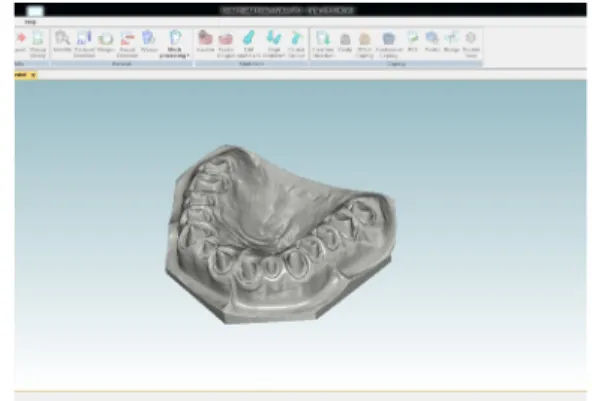
지대치는 DT11(DTP Model, JK DENS, Korea)의 모 델을 사용하여 모델 스캐너(D700; 3Shape, Denmark)로 3차원 이미지를 획득하였다(Fig. 1).
Fig. 1. Master model
2.3 Coping crown 제작
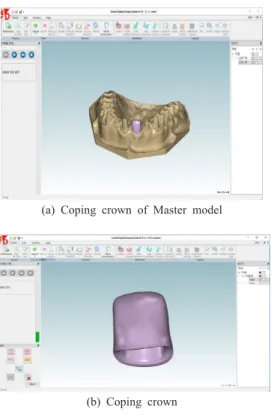
Coping crown의 일률적인 디자인 적용을 위해 모든 디자인은 CAD(Dental Digital Design Systems, Daesung Industrial Co., Ltd, Korea)를 이용하여 디자인 하였다. Milling법과 Milling/sintering법은 Milling machine (Yenadent D40 series, Yena Makina, Turkey) 을 이용하여 제작하였고, 제조사의 지시에 따라 후처리 를 진행하였다. Printing법은 SLME군은 EOSINT M 270(EOS GmbH, Germany)으로 제작하였고, SLMR군 은 M1(Concept Laser GmbH, Germany)으로 제작하여, 제조사의 지시에 따라 후처리를 진행하였다.
(a) Coping crown of Master model
(b) Coping crown
Group Material name Manufacturer Method
MM Magnum Lucens MESA di Sala Giacomo & C Snc
Milling MS Starbond CoS S&S Scheftner GmbH
MSC Ceramill Sintron Amann Girrbach
Milling/sintering
MSS Soft Metal LHK
SLME EOS Cobalt Chrome SP2 EOS GmbH
Selective laser melting SLMR Remanium star CL Dentaurum GmbH & Co KG
MSZ Zenostar Wieland
Milling/sintering
MSC Cercon Dentsply
Table 1. Material used Fig. 2. Design of coping crown
2.4 변연 적합도 측정
리플리카 테크닉을 사용하여 변연적합도 측정을 실시 하였다. 주모형에 Coping Crown 내부에 light body(DentaSil, Sungbotech, Korea)를 주입하여 시적 후 50N의 정하중기 압력으로 실리콘이 완전히 경화되도록 유지 하였다. 실리콘이 완전히 경화되면 주모형에서 Coping Crown을 제거하고 medium body(Examixfine Regular, GC Co., Japan)을 채운 후 포매 하였다. 포매한 시편은 근원심 방향으로 정중앙에서 날카로운 칼로 4등
분으로 절단 분리 하였다. 측정부위는 기존 문헌을 참고 하여 12부위로 지정하였고[7], 절단 분리된 시편은 실체 현미경(SZ61, Olympus, Japan)을 160배율로 확대하여 측정하였다. 측정은 지대치의 근원심에서 각각 측정한 평균값을 사용하였다.
2.5 통계분석
각 그룹간의 제작방법과 재료에 따른 영향을 알기 위 하여 이원배치분산분석(two-way ANOVA)을 실시하였 다. 또한 각 그룹 간 평균값들의 통계적 차이를 알아보기 위해 일원배치분산분석(one-way ANOVA)과 Dancan’s test를 시행하였다. 통계분석은Statistical Package for Social Sciences 22.0 for windows(Chicago, IL, USA)를 이용하여 유의수준은 p <0.05 수준으로 결정하였다.
3. 연구결과
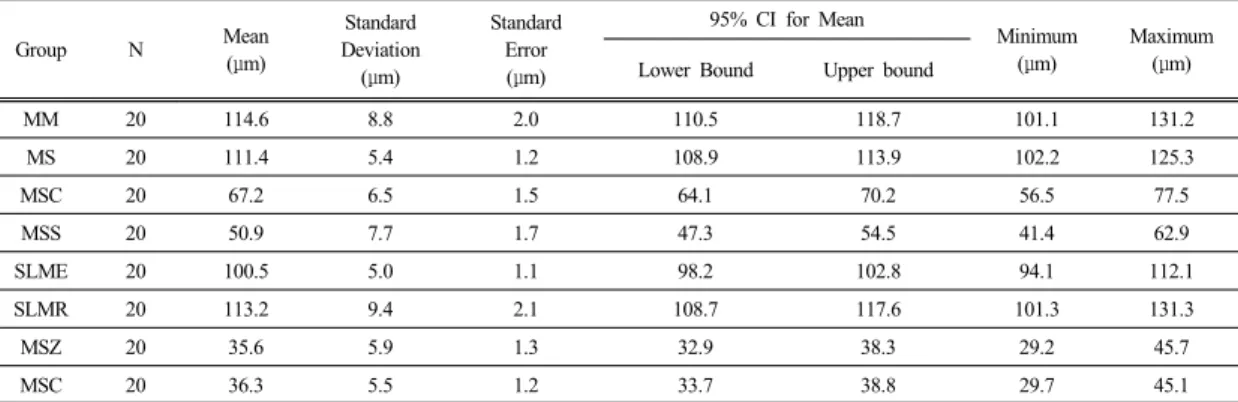
합금의 Milling 제작법에서 MM군은 114.6±8.8 μm, MS군은 111.4±5.4 μm 값을 나타냈고, Milling/Sintering 제작법에서 MSC군은 67.2±6.5 μm, MSS군은 50.9±7.7 μm 값을 나타냈고, Printing 제작법에서 SLME군은 100.5±5.0 μm, SLMR군은 113.2±9.4 μm 값을 나타냈 고, 세라믹의 Milling/Sintering 제작법에서 MSZ군은 35.6±5.9 μm, MSC군은 36.3±5.5 μm 값을 나타냈다 (Table 2, Fig 3).
Table 3는 제작방식과 재료에 따른 이원배치분산분석 결과이다. 제작방식에에 따른 유의한 차이는 보이지 않 았으나, 재료에 따른 유의한 차이는 보였다(p <0.05).
Group N Mean (μm)
Standard Deviation
(μm)
Standard Error (μm)
95% CI for Mean
Minimum (μm)
Maximum Lower Bound Upper bound (μm)
MM 20 114.6 8.8 2.0 110.5 118.7 101.1 131.2
MS 20 111.4 5.4 1.2 108.9 113.9 102.2 125.3
MSC 20 67.2 6.5 1.5 64.1 70.2 56.5 77.5
MSS 20 50.9 7.7 1.7 47.3 54.5 41.4 62.9
SLME 20 100.5 5.0 1.1 98.2 102.8 94.1 112.1
SLMR 20 113.2 9.4 2.1 108.7 117.6 101.3 131.3
MSZ 20 35.6 5.9 1.3 32.9 38.3 29.2 45.7
MSC 20 36.3 5.5 1.2 33.7 38.8 29.7 45.1
Table 2. Results of one-way ANOVA for marginal discrepancy
Level Sum of Squares df Mean
Square F P
Material 4347.475 4 1086.869 22.501 .000
Fabrication method 0.0153 1 0.0153 1.195 .840
Material×Fabrication
method 0.952 4 0.957 4.561 .095
Error 7342.050 152 48.303
Total 1169895.000 160
Corrected Total 179061.994 159
Table 3. Results of two-way ANOVA for marginal discrepancy Fig. 3. Marginal discrepancy eval uation by group
4. 고찰
치과보철물의 기능적 만족도를 높이기 위해서는 여러 가지 요소가 고려되어야 하며, 그 중에서도 변연적합도 는 가장 중요한 요소 중에 하나이다[8]. 변연적합도가 맞 지 않을 경우에는 치아 우식증 및 치은·치주염이 발생할 확률이 높아지게 되므로 변연 적합도를 높일 수 있는 방 안이 요구되었으며[9], 이를위해 CAD/CAM 시스템이 치과에 도입이 되었다.
초기에 치과 CAD/CAM 시스템은 임상에서 적용하기 에는 허용되지 않은 적합도를 나타내었지만, 소프트웨 어, 장비, 재료의 급격한 발전에 통해서 임상 결과 역시 많은 변화 및 개선이 이루어졌다[10].
변연적합도 측정방법에는 여러 가지 방법이 사용되며 대표적인 방법으로는 지대치 모형과 보철물을 시적 후 포매하여 절단 후 단면에서의 간격을 현미경으로 측정하 는 절단 관찰법[11, 12], 지대치 모형에 보철물을 시적한 상태에서 변연부를 측정하는 직접 관찰법[13, 14], 지대 치 모형과 보철물 사이에 연질의 실리콘 인상재을 채워 경화된 실리콘의 두께를 측정하는 실리콘 복제법[15, 16]등 여러 가지 방법을 통해서 변연적합도를 측정하고 있다. 치과보철물의 변연적합도를 측정하기 위해서는 이 처럼 다양한 방법이 제시되어 사용되고 있지만, 현재까 지는 국제적으로 공인된 측정방법과 기준은 미흡한 실정 이다. 본 연구에서 사용된 변연 적합도 방식은 실리콘을 이용한 방식으로 많은 연구에서 사용된 대표적인 방법으 로 측정하였다.
변연적합도의 임상적으로 허용되는 수치는 연구마다 약간의 차이가 있지만, 대부분의 연구에서 120 μm라고
보고되어있기 때문에, 본 연구에서도 최대 허용 수치를 120 μm 으로 설정하였다[17, 18].
본 연구 결과에서는 1:1 가공을 하는 Milling법과 후 처리를 진행하여 재료가 수축하는 Milling/Sintering의 변연적합도는 Milling법이 우수할 것으로 예상하였지만, 반대로 Milling/Sintering의 제작법이 적합도가 높게 나 타났다. 이는 후처리를 하더라도 재료의 수축률이 일정 하게 일어나기 때문에 수축이 변연적합도에는 영향을 주 지 않는 것으로 나타났다. 적합도가 가장 높게 나타난 군 은 세라믹의 Milling/Sintering 제작법에서 MSZ군은 35.6 으로 나타났으며, 세라믹이 금속보다 변연적합도가 우수한 것으로 나타났다. Mously 등의 연구에서는 세라 믹의 marginal gap을 30, 60, 100 μm 으로 구분하여 변 연적합도를 측정한 연구에서는 90.04 μm, 127.68 μm, 147.71 μm 로 나타났으며, marginal gap이 높을수록 변 연적합도 값이 높게 나타났으며 marginal gap을 제외하 고는 본 연구결과와 비슷한 값을 나타내었다[19].
Francisco 등의 연구에서는 In-Ceram Zirconia 29.98 μm 본 연구결과와 비슷한 결과 값을 나타내었다[20].
본 연구의 제한점으로는 단일치아의 변연적합도만을 측정하여 비교하였으므로, 향후 브릿지 혹은 Full-arch 의 변연적합도 측정의 비교가 필요하다고 생각된다. 또 한 금속은 Milling법, Milling/Sintering법, Printing법을 다양하게 군으로 설정하였지만, 세라믹은 현재 사용되 는 방법이 Milling/Sintering법만 제작법으로 사용되기 때문에 한 가지 군만 설정하여 비교하였으므로, 향후 추가적인 제작방법을 추가하여 비교연구가 필요하다고 생각된다.
5. 결론
본 연구에서는 CAD/CAM 시스템을 활용하여 제작된 Coping crown의 변연 적합도 비교와 관련하여 다음과 같은 결론을 내릴 수 있었다.
1. Milling/Sintering 제작법에서 MSZ군이 35.6 μm 값으로 가장 좋은 변연 적합도 값을 나타내었고, Milling 제작법에서 MM군이 114.6 μm 값으로 가 장 나쁜 변연 적합도 값을 나타내었다.
2. 제작방식에 따라서는 유의한 차이를 보이지 않았
으나(p >0.05), 재료에 따라서는 유의미한 차이가 있었다(p <0.05).
세라믹 재료의 Milling/sintering 법이 가장 낮은 값을 보이며 최적의 방법으로 검증이 되었다. 그러나 CAD/CAM 시스템을 활용하여 제작된 Coping crown의 변연 적합도는 임상에 적용이 가능한 값을 보였다.
References
[1] S. C. Kim, H. H. Lee, "Marginal Accuracy of Three-Unit Bridge Fabricated Using Dental Co-Cr CAD/CAM Soft Metal Block", Kor J Dent Mater, vol.
43, no. 2 pp. 177-184, June, 2016.
DOI: http://dx.doi.org/10.14815/kjdm.2016.43.2.177 [2] R. Luthard, A. Weber, H. Rudolph, S. Quaas, M. Walter,
"Design and production of dental prosthetic restoration:
basic research on dental CAD/CAM technology", Int J Comput Dent, vol. 5, no. 2-3 pp. 165-176, April, 2002.
[3] J. B. Huh, C. G. Park, H. Y. Kim, C. K. Park, S. W.
Shin, “Evaluation using Replica Technique on the marginal and internal fitness of zirconia cores by several CAD/CAM systems”, vol. 48, no. 2 pp. 135-142, April, 2010.
DOI: http://dx.doi.org/10.4047/jkap.2010.48.2.135 [4] V. Vera, E. Corchado, R. Redondo, J. Sedano, A. E.
Garcia, "Applying soft computing techniques to optimise a dental milling process", Neurocomputing, vol. 109, no.
3 pp. 94-104, October, 2012.
DOI: http://dx.doi.org/10.1016/j.neucom.2012.04.033 [5] J.K. Jung, S. O. Lee, K. B. Kim, "Evaluation of shear
bond strength between metal core fabricated by 3D printing and dental porcelain". Journal of the Korea Academia-Industrial cooperation Society, vol. 16, no. 4 pp. 2585-2592, April, 2015.
DOI: http://dx.doi.org/10.14347/kadt.2012.34.2.105 [6] C. Besimo, C. Jeger, R. Guggenheim, "Marginal
adaptation of titanium frameworks produced by CAD/CAM technique", Int J Prosthodont, vol. 10, no. 6 pp. 541-546, Dec. 1997.
[7] Y. Kokubo, M. Tsumita, T. Kano, S. Sakurai, S.
Fukushima, “Clinical marginal and internal gaps of zirconia all-ceramic crowns”, J Prosthodont Res, vol. 55, no. 1 pp. 40-43, Jan. 2011.
DOI: http://dx.doi.org/10.1016/j.jpor.2010.09.001 [8] M. S. Han, E. J. Kwon, E. Chio, S. C. Kim,
"Comparison of the fit of the coping pattern constructed by manual and CAD/CAM, depending on the margin of the abutment tooth", Journal of the Korea Academia-Industrial cooperation Society, vol. 16, no. 10 pp. 6611-6617, October, 2015.
DOI: http://dx.doi.org/10.5762/KAIS.2015.16.10.6611 [9] D. Felton, B. Kanoy, SA. Bayne, G. Wirthman, " Effect
of in vivo crown margin discrepancies on periodontal health", J Prosthet Dent, vol. 65. no. 3 pp. 357-364,
March, 1991.
DOI: http://dx.doi.org/10.1016/0022-3913(91)90225-L [10] S. H. Oh, H. B. Shi, H. R. Noh, J. H. Ji, M. H. Lee,
T. S. Bae, "Evaluation of Marginal and Internal Fitness of Zirconia Cores Fabricated on Abutments Prepared with Four Different Tip-designed Burs", Korean Journal of Dental Materials, vol. 43, no. 3. pp. 281-288, September, 2016.
DOI: http://dx.doi.org/10.14815/kjdm.2016.43.3.281 [11] J. R. Gavelis, J. D. Morency, E. D. Riley, R. B. Sozio,
"The effect of various finish line preparations on the marginal seal and occlusal seat of full crown preparations", J Prosthet Dent, vol. 92, no. 1 pp. 1-7, July, 2004.
DOI: http://dx.doi.org/10.1016/0022-3913(81)90330-9 [12] S. C. Kim, M. S. Han, B. J. Choi, C. J. Lee, H. H. Lee,
"Internal fit of bridge patterns fabricated by a 3D printing technique", Kor J Dent Mater, vol. 41, no. 4 pp.
239-244, December, 2014.
DOI: http://dx.doi.org/10.14815/kjdm.2014.41.4.239 [13] S. Witkowski, F. Komine, T. Gerds, "Marginal accuracy
of titanium copings fabricated by casting and CAD/CAM techniques", J Prosthet Dent, vol. 96, no. 1 pp. 47-52, July, 2006.
DOI: http://dx.doi.org/10.1016/j.prosdent.2006.05.013 [14] P. L. Tan, D. G. Gratton, A. M. Diaz-Arnold, D C.
Holmes, "An in vitro comparison of vertical marginal gaps of CAD/CAM titanium and conventional cast restorations", J Prosthodont, vol. 17 no. 5 pp. 378-383, July, 2008.
DOI: http://dx.doi.org/10.1111/j.1532-849X.2008.00302.x [15] H. Y. Rahme, G. E. Tehini, S. M. Adib, A. S. Ardo, K.
T. Rifai, "In vitro evaluation of the "replica technique"
in the measurement of the fit of Procera crowns", J Contemp Dent Pract, vol. 9 no. 2 pp. 25-32, Feb. 2008.
[16] K. Quante, K. Ludwig, M. Kern, "Marginal and internal fit of metal-ceramic crowns fabricated with a new laser melting technology", Dent Mater, vol. 24, no. 10 pp.
1311-1315, October, 2008.
DOI: http://dx.doi.org/10.1016/j.dental.2008.02.011 [17] D. Assif, Y. Rimer, I. Aviv, "The f low of zinc
phosphate cement under a full-coverage restoration and its effect on marginal adaptation according to the location of cement application", Quitessence Int, vol. 18, no. 11 pp. 765-774, Nov. 1987.
[18] J. W. McLean, J. A. Fraunhofer, "The estimation of cement film thickness by an in vivo technique", J Br Dent, vol. 131. no. 1 pp. 107-111, Aug. 1971.
DOI: http://dx.doi.org/10.1038/sj.bdj.4802708
[19] H. A. Mously, M. Finkelman, R. Zandparsa, H.
Hirayama, "Marginal and internal adaptation of ceramic crown restorations fabricated with CAD/CAM technology and the heat-press technique", Journal of Prosthetic Dentistry, vol. 112. no. 2 pp. 249-256, Aug.
2014.
DOI: http://dx.doi.org/10.1016/j.prosdent.2014.03.017 [20] M. R. Francisco, J. S. María, P. Guillermo, "Evaluation
of the absolute marginal discrepancy of zirconia-based ceramic copings", Journal of Prosthetic Dentistry, vol.
105. no. 2 pp. 108-114, February, 2011.
DOI: http://dx.doi.org/10.1016/S0022-3913(11)60009-7
이 희 성(Hee-Sung Lee) [정회원]
•2014년 2월 : 영남대학교 대학원 보건학과 (보건학석사)
•2017년 2월 : 경북대학교 대학원 치의과학과 (치의과학박사 수료)
•2016년 2월 ∼ 현재 : 경북대학 교 첨단정보통신융합기술원 전임 연구원
<관심분야>
치과재료학, 치과보철학
신 성 훈(Seong-Hun Shin) [정회원]
•2015년 2월 : 우송대학교 대학원 컴퓨터과학 (공학석사)
•2015년 12월 ∼ 현재 : 대성산업 (주) 기계사업부
<관심분야>
CAD/CAM, 치과 디자인 SW
송 준 기(Joon-Ki Song) [정회원]
•1991년 2월 : 단국대학교 대학원 치의학과 (치의학석사)
•1998년 8월 : 단국대학교 대학원 치의학과 (치의학박사)
•1991년 8월 ∼ 현재 : 지산치과 대표원장
•2016년 7월 ∼ 현재 : (주)제이케 이덴스 대표이사
<관심분야>
치과보철학, 임플란트학