정부연구개발비 유용행위 시 제재부가금에 관한 연구
노상균1, 안은숙2, 현병환1*
1대전대학교 융합학과, 2대전교육청
A Study on the Imposition of Sanctions on Illegal Use of Government R&D Expenses
Sang-Kyun Noh
1, Eun-Sook An
2, Byung-Hwan Hyun
1*1
Department of Convergence, Daejeon University
2
Daejeon Office of Education
요 약 기초연구투자, 성장동력창출 등 미래 성장시장 개척을 위해, 2019년도 정부R&D 예산은 20조원을 돌파하게 되었다.
이처럼 연구개발 투자의 중요성은 높아지고 있으며, 효율적이고 투명한 사업비 집행을 위한 다양한 제도 또한 확대 시행중이 다. 그러나 사업비 부정집행 등 연구비 유용행위는 지속적으로 발생되고 있는바, 이에 대해 강력한 제재조치수단인 제재부가 금 부과제도가 본격 도입 시행되고 있다. 본 논고에서는 제재부가의 법적근거, 부처 간 법령 비교검토, 부과기준(부과율) 분석을 실시하였으며, 실무 활용에 본 연구의 목적이 있다. 또한 부처 부가금 부과기준의 일원화 개정이후 단일기준을 적용 시행함에 따라, 이에 부가금제도의 변천과정을 고찰하고, 최근 3년간 부과자료를 근거로 구간별 부과현황 등 정밀분석을 실 시하였다. 데이터 분석결과 소액 유용행위에 집중 부과되고 있음을 도출하였으며, 이에 상응한 새로운 정책방안을 제시하였다.
Abstract The Government R&D budget for 2019 exceeded 20 trillion won in order to develop future growth market such as basic research investment and creation of growth engine. As such, the importance of R&D investment is increasing, and various schemes for enforcing efficient and transparent business expenses are being expanded.
However, research expenses (Charge ratio) such as fraudulent execution of funds are continuously being generated, and a system of imposition of sanctions is being introduced. In this paper, the legal grounds of sanctions, comparative review of laws and regulations between the ministries, and the criteria of imposition (imputation) were analyzed. In addition, since the amendment of the standard for imposing the intergovernmental surcharges, a single standard has been applied, and the transition process of the surcharging system has been reviewed. As a result of the data analysis, it was found that they focused on micro - utility activities and suggested new policy measures corresponding to them.
The Korea Academia-Industrial cooperation Society. The Korea Academia-Industrial cooperation Society.
Keywords : Additional criteria, National R&D, Rate of addition, Sanctions, Uses out of purpose
*Corresponding Author : Byung-Hwan Hyun(Daejeon Univ.) Tel: +82-42-280-4181 email: [email protected]
Received October 19, 2018 Revised (1st November 13, 2018, 2nd November 26, 2018) Accepted December 7, 2018 Published December 31, 2018
1. 서 론
1.1 연구배경
국가연구개발사업이란 “정부가 국가 전체의 과학기 술 연구개발 활동을 직접적으로 지원하기 위하여 당해
회계연도에 투입한 중앙행정기관의 예산”이다(과기부, 1999). 이는 기초연구투자 및 성장 동력을 확보하여 미 래 먹거리 시장을 창출하기 위함이다. 하지만 본연의 연 구개발 취지와 목적에서 이탈하여 사유 금고화 하거나, 부정한 하는 추세이다.
이러한 연구개발비 유용행위에 대하여 그간 모법「과 학기술기본법」11조의2, 「산업기술촉진법(이하 산촉 법)」제11조의3, 「중소기업기술혁신촉진법(이하 기촉 법)」제31조, 연구비를 사용용도 외의 용도로 사용한 경 우에는 사용 금액의 5배 이내 범위에서 제재부가금을 부 과·징수할 수 있도록 명시하고 있다. 그럼에도 모법 대비 낮은 부가금 부과율과 부처간 상이한 부과기준에 대해 국회 및 언론 등의 지적이 빈번하였다[1-3].
이에 3개 부처는 부과금액 산정 방식의 기준안을 (’15.7)마련 하였으며, 기존 부과구간을 세분화 (5개 → 6 개)하고, 모법의 취지 (5배 이내 부과)에 맞도록 제재부 가금 부과율을 상향 조정 (20∼60% → 50∼300%)하였 다.
이는 부과 구간 경계선 상에서 상대적으로 과다한 부 과금액이 산정 (상위 부과율 적용)되는 것을 방지하고, 연구비 부정사용에 대한 엄중함과 투명한 연구문화 정착 을 위해 초과누진제를 도입하게 되었다.
1.2 연구목적
본 논고에서는 첫째, 연구개발의 중추적 역할을 하고 있는 과학기술정보통신부(이하 과기부), 산업통상자원부 (이하 산업부), 중소벤처기업부(이하 중기부)의 제재부가 금에 대한 법적근거를 비교‧검토하고, 둘째, 부과 절차 중 심의위원회의 구성 및 위촉을 끝냄에 대해 부처 간 차이점을 도출·정리하고, 셋째 부가금 부과현황을 조사·
분석하여 새로운 정책대안을 제시하여, 실무자들의 이해 와 관심도를 높이고 부가금 제도의 효용성과 합리성을 추구하고자 한다[4-10].
제재부과금은 연구비를 사용용도 외의 용도로 사용한 경우, 사업비 환수와는 별개의 금전적 제재수단으로써 5 배 이내 범위에서 부과하는 징벌적 손해배상제이다. 이 는 2012년 12월 중기부 「중소기업기술혁신촉진법」제 31조, 2014년 5월 산업부 「산업기술혁신촉진법」제11 조의3, 제재부가금의 부과·징수가 신설되었다. 2014년 5 월에는 과기부가「과학기술기본법」제11조의 2항 제재 부가금 제도 신설 및 제재 대상을 확대하였다. 그러나 부 가기준이 각기 상이함에 따라, 혼선과 형평성의 불균형 을 초래하여 3개 부처 간 단일화를 확정(초과누진제 적 용, `15.7)하여 운영(`16.1)하고 있다.
그러나 최근 3개년 부과현황 테이터를 정밀 분석한 결과 부과 대상자 대부분이 소액 유용금액 구간에 분포
하고 있다. 이에 문제점을 제기하여 소액유용 금액 구간 의 세분화(1개 구간신설)와 부과율 조정 등 제도개선을 위한 정책방안을 제시하고자 한다.
2. 제재부가금에 관한 연구
2.1 선행연구
정부 연구개발 효용성 측면에서는 Lin, Y(2004)는 세 계 경쟁 및 장기적 관점에서 정부의 최소화와 연구개발 역할의 제고를, 김주호(2015)는, 연구과제 선정평가에 대한 마이팅 툴 개념모델을 적용하였으며, 유창현(2016) 은, R&D 투자기업의 사업화실현 성공요인 실증분석에 지속성장 가능성을, 이종원(2017)은, 예비타당성 및 메 타분석법을 통한 기획강화 방안을 제시하였다[11-14].
국가연구개발의 성과측면에서는 Procca, A.E(2008) 는 연구개발 프로젝트 관리 모델을 다양하게 제시하였으 며, 민철구 등(2013)은 연구 성과에 영향을 미치는 요인 을 분석하였고, 배용국(2013)은 국가 R&D와 기술 및 사 업화의 연관관계를 실증 분석하였다. 배정회(2014) 등은 국가연구개발 현황과 성과평가의 특징을 고찰, 손동희 (2015) 등은 OECD 국가를 대상으로 연구개발투자의 경 제성장과 고용창출의 상관관계를 분석하였으며, 안준모 (2016)는 국가연구개발의 새로운 역할중 개방형혁신을, 김진수(2016) 등은 벤처케피탈 투자가 기술사업화에 미 치는 영향의 지대함을 입증 하였다[15-21].
연구개발비 측면에서는 Weele, M(2010)은 벤처기업 과 연구개발의 상호역할관계의 개선을, 조현대(2015)는 국가연구개발사업의 공공가치의 개념과 정책방향을 제 시하였으며, 노상균(2018)은 제재조치(환수, 참여제한) 에 관한 해외사례 비교검토를 통해 강력한 규정보다는 유연한 제도운영의 필요성과 인식개선을 강조하였다
[22-24].
2.2 제재부가금 관련 법률
제재부가금은 연구비를 사용용도 외의 용도로 사용한 경우, 사업비 환수와는 별개의 금전적 제재수단으로서 징벌적 추가배상 책임을 부과하는 침익적 행정행위이다.
위와 유사한 추가배상 책임을 부과하는 행정제도는「하 도급거래 공정화에 관한 법률(하도급법, `13.5)」, `하도 급기술 탈취·유용` 건에 대해 손해배상 책임을 3배 부과
division
Ministry of Science and Technology
Ministry of Commerce, Industry and
Energy
Department of Small
& Medium Venture Business
law
"Science and Technology“
Article 11 Of 2
“Industrial Technology
Innovation Acceleration
method“
Article 11-3
Article 20-3 of the Enforcement Decree of the Promotion of
Technology Innovation of Small
and Medium Enterprises
Enforce ment Decree
-
“Enforcement Decree of
Industrial Technology
Innovation Promotion ActArticle”
14-4 Article 14-5
Article 20-3 of the Enforcement Decree of the Promotion of
Technology Innovation of Small
and Medium Enterprises
Rule
"National research dog Management of
foot business Related to
tablet"
Enforcement Regulations of the
Act Ch 1, Article 4
Surge Inspecto
Rule of Operation of Imposition of Sewage Waste for R
& D Use (16.1)
division
Ministry of Science and Technology
Ministry of Commerce, Industry
and Energy
Department of Small
& Medium Venture Business
law Rule law Enforcement
Decree Rule Rule law Enforcement DecreeRule
Basis of imposition
○ ○ ○
Exemption standard
○
Actual situation
survey
○
○○
Collection of unpaid
balance
○ ○
Dunning and
delinquent disposition
○ ○ ○ ○ ○
Charge criteria
(charge rate)
○ ○ ○ ○
Weighted criterion
○ ○
Reduction standard
○ ○ ○
Charging procedure
○ ○ ○ ○ ○
Appeal procedure
○
Refund of
overpayment
○
Review Committee
○ ○ ○
Detailed operation procedures of the
committee
○ ○ ○
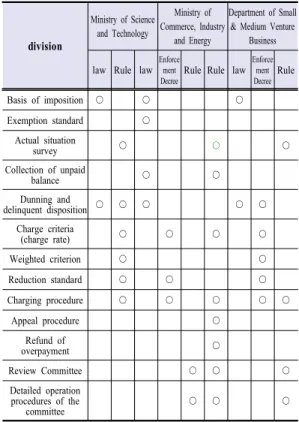
하는 경우가 있다. 국가연구개발사업의 예산규모 등 가 장 활발하고 사업수가 많은 과기부, 산업부, 중기부 등 3 개 부처의 제재부가금 제도의 법률적 근거를 고찰하고자 한다.
2.2.1 과기부
「과학기술기본법」제11조의2(국가연구개발사업에 대한 참여제한 등) 연구비를 사용용도 외의 용도로 사용 한 경우에는 사용 금액의 5배 이내 범위에서 제재부가금 을 부과·징수할 수 있다(`14.5).「국가연구개발사업의 관 리 등에 관한 규정」(제27조의4) 사용용도 외 사용 금액 에 따른 제재부가금 부과 기준(제27조의5), 제재부가금 부과 및 납부 절차를 규정(`14.11)하고 있다.
2.2.2 산업부
「산업기술혁신촉진법」제11조의3 제재부가금의 부 과·징수(`14.5), 동법 시행령 제14조의4(제재부가금 부과 기준, `14.8), 제14조의5(제재부가금의 부과 및 납부,
`14.8), 동법 시행규칙 1조의 4(제재부가금 심의위원회 의 구성 및 운영, `14.8), 「제재부가금 업무처리규정」
(`14.8), 제재부가금 심의위원회 운영규칙(`14.8)을 고시 운영하고 있다.
2.2.3 중기부
「중소기업 기술혁신 촉진법」제31조 제2항(연구용 도외 사용 시 제재부과 등, `12.12) 동법 시행령 제20조 의3 제2항(부과결정 등 세부 사항에 대해 중기부장관이 고시) 제20조의4(제재부가금의 부과 및 납부, `13.6),
「연구개발비 유용에 따른 제재부가금 부과 운영규칙」
(16.1. 제정)을 운영하고 있으며, 중요 부과제도 조문 반 영 등 상세한 내용은 Table 1, 2와 같다.
Table 1. Ministries (3) Statutory provisions related to sanitary surcharge
Table 2. Comparison of provisions related to ministry sanctions
3. 제재부가금 부과절차
3.1 평가단(심의위원회)의 역할 및 구성 3.1.1 평가단의 역할
제재부가금 부과에 관한 사항은 제재조치 평가단의 심의를 거쳐야 하며, 제재조치 평가단은 제재 사유 발생 시 구체적인 사안을 고려하여 참여제한 기간, 환수금액,
division Ministry of Science and Technology
Ministry of Commerce, Industry and Energy
Department of Small & Medium
Venture Business
Rule
Regulations on the management of national R & D
projects "
Article 4 of the Enforcement Rule of the
same Act (Composition and operation of sanctioned loading surveillance committee (`1
Rules on the operation of imposition surcharge
(16.1. Enactment)
Evaluation Team Name
Sanctions assessment
team Committee on sanitary surcharge
Committee on sanitary surcharge
dismissal
In addition to the matters stipulated in Paragraphs 6 to 8 of Article 7 ⑨, matters necessary for the composition and operation of the
1. Failure to perform the duties of members in good faith
2. When it reveals secrets that you have learned about the work of the Commission 3. When a complaint is caused by improper
conduct in connection with the work of the Commission.
evaluation team for sanction measures shall be determined by the head of the central administrative
agency.
4. When the committee members decide to resign themselves
5. In the case of any one of the items of Article 10,
6. When the dignity as other members is impaired or is deemed inappropriate as a member
제재부가금 부과액 등을 심의한다. 산업부, 중기부는 `제 재부가심의위원회` 등으로 명명하고 있으며, 과기부는 ` 제제조치 평가단` 등으로 구성 운영하고 있다. 부처에 별 도의 근거 법률이 있어 해당 법률 내용에 따라 심의 범 위 등이 상이할 수 있으며, 다만 중앙행정기관의장은 제 재부가금을 부과하려는 경우에는 `제재조치평가단`의 심 의를 거쳐야 한다(국가연구개발사업의 관리 등에 관한 규정 제27조의4 제2항)로 되어 있어 취지가 손상되지 않 도록 유념할(의결 절차 준수 등) 필요가 있다.
3.1.2 평가단의 구성
「국가연구개발사업의 관리 등에 관한 규정」(제27조 제6항)에서 제재조치 평가단 구성·운영에 대하여 구체적 인 사항을 정하고 있지 않으나, 다음 각 호에 해당하는 사람은 제재조치 평가단에 제외 할 것을 규정하고 있다.
제재조치대상자와 사제(師弟)관계이거나「민법」제 777조에 따른 친족관계인 사람, 제재조치 대상연구개발 과제의 참여연구원, 제제조치 대상자와 같은 기관에 소 속된 사람, 그 밖에 평가의 공정성을 해할 염려가 있는 사람 등으로 이를 제외하고 있으며. 각 부처에서는 평가 단의 구성, 운영 방식 등을 특성에 맞게 적절히 구성‧운 영 할 수 있도록 하고 있다. 부과에 있어 가장 중요한 행 정절차로 3개 부처의 평가단 구성 및 해촉의 조건 등을 비교 검토하였다. 3개 부처(과기부, 산업부, 중기부)의 평가단(심의위원회)의 구성 요건을 비교하면 Table 3과 같다.
Table 3. Constitution of Evaluation Team and Conditions for Promotion
4. 제재부가금 부과 고찰
4.1 제재부가금 부과기준 변천
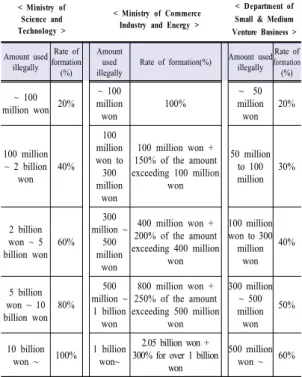
기존(`15.7월, 부처 부가 기준단일화전)에는 부처에 따라 부과구간별 기준 금액이 상이하고, 부과율도 과기 부와 중기부는 누진제, 산업부는 초과누진제를 적용하고 있으며, 상세한 내용은 Table 4와 같다.
Table 4. Survey loading levy by ministry (before reorganization)
< Ministry of Science and Technology >
< Ministry of Commerce Industry and Energy >
< Department of Small & Medium Venture Business >
Amount used illegally
Rate of formation (%)
Amount used illegally
Rate of formation(%) Amount used illegally
Rate of formation
(%)
~ 100 million won 20%
~ 100 million
won 100%
~ 50 million
won 20%
100 million
~ 2 billion won
40%
100 million won to
300 million
won
100 million won + 150% of the amount exceeding 100 million
won
50 million to 100 million
30%
2 billion won ~ 5 billion won 60%
300 million ~
500 million
won
400 million won + 200% of the amount exceeding 400 million
won
100 million won to 300 million
won 40%
5 billion won ~ 10 billion won 80%
500 million ~ 1 billion
won
800 million won + 250% of the amount exceeding 500 million
won
300 million
~ 500 million won
50%
10 billion
won ~ 100% 1 billion won~
2.05 billion won + 300% for over 1 billion
won
500 million won ~ 60%
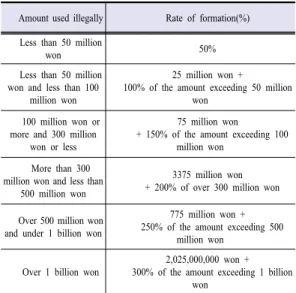
현행 부과금액 산정 방식은 기존 부과구간을 추가 (5 개 → 6개)하고, 모법의 취지 (5배 이내 부과)에 맞도록 제재부가금 부과율을 상향 조정 (20∼60% → 50∼
300%)하였다. 상세한 내용은 Table 5와 같다.
Table 5. Improvement of sanitary surcharge levy standards(`16. Unification of the Buddha)
Amount used illegally Rate of formation(%) Less than 50 millionwon 50%
Less than 50 million won and less than 100
million won
25 million won +
100% of the amount exceeding 50 million won
100 million won or more and 300 million
won or less
75 million won
+ 150% of the amount exceeding 100 million won
More than 300 million won and less than
500 million won
3375 million won + 200% of over 300 million won
Over 500 million won and under 1 billion won
775 million won + 250% of the amount exceeding 500
million won
Over 1 billion won
2,025,000,000 won + 300% of the amount exceeding 1 billion
won
4.2 부처별 제재부과 현황 4.2.1 제재부가금 부과 3개년 현황
연구개발 상위(예산규모, 물량) 3개 부처를 대상으로 최근 3개년 제재부가금 부과 현황을 살펴보면 (NTIS 자 료: `17.12.31) 총 103건 중 산업부 70건으로 68.0%, 중 기부 20건으로 19.4%, 과기부 13건으로 12.6%를 각각 점유하고 있다.
이를 구간별로 세분화하여 분석하면 5천만 원 이하의 구간에서 전체 건수의 86.4%를 차지하고 있으며, 5천만 원 이상 에서는 14건으로 13.6%를 점유하고 있다. 연도 별, 구간별 부과현황은 Table 6, 7과 같다.
Table 6. Total Status of Imposition of Sanctioning Waste
(Unit: case, million won)
division
Ministry of Science and Technology
Ministry of Commerce, Industry
and Energy
D epartm ent of Sm all &
Medium Venture B usiness
Sum
case amount
moneyof case amount of money case amount of money case amount of money
2015 - - 33 1,400 9 100 42 1,500
2016 2 - 37 2,000 4 100 43 2,100
2017 11 300 - - 7 300 18 600
Total 13 300 70 3,400 20 500 103 4,200
Table 7. Status of loading of sanitary surcharge (Unit: case, %)
division
Ministry of Science and Technology
Ministry of Commerce, Industry and
Energy
Department of Small &
Medium Venture Business
Sum
case % case % case % case %
Less than 50 million
won 11 10.7 63 61.2 15 14.6 89 86.4
Less than 50 million won and less than 100
million won 2 1.9 1 1.0 5 4.9 8 7.7
100 million won or more and 300 million
won or less - - 4 3.9 - - 4 3.9
More than 300 million won and less than 500
million won
- - - -
Over 500 million won and under 1 billion
won
- - 1 1.0 - - 1 1.0
Over 1 billion won - - 1 1.0 - - 1 1.0
Total 13 12.6 70 68.0 20 19.4 103 100.0
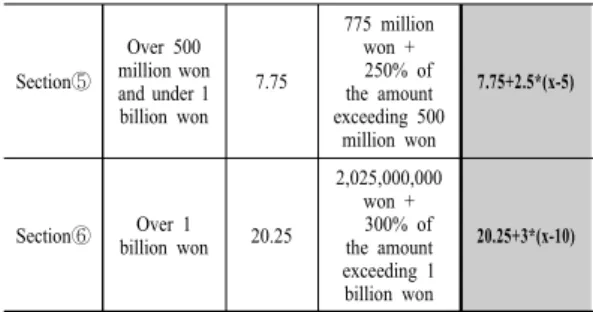
4.3 제재부가 기준에 대한 분석 4.3.1 제재부가 구간별 분석 및 산식도출 각 부과 구간별 5천만 원 이하 시, 부과율 50%를~10 억 원 초과 시, 부과율 20억2천5백만 원 + 10억 원 초과 금액의 300%를 각 각 ①구간 ~⑥구간으로 지정하고, χ
=용도외 사용금액(억원) 으로 지칭하여 부과금액에 대한 산식을 도출하였다. 각 구간별 지정 현황은 Table 8과 같으며 산식 도출은 다음과 같다.
Table 8. Specification of sanitary surcharge (current)
division Amount used illegally Imposed amountSection① Less than 50 million
won 50%
Section②
Less than 50 million won and less than 100
million won
25 million won + 100% of the amount exceeding 50
million won
Section③
100 million won or more and 300 million
won or less
75 million won + 150% of the amount exceeding
100 million won
Section④
More than 300 million won and less than 500
million won
3375 million won + 200% of over 300 million won
Section⑤ Over 500 million won and under 1 billion won
775 million won + 250% of the amount exceeding 500
million won
Section⑥ Over 1 billion won 2,025,000,000 won + 300% of the amount exceeding 1
billion won
division
Amount used illegally
Imposed amount (Billion)
Now Charge rate((%)
Imposed amount (Y)
formula Section① Less than
50 million
won - 50% 0.5*x
Section②
Less than 50 million won and less than 100 million
won
0.25
25 million won + 100% of the
amount exceeding 50
million won
0.25+(x-0.5)
Section③
100 million won or more and 300 million won or less
0.75
75 million + 150% of won
the amount exceeding 100
million won
0.75+1.5*(x-1)
Section④
More than 300 million
won and less than 500 million
won
3.75
3375 million + 200% of won over 300 million won
3.75+2*(x-3)
Section⑤
Over 500 million won and under 1 billion won
7.75
775 million won + 250% of the amount exceeding 500
million won
7.75+2.5*(x-5)
Section⑥ Over 1 billion won 20.25
2,025,000,000 won + 300% of the amount exceeding 1 billion won
20.25+3*(x-10)
① 구간 연구용도외 사용금액 5천만원 이하, 부과율 50% 부과 책정 시 부과금액 Y 값은
Y = 0.5 × χ
② 구간 연구용도외 사용금액 5천만원 초과 1억원 이 하, 부과율 2천5백만원 + 5천만 초과금액의 100%
부과 책정 시 부과금액 Y 값은
Y= 0.25+(χ-0.5)
③ 구간 연구용도외 사용금액 1억원 초과 3억원 이하, 부과율 7천5백만원 + 1억원 초과금액의 150% 부 과 책정 시 부과금액 Y 값은
Y = 0.75+1.5×(χ-1)
④ 구간 연구용도외 사용금액 3억원 초과 5억원 이하, 부과율 3억 7천5백만원 + 3억원 초과금액의 200%
부과 책정 시 부과금액 Y 값은
Y = 3.75+2×(χ-3)
⑤ 구간 연구용도외 사용금액 5억원 초과 10억원 이 하 시, 부과율 7억 7천5백만원 + 5억원 초과금액 의 250% 부과 책정 시 부과금액 Y 값은
Y = 7.75+2.5×(χ-5)
⑥ 구간 연구용도외 사용금액 10억원 초과, 부과율 20억 2천5백만원 + 10억원 초과금액의 300% 부 과 책정 시 부과금액 Y 값은
Y = 20.25+3×(χ-10)
현행 부가기준 구간별 부과액 산식을 종합 요약하면 Table 9와 같다.
Table 9. Sanctioned loading imposition formula (summary)
* Formula [ x = Amount used illegally (100 million won)]
4.3.2 소액 부가구간에 대한 문제 제기
부가기준 일원화 및 시행 이후 3개 부처 부과현황을 고찰 해보면 5천만 원 이하 구간에서 86%(103건 중 89 건 차지)가 집중 되고 있음을 알 수 있다. 특히 1천만 원 이내의 부정사용에 대해 자료조사 결과 총 103건 중 70 건을 차지(70%)하고 있어 대부분의 대상자가 소액 부과 자임을 알 수가 있다. 따라서 소규모 연구용도외 사용금 액에 대해 현행의 제재부가금 부과율 50%를 20%로 하 향 조정할 필요가 있으며, 현행 5천만 원 이하 시 50%를 준용(3천만 원 초과 5천만 원 이하)하고, 3천만 원 이하 금액에 대해서는 구간을 신설하여 20%로 하향 조정하 는 등 부가기준에 대한 제고가 필요하다. 이는 연구개발 비 용도외 사용 등 부정 집행 행위가 소액 규모에 다수 집중되어 있으며, 소액구간 50% 부과율 적용은 과도하 게 작용할 소지가 있어 이를 세분화하고 책정비율을 낮 출 필요가 있다. 다시 말해 소액 유용 건이 대다수를 이 루고 있으며, 이는 소기업에 강력한 제재수단으로 경영 악화를 초래할 수 있는 요인으로 작용할 수 있다.
5. 결론 및 제언
5.1 결론
정부 연구개발사업 수행 시 자금집행의 부정행위에 대해서는 환수 등 여러 가지 제재조치가 따른다. 특히 사 업비 유용 시 제재부과금은 침익적 행정행위로 법률에 근거하고 있으며, 강력하고 엄중한 처벌제도이다. 이는 도덕적 해이 방지와 건전한 연구개발문화 정착, 재정누 수의 차단이 목적이라 할 수 있다. 그러나 제재부가금 부 과기준에 있어 부과율 책정의 효율화에 대해서는 더 많 은 연구가 필요하다. 다만 개정 이후 시행된 제재부가금 부과현황에서 도출된 결과는 소액 용도외사용 구간(5천
만 원 이하)에 86.4%가 집중 부과 분포되어 있다는 점이 다. 이에 대한 활발한 논의와 제고를 통해 최적의 부과율 책정에 접근해야 할 것이다.
5.2 제재부가금 부과기준 제시
중기부 기술개발사업 지원현황 통계자료(`17.12.31.
기준)에 의하면 매출액 규모별 50억 원 미만 업체가 전 체의 71.0%이며, 업력 10년 미만기업이 전체의 63.6%, 종사자 50인 미만 업체가 전체의 76.0%를 차지하고 있 어 연구개발사업 참여기업 70% 이상이 소기업임을 나 타내고 있다. 따라서 법의 취지와 목적에 부합되도록, 현 행 부과기준을 최대한 준용하면서, 일부 구간에 대한 개 선의 필요성이 있다. 즉, 최하위 구간인 5천만 원 이하 에 부과구간을 1개 추가 신설(6 →7개 구간, 3천만 원 이 하)하고 부과율을 낮게 책정(50→ 20%)하여 제재부가금 부과액을 완화코자 한다. 제시하는 정책제안(신설 부과 기준)은 Table 10과 같다.
Table 10. Suggest criteria for imposing sanitary surcharge (plan)
Amount used illegally Imposed amount
Less than 30 million won 20%
Less than 30 million won and less
than 50 million won 50%
Less than 50 million won and less than 100 million won
25 million won + 100% of the amount exceeding 50
million won
100 million won or more and 300 million won or less
75 million won
+ 150% of the amount exceeding 100 million won
More than 300 million won and less than 500 million won
3375 million won + 200% of over 300 million won
Over 500 million won and under 1 billion won
775 million won + 250% of the amount exceeding 500
million won
Over 1 billion won
2,025,000,000 won + 300% of the amount exceeding 1
billion won
5.3 제재 부과기준 제시안의 기대효과 제재부과를 시행하는 행정기관의 제재부과금 수입을 Sinc, 제재부과금을 납부하는 단체(기업)의 납부금 지출 을 Sexp라 할 때
Sinc + Sexp = 0
Sinc(부과)가 증가 하면, Sexp(납부)도 증가 ⇒ Sinc(부과)가 감소 하면, Sexp(납부)도 감소
즉 제재부과금을 납부하는 단체(기업)의 부과금이 감 소할수록 정부수입도 감소하는 비례 구조라 할 수 있다.
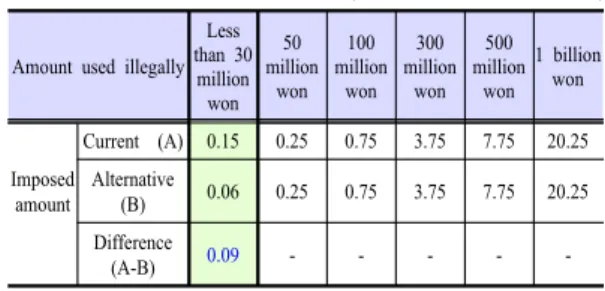
현행 용도외 사용액 5천만 원 이하 구간의 부과기준 50%를 3천만 원 이하 구간에(최근 3년 부과실적, 현행 총 84건, 432백만 원) 제시(안) 부과율 책정 20%를 적용 하게 되면, 단체(기업)에서의 납부액은 172.8백만 원으 로 현행 부과액보다 259.2백만 원의 절감효과를 나타낸 다. 이를 년 평균으로 환산 시 86.4백만 원으로 집계된 다.
개별 건으로 제재부과액 제시안 비교(Table 11)에서 와 같이 3천만 원 이하 구간에서 최대 6백만 원의 부과 액을 현행 부과액 기준으로는 15백만 원을 부과하게 되 어 차액은 9백만 원의 절감을 나타내고 있다. 부과액 제 시안의 비교는 Table 11과 같다.
Table 11. Suggestion of sanitary surcharge compare (unit : 100 million won)
Amount used illegally Less than 30
million won
50 million
won 100 million
won 300 million
won 500 million
won 1 billion
won
Imposed amount
Current (A) 0.15 0.25 0.75 3.75 7.75 20.25 Alternative
(B) 0.06 0.25 0.75 3.75 7.75 20.25
Difference
(A-B) 0.09 - - - - -
제안한 부가책정 기준이 단체(기업)의 부과 금액 절감 으로 연결 되어 기업경영의 기여 및 경영악화 방지 등의 실효성에 대해서는 본 연구의 한계로 남으며, 제안한 부 가기준 부과율의 적절성, 효율성은 보다 많은 연구와 추 후 제재부과 실적 데이터의 축적을 통해 충분히 검토하 는 등 지속적인 접근의 여지가 필요하다.
References
[1] Digital Time Magazine, "Foreclosure of Assets when Granting Unfair Use, Strengthening Management System for Mid-Term R&D Projects"(17.11.21), page 14, 2017.
[2] Segye Times Magazine, “Supporting Countries R&D
expenses”(`18.09.13), page 001, 2018.
[3] Electronic newspaper, "Bad R&D Regulation Regulation Hole"(`18.1010), page 020, 2018
[4] Ministry of Science and Technology, "Regulations on the Management of National R&D Projects", 2017.
[5] Ministry of Science and Technology, Ministry of Information and Communication, "Regulations for the R&D Projects in Science and Technology", 2017.
[6] Ministry of Industry and Trade, "Industrial Technology Innovation Promotion Act", 2018.
[7] Ministry of Commerce, Industry and Energy,
"Guidelines for Management of Technology Development and Evaluation of Industrial Technology Innovation Project", 2018.
[8] Small Venture Business Division, "SME Technology Innovation Promotion Act", 2018.
[9] Small Venture Business Division, "Enforcement Decree of the Small Business Innovation Promotion Act", 2018.
[10] Small and Medium Venture Business Division,
"Operation Support Program for SME Technology Development", 2017.
[11] Lin. Y, “Spring Manufacturers Need Research and Development In the face of global competition and customer pressure to reduce costs, North American springmakers must look to R&D, not government intervention, for long-term competitiveness”, SPRINGS, vol.43, no.1, 2004.
[12] J. H. Kim, "A Theoretical Review on the Improvement of the Selection Method of Research Projects in National R&D Projects" Wednesday, June 24, 2015, 1:00:00 PM
| Go to full article Proceedings of the Korean Information Science Society Conference;(AN edspia.2768721); ISSN: 24660825. 2015.
[13] C. h. Yoo, “ A Study on the Factors of Successful Realization of Commercialization of R&D-invested Enterprises” - Focused on Innovative SMEs, Kyonggi University, 2016.
[14] J. W. Lee, “A Study on Meta Analysis of Preliminary Feasibility for Government R&D Programs to Improve Planning Project of the Government Funded Research Institutes, Journal of the Korea Academia-Industrial cooperation Society”, vol. 18, no. 11, pp. 445-453, 2017.
DOI: https://doi.org/10.5762/KAIS.2017.18.11.445 [15] C.G. Min, S.W. Park,. "Analysis of the Factors
Affecting the Research Results of Government - funded Research Institutions", Technology Innovation Research, 21 (3), 121-140. 2013
[16] Procca. A. E, “Development of a Project Management Model for a Government Research and Development Organization”, Project management journal, vol. 39, no. 4, 2008.
DOI: https://doi.org/10.1002/pmj.20081
[17] Y. G.Bae, “A Study on the National R&D and Technology and Commercialization”, Domestic Doctoral Thesis, Daejeon University, 2013.
[18] J. W. Bai, S. Y. Jung, & S. J. Eun, “Development and Characteristics of Korea's National R&D Performance Evaluation” (1999 ~ 2013). Technology Innovation
Research, vol. 22, no. 4, pp. 165-198, 2014.
DOI: https://doi.org/10.14383/SIME.2014.22.4.165 [19] D. H. Son, W. Y. Han, & Sun only. “An Empirical
Study on Economic Growth and Employment Effect of R&D Investment” - Focusing on Oecd Countries.
International Area Studies, vol. 19, no. 3, pp. 177-194, 2015.
[20] J. M. An, “New Role and Policy Direction of National R&D: Increase of social utility and expansion of openness”, Social Science Research, vol. 42, no. 3, pp.
119-139, 2016.
[21] J. S. Kim & Y. J. Kim, “The Influence of Venture Capital Investments on the Technology Commercialization of Small and Medium Enterprises” - Focusing on Small and Medium Enterprises Performing National R&D Projects, Productivity Review (Old Productivity Research), vol. 30, no. 3, pp. 135-170, 2016.
[22] Van Weele, M.; Thompson, N.; Herrmann, A.; Stam, E;“A Green - Entrepreneurial - Deal Explaining the Development of Green Ventures and the Role of Government Subsidies”, Frontiers of Entrepreneurship Research, vol. 30, 2010.
[23] H. D. CHO, “An Analysis and Policy Recommendations for Applying the Notion of Public Value to National R&D Programs”, ISSN: edspia, KISTEP, pp. 35~61, 2015.
[24] S. K. Noh, “To ensure transparency in the implementation of national R&D Sanctions(refunds, participation restrictions) Research”, vol. 19, no. 8, pp.
433-440, 2018.
DOI: https://doi.org/10.5762/KAIS.2018.19.8.433
노 상 균(Sang-Kyun Noh) [정회원]
•2017년 3월 ~ 현재 : 대전대학교 융합학과 박사 과정중
<관심분야>
국가연구개발, 기업(기술, 특허) 경영, 중소기업정책
안 은 숙(Eun-Sook An) [정회원]
•2001년 2월 : 한국교원대학교 교육 대학원(교육학석사)
•2018년 8월 : 대전시교육청(교사)
<관심분야>
기업가정신, 교육(기업과윤리)
현 병 환(Byung-Hwan Hyun) [정회원]
•2010년 2월 : 과학기술연합대학원 대학교 기술정책학과 교수
•2018년 11월 : 대전대 일반대학원 융합학과 전담교수
<관심분야>
기술경영, 연구전략기획, 기술사업화