Karasek의 Job Content Questionnaire와 Korea Occupational Stress Scale의 비교 연구
이종빈⋅장성록 †
부경대학교 안전공학과(2014. 6. 9. 접수 / 2014. 7. 25. 수정 / 2014. 10. 7 채택)
Comparison of Karasek’s Job Content Questionnaire and Korea Occupational Stress Scale
Jong-Bin Lee⋅Seong Rok Chang †
Department of Safety Engineering, Pukyong National University (Received June 9, 2014 / Revised July 25, 2014 / Accepted October 7, 2014)
Abstract : According to the report of the WHO, workers have been exposed to much job strain such as job load, responsibility, role,
interpersonal conflict etc. In Korea, studies on job strain started to become active from 1990s and now hundreds of studies are actively under going or publishing so that the studies are contributing to development and improvement of job strain. Representative measurement models of job strain are Job Strain Model of Karasek, Job Stress Model of NOISH, Korea Occupational Stress Scale, JSQ(Job Stress Questionnaire), K-OSI(Korea Version of Occupational Stress Inventory) etc. (Lee Kwan-Suk, 2012 ; KOSHA, 2003). Among them, Job Strain Model of Karasek had been loved by many researchers of job strain before Korea Occupational Stress Scale was developed. Job Strain Model of Karasek had been fitted to Korean style and then, used to analyze job strain of Korean people so that this Scale highly contributed to seeking relationship with cardiovascular disease, musculoskeletal disease caused by job, smoking, drug, alcohol poisoning, and pulse(Lee Kwan-Suk, 2012). But as this Model was studied and developed based on foreign culture and life pattern, a model fit to Korea was developed to measure job strain for Korean people, which is Korea Occupational Stress Scale now most frequently used in measuring job strain. Accordingly, after this study made questionnaire survey about same population using the two methods used most frequently in measuring job strain, the study investigated what features appeared, what correlations appear between two models, and comparatively analyzed characteristics each independent and dependent variable. Based on this, the study aimed to exactly express job strain of Korean people. The subjects of the study were a population of 233, and Karasek's Questionnaire and KOSS's Questionnaire were surveyed at the same time. The results were analyzed by statistical program to obtain significant difference between two models. Four particular groups were divided with Job Strain Model of Karasek and the four particular groups were measured with Korea Occupational Stress Scale. And job strain come from combination of two models was measured, with which new comparative analysis method was suggested.Key Words : job strain model of karasek, job stress model of NIOSH, korea occupational stress scale, JSQ, K-OSI
†
Corresponding Author : Seong Rok Chang, Tel : +82-51-629-6468, E-mail : [email protected]
1.
서 론세계보건기구(WHO)가 발표한 보고에 의하면, 세계 적으로 4억 5천만 명이 정신질환, 신경학적 질환, 약물 및 알코올 중독 등의 정신심리학적 문제로 고통을 받 고 있는 것으로 추산되고 있고, 전체 질병 중 정신 및 행동장애로 인한 질병부담이 약 12%를 차지하여 정신, 사회적 건강수준의 심각성이 대두되고 있다 1) .
우리나라에서는 1997년 이후 4년간 직업병에 의한
사망자는 모두 2천945명인데, 이 가운데 뇌혈관 및 심
장질환 사망자가 1천547명으로 53%를 차지했다. 또한
국내 직업병이 진폐증이나 중금속 중독 등 1차 산업형
에서 반복 작업이나 직무스트레스로 발생하는 3차 산
업형 작업성 질환으로 빠르게 바뀌고 있으며, 이에 따
라 독성물질이나 재해로 인한 직업병의 발생보다는 스
트레스나 피로에 의한 작업관련성 질환이 급증하고 있
다 2) . 한국산업안전보건공단에서 245개 사업체 근로자 를 대상으로 스트레스에 관한 조사를 실시하였다. 이 조사에 따르면, 스트레스와 관련이 없는 건강한군이 5%, 잠재적 스트레스군은 73%, 극도의 스트레스를 받 는 고위험군은 22%나 된다고 한다 2) .
직무스트레스로 인한 구체적인 증상은 두통, 근골격 계 통증, 혈압 상승, 변비 등의 신체적인 증상과 불안, 분노, 공포, 우울, 기억력 감퇴 등의 정서적 증상이 나 타나고 3) , 근심과 스트레스는 뇌에서 나오는 “10번 부 교감 신경”을 자극하여 위와 장운동이 떨어지고, 식욕 감퇴와 불면을 가져다 준다 4) . 또한, 과도한 직무스트레 스는 생산성 감소, 사고증가 등을 유발시키고, 순환기 질환 뿐만 아니라, 정신질환, 불면증 등의 각 종 건강 장애의 주요인으로 작용한다 5) . 직무스트레스와 관련된 연구를 수행하기 위해 적합한 직무스트레스 모델 및 직무스트레스 측정도구의 사용은 매우 중요한 요소라 할 수 있다.
직무스트레스의 측정 모델은 대표적으로 Karasek의 Job Content Questionnaire(이하 Karasek’s JCQ), NOISH 의 Job Stress Model, Korea Occupational Stress Scale(이 하 KOSS), JSQ(Job Stress Questionnaire), K-OSI(Korea Version of Occupational Stress Inventory)등이 있다. 이러 한 모델의 측정방법은 크게 3가지로 분류된다. 첫째, 생 화학적(내분비적) 측정방법이다. 둘째, 임상적인 면접과 상담을 통한 개인의 성격, 행동양식을 측정하는 것이다.
셋째, 설문지를 통한 정신 사회적 스트레스 측정법이다
6) . 이중에서 집단을 대상으로 한 선별 검사 목적으로나, 2차 예방을 목적으로 한 일차 환경에서는 설문지법이 가장 용이할 것으로 보인다. 실제 조사의 편이성, 비용, 절감 등의 이유로 대부분의 측정에서 자기보고식 설문 지에 의존한다고 한다 7) . 그러나 설문지법의 경우에는 타당도와 신뢰도가 문제로 지적되고 있으며 8) , 미국 교육 및 심리검사 기준 (Standards for Education and Psychological Testing)에서는 설문지도 개인용과 집단용을 명확히 구 분하여 평가 할 것을 권하고 있다 9,10) . 직무스트레스에 대한 두 가지 모델 비교는 Karasek Model과 Effort Reward Imbalance Model에 대한 비교와 국내에서 아직 사용 중이지 않는 Karasek‘s JCQ2.0 버전과 KOSS를 비 교한 정도이다 5) .
직무스트레스 측정 도구의 종류를 조사해 본 결과 , 우리나라에 발표된 직무스트레스 연구에 가장 흔히 적 용된 도구는 한국산업안전공단에서 장세진 등 11) 이 개 발한 KOSS인 것으로 나타났다. 보건학 분야에서는 KOSS가 27.8%, Karasek‘s JCQ가 18.2%로 가장 많이 사 용되는 것으로 나타났다 12) . 따라서, 본 연구는 직무스트
레스 측정에 많이 사용되고 있는 두 가지 측정도구인 Karasek’s JCQ와 KOSS를 비교․분석하여 측정방법의 차이점을 분석하고 , 두 모델이 어떠한 상관이 있는지를 파악함으로써, 직무스트레스를 보다 효율적으로 측정 할 수 있도록 기여하고자 함에 그 목적이 있다.
2.
연구방법2.1. 연구대상
사회인구학적 특성 중 결혼여부, 연령과 직업관련 특성인 근속년수 , 고용형태, 근무형태를 계층변수로 하 여 종속변수인 두 모델 (Karasek‘s JCQ, KOSS)간의 차 이점을 비교․분석하기 위하여 동일 집단인 국내의 A 석유화학업체에 종사하는 근로자 325명을 대상으로 동 일한 시간에 설문을 실시하였고, 회수된 설문지 중 평 가에 적합한 총 233명에 대한 설문지를 분석에 사용하 였다 .
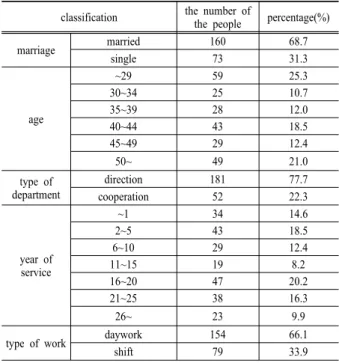
Table 1에서 나타낸 바와 같이 설문 대상자의 평균연 령(±표준편차)은 39.2(±9.8)세로 나타났으며, 연령 분포 를 보면 29세 이하가 25.3%(n=59)로 가장 많았고, 가장 적은 연령은 30세~34세로 10.7%(n=25)를 차지하고 있 다. 근속년수는 16년~20년이 20.2%(n= 47)로 가장 많았 고, 11년~15년이 8.2%(n=19)로 가장 적었다. 석유화학 업종의 특성상 하도급 비율이 적어 직영이 77.7%
(n=181), 협력업체가 22.3%(n=52)로 구성되었다. 근무형 태는 주간 66.1%(n= 154)로서, 교대근무 33,9%(n=79) 보
Table 1. Characteristics of participants
classification the number ofthe people percentage(%)
marriage married 160 68.7
single 73 31.3
age
~29 59 25.3
30~34 25 10.7
35~39 28 12.0
40~44 43 18.5
45~49 29 12.4
50~ 49 21.0
type of department
direction 181 77.7
cooperation 52 22.3
year of service
~1 34 14.6
2~5 43 18.5
6~10 29 12.4
11~15 19 8.2
16~20 47 20.2
21~25 38 16.3
26~ 23 9.9
type of work daywork 154 66.1
shift 79 33.9
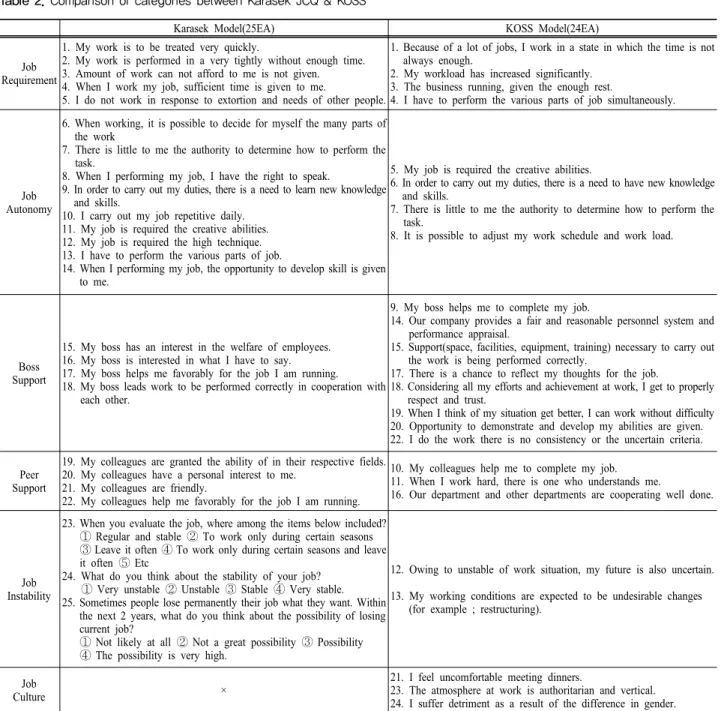
Karasek Model(25EA) KOSS Model(24EA)
Job Requirement
1. My work is to be treated very quickly.
2. My work is performed in a very tightly without enough time.
3. Amount of work can not afford to me is not given.
4. When I work my job, sufficient time is given to me.
5. I do not work in response to extortion and needs of other people.
1. Because of a lot of jobs, I work in a state in which the time is not always enough.
2. My workload has increased significantly.
3. The business running, given the enough rest.
4. I have to perform the various parts of job simultaneously.
Job Autonomy
6. When working, it is possible to decide for myself the many parts of the work
7. There is little to me the authority to determine how to perform the task.
8. When I performing my job, I have the right to speak.
9. In order to carry out my duties, there is a need to learn new knowledge and skills.
10. I carry out my job repetitive daily.
11. My job is required the creative abilities.
12. My job is required the high technique.
13. I have to perform the various parts of job.
14. When I performing my job, the opportunity to develop skill is given to me.
5. My job is required the creative abilities.
6. In order to carry out my duties, there is a need to have new knowledge and skills.
7. There is little to me the authority to determine how to perform the task.
8. It is possible to adjust my work schedule and work load.
Boss Support
15. My boss has an interest in the welfare of employees.
16. My boss is interested in what I have to say.
17. My boss helps me favorably for the job I am running.
18. My boss leads work to be performed correctly in cooperation with each other.
9. My boss helps me to complete my job.
14. Our company provides a fair and reasonable personnel system and performance appraisal.
15. Support(space, facilities, equipment, training) necessary to carry out the work is being performed correctly.
17. There is a chance to reflect my thoughts for the job.
18. Considering all my efforts and achievement at work, I get to properly respect and trust.
19. When I think of my situation get better, I can work without difficulty 20. Opportunity to demonstrate and develop my abilities are given.
22. I do the work there is no consistency or the uncertain criteria.
Peer Support
19. My colleagues are granted the ability of in their respective fields.
20. My colleagues have a personal interest to me.
21. My colleagues are friendly.
22. My colleagues help me favorably for the job I am running.
10. My colleagues help me to complete my job.
11. When I work hard, there is one who understands me.
16. Our department and other departments are cooperating well done.
Job Instability
23. When you evaluate the job, where among the items below included?
①
Regular and stable②
To work only during certain seasons③
Leave it often④
To work only during certain seasons and leave it often⑤
Etc24. What do you think about the stability of your job?
①
Very unstable②
Unstable③
Stable④
Very stable.25. Sometimes people lose permanently their job what they want. Within the next 2 years, what do you think about the possibility of losing current job?
①
Not likely at all②
Not a great possibility③
Possibility④
The possibility is very high.12. Owing to unstable of work situation, my future is also uncertain.
13. My working conditions are expected to be undesirable changes (for example ; restructuring).
Job
Culture × 21. I feel uncomfortable meeting dinners.
23. The atmosphere at work is authoritarian and vertical.
24. I suffer detriment as a result of the difference in gender.