국내산 산채류의 물 및 메탄올 추출물에 대한 항산화 활성
이영민1․배지현1․정호영2․김재현1․박동식1†
1
농촌진흥청 기능성식품과
2
엘리드 임상시험 연구소
Antioxidant Activity in Water and Methanol Extracts from Korean Edible Wild Plants
Young Min Lee1, Ji Hyun Bae1, Ho Young Jung2, Jae-Hyun Kim1, and Dong Sik Park1†
1Functional Food & Nutrition Division, Rural Development Administration, Gyeonggi 441-853, Korea
2Ellead Skin Research Center, Seongnam 463-824, Korea
Abstract
The present study was performed to investigate antioxidant activities of Korean edible wild extracts. In water and methanol extracts of edible wild plants, total polyphenol content of water and methanol extracts ranged 4.6~183.8 and 8.2~270.1 mg/g, respectively. Radical scavenging activity against DPPH and ABTS radicals was observed to be high in Lysimachia barystachys, Aceriphyllum rossii, Securinega suffruticosa, Sedum kamt- schaticum, and Pedicularis resupinata. Pedicularis resupinata, Securinega suffruticosa, Patrinia villosa, and Solidago virga-aurea var. asiatica showed effective SOD-like activity. There was significant correlation be- tween polyphenol content and DPPH and ABTS radical scavenging activities, and SOD-like activity. Plant ex- tracts such as Pedicularis resupinata, Securinega suffruticosa, Rhapontica uniflora, Lysimachia barystachys, and Aceriphyllum rossii had higher polyphenol content, radical scavenging, and SOD-like activity. These results indicate that Korean edible wild plants may be useful as potential antioxidant sources for improving human antioxidant defense system.
Key words: edible wild plant extracts, polyphenol, DPPH and ABTS radical, SOD-like
†
Corresponding author. E-mail: [email protected]
†
Phone: 82-31-299-0520, Fax: 82-31-299-0503
서 론
미토콘드리아는 체내 자유 라디칼의 주요 생성장소로써, 세포 생명 유지에 필수적인 에너지(ATP)를 생성하는 호흡 과정에서 세포내 산소대사의 부산물로 superoxide radical, hydrogen peroxide, hydroxyl radical 등과 같은 반응성이 높은 산소 라디칼을 많이 생성하고 있으며(1), 전체 미토콘 드리아 산소 대사의 2%까지 라디칼 생성을 일으키는 것으 로 추정되어졌다(2). 또한 대기오염물질, 방사선, 자외선, 중 금속, 준금속, 농약, 다환방향족탄화수소(polycyclic aromatic hydrocarbon) 등은 생체 표적 기관에서 활성산소종(reactive oxygen species)과 활성질소종(reactive nitrogen species) 의 생성을 유도한다(3). 따라서 생체는 활성산소종의 생성을 차단시키거나 감소시키기 위한 항산화 시스템을 가지고 있 어, 정상적 상태에서는 산화 작용이 생체 항산화 시스템에 의해 방어되어 해로운 영향을 주지 않는다. 그러나 환경이나 질병 등에 의해 산화와 항산화 작용의 평형이 깨지게 되면 산화적 스트레스가 발생하게 되고 이것은 세포내 지질, 단백
질, 또는 DNA를 손상시키고 정상적인 기능을 방해할 수 있 다(4).
통계청 발표에 따르면, 우리나라 2008년 3대 사망원인은 악성신생물(암), 뇌혈관질환, 심장질환으로 총 사망자의 거 의 반을 차지하며(5), 여러 연구에서 활성산소종의 생성이 이러한 만성질환의 위험을 증가시키는 것으로 보고한 바 있 다(6-10). 또한 노화와 함께 활성산소종의 생성이 증가한 반 면, 항산화시스템 내 효소 활성과 항산화물질의 수준이 감소 하여(11,12), 수명이 계속 증가하고 있는 이때에 인체 항산화 능을 증진시키기 위한 물질을 탐색하고 기능성식품을 개발 하는 것이 매우 시급하다 하겠다.
체내 항산화시스템 중, 내인성 항산화제는 체내에서 생성
되는 것으로 catalase, superoxide dismutase, glutathione
peroxidase 등을 포함한다(13). 그 외에도 전자를 공여함으
로써 자유 라디칼을 환원시키는 비타민 C, 비타민 E, glu-
tathione, 카로티노이드, 폴리페놀, 플라보노이드 등의 식이
미량영양소와 항산화효소의 조효소로 작용하는 셀레늄, 구
리, 아연 및 망간 또한 중요한 항산화 방어 시스템을 구성한
다(3). 따라서 자유 라디칼에 의해 유도되는 산화적 스트레 스를 예방 또는 감소시키기 위해서 외부로부터 항산화물질 이 충분히 섭취되어야 하며, 비타민과 무기질, 식물 유래 생 리활성물질(phytochemicals) 등의 식이 항산화제가 풍부한 것으로 과일류와 채소류 및 식물성 식품을 들 수 있다. 과일 및 채소의 섭취는 심혈관 질환, 암, 당뇨, 노화 등의 위험성 감소와 관련되어 있으며(14,15), 이들 식품의 항산화능은 주 로 폴리페놀 등의 생리활성물질에 의한 것으로 보고되었다 (16).
산채류는 최근 건강한 식생활에 대한 관심이 증가하면서 그 수요가 증가하고, 안전성이나 기능성 측면에서 많은 관심 을 받고 있다. 산채는 자연에서 자생하는 식물 중 식용이 가능한 것으로, 환경으로부터 자신을 보호하기 위한 생리활 성물질들이 다량 함유되어 있으리라 여겨진다. 다양한 산채 류의 기능성과 관련하여 많은 연구들이 보고되고 있으나 (17), 수많은 식물 유래 생리활성물질이 밝혀지지 않아(18) 자국의 식물자원으로부터 생리활성을 탐색하고 기능성 성 분을 구명하는 것이 요구된다. 따라서 본 연구에서는 산채류 34종의 물 추출물과 메탄올 추출물을 제조한 후 항산화 활성 을 탐색하여 산채류 유래 항산화 물질을 탐색하고 기능성식 품을 개발하기 위한 항산화능 우수 산채류 선발의 기초 자료 를 제공하고자 하였다.
재료 및 방법
시료
본 연구에 사용된 산채류는 총 34종으로, 문헌고찰을 토대 로 선정하여 한국생명공학연구소 한국식물추출물은행에서 건조 분말 형태로 분양받았다. 고려엉겅퀴(
Cirsium setidens), 승마(
Cimicifuga heracleifolia), 바디나물(
Angelica de- cursiva) 등 전초식물이 24종이고, 돌단풍(
Aceriphyllum rossii), 활량나물
(Lathyrus davidii) 등 지상부 4종과 음나무 (
Kalopanax pictus), 광대싸리(
Securinega suffruticosa)와 같은 잎과 줄기 5종, 더덕(
Codonopsis lanceolata)과 같은 뿌리 1종이다(Table 1).
추출물 제조
물 추출은 시료 10 g에 중량대비 10배의 증류수를 가하고 80
oC 수욕상에서 환류냉각하면서 3시간씩 2회 반복추출하 고, ADVANTEC paper(No.6)(ADVANTEC Co., Tokyo, Japan)을 이용하여 감압 여과하는 과정을 2번 거친 후 감압 농축기(EYELA N-1000, Riakikai Co., Ltd., Tokyo, Japan) 를 사용하여 농축한 후 동결건조(PVTFD 10R, Ilsin Lab, Yangju, Korea)하여 phosphate buffered saline(PBS)에 녹 여 시료로 사용하였다.
메탄올 추출은 시료 10 g에 중량대비 10배의 100% 메탄올 을 가하고 교반추출(Jeio tech sk-71, Lab companion, Daejeon, Korea)하면서 16시간, 3시간 동안 2회 반복추출하
고, ADVANTEC paper를 이용하여 감압 여과하였다. 그 후 에 감압농축기를 사용하여 농축하였으며 동결건조 하여 5%
dimethyl sulfoxide(DMSO)에 10 mg/mL로 녹여 시료로 사 용하였다.
총 폴리페놀 함량
총 페놀 함량은 Folin-Denis법(19)에 따라 각 추출물 10 μ L에 Folin reagent 10 μL 및 2% Na
2CO
3200 μL을 가하고 혼합한 다음 실온에서 30분간 정치한 후 750 nm에서 흡광도 를 측정하였다. 표준물질로는 tannic acid(Sigma Co., St.
Louis, MO, USA)를 사용하여 시료와 동일한 방법으로 분석 하여 얻은 검량선으로부터 총 페놀 함량을 산출하였다. 실험 은 3회 반복 수행하여 평균값을 제시하였다.
DPPH 라디칼 소거능
각 추출물의 1,1-diphenyl-2-picrylhydrazyl(DPPH) 라 디칼 소거능은 Blois 등(20)의 방법을 약간 변형하여 평가하 였다. 농도별 시료 40 μL에 1.5×10
-4M DPPH(Sigma Co.) 용액 160 μL를 가하여 잘 혼합하고, 암소에서 30분간 방치 후 518 nm에서 흡광도를 측정하였다. 결과 값은 시료를 첨 가하지 않은 대조군과 비교하여 라디칼의 제거활성으로 나 타냈으며 양성대조군으로는 ascorbic acid를 사용하였다. 실 험은 3회 반복 수행하여 평균값을 제시하였다.
ABTS 양이온(ABTS
․+) 소거능
2,2'-azino-bis(3-ethylbenzthiazoline-6-sulfonic acid) (ABTS)와 과황산칼륨(potassium persulfate)을 혼합하여 암소에 두면 ABTS 양이온이 생성되는데 추출물의 항산화 물질과 반응하여 양이온이 소거됨으로써 특유의 청록색이 탈색되며 이의 흡광도를 측정하여 항산화 능력을 측정할 수 있다(21). 7.4 mM ABTS 용액과 2.6 mM 과황산칼륨을 혼합 하여 암소에서 약 15시간 반응시킨 후 734 nm에서 흡광도가 1.5가 되도록 희석하였다. 희석한 용액 300 μL에 1, 0.1 mg/mL로 조제한 시료 20 μL를 첨가하여 잘 혼합하고 실온 에 30분간 방치한 다음 734 nm에서 흡광도를 측정하였다.
결과 값은 시료를 첨가하지 않은 대조군과 비교하여 라디칼 의 제거활성으로 나타냈으며 양성대조군으로는 ascorbic acid를 사용하였다. 실험은 3회 반복 수행하여 평균값을 제 시하였다.
SOD 유사활성
Superoxide dismutase(SOD) 유사활성은 중성이나 알칼
리 상태에서 pyrogallol이 superoxide에 의해 자동산화 되면
서 갈색물질이 생성되는 원리를 이용하여 pyrogallol의 자동
산화를 억제시키는 효과를 측정하였다(22,23). 5 mg/mL로
조제한 시료 20 μL에 pH 8.5로 보정한 tris-HCl buffer(50
mM tris+10 mM EDTA, pH 8.5) 300 μL와 7.2 mM
pyrogallol 20 μL를 첨가하여 25
oC에서 10분간 반응 후, 1
N HCl 10 μL를 가하여 반응을 정지시켰다. 반응액 중 산화
된 pyrogallol의 양은 420 nm에서 흡광도의 변화를 측정하여
Table 1. List of 34 edible wild plants used for this experiment, yields, and polyphenol content of their water and methanol extracts
Scientific name Korean
name Part Family Extraction yield (%) Polyphenol (mg/g) Water
Ext. Methanol
Ext. Water
Ext. Methanol Ext.
1 2 3 4 5 6 7 8 10 9 11 12 13 14 15 16 17 18 19 20 21 22 23 24 25 26 27 28 29 30 31 32 33 34
Cirsium setidens Cimicifuga heracleifolia Angelica decursiva Synurus deltoides Aceriphyllum rossii Bupleurum longeradiatum Lathyrus davidii
Rhapontica uniflora Chrysanthemum indicum
Artemisia princeps var. orientalis Adenocaulon himalaicum
Lysimachia barystachys Codonopsis lanceolata Patrinia villosa Kalopanax pictus Ainsliaea acerifolia Sedum kamtschaticum Viola acuminata Agrimonia pilosa Securinega suffruticosa Aralia elata
Cardamine leucantha
Solidago virga-aurea var . asiatica Allium thumbergii
Adenophora triphylla var . japonica Pueraria thunbergiana
Pteridium aquilinum var . latiusculum Staphylea bumalda
Eupatorium japonicum Patrinia scabiosaefolia Disporum smilacinum Chrysanthemum boreale Lactuca raddeana Pedicularis resupinata
고려엉겅퀴 바디나물 승마
수리취 돌단풍 활량나물 개시호
뻐꾹채 감국 멸가치 쑥 까치수영 더덕
음나무 뚝갈 단풍취 기린초 졸방제비꽃
짚신나물 광대싸리 미나리냉이 두릅나무
미역취 산부추 잔대 칡 고추나무 고사리 등골나물 마타리 애기나리 산국 산씀바귀 송이풀
whole whole whole whole aerial whole aerial aerial whole whole aerial whole whole root leaf, stem
whole whole whole whole leaf, stem leaf, stem whole whole whole whole leaf, stem
whole leaf, stem
whole whole whole whole whole whole
Compositae Ranunculaceae
Umbelliferae Compositae Saxifragaceae
Umbelliferae Leguminosae Compositae Compositae Compositae Compositae Primulaceae Campanulaceae
Valerianaceae Araliaceae Compositae Crassulaceae
Violaceae Rosaceae Euphorbiaceae
Araliaceae Cruciferae Compositae
Liliaceae Campanulaceae
Leguminosae Pteridaceae Staphyleaceae
Compositae Valerianaceae
Liliaceae Compositae Compositae Scrophulariaceae
20.3 15.3 16.1 13.0 20.0 18.3 10.2 17.3 22.0 20.0 21.0 13.1 34.6 13.8 12.6 15.3 19.6 20.2 21.1 10.6 12.4 17.2 21.1 21.2 28.4 4.6 11.9 9.1 9.4 8.3 14.7 23.8 21.6 9.8
8.7 9.5 8.4 6.8 15.0 10.8 4.4 8.7 9.8 6.5 17.8 10.9 45.0 9.7 9.8 8.0 11.8 20.2 17.7 4.3 8.0 9.7 11.4 9.5 13.7 6.0 6.4 4.5 3.4 4.0 12.6 11.1 13.5 3.6
43.0±9.3 79.5±19.6 32.8±0.9 42.0±4.9 183.8±26.7
45.2±7.1 27.1±3.7 97.0±38.5 40.2±6.4 37.6±1.5 46.5±4.4 132.4±0.2 39.0±11.3 - 60.6±20.8 40.7±8.0 145.8±14.9
69.7±9.7 120.0±9.9 166.9±19.6
36.0±17.7 29.5±3.7 66.8±14.0
8.0±2.3 4.6±2.5 26.8±7.2 43.1±1.1 57.6±12.3 68.5±3.7 65.1±8.1 49.6±11.6 28.7±3.3 70.9±4.2 128.2±22.2
42.9±9.8 63.7±3.0 39.5±7.4 70.5±4.0 270.1±43.4
25.7±4.1 37.2±3.5 85.3±10.9 72.7±14.6 55.6±2.6 21.5±2.8 166.0±5.9 12.4±1.1 88.1±2.1 51.4±9.6 39.9±8.1 194.1±10.6
33.6±2.2 114±19.5 184.1±21.4 70.8±22.9 37.9±11.0 76.4±12.5 8.2±4.9 10.9±5.7 27.4±9.9 37.2±12.9 39.8±5.9 54.4±8.6 32.8±7.8 46.3±8.3 37.7±5.6 68.9±7.8 151.6±10.0 Data was expressed as mean±SD.
대조군과 비교하여 저해활성으로 나타내었다. 양성대조군 으로는 ascorbic acid를 사용하였으며 실험은 3회 반복 수행 하여 평균값을 제시하였다.
통계처리
실험 결과는 3회 반복 측정 후 평균±표준편차로 나타내 었다. 변수간의 상관성은 관찰값을 차례로 순위를 매긴 뒤 순위를 이용해서 비모수적 상관계수인 스피어만 상관계수 (Spearman correlation coefficient)로 구하였다.
결과 및 고찰
추출수율
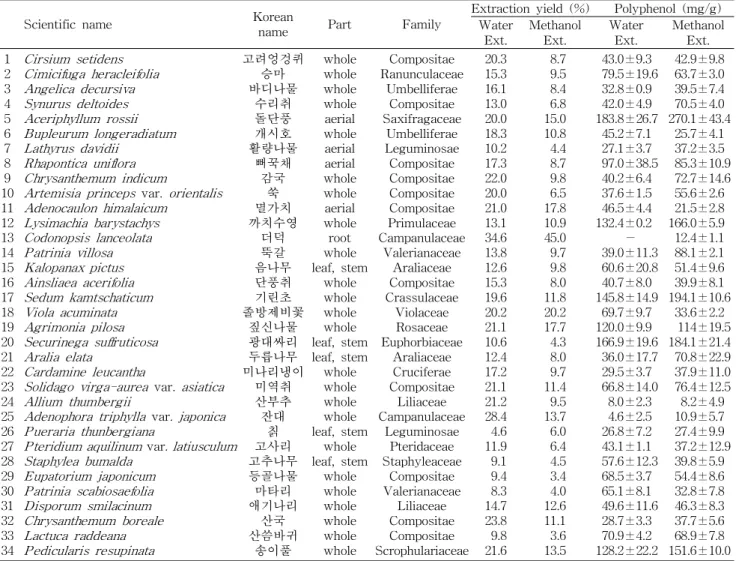
실험에 사용한 산채류의 물 및 메탄올 추출물 수율은 Table 1에 제시한 것과 같이, 물 추출물의 경우 4.6~34.6%이었고, 메탄올 추출물의 경우 3.4~45.0%이었다. 산채류 중 물 추출 물과 메탄올 추출물 모두에서 더덕(
Codonopsis lanceolata) 의 수율이 가장 높았고, 더덕과 칡(
Pueraria thunbergiana)
을 제외하고는 물 추출물의 수율이 메탄올 추출물 수율보다 높았다. 물 추출물에서는 더덕 다음으로 잔대(
Adenophora triphyllavar
. japonica)와 산국(
Chrysanthemum boreale)이 각각 28.4%, 23.8%로 높은 수율을 보였고, 메탄올 추출물에 서는 졸방제비꽃(
Viola acuminata), 멸가치(
Adenocaulon himalaicum)가 각각 20.2% 및 17.8%의 높은 수율을 보였다.
총 폴리페놀 함량
총 34종의 산채류에서 조제된 물 추출물과 메탄올 추출물
의 총 폴리페놀 함량은 Table 1과 같다. 물 추출물의 폴리페
놀 함량은 4.6~183.8 mg/g이고, 메탄올 추출물의 폴리페놀
함량은 8.2~270.1 mg/g으로 식물 종에 따른 페놀성 물질의
함량이 다양한 것으로 나타났다. 물 추출물에서 폴리페놀
함량이 높은 산채류로는 돌단풍(
Aceriphyllum rossii)이
183.8 mg/g으로 가장 높았고, 다음으로 광대싸리(
Securinega suffruticosa)가 166.9 mg/g으로 높았다. 기린초(
Sedum kamtschaticum)와 까치수영(
Lysimachia barystachys), 송
이풀(
Pedicularis resupinata), 짚신나물(
Agrimonia pilosa)
또한 각각 145.8, 132.4, 128.2, 120.0 mg/g으로 10% 이상의 높은 폴리페놀 함량을 보였다. 메탄올 추출물의 경우는 돌단 풍이 270.1 mg/g으로 가장 높았고, 기린초가 194.1 mg/g으 로 다음으로 높았으며, 이외에도 광대싸리(184.1 mg/g), 까 치수영(166.0 mg/g), 송이풀(151.6 mg/g), 짚신나물(114.0 mg/g) 순으로 폴리페놀 함량이 10% 이상으로 높게 평가되 었다. 이와 반대로 더덕(
Codonopsis lanceolata), 잔대(
Ade- nophora triphyllavar
. japonica), 그리고 산부추(
Allium thumbergii)의 물 추출물은 1% 미만의 낮은 폴리페놀 함량 을 나타냈고, 그 다음에 칡(
Pueraria thunbergiana)이 26.8 mg/g, 활량나물(
Lathyrus davidii)이 27.1 mg/g, 산국(
Chry- santhemum boreale)28.7 mg/g 순으로 폴리페놀 함량이 낮 았다. 메탄올 추출물에서는 산부추(8.2 mg/g), 잔대(10.9 mg/g), 더덕(12.4 mg/g), 멸가치(
Adenocaulon himalaicum) (21.5 mg/g), 그리고 개시호(
Bupleurum longeradiatum) (25.7 mg/g)가 폴리페놀 함량이 3% 미만인 것으로 측정되었다.
식이 폴리페놀은 사람에게 있어서 항산화제의 주요한 급 원으로 주로 과일, 채소, 허브 등의 식물에서 공급받을 수 있으며 항 노화뿐만 아니라 항암, 혈중 콜레스테롤 농도 감 소 및 골다공증 개선 등의 다양한 생리활성을 가지는 것으로 알려져 있다(24). 따라서 본 연구에서 물 추출물과 메탄올 추출물에서 공통적으로 폴리페놀 함량이 높은 것으로 평가 된 돌단풍, 광대싸리, 기린초, 까치수영, 송이풀은 천연항산 화제로서 개발 가치가 높은 것으로 판단된다. 또한 이들 시 료의 메탄올 추출물에서 폴리페놀 함량이 각각 47%, 10%, 33%, 25%, 18% 증가한 것으로 나타나 메탄올에 의한 추출 이 이들 산채류로부터 폴리페놀 추출 함량을 증가시킬 수 있는 효율적 추출법으로 나타났다.
Lee 등(25)이 울릉도 특산물 산채류 7종의 부위별 80%
메탄올 추출물로부터 폴리페놀 함량을 측정하여 물엉겅퀴 잎과 섬고사리 잎 추출물, 그리고 울릉미역취 뿌리 추출물이 각각 130.2, 120.7, 127.2 mg/g으로 가장 높은 값으로 보고한 것에 비하면, 본 연구에서 사용된 산채류의 폴리페놀 함량은 상당히 높은 것으로 나타났다.
DPPH 라디칼 소거능
항산화 활성은 각 추출물의 DPPH 라디칼에 대한 전자공 여효과로 나타나는 시료의 환원력으로 측정하였다. DPPH 라디칼 소거능은 DPPH가 짙은 자색의 안정한 자유 라디칼 로 항산화 물질에 의해 환원되면서 짙은 자색이 탈색되는 원리를 이용하여 측정하며 그 측정 방법이 비교적 간단하여 여러 개의 시료로부터 항산화 활성을 탐색할 때 유용하다.
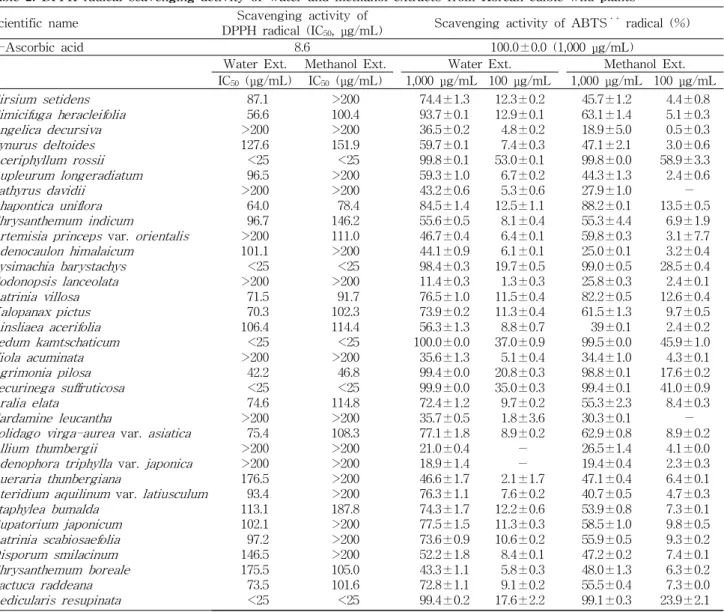
산채류 시료 34종의 DPPH 라디칼 소거능을 측정한 결과 (Table 2), 까치수영(
Lysimachia barystachys), 돌단풍 (
Aceriphyllum rossii), 광대싸리(
Securinega suffruticosa), 기린초(
Sedum kamtschaticum), 송이풀(
Pedicularis re- supinata)이 물과 메탄올 추출물 모두에서 매우 우수한 항산 화능을 나타내 IC
50(DPPH의 농도가 50% 감소되는데 필요
한 시료의 농도)이 25 μg/mL 미만인 것으로 평가되었다. 물 추출물의 경우 이외에 짚신나물(
Agrimonia pilosa), 승마 (
Cimicifuga heracleifolia), 뻐꾹채(
Rhapontica uniflora), 메 탄올 추출물의 경우 짚신나물이 70 μg/mL 미만의 IC
50을 갖 는 것으로 나타났다. 반면에 산부추(
Allium thumbergii), 잔 대(
Adenophora triphyllavar
. japonica), 더덕(
Codonopsis lanceolata), 바디나물(
Angelica decursiva), 졸방제비꽃 (
Viola acuminata), 미나리냉이(
Cardamine leucantha), 활 량나물(
Lathyrus davidii)은 물과 메탄올 추출물 모두 200 μ g/mL 이상의 IC
50을 보였으며, 메탄올 추출물에서는 이외 에도 고사리(
Pteridium aquilinumvar
. latiusculum)와 마 타리(
Patrinia scabiosaefolia) 등이 200 μg/mL 이상의 IC
50을 나타냈다. 100 μg/mL에서의 DPPH 라디칼 소거능을 추 출물별로 비교해보면(데이타는 제시하지 않음), 고사리(3.6 배)와 미나리냉이(3.0배), 칡(2.6배), 등골나물(
Eupatorium japonicum, 2.5배), 마타리(
Patrinia scabiosaefolia, 2.4배), 멸가치(
Adenocaulon himalaicum, 1.8배) 등 DPPH 라디칼 소거능이 낮은 산채류에서는 메탄올 추출물보다 물 추출물 에서 그 활성이 약 2배 이상 증가하였으나, 돌단풍(1.0배), 광대싸리(1.0배), 까치수영(1.1배), 기린초(1.1배), 송이풀 (1.1배), 짚신나물(1.1배) 등 DPPH 라디칼 소거능이 우수한 산채류에서는 추출물별로 그 활성에 차이가 없었다.
까치수영의 경우, 본 연구에서 사용된 부위는 전초로서 IC
50이 25 μg/mL 미만인 것은 Lee 등(26)의 연구에서 꽃, 뿌 리, 지상부가 각각 30.93, 32.94, 16.08 μg/mL로 조사된 결과 와 유사하다. 광대싸리의 경우 또한, Kim 등(27)의 연구에서 IC
50이 50% 에탄올 추출물에서 43.12 μg/mL, 에틸아세테이 트 분획에서 12.8 μg/mL, aglycone 분획에서 9.04 μg/mL로 보고되어져 본 연구의 결과와 유사하다.
ABTS 양이온(ABTS
․+) 소거활성
ABTS 양이온(ABTS
․+) 소거활성은 ABTS 용액과 과황
산칼륨과의 반응에 의해 생성된 ABTS 양이온이 추출물의
항산화력에 의해 제거되어 radical 특유의 색인 청록색이 탈
색되는 것을 이용한 측정방법이다. DPPH assay와 마찬가지
로 인위적인 라디칼을 제거하는 작용 기작이 공통적이며,
DPPH radical 제거능과 유의적인 상관성을 보이는 것으로
알려져 있다. 산채류 34종의 물 추출물과 메탄올 추출물의
ABTS 양이온 소거활성을 1,000 μg/mL와 100 μg/mL의 시
료 농도에서 조사한 결과를 Table 2에 제시하였다. 모든 추
출물이 농도의존적인 ABTS 양이온 소거활성을 보였다. 물
추출물에서 ABTS 양이온 소거활성이 우수한 시료로는 기
린초(
Sedum kamtschaticum), 광대싸리(
Securinega suf- fruticosa), 돌단풍(
Aceriphyllum rossii), 짚신나물(
Agri- monia pilosa), 송이풀(
Pedicularis resupinata), 까치수영
(
Lysimachia barystachys), 승마(
Cimicifuga heracleifolia)
등이 1,000 μg/mL에서 90% 이상의 라디칼 소거활성을 보였
으며, 특히 이중에서 돌단풍은 100 μg/mL에서 53.0%의 라
Table 2. DPPH radical scavenging activity of water and methanol extracts from Korean edible wild plants
Scientific name Scavenging activity of
DPPH radical (IC
50, μg/mL) Scavenging activity of ABTS
․+radical (%)
L-Ascorbic acid 8.6 100.0±0.0 (1,000 μg/mL)
Water Ext. Methanol Ext. Water Ext. Methanol Ext.
IC
50(μg/mL) IC
50(μg/mL) 1,000 μg/mL 100 μg/mL 1,000 μg/mL 100 μg/mL Cirsium setidens
Cimicifuga heracleifolia Angelica decursiva Synurus deltoides Aceriphyllum rossii Bupleurum longeradiatum Lathyrus davidii
Rhapontica uniflora Chrysanthemum indicum
Artemisia princeps var. orientalis Adenocaulon himalaicum
Lysimachia barystachys Codonopsis lanceolata Patrinia villosa Kalopanax pictus Ainsliaea acerifolia Sedum kamtschaticum Viola acuminata Agrimonia pilosa Securinega suffruticosa Aralia elata
Cardamine leucantha
Solidago virga-aurea var. asiatica Allium thumbergii
Adenophora triphylla var. japonica Pueraria thunbergiana
Pteridium aquilinum var. latiusculum Staphylea bumalda
Eupatorium japonicum Patrinia scabiosaefolia Disporum smilacinum Chrysanthemum boreale Lactuca raddeana Pedicularis resupinata
87.1
>200 56.6 127.6
<25
>200 96.5 64.0 96.7
>200 101.1
<25
>200 71.5 70.3 106.4
<25
>200 42.2 <25
>200 74.6
>200 75.4
>200 176.5 93.4 113.1 102.1 146.5 97.2 175.5 73.5
<25
>200 100.4
>200 151.9
<25
>200
>200 146.2 78.4 111.0
>200
<25
>200 102.3 91.7 114.4
<25
>200 46.8 <25 114.8
>200 108.3
>200
>200
>200
>200 187.8
>200
>200
>200 105.0 101.6
<25
74.4±1.3 93.7±0.1 36.5±0.2 59.7±0.1 99.8±0.1 59.3±1.0 43.2±0.6 84.5±1.4 55.6±0.5 46.7±0.4 44.1±0.9 98.4±0.3 11.4±0.3 76.5±1.0 73.9±0.2 56.3±1.3 100.0±0.0 35.6±1.3 99.4±0.0 99.9±0.0 72.4±1.2 35.7±0.5 77.1±1.8 21.0±0.4 18.9±1.4 46.6±1.7 76.3±1.1 74.3±1.7 77.5±1.5 73.6±0.9 52.2±1.8 43.3±1.1 72.8±1.1 99.4±0.2
12.3±0.2 12.9±0.1 4.8±0.2 7.4±0.3 53.0±0.1 6.7±0.2 5.3±0.6 12.5±1.1 8.1±0.4 6.4±0.1 6.1±0.1 19.7±0.5 1.3±0.3 11.5±0.4 11.3±0.4 8.8±0.7 37.0±0.9 5.1±0.4 20.8±0.3 35.0±0.3 9.7±0.2 1.8±3.6 8.9±0.2
- - 2.1±1.7 7.6±0.2 12.2±0.6 11.3±0.3 10.6±0.2 8.4±0.1 5.8±0.3 9.1±0.2 17.6±2.2
45.7±1.2 63.1±1.4 18.9±5.0 47.1±2.1 99.8±0.0 44.3±1.3 27.9±1.0 88.2±0.1 55.3±4.4 59.8±0.3 25.0±0.1 99.0±0.5 25.8±0.3 82.2±0.5 61.5±1.3 39±0.1 99.5±0.0 34.4±1.0 98.8±0.1 99.4±0.1 55.3±2.3 30.3±0.1 62.9±0.8 26.5±1.4 19.4±0.4 47.1±0.4 40.7±0.5 53.9±0.8 58.5±1.0 55.9±0.5 47.2±0.2 48.0±1.3 55.5±0.4 99.1±0.3
4.4±0.8 5.1±0.3 0.5±0.3 3.0±0.6 58.9±3.3 2.4±0.6
- 13.5±0.5
6.9±1.9 3.1±7.7 3.2±0.4 28.5±0.4 2.4±0.1 12.6±0.4 9.7±0.5 2.4±0.2 45.9±1.0 4.3±0.1 17.6±0.2 41.0±0.9 8.4±0.3
- 8.9±0.2 4.1±0.0 2.3±0.3 6.4±0.1 4.7±0.3 7.3±0.1 9.8±0.5 9.3±0.2 7.4±0.1 6.3±0.2 7.3±0.0 23.9±2.1 Data was expressed as mean±SD.
디칼 소거활성을, 기린초와 광대싸리는 각각 37.0%, 35.0%
의 소거활성을 나타내 항산화능이 우수한 것으로 조사되었 다. 메탄올 추출물에서도 마찬가지로 시료 추출물 농도 1,000 μg/mL에서 돌단풍, 기린초, 광대싸리, 송이풀, 까치수 영, 짚신나물이 약 99%의 강한 ABTS 양이온 소거활성을 보였고, 100 μg/mL에서 돌단풍이 58.9%, 기린초가 45.9%, 광대싸리가 41.0%의 라디칼 소거활성을 보였다. 반면에 더 덕(
Codonopsis lanceolata), 잔대(
Adenophora triphylla var. japonica), 산부추(
Allium thumbergii), 졸방제비꽃 (
Viola acuminata), 미나리냉이(
Cardamine leucantha), 바 디나물(
Angelica decursiva) 등은 1,000 μg/mL에서 40% 미 만의 낮은 라디칼 소거능을 보였으며, 이외에도 멸가치 (
Adenocaulon himalaicum)와 활량나물(
Lathyrus davidii), 단풍취(
Ainsliaea acerifolia)는 메탄올 추출물 1,000 μg/mL 에서 40% 미만의 라디칼 소거능을 보였다. 100 μg/mL에서 추출물별 ABTS 양이온 소거활성을 비교해 볼 때 돌단풍
메탄올 추출물에서 물 추출물에 비하여 1.1배의 증가를 보였 으며, 기린초와 광대싸리가 1.2배, 까치수영과 송이풀이 1.4 배 증가를 나타내 메탄올에 의한 추출이 이들 산채류의 라디 칼 소거활성을 증진시키는데 효율적인 추출법인 것으로 평 가되었다. Bang 등(28)의 연구에서 산채 어수리를 추출용매 와 온도 조건을 달리하여 1,000 ppm으로 처리했을 때 ABTS 양이온 소거능이 36~86% 저해된 결과에 비하면, 본 연구에 서 활성이 우수한 것으로 평가된 산채류의 항산화능은 매우 높은 수준으로 항산화 활성을 가진 천연 소재를 선정하는데 유용한 정보를 제공할 수 있을 것으로 사료된다.
SOD 유사활성
Superoxide는 산소가 전자 하나를 받아 환원된 형태로,
체내 산화적 손상을 야기할 수 있으며 이것을 산소로 전환시
키는 것이 SOD이다. SOD 유사물질이란 SOD와 같이 su-
peroxide를 정상의 산소로 전환시킬 수는 없으나 super-
Table 3. SOD-like activity in water extracts from 34 edible wild plants
Scientific name SOD-like activity (%) L-Ascorbic acid (5 mg/mL) 92.4±5.2
Water
Ext. Methanol Ext.
Cirsium setidens Cimicifuga heracleifolia Angelica decursiva Synurus deltoides Aceriphyllum rossii Bupleurum longeradiatum Lathyrus davidii
Rhapontica uniflora Chrysanthemum indicum
Artemisia princeps var. orientalis Adenocaulon himalaicum
Lysimachia barystachys Codonopsis lanceolata Patrinia villosa Kalopanax pictus Ainsliaea acerifolia Sedum kamtschaticum Viola acuminata Agrimonia pilosa Securinega suffruticosa Aralia elata
Cardamine leucantha
Solidago virga-aurea var. asiatica Allium thumbergii
Adenophora triphylla var. japonica Pueraria thunbergiana
Pteridium aquilinum var. latiusculum Staphylea bumalda
Eupatorium japonicum Patrinia scabiosaefolia Disporum smilacinum Chrysanthemum boreale Lactuca raddeana Pedicularis resupinata
31.1±15.9 41.0±13.1 26.8±11.8 35.9±5.3 59.6±13.1 49.1±9.1 33.9±9.4 48.7±7.9 53.0±4.2 25.7±4.0 45.7±7.0 61.2±20.8 13.3±9.8 83.6±14.7 52.8±4.9 27.4±4.5 15.2±11.8 43.9±6.7 45.7±9.9 99.4±7.5 54.1±10.6 63.5±5.3 72.6±13.3 15.5±5.5 13.9±14.2 48.5±4.7 35.7±8.1 35.9±8.6 50.9±17.8 40.2±11.4 21.2±15.7 16.8±24.5 55.5±17.3 100±0.0
23.2±21.3 27.2±7.6 15.7±7.6 - 38.6±15.7 52.3±9.2 34.2±7.2 71.9±14.1 34.3±22.8 22.0±5.9
8.7±9.9 19.4±6.1 35.1±17.5 - 34.6±12.9 12.4±3.9 - 40.7±5.2 45.9±13.6 - 33.7±8.1 19.1±2.0 49.4±5.6
- - 17.7±7.0
6.0±7.9 18.5±6.9 36.0±7.5 18.0±10.8 -
0.4±5.1 100±0.0 - Data was expressed as mean±SD. The SOD-like activity of plant extracts at 5 mg/mL was determined.
Table 4. Correlation coefficient between polyphenol content and antioxidant activities of water extracts from edible wild plants
Polyphenol
1)DPPH
2)ABTS
3)SOD
4)Polyphenol
DPPH ABTS
1.000 0.812
**(0.000) 1.000
0.837
**(0.000) 0.922
**(0.000) 1.000
0.482
**(0.004) 0.598
**(0.000) 0.504
**(0.002)
1)
Polyphenol content in mg/g tannic acid eq. (ranking).
2)
DPPH radical scavenging activity at final 100 μg/mL (ranking).
3)
ABTS
․+radical scavenging activity at 1,000 μg/mL (ranking).
4)
SOD-like activity at 5 mg/mL (ranking).
**
Correlation is significant at p<0.01.
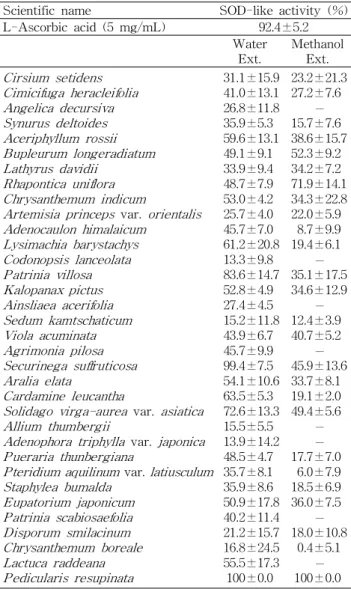
oxide의 반응성을 억제하여 생체를 산화적 손상으로부터 보 호할 수 있는 주로 phytochemical의 저분자 물질을 의미한 다(23). 따라서 SOD 유사활성은 중성이나 알칼리 조건 하에 서 superoxide에 의해 pyrogallol이 자동산화 되면서 갈색 물질을 생성하는 원리를 이용하여 자동산화를 억제하는 정 도로 활성을 측정하게 된다. 산채류 34종의 물과 메탄올 추 출물의 1 mg/mL 농도에서 SOD 유사활성을 측정하였을 때 는 거의 모든 시료의 활성이 나타나지 않아(데이터 제시하지 않음) 추출물 5 mg/mL 농도에서 SOD 유사활성을 측정하였 다. 그 결과(Table 3), 물과 메탄올 추출물 모두에서 송이풀 (
Pedicularis resupinata)은 pyrogallol의 자동산화를 완전 히 억제시켰으며, 광대싸리(
Securinega suffruticosa) 물 추 출물은 L-ascorbic acid보다 높은 SOD 유사활성을 나타냈 다. 그 다음으로는 물 추출물에서는 뚝갈(
Patrinia villosa), 미역취(
Solidago virga-aureavar
. asiatica), 미나리냉이
(
Cardamine leucantha), 까치수영(
Lysimachia barystachys), 돌단풍(
Aceriphyllum rossii) 순으로 약 60% 이상의 SOD 유사활성을 보였고, 메탄올 추출물에서는 뻐꾹채(
Rhapontica uniflora), 개시호(
Bupleurum longeradiatum), 미역취가 약 50% 이상의 SOD 유사활성을 보였다. 반면에 물 추출물 중 에서는 더덕(
Codonopsis lanceolata), 잔대(
Adenophora triphyllavar
. japonica), 기린초(
Sedum kamtschaticum), 산 부추(
Allium thumbergii), 산국(
Chrysanthemum boreale) 이 20% 미만의 낮은 활성을 나타냈고, 메탄올 추출물 중에 서는 잔대, 짚신나물(
Agrimonia pilosa), 더덕, 바디나물 (
Angelica decursiva), 단풍취(
Ainsliaea acerifolia), 산부추, 산씀바귀(
Lactuca raddeana), 마타리(
Patrinia scabiosaefolia) 등 8종에서 SOD 유사활성이 나타나지 않았다. 추출물별로 유사활성을 비교해 보면, 메탄올 추출물에 비하여 물 추출물 에서 광대싸리가 2.2배, 뚝갈이 2.4배, 미역취가 1.5배, 미나 리냉이가 3.3배, 까치수영이 3.2배 증가하는 등 전반적으로 물 추출물에서 그 활성이 증가하였다. SOD 유사활성은 한약 재 물 추출물에서 에탄올 추출물보다 높은 경향이 있었으며 (29), 녹차 또한 물 추출물에서 에탄올 추출물보다 높은 것으 로 보고된 바 있다(30). Park(29)의 연구에서 한약재 황기, 국화, 구기자, 감초, 당귀, 대추, 작약, 천궁 등 8종을 물과 에탄올 추출하여 SOD 유사활성을 측정하였을 때, 물 추출물 중 황기에서 41.8%, 에탄올 추출물 중 구기자가 38.2%의 가 장 높은 활성을 보고한 것에 비하면 본 연구에서 조사된 산 채류의 SOD 유사활성은 동일 농도 5 mg/mL에서 상당히 높은 것으로 평가되었다.
폴리페놀 함량과 항산화 활성간의 상관관계
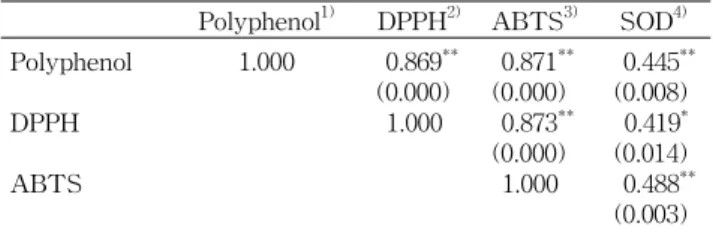
본 연구에서 조사한 산채류 34종의 물 추출물과 메탄올 추
출물의 폴리페놀 함량과 항산화 활성간의 상관관계를 Table
4, 5에 제시하였다. 폴리페놀 함량과 항산화 활성간의 상관
성은 관찰값을 차례로 순위를 매긴 뒤 순위를 이용해서 비모
수적 상관계수인 스피어만 상관계수(Spearman correlation
coefficient)로 구하였다. 그 결과 물 추출물이나 메탄올 추출
물 모두에서 변수간의 상관성은 유사하게 나타나, 폴리페놀
Table 5. Correlation coefficient between polyphenol content and antioxidant activities of methanol extracts from edible wild plants
Polyphenol
1)DPPH
2)ABTS
3)SOD
4)Polyphenol
DPPH ABTS
1.000 0.869
**(0.000) 1.000
0.871
**(0.000) 0.873
**(0.000) 1.000
0.445
**(0.008) 0.419
*(0.014) 0.488
**(0.003)
1)
Polyphenol content in mg/g tannic acid eq. (ranking).
2)
DPPH radical scavenging activity at final 100 μg/mL (ranking).
3)
ABTS
․+radical scavenging activity at 1,000 μg/mL (ranking).
4)
SOD-like activity at 5 mg/mL (ranking).
Correlation is significant at
**p<0.01,
*p<0.05.
함량과 DPPH 라디칼 제거능, ABTS 양이온 소거활성능 사 이에는 유의적인 양의 상관관계가 있는 것으로 나타났으며 이는 다른 연구에서 보고한 결과와 일치한다(30-32). 본 연 구에서 조사된 산채류 중 돌단풍(
Aceriphyllum rossii), 광 대싸리(
Securinega suffruticosa), 기린초(
Sedum kamt- schaticum), 까치수영(
Lysimachia barystachys), 송이풀 (
Pedicularis resupinata), 짚신나물(
Agrimonia pilosa), 승 마(
Cimicifuga heracleifolia), 뻐꾹채(
Rhapontica uniflora) 등은 각 추출물에서 폴리페놀 함량과 DPPH와 ABTS 라디 칼 소거능이 우수하였다. 그러나 SOD 유사활성에서는 이들 시료 이외에 뚝갈(
Patrinia villosa), 미역취(
Solidago virga- aureavar
. asiatica), 미나리냉이(
Cardamine leucantha) 물 추출물 등이 높게 나타났으며 폴리페놀 함량, DPPH와 ABTS 라디칼 소거능의 세 변수와 SOD 유사활성 사이에는 양의 상관관계가 있었고 통계적으로 유의적이었다. Kim 등 (33)의 연구에서도 갈근, 감초, 경포부자 등 20종의 약용식물 들에서 폴리페놀 함량과 총 항산화 활성, DPPH 라디칼 소거 활성, SOD 라디칼 소거활성 사이에 양의 상관관계를 보고한 바 있어 본 연구결과와 일치한다. 결론적으로, 본 연구에서 폴리페놀 함량, 라디칼 소거능, SOD 유사활성이 모두 우수 한 것은 송이풀, 광대싸리, 뻐꾹채, 까치수영, 돌단풍이었다.
돌단풍의 경우 플라보노이드 6종을 분리하여 그들의 항산화 활성 및 항암활성을 보고한 연구가 있으나(34,35), 광대싸리, 까치수영, 송이풀, 뻐꾹채 등에 대해서는 연구가 거의 없어 항산화물질을 분리하고 특성을 구명하여 이들의 항산화능 의 이용성을 증대시키기 위한 추가적 연구가 수행되어야 할 것이다.
요 약
본 연구에서는 산채류 34종의 물 추출물과 메탄올 추출물 을 제조한 후 항산화 활성을 탐색하여 산채류 유래 항산화 물질을 탐색하고 기능성식품을 개발하기 위한 항산화능 우 수 산채류 선발의 기초 자료를 제공하고자 하였다. 산채류 시료 34종을 물과 메탄올 추출하였을 때 추출 수율은 물 추
출의 경우 4.6~34.6%이었고, 메탄올 추출의 경우 3.4~
45.0%이었다. 총 폴리페놀 함량은 물 추출물에서 4.6~183.8 mg/g이고, 메탄올 추출물에서 8.2~270.4 mg/g이었다. 물과 메탄올 추출물에서 돌단풍(
Aceriphyllum rossii)이 각각 183.8, 270.1 mg/g의 가장 높은 폴리페놀 함량을 보였고, 공 통적으로 광대싸리(
Securinega suffruticosa), 기린초(
Se- dum kamtschaticum), 까치수영(
Lysimachia barystachys), 송 이풀(
Pedicularis resupinata)이 높은 폴리페놀 함량을 보였 다. DPPH와 ABTS 라디칼 소거능은 까지수영, 돌단풍, 광 대싸리, 기린초, 송이풀(
Pedicularis resupinata), 승마 (
Cimicifuga heracleifolia), 짚신나물(
Agrimonia pilosa), 뻐 꾹채(
Rhapontica uniflora)에서 우수하였다. 변수간의 상관 성을 분석했을 때, 폴리페놀 함량과 DPPH 및 ABTS 라디칼 소거능, SOD 유사활성 사이에는 유의적인 양의 상관관계가 있었으며, 이들 측정치에서 공통적으로 우수한 것으로 조사 된 산채류는 송이풀, 광대싸리, 뻐꾹채, 까치수영, 돌단풍이 었다.
감사의 글
이 연구는 농촌진흥청 바이오그린 21사업(PJ006457)에 의해 지원된 것이며, 그 지원에 감사드립니다.
문 헌