*Corresponding author: Young-Man Yoon Phone: +82-31-670-5665; Fax: +82-31-670-5666;
E-mail: [email protected]
Korean J Environ Agric. 2016;35(2):121-127. Korean Online ISSN: 2233-4173
Published online 2016 May 23. http://dx.doi.org/10.5338/KJEA.2016.35.2.12 Print ISSN: 1225-3537
기질과 접종액의 비율이 도계 가공장 슬러지 열가수분해액의 메탄생산퍼텐셜에 미치는 영향
오승용, 윤영만*
한경대학교 바이오가스연구센터
Effects of Substrate to Inoculum Ratio on Biochemical Methane Potential in Thermal Hydrolysate of Poultry Slaughterhouse Sludge
Seung-Yong Oh and Young-Man Yoon
*(Biogas Research Center, Hankyong National University, Anseong 17579, Korea)
Received: 2 May 2016 / Revised: 14 May 2016 / Accepted: 16 May 2016 Copyright ⓒ 2016 The Korean Society of Environmental Agriculture
This is an Open-Access article distributed under the terms of the Creative Commons Attribution Non-Commercial License (http://creativecommons.org/licenses/by-nc/3.0) which permits unrestricted non-commercial use, distribution, and reproduction in any medium, provided the original work is properly cited.
ORCID Seung-Yong Oh
http://orcid.org/0000-0001-9116-8279 Young-Man Yoon
http://orcid.org/0000-0001-9294-8277
121
Abstract
BACKGROUND: Anaerobic digestion is the most feasible technology because not only the energy embedded in organic matters can be recovered, but also they are stabilized while being degraded. This study carried out to improve methane yield of slaughterhouse wastewater treatment sludge cake by the thermal pre-treatment prior to anaerobic digestion.
METHODS AND RESULTS: Slaughterhouse wastewater treatment sludge cake was pre-treated by the closed hydrothermal reactor at reaction temperature of 190℃.
BMPs (Biochemical methane potential) of the thermal hydrolysate was tested in the different S(Substrate)/
I(Inoculum) ratio conditions. COD(Chemical oxygen demand) and SCOD(Soluble chemical oxygen demand) contents of thermal hydrolysate were 10.99% and 10.55%, respectively, then, the 96.00% of COD was remained as a soluble form. The theoretical methane potential of thermal hydrolysate was 0.51 Nm
3kg
-1-VS
added. And BMPs were decreased from 0.56 to 0.22 Nm
3kg
-1-VS
addedwhen S/I ratio
were increased from 0.1 to 2.0 in the VS content basis.
Those were decreased from 0.32 to 0.13 Nm
3kg
-1-COD
addedwhen S/I ratio were increased from 0.1 to 2.0 based on COD content. The anaerobic degradability of VS basis have showed 196.9%, 102.2%, 80.7%, 67.4%, and 39.4% in S/I ratios of 0.1, 0.3, 0.5, 1.0, and 2.0, respectively. Also the COD of 119.6%, 76.3%, 70.1%, 69.0%, and 43.1% were degraded anaerobically in S/I ratios of 0.1, 0.3, 0.5, 1.0, and 2.0, respectively.
CONCLUSION: BMPs obtained in the S/I ratios of 0.1 and 0.3 was overestimated by the residual organic matters remaining at the inoculum. And inhibitory effect was observed in the highest S/I ratio of 2.0. The optimum S/I ratios giving reasonable BMPs might be in the range of 0.5 and 1.0 in S/I ratio. Therefore VS biodegradability of thermal hydrolysate was in 67.4-80.7% and COD biodegradability showed 69.0-70.1%.
Key words: Anaerobic Digestion, Biochemical Methane Potential, Substrate to Inoculum Ratio, Thermal Hydrolysis
서 론
유기성 폐자원의 혐기소화 기술은 기후변화의 주요원인인 이산화탄소를 줄이고 화석연료를 대체하기 위한 신재생에
Research Article Open Access
Table 1. Chemical characteristics of sludge cake
Parameters pH TSa) VSb) CODCrc)
TNd) NH4+
-N - --- (%, w/w) ---
Sludge cake 7.30 20.99
(0.02)e)
18.80 (0.04)
26.59 (0.08)
1.32 (0.04)
0.17 (0.02)
a) Total solid, b) Volatile solid, c) Chemical oxygen demand, d) Total nitrogen, e) Values in parentheses are standard deviations.
너지 개발 측면에서 많은 연구가 진행되고 있다. 혐기소화 기 술은 산소(O
2)가 없는 환원상태에서 혐기미생물(Anaerobic microorganism) 화학반응을 통해 유기물 중의 유기탄소(C)를 메탄(CH
4)으로 전환시키는 기술이다. 혐기소화에서 미생물의 화학반응은 크게 가수분해(Hydrolysis), 산생성(Acidogenesis), 초산생성(Acetogenesis), 메탄생성(Methanogenesis)의 4단 계로 진행된다. 혐기소화 초기의 가수분해 반응은 입자상 또 는 교질상의 고분자 유기물을 용해성의 저분자 유기물로 전 화시키는 단계로 오랜 시간을 요하는 반응속도 결정 단계 (Rate determining step)이다(Van Lier et al ., 2008). 최근 에는 혐기소화 효율의 증진을 위해 혐기소화 이전에 유입 원 료의 가수분해를 촉진시키는 방법으로 열화학적 전처리 연구 가 진행되고 있으며, Neyens과 Baeyens(2003), Carlsson 등(2012)은 하수슬러지 등의 열화학적 전처리를 통해 혐기소 화 효율이 증진된다고 보고 한 바 있다.
우리나라에서는 가축분뇨, 음식물쓰레기, 하수슬러지를 이 용한 혐기소화 시설이 상용화되어 보급되고 있으며, 혐기소화 를 위한 원료 확대를 위해 농업부산물, 도축부산물, 수산부산 물 등을 이용한 혐기소화 연구가 활발히 진행되고 있다. 다양 한 유기성 바이오매스의 혐기소화 효율은 메탄생산퍼텐셜 (Biochemical Methane Potential, BMP) 시험을 통해 얻어지 는 단위 유기물당 메탄생산량으로 평가한다. BMP 시험은 각종 바이오매스의 혐기적 분해율을 평가하는 기본적인 방법으로 혐기소화조 효율과 경제성에 영향을 미치는 주요인자이며, 혐 기소화조의 설계와 유지관리에 있어 필수적인 설계인자이다.
BMP는 표준상태(0℃, 1atm)에서 휘발성고형물(Volatile solid, VS) 또는 화학적산소요구량(Chemical Oxygen Demand, COD)의 함량을 기준으로 하는 단위 유기물당 메탄생산량 (Nm
3kg
-1-VS
added또는 Nm
3kg
-1-COD
added)을 말하며, 유 기물 표현 방식의 선택은 시료의 특성, 연구자의 주관적 판단 에 의해 채택된다. BMP는 Hungate(1969)가 혐기성 미생물 의 배양방법을 개발한 이후 많은 연구자들에 의해 사용되어 왔으며, Owen과 Chynoweth(1993), Angelidaki과 Sanders (2004), Hansen 등(2004) 등에 의해 시험분석법이 제안된 바 있다. 현재 독일과 미국에서는 각각 VDI4630(2006)과 ASTM E2170-01(2008)과 같은 BMP 표준분석방법을 마련 하여 운용하고 있으나 아직까지 국내에서는 BMP 표준 분석 방법이 마련되어 있지 않다. BMP의 측정은 장비의 종류, 혐 기미생물 접종액과 기질의 물리화학적 특성, 접종액의 미생물 활성도, 배지의 양분균형, 반응기의 pH, 반응기 내 여유 공간 (Head space)의 정도, 반응기의 교반방법 등 다양한 분석환 경의 영향을 받는다(Shelton and Tiedje, 1984; Angelidaki
et al ., 2009; Shin et al ., 2011a). 특히 혐기미생물 접종액과 기질의 물리화학적 특성의 영향은 BMP 측정에 있어서 매우 중요한 영향인자이다. 국외에서는 Liu 등(2009), Neves 등 (2004), Raposo 등(2009)이 가축분뇨, 작물부산물, 음식물쓰 레기, 해바라기유박 등의 다양한 바이오매스의 혐기소화 특성 을 파악하기 위하여 기질과 접종액의 특성 및 기질과 접종액 의 비율이 BMP에 미치는 영향에 대한 연구를 진행한 바 있 다. 국내에서는 Shin 등(2011a), Shin 등(2011b)과 Kim 등 (2012b)이 기존 BMP 측정방법들을 고찰하고 국내외 각종 바이오매스의 BMP를 보고하였다. 또한 Kim 등(2012a)과 Kim 등(2012b)은 양돈분뇨의 열전처리에서 기질과 접종액의 비율이 BMP에 미치는 영향을 보고하고 있으나 BMP 연구는 일부 농업부산물에 한정되고 있는 상황이다. 따라서 본 연구 에서는 도계 가공장에서 발생하는 폐수처리 슬러지의 열가수 분해액의 혐기적 유기물 분해율을 평가하기 위하여 기질과 접종액의 비율을 달리하여 BMP를 측정하였으며, 휘발성 고 형물과 화학적 산소 요구량 기준으로 수열탄화액의 혐기적 유기물 분해율을 분석하였다.
재료 및 방법
시험재료
본 연구에서는 충청남도 진천에 위치한 도계 가공장의 폐 수처리 시설에서 발생하는 유기성 슬러지 케이크의 열가수분 액(Thermal hydrolysate)을 대상으로 하였으며, 실험에 사 용한 슬러지 케이크의 이화학적 특성은 Table 1과 같다. 채 취한 슬러지의 열화학 반응은 외부 전기 히터(Heater)에 의 해 열원을 공급하는 2 L 용량의 밀폐형 회분식 압력반응기에 1 kg의 시료 원물을 정량 투입 후 190℃에서 실시하였다. 반 응기의 온도는 반응기 내부에 설치한 온도 계측기로 제어하 였으며, 운전시간은 승온시간 40분, 반응시간 1시간으로 하 였다. 또한 열가수분해 반응기는 반응기 내부온도의 균질화 를 위하여 내부에 교반기를 설치하였으며, 반응기의 내부압 력은 반응온도별로 발생하는 내부 포화수증기압 조건으로 유 지하였다. 열가수분해 반응을 마친 잉여슬러지 수열탄화액은 정성 여과지(Qualitative filter paper No. 1, Advantec MFS, Inc., Dublin, Califonia, USA)로 여과하여 BMP 시험 에 공시하였다.
이론적 메탄퍼텐셜(Theoretical methane potential; B
th) 분석
이론적 BMP는 Boyle(1976)의 혐기적 유기물 분해 반응
Table 2. Chemical characteristics of inoculum
Parameters pH TSa) VSb) CODCrc)
TNd) NH4+
-N Alkalinity
(% as CaCO3) - --- (%, w/v) ---
Inoculum 8.81 3.78
(0.05)e)
2.25 (0.04)
3.31 (0.06)
0.43 (0.02)
0.32 (0.01)
2.09 (0.03)
a) Total solid, b) Volatile solid, c) Chemical oxygen demand, d) Total nitrogen, e) Values in parenthesis mean standard deviations.
식과 유기물 산화 반응식 (Eq. 1, Eq. 3)을 이용하여 시료의 원소분석결과로부터 화학양론적으로 계산하였다. 표준상태 (0℃, 1기압)에서 VS 함량을 기준으로 산출하는 이론적 BMP
(B
th-VS)는 Eq. 2와 같으며, COD를 기준으로 산출하는 이론적
메탄생산 퍼텐셜은 Eq. 4와 같다. 여기서 COD 기준의 이론 적 메탄생산 퍼텐셜(B
th-COD)은 0.35 Nm
3kg
-1-COD
added이 다.
→
(Eq. 1)
×
(Eq. 2)
→
(Eq. 3)
×
×
(Eq. 4)
메탄생산퍼텐셜(Ultimate methane potential; B
u) 시험 BMP 시험에 사용한 접종액(Inoculum, I)은 경기도 안성 에 위치한 한경대학교 바이오가스 상용화 연구시설에서 채취 하였다. 채취한 혐기소화액은 2 mm 체를 통과시킨 후, 38℃
항온 배양기에서 배양하여 소화액 중의 이분해성의 유기물과 잔여가스를 충분히 제거한 후 사용하였다. 각 처리구별 기질 (Substrate, S)은 기질의 VS 함량과 접종액의 VS 함량의 비 율 (S/I ratio)을 0.1, 0.3, 0.5, 1.0, 2.0가 되도록 조정하여 투입하였다. 회분식 반응기는 처리구당 3반복으로 serum bottle을 이용하였다. 반응기의 용적(Total volume)은 160 mL, 유효용적(Working volume)은 80 mL, 상층부 여유공 간(Head space)은 80 mL로 하였다. 반응기의 상층부 여유
공간은 N
2가스로 충진 후 고무마개와 알루미늄 캡을 이용하 여 2중으로 밀폐시켰으며, 38℃ 항온 배양기에서 일일 1회 손으로 반응기를 흔들어 교반하면서 90일간 배양하였다. 또 한 접종액에서 발생하는 메탄가스를 보정하기 위하여 접종액 만을 투입한 3반복의 혐기 반응기를 시료와 동일한 조건에서 운영하였다. 접종액의 이화학적 성상은 Table 2와 같다.
회분식 혐기반응기의 바이오가스 발생량 측정은 2% 황산 에 resazurin 0.1%를 함유하는 수주차식 가스량 측정기를 사용하였으며(Williams et al ., 1996; Beuvink et al ., 1992), 발생 바이오가스는 Eq. 5와 같이 온도와 수분을 보정 하여 표준상태(0℃, 1기압)에서의 건조 가스 부피로 환산하여 누적 메탄생산곡선을 구하였다. BMP 산출을 위한 누적 메탄 생산곡선은 Modified Gompertz model(Eq. 6)을 이용하여 SigmaPlot(SigmaPlot Version 10.0, Systat Software Inc., San Jose, Califonia, USA)으로 해석하였다(Lay et al ., 1998).
×
×
(Eq. 5)
이때, V
dry gas는 표준상태(0℃, 1기압)에서의 건조 가스의 부피, T는 반응기의 운전온도, V
wet gas at T℃는 반응기 운전온 도(38℃)에서의 습윤 가스의 부피, P는 가스 부피측정 당시 의 대기압, P
T는 T℃에서의 포화수증기압(mmHg)이다.
× exp exp
(Eq. 6)
이때, M은 누적 메탄생산량(mL), t는 혐기배양기간 (days), P는 최종메탄생산량(mL), e는 exp(1), R
m은 최대메 탄생산속도(mL day
-1), λ는 지체성장시간(lag growth phase time, days)이다.
혐기적 유기물 분해율(Anaerobic biodegradability)은 VDI4630(2006)에 따라 평가하였으며, VS 함량 기준의 혐기 적 유기물 분해율(
)은 Eq. 7과 같으며, COD 함량 기준 의 혐기적 유기물 분해율(
)은 Eq. 8과 같다.
×
×
×
×
(Eq. 7)
Table 3. Chemical characteristics of sludge cake and thermal hydrolysate Parameters pH TSa) VSb) CODCrc)
SCODCrd)
TNe) NH4+
-N SSf) (g L-1)
Alkalinity (% as CaCO3) - --- (%, w/v) ---
Thermal
hydrolysate 6.03 6.64 (0.02)g)
6.28 (0.04)
10.99 (0.08)
10.55 (0.05)
0.96 (0.04)
0.33 (0.02)
0.05 (0.006)
0.93 (0.02)
a) Total solid, b) Volatile solid, c) Chemical oxygen demand, d) Soluble chemical oxygen demand, e) Total nitrogen, f) Suspended solid, g) Values in parentheses are standard deviations.
Table 4. Elemental composition and theoretical methane potential of thermal hydrolysate
Parameters Elemental composition
Btha)
(Nm3 kg-1-VSadded)
C H O N S
--- (%, w/w) ---
Thermal hydrolysate 45.5 7.9 26.2 13.0 0.0 0.51
a) Theoretical methane potential.
이때,
는 VS 기준 유기물 분해율 (%),
는 바 이오가스의 부피(Nm
3),
는 바이오가스 중 메탄과 이산화탄소의 질량 분율(kg Nm
-1),
는 기질의 질량 (kg),
는 투입기질의 VS 농도(g g
-1),
는 투입기질의 VFA 농도(g g
-1), 0.93은 투입 VS 중 이론적 인 바이오가스 전환율이다.
×
×
× ×
(Eq. 8)
이때,
은 COD 기준 유기물 분해율(%),
는 바 이오가스 중 메탄의 농도(%, v/v),
는 투입기질의 질량(kg),
는 투입기질의 COD 함량(g g
-1), 0.32 는 투입 COD 중 이론적 메탄 전환율이다.
시험분석
바이오가스의 가스성분분석은 TCD(Thermal conductivity detector)가 장착된 Gas chromatography(Clarus 680, PerkinElmer, Waktham, Massachusetts, USA)를 이용하 였다. 컬럼은 HayesepQ packed column(3 mm × 3 m, 80~100 mesh size)을 이용하였으며, 고순도 아르곤(Ar) 가 스를 이동상으로 사용하여 30 mL min
-1의 운전 상태에서 주 입부(Injector) 온도 150℃, 컬럼부(Column oven) 90℃, 검출부(Detector) 150℃에서 분석하였다(Sorensen et al ., 1991). 시료의 원소분석은 원소분석기(EA1108, Thermo Finnigan LLC, San Jose, Califonia, USA)를 사용하였으 며, 총고형물(Total solid, TS), 휘발성 고형물(Volatile solid, VS), 화학적 산소요구량(Chemical oxygen demand, COD
Cr), 용해성 화학적 산소요구량(Soluble chemical oxygen demand, SCOD
Cr), 총질소(Total nitrogen, TN),
암모니아태 질소(NH
4+-N), 알칼리도(Alkalinity), 휘발성지 방산(VFA, Volatile fatty acid) 등은 표준분석법(APHA, 1998)에 따라 3반복으로 수행하였다.
결과 및 고찰
열가수분해액의 특성
도계가공장 폐수 슬러지 케이크의 열가수분해액의 성상은 Table 3과 같다. 열가수분해액의 pH는 6.03이었으며, TS 6.64%, VS 6.28%로 TS 함량의 94.58%를 차지하였다. 열가 수분해액의 COD는 10.99%, SCOD이 10.55%로 약 96.00%
의 유기물의 대부분이 용해성 물질로 존재하였다. Kim 등 (2012)은 양돈분뇨를 200∼270℃ 온도 범위에서에서 열가수 분해한 결과 COD가 6.2∼9.6%, SCOD가 6.1∼8.8%로 나 타났으며, SCOD의 비율이 91.7∼98.4%의 범위를 보였다고 보고한 바 있어 본 연구결과와 유사하였다. 열가수분해액의 TN은 0.96%이었으며, NH
4+-N은 0.33%를 보여 높은 질소 수준을 나타내었다. 이러한 높은 질소농도는 열가수분해액을 혐기소화하는 경우 고농도의 암모니아성 질소 생성에 따라 암모니아 저해 영향의 문제가 있을 것으로 판단된다.
이론적 메탄생산퍼텐셜
도계가공장 폐수 슬러지 케이크의 열가수분해액의 구성원 소와 원소분석결과로부터 Boyle(1976)의 혐기적 유기물 분해 반응식을 이용하여 산출한 이론적 BMP는 Table 4와 같다.
열가수분해액의 구성원소는 탄소(C) 45.5%, 수소(H) 7.9%, 산소(O), 26.2%, 질소(N) 13.0%로 나타났으며, 이론적 BMP 는 0.51 Nm
3kg
-1-VS
added이었다.
S/I 비율에 따른 메탄생산퍼텐셜
도계가공장 폐수 슬러지 열가수분해액의 혐기소화 특성
Fermentaion time(days)
0 20 40 60 80 100
Cumulative methane production(NmL)
0 100 200 300 400 500 600 700
S/I ratio 0.1 S/I ratio 0.3 S/I ratio 0.5 S/I ratio 1.0 S/I ratio 2.0
Fig. 1. Cumulative methane production curve optimized by Modified Gompertz model in different S/I ratios.
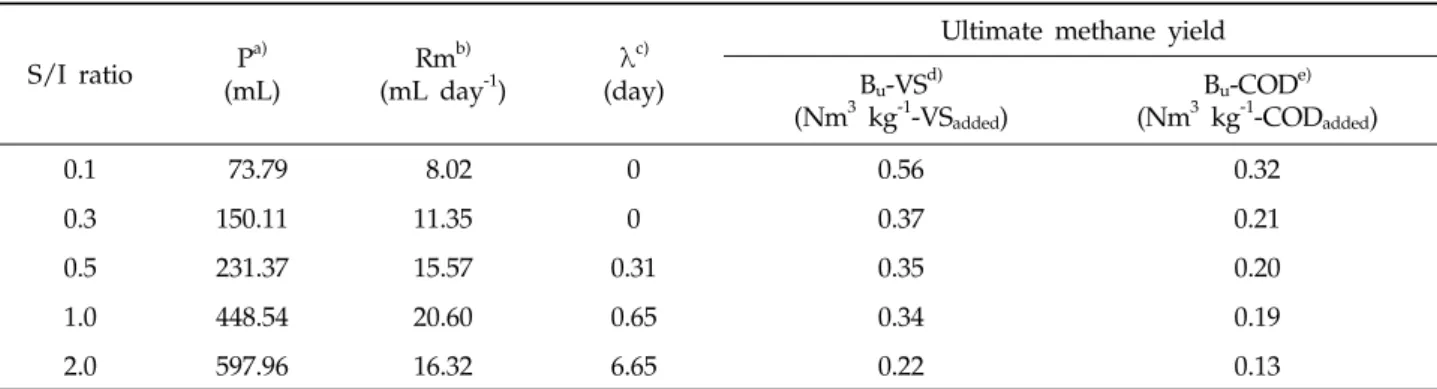
Table 5. Model parameters by the modified Gompertz model and ultimated methane potentials estimated from the cumulative methane production data
S/I ratio Pa) (mL)
Rmb) (mL day-1)
λc) (day)
Ultimate methane yield Bu-VSd)
(Nm3 kg-1-VSadded)
Bu-CODe) (Nm3 kg-1-CODadded)
0.1 73.79 8.02 0 0.56 0.32
0.3 150.11 11.35 0 0.37 0.21
0.5 231.37 15.57 0.31 0.35 0.20
1.0 448.54 20.60 0.65 0.34 0.19
2.0 597.96 16.32 6.65 0.22 0.13
a) Methane production, b) Specific methane production rate, c) Lag phase time, d) Ultimated methane potential in the basis of VS content, e) Ultimated methane potential in the basis of COD content, f) Values in parentheses are standard deviations.
을 파악하기 위하여 기질과 접종액의 비율(S/I ratio)을 달리 하여 90일간 중온 혐기소화를 실시하였다. 이로부터 얻은 누 적 메탄생산곡선과 Modified Gompertz model을 이용하 여 최적화한 곡선은 Fig. 1과 같다. 열가수분해액의 최종 BMP와 Modified Gompertz model의 인자들은 Table 5 에 나타내었다. S/I 비율이 0.1에서 2.0으로 증가할수룩 VS 를 기준으로 하는 최종 BMP는 0.56에서 0.22 Nm
3kg
-1-VS
added로 감소하였으며, COD를 기준으로 하는 최종
BMP는 0.32에서 0.13 Nm
3kg
-1-COD
added으로 감소하는 것으로 나타났다. 이때 S/I 비율 0.1에서는 VS 기준 최종 BMP(0.56 Nm
3kg
-1-VS
added)는 앞에서 구한 이론적 BMP(0.51 Nm
3kg
-1-VS
added)과 비교하여 높은 수치를 나타 내었다. Yoon 등(2014)은 돼지도축장에서 발생하는 혈분, 내 장류, 장내 잔재물의 S/I 비율에 따른 혐기소화 연구에서 S/I 비율이 0.1일 때 최종 BMP가 기질의 이론적 BMP를 초과하 는 결과를 보고한 바 있다. 따라서 S/I 비율이 낮을 경우에는 접종액에 잔존하는 유기물로 인하여 기질의 최종 BMP가 과 대하게 평가 될 수 있다. Modified Gompertz mode을 이
용하여 구한 최종 메탄생산량(P)은 S/I 비율 0.1에서 73.79 mL를 보였으며, S/I 비율의 증가와 함께 증가하여 2.0에서 는 597.96 mL를 나타내었다. 최대 메탄생산속도(R
m)는 S/I 비율 0.1에서 8.02 mL day
-1을 보였으며, S/I 비율 1.0에서 20.60 mL day
-1으로 가장 높았다. 지체성장시간(λ)은 S/I 비율 0.1과 0.3에서 0 day로 나타나 낮은 S/I 비율에서는 지 체성장기 없이 빠른 메탄생산이 이루어졌으며, S/I 비율이 0.5에서 2.0으로 증가할수록 지체성장시간 또한 0.31에서 6.65 day로 증가하여 S/I 비율의 증가는 지체성장시간을 증 가시키는 것으로 나타났다. 특히 S/I 비율 2.0에서 6.65 day 의 긴 지체성장시간을 보인 것은 반응기 운전 초기에 혐기미 생물의 메탄생산에 저해영향이 있었던 것으로 판단된다.
Ferrer 등(2008)은 유기성 슬러지를 70℃에서 열가수분해
시킨 결과 고온혐기소화의 효율이 증가하였다고 보고하였고,
Yoneyama 등(2006)은 180℃에서 우분의 열가수분해에 따
른 혐기소화 효율의 증가를 보고한 바 있다. 이와 같이 일반
적으로 열가수분해 반응은 입자상 유기물을 가용화시켜 용해
성 유기물의 함량을 증가시키고 가수분해 단계의 반응을 촉
진시킴으로써 메탄가스의 생산효율을 증가시킨다. 이러한 연
구결과와는 반대로 열가수분해 전처리가 혐기소화 효율을 저
해할 수 있다는 연구결과도 있다. Martins와 Van Boekel
(2005)과 Ajandouz 등(2008)은 유기성 슬러지의 열화학적
처리에서 난분해성 물질이 생성되고, 이러한 물질은 혐기미생
물에 저해작용을 일으킬 수 있다고 보고한 바 있다. 이는 고
온의 열처리과정에서 탄수화물이 아미노산과 반응하면서 갈
변반응(Maillard reaction)에 의해 멜라노이딘(melanoidin)
과 같은 난분해성 물질을 생성하기 때문이다. 따라서 S/I 비
율의 증가가 누적 메탄생산곡선의 지체성장시간을 연장시키
는 결과를 볼 때, 도계 가공장 폐수슬러지를 열가수분해시키
는 과정(190℃)에서 일부 난분해성의 열가수분해 산물이 생
성되는 것으로 생각된다. 이러한 갈변반응은 온도와 pH, 수
분의 활동도에 따라 발생량을 달리하는 것으로 보고(Martins
et al ., 2000)되고 있으며, 100℃ 이하의 낮은 온도영역에서
도 갈변반응이 관찰되었다는 연구결과(Martins and Van
Table 6. Organic composition characteristics and anaerobic biodegradability in sludge, liquid and solid fraction of sludge
S/I ratio DVSa)
DCODb)
--- (%, w/w) ---
0.1 196.9 119.6
0.3 102.2 76.3
0.5 80.7 70.1
1.0 67.4 69.0
2.0 39.4 43.1
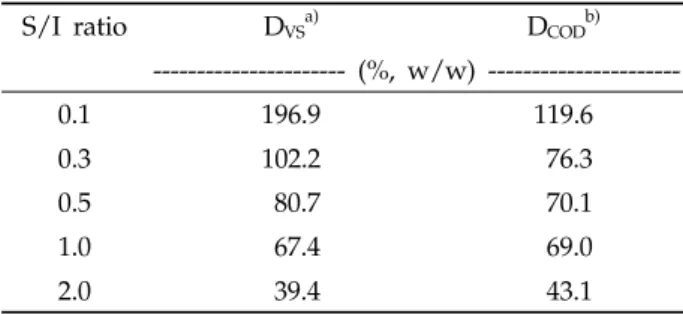
a) Anaerobic biodegradability estimated in the basis of VS content, b) Anaerobic biodegradability estimated in the basis of COD content.
Boekel, 2005)도 있다. 또한 Kim과 Jeon(2015)은 동일한 온 도에서 열가수분해를 진행하더라도 반응기의 승온시간, 반 응기내 교반효율에 따라 갈변반응의 정도가 차이를 보인다 고 하였다.
S/I 비율별 유기물 분해율 평가
Table 6은 Eq. 7과 Eq. 8(VDI4630, 2006)에 따라 계산 된 열가수분해액 중 유기물의 혐기적 분해율을 나타낸다. VS 기준 유기물 분해율은 S/I 비율 0.1과 0.3에서 196.9%, 102.2%로 나타나 이론적인 분해율 100%를 초과했고, S/I 비율이 0.5에서 2.0으로 증가함에 따라 유기물 분해율은 80.7%에서 39.4%로 감소하였다. COD 기준 유기물 분해율 에서도 S/I 비율 0.1에서 119.6%로 이론적인 분해율 100%
를 초과하였으며, S/I 비율이 0.3에서 2.0으로 증가함에 따라 76.3%에서 43.1%로 감소하였다. VDI4630(2006)에서는 혐 기소화조 투입 기질에 대하여 분해된 유기물의 약 7% 정도가 혐기미생물의 바이오매스 축적에 이용되는 것으로 보고하고 있다. 따라서 앞에서 구한 이론적 BMP(0.51 Nm
3kg
-1-VS
added)에서 약 7%는 혐기미생물의 증식에 이용되고 실질
적으로 메탄가스로 전환가능한 이론적 BMP는 0.47 Nm
3kg
-1-VS
added으로 평가된다. 또한 COD 기준의 이론적 메탄 생산 퍼텐셜은 0.35 Nm
3kg
-1-COD
added으로 알려져 있으나 VDI4630(2006)에서는 혐기미생물 증식에 이용되는 부분을 제외하고 이론적 BMP를 0.32 Nm
3kg
-1-COD
added으로 설 정하여 유기물의 혐기적 분해율을 산출하고 있다. 이와 같이 혐기미생물의 증식에 이용되는 분해유기물의 양을 고려하는 경우 VS 기준 유기물 분해율은 S/I 비율 0.1과 0.3에서 100%를 초과하였고, COD 기준 유기물 분해율은 S/I 비율 0.1에서 100%를 초과하는 것으로 나타났다. 따라서 본 연구 에서 도계 가공장 폐수슬러지 열가수분해액의 최종 BMP 측 정을 위한 S/I 비율은 0.5∼1.0의 범위가 적정한 것으로 판 단되며, S/I 비율 0.1과 0.3은 접종액 중의 유기물에서 유래 하는 메탄에 의해 최종 BMP가 과대 평가될 수 있고, S/I 비 율 2.0은 열가수분해액의 혐기소화 저해작용이 일어날 수 있 는 것으로 분석되었다.
결 론
본 연구는 도계 가공장에서 발생하는 폐수처리 슬러지의 혐기소화 효율을 증진시키기 위하여 190℃ 반응온도에서 열 가수분해하여 전처리 한 후 S/I 비율을 달리하여 폐수 슬러 지 열가수분해액의 혐기소화 특성을 분석하였다. 열가수분해 액의 COD와 SCOD는 각각 10.99%와 10.55%로 약 96.00%의 유기물이 용해성 물질로 존재하였다. 열가수분해액 의 이론적 BMP는 0.51 Nm
3kg
-1-VS
added로 나타났으며, S/I 비율 0.1에서 2.0으로 증가할수룩 VS 기준 최종 BMP는 0.56에서 0.22 Nm
3kg
-1-VS
added로 감소하였으며, COD 기 준 최종 BMP는 0.32에서 0.13 Nm
3kg
-1-COD
added으로 감 소하는 것으로 나타났다. S/I 비율 0.1과 0.3은 접종액 중의 유기물에서 유래하는 메탄에 의해 최종 BMP가 과대하게 평 가되는 문제가 나타났으며, S/I 비율 2.0은 열가수분해액의 혐기소화 저해작용에 의해 낮은 BMP를 보이는 문제가 나타 났다. 따라서 폐수 슬러지 열가수분해액의 BMP 측정을 위한 적정 S/I 비율은 0.5∼1.0이었으며, S/I 비율 0.5, 1.0에서 VS 기준 BMP는 0.35과 0.34 Nm
3kg
-1-VS
added이었고, COD 기준 BMP는 0.20와 0.19 Nm
3kg
-1-COD
added으로 나타났다.
Acknowledgment
This work was supported by Korea Institute of Planning and Evaluation for Technology in Food, Agriculture, Forestry and Fisheries (IPET) through Agri-Bio industry Technology Development Program, funded by Ministry of Agriculture, Food and Rural Affairs(MAFRA)(Project No. 314010-04-2-HD040)
References