• 검색 결과가 없습니다.

The Effect of Job Stress and Job Exhaustion on Job Performance of Body Guards and Security Guards due to Organizational Culture

N/A
N/A
Protected

Academic year: 2021

Share "The Effect of Job Stress and Job Exhaustion on Job Performance of Body Guards and Security Guards due to Organizational Culture"

Copied!
10
0
0

로드 중.... (전체 텍스트 보기)

전체 글

(1)

JKSCI

The Effect of Job Stress and Job Exhaustion on Job Performance of Body Guards and Security Guards due to Organizational Culture

1)

Sang-Jin Kim*

*Professor, Dept. of Security Service, Yongin University, Yongin, Korea

[Abstract]

This study conducted a questionnaire survey of 320 security guards to investigate the effects of job stress and job exhaustion on job performance according to the bodyguard's organizational culture. The conclusions obtained through this study are as follows. First, in the organizational culture, the innovation culture was found to have a negative effect on the job stress at the .01 level. Second, organizational culture was found to have no direct effect on job performance. Third, among organizational cultures, market culture was found to have a statistically negative effect on job performance at the .01 level. Fourth, job stress was found to affect job performance statistically as a negative (-) at .001 level. Fifth, job exhaustion was found to affect job performance statistically as negative (-) at .001 level. Sixth, job stress was found to have a mediating effect as negative (-) at the .01 level statistically in relation to the innovation culture of organizational culture and job performance.

Seventh, job exhaustion was found to have no statistically significant effect on the relationship between organizational culture and job performance.

▸Key words: Organizational Culture, Bodyguard, Protection, Security Guard, Job Stress, Job Exhaustion, Job Performance

[요 약]

본 연구는 경호경비원의 조직문화에 따른 직무스트레스와 직무소진이 직무성과에 미치는 영향 을 규명하기 위하여 경호경비원 320명을 대상으로 설문조사를 실시하였다. 이 연구를 통하여 얻 은 결론은 다음과 같다. 첫째, 조직문화에서 혁신문화는 직무스트레스에 통계적으로 .01수준에서 부적 (-)인 영향을 미친다. 둘째, 조직문화는 직무성과에 직접적인 영향을 미치지 않는다. 셋째, 조 직문화 가운데 시장문화는 직무성과에 통계적으로 .01수준에서 부적(-)으로 영향을 미친다. 넷째, 직무스트레스는 직무성과에 통계적으로 .001수준에서 부적(-)으로 영향을 미친다. 다섯째, 직무소 진은 직무성과에 통계적으로 .001수준에서 부적(-)으로 영향을 미친다. 여섯째, 직무스트레스는 조 직문화의 혁신문화와 직무성과의 관계에서 통계적으로 .01수준에서 부적(-) 매개효과가 있다. 일곱 째, 직무소진은 조직문화와 직무성과의 관계에서 통계적으로 유의한 영향이 없다.

▸주제어: 조직문화, 경호원(신변보호), 경비원(시설, 기계경비), 민간경비, 신변보호, 직무스트레스, 직무소진, 직무성과

∙First Author: Sang-Jin Kim, Corresponding Author: Sang-Jin Kim

*Sang-Jin Kim ([email protected]), Dept. of Security Service, Yongin University

∙Received: 2020. 06. 01, Revised: 2020. 06. 19, Accepted: 2020. 07. 16.

Copyright ⓒ 2020 The Korea Society of Computer and Information http://www.ksci.re.kr pISSN:1598-849X | eISSN:2383-9945
(2)

I. Introduction

조직문화는 구성원의 행동이나 태도에 유의한 영향을 미치게 된다[1, 2]. 특히, 소규모 조직이면서 인적 의존도 가 높은 경우, 경영방식이 체계적이기 보다는 관례에 의존 하는 바가 크고[3] 구성원들의 가치체계와 행동체계가 고 객 서비스에 직접적으로 전달될 수 있기 때문에 조직문화 를 어떻게 형성해 나가느냐에 따라서 직무성과에 많은 영 향을 미치게 된다[4, 5].

특히, 조직문화는 빠른 변화를 요구하는 기업환경에서 개인역량을 강화시켜 조직몰입도를 높이기도 하지만[6, 7, 8] CEO의 경영방식에 따라 차이가 있다. 가령, CEO가 변화 와 혁신을 추구하는 혁신 지향적인지, 의사결정체계와 절차 를 중시하는 위계 지향적인지, 또는 과업달성을 위하여 경 쟁구도를 중시하는 시장 지향적인지, 아니면 관계를 중시하 여 관계 지향적인지 등의 여부에 따라서 조직 구성원들에게 직무성과는 증폭 또는 약화될 여지가 있다[9, 10]. 그러므로 조직은 일관된 행동 방향을 제시해 줄 수 있는 전사적 차원 에서의 조직문화에 대한 개발이 필요하다[11].

경호경비업은 업무 특성상 인적 의존율이 높고, 일방적 이며, 획일적인 조직문화를 추구하는 성향이 있다. 또한, 업무특성상 위계문화를 중시하고, 사회적 흐름에 따라 변 화와 혁신을 추구해 나가야 하는 특수성이 있다. 하지만 대 부분의 업체들이 영세하기 때문에 시장지향 문화를 추구해 나가는 성향이 다분하다. 이로 인하여 조직 구성원들은 직 무스트레스와 직무소진을 경험하게 되어 직무성과에 부정 적인 영향을 초래하게 된다. 그러므로 조직문화와 관련하 여 직무성과 사이에서 작용하는 매개변수를 통하여 다양한 관점에서 이들 간의 관계를 진단해 볼 필요가 있다.

물론, 그동안 조직문화와 관련하여 임파워먼트, 직무지 속의지, 조직커뮤니케이션, 조직 환경 및 조직성과, 인적 자원관리 및 조직성과, 조직신뢰, 조직몰입, 조직애착도, 조직효과성 등 다양한 변수를 대상으로 경호경비 조직에 대한 실정을 조사해왔으나[12, 13, 14, 15, 9], 직무성과를 저하시키는 원인에 관한 연구가 미비한 실정이다.

그러므로 이 연구에는 경호경비원이 인식하는 조직문화 에 따라서 직무성과에 어떠한 관계가 있으며, 또 이 두 변 수의 관계에서 직무스트레스와 직무소진에 대한 경험이 어떠한 매개역할을 하게 되는지 조사함으로써 현 경호경 비 산업의 실정을 조사 및 참고하는 중요한 자료로 제시하 고자 한다. 따라서 본 연구의 목적은 경호경비원의 조직문 화에 따른 직무스트레스가 감정소진과 조직성과의 관계를 규명하는데 있다.

II. Theoretical background

1. Organizational culture, Job performance 그동안 조직문화는 조직경쟁력의 원천이자, 조직성과에 영향을 미치는 중요한 요인이라는 것이 수많은 연구들을 통하여 지지되어 왔다[16, 17]. 즉, 조직구성원의 행동은 조직문화를 바탕으로 이뤄지며, 구성원의 노력을 증가시킴 으로써 높은 성과를 창출할 수 있는 것이다[18]. 그러나 조 직문화는 경우에 따라서 직무성과에 긍정적․부정적 영향을 미치게 된다[19, 20, 21, 22, 23, 24]. 특히, 조직문화 유형 중에서 시장문화는 개인 혹은 조직의 성과에 긍정적인 영 향을 미친다[21, 25, 23, 26]. 경호경비 산업에서 특수경비 원을 대상으로 조사한 김호준(2011)의 연구에 의하면 조직 성과는 서열화 되어 있는 조직의 특성상 위계문화에서 긍 정적으로 유의한 영향을 미치는 것으로 조사되었다[14].

하지만 일반경비원의 경우 조직성과는 조직문화에 유의한 영향을 미치지 않는 것으로 나타나, 특수경비원과 일반경 비원에 있어서 조직문화와 직무성과는 차이가 있는 것으 로 조사되었다[13].

2. Organizational culture, Job stress

조직문화는 주어진 상황 하에서 구성원들을 하나의 구 심점으로 결집시키고, 이들의 열정과 에너지를 이끌어 낼 수 있는 요소로 작용한다[27]. 하지만 이외의 나쁜 조직문 화는 조직의 성장단계에서 제약 요인이 될 수 있고, 갈등 을 일으킬 수도 있다[28]. 이는 일반적으로 관리자와 조직 구성원들 간의 관계에서 스트레스 요인으로 갈등이 유발 되는데[29, 30], 경찰과 민간경비 조직을 비교 조사한 김 영배(2019)의 연구에 따르면, 경찰공무원이 민간경비원보 다 혁신문화, 위계문화, 시장문화에서 직무스트레스가 높 은 것으로 조사되었다[9]. 그러나 특수경비원 집단의 경우, 위계문화가 직무스트레스에 직접적인 영향을 미치는 것으 로 조사되었다[15]. 이는 비단 다른 분야에서도 유의한 영 향을 미치는 것으로 조사되었다. 사회복지사의 경우 위계 지향 문화가 높을수록 직무스트레스가 높았으며[31], 보육 시설의 영아교사도 위계문화가 높으면 직무스트레스가 높 은 것으로 조사되었다[32, 33].

3. Organizational culture, Job exhaustion

소진(Burnout)에 대한 사전적 정의는 ‘신체적 또는 정

신적인 극도의 피로’로, 에너지나 힘, 자원들이 고도의 소

비에 의해 소멸되어 버리거나 피폐해져 버리는 것을 일컫

는다[34]. 직무소진은 대인관계 직무를 수행하는 구성원들

(3)

에게 나타나는 신체적, 정서적, 감정적 고갈상태라 하였으 며 직원들의 감정적 대인 관계적 스트레스 요인에 의한 부 정적인 경험을 지칭하는 개념에서 시작되었다[35]. 경호경 비원을 대상으로 한 선행연구는 없으나, 타 분야의 선행연 구 가운데 교사의 경우 위계지향 문화가 높을수록 직무소 진이 높아지는 것으로 조사되었으며[32], 카지노종사자의 경우에는 관계지향 및 위계지향 문화가 높을수록 직무소 진이 높은 것으로 조사되었다[37].

4. Job stress, Job performance

직무스트레스란 직무를 수행함에 있어서 조직행동 변인 및 개인적 특성에 관한 포괄된 연구로 Robert(1984)에 의 해 수행되었으며, 주로 스트레스 관련 변인들 간의 관계를 고려하고 스트레스로 인한 심리적·신체적 긴장뿐만 아니라, 이들에 의해 영향을 받는 직무성과 또는 직무만족 등을 포 함하여 광범위한 변수로 활용되어왔다[38]. 과도한 업무부 하와 이로 인한 피로와 스트레스, 직무소진 등은 개인적 차 원에서 정신적, 육체적으로 부정적인 영향을 미칠 수 있다 [39]. 이와 관련해서, Ivancevich와 Matteson(1979)은 직 무스트레스가 높을수록 심리적 긴장도가 높아지고 직무성 과에 부정적 영향을 줄 뿐만 아니라, 이러한 긴장이 신체적 질환으로 나타날 때 높은 결근율, 작업수행 감소를 초래한 다고 보고하였다[40].

5. Job exhaustion, Job performance

직무소진은 일반적으로 감정적 고갈, 냉소주의 혹은 직 업 성취감 결여라는 세 가지 요인으로부터 발생하는 결과 로서 다루어져 왔다[41]. 이는 사원들의 이직 및 근태율의 증가와 생산성의 감소, 직무만족 및 조직몰입의 저하 등을 통하여 조직효과성에도 부정적인 영향을 미치게 되는데 [41], 직무소진을 경험한 사람은 다른 동료 사원들로 쉽게 확산될 우려가 있다[39]. 특히, 사무직 사원들보다 영업직 사원들에게서 더욱 높게 나타나며[39], 직무소진이 높으면 조직구성원들은 개인차원의 직무성과에 부정적인 영향을 미치는 것으로 나타났다[42]. 그러나 직무소진과 직무성과 의 관계에 대한 일부 선행연구는 영향관계가 없거나 긍정 적인 관계를 나타내는 결과를 내놓기도 하였다. 이러한 연 구결과에 관하여 변찬복·조경섭(2012)은 직무소진이 일로 부터의 일탈이라는 표면적 이유에서만 그치는 것이 아니 라 감정적 고갈로도 이어지기 때문이라고 주장하였다[43].

III. Research method

1. Variable operational definition and measurement tools

1.1 Organizational culture

조직문화는 조직 구성원에게 주어진 환경 하에서 상호 간에 공유된 규범이나 신념 및 가치의 체계로 정의하며, 조직문화를 구성하는 하위 요인으로서 Quinn &

McGrath(1985)의 연구에서 검증한 집단문화 개발문화 위 계문화, 합리문화 등 20문항을 본 연구에 적합하게 수정․

보완하여 사용하였다[26].

1.2 Job stress

본 연구는 직무스트레스를 감정적 차원에서 접근하여

“근로자가 직무수행 과정에서 경험하는 조직의 기대와 현 실간의 불합치에서 발생하는 정서적 반작용”으로 정의하 며(이동선, 2017), Ivancevich& Matteson(1980)에 의해 개발된 직무스트레스의 측정도구 8문항을 수정․보완하여 사용하였다[44].

1.3 Job exhaustion

직무소진은 대인관계 직무를 수행하는 구성원들에게 나 타나는 신체적, 정서적, 감정적 고갈상태로 좌절감과 인간 적인 회의감을 겪은 상태라고 정의하며, 직무소진은 Maslach & Jackson(1981)의 연구 중에서 문항을 수정 보완하여 6문항으로 구성하였다[41].

1.4 Job performance

직무성과는 조직의 목표나 개인의 과업을 달성 하려고 하 는 구성원의 다차원적인 행동으로 구성원이 실현하고자 했 던 성취도나 혹은 목표에 대한 달성이라고 정의하며, 직무성 과는 Parasuraman et al.(1988)이 제시한 본인 서비스의 신뢰성, 고객의 요구에 대한 이해, 본인서비스의 접근성, 유 형성, 숙련성 등의 내용을 조한주(2015)에 의해서 번안되었 으며, 이를 수정 보완하여 5문항으로 구성하였다[45, 46].

2. Research Object and Research Method 2.1 Research Object

연구대상은 수도권(서울, 경기남부)에 소재하고 있는 경

호·경비업체에 재직 중인 경호원과 경비원을 모집단으로

선정한 후 유층집락무선표집법을 사용하여 표본을 추출하

였다. 설문지는 5개 업체에 직접 방문하여 관리자의 협조

하에 모집단에게 연구의 취지를 설명한 후 자기평가기입

(4)

방법을 통하여 응답하도록 하였다. 설문지는 각 업체마다 80부씩 배포하였다. 배포된 설문지는 총 400부이며 설문 지 중 극단치가 있는 설문지는 본 연구에서 제외시켰다.

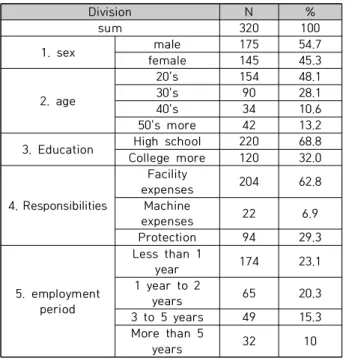
본 연구에서 사용된 최종 유효 표본은 총 320부로 확정하 였다. 최종적으로 확정된 표본에 대한 사회인구학적 특성 은 Table 1과 같다.

Division N %

sum 320 100

1. sex male 175 54.7

female 145 45.3

2. age

20's 154 48.1

30's 90 28.1

40's 34 10.6

50's more 42 13.2

3. Education High school 220 68.8

College more 120 32.0

4. Responsibilities

Facility

expenses 204 62.8

Machine

expenses 22 6.9

Protection 94 29.3

5. employment period

Less than 1

year 174 23.1

1 year to 2

years 65 20.3

3 to 5 years 49 15.3 More than 5

years 32 10

Table 1. Personal characteristics

2.2 Research method and research hypothesis 2.2.1 research hypothesis

연구문제에 따른 가설을 검증하기 위하여 본 연구에서 는 2019년 10월 1일 부터 12월까지 2개월간 서울과 경기 도에 소재중인 경호경비업체에 방문하여 관리자의 협조 하에 연구의 취지를 설명한 후 설문지에 응답하도록 하였 다. 수집된 데이터는 SPSS 24.0과 Amos 24.0을 활용하 여 연구결과를 도출하였다. 연구의 목적에 따라 빈도분석, 탐색적 요인분석, 확인적 요인분석, 신뢰도분석, 구조방정 식 모형 분석 등을 실시하여 가설을 검증하였다.

2.2.2 Research hypothesis

가설1. 경호경비원의 조직문화는 직무스트레스에 유의 한 영향을 미칠 것이다.

가설2. 경호경비원의 조직문화는 직무소진에 유의한 영 향을 미칠 것이다.

가설3. 경호경비원의 조직문화는 직무성과에 유의한 영 향을 미칠 것이다.

가설4. 경호경비원의 직무스트레스는 직무성과에 유의

한 영향을 미칠 것이다.

가설5. 경호경비원의 직무소진은 직무성과에 유의한 영 향을 미칠 것이다.

가설6. 경호경비원의 직무스트레스는 조직문화와 직무 성과의 관계에서 매개역할을 할 것이다.

가설7. 경호경비원의 직무소진은 조직문화와 직무성과 의 관계에서 매개역할을 할 것이다.

IV. Result

1. Validation and reliability verification of measurement tools

1.1 Exploratory factor analysis

본 연구에서는 탐색적 요인분석(EFA:Exploratory factor analysis)을 실시하여 요인 간 구성타당도를 검증 하였다. 검증과정에서 하나의 개념으로 조합이 어렵거나 요인 적재값(Factor loading value)이 .40이하인 문항은 간섭을 일으키므로 삭제하여 구성타당도를 높이고자 하였 다. 또한, 공유값(communality)이 .04이하인 문항은 극단 치가 있는 것으로 간주하여 이 또한 삭제하도록 하였다.

탐색적 요인분석을 실시한 결과는 <표 3>과 같다.

1.1.1 Organizational culture

Table 2에서 보는 바와 같이, 조직문화유형은 4개의 다 차원적 하위개념으로 구성되었다. 요인1 ‘혁신문화’은 3개 의 문항으로 구성되어졌으며 요인 적재치는 .780∼.848로 나타났다. 요인2 ‘시장문화’는 3개의 문항으로 구성되어졌 으며 요인 적재치는 .704∼.820으로 나타났다. 요인3 ‘관 계문화’는 4개의 문항으로 구성되어졌으며 요인 적재치는 .563∼.828로 나타났다. 요인4 ‘위계문화’는 2개의 문항으 로 구성되었으며, 요인 적재치는 .764∼.826으로 나타났 다. 그러나 a4, a8, a9, a12 문항 등은 요인 간 간섭을 주 는 것으로 조사되어 이 연구에서 제거되었으며, 각 요인에 대한 신뢰도 계수는 ‘혁신문화’가 α=.849, ‘시장문화’가 α

=.786, ‘관계문화’는 α=.798, ‘위계문화’는 α=.735로 나타

나 전체적으로 신뢰도가 높은 것으로 조사되었다. 따라서

조직문화유형은 최종적으로 15개 문항 가운데 4문항이 삭

제되어 4개 하위요인 11개 문항으로 구성되었으며, 신뢰

도는 α=.735∼α=.849로 나타났다.

(5)

문항 요인 성분

f1 f2 f3 f4

a7. Emphasis on adventure, innovation and personality .848 .065 .248 .108

a5. Innovative and adventurous spirit .807 .169 .317 .076

a6. Organizational unity through innovation and development .780 .220 .211 .226 a14. Emphasis on task achievement and goal achievement .109 .820 .130 .190

a15. Value competitiveness and achievement .163 .819 .008 .186

a13. Management goals and performance .137 .704 .274 .289

a1. Home-like comfor .303 .100 .828 .071

a2. Manager's help and support .307 .139 .804 .195

a3. Loyalty and mutual trust .265 .215 .563 .448

a10. Solidarity with emphasis on regulations and guidelines .143 .220 .160 .826 a11. Emphasis on status stability, unity, and relationship persistence .138 .378 .150 .764

Total 2.331 2.187 1.997 1.734

% of Variance 21.194 19.879 18.152 15.761

Cumulative % 21.194 41.073 59.225 74.986

Chronbach's α .849 .786 .798 .735

Table 2. Exploratory factors and reliability analysis for organizational culture types

1.1.2 Job stress

Table 3에서 보는 바와 같이, 대인관계스트레스는 단일 개념 4개의 문항으로 구성되어졌으며 요인 적재치는 .788

∼.904로 나타났다. 신뢰도 계수는 α=.873으로 비교적 높 게 나타났다.

문항 요인성분

b13. Consider turning over for better terms .904 b12. Unfairness of opportunity for development

and promotion .893

b11. Increased feelings of helplessness

and fatigue for the current task .835 b14. Tension about growing jobs .788

Total 2.934

% of Variance 73.343

Cumulative % 73.343

Chronbach's α .873

Table 3. Exploratory factors and reliability analysis for job stress

1.1.3 Job exhaustion

Table 4에서 보는 바와 같이, 감정소진은 단일개념 5개의 문항으로 구성되어졌으며, 요인 적재치는 .734~.874로 나타 났다. 신뢰도 계수는 α=.873으로 비교적 높게 나타났다.

문항 요인성분

m5. Exhaustion of charge .874

m2. Exhausted from work .851

m1. Emotional exhaustion .840

m3. Tiredness at work .776

m4. Business tension .734

Total 3.332

% of Variance 66.645

Cumulative % 66.645

Chronbach's α .873

Table 4. Exploratory factors and reliability analysis for job exhaustion

1.1.4 Job performance

Table 5에서 보는 바와 같이, 직무성과는 단일개념 5개의 문항으로 구성되어졌으며, 요인 적재치는 .755~.867로 나타 났다. 신뢰도 계수는 α=.873으로 비교적 높게 나타났다.

문항 요인성분

y5. Customer service with sincerity .867 y2. Kindness to customer service .850 y3. Prompt service delivery .845 y4. Appearance management for best

service .838

y1. Interest in customer service .755

Total 3.460

% of Variance 69.200

Cumulative % 69.200

Chronbach's α .886

Table 5. Exploratory factors and reliability analysis for job performance

1.2 Confirmatory factor analysis

변수간의 내재된 요인 및 차원을 확인하고자 확인적 요인 분석(CFA:Confirmatory factor analysis)을 실시하였다.

이 연구에서는 이순묵(1990)이 제안한 χ

2

, 기초부합지수 (GFI: Goodness of Fit Index), 비교부합지수(CFI:

Comparativie Fit Index), 표준적합지수(NFI: Normed Fit

Index), 비표준적합지수(TLI: Tucker-Lewis Index)와

Browne과 Cudeck(1993)가 제안한 근사평균 오차제곱근

(RMSEA: Root Mean Square Error of Approximation)

지수로 부합도 측정 지수로 사용하였다[47]. GFI, CFI, NFI,

TLI 값은 0.9≧이상이면 부합도가 좋은 것으로 간주되고,

모형의 간명성을 고려하는 RMSEA 지수는 0.05≦이면 좋은

부합도로 간주하며, 0.05~0.08≧이면 수용할 수 있는 부합

도로 간주한다. 그리고 RMR(Root Mean Square

Residule)은 0에 가까우면 양호한 것으로 간주한다[48].

(6)

1.2.1 Goodness of fit analysis for measurement model 측정모형에 대한에 대한 적합도 분석 결과는 <표 >와 같 다. 확인적 요인분석 결과, 전체 적합도지수는 χ

2

=324.889, df=155, ρ=.000, RMR=.048, GFI=.907, NFI=.906, TLI=.936, RMSEA=0.59를 보였다. 그러나 ‘직무성과’을 구성하고 있는 문항 m4는 요인 부하량이 0.5보다 낮게 나 타났기 때문에 이 연구에서 제거되었다. 따라서 연구모형 은 전체적으로 수용이 가능하다고 할 수 있다. 측정모형에 대한 적합도 지수는 Table 6과 같다.

Fitness

x2

/df, ρ RMR GFI NFI TLI RMSEA structure

model 2.096/.000 .048 .907 .906 .936 .059 기준치 = ρ<.05이하, RMR:05이하, GFI, NFI, TLI:.90이상, RMSEA:.10이하 Table 6. Goodness of fit index according to confirmatory factor analysis result

연구모형을 구성하는 확인적 요인분석에 대한 전체 모 형도는 [그림 1]과 같다.

x

2

=324.889,(ρ=.000), df=155, x

2

/df=2.096 Fig. 1. Structural model for confirmatory factor analysis

1.2.2 Convergence and discriminant validity analysis for measurement models

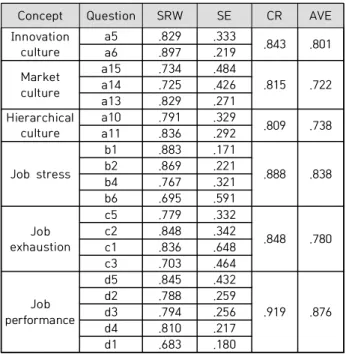
측정모형의 확인적 요인을 통한 경로계수에 대한 표준적 재치와 표준오차 값을 통하여 <표 6>과 같이 개념 신뢰도 및 수렴 타당성을 분석을 실시하였다. <표 >에서 보는 바와 같이, 각 요인에 대한 표준적재치가 .50이상이기 때문에 개 념타당성은 확보되었음을 확인할 수 있다. 또한, 각 요인에 대한 개념 신뢰도가 0.7이상이고, 분산추출지수가 0.5이상 이기 때문에 수렴타당도가 확보되었다 할 수 있으며, 구성 개념간의 관계를 보여주는 상관계수의 신뢰구간에 1이 포

함되지 않아 판별타당성이 확보된 것으로 나타났다. 측정 모형의 개념 및 분산추출지수는 Table 7과 같다.

Concept Question SRW SE CR AVE

Innovation culture

a5 .829 .333 .843 .801

a6 .897 .219

Market culture

a15 .734 .484

.815 .722

a14 .725 .426

a13 .829 .271

Hierarchical culture

a10 .791 .329 .809 .738

a11 .836 .292

Job stress

b1 .883 .171

.888 .838

b2 .869 .221

b4 .767 .321

b6 .695 .591

Job exhaustion

c5 .779 .332

.848 .780

c2 .848 .342

c1 .836 .648

c3 .703 .464

Job performance

d5 .845 .432

.919 .876

d2 .788 .259

d3 .794 .256

d4 .810 .217

d1 .683 .180

Table 7. Construct Reliability and Average Variance Extracted

2. Hypothesis verification

측정모형을 통하여 타당도와 신뢰도를 검증하는 한편, 모 형의 적합도 지수가 양호한 것으로 검증되어 변수간의 관계 를 확정된 구조모형으로 설정하였다. 본 연구는 가설검증이 목적이므로 모형의 적합도 지수를 높이기 위하여 수정지수 는 사용하지 않았다. 적합도지수를 분석한 결과, 연구모형 에 대한 적합도 지수는 기준치에 부합한 것으로 나타났으며, 구조모형에 대한 적합도 지수는 Table 8과 같다.

Fitness

x2

/df) /ρ RMR GFI NFI TLI RMSEA structure

model 1.540/.000 .046 .933 .935 .976 .041 기준치 = ρ<.05이하, RMR:05이하, GFI, NFI, TLI:.90이상, RMSEA:.10이하 Table 8. Overall goodness-of-fit index for structural models

연구모형을 도식화한 것은 Fig. 2와 같다.

(7)

Fig. 2. Path coefficient between structural models

확정된 연구모형을 이용하여 조직문화, 직무스트레스, 직무소진, 직무성과 간의 인과관계에 대한 가설을 검증하 고자 하였다.

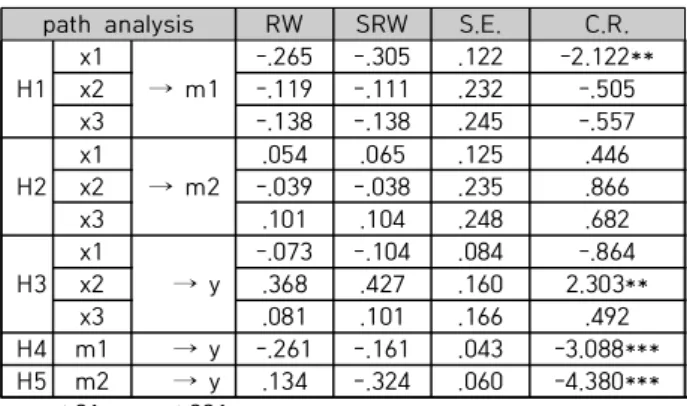
2.1 Causal relationship between variables: H1~ H5 변수간의 직접적인 인과관계를 검증한 경로분석 결과는 Table 9와 같다.

path analysis RW SRW S.E. C.R.

H1 x1

→ m1

-.265 -.305 .122 -2.122**

x2 -.119 -.111 .232 -.505

x3 -.138 -.138 .245 -.557

H2 x1

→ m2

.054 .065 .125 .446

x2 -.039 -.038 .235 .866

x3 .101 .104 .248 .682

H3 x1

→ y

-.073 -.104 .084 -.864

x2 .368 .427 .160 2.303**

x3 .081 .101 .166 .492

H4 m1 → y -.261 -.161 .043 -3.088***

H5 m2 → y .134 -.324 .060 -4.380***

**p<.01, ***p<.001

*x1:Innovation culture, x2:Market culture, x3:Hierarchical culture, m1:Job stress, m2:Job exhaustion, y:Job performance

Table 9. Research Model Path Analysis Results

2.2 Relationship between organizational culture and job stress: H1.

경호경비원의 혁신문화가 직무스트레스에 미치는 표준화 경로계수는 -.305이고, C.R. 값이 -2.1223이며, 통계적으 로는 p<.01 수준에서 유의한 영향을 미치는 것으로 나타났 다. 하지만 시장문화, 위계문화는 직무스트레스에 통계적으 로는 p<.05수준에서 유의한 영향을 미치지 않는 것으로 나 타났다. 따라서 경호경비원의 혁신지향 문화는 직무스트레 스에 유의한 영향을 미치는 것으로 나타나 ‘가설1’은 ‘부분 채택’되었다. 이러한 결과는 경호경비원을 대상으로 조사한

김영배(2019)의 연구와 부분적으로 일치 하지만[9], 특수경 비원의 경우 위계지향 문화에서만 직무스트레스와 유의한 상관관계가 있다고 보고한 김찬선·조병해·이지은(2011)의 연구와 상이한 것으로 조사되었다[15]. 따라서 본 연구를 통 하여, 경호경비원의 조직문화는 주 업종에 따라서 조직문화 는 상이하게 나타날 수 있고, 경호경비 조직도 기업 환경의 변화에 따라 혁신을 도모하고 있다는 것을 알 수 있다.

2.3 Organizational culture and job exhaustion: H2 본 연구에서 혁신문화, 시장문화, 위계문화는 직무스트 레스에 유의한 영향을 미치지 않는 것으로 조사되었다. 따 라서 가설2는 ‘기각’되었다. 이러한 결과를 통하여 경호경 비원의 조직문화가 직무소진에 직접적으로 영향을 미치지 않는 다는 것을 알 수 있다. 하지만 서비스종사자를 대상으 로 조사한 김봉철(2012), 김기옥·박성규(2019)의 연구에서 는 직무스트레스가 높으면 그와 같은 관점에서 감정소진에 영향을 미친다는 결과를 보고하였다[49, 39]. 그런 관점에 서 경호경비원 조직은 혁신문화가 높으면 직무스트레스에 영향을 미치지만 직무소진에는 영향을 받지 않는 다는 점 에서 상이한 결과라 할 수 있다. 따라서 이러한 결과가 나 온 것은 이 직업군이 이직률이 높다는 측면에서 볼 때, 구 성원들이 스트레스 상황에 놓여 직무소진을 경험하게 되면 언제든지 그만두고 있기 때문이라고 판단할 수 있다.

2.4 Organizational Culture and Job Performance: H3 경호경비원의 시장문화가 직무성과에 미치는 표준화경 로계수는 .427이고, C.R. 값이 2.303이며, 통계적으로는 p<.01 수준에서 유의한 영향을 미치는 것으로 나타났다.

하지만 혁신문화, 위계문화는 직무성과에 통계적으로 유의

한 영향을 미치지 않는 것으로 나타났다. 따라서 경호경비

원의 시장문화는 직무성과에 유의한 영향을 미치는 것으

로 나타나 ‘가설3’은 ‘부분채택’되었다. 이러한 결과는 시

장문화가 개인 혹은 조직의 성과에 긍정적인 영향을 미친

다고 보고한 안경섭(2008), 임정빈(2015), 허성욱・최재송

(2019) 등의 결과와 일치한다[20, 25, 23]. 또한, 경호경비

원을 대상으로 조사한 김영배(2019)의 연구과 부분적으로

일치한다[9]. 하지만 특수경비원을 대상으로 조사한 김호

준(2011)의 연구에서는 위계문화에서 긍정적으로 영향을

미치는 것으로 조사되었으며[14], 일반경비원을 대상으로

조사한 김창호(2007)의 연구에서는 조직문화는 직무성과

에 유의한 영향을 미치지 않는다고 보고하였다[13]. 이러

한 관점에서 볼 때 경호경비업은 주업종의 차이에 따라서

상이하게 나타날 수 있음을 시사해준다.

(8)

2.5 Relationship between job stress and job performance: H4

경호경비원의 직무스트레스가 직무성과에 미치는 표준 화경로계수는 .161이고, C.R. 값이 -3.088이며, 통계적으 로는 p<.001 수준에서 유의한 영향을 미치는 것으로 나타 났다. 이러한 결과는 과도한 업무부하로 인한 직무스트레 스가 직무성과에 부정적인 영향을 미칠 뿐만 아니라, 높은 결근율과 작업수행 감소를 초래한다고 보고한 김기옥·박성 규(2019), Ivancevich와 Matteson(1979)연구와 일치한다 [39, 40]. 같은 관점에서 민간경비원을 대상으로 조사한 주일엽(2010), 정육상(2014)의 연구와 일치한다[50, 51].

이를 통하여, 경호경비원의 직무스트레는 직무성과에 부정 적인 요인으로 영향을 미친다는 것을 알 수 있다.

2.6 Relationship between job exhaustion and job performance: H5

경호경비원의 직무소진이 직무성과에 미치는 표준화경 로계수는 -.324이고, C.R. 값이 -4.380이며, 통계적으로 는 p<.001 수준에서 유의한 영향을 미치는 것으로 나타났 다. 이러한 결과는 직무소진을 경험한 사람이 다른 동료들 에게 확산시킨다는 점에서 직무성과에 부정적인 결과를 초래한다는 김기옥·박성규(2019)의 연구와 일치한다[39].

또한, 이는 감정적 고갈로 이어져 직무성과에 부정적으로 초래한다는 변찬복·조경섭(2012)의 견해와 일치한다[43].

따라서 이 연구의 결과는 다른 분야와 마찬가지로 경호경 비원에게 직무소진은 직무성과에 부정적인 결과를 초래한 다는 점을 시사해준다.

2.7 Mediating effect verification : H6, H7

이 연구에서 매개효과를 검증하기 위하여 직접효과, 간 접효과, 총 효과를 구하였다. 매개효과에 대한 판단은 독 립변인이 종속변인에 대하여 간접효과가 유의하게 나오면 매개효과가 있는 것으로 판단하며 독립변인과 종속변인 간의 직접효과는 유의하지 않고 간접효과만 유의하게 나 타나면 완전매개, 직접효과와 간접효과가 동시에 유의하면 부분매개로 설정하였다. 이 연구에서 간접효과의 유의성 검증을 하고자 Bootstrapping을 실시하였다. 그러나 가설 7은 조직문화가 직무성과에 직접효과가 없으므로 매개효 과는 기각되어, 가설6만 검증하도록 하였다. 변수간의 직 간접효과는 <표 3-8>과 같다.

Path type directly

effect Indirect

effect Total effect

H6

x1 x1→m1 -.305** - -.305**

→m1 m1→y -.161*** - -.161***

→y x1→y -.104 .049 -.055**

*p<.05, ***p<.001

*x1:Innovation culture, x2:Market culture, x3:Hierarchical culture, m1:Job stress, m2:Job exhaustion, y:Job performance

Table 3-8. Analysis of direct and indirect effects on job stress

2.8 Mediating effects of job stress in the

relationship between organizational culture and job performance: H6

<표 3-8>에서 보는 바와 같이, 직무스트레스의 매개효 과는 혁신문화와 직무성과 간의 관계에서 -.055(-.305 × -.161)로 p<.01 수준에서 유의한 영향을 미치는 것으로 조 사되었다. 그러나 이 과정에서 혁신문화는 직무성과에 직 접효과가 없는 것으로 보아 직무스트레스는 혁신문화와 직무성과 간의 관계에서 완전매개효과가 있다는 것을 알 수 있다. 따라서 조직문화의 하위요인 혁신문화는 직무스 트레스를 매개하지 않고는 조직성과에 영향을 미칠 수 없 다는 것을 시사한다. 따라서 ‘가설 6’은 채택 되었다.

V. Conclusions

본 연구는 경호경비원의 조직문화에 따른 직무스트레스

와 직무소진이 직무성과에 미치는 영향을 규명하기 위한

목적으로 수행되었다. 검증결과, 첫째, 조직문화 가운데

혁신문화에서만 직무스트레스에 통계적으로 .01수준에서

부적(-)으로 영향을 주는 것으로 확인되어, 가설1은 부분

채택 되었다. 둘째, 조직문화는 직무성과에 직접적인 영향

이 없는 것으로 확인되어, 가설2는 기각되었다. 셋째, 조직

문화 가운데 시장문화에서만 직무성과에 통계적으로 .01

수준에서 부적(-)으로 영향을 주는 것으로 확인되어, 가설

3은 부분채택 되었다. 넷째, 직무스트레스는 직무성과에

통계적으로 .001수준에서 부적(-)으로 영향을 주는 것으로

확인되어, 가설4는 채택 되었다. 다섯째, 직무소진은 직무

성과에 통계적으로 .001수준에서 부적(-)으로 영향을 주는

것으로 확인되어, 가설4는 채택 되었다. 여섯째, 직무스트

레스는 조직문화의 혁신문화와 직무성과의 관계에서 통계

적으로 .01수준에서 부적(-)으로 매개효과가 있는 것으로

확인되어, 가설6은 채택되었다. 일곱째, 직무소진은 조직

문화와 직무성과의 관계에서 통계적으로 유의한 영향이

없는 것으로 확인되어, 가설7은 기각되었다.

(9)

REFERENCES

[1] Parker R. and Bradley L., "Organizational Culture in the Public Sector: Evidence from Six Organizations", International Journal of Public Sector Management, Vol. 13, No. 2, pp. 128-129, 2000.

[2] Jassawalla, A. R., and Sashittal, H. C., Cultures that support product-innovation processes. Academy of Management Perspectives, Vol. 16, No. 3, pp. 42-54, 2002.

[3] D. Lee, Organizational behavior, PandC Media: Seoul Korea, 2018.

[4] K. Yoo, The influence of organizational culture types on job performance : focused on organizational commitment as a mediator, Graduate School of Kyonggi University, South Korea, 2011.

[5] C. Choi, A study on the mediating effect of innovation behavior in the relationship between organizational culture and individual job performance, Graduate School Korea University, South Korea, 2012.

[6] Cameron, K. S., and Quinn, R. E., Diagnosing and Changing, Organizational Culture: Based on The Competing Values Frame work, Readings, MA : Addison-Wesley, 1999.

[7] S. Won, A study on the effect of regionalism to the supervisor's trust-in-subordinate, Graduate School of Ewha Women University, South Korea, 2000.

[8] H. Kim, Effects of Organizational Culture on Organizational Commitment and Job Satisfaction in the Public Sector, Korean Public Administration Review, Vol. 36, No. 4, 2002.

[9] Y. Kim, The Effect of Organizational Culture Type of Police and Private Security on Their Organizational Effectiveness : Focusing on the Mediating Effect of Job Stress and Social Support, Graduate School of Korea University, South Korea, 2019.

[10] C. Jo, A study on structural relationship between job stress, burnout, and organizational effectiveness of private security guards as emotional labor, Graduate School of Yong-in University, South Korea, 2014.

[11] H. Han, The influence of corporate culture types on financial performance, Graduate School of Kyonggi University, South Korea, 2011.

[12] N. Jung, The Influence of the Organizational Environment and Culture of the Employees in Private Security Corporation on the Organizational Performance, Korea Security Journal, Vol. 29, pp.

251-278, 2011.

[13] C, Kim, The Relationship between Organizational Culture, Human Resource Management and Organizational Performance in the Private Security Corporation, Korean Security Journal, Vol. 14, pp. 125-140, 2007.

[14] H, Kim, Relationship between Organizational Culture, Organizat ional Trust and Organizational Performance of Special Guard Organization, Korean Security Journal, Vol. 29, pp. 59-86, 2011.

[15] C. Kim and B. Jo and J. Lee, Relation of Organizational Culture and Job Stress and Organizational Commitment in Special Guard, Journal of convergence security, Vol. 11, No. 5, pp. 65-76, 2011.

[16] C. Park, The effect of fit between leadership and organizational culture on organizational effectiveness, Graduate of School Changwon National University, South Korea, 2015.

[17] Y. Cha, A Review on the Relationship between Organizational Culture and Performance, Journal of Korea Academia-Industrial cooperation Society, Vol. 13, No. 5, pp. 2054-2062, 2012.

[18] H. Shin and Y. Ko, The Effects of GWP Organization Culture on Need for Achievement, Job Satisfaction, and Job Performance : Comparison Analysis of Workers in Manufacturing, Service, and Finance Industries, Management and Information Systems Review, Vol. 34, No. 2, 2015.

[19] Y. Kim and S. Park, Empirical study on the relationships between cultural type, strenght and organizational performance in Korean firms, Korean Journal of Management, Vol. 6, pp. 195-238, 1998.

[20] K. Ann, The Effects of Organizational Culture in Public Sector on Organizational Performance, korean policy sciences review, Vol. 12, No. 4, pp. 103-131, 2008.

[21] S. Lee, A Study on Impact of Organizational Culture and Organizational Citizenship Behavior on Organizational Performance : Based on Local Public Hospital, The Korean Governance Review, Vol. 17, No. 1, pp. 29-51, 2010.

[22] J. Ko, The Effect of Family-Friendly Policies on Organizational Performance in Public Organization : Focused on the Moderating Effects of Organizational Culture, Korea Association for Organizational Studies, Vol. 13, No. 3, pp. 75-97, 2016.

[23] S. Hur. and J. Choi, Organizational Culture and Organizational Performance: Focusing on the Mediating Role of Authentic Leadership, Korean Public Management Review, Vol. 33, No.

2, pp. 37-58, 2019.

[24] Sathe, V., Culture and related corporate realities: Text, cases, and readings on organizational entry, establishment, and change.

Richard D Irwin, 1985.

[25] J. Im, A Study on the Relationships between Organizational Culture and Performance of Local Public Enterprises: Focusing on Local Public Enterprises in Gyeonggi Province, Korean Public Personnel Administration Review, Vol. 14, No. 4, pp. 177-209, 2015.

[26] Quinn, R. E., and Mc Grath, M. R., The transformation of organizational cultures: A competing values perspective, 1985.

[27] B. Choi, Creating a strong organizational culture, LG Economic Research Institute, Vol. 7, pp. 18~24, 2003.

[28] J. Min, A Review of Conceptualizations and Re-conceptualizat ions of Organizational Effectiveness, Korean Public Administr ation Review, Vol. 37, No. 2, pp. 83-104, 2003.

[29] Dimitris B., John A., Mantes Y. and Kefalas A. G., Culture Gap

in Greek Management, Organization Studies, Vol. 11, No. 2,

(10)

pp.261-283, 1999.

[30] M. Go, A study on the influence of organizational culture gap on the organizational commitment, Graduate School of Seoul Women's University, South Korea, 2000.

[31] K. Park and S. Kim, Impact of organizational culture, job stress and burnout on turnover intention in social workers, Institute for Human studies, Vol. 35, pp. 137-158, 2014.

[32] O. Kim and H. Jo, effect of infant teachers professionalism awareness and the organizational culture at child care centers on teacher job stress, Korean Journal of Early Childhood Education, Vol. 30, No. 2, pp.193-209, 2010.

[33] Y. Lee and H. Park, Nurses Perceived Organizational Culture, Verbal Abuse and Job Stress, The Journal of the Korea Contents Association, Vol. 15, No. 10, pp. 292-304, 2015.

[34] H. Roh. Relationship between school organizational culture, psychological exhaustion, and job satisfaction, Graduate School of Korea University, South Korea, 2015.

[35] Maslach, C., and Jackson, S. E., The measurement of experienced burnout. Journal of Occupational, Behavior, Vol. 2, No. 2, pp.

99-113, 1981.

[36] S. Jung, Job stress, psychological exhaustion, and teaching commitment according to the organizational culture perceived by teachers, Graduate School of Ajou Unversity, South Korea, 2017.

[37] S. Lee, The Effect of the Organizational Culture of Casino Employees' Perception on Turnover Intention : Focused on the Mediation Effects of Burnout, Graduate School of Kyonggi University, South Korea, 2019.

[38] J. Lee and D. Song and H. Park and B. Song, A Model Testing Study on the Job stress and Organizational outcomes, Korean Society of Sport Psychology, Vol. 4, No. 1, pp. 1-21. 1991.

[39] K. Kim and S. Park, The impact of job stress, job burnout on organizational performance, Korean Review of Corporation Management, Vol. 10, No. 2, pp. 275-297, 2019.

[40] Ivancevich, J, M., and Matteson, M, T, Occupational stress, type A Behavior and Physical welling, Academy of Management Joural, Vol. 25, No. 2, 1981.

[41] Maslach, C., and Jackson, S. E., The measurement of experienced burnout. Journal of Occupational, Behavior, Vol. 2, No. 2, pp.

99-113, 1981.

[42] Babakus, E., Yavas, U., and Ashill, N. J., The role of customer orientation as a moderator of the job demand burnout performance relationship: a surface level trait perspective, Journal of Retailing, Vol. 85, pp. 480-492, 2009.

[43] C. Byon and K. Jo, "The Impact of Job Satisfaction and Burnout on Organizational Citizenship Behavior and Job Performance, Northeast Asia Tourism Research, Vol. 8, No. 3, pp. 145-167, 2012.

[44] Ivancevich, J. M., and Matterson, M. T., Stress and Work: A

Managerial Per pective. Scott, Fores man, 1980.

[45] Parasuraman, A, Zeithaml, V. and Berry. L., SERVQUAL: A Multiple-item for Mwasuring Consumer Perception of Service Quality, Journal of Retailing, Vol. 64, No. 1, pp. 12-40, 1988.

[46] H. Jo, A Study of the Effects of Resilience factor on Flight attendants' Job performance and organizational effectiveness, Graduate School of Kyonggi University, South Korea, 2015.

[47] Browne, M. W. and Cudeck, R., Alternative Ways of Assessing Model fit, In K. A. Bollen and J. S. Long(Eds.), Testing Structural Equation Models, Newbury Park, CA: Sage, 1993.

[48] K. Kim, Structural Equation Model Analysis, Seoul: Hannarae, 2007.

[49] B. Kim, A Study on How Service Employees Job Stress Caused by Customer Crowding Affects Emotional Burnout and Job Performance, Graduate School of Kyonggi University, South Korea, 2012.

[50] I. Ju, Effect of Private Guard's Job Stress on Job Performance, Journal of Korean Public Police and Security Studies, Vol. 17, No. 1, pp. 127-152, 2010.

[51] Y. Jung, A Study on the Relationships among Private Security Guard's Job Insecurity, Job Stress and Job Performance, Journal of The Korean Society of Private Security, Vol. 13, No. 2, pp.

213-232, 2014.

Authors

In 2008, Sang-Jin Kim recruited a Doctor of

Security and Security from Gyeonggi

University. He also deserved a master's degree

in 2003 from the Department of Security at

Yongin University and completed his semester

in 2001. Dr. Kim is currently a professor at Yongin

University and is interested in bodyguard, private security,

and criminal science.

수치

Table  1.  Personal  characteristics
Table  2.  Exploratory  factors  and  reliability  analysis  for  organizational  culture  types
Table  7.  Construct  Reliability  and  Average  Variance  Extracted 2.  Hypothesis  verification 측정모형을 통하여 타당도와 신뢰도를 검증하는 한편, 모 형의 적합도 지수가 양호한 것으로 검증되어 변수간의 관계 를 확정된 구조모형으로 설정하였다
Table  9.  Research  Model  Path  Analysis  Results

참조

관련 문서

Among the organizational culture types, relationship-orientated culture (p<0.001) and innovation-orientated culture (p=0.006) were significant influences on

The purpose of this study was to examine the mediating effects of rapport on the relationship between type of organizational culture and innovative behavior of

The Effect of Organizational Fairness, Organizational Culture Improvement, and Service Encounter on Hospital Management Performance..

Influence of organizational culture type and job satisfaction on nurses' innovation behavior in a University hospital.. Where angels fear to tread--nursing and the

This study analyzes the effect of authentic leadership on organizational climate, organizational citizenship behavior, and job performance to suggest

Abstract The purpose of this study was to examine the effects of hospital organizational culture, organizational silence and job complexity on turnover

Influence of organizational culture type and job satisfaction on nurses' innovation behavior in a University hospital.. Where angels fear to tread--nursing and

Abstract This study examined the causal relationship among theleadership type, organizational commitment, and job performance, and to improve the organizational performance