ABSTRACT
Objectives: The purpose of the study is to evaluate the contents analysis of the community dental hygiene practice in the dental hygiene students and suggest the outcome based evaluation index of community dental hygiene practice. This study will provide the basic data for the community nursing and social welfare practice.
Methods: A self-reported questionnaire was completed by 82 dental hygiene professors and 254 dental hygienists in community health centers after receiving informed consent based on institutional review board from 5th Dec 2014 to 30th Jul 2015. A total of 49 professors and 134 dental hygienists gave the complete answers. The study instrument was adapted from the literature review. The questionnaire consisted of evaluation, purpose of evaluation, and evaluation format. Data were analyzed using SPSS 20.0 program. The contents analysis was carried out through input, process, output, and outcome.
Results: The practice outcome evaluation was conducted in 62.9% of the dental hygiene departments and 32.9% of the community health centers. Most of the dental hygiene professors chose “To know what students learned(27.3%)” and “To ensure student’s role and behavior in practice(27.3%).” as the purpose of evaluation. The public dental hygienists chose “To score the practice grade(42.1%).” The evaluation method was done anonymously.
Conclusions: The outcome based evaluation in community dental hygiene practice was the best method to evaluate the practice education for the competency of the dental hygiene students.
Key Words: community dental hygiene, community health center, outcome evaluation, practice education
색인: 보건소, 성과평가, 지역사회치위생학, 현장실습5)
▶ 이 연구는 2014년 대한치위생(학)과교수협의회의 연구비를 지원 받아 수행하였음.
Copyrightⓒ2016 by Journal of Korean Society of Dental Hygiene
This is an open-access article distributed under the terms of the Creative Commons Attribution Non-Commercial License (http://creativecommons.org/
licenses/by-nc/3.0/), which permits unrestricted non-commercial use,
distribution, and reproduction in medium, provided the original work is properly cited.
http://dx.doi.org/10.13065/jksdh.2016.16.01.37 ISSN 2288-2294(Online)
J
지역사회치위생학 현장(보건소)실습 성과평가 내용분석
이가영⋅한양금
1⋅김영경
2⋅임현주
3⋅권양옥
4⋅김한미
5⋅박정란
6⋅김남희
7연세대학교 대학원 치위생학과⋅1대전보건대학교 치위생과⋅2충청대학교 치위생과⋅3동주대학교 치위생과⋅4부산시 사상구 보건소⋅5강원도 횡성군 보건소⋅6백석대학교 치위생학과⋅7연세대학교 원주의과대학 치위생학과
Contents analysis of the community dental hygiene practice outcome evaluation
Ga-Yeong Lee⋅Yang-Keum Han
1⋅Young-Kyung Kim
2⋅Hyun-Ju Lim
3⋅Yang-Ok Kown
4⋅Han-Mi Kim
5⋅ Jeong-Ran Park
6⋅Nam-Hee Kim
7Department of Dental Hygiene, The Graduate School, Yonsei University⋅1Department of Dental Hygiene, Daejeon Health Science College⋅2Department of Dental Hygiene, Chungcheong University⋅3Department of Dental Hygiene, DongJu College⋅4Public Health Center, Sasang-gu, Busan, Public Health Center⋅5Hoengseong-gun, Gangwon-do, Public Health Center⋅6Department of Dental Hygiene, Baek seok University⋅7Department of Dental Hygiene, Wonju College of Medicine, Yonsei University
*Corresponding Author: Nam-Hee Kim, Department of Dental Hygiene, Wonju College of Medicine, Yonsei University, 20 Ilsanro, Wonju, Gangwondo, 220-701, Republic of Korea, Tel: +82-33-741-0391, Fax: +82-33-735-0391, E-mail: [email protected] Received: 24 August 2015; Revised: 4 December 2015; Accepted: 25 January 2016
한국치위생학회
38
•J Korean Soc Dent Hyg 2016; 16(1): 37-43서론
Winslow[1]의 정의에 따르면, “공중보건은 조직된 지역 사회의 노력을 통하여 질병을 예방하고 수명을 연장하며 건 강과 효율을 증진시키는 과학 및 기술”이라 하였고, Last[2]
는 “공중보건은 국민건강을 보호하고, 증진하며, 회복하기 위한 지역사회의 조직된 노력들 가운데 하나 ”로 정의하였다.
1920년과 1988년에 정의된 공중보건에 발맞춰 최근 우리나 라 보건소의 기능이 진료 중심에서 질병예방 중심의 기능으 로 옮겨지고 있다[3].
최근 치과대학에 입학하는 여학생의 비율이 많아지고, 치과대학이 치의학 전문대학원으로 전환되면서 군복무를 대 신하여 지역에 배치할 남자 치과의사들이 줄어들어감에 따 라 공중보건 치과의사 수가 줄어들고 있다[4]. 또한 공중보 건의 정의에 따라 구강분야에서도 치료보다 지역주민 전체 를 대상으로 펼치는 구강보건 교육과 예방사업이 중요시되 고 있음에 따라[5], 보건치과위생사 역할의 중요성이 더욱 더 대두되고 있다. 이에 지역사회 현장(보건소)에서 활동하 는 보건치과위생사가 그 역량을 발휘할 시점이다.
지역사회치위생학은 학교마다 교과목 명칭이 통일되어 있지 않지만 그 목적은 지역사회 주민의 구강건강 증진을 위하여 보건소 구강보건실, 학교 구강보건실의 구강보건활 동 및 예방사업 운영에 보건 치과위생사로서 업무를 적절히 수행할 수 있는 능력을 배양하는 것이다[6]. 그러므로 보건 치과위생사로서 능력을 향상시키기 위해서는 이론을 통해 배운 기초, 임상 지식을 통합하는 능력을 발전시키고 실무 수행능력과 문제해결능력을 향상시키는 실습도 병행하여야 한다[7]. 그러나 사전연구의 결과에 따르면 일부학교에서는 지역사회치위생학 현장실습을 실시하고 있지 않아, 지역사 회치위생학 현장실습 표준안 마련의 필요는 이미 지적된 바 있다[8], 지역사회치위생학 현장실습의 내실화를 통해 보건 치과위생사의 실무능력을 갖춘 치과위생사 양성에 힘써야 할 필요성이 대두되고 있다.
역량이 과제수행의 맥락에 적합한 지식, 기능, 전략, 가 치 등을 선택, 활용해가는 인지적 반성적 성찰 능력을 나타 내는 개념이라면[9], 그 사람의 역량이 발휘된 결과물을 성 과라 할 수 있다. 성과중심교육(Outcome based education) 은 학습자들이 과정을 마칠 때 보여주어야 하는 성과를 바 탕으로 역량을 설계하는 교육과정 접근법이다[10]. 특히 실 습교육의 평가는 실습을 마친 실습생들이 그 과정의 특성을 성취하여 지니게 된 능력정도를 평가하는 것이다.
지역사회치위생학 현장실습 학습목표로 실습생이 갖춰 야 할 역량을 설정했다면, 그 역량의 결과를 성과로 평가해 야 역량의 함양여부와 그 정도를 제대로 파악했다고 할 수 있다. 그러나 치위생(학)과에서 현재 실시하고 있는 실습 평 가는 만족도 및 태도 평가에 그치고 있다. 실습에 대한 만족 도와 태도는 실습생이 어떠한 자세와 태도로 실습에 임하고
있는 가를 측정하는 과정평가의 한 방법일뿐 , 실습 목적인
‘실습을 통해 무엇을 할 수 있느냐’와 ‘어떻게 하느냐’를 강 조하는 역량을 가졌는지 판단하기 어렵다[11].
최근 모든 보건사업은 ‘기획-수행-평가’의 과정을 거쳐 실시된다. 기획은 의도된 미래의 상에 맞추기 위하여 현재 를 변화시키는 과정으로 이를 통해 우리가 나아가야할 목표 를 정하고, 이를 위한 수행방법을 정하고 실시하는 것이다.
그 후 실시한 것들에 대한 평가를 통해 다음 기획의 의사결 정에 도움을 준다[12]. 지역사회치위생학 현장(보건소) 실습 평가 시 실습생들이 각 ‘기획-수행-평가’ 단계에서 필요한 실무 역량을 갖추었는지 평가해야 한다 .
따라서 지역사회치위생학 현장실습의 궁극적인 목표가 단지 실습생이 기본적으로 갖춰야 할 자세와 태도만을 함양 하기 위한 것이 아니라면, 그들이 이 실습을 통해 얻어야 할 역량을 바탕으로 무엇을 할 수 있게 되었는지 그 성과에 주 목해야 한다.
이 연구는 현재 전국 치위생(학)과의 지역사회치위생학 현장(보건소)실습 성과평가 실태를 조사하고, 간호학과 사 회복지학의 유사과목 실습 성과평가의 내용을 분석하여 지 역사회치위생학 현장(보건소)실습(이하 현장실습) 성과평가 지표를 제안하고자 하였다.
연구 방법
1. 지역사회치위생학 현장실습 평가 현황 조사 1.1. 연구대상
이 연구는 2014년 12월 5일부터 2015년 7월 30일까지 진행되었다 .
전국 82개 치위생(학)과에서 지역사회치위생학 교과목을 담당하는 대표 교수자 82명과 254개 보건소 구강보건실에 서 근무하는 대표 보건치과위생사 254명을 연구대상으로 선정하였다 . 연구는 연세대학교 원주의과대학 연구윤리위원 회에서 승인(승인번호: YWDR-15-4-055)을 받은 후 진행 하였다 . 설문에 참여한 대상자는 교수자 49명(응답률 59.8%) 과 보건치과위생사 134명(응답률 52.8%)이었다.
1.2. 연구도구 및 자료 분석
연구도구 설정 및 방법은 기존문헌[8]의 연구도구를 이 용하였다. 기존문헌의 설문 문항 중 각 학교와 보건소에서 의 지역사회치위생학 현장실습 ‘평가 여부’와 ‘평가 목적’,
‘평가서 양식’에 대한 문항을 이용하였다. 자료 분석은
SPSS 20.0을 이용하여 빈도분석을 시행하였다.
2. 간호학, 사회복지학의 유사과목 교과과정 실습성과 문헌고찰
지역사회를 대상으로 실습을 시행하는 간호학과 사회복 지학 과목 중 지역사회치위생 실습과 유사과목인 ‘지역사회 간호학 실습’과 ‘사회복지현장실습’과목을 대상으로 하였다.
‘지역사회간호학’과 관련된 문헌 중 이정열 등의 ‘4년제 간 호대학(과) 지역사회간호학 실습교육의 현황분석[13]’과 한 국사회복지사협회에서 제시한 ‘사회복지현장실습 실태조사 및 지침서[14]’를 이용하였다. 이 두 문헌의 평가지표를 보 건사업의 논리적 모형인 투입 (input), 활동(process), 산출(output), 결과 (outcome)에 기초하여 ‘지식(input)-태도(process)-술기능력 (output)-성과(outcome)’로 분류하여 내용 분석하였다.
3. 지역사회치위생학 현장실습 평가 지표 제안
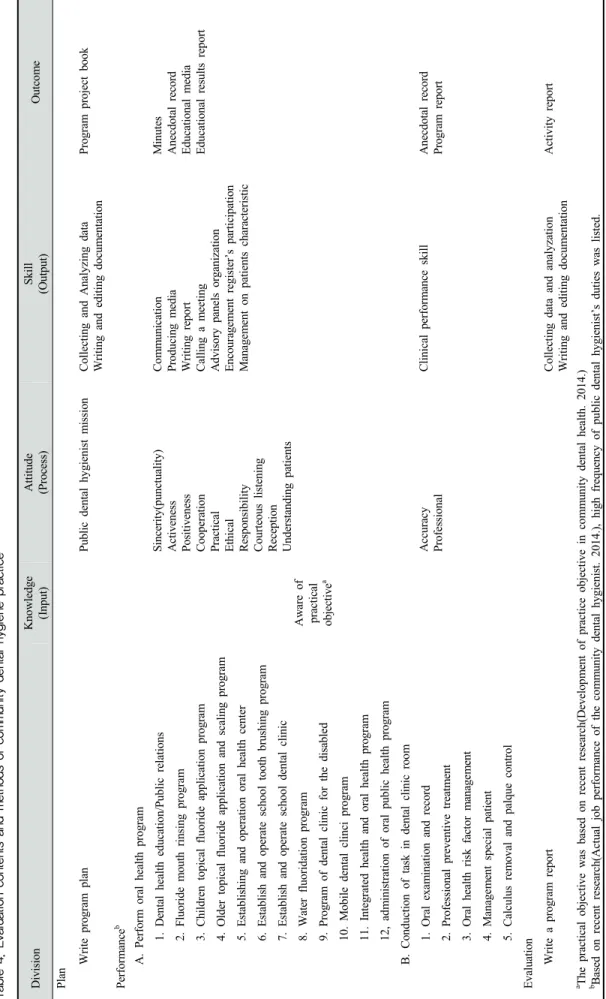
간호학과 사회복지학의 현장실습 평가지표를 기반으로 하여 ,
‘지식(input)-태도(process)-술기능력(output)-성과(outcome)’
의 분류로 보건치과위생사의 직무 중 최근연구[15]의 결과에 따라 수행 빈도가 높은 보건사업을 ‘기획-수행-평가’ 단계에 따라 분류하여 지역사회치위생학 현장실습 평가 지표를 제안하 였다.
연구 결과
1. 치위생(학)과와 보건소의 지역사회치위생학 현장실습 평가 현황
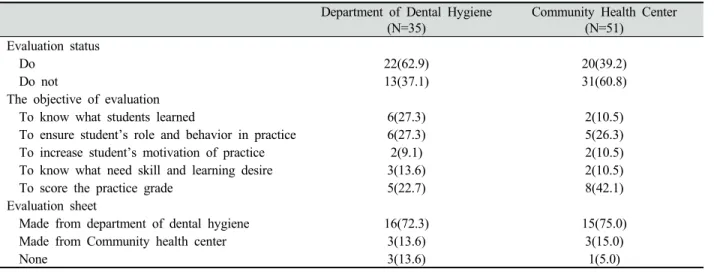
지역사회치위생학 현장실습 평가 현황에 대해서 조사한 결과는 <Table 1>과 같다.
치위생(학)과의 62.9%가 평가를 실시하였고, 보건소에서 는 39.2%만이 평가를 실시하고 있었다.
실습성과 평가를 실시하는 목적으로는 학교에서는 ‘실습 을 통하여 무엇을 배웠는지 알기 위해서(27.3%)’와 ‘실습생 들로 하여금 자신들의 행동 및 역할을 명확히 하기 위해서 (27.3%)’를 가장 많이 응답하였고, 보건소에서는 ‘현장실습 채점점수를 입력하기 위해서 (42.1%)’로 가장 많이 응답하 였다.
실습평가 양식으로는 학교(72.3%)와 보건소(75.0%) 모 두 대부분 ‘대학의 실습평가서’를 사용하고 있었다.
2. 간호학과 사회복지학의 관련 교과과정 실습성과 평가 방법
2.1. 간호학
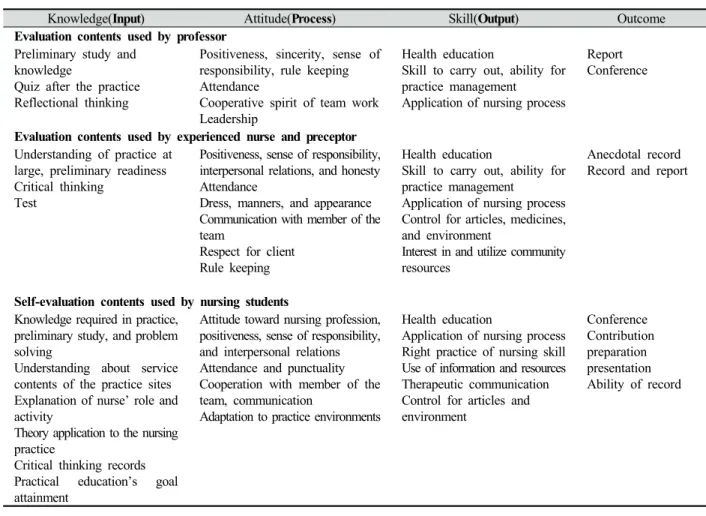
전국의 53개의 간호학과를 조사한 연구[13]에 따르면, 35개의 학교에서 지역사회간호학 실습 평가내용은 <Table 2>와 같았다.
실습성과 평가는 크게 지도교수, 실습지도 강사, 학생 자 체 평가 3가지로 이루어졌다. 이 결과를 지식, 태도, 술기능 력, 성과로 나누어 살펴보았을 때, 지식 부분은 사전의 지식 을 실습과정에 적용하는지를 시험, 퀴즈 등을 통해 평가하 였다. 태도는 긍정적, 책임감, 출석/시간엄수, 조원 간의 의 사소통/협동력, 용모, 실습에 적용하는 것을 평가하였고, 술 기능력은 보건교육, 간호 실습 관리를 수행하는 능력, 간호 과정의 적용, 물품 관리 및 지역사회 자원의 활용 정도로 평 가하였다. 최종 학습 성과를 평가하가 위해서 실습 활동일 지, 중간 및 최종보고서, 리포트로 평가하였고, 각 case에 대해 집단토론회를 통한 발표로 평가를 실시하였다.
2.2. 사회복지학
한국사회복지사협회에서 발표한 ‘사회복지현장실습 실태 조사 및 지침서[14]’에서 제시하고 있는 사회복지학 현장실
Department of Dental Hygiene (N=35)
Community Health Center (N=51)
Evaluation status
Do 22(62.9) 20(39.2)
Do not 13(37.1) 31(60.8)
The objective of evaluation
To know what students learned 6(27.3) 2(10.5)
To ensure student’s role and behavior in practice 6(27.3) 5(26.3)
To increase student’s motivation of practice 2(9.1) 2(10.5)
To know what need skill and learning desire 3(13.6) 2(10.5)
To score the practice grade 5(22.7) 8(42.1)
Evaluation sheet
Made from department of dental hygiene 16(72.3) 15(75.0)
Made from Community health center 3(13.6) 3(15.0)
None 3(13.6) 1(5.0)
Table 1. Evaluation of community dental hygiene practice Unit: N(%)
40
•J Korean Soc Dent Hyg 2016; 16(1): 37-43습 평가서의 내용은 <Table 3>과 같다.
지식, 태도, 술기능력, 성과지표로 분류한 결과, 지식은 실습기관의 이해, 사전 지식의 실습적 이해, 자료에 근거한 적절한 대상자 사정의 분류 등 실습에 필요한 지식을 가지 고 있는지를 평가하였다. 태도는 시간엄수, 적극성/긍정적, 수용성, 성실성, 타인과의 관계, 전문가로서 객관성과 책임 감의 분류로 사회복지사로서 지역사회 실습에 적절한 태도 로 임하는지를 평가하였다. 이를 통해 일의 우선순위를 결
정하고, 할당된 시간 내 일을 계획 및 수행하면 적절한 주변 자원을 활용하고 자료를 수집 할 수 있는가를 통해 술기능 력을 평가하였다 . 실습성과는 실습계획서, 기관분석보고서, 실습일지, 실습 중간 및 종결 평가서를 이용하여 평가하였다.
Knowledge(Input) Attitude(Process) Skill(Output) Outcome
Understanding of community practice institute
Understanding of practice at preliminary study
Right patient assessment based on data
Attendance and punctuality Activeness/positiveness Receptiveness
Sincerity
Relationship with preceptors Cooperation with members of team
Objectivity Responsibility
Decision prioritizing task Communication skill with clients
Ability to react
Schedule/fulfill within allotted time
Application of social welfare process
Control for recourse around Collecting suitable data
Record practice program Institute analysis report Anecdotal record
Middle term practice evaluation sheet
Final term practice evaluation sheet
Table 3. Evaluation index of social welfare practice
Knowledge(Input) Attitude(Process) Skill(Output) Outcome
Evaluation contents used by professor Preliminary study and
knowledge
Quiz after the practice Reflectional thinking
Positiveness, sincerity, sense of responsibility, rule keeping Attendance
Cooperative spirit of team work Leadership
Health education
Skill to carry out, ability for practice management
Application of nursing process
Report Conference
Evaluation contents used by experienced nurse and preceptor Understanding of practice at
large, preliminary readiness Critical thinking
Test
Positiveness, sense of responsibility, interpersonal relations, and honesty Attendance
Dress, manners, and appearance Communication with member of the team
Respect for client Rule keeping
Health education
Skill to carry out, ability for practice management
Application of nursing process Control for articles, medicines, and environment
Interest in and utilize community resources
Anecdotal record Record and report
Self-evaluation contents used by nursing students Knowledge required in practice,
preliminary study, and problem solving
Understanding about service contents of the practice sites Explanation of nurse’ role and activity
Theory application to the nursing practice
Critical thinking records
Practical education’s goal attainment
Attitude toward nursing profession, positiveness, sense of responsibility, and interpersonal relations Attendance and punctuality Cooperation with member of the team, communication
Adaptation to practice environments
Health education
Application of nursing process Right practice of nursing skill Use of information and resources Therapeutic communication Control for articles and environment
Conference
Contribution
preparation
presentation
Ability of record
Table 2. Evaluation contents of community nursing practice
이가영⋅한양금⋅김영경⋅임현주⋅권양옥⋅김한미⋅박정란⋅김남희 / 지역사회치위생학 현장(보건소)실습 성과평가 내용분석 DivisionKnowledge (Input)Attitude (Process)Skill (Output)Outcome Plan Aware of practical objectivea
Write program planPublic dental hygienist missionCollecting and Analyzing data Writing and editing documentationProgram project book Performanceb A. Perform oral health program 1. Dental health education/Public relationsSincerity(punctuality) Activeness Positiveness Cooperation Practical Ethical Responsibility Courteous listening Reception Understanding patients Communication Producing media Writing report Calling a meeting Advisory panels organization Encouragement register’s participation Management on patients characteristic Minutes Anecdotal record Educational media Educational results report
2. Fluoride mouth rinsing program 3. Children topical fluoride application program 4. Older topical fluoride application and scaling program 5. Establishing and operation oral health center 6. Establish and operate school tooth brushing program 7. Establish and operate school dental clinic 8. Water fluoridation program 9. Program of dental clinic for the disabled 10. Mobile dental clinci program 11. Integrated health and oral health program 12, administration of oral public health program B. Conduction of task in dental clinic room 1. Oral examination and recordAccuracy ProfessionalClinical performance skillAnecdotal record Program report 2. Professional preventive treatment 3. Oral health risk factor management 4. Management special patient 5. Calculus removal and palque control Evaluation Write a program reportCollecting data and analyzation Writing and editing documentationActivity report aThe practical objective was based on recent research(Development of practice objective in community dental health. 2014.) b Based on recent research(Actual job performance of the community dental hygienist. 2014.), high frequency of public dental hygienist’s duties was listed.
Tab le 4. E val uat io n cont en ts a nd m et hods of com m un ity de nt al h yg iene pr ac tice
42
•J Korean Soc Dent Hyg 2016; 16(1): 37-433. 지역사회치위생학 현장실습 성과평가내용 및 방법 제안