13
Copyright © 2019 The Korean Society of Fisheries and Aquatic Science pISSN:0374-8111, eISSN:2287-8815
서 론
Biogenic amines (BAs)
은미생물,
식물,
동물의대사과정에 서아미노산의탈탄산작용혹은알데하이드와케톤의아미노화 와아미노기전이반응을통해생성되며(Karovicova and Koha- jdova, 2005)
지방족(putrescine, cadaverine, spermine, spermi- dine),
방향족(tyramine, phenylethylamine),
헤테로고리구조(histamine, tryptamine)
를가진형태로되어있다(Silla-Santos, 1996).
이러한BAs
는호르몬,
알카로이드,
핵산,
단백질등의 생합성을위한전구물질로알려져있으며,
체온및혈압조절등 의기능을갖는것으로보고되었다(Silla-Santos, 1996; Greif et al., 1997).
또한, putrescine, spermidine, spermine
과cadaver- ine
은살아있는세포의구성성분으로핵산작용의조절,
단백질 합성과막안정성에중요한역할을하고있으며,
식품의향과 맛에도영향을주는것으로알려져있다(Halasz et al., 1994).
BAs
는인체에서생합성되는필수생리물질로서합성·
분해의 대사과정을통해일정한균형을이루고있다.
일반적으로인체에는바이오제닉아민을분해하는
mono-, diamine oxidase
가 소장에존재하여무독화하는시스템을갖추고있다.
하지만과 잉의아민이섭취되는경우,
우울증치료제인phenelzine
과같 은mono-amine oxidase inhibitors (MAOIs)
를복용하고있는 환자의경우,
술을과량섭취한경우, putrescine
과cadaverine
등이함께존재하는경우및소장에질환이있는경우에는효소 의작용이이루어지지않아BAs
가소량섭취되어도인체에유 해한증상이나타날수있다(Bjeldanes et al., 1978; Chu and Bjeldanes, 1981).
또한putrescine, spermidine, spermine
은종 양생장을촉진하며(Bardocz, 1995), agmatine, spermine, sper- midine
등은발암물질인nitrosamine
의전구체로알려져있다(Halasz et al., 1994).
특히, histamine
은sco-mbrotoxicosis
를유발하는것으로알려져있으며
, tyramine
은혈관수축에관여하여
‘cheese reaction’
을통한고혈압및편두통을유발하는것 으로알려져있다(Bardocz, 1995; Cho et al., 2006).
이러한독 성으로 인해,
미국FDA
는수산물에서histamine 50 mg/kg, tyramine 100 mg/kg,
총BAs 1,000 mg/kg
을수산물의잔류젓갈류 및 배추김치에서의 바이오제닉 아민류 함량 조사 연구
신상운*·김영숙·김양희·김한택·엄경숙·홍세라·강효정·박광희·윤미혜
경기도보건환경연구원 보건연구기획팀
Biogenic-Amine Contents of Korean Commercial Salted Fishes and Cabbage Kimchi
Sang-Woon Shin*, Young-Sug Kim, Yang-Hee Kim, Han-Taek Kim, Kyoung-Suk Eum, Se-Ra Hong, Hyo-Jeong Kang, Kwang-Hee Park and Mi-Hye Yoon
Public Health Research Planning Team, Gyeonggi-Do Institute of Health and Environment, Suwon 16205, Korea
We determined the contents of 11 biogenic amines in 20 types of cabbage kimchi, 10 types of fish sauce, and 40 types of salted fish purchased from small- and medium-sized grocery stores in Gyeonggi-Do, Republic of Korea, from June to October 2017. The content of each of the biogenic amines in the various types of cabbage kimchi was slightly lower than that in detection amounts of each of the 10 types of biogenic amines and the values reported by Joe et al . The histamine content of all five types of anchovy sauce was lower than the limit set by the European Union (400 mg/
kg), but that of three of the five types of sand lance sauce was higher. Analyzing the ratios of the contents of five highly toxic biogenic amines to those of the 11 biogenic amines yielded no quantitative correlation. The estimated daily intake of the five highly toxic biogenic amines in cabbage-kimchi and fermented fish was ≤ 6 mg.
Key words: Biogenic amines, Exposure assessment, Histamine, Salted fish, Kimchi
*Corresponding author: Tel: +82. 31. 250. 2582 Fax: +82. 31. 250. 2588 E-mail address: [email protected]
This is an Open Access article distributed under the terms of the Creative Commons Attribution Non-Commercial Licens (http://creativecommons.org/licenses/by-nc/3.0/) which permits unrestricted non-commercial use, distribution, and reproduction in any medium, provided the original work is properly cited.
Received 12 November 2018; Revised 17 December 2018; Accepted 26 December 2018 저자 직위: 신상운(연구사), 김영숙(연구기획팀장), 김양희(연구관), 김한택 (연구사), 엄경숙(행정주사보), 홍세라(공무직), 강효정(공무직), 박광희(연 구부장), 윤미혜(연구원장)
https://doi.org/10.5657/KFAS.2019.0013
Korean J Fish Aquat Sci 52(1), 13-18, February 2019
허용기준으로
, EU
에서는histamine 100 mg/kg,
총BAs 300 mg/kg
을수산물의잔류허용기준으로, histamine 400 mg/kg
을 젓갈류의잔류허용기준으로제안하고있으며(Lehane and Ol- ley, 2000; Hu et al., 2012)
우리나라의경우2013
년수산물중 냉동어류,
염장어류,
통조림,
건조/
절단등단순처리한것에한 하여histamine
기준을200 mg/kg
로설정하여관리하고있다(MFDS, 2016).
발효식품내에BAs
의함량은합성효소인아 미노산탈탄산효소활성과분해효소인바이오제닉아민산화효소활성에의해결정된다
. BAs
의생성은식품의위생적측면뿐만아니라발효기술등의제조방법에따라좌우되기때문에 국내외의연구들은맥주
,
소시지,
치즈등발효식품의
BAs
함 유량조사와함께이들성분을최소화하는방향으로진행되고 있다(Cho et al., 2006).
액젓의BAs
저감화를위한연구로는액 젓을제조할때단백질분해효소또는starter
를첨가하여BAs
생성균의생육을저해하는방법(Yongsawatdigul et al., 2007;
Jeong et al., 2014; Udomsil et al., 2015),
액젓에chlorine di- oxide
첨가하는방법(Zaman et al., 2011),
양념류의에탄올추 출물첨가에의한저해효과(Zhou et al., 2016),
어류가공품의pH
를4.5
이하로낮추어탈탄산효소활성의억제(Dapkevicius et al., 2000),
또는감마선조사에의한BAs
생성균의생육억제(Kim et al., 2004)
등의연구가진행되었으나실효성및현장 적용에는문제점이있는실정이다(Um et al., 2016). EU
에서 는젓갈류의histamine
기준을400 mg/kg
으로설정하여관리하고있지만
(EU, 2013)
우리나라의경우에는배추김치에많이사용되는멸치액젓이나까나리액젓또는각종수산물가공식품 인젓갈류의
BAs
에대한기준이설정되어있지않아수산식품위생및국민건강을위해
BAs
관리의필요성이꾸준히제기되고있다
.
또한,
발효제조의특성상식품내생성잔류가능한BAs
함량이일정하지않음에따라지속적인모니터링과관리가필 요하다.
따라서현시점에서기준설정이되어있지않은수산가 공식품에서의BAs
잔류정도를모니터링하여향후수산가공식품의
BAs
기준설정및관리와더불어소비자에게유용한정보를제공하기위해이번조사연구를수행하였다
.
재료 및 방법
재료 및 시약
실험에사용한배추김치
(20
건)
및젓갈류(50
건)
는2017
년6
월부터10
월까지 경기도 중소형 유통매장에서 구입하였다. Biogenic amine
표준품인agmatine (AGM) (97%), putrescine (PUT), cadaverine (CAD) (95%), spermidine (SPD), spermine (SPM), tryptamine (TRY) (97.5%), histamine (HIS), tyramine (TYR) (98.5%), β-phenylethylamine (PHE), serotonin (SER) (98%), noradrenaline (NOR) (98%), dopamine (DOP)
와내부 표준물질로서사용되는1,7-diaminoheptane (IS) (98%)
및유 도체시약dansyl chloride
는모두Sigm-Aldrich (St Louis, Mis-
souri, USA)
제품을사용하였다.
이동상인acetonitrile (Sigm- Aldrich, St Louis, Missouri, USA)
은HPLC
급을사용하였으 며, ether (Sigm-Aldrich, St Louis, Missouri, USA)
등은모두 특급시약을사용하였다.
표준용액 조제
각표준품및내부표준물질을
0.1N HCl
에녹여약1,000 mg/
L
가되도록한것을표준원액으로사용하였고이를각혼합하 여IS
는98 mg/L, AGM
및DOP
는각각30 mg/L, PUT, CAD, SPD, CAD, SPM, TRY, HIS, TYR, PHE, SER
및NOR
은각 각10 mg/L
정도로희석한것을혼합표준용액으로하였다(Fig.
1).
정량분석시검량선은혼합표준용액농도를기준으로1/2
씩 단계희석하여적용하였다.
시료추출 및 유도체화
BAs
의분석은식품공전의수산물에대한규격(MFDS, 2016)
에준 하여실시하였다.
시료1.0 mL
에0.1N HCl
을가하여50 mL
로 정용하여시험용액으로사용하였다.
시험용액1.0 mL
를시험 관에취하고여기에내부표준용액0.1 mL,
포화탄산나트륨용 액0.5 mL
와1% dansyl chloride
용액0.8 mL
를가하여충분 히혼합한후마개를하여45℃
에서1
시간유도체화하였다.
유 도체화한 표준용액및시험용액에10% proline
용액0.5 mL
및ether 5 mL
를가하여10
분간진탕하고상층액을취하여질 소가스로농축한뒤acetonitrile 1 mL
를가하여녹이고0.45 μm syringe filter
로여과한것을HPLC system (Ultimate 3000, ThermoFisher scientific co., Massachusetts, Waltham, USA)
으로분석하였으며,
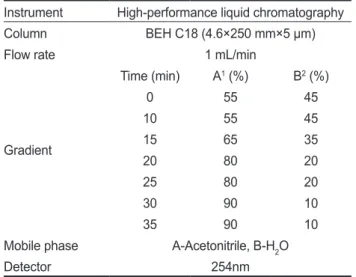
분석조건은Table 1
과같다.
회수율 및 검출 한계
회수율은시료에표준물질을
10 mg/kg
이되도록용액을조제Table 1. Analytical conditions of liquid chromatography Instrument High-performance liquid chromatography
Column BEH C18 (4.6×250 mm×5 µm)
Flow rate 1 mL/min
Gradient
Time (min) A1 (%) B2 (%)
0 55 45
10 55 45
15 65 35
20 80 20
25 80 20
30 90 10
35 90 10
Mobile phase A-Acetonitrile, B-H2O
Detector 254nm
A1, Acetonitrile; B2, H2O.
하여첨가한뒤분석법에따라
3
회반복처리하여측정하였다.
검출한계(limits of detection, LOD)
와정량한계(limits of quan- titation, LOQ)
는ICH guideline (ICH Expert Working Group, 2005)
에서제시한아래산출방법에따라구하였다.
LOD=3. 3×σ/S LOQ=10×σ/S
σ=The standard deviation of Y entercept S=The slope of the calibration curve
결과 및 고찰
회수율, 검출한계 및 정량한계
오징어젓갈에서의 분석대상
BAs 12
종의 회수율,
검출한 계및정량한계는Table 2
와같다.
상관계수는0.9902-0.9996
으로양호한직선성을보였다.
분석대상BAs 12
종의LOD
는0.03-0.80 mg/kg, LOQ
는0.06-2.43 mg/kg
수준이었고 회수 율은AGM 56.3% (
상대표준편차4.5%)
을제외한BAs 11
종은81.4%-97.4%,
상대표준편차는10%
이내로본연구의실험수 행에적합한것으로판단되었다.
품목별 분석 결과
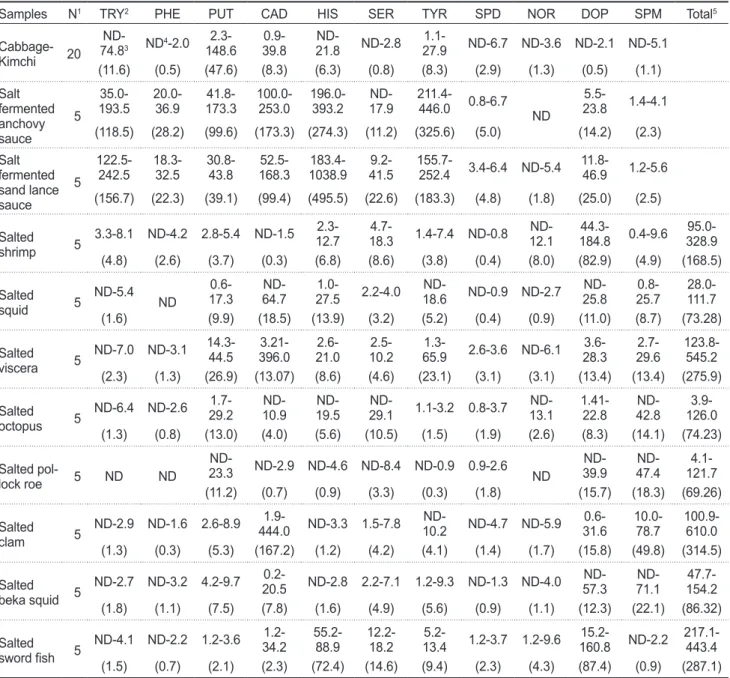
시료의분석결과는
Table 3
에나타내었다.
배추김치에존재하는
PUT
은2.3 mg/kg-148.6 mg/kg (
평균47.6 mg/kg), TRY
은불검출-74.8 mg/kg (
평균11.6 mg/kg), CAD
은0.9 mg/kg- 39.8 mg/kg (
평균8.3 mg/kg), TYR
은1.1 mg/kg-27.9 mg/kg (
평균8.3 mg/kg), HIS
은불검출-21.8 mg/kg (
평균6.3 mg/kg)
으로검출되었다.
그외BAs
는10 mg/kg
미만이었다.
배추김치 는배추에식염,
고춧가루,
마늘,
젓갈등부재료를넣어만든발 효식품으로김치에많이사용되는액젓의사용량에따라BAs
함량이늘어날수있으며(Mah et al., 2004; Cho et al., 2006),
저장및숙성과정에서미생물의작용으로
BAs
함량이늘어날수있다
(Kalac et al.,1999).
따라서본실험에사용한김치가모 두숙성후저장보관중이던시료임에도불구하고기존연구보 고(Cho et al., 2006)
와BAs
각각의검출량평균을비교하였을 때NOR, DOP
을제외한10
종의BAs
함량이다소낮게나타난 것은현대인의식생활변화에맞추어김치제조시액젓의사용 량이줄었거나BAs
저감화노력으로액젓에포함된BAs
의함 량이줄었을가능성이있다.
하지만일부김치에서Kalac et al.
(1999)
이제안한BAs
허용기준HIS 10 mg/kg, TYR 20 mg/kg
이하보다높은검출량을나타내어BAs
에대한저감화노력과 지속적인모니터링이필요할것으로보인다.
젓갈은어류,
갑각 류,
연체동물류등의전체또는일부분을주원료로하여식염을 가하여발효숙성시킨식품이다.
액젓은젓갈을여과하거나분 리한액또는이에여과분리하고남은것을재발효또는숙성 시킨후여과하거나분리한액을혼합한것을말한다(MFDA 2016).
멸치액젓은TRY 35.0 mg/kg-193.5 mg/kg (
평균118.5 mg/kg), PHE 20.0 mg/kg-36.9 mg/kg (
평균28.2 mg/kg), PUT 41.8 mg/kg-173.3 mg/kg (
평균99.6 mg/kg), CAD 100.0 mg/
kg-253.0 mg/kg (
평균173.3 mg/kg)
이검출되었다. HIS
의경 우196.0 mg/kg-393.2 mg/kg (
평균274.3 mg/kg)
이검출되었 고실험에사용한멸치액젓5
건모두EU
연합기준인400 mg/
kg
미만이었다.
또한SER
불검출-17.9 mg/kg (
평균11.2 mg/
kg), TYR 211.4 mg/kg-446.0 mg/kg (
평균325.6 mg/kg), SPD 0.8 mg/kg-6.7 mg/kg (
평균5.0 mg/kg), NOR
은불검출, DOP 5.5 mg/kg-23.8 mg/kg (
평균14.2 mg/kg), SPM 1.4 mg/kg-4.1 mg/kg (
평균2.3 mg/kg)
을나타내었다.
까나리액젓에서TRY 122.5 mg/kg-242.5 mg/kg (
평균156.7 mg/kg), PHE 18.3 mg/kg- 32.5 mg/kg (
평균22.3 mg/kg), PUT 30.8 mg/kg-43.8 mg/kg (
평균39.1 mg/kg), CAD 52.5 mg/kg-168.3 mg/kg (
평균99.4 mg/kg)
이검출되었다. HIS
의경우183.4 mg/kg-1038.9 mg/
kg (
평균495.5 mg/kg)
이검출되었고실험에사용한까나리액 젓5
건중2
건(183.4 mg/kg, 209.1 mg/kg)
을제외한나머지3
건(424.0 mg/kg, 622.1 mg/kg, 1038.9 mg/kg)
은모두EU
연 합기준400 mg/kg
을초과하였다.
또한SER 9.2 mg/kg-41.5 mg/kg (
평균22.6 mg/kg), TYR 155.7 mg/kg-252.4 mg/kg (
평 균183.3 mg/kg), SPD 3.4 mg/kg-6.4 mg/kg (
평균4.8 mg/kg), NOR
은불검출-5.4 mg/kg (
평균1.8 mg/kg), DOP 11.8 mg/
kg-46.9 mg/kg (
평균25.0 mg/kg), SPM 1.2 mg/kg-5.6 mg/
Table 2. LOD, LOQ and recoveries of in squid jeotgal Biogenic
amines
Correlation coefficient
(r2)
LOD1 (mg/kg)
(n=6)
LOQ2 (mg/kg)
(n=6)
Recovery±
SD (%) (n=3)
AGM3 0.9972 0.80 2.43 56.3±4.5
TRY 0.9990 0.26 0.79 84.7±4.2
PHE 0.9965 0.19 0.57 97.4±4.3
PUT 0.9970 0.28 0.86 85.6±4.7
CAD 0.9945 0.44 1.32 91.1±1.6
HIS 0.9902 0.13 0.40 95.4±3.6
SER 0.9991 0.03 0.09 84.5±4.2
TYR 0.9996 0.05 0.16 82.2±1.5
SPD 0.9942 0.11 0.35 81.4±1.3
NOR 0.9950 0.02 0.06 85.2±4.2
DOP 0.9978 0.07 0.21 85.4±4.4
SPM 0.9988 0.42 1.27 83.4±1.8
1Limit of detection. 2Limit of quantification. 3AGM, agmatine;
TRY, tryptamine; PHE, β-phenylethylamine; PUT, putrescine;
CAD, cadaverine; HIS, histamine; SER, serotonine; TYR, tyra- mine SPD, spermidine; NOR, noradrenaline; DOP, dopamine;
SPM, spermine.
Table 3. The contents of biogenic amines in cabbage-kimches, salt-fermented fish sauces and salt-fermented fish products (mg/kg)
Samples N1 TRY2 PHE PUT CAD HIS SER TYR SPD NOR DOP SPM Total5
Cabbage- Kimchi 20
74.8ND-3 ND4-2.0 2.3-
148.6 0.9-
39.8 ND-
21.8 ND-2.8 1.1-
27.9 ND-6.7 ND-3.6 ND-2.1 ND-5.1 (11.6) (0.5) (47.6) (8.3) (6.3) (0.8) (8.3) (2.9) (1.3) (0.5) (1.1) Salt
fermented anchovy sauce
5 35.0-
193.5 20.0-
36.9 41.8-
173.3 100.0-
253.0 196.0- 393.2 ND-
17.9 211.4-
446.0 0.8-6.7 ND
23.85.5- 1.4-4.1 (118.5) (28.2) (99.6) (173.3) (274.3) (11.2) (325.6) (5.0) (14.2) (2.3) Salt
fermented sand lance sauce
5
122.5- 242.5 18.3-
32.5 30.8-
43.8 52.5-
168.3 183.4- 1038.9 9.2-
41.5 155.7-
252.4 3.4-6.4 ND-5.4 11.8-
46.9 1.2-5.6 (156.7) (22.3) (39.1) (99.4) (495.5) (22.6) (183.3) (4.8) (1.8) (25.0) (2.5)
Salted
shrimp 5 3.3-8.1 ND-4.2 2.8-5.4 ND-1.5 2.3-
12.7 4.7-
18.3 1.4-7.4 ND-0.8 ND-
12.1 44.3-
184.8 0.4-9.6 95.0- 328.9 (4.8) (2.6) (3.7) (0.3) (6.8) (8.6) (3.8) (0.4) (8.0) (82.9) (4.9) (168.5) Salted
squid 5 ND-5.4
ND 0.6-
17.3 ND-
64.7 1.0-
27.5 2.2-4.0 ND-
18.6 ND-0.9 ND-2.7 ND-
25.8 0.8-
25.7 28.0- 111.7 (1.6) (9.9) (18.5) (13.9) (3.2) (5.2) (0.4) (0.9) (11.0) (8.7) (73.28) Salted
viscera 5 ND-7.0 ND-3.1 14.3-
44.5 3.21- 396.0 2.6-
21.0 2.5-
10.2 1.3-
65.9 2.6-3.6 ND-6.1 3.6-
28.3 2.7-
29.6 123.8- 545.2 (2.3) (1.3) (26.9) (13.07) (8.6) (4.6) (23.1) (3.1) (3.1) (13.4) (13.4) (275.9) Salted
octopus 5 ND-6.4 ND-2.6 1.7-
29.2 ND-
10.9 ND-
19.5 ND-
29.1 1.1-3.2 0.8-3.7 ND-
13.1 1.41-
22.8 ND-
42.8 3.9- 126.0 (1.3) (0.8) (13.0) (4.0) (5.6) (10.5) (1.5) (1.9) (2.6) (8.3) (14.1) (74.23) Salted pol-
lock roe 5 ND ND
23.3ND- ND-2.9 ND-4.6 ND-8.4 ND-0.9 0.9-2.6 ND
39.9ND- ND-
47.4 4.1- 121.7 (11.2) (0.7) (0.9) (3.3) (0.3) (1.8) (15.7) (18.3) (69.26) Salted
clam 5 ND-2.9 ND-1.6 2.6-8.9 1.9-
444.0 ND-3.3 1.5-7.8 ND-
10.2 ND-4.7 ND-5.9 0.6-
31.6 10.0-
78.7 100.9- 610.0 (1.3) (0.3) (5.3) (167.2) (1.2) (4.2) (4.1) (1.4) (1.7) (15.8) (49.8) (314.5) Salted
beka squid 5 ND-2.7 ND-3.2 4.2-9.7 0.2-
20.5 ND-2.8 2.2-7.1 1.2-9.3 ND-1.3 ND-4.0 ND-
57.3 ND-
71.1 47.7- 154.2 (1.8) (1.1) (7.5) (7.8) (1.6) (4.9) (5.6) (0.9) (1.1) (12.3) (22.1) (86.32) Salted
sword fish 5 ND-4.1 ND-2.2 1.2-3.6 1.2-
34.2 55.2-
88.9 12.2- 18.2 5.2-
13.4 1.2-3.7 1.2-9.6 15.2-
160.8 ND-2.2 217.1- 443.4 (1.5) (0.7) (2.1) (2.3) (72.4) (14.6) (9.4) (2.3) (4.3) (87.4) (0.9) (287.1)
1Number of samples examined. 2TRY, tryptamine; PHE, β-phenylethylamine; PUT, putrescine; CAD, cadaverine; HIS, histamine; SER, serotonine; TYR, tyramine SPD, spermidine; NOR, noradrenaline; DOP, dopamine; SPM, spermine. 3Minimum-maximum value (mean value). 4Not detected. 5Sum of TRY, tryptamine; PHE, β-phenylethylamine; PUT, putrescine; CAD, cadaverine; HIS, histamine; SER, sero- tonine; TYR, tyramine; SPD, spermidine; NOR, noradrenaline; DOP, dopamine; SPM, spermine in salt-fermented fish products.
kg (
평균2.5 mg/kg)
을나타내었다. HIS
의경우기존연구에서Cho et al. (2006)
은멸치액젓352.5 mg/kg-1127.6 mg/kg (
평 균624.5 mg/kg),
까나리액젓215.4 mg/kg-1124.1 mg/kg (
평 균584.2 mg/kg)
으로보고하였고Kim et al. (2011)
은멸치액 젓421.2-1507.1 mg/kg (
평균763.0 mg/kg),
까나리액젓419.1 mg/kg-1025.5 mg/kg (
평균666.5mg/kg)
으로높은검출량을 보고하였는데본실험에서는멸치액젓은모두EU
연합기준 인400 mg/kg
미만이었고까나리액젓은5
건중3
건의시료에서
EU
연합기준인400 mg/kg
을넘는검출량을나타내어멸 치액젓보다까나리액젓의HIS
함량이더높은것으로나타났 다.
본실험에사용한멸치액젓의멸치함량은75%-77%,
까나리액젓의까나리함량은
50%
였다.
이번연구결과에서까나리액젓의함량이더적음에도불구하고
HIS
함량이높게나타난것은어종이나숙성정도에따른것으로판단된다
.
멸치액젓및 까나리액젓의BAs
함량은여전히높은수준이지만김치등식 품의부재료로소량첨가되어섭취되므로위해성이높지않을것으로판단된다
.
하지만수출에서의문제점이있는등BAs
함 량을저감화할수있는발효및저장온도를낮추거나글리신이 나마늘추출물을첨가하여부패미생물을효과적으로조절하 는방법등의지속적인연구와모니터링이필요할것으로판단 된다.
젓갈의총BAs
함량은조개젓갈100.9 mg/kg-610.0 mg/
kg (
평균314.5 mg/kg),
황석어젓갈217.1 mg/kg-443.4 mg/kg (
평균287.1 mg/kg),
창란젓갈123.8 mg/kg-545.2 mg/kg (
평균275.9 mg/kg),
새우젓갈95.0 mg/kg-328.9 mg/kg (
평균168.5 mg/kg),
꼴뚜기젓갈47.7 mg/kg-154.2 mg/kg (
평균86.32 mg/
kg),
낙지젓갈3.9 mg/kg-126.0 mg/kg (
평균74.23 mg/kg),
오 징어젓갈28.0 mg/kg-111.7 mg/kg (
평균73.28 mg/kg),
명란젓 갈4.1 mg/kg-121.7 mg/kg (
평균69.26 mg/kg)
순으로나타났 다. HIS, TYR, PUT, CAD, PHE
등5
종은독성발현가능성으 로인해발효식품중주요잔류분석조사대상(Beneduce et al., 2010)
이며본연구에서의분석대상11
종의BAs
총함량대비독성발현가능성이높은것으로보고된
BAs 5
종의함량비율은창란젓갈
63.8%,
오징어젓갈58.6%,
황석어젓갈39.9%,
조 개젓갈38.0%,
낙지젓갈31.4%,
꼴뚜기젓갈30.8%,
명란젓갈16.6%,
새우젓갈13.1%
순으로나타났다.
하지만,
총BAs
잔 류량과독성유발가능5
종BAs
잔류량간의정량적상관성은관 찰되지않았다.
Biogenic amine의 섭취량
식품별일일섭취량
(KHIDI, 2015)
을기초로하여김치및낙 지젓갈,
명란젓갈,
오징어젓갈,
창란젓갈,
조개젓갈그리고새 우젓갈에대한독성발현가능성이높은5
종의BAs
의일일섭취 량을추정하였다(Table 4).
그결과기존연구보고(Horowitz et al., 1964; Bieck et al., 1998; Cho et al., 2006)
에서는TYR
섭취량이
6 mg
이상이되는배추김치가조사되어편두통환자나MAOIs
계약물을복용하는사람은가급적피하는것이좋을것으로판단되었으나이번연구에서는김치및젓갈모두에서
6
mg
을넘지않았다.
하지만기호에따라섭취하는식품종류및섭취량은달라질수있으므로여전히주의해야할필요가있을 것으로판단된다
.
References
Bardocz A. 1995. Polyamines in food and their consequences for food quality and human health. Trends Food Sci Technol 6, 341-346. https://doi.org/10.1016/s0924-2244(00)89169- Beneduce L, Romano A, Capozzi V, Lucas P, Barnavon L, Bach 4.
B, Vuchot P, Grieco F and Spano G. 2010. Biogenic amine in wines. Ann Microbiol 60, 573-8. https://doi.org/10.1007/
s13213-010-0094-4.
Bieck PR and Antonin KH. 1988. Oral tyramine pressor test and the safety of monoamine oxidase inhibitor drugs: com- parison of brofaromine and tranylcypromine in healthy subjects. J Clin Psyachopharmacol 8, 237-245. https://doi.
org/10.1097/00004714-198808000-00002.
Bjeldanes LF, Schutz DE and Morris MM. 1978. On the aetiol- ogy of scombroid poisoning: cadaverine potentiation hista- mine toxicity in guinea pig. Food Cosmet Toxicol 16, 157- 159. https://doi.org/10.1016/s0015-6264(78)80196-5.
Cho TY, Han GH, Bahn KN, Son YW, Jang MR, Lee CH, Kim SH, Kim DB and Kim SB. 2006. Evalution of biogenic amines in Korean commercial fermented foods. Korea J Food Sci Technol 38, 730-737.
Chu CH and Bjeldanes LF. 1981. Effects of diamines poly- amines and tuna fish extracts on the binding of histamine to mucin in vitro. J Food Sci 47, 7980-7988. https://doi.
org/10.1111/j.1365-2621.1982.tb11031.x.
Dapkevicius MLNE, Nout MJR, Rombouts FM, Houben JH and Wymenga W. 2000. Biogenic amine formation and deg- radation by potential fish silage starter microorganisms. Int J Food Microbiol 57, 107-114. https://doi.org/10.1016/s0168- 1605(00)00238-5.
EU (European Union). 2013. Regulation 1019/2013/EU. Com- mission Regulation EU No 1019/2013. Amending annex I to regulation EC No 2073/2005 as regards histamine in fish- ery products. OJ L 282, 46-47.
Greif G, Greifova M and Drdak M. 1997. Determination of biogenic amines in foods of animal origin by HPLC. Potrav Table 4. Estimation of histamine, tyramine, putrescine, cadaverine and β-phenylethylamine intake based on dietary intake about fermented foods
Samples Daily intake (g/day) Intake (mg/day)
Histamine Tyramine Putrescine Cadaverine β-phenylethylamine
Cabbage-kimchi 68.4 0-1.5 0.1-1.8 0-0.1 0.1-2.7 0-0.1
Salted octopus 28.5 0-0.6 0-0.1 0-0.8 0-0.3 0-0.1
Salted pollock roe 16.0 0-0.1 0 0-0.4 0 0
Salted shrimp 4.8 0-0.1 0 0 0 0
Salted squid 11.3 0-0.3 0-0.2 0-0.2 0-0.7 0
Salted clam 9.7 0 0-0.1 0-0.1 0-4.3 0
Salted viscera 10.6 0-0.2 0-0.7 0.2-0.5 0.3-4.2 0
Vedy 15, 119-129.
Halasz A, Barath A, Simon-Sarkadi L and Holzapfel W. 1994.
Biogenic amines and their production by microrganisms in food. Trends Food Sci Technol 5, 42-49.
Horowitz D, Lovenberg W and Engelmann K. 1964. Mono- amine oxidase inhibitors, tyramine, and cheese. JAMA 188, 1108. https://doi.org/10.1001/jama.1964.03060390010002.
Hu Y, Huang Z, Li J and Yang H. 2012. Concentration of bio- genic amines in fish, squid and octopus and their changes during storage. Food Chem 135, 2604-2611. https://doi.
org/10.1016/j.foodchem.2012.06.121.
ICH Expert Working Group. 2005. Validation of analytical pro- cedures: Text and methodology Q2(R1). ICH Harmonised tripartite guideline. Step 4, 1-18.
Jeong DW, Han S and Lee JH. 2014. Safety and technological characterization of Staphylococcus equorum isolates from jeotgal, a Korean high-salt-fermented seafood, for starter de- velopment. Int J Food Microbiol 188, 108-115. https://doi.
org/10.1016/j.ijfoodmicro.2014.07.022.
Kalac P, Spicka J, Krizek M, Steidlova S and Pelikanova T.
1999. Concentrations of seven biogenic amines in sauer- kraut. Food Chem 67, 275-280. https://doi.org/10.1016/
s0308-8146(99)00131-4.
Karovicova J and Kohajdova Z. 2005. Biogenic amines in Food Chem Pap 59, 70-79.
Kim BK, Kim YH, Lee HH, Cho YJ, Kim DS, Oh SM and Shim KB. 2011. Comparison of the chemical compositions and biogenic amine contents of aalt-fermented fish sauces pro- duced in Korea to evaluate the quality characteristics. Jour Fish Mar Sci Edu 23, 607-614.
Kim JH, Ahn HJ, Jo C, Park HJ, Chung YJ and Byun MW.
2004. Radiolysis of biogenic amines in model system by gamma irradiation Food Control 15, 405-408. https://doi.
org/10.1016/s0956-7135(03)00102-6.
Lehane L and Olley J. 2000. Histamine fish poisoning revis- ited. Int J Food Microbiol 58, 1-37. https://doi.org/10.1016/
s0168-1605(00)00296-8.
Mah JH, Kim YJ, No HK and Hwang H. J. 2004. Determination of biogenic amines in kimchi, Korean traditional fermented vegetable products. Food Sci Biotechnol 6, 826-829.
MFDS (Ministry of Food and Drug Safety).2016. Report of risk assessment of Biogenic Amines. National Institute of Food and Drug Safety Evaluation Report, Cheongju, Korea.
MFDS (Ministry of Food and Drug Safety). 2018. Food Code.
Retrieved from https://www.foodsafetykorea.go.kr/portal/
safefoodlife/food/foodRvlv/foodRvlv.do on Nov 9, 2018.
KHIDI (Korea Health Industry Development Institute). 2015.
National Food & Nutrition Statistics 2013: based on 2013 Korea National Health and Nutrition Examination Survey.
Retrieved from https://www.khidi.or.kr/kps on Feb 14, 2018.
Silla-Santos MH. 1996. Biogenic amines: Their importance in foods. Int J Food Microbiol 29, 213-231. https://doi.
org/10.1016/0168-1605(95)00032-1.
Udomsil N, Rodtong S, Tanasupawat S and Yongsawatdigul J.
2015. Improvement of Fish Sauce Quality by Strain CMC5- 3-1: A Novel Species of Staphylococcus sp. J Food Sci 80, 2015-2022. https://doi.org/10.1111/1750-3841.12986.
Um IS, Kim TO and Park KS. 2016. Isolation and Character- ization of Putrescine-producing Bacteria in commercially availabel sauces made from salted and fermented sand lance ammodytes personatus. Korean J Fish Aquat Sci 49, 573- 581. https://doi.org/10.5657/kfas.2016.0573.
Yongsawatdigul J, Rodtong S and Raksakulthai N. 2007. Ac- celeration of Thai fish sauce fermentation using proteinases and bacterial starter cultures. J Food Sci 72, 382-390. https://
doi.org/10.1111/j.1750-3841.2007.00532.x.
Zaman MZ, Baker FA, Jinap S and Bakar J. 2011. Novel starter cultures to inhibit biogenic amines accumulation during fish sauce fermentation. Int J Food Microbiol 145, 84-91. https://
doi.org/10.1016/j.ijfoodmicro.2010.11.031.
Zhou X, Qiu M, Zhao D, Lu F and Ding Y. 2016. Inhibitory effects of spices on biogenic amine accumulation during fish sauce fermentation. J Food Sci 81, 913-920. https://doi.
org/10.1111/1750-3841.13255.