옥수수주정박이 산란계의 생산성, 영양소이용율 및 분 암모니아 방출에 미치는 효과
신명호1ㆍ유한진1ㆍ이학림1ㆍ이수기1ㆍ이봉덕1*1
Effects of Corn Distiller's Dried Grains with Solubles on Production Performance, Nutrient Digestibilities and Fecal
Ammonia Emission in Laying Hens
M. H. Shin1․H. J. Rew1․H. R. Lee1․S. K. Lee1․B. D. Lee1*
ABSTRACT
A layer feeding trial was conducted to investigate the effects of high quality corn distiller's dried grains with solubles(DDGS) on laying performance and nutrient metabolizabilities. A total of 216 Hy-line Brown layers, 23-wk of age, were employed in a 10-wk feeding trial consisting of three dietary treatments(0%, 10%, and 20% DDGS), and six replicates per treatment. All experimental diets were prepared as iso-protein(17%) and iso-calorie(2,780 kcal/kg). At the end of the trial, the effect of DDGS on fecal ammonia emission was also estimated. The use of DDGS up to 20% in layer diets did not affect the feed intake, laying rate, egg weight, and feed conversion ratio(P>0.05). The DM metabolizability decreased significantly(P<0.05) by the DDGS supplementation(P<0.05). The NFE metabolizability decreased gradually as the level of DDGS increased(P<0.05). The fecal ammonia emission from DDGS-fed birds tended to decrease as the storage days extended. In conclusion, albeit DDGS has some unfavorable effects on DM and NFE
2008년 1월 25일 접수; 2008년 6월 25일 채택
1충남대학교 동물자원생명과학전공(Department of Animal Science, Chungnam National University, 220 Gung-dong, Yuseong-gu, Daejeon, 305-764 Korea)
*교신저자: 이봉덕(E-mail: [email protected])
metabolizabilities, it could be included in layer diets up to 20% level without any harmful effects on laying performance.
Key words: corn distiller's dried grains with solubles, layer, laying performance, nutrient metabolizability, ammonia emission.
Ⅰ. 서 론
최근 고유가 시대를 맞이하여 화석연료를 대 체하기 위한 바이오 연료의 생산이 계속적으로 증가하고 있다. 바이오 연료는 대표적으로 옥수 수, 사탕수수, 밀 등으로 부터 얻어지는 에탄올 과 식물유로부터 얻어지는 바이오디젤을 들 수 있다. 그 중에 옥수수를 이용한 에탄올 생산이 가장 많은 미국의 경우 그 생산량이 매년 급증 하고 있는 실정이다. 2006년에는 미국에서 생산 되는 옥수수의 20%가 209억 리터의 에탄올을 생산하는데 사용되었고, 현재 미국의 계획에 의 하면 2017년에는 1,320억 리터의 에탄올을 생산 한다는 목표를 세우고 있다. 이처럼 옥수수를 이용한 에탄올의 생산은 옥수수 가격상승의 원 인이 되고 있다. 옥수수 가격이 상승하면 소맥, 대두 등과 같은 타 곡물의 동반 가격상승도 잇 따를 수 있다. 따라서 대부분의 사료용 곡물을 수입에 의존하는 우리나라로서는 옥수수를 대체 할 새로운 사료자원의 개발이 절실한 실정이다.
이와 더불어 연료용 에탄올 산업의 부산물인 옥 수수 주정박(corn distiller's dried grains with solubles; DDGS)의 사용량도 증가할 것으로 예 상된다.
DDGS는 옥수수를 발효시켜 연료용 에탄올을 추출한 후 남은 부산물이다. 미국에서 DDGS 생
산량은 2000년 이후 년 50%씩 성장해 왔으며, 2007년에는 1,940만톤에 달하였고, 2010년에는 2,500만톤으로 증가될 것으로 예상된다(The ProExporter Network
®, 2008). 이 경우 미국에 서 전량이 소비되기는 어렵고, 생산량의 상당량 이 수출되어져야 할 것으로 예상된다.
최근 10여 년 동안 가금산업에서는 옥수수와 대두박 그리고 인산칼슘의 대체원료로 DDGS에 대한 연구가 활발히 진행되고 있다. 현재 산란 계에 15~20%까지 사용할 경우 생산성에는 유 의한 차이가 없고 오히려 사료비를 절감하는 효 과를 얻을 수 있다고 보고하고 있다(Cheon 등, 2008).
그러나 우리나라에서는 물류비가 차지하는 비 중이 크고 수송에 대한 어려움 때문에 아직 DDGS의 사용은 그리 많지 않은 실정이다. 하지 만 연료용 에탄올 산업의 확장으로 인한 옥수수 등 원료사료의 가격상승과 그에 따른 공급부족 등을 예상할 때, 향후 국내 사료산업에서 DDGS 의 비중은 점차 증가할 것으로 사료된다.
따라서 본 연구는 고품질의 DDGS를 산란계
용 배합사료에 활용할 경우 산란계의 생산성과
영양소대사율에 미치는 영향을 조사하고, 더 나
아가서 계분의 암모니아 발생에 미치는 영향을
조사하기 위하여 실시하였다.
Ⅱ. 재료 및 방법
1. 시험사료
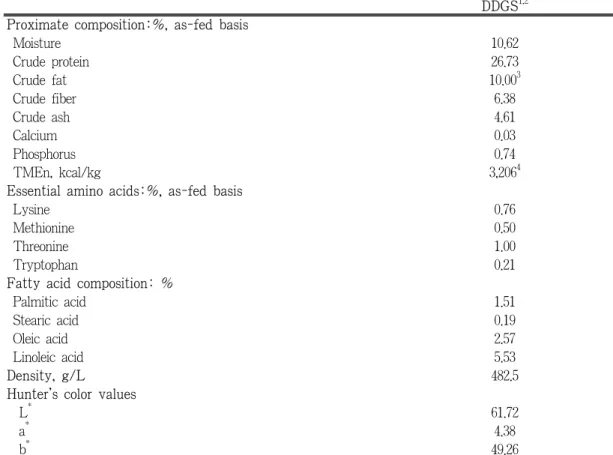
본 시험에서는 미국산 DDGS를 사용하였으며, 그 영양소 조성은 Table 1에 수록된 바와 같다.
사용한 DDGS의 Hunter's color value는 L
*61.72, a
*4.38, b
*49.26으로써 양질의 황갈색 DDGS임을 알 수 있었다. 시험사료는 DDGS를 0% 함유한 사료를 대조구(T1)로 하고, 대조구
Table 1. Nutrient composition of DDGS
DDGS
1,2Proximate composition:%, as-fed basis
Moisture 10.62
Crude protein 26.73
Crude fat 10.00
3Crude fiber 6.38
Crude ash 4.61
Calcium 0.03
Phosphorus 0.74
TMEn, kcal/kg 3,206
4Essential amino acids:%, as-fed basis
Lysine 0.76
Methionine 0.50
Threonine 1.00
Tryptophan 0.21
Fatty acid composition: %
Palmitic acid 1.51
Stearic acid 0.19
Oleic acid 2.57
Linoleic acid 5.53
Density, g/L 482.5
Hunter's color values
L
*61.72
a
*4.38
b
*49.26
1 Corn distillers dried grains with solubles imported from the US.
2 Analyzed values.
3 Extracted 3 h with petroleum ether(AOAC, 1995).
4 Calculated.
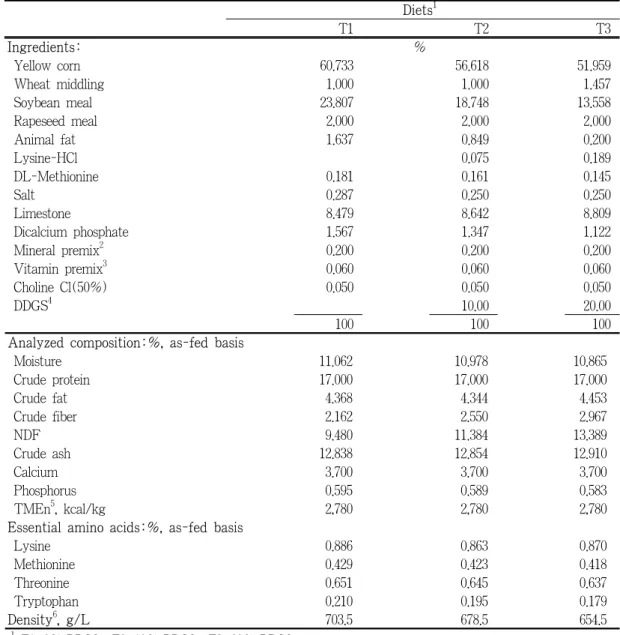
와 동에너지 (TMEn 2,780 kcal/kg)-동단백질 (17.0%)이 되게끔 DDGS를 10%(T2) 및 20%(T3) 첨가한 3가지 사료를 사용하였다. 시험사료들의 배합은 상용 배합률 프로그램(Bestmix 5.04, Adifo.b.v.)을 사용하였다.
2. 사양시험
시험동물은 Hy-line Brown 계통의 23주령 산
란계 216수를 3단 철제케이지를 이용해 충남대
Table 2. Formula of experimental diets of layers
Diets
1T1 T2 T3
Ingredients: %
Yellow corn 60.733 56.618 51.959
Wheat middling 1.000 1.000 1.457
Soybean meal 23.807 18.748 13.558
Rapeseed meal 2.000 2.000 2.000
Animal fat 1.637 0.849 0.200
Lysine-HCl 0.075 0.189
DL-Methionine 0.181 0.161 0.145
Salt 0.287 0.250 0.250
Limestone 8.479 8.642 8.809
Dicalcium phosphate 1.567 1.347 1.122
Mineral premix
20.200 0.200 0.200
Vitamin premix
30.060 0.060 0.060
Choline Cl(50%) 0.050 0.050 0.050
DDGS
410.00 20.00
100 100 100
Analyzed composition:%, as-fed basis
Moisture 11.062 10.978 10.865
Crude protein 17.000 17.000 17.000
Crude fat 4.368 4.344 4.453
Crude fiber 2.162 2.550 2.967
NDF 9.480 11.384 13.389
Crude ash 12.838 12.854 12.910
Calcium 3.700 3.700 3.700
Phosphorus 0.595 0.589 0.583
TMEn
5, kcal/kg 2,780 2,780 2,780
Essential amino acids:%, as-fed basis
Lysine 0.886 0.863 0.870
Methionine 0.429 0.423 0.418
Threonine 0.651 0.645 0.637
Tryptophan 0.210 0.195 0.179
Density
6, g/L 703.5 678.5 654.5
1 T1, 0% DDGS; T2, 10% DDGS; T3, 20% DDGS.
2 Provided followings per kg of diet : Cu, 10mg; Fe, 80mg; Mn, 80mg; Zn, 80mg; I, 0.9mg; Se, 0.2mg;
Co, 0.5mg.
3 Provided followings per kg of diet: vit. A, 12,000IU; vit. D3, 3,000IU; tocopherol 15mg; vit. K3, 2mg;
thiamin, 2.0mg; riboflavin, 6.0mg; pyridoxin, 2mg; vit.B12, 0.03mg; folic acid, 1.0mg; biotin, 0.15mg;
niacin, 45mg; D-Ca pantothenate, 15mg; antioxidant, 0.5mg.
4 Corn distillers dried grains with solubles from the US.
5 Calculated values.
6 Density of experimental diets.
학교 동물사육장의 개방계사에서 10주간 실시하 였다. 점등관리는 일일 17시간 점등하였고, 시험 구는 3처리 6반복으로 반복당 12수씩 완전임의 배치하였다. 사료와 물은 자유롭게 섭취할 수 있게 하였다.
3. 측정 항목 및 방법
사료섭취량은 7일 단위로 총 급여량에서 잔량 을 제외하여 측정하였다. 산란율은 시험기간 동 안 매일 오후 1시에 수집한 산란 개수와 연란, 파란 등을 합한 총 산란개수를 사육두수로 나누 어 백분율로 표시하여 산란율을 계산(hen-day 산란율로 매일 측정)하였다. 난중은 수집된 전 부를 칭량하여 총난중과 계란 수로 나누어 평균 난중을 매일 측정하였다.
영양소대사율 측정은 처리구별로 4수씩 선발 하여 대사케이지에 수용하여 3일간의 예비기간 을 거친 후 전분채취법으로 3일간 분을 채취하였 다. 채취한 분은 건조기에서 65℃로 3일간 건조 후 분쇄기로 분쇄 후 시험사료와 함께 AOAC법 (1995)에 준하여 분석을 실시하였다.
계분의 암모니아 측정은 처리구별로 3수씩 50 g을 다른 이물질의 침입을 배제하여 생분을 채 취하고, 이를 500mL의 용기에 담아 외부온도를 38℃로 유지하며 0일~7일까지 용기내의 암모니 아 농도를 Gastec과 NH
3gas 검지관(Gastec, Kitagawa, Japan) 이용해 측정하였다.
4. 통계 분석
본 시험에서 얻어진 결과는 SAS(2000)의 GLM을 이용하여 5% 수준에서 분산분석 (ANOVA)을 실시하여 유의성을 검정하였다.
Ⅲ. 결과 및 고찰
1. 사료섭취량, 산란율, 난중 및 사료요구율 Hy-line Brown 계통의 산란계 216수에 DDGS 0%, 10% 및 20% 수준으로 첨가한 시험사료를 10주간 급여했을 때 결과를 Table 3에 수록하였 다. 시험기간 동안 산란계 1마리의 평균 사료 섭취량은 처리구간에 유의적인 차이는 나타나지 않았다(P>0.05). 평균난중은 DDGS 20% 처리구 가 약간 낮게 나타났지만 유의적인 차이는 보이 지 않았다. 총난중의 경우 DDGS 20% 처리구가 다른 처리구에 비해 낮게 나타났지만 유의적인 차이는 없었다. 그리고 난생산 사료요구율에도 처리간 유의적인 차이는 나타나지 않았다. 산란 율의 경우는 DDGS를 10% 첨가한 처리구가 대 조구에 비해 약간 높았고, DDGS를 20% 첨가한 처리구는 다른 처리구에 비해 낮게 나타나는 경 향이 있지만 유의적인 차이는 나타나지 않았다.
Cheon 등(2008)은 Hy-line Brown 계통의 산 란계 900수를 이용해 사료에 DDGS를 0%, 10%, 15%, 20% 수준까지 단계적으로 첨가하여 10주간 급이한 결과 DDGS의 첨가수준이 높아 질수록 산란율이 감소하는 경향을 보였지만 유 의성은 나타나지 않았다고 하여서 본 시험과 유 사한 결과를 보이고 있다. 또한 Roberson 등 (2005)은 산란계 사료에 DDGS를 0%, 10%, 15%, 20% 첨가한 연구에서 DDGS의 첨가 수준 이 높아질수록 52~53주령에 산란율이 감소한다 고 보고하였다. 이와 같이 DDGS의 첨가 수준이 높아질수록 산란율이 낮아지는 경향이 보이는 것은 DDGS의 첨가량이 증가함에 따라 사료의 밀도가 감소하기 때문으로 생각된다(Table 2).
Lumpkins 등(2005)은 22주령에서 44주령까지
일반적인 사료(2,871kcal TME/kg)와 저밀도 사료(2,805kcal TME/kg)에 DDGS를 0%, 15%
첨가하여 급이하였을 때, 저밀도 사료 처리구에 서 26~34주령에 산란율이 약간 감소하였고 63 주령에는 난중이 감소하였다고 보고하였다.
2. 영양소 대사율
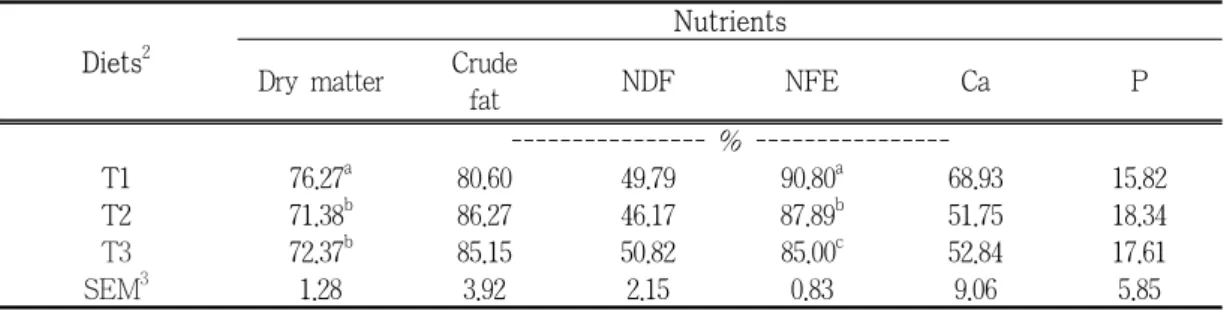
산란계에 DDGS 0%, 10% 및 20% 수준으로 첨가한 시험사료를 급여한 결과, 그 영양소 대 사율은 Table 4에 보는 바와 같다. 건물대사율 의 경우 DDGS를 첨가한 처리구들에서 유의적 으로 낮게 나타났다(P<0.05). 조지방 대사율은
Table 3. Effects of DDGS in layer diets on the performance of layers
1Items Diets
2SEM
5T1 T2 T3
Feed intake, g/bird/day 124.44 124.04 124.10 1.75
Laying rate
3, % 89.57 90.78 85.63 3.49
Egg weight, g/egg 64.87 64.83 63.79 0.84
Feed conversion
42.33 2.29 2.45 0.04
1 Hy-line Brown layers were used. 2 See Table 2.
3 Hen-day egg production rate. 4 Total feed intake /total egg weight.
5 Standard error of the mean.
Table 4. Effects of different levels of DDGS in layer diets on nutrient metabolizability of layers
1Diets
2Nutrients Dry matter Crude
fat NDF NFE Ca P
--- % ---
T1 76.27
a80.60 49.79 90.80
a68.93 15.82
T2 71.38
b86.27 46.17 87.89
b51.75 18.34
T3
72.37
b85.15 50.82 85.00
c52.84 17.61
SEM3
1.28 3.92 2.15 0.83 9.06 5.85
1 Hy-line Brown layers were used. 2 See Table 2.
3 Standard error of the mean.
a-c Means with different superscripts in the same row significantly differ(P<0.05).
DDGS를 첨가한 처리구가 다소 높은 결과를 보 였지만 유의성은 나타나지 않았다(P>0.05). NDF 의 대사율은 DDGS를 첨가한 처리구과 대조구 에서 유의적인 차이가 나타나지 않았다. 가용무 질소물의 대사율은 DDGS 첨가 수준이 높아질 수록 유의적으로 낮게 나타났다(P<0.05). Ca의 대사율은 DDGS를 첨가한 처리구가 대조구에 비해 다소 낮은 경향이 있지만 유의적인 처이는 나타나지 않았다. P의 대사율은 DDGS를 첨가 한 처리구가 다소 높은 결과를 보이지만 유의적 인 차이는 나타나지 않았다.
3. 계분의 암모니아 발생량
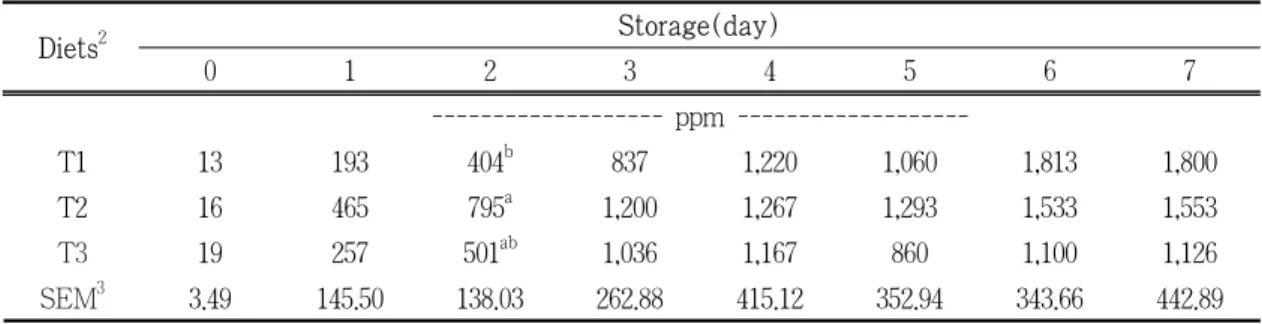
산란계 사료 내 DDGS의 첨가 수준에 따른 계분의 암모니아 발생에 미치는 영향을 Table 5 과 Figure 1에 수록하였다. 계분의 암모니아 가 스 농도가 매우 높은 것은 신선한 분을 포집통 에 보관하면서 측정하였기 때문이다. 1일차의 경우 대조구에 비해 DDGS를 첨가한 처리구가 다소 높게 나타났지만 유의적인 차이는 나타나 지 않았다(P>0.05). 2일차의 경우 DDGS를 첨가 한 처리구가 대조구에 비해 암모니아 발생량이 유의적으로 높게 나타났다(P<0.05). 5일차 이후 부터 DDGS를 첨가한 처리구에서 암모니아가 다소 적게 발생되는 경향을 보였으나 유의적인 차이는 나타나지 않았다.
Spiehs 등(2000)은 육성돈-비육돈에게 급여한 옥수수-대두박 기초사료에 DDGS 0%, 20%를 첨가한 후 분뇨를 채취하여 0,2,5,8 주에 황화수 소와 암모니아를 측정하였다. 그 결과 DDGS를 첨가한 처리구와 대조구 사이에 유의적인 차이 가 나타나지 않았다. 이는 본 시험과 유사한 결 과를 보이고 있다.
Table 5. Effects of DDGS in layer diets on ammonia emission from excreta of layers
1Diets
2Storage(day)
0 1 2 3 4 5 6 7
--- ppm ---
T1 13 193 404
b837 1,220 1,060 1,813 1,800
T2 16 465 795
a1,200 1,267 1,293 1,533 1,553
T3
19 257 501
ab1,036 1,167 860 1,100 1,126
SEM3
3.49 145.50 138.03 262.88 415.12 352.94 343.66 442.89
1 Hy-line Brown layers were used. 2 See Table 2.
3 Standard error of the mean.
a-c Means with different superscripts in the same row significantly differ(P<0.05).