The Effect of Taekwondo and Allium Tuberosum Intake on Body Composition, Blood Lipids and C-Reactive Protein
Sang-Ho Lee and Yeong-Ho Baek*
Department of Physical Education, Busan National University, Busan 609-735, Korea
Received November 2, 2010 /Accepted January 25, 2011The purpose of this study was to investigate the effect of taekwondo and allium tuberosum intake on body composition, blood lipids and C-reactive protein in male high school students. Twenty-four male students of B city volunteered to be test subjects. Experimental groups were taekwondo with allium turberosum group (A, n=6), taekwondo group (B, n=6), allium tuberosum group (C, n=6), con- trol group (D, n=6). The total experimental period was 10 weeks. Groups A and B practiced taekwon- do 4 times a week for 10 weeks with an intensity of 60~80% HRR. Each practice was 50 minutes.
Groups A and C were instructed to take an allium tuberosum pill every day before their taekwondo exercise during the 10 weeks. The results of this study are as follows: Within groups A, B and C, there was a significant decreas in % fat. Groups A and B showed a significant increase in HDL-C concentration, as well as a more significant increase in HDL-C concentration than groups C and D.
Group A showed a more significant decreased in LDL-C concentration than group D. In conclusion, taekwondo and allium tuberosum intake seem to have a positive effect on % fat, HDL-C and LDL-C.
Further research regarding the effect of allium tuberosum diets is required.
Key words : Taekwondo, allium tuberosum, blood lipids, C-reactive
*Corresponding author
*Tel:+82-51-510-2719, Fax:+82-51-515-1991
*E-mail : [email protected]
서 론
청소년기는 신체적·심리적으로 급속한 성장과 발달이 일어 나고 자아 개념이 구체적으로 형성되면서 호기심과 자극에 대해 매우 민감하기 때문에 이 시기의 학습과 경험은 그 사람 의 평생을 좌우하며 인격 및 태도의 결정적 요인으로 작용하 게 된다. 또한 청소년기에 있어서 스포츠 활동의 중요성을 인 식하게 하고, 스포츠 활동을 적극적으로 권장함으로써 스포츠 활동을 적극적으로 권장함으로써 스포츠를 통하여 습득되는 활동 능력은 원만한 대인관계를 형성을 위한 필요한 지식 및 인격발달에 도움을 줄뿐만 아니라 집단생활에서 요구되는 새 로운 경험을 제공해 준다[36].
혼자서 하는 운동보다 친구들과 어울러서 할 수 있는 운동 이 지루하지 않으며 장기간 규칙적으로 실시할 수 있게 된다 고 하였는데, 이러한 요소를 포함하고 있는 운동 중 하나가 태권도이며, 태권도는 우리나라 민족의 역사와 전통을 지닌 고유의 무술이며, 무도이다. 또한 태권도는 수련자들에게 강 인하고 용기 있는 성품을 만들어 주어 매사에 주저함이 없이 앞장설 수 있는 통솔력과 강한 담력을 길러줄 수 있기 때문에 각광 받고 있는 스포츠 종목이라 할 수 있다[33].
태권도는 신체의 모든 부위를 사용하여 근력, 근지구력, 심 폐지구력은 물론 뼈와 관절 및 근조직을 발달시켜 청소년은
물론 성인의 체력단련 및 균형 잡힌 신체를 형성하는데 도움 을 주는 운동방법이며[24], 청소년기 태권도 실시에 따른 체력 및 혈중 지질 비교에서 체력의 향상 및 고밀도 지단백 콜레스 테롤의(High density lipoprotein cholesterol; HDL-C)의 증가 와 저밀도 지단백 콜레스테롤(Low density lipoprotein cho- lesterol; LDL-C)가 감소한다고 하였다[31]. 또한 태권도 수련 집단과 비수련집단간 총콜레스테롤(Total cholesterol; TC), HDL-C, LDL-C, 혈당(glucose)에서 유의한 차가 나타나지 않 았지만 비교집단의 수치가 태권도 수련집단에 비해 높은 경향 을 나타내었다고 하여[30], 태권도운동이 지질대사에 긍정적 인 영향을 미칠 것으로 생각된다.
CRP (C-reactive protein)는 염증이 발생되면 단핵세포, 대
식세포 및 지방세포에서 유도되는 염증유발성(pro-in-
flammation) 사이토카인(cytokine)에 의하여 촉진되어 간에서
합성이 이루어져 혈액 내로 나오는 것으로 알려져 있으며[21],
지방조직과도 상관성을 보이는 것으로 알려져 있다[44]. 규칙
적인 신체활동 및 유산소 운동은 심폐체력을 증가시키며, 심
혈관질환의 발병 및 사망률을 감소시키고[5,11], 혈관염증과정
을 변화시켜 피브리노겐 수준을 감소시킴으로써 심혈관질환
의 예측인자인 CRP 수준에도 영향을 미치는 것으로 알려져
있다[17]. 따라서 태권도는 모든 신체부위를 사용함으로써 심
폐지구력 및 근지구력을 강화시키고[24], 체지방 연소의 효과
를 증대시켜[22,32] CRP에 긍정적인 영향을 가져온다.
Table 1. Physical characteristics of subjects
Capital Age (yr) Height (cm) Weight (kg) BMI (kg/m2)
A (n=6) B (n=6) C (n=6) D (n=6)
16.7±1.1ns 16.8±0.3 16.9±1.0 16.4±0.4
178.21±4.78 ns 172.87±5.76 174.83±7.45 169.07±6.30
74.70±16.13 ns 71.93±11.58 65.70±14.58 58.00±6.10
23.67±5.78 ns 23.93±2.60 21.43±4.28 20.73±2.53 Values are M±SD.
NS: not significant
A: taekwondo with allium tuberosum group, B: taekwondo group, C: allium tuberosum diet group, D: control group Table 2. Taekwondo program
Week Exercise Intensity (%) Duration
1~10
Warming up
(5 min) stretching
Main exercise (40 min)
rope-skipping, shuttle run, kick, poom sae (1~8),
sparring 60∼70% HRR 1~5
rope-skipping, shuttle run, burpee test, kick, poom sae
(5~8, koryo, keum-gang), sparring 70∼80% HRR 6~10 Cooling down
(5 min) stretching
부뚜막에 심어 먹는 채소라 하여 부추(Allium tuberosum) 라고 유래되었지만 지방에 따라 그 호칭도 여러 가지로 솔 (전라도 지방), 졸(충청도 지방), 정구지(경상도 지방)라고도 불리며, 부추는 백합과에 속하는 Allium속 식물로 중국이 원 산지로 아시아의 중부와 북부지방에서 자생하고 일본, 중국, 한국, 인도, 네팔, 태국, 필리핀 등지에서 재배되고 있다 [8,51]. 부추의 일반 성분으로는 100 g 당 수분 91.4%, 단백질 2.9%, 지질 0.5%, 당질 3.9% 등으로 다른 Allium속 식물에 비해 비타민 A, B, C가 풍부한 녹황색 채소로 특히, 건조 중 량 당 35%의 식이섬유를 함유하고 있어 현대인에게 부족하 기 쉬운 식이섬유를 용이하게 공급할 수 있는 급원이 될 수 있다[14].
부추는 allyl sulfide, dimethyl disulfide, dimethyl tri- sulfide과 같은 함황화학물[23], 함황 아미노산의 최종 산물인 taurine, linalool, kaempherol과 같은 flavonid를 함유하고 있 다. Allium 속 식물의 함황화합물은 항암, 항균, 심혈관계질환 예방 활성, 황산화활성 및 독성물질에 대한 간독성 완화작용 등의 생리활성을 가지고 있다[3,41,43].
이처럼 부추는 다양한 생리적 유용성을 지닌 작물로 최근 부추에 대한 영양학적 가치와 저칼로리 식품으로써 단백질, 비타민 및 각종 무기성분이 풍부하게 함유된 건강식품으로 인식되고 있음에도 불구하고 부추의 이용에 대한 다양한 연구 는 충분치 못한 실정이다. 따라서 본 연구는 생리활성이 우수 한 부추섭취와 태권도운동이 남자고등학생을 대상으로 신체 조성, 혈중지질 및 C-반응단백에 미치는 영향들을 구명하기 위하여 실시하였다.
재료 및 방법
연구대상
연구의 대상은 B광역시 G고등학교 재학중인 건강한 남 자고등학생으로 본 연구의 목적을 이해하고 참여에 동의한 24명을 대상으로 하였다. 참여자로부터 연구시작 전 실험 참여 동의서를 받았고, 그룹은 무작위로 선정하여 태권도+
부추섭취군(n=6), 태권도군(n=6), 부추섭취군(n=6), 대조군 (n=6)으로 구분하였다. 대상자들의 신체적 특성은 Table 1 과 같으며 나이, 신장, 체중, BMI는 집단 간 유의한 차이가 없었다.
운동방법
태권도 프로그램은 김명일[28]의 태권도 프로그램을 수정 보완하여 구성하였고, 운동강도는 PPLAR (Polar RS400sd, APAC, 90026360, USA)를 통한 심박수 변화량을 측정하여 1~5주는 60∼70%HRR, 6~10주는 70∼80%HRR로 설정하였으 며, 주 4회씩 매회 50분간, 10주간 실시하였으며, 태권도 프로 그램은 Table 2와 같다.
식이방법
부추섭취는 10주간 부추환을 섭취시켰다. 부추환을 섭취하
는 동안 일체의 약물이나 건강보조식품을 금하였고, 부추환의
성분은 수분 11.0%, 조단백질 17.3%, 조지방 4.5%, 조회분
9.5%이었다.
Table 3. Changes of body composition in pre and post test
Variables Times
Groups Pre (M±SD) Post (M±SD) t-value F-value Duncan
weightBody (kg)
A (n=6) 74.70±16.13 74.35±15.34 0.783
2.317 NS
B (n=6) 71.93±11.58 70.95±11.30 -1.783
C (n=6) 65.70±14.58 65.35±13.86 -0.455
D (n=6) 58.00±6.10 58.95±6.50 2.707*
%fat(%)
A (n=6) 18.82±10.36 17.72±10.02 -3.514*
0.346 NS
B (n=6) 20.55±4.30 19.58±3.74 -3.001*
C (n=6) 15.30±7.83 14.25±7.89 -5.015**
D (n=6) 15.35±6.94 13.63±6.37 -2.117
Muscle mass
(kg)
A (n=6) 54.93±5.06 55.50±4.98 2.215
1.245 NS
B (n=6) 52.63±6.04 52.87±6.00 1.453
C (n=6) 51.10±7.32 51.72±7.04 1.376
D (n=6) 45.41±2.51 47.75±6.03 1.405
Values are M±SD.
NS: not significant
A: taekwondo with allium tuberosum group, B: taekwondo group, C: allium tuberosum diet group, D: control group
*
p
<0.05, **p
<0.01분석방법 신체조성
피험자들의 신장과 체중, 체지방률, 부위별 근육량은 X-SCAN PLUS Ⅱ (JAWON Medical, PYD0017-070418, Korea)를 이용하여 반팔과 반바지의 간편한 복장으로 양말을 벗고, 시계와 목걸이, 귀고리 및 반지 등 금속류를 제거한 후, 기기에 올라서서 자동으로 신장과 체중을 측정하고, 양팔을 차렷 자세에서 가볍게 벌린 상태에서 힘을 뺀 편안한 자세로 체지방률과 부위별 근육량을 2회(0주, 10주) 측정하였다.
혈액채취 및 분석방법
실험 전(0주)과 실험 후(10주)에 채혈 12시간 전 공복상태로 피험자의 전완정맥에서 10 ml를 채혈하여 원심분리기로 10분 간 3,000 rpm에서 원심 분리하여 혈청을 분리한 후 분석 시까 지 -70℃이하에서 보관 후 분석하였다.
혈중지질
혈중지질 검사는 총콜레스테롤(TC), 중성지방(TG), 고밀도 지단백 콜레스테롤(HDL-C), 저밀도지단백 콜레스테롤 (LDL-C)의 농도는 혈액자동분석기(HITACHI 7600-210 &
HITACHI 7180, Japan)에서 분석하였다.
C반응단백
High sensitivity C-반응단백은 BN Ⅱ 분석기(Dade Behring Inc, Deerfield, Illinois, USA)를 사용하여 자동화된 면역 비탁법(latex-enhanced immunonephelometric assay)으 로 측정하였다.
자료처리 자료처리는 SPSS 18.0 통계프로그램을 이용하였으며, 측정 된 모든 자료에 대해 평균과 표준편차(Mean±SD)를 산출하였
다. 집단 내 사전·후 차이검증은 paired t-test, 집단 간 차이검 증은 일원변량분석(one-way ANOVA)를 실시하였다. 사후검 증은 Duncan을 실시하였으며, 통계적 유의적 수준은 α=0.05 로 하였다.
결 과
신체조성
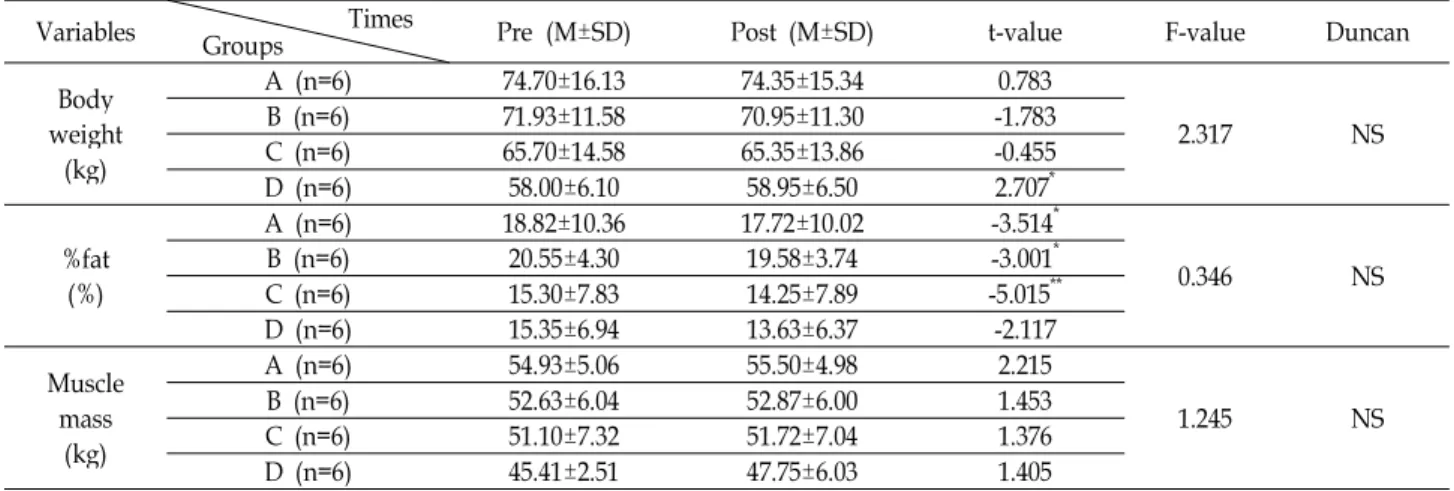
운동전과 10주간 운동 후 신체조성의 변화는 Table 3와 같 다. 집단내에서 태권도+부추섭취군, 태권도군, 부섭섭취군은 체중과 근육량은 유의한 차이가 나타나지 않았으나, 체지방률 은 태권도+부추섭취군, 태권도군(p<0.05), 부추섭취군이 (p<0.01) 유의하게 감소하였다. 대조군은 체중은 유의하게 (p<0.05) 높게 나타났으나, 체지방률과 근육량은 유의한 차이 가 나타나지 않았다. 집단 간 유의한 차이는 없었다.
혈중지질
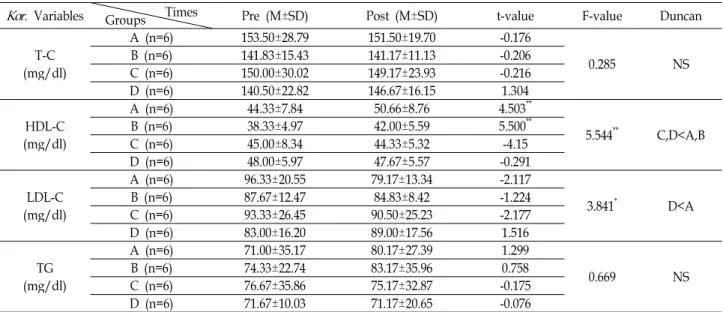
운동전과 10주간 운동 후 혈중지질의 변화는 Table 4와 같 다. T-C와 TG의 변화는 태권도+부추섭취군, 태권도군, 부추섭 취군, 대조군 모두 집단내 집단간 차이가 없었다. HDL-C는 집단내 태권도+부추섭취군과 태권도군이 유의하게(p<0.01) 증가하였으며, 부추섭취군과 대조군은 유의한 차이가 없었다.
집단간 태권도+부추섭취군과 태권도군이 부추섭취군과 대조 군보다 유의하게(p<0.01) 증가하였다. LDL-C의 변화는 집단 내 유의한 차이는 없었으나, 집단간 태권도+부추섭취군이 대 조군보다 유의하게(p<0.05) 감소하였다.
C-반응단백
운동전과 10주간 운동 후 C-반응단백의 변화는 Table 5와
Table 4. Changes of blood lipid profiles
Kor.
Variables Groups Times Pre (M±SD) Post (M±SD) t-value F-value Duncan(mg/dl)T-C
A (n=6) 153.50±28.79 151.50±19.70 -0.176
0.285 NS
B (n=6) 141.83±15.43 141.17±11.13 -0.206
C (n=6) 150.00±30.02 149.17±23.93 -0.216
D (n=6) 140.50±22.82 146.67±16.15 1.304
HDL-C (mg/dl)
A (n=6) 44.33±7.84 50.66±8.76 4.503**
5.544** C,D<A,B
B (n=6) 38.33±4.97 42.00±5.59 5.500**
C (n=6) 45.00±8.34 44.33±5.32 -4.15
D (n=6) 48.00±5.97 47.67±5.57 -0.291
LDL-C (mg/dl)
A (n=6) 96.33±20.55 79.17±13.34 -2.117
3.841* D<A
B (n=6) 87.67±12.47 84.83±8.42 -1.224
C (n=6) 93.33±26.45 90.50±25.23 -2.177
D (n=6) 83.00±16.20 89.00±17.56 1.516
TG (mg/dl)
A (n=6) 71.00±35.17 80.17±27.39 1.299
0.669 NS
B (n=6) 74.33±22.74 83.17±35.96 0.758
C (n=6) 76.67±35.86 75.17±32.87 -0.175
D (n=6) 71.67±10.03 71.17±20.65 -0.076
Values are M±SD.
NS: not significant
A: taekwondo with allium tuberosum group, B: taekwondo group, C: allium tuberosum diet group, D: control group
*
p
<0.05, **p
<0.01Table 5. Changes of C-reactive protein
variables Group Time Pre (M±SD) Post (M±SD) t-value F-value Duncan
(mg/dl)CRP
A (n=6) 0.35±0.33 0.24±0.17 1.581
1.822 NS
B (n=6) 0.14±0.07 0.10±0.05 1.138
C (n=6) 0.32±0.28 0.29±0.26 1.781
D (n=6) 0.44±0.34 0.52±0.41 -1.304
Values are M±SD.
NS: not significant
A: taekwondo with allium tuberosum group, B: taekwondo group, C: allium tuberosum diet group, D: control group
같다. C-반응단백의 변화는 태권도+부추섭취군, 태권도군, 부 추섭취군, 대조군 모두 집단 내 집단간 차이가 없었다.
고 찰
신체조성
이상적인 신체조성의 형성은 운동을 통해 이루어질 수 있는 데, 이는 제지방의 증가와 체지방의 감소로 표현될 수 있다.
신체조성을 측정하는 것은 제지방량의 손실을 막아주는 더 효과적인 영양, 이상적인 체중과 식이요법을 위한 규정의 명 확화, 지방이 지나치게 많거나 부족해서 생기는 위험을 파악 하는데 그 기초가 되기 때문에 더욱 중요하다[7,48].
선행연구에서 과체중과 비만고등학생을 대상으로 유산소 운동을 실시한 결과 체지방률이 유의하게 감소하였고[26,29], 정상체중의 남자 대학생을 대상으로 8주간 운동을 실시한 후 체지방이 감소하였다고 하였으며[12], 비만 청소년을 대상으
로 12주간 태권도 수련을 실시한 결과 체지방률이 유의하게 감소하였다[4]. 또한 태권도 운동을 하는 여자 대학생이 태권 도 운동을 하지 않는 여자 대학생보다 체지방율이 유의하게 낮았다고 하였다[39].
본 연구 결과에서도 선행연구와 유사하였는데 태권도+부 추섭취군, 태권도군, 부추섭취군의 체지방률 감소는 운동 형 태에 상관없이 운동이 지속적일 경우 신체에 여러 가지 긍정 적인 효과와 에너지 소비를 증가시켜 청소년기 비만을 예방하 고 발육을 촉진시키므로 체지방에 긍정적인 효과를 주며, 부 추에 포함된 비타민 및 각종 무기성분과 식이섬유가 풍부한 부추의 지속적인 섭취가 체내의 생리적 대사에 긍정적인 영향 을 주어 체지방률 감소에 도움을 준 것으로 사료된다.
근육량의 감소는 신체적 기능저하는 물론 대사성 및 퇴행성 질환 발생에도 영향을 미칠 수 있는 것으로 보고되었다[10].
그러나 규칙적인 신체활동은 근육의 감소를 방지할 수 있으
며, 근수축이 활발하게 이루어져서 골격근의 성장 및 비대를
유발하고 성장과 발육을 촉진시킨다[15]. 또한 태권도 수련은 근육량의 증가와 지방의 감소를 가져와 신체조성에 긍정적인 변화를 미치는데, 본 연구에서는 근육량의 유의한 변화가 나 타나지 않았다. 이는 태권도의 운동형태가 무산소성 운동보다 는 유산소성 운동에 가까워 근육량의 증가를 가져오지 못 하 였으며, 운동강도가 낮아 근육량의 증가를 가져오지 못 한 것 으로 사료된다.
혈중지질
T-C는 심혈관계 질환에 유용한 지표로 활용되며, 모든 세포 에서 존재하고 콜레스테롤 항상성을 유지하도록 도와준다 [1,2]. 운동형태에 따라 혈중지질에 미치는 영향은 잘 알려져 있는데, 일반적으로 T-C는 운동과 트레이닝에 의해 잘 감소하 지 않고, 운동기간에도 영향을 받지 않으나[16], 체중과 체지방 의 감소로 인해 수치가 감소하기도 한다. 연구결과 TC는 유의 한 차이가 나타나지 않았는데 이는 대상자의 체격, 체중, 식사 습관의 차이와 운동강도가 낮았던 것으로 사료된다.
규칙적인 유산소운동에 의해 안정 시 HDL-C 농도가 증가 하는 것으로 알려져 있는데[25], 이는 운동에 의해 혈장 내 LPLA (lipoprotein lipase activity)가 활성화 되어 chylomi- cron, VLDL (very low density lipoprotein) 및 LDL 내의 콜레 스테롤이 HDL로 전환되는 비율이 증가되고 간의 HTGLA (hepatic triglyceride lipase activity)가 운동에 의해 통제됨으 로써 HDL의 catabolism이 낮아지기 때문이라고 하였다[18].
선행연구에서 흰쥐를 대상으로 유산소운동과 부추를 섭취시 킨 결과 유산소운동과+부추섭취군, 유산소운동군, 부추섭취 군이 HDL-C가 유의하게 증가하였다고 보고하였으며[8], 유산 소운동을 8주간 실시 한 후 HDL-C 농도가 유의하게 증가하였 다[13]. 이는 다양한 운동강도와 운동소요시간 등의 요인들이 HDL-C의 변화에 직접적으로 영향을 미치며[44], polyphenol 성분이 HDL-C 농도에 긍정적인 영향을 미친다[42]. 본 연구에 서도 태권도를 통한 유산소운동이 체지방률을 낮추고, lip- oprotein lipase activity의 활성화를 가져와 HDL-C에 긍정적 인 영향을 미친 것으로 사료된다.
LDL-C은 고지혈증 및 동맥경화증의 위험인자로 알려져 있 으며, 주요기능은 말초조직으로 cholesterol을 운반하는 역할 을 한다[6]. 선행 연구에서는 유도수련으로 LDL-C의 농도를 감소 하였고[27], 지구성 운동으로 LDL-C 농도가 유의한 감소 를 나타낸다고 하였으며[45], 지방산군(들기름, 옥수수 유 및 돈지)에서 부추를 섭취시켰을 때 LDL-C 함량을 더 감소시켰 다고 하였다[35]. 본 연구결과 태권도+부추섭취군이 대조군에 비해 긍정적인 효과가 있었는데, 이는 태권도 운동과 부추섭 취의 시너지 효과가 있는 것으로 생각되며, 태권도 운동으로 HDL-C 농도가 높아져 LDL-C 농도를 낮추었으며, 식이섬유 는 혈중지질 및 지단백 농도를 감소시키는데 효과적인데, 부 추의 식이 섬유와 클로로필이 풍부하고 항혈전 성분인 ad-
enosine이 LDL-C 농도를 감소시키는데 긍정적인 영향을 미친 것으로 사료된다.
TG는 음식물에 의해 가장 많은 영향을 받지만, 신체적 훈련 에 의해서도 20~60%까지 감소되어진다[42]. 선행연구에서 태 권도 품새 프로그램 수행이 운동에 의해 에너지원으로 활용되 어 TG가 감소되었다는 보고[22]와 12주간 태권도 운동이 비만 여성의 TG가 감소되었다고 하였다[34]. 이는 유산소운동으로 간 및 근육의 글리코겐이 소비되면서 근육과 순환되는 혈액중 의 지방이 에너지원으로 이용되기 때문이다[44]. 부추의 첨가 가 중성지방을 감소시키는 효과가 있다고 하였으나[35], 본 연 구에서는 유의한 효과가 없었는데, 이는 흰쥐를 대상으로 유 산소운동과 부추를 섭취시킨 연구에서[8] TG에서 차이가 없 었다는 연구와 유사하다. 이는 태권도의 수련기간이 짧으며, 비만군이 아니라 정상군이어서 TG의 차이가 없는 것으로 사 료된다.
혈중 지질성분에 대한 연구는 비만인을 대상으로 하는 연구 가 많았으나, 비만 및 정상체중 남성을 대상으로 복합운동을 시킨 결과 정상체중군도 혈중지질에 긍정적인 영향을 주었다 고 보고 [12]하여 향후 다양한 대상으로 지속적으로 연구가 되어야 할 것이다.
C-반응단백
C-반응단백(CRP)은 동맥경화성 혈관의 염증반응 정도를 반영하는 대표적인 지표로 인식 되어지고 있다[37]. 높은 혈중 CRP 농도는 혈관내피 기능 손상과 혈관내피 중막을 두껍게 하여 조기 죽상경화증을 진행시켜 심혈관질환 발병 위험성을 높이는 것으로 알려져 있다[40]. 아직 혈중 CRP농도의 감소 매커니즘은 정확히 밝혀지지 않고 있지만, CRP의 생성이 지 방세포에서 분비되는 IL-6 (interleukin6)와 TNF-α (tumor ne- crosis factor-α) 등의 염증관련성 cytokine의 상승과 관련[38]
이 있는 것으로 보아 체중 감량을 통한 지방량의 감소가 염증 관련성 cytokine 및 CRP를 감소시키는 것으로 생각된다. 이와 같은 CRP농도는 체중감소에 따라 감소된다고 보고되면서[47]
CRP 개선을 위한 운동프로그램에 대한 연구가 진행되고 있 다. 만성적으로 C-반응단백 농도가 높으면 심장병과 성인 당 뇨병 위험이 커지고, 염증은 심장마비와 C-반응단백 농도가 0.50 mg/dl 이상이면 심혈관계 질환도가 매우 높은 것으로 나타났으며, 규칙적인 운동을 실시하면 심혈관계 질환의 위험 도 지연시킬 수 있으며[49], C-반응단백의 수준이 높으면 건강 한 중년 남녀의 성인병 발병률이 2~3배 증가하는 것으로 보고 하였다[20].
선행연구에서 비만청소년과 비만성인을 대상으로 운동 트
레이닝 또는 체중 감량 프로그램을 실시한 결과 CRP 농도가
감소하였고[9], 비만 남고생을 대상으로 복합운동과 마늘환을
섭취시킨 결과 복합운동+마늘환섭취군이 유의하게 감소하였
으며[46], 저칼로리섭취와 유산소운동을 병행한 결과 C-반응
단백 농도가 유의하게 감소하였다[50]. 또한 HRR 60~70%에 서 유산소운동을 실시한 후에 CRP농도가 감소하였다는 보고 와[19] 정상체중에서도 염증반응인자들이 긍정적으로 개선된 다[12]는 선헹연구의 결과와는 일치하지 않게 본 연구에서는 상반된 결과인 본 연구에서는 C-반응단백에 차이가 나타나지 않았다. 이는 비만인이 아닌 정상인을 대상으로 하여 대상자 의 특징과 운동강도가 낮았던 것으로 사료되어 운동방법과 대상에 따른 추후 지속적인 연구가 필요하다고 사료된다.
감사의 글
이 논문은 부산대학교 자유과제 학술연구비(2년)에 의하여 수행되었습니다.
References
1. American Collage of Sports Medicine (ACSM). 2000.
ACSM`s guidelines for exercise testing and prescription
(6th eds.).Lipponcott Williams and Wilkins, Philadelphia, PA.
2. American Collage of Sports Medicine (ACSM). 2006.
Guidelines for exercise Testing and Prescription
, 7th eds.American College of Sports Medicine.
3. Agarwal, K. C. 1996. Therapeutic actions of garlic constituents.
Med. Research Rev.
16, 11-124.4. An, S. O. 2005. The effect of taekwondo training on physical fitness and insulin on obese adoloscents. Unpublished doc- toral dissertation, Dong-A University, Busan.
5. Aronson, D., P. Bartha, O. Zinder, A. Kerner, W. Markiexicz, O. Avizohar, G. J. Brook, and Y. Levy. 2004. Obesity is the major determinant of elevated C-reactive protein in subjects with the metabolic syndrome.
Int. J. Obes. Relat Metab Disord.
28, 674-679.
6. Baek, I. Y. 2009. Exercise and energy metabolism.
Daehanmedia.
7. Baek, Y. H. 2008. Exercise nutrition, Pusan national uni- versity published.
8. Baek, Y. H. and S. H. Lee. 2010. The effect of aerobic exercise and allium tuberosum intake on blood lipids, MDA and an- tioxidant enzyme in rats.
J. Life Sci.
20, 245-252.9. Balagopal, P., D. George, N. Patton, H. Yarandi, W. L.
Roberts, E. Bayne, and S. Gidding. 2005. Lifestyle-only inter- vention attenuates the inflammatory state associated with obesity: a randomized controlled study in adolescents
. J.
Pediatr
. 146, 342-348.10. Beaufrere, B. and B. Morio. 2000. Fat and protein redis- tribution with aging: metabolic consideration
. Eur. J. Clin.
Nutr.
54, S48-S53.11. Booth, F. W., S. E. Gordon, C. J. Carson, and M. T. Hamilton.
2000. Waging war on mogen chronic disease: primary pre- vention through exercise biology.
J. Appl. Physiol.
88, 774-787.12. Byun, J. C. and H. Y. Woo. 2009. Effects of long-term com-
bined exercise training on body composition, blood lipids, inflammatory markers and ghrelin level in obese and non-obese men.
Korean J. Sport Sci.
20, 455-465.13. Kim, Y. H. 2004. The effects of taekwondo exercise programs on physical fitness, bone mineral density, blood lipid and leptin in obese adult women. Unpublished doctoral dis- sertation, Kyung-hee university, Seoul.
14. Choi, H. J., C. G. Jang, Y. M. Lee, and B. U. Ok. 2007. A taxonomic study of Korean Allium L. based on the morpho- logical characters.
Korean J. Plant Taxon
. 37, 275-308.15. Dennis, R. T. 2006. Sarcopenia: Exercise as a treatment strategy.
Australian Family Physician
35, 130-133.16. Dustine, L., W. Gradjean, A. Cox, and D. Thompson. 2002.
Lipids, lipoproteins and exercise.
J. Cardiopulm. Rehabil.
22, 385-398.17. Geffken, D. F., M. Cushman, G. L. Burke, J. F. Polak, P.
A. Sakkinen, and R. P. Tracy. 2001. Association between physical activity and markers of inflammation in a healthy elderly population.
Am. J. Epidemiol.
153, 242-250.18. Goldberg, L., D. L. Elliot, R. W. Schultz, and F. E. Kloster.
1984. Changers in lipid and lipoprotein levels after weight training.
Am. J. Med.
252, 504-506.19. Goldhammer, E., A. Tanchilevitch, I. Maor, I. Benia, Y.
Beniamini, U. Rosenschein, and M. Sagiv. 2005. Exercise training modulates cytokines activity in heart disease patients.
Int. J. Cardiol.
100, 93-99.20. Hwang, J. S., H. S. Lee, and S. H. Park. 2003. The correlation of Korea man related CRP and obesity.
J. Korean Society for the Study of Obesity
11, 303-303.21. Jialal, I. and S. Devaraj. 2003. Role of C-reactive protein in the assessment of cardiovascular risk.
Am. J. Cardiol.
91, 200-202.22. Jo, Y. M. 2006. The effect of taekwondo form training on the body composition, physical fitness, blood components.
Korean Society Sports Sci.
15, 587-593.23. Kameoka, H. and A. Miyake. 1974. The constituents of the steam volatile oil from Allium tuberosum Rotter.
Nip.
Nogeikagaku Kaishi.
48, 385-392.24. Kim, G. S. and C. G. Kim. 2003. The study on program model a obesity for young child training experience taekwondo.
Korean J. Sport Research
14, 399-412.25. Kim, B. R. and J. P. Park. 2003. The effects of bare feet walk- ing on the body composition and blood lipid profiles of obese female-students in the middle school.
Korean J. Phy.
Edu.
12, 517-528.26. Kim, E. S., J. A. Im, K. C. Kim, J. H. Park, S. H. Suh, E.
S. Kang, S. H. Kim, Y. Jekal, C. W. Lee, Y. J. Yoon, H. C.
Lee, and J. Y. Jeon. 2007. Improved insulin sensitivity and adiponectin level after exercise training in obese Korean youth.
Obesity (Silver sprig)
15, 3023-3030.27. Kim, H. S. and H. H. Choi. 2010. Effects of a judo training on body composition, blood lipid profiles, insulin and IGF-!
In obese Juveniles.
J. Sport and Leisure Studies
39, 727-736.28. Kim, M. I. 2006. The effects of Taekwondo training on body composition, physical fitness and blood constituent for 12 weeks.
J. Sport and Leisure Studies
28, 253-260.29. Kim, S. S., D. S. Wee, H. J. Lee, Y. H. Park, Y. S. Jo, W.
S. Han, J. H. Park, and D. H. Kim. 2001. The correlation of GH and IGH-1 with the index of obesity and the change by exercise.
Korean Society of Sport and Lesure Studies
16, 271-280.30. Kim, H. C. 2005. Effects of taekwondo practice period on body composition, blood variables, and visceral fat in male elementary school students. Unpublished doctoral dis- sertation, Kyung-hee university, Seoul.
31. Kim, M. S. 2003. The effect of kumdo and taekwondo on physical fitness and blood lipids in adolescence. Dept. of Education Chongju University.
32. Korea taekwondo associated. 2002. www. koreataekwondo.org.
33. Lee, J. S., W. Y. Han, and S. Y. Ji. 2004. Effect of taekwondo career on the bone mineral density and body composition in juvenile athletes.
Korean J. Phy. Edu.
43, 427-437.34. Lee, K. K. 2010. The effects of taekwondo training for 12 weeks on blood lipid, bone mineral status, body composi- tion and physical fitness in obese women.
J. Sport and Leisure Studies
40,
575-585.35. Moon, G. S. and M. J. Lee. 2003. The long term effect of Buchu (Chinese chives) diet on ROS formation in the Liver and skin tissue of ICR mice.
J. Korean Society of Food Sci.
Nutr.
32, 444-449.36. Nam, S. G. 2002. The relationship between pro-social behav- ior and sports participation of adolescent`s.
Korean J. Phy.
Edu.
41, 111-117.37. Nicklas, B. J., T. You, and M. Pahor. 2005. Behavioural treat- ments for chronic systemic inflammation: effect of dietary weight loss and exercise training.
A. J. Clin. Med.
172, 1199-1209.38. Nicklas, B. J., W. Ambrosius, S. P. Messier, G. D. Miller, B. W. Penninx, R. F. Loeser, S. Palla, E. Bleecker, and M.
Pahor. 2004. Diet- induced weight loss, exercise and chronic inflammation in order, obese adult: a randomized controlled clinical trail.
Am. J. Clin. Nutr
. 79, 544-551.39. Park, S. Y. and G. J. Song. 2006. The effect of taekwondo training on body composition and bone mineral density in frame colleriate students
. Korean Society of Sport and Lesure Studies
28, 293-300.40. Pearson, T. A., T. L. Bazzarre, S. R. Daniels, J. M. Fair, S.
P. Fortmann, B. A. Franklin, L. B. Goldstein, Y. Hong, G.
A. Mensah, J. F. Jr. S. Sallis, J. R. Smith, N. J. Stone, and K. A. Taubert. 2003. American heart association guide for improving cardiovascular health at the community level: a
statement for public health practitioners, healthcare pro- viders, and health policy makers from the American heart association expert panel on population and prevention sciences.
Circulation
107, 645-651.41. Pinto, J. T., C. Qiao, J. Xing, R. S. Rivlin, M. L. Protomastro, M. L. Weissler, Y. Tao, H. Thaler, and W. D. Hesto. 1997.
Effect of garlic thioallyl derivatives on growth, glutathione concentration, and polyamine formation of human prostate carcinomacells in culture.
Am. J. Clin
.Nutr.
66, 398-405.42. Scjokman, C. P., H. Ingrid, E. Rutishauser, and R. J. Wallace.
1999. Pre and post game macronutrient in take of a group of elite Australian football players
. Int. J. Sport Nutr. Exerc.
Metab.
9, 60-96.43. Senapati, S. K., S. Dey, S. K. Dwivedi, and D. Swarup. 2001.
Effect of garlic (Allium sativum L.) extract on tissue lead level in rats.
J. Ethnopharmacology
76, 229-232.44. Shin, Y. A., K. I. Lim, and M. H. Suk. 2007. Effect of aerobic exercise on c-reactive protein and inflammatory markers in obese women.
Korean Society of Sport and Lesure Studies
30, 571-581.45. Song, S. K. 2007. Effects of dance sports exercise on health-re- lated fitness, body composition and serum lipids in old-aged women. Graduate School of Education Kyung-sung University.
46. Sung, G. D., Y. S. Kwak. S. H. Lee, and Y. H. Baek. 2009.
The combined effects of exercise and garlic pill intake on body composition, CRP and adiponectin in obese high school male students.
J. Life Sci.
19, 1605-1610.47. Tchernof, A., A. Nolan, C. K. Sites, P. A. Ades, and E. T.
Poehlman. 2002. Weight loss reduces C-reactive protein lev- els in obese postmenopausal women.
Circulation
105, 564-569.48. The Korean society of nutrition. Recommended dietary al- lowances for Koreans. 7th revision.
49. Tracy, R. P., B. M. Psaty, E. Macy, E. G. Bovill, M. Cushman, E. S. Cornell, and L. H. Kuller. 1997. Lifetime smoking ex- posure affects the association of C-reactive protein with car- diovascular disease risk factor and subclinical disease in healthy elderly subjects.
Arterioscler Thromb Vasc. Biol.
17, 2167-2176.50. Viru, A. and T. Smirrova. 1995. Health promotion and ex- ercise training sports.
J. Med.
19, 123-126.51. Yoo, S. O. and J. H. Bae. 2001. Investigation of Korean native Chinese chives on flower bud differentiation