Effects of Bacillus subtilis on Growth Performance and Resistance to Salmonella Infection in Broiler Chickens
Jae Hong Yoo
Agricultural Microbiology Division, National Academy of Agricultural Science, Rural Development Administration, Suwon 441-707, Korea
ABSTRACT The experiment was undertaken to see the effects of Bacillus sp. on the growth performance and disease resistance to Salmonella sp. infections. The use of probiotic microbes in poultry is commonly practiced. In this study, Bacillus subtilis was tested using a total of 120 chicks of age of 1 day after hatching. The growth traits examined were body weight gain and feed conversion rate. And also, the Salmonella resistance of Bacillus subtilis was tested after the chicks were orally administered with Salmonella pullorum by gavage force injections. The result showed that Bacillus subtilis yielded a high feed efficiency, consequently increased growth rate. For the effect of Bacillus subtilis on Salmonella infection, Bacillus subtilis significantly improved the resistance to Salmonella pullorum infection. Various clinical symptoms of Salmonella infection were highly decreased by addition of Bacillus sp.
(Key words : Bacillus subtilis, broiler chicks, Salmonella resistance, body weight gain, feed conversion ratio)
†To whom correspondence should be addressed : [email protected]
INTRODUCTION
Many studies have been made on the efficiency of micro- organisms as feed additives for the various economic traits of poultry (Kim et al., 2013; Lee et al., 2013; Hwangbo et al., 2011; Kim et al., 2010; Jung et al., 2010; Kim et al., 2008).
The microbes being widely used in poultry industry are termed as probiotic microbes such as Lactobacillus sp, Bacillus sp, yeasts and etc. The main concept of using microbes in poul- try farms is the extra enhancement of economic traits after being added to the main diets. The main functions of micro- bes in chickens as well as other livestock species are the meta- bolites that are excreted by the microbes, especially the various types of enzymes and other anti-bacterial and anti-fungal exc- retes. The cell count of the microbes is less emphasized than the metabolites from the microbes. Out of several genus of Bacillus species, Bacillus subtilis is most commonly used as feed additives in the probiotics industry of livestock. Lactoba- cillus species are also commonly used as feed additives. Some toxins excreted by the microbes often can be useful or harm- ful, depending upon the metabolites produced by the microbes.
For green farming of environment-friendly objectives, microbes as probiotic microorganism are the very useful alternative over conventional farming with some use of chemical and artificial
materials (Vila et al, 2009) and also stated that the well-balan- ced native microbes can decrease the presence of Salmonella in optimal conditions. However, these conditions are also influ- enced by various environmental factors. As reported by Awad et al. (2006), Salmonella is the major pathogen for the poultry industry. Both growth performance and meat quality were imp- roved by the probiotic microbes in chickens (Lee et al., 2013).
Similar trend was found in layers (Jung et al., 2010).
MATERIALS AND METHODS
1) Experiment
The chicks were 1 day old broiler chicks of commercial lines. A total of 120 chicks were used in the experiment.
They were all measured for their weights individually. The microbe used in this study is the Bacillus subtilis which was isolated from the soil around Suwon, Kyonngi-Do Korea.
Hereafter the term of Bacillus sp refers Bacillus subtilis throughout the paper. They were assigned randomly into four groups; (-) Control (=T1), (+) Control (=T2), and the two Bacillus subtilis-added treatment groups in that one without Salmonella infection (=T3) and the other with induction of Salmonella (=T4) after 14 days feeding since hatching. The microbes used were Bacillus subtilis. For a feeding trial, they
were fed ad libitum with a commercial starter (the formula shown in Table 1) for 2 weeks and then, the treatment group was orally infected with 1 mL of PBS suspension containing 1 × 10⁸ cfu Salmonella pullorum by gavage force feeding.
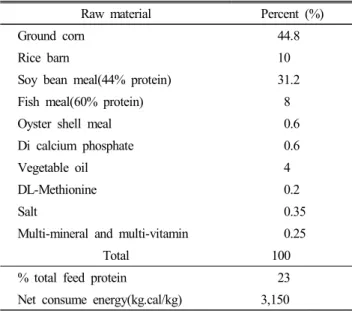
The experimental design with 4 levels of the treatment is descri- bed in Table 2. During the experiment, measured were body weight gain (BWG), total feed intake at day 1, 7, 14 and 21. After Salmonella pullorum was induced, clinical symptoms such as mortality and mobility were observed. And also, autopsy was practiced after 3 weeks old. The cultivated liquid broth of Bacillus subtilis was dried with glucose powder. The Bacillus subtilis powder then was added to the feed as 0.3 % of the total feed.
2) Statistical Model
The analysis made was the one way ANOVA using SAS.
The model analyzed was as;
Yij = μ + Ti + eij
Where yij= the observed data observation μ = overall mean
Ti= Treatment group (1 to 4) eij= residual
The mean differences among the treatment groups were tested by Tukey’s method.
RESULTS AND DISCUSSION
1) Growth Performance
The commercial broilers have been bred for meat consump- tion with fast growth and high feed efficiency. The body weight gain and feed intake in each treatment group were calculated, which was shown in Table 3. For the effect of Salmonella infection vs. non-infection (T1 vs. T2), the diffe- rence was about 75 g in body weight gain at day 21 (3 weeks of age). For the effect of Salmonella infection on growth performance, when the chicks were infected (T2) and the infected group added with Bacillus subtilis (T4), the body weight gains were 360.33 g and 427.69 g, respectively. The increase of growth performance was also reported by Kim et al. (2008), Hwangbo et al. (2011) and Kim et al. (2010). The
Table 1. Broiler feed formulation
Raw material Percent (%)
Ground corn 44.8
Rice barn 10
Soy bean meal(44% protein) 31.2
Fish meal(60% protein) 8
Oyster shell meal 0.6
Di calcium phosphate 0.6
Vegetable oil 4
DL-Methionine 0.2
Salt 0.35
Multi-mineral and multi-vitamin 0.25
Total 100
% total feed protein 23
Net consume energy(kg.cal/kg) 3,150
Table 2. Treatment group used in the experimental design Treatment1) Bacillus subtilis
added in feed
Salmonella pullorum induced orally
T1 No No
T2 No Yes
T3 Yes No
T4 Yes Yes
1) T1 : negative control, T2 : positive control, T3 : negative control added with Bacillus sp., T4 : positive control added with Bacillus sp.
Table 3. Growth rate and feed efficiency for 3 weeks old broiler
Treatment1)
Body weight gain; BWG
(g/bird)2)
Feed intake (g/bird)
Feed conversion ratio; FCR T1 435.6 ± 16.83a 611.5 ± 16.93a 1.40 T2 360.33 ± 19.53b 568.33 ± 14.01b 1.58 T3 557.17 ± 16.71c 625.63 ± 17.52a 1.12 T4 427.69 ± 28.91a 543.0 ± 16.81b 1.27
1) T1: negative control, T2: positive control, T3: negative control added with Bacillus sp., T4: positive control added with Bacillus sp., Note: Different superscripts in columns significantly differ (p<0.05).
addition of Bacillus subtilis was phenomenal such that even when the chicks were infected, the addition of Bacillus subtilis significantly compensated the loss of body weight gain and
Fig. 1. Salmonellosis symptom(Cloacae prolapsed), left (not infected) and right(infected).
Fig. 2. Enteritis of anterior of small intestine of Salmonella infection.
the difference between them (T2 vs T4) was significantly different, which is possibly due to one of the potential immu- nological enhancement of the infected chicks. Therefore, the addition of Bacillus subtilis could reduce the risk of body weight gain loss even when the chicks were under Salmonella infection. Consequently, feed conversion ratio (FCR) was significantly lower when Bacillus subtilis was added as a feed additive, which is of major concern for broiler farmers in sense of farm profits. Hume (2011) reported the probiotic function in broiler chicken that induce intestinal villi absorption efficiency would lead to raise up the feed utilization of chicken and induce the immunity of intestinal tract. In addition with improved body weight gain and FCR, the clinical symptoms were also investigated and shown in Table 4 and Fig. 1 and 2.
2) Salmonella Resistance
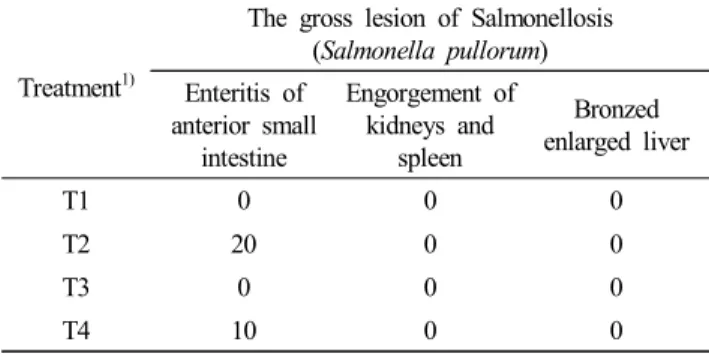
Different types of typical clinical symptoms of Salmonello- sis were described in Table 5 and pictured in Fig. 1 and 2. The chicks with feeding Bacillus subtilis showed significantly high resistance to Salmonella infection (gavage force feeding throu- gh oral) when compared with the groups with no addition of
Bacillus subtilis. Even for the groups without addition of Bacillus subtilis, the mobility and mortality rates were highly significant in that mobility rate was improved by 80% and by 43% for the mortality of the infected groups (T1 vs. T2) as shown in Table 4. When the chicks were infected with Salmonella, the mobility and mortality rates were also dra- stically decreased by 50%. When infected with Salmonella sp. the clinical signs were shown in Fig. 1 and 2. The typical symptoms of Salmonellosis were pictured in Fig. 1 and 2.
The Salmonellosis symptom in Fig. 1 indicated the sign of Cloacae prolapsed and Fig. 2 indicated the enteritis of ante-
Table 4. The Salmonella susceptibility rate in each treatment Treatment1) Salmonella susceptibility
Mobility rate (%) Mortality rate (%)
T1 0 0
T2 24 (80) 13 (43.33)
T3 0 0
T4 14 (46.67) 6 (20)
1) T1: negative control, T2: positive control, T3: negative control added with Bacillus sp., T4: positive control added with Bacillus sp.
Table 5. The clinical symptom of each treatment after Salmonella challenge
Treatment1)
The number of chicken with clinical symptom of Salmonellosis (Salmonella pullorum) Weakness
&
dejection
Reluc- tance to move
Anorexia Yellowish diarrhea
Cloacae prolapsed
T1 0 0 0 0 0
T2 24 10 24 4 8
T3 0 0 0 0 0
T4 10 2 9 0 1
1) T1: negative control, T2: positive control, T3: negative control added with Bacillus sp., T4: positive control added with Bacillus sp.
infection. To summarize the conclusion of this study, the trial of broiler chicks was undertaken to see the effects of Bacillus subtilis on growth traits and Salmonella resistance. The growth performance of broiler chicks after adding Bacillus subtilis to the feed was significantly improved and the Salmonella resis- tance was also highly increased. The mobility and mortality rates were considerably improved and thus, some strains of Bacillus subtilis could be an excellent feed additive as well as an alternative of chemical vaccination or treatment for the pathogenic diseases of chickens. Out of various sources of probiotic microbes, certain microbes such as the Bacillus subtilis used in this study showed significant impacts on the performance of broiler chicks. Of importance is not only the cell count of the microbes but more importantly, the meta- bolites excreted from the microbes are the better criteria for
Table 6. The gross lesion of each treatment after Salmonella challenge
Treatment1)
The gross lesion of Salmonellosis (Salmonella pullorum) Enteritis of
anterior small intestine
Engorgement of kidneys and
spleen
Bronzed enlarged liver
T1 0 0 0
T2 20 0 0
T3 0 0 0
T4 10 0 0
1) T1: negative control, T2: positive control, T3: negative control added with Bacillus sp., T4: positive control added with Bacillus sp.
the choice of the probiotic microbes.
REFERENCES
Awad WA, Bohm J, Razzazi-Fazeli E, Ghareeb K, Zentek J.
2006. Effect of addition of a probiotic microorganism to broiler diets contaminated with deoxynivalenol on perfor- mance and histopathological alterations of intestinal villi of broiler chickens. Poultry Sci 85:974-979.
Hwangbo J, Hong EC, Kang BS, Kim HK, Heo KN, Choo HJ, Kim W. 2011. Effect of dietary phytase on growth performance and excreta excretion of broilers. Korean J Poult Sci 38(4):255-263.
Hume ME. 2011. Historic perspective: Prebiotics, probiotics, and other alternatives to antibiotics. In food safety sym- posium: Potential impact of reduced antibiotic use and the roles of prebiotics, probiotics, and other alternatives in antibiotic-free broiler production. Poultry Sci 90:2663-266.
Jung JH, Kim HJ, Wang JP, Kim CH, Jung CH, Kim IH.
2010. Effect of agariemycetes supplementation on egg quality and fecal noxious gas concentration in laying hens.
Korean J Poult Sci 37(2):145-150.
Kim SC, Kim JW, Kim JU, Kim IH. 2013. Effects of dietary supplementation of bacteriophage on growth performance, nutrient digestibility, blood profiles, carcass characteristics and fecal microflora in broilers. Korean J Poult Sci 40(1):
75-81.
Kim HK, Kim SE, Shim KM, Kim JC, Bae CS, Choi SH, Kang SS. 2010. Effects of CS682, a fermentation product of Korean soil bacteria, on growth performance in chickens and pigs. Journal of Life Science 20(2):231-236.
Kim HJ, Cho1 JH, Chen YJ, Kim HJ, Yoo JS, Wang W, Sim JM, Kim IH. 2008. Effects of antibiotic and yeast supple- mental high energy diet on growth performance, blood characteristics and carcass trait in broilers. Korean J Poult Sci 35(2):123-129.
Lee JH, Kim SY, Lee JY, Aammed M, Ohh SJ. 2013. Effect of dietary live or killed Kimchi lactic acid bacteria on growth performance, nutrient utilization, gut microbiota and meat characteristics in broiler chicken. Korean J Poult Sci 40(1):57-65.
Vila B, Fontgibell A, Badiota I, Esteve-Garcia E, Jimenez G,
Castillo M, Brufau J. 2009. Reduction of Salmonella enteric var. Enteritidis colonization and invasion by Bacillus cereus var. toyoi inclusion in poultry feeds. Poultry Sci
88:975-979.
(접수: 2013. 9. 09, 수정: 2013. 9. 23, 채택: 2013. 9. 23)