• 검색 결과가 없습니다.

Physical Examination and Computed Tomography in Children with Toe in Gait

N/A
N/A
Protected

Academic year: 2021

Share "Physical Examination and Computed Tomography in Children with Toe in Gait"

Copied!
6
0
0

로드 중.... (전체 텍스트 보기)

전체 글

(1)

Received January 27, 2010; Accepted October 11, 2010 Corresponding author: Kyung-Sik Choi

Department of Rehabilitation Medicine, Dongsan Medical Center, Keimyung University School of Medicine, Dongsan-dong, Jung-gu, Daegu 700-712, Korea

Tel: +82-53-250-7264, Fax: +82-53-250-7268, E-mail: [email protected] Copyright © 2011 by Korean Academy of Rehabilitation Medicine

Physical Examination and Computed Tomography in Children with Toe in Gait

Soyoung Lee, M.D., Kyung-Sik Choi, M.D., In-Suek Jeung, M.D., Jee-Eun Lee, M.D., Shi-Mo Yang, M.D., Sung-Moon Lee, M.D. 1

Departments of Rehabilitation Medicine,

1

Radiology, Dongsan Medical Center, Keimyung University School of Medicine, Daegu 700-712, Korea

Objective To determine the correlation between the physical examination and the computed tomography of femoral anteversion and tibial internal torsion.

Method The angle of internal and external rotation of hip for femoral anteversion and thigh-foot angle for tibial internal torsion were measured by a rehabilitation physician for 116 young children with toe in gait. Within a week after the physical examination, the angle of femoral anteversion and tibial internal torsion were measured by computed tomography for comparison.

Results Two-hundred thirty-two lower limbs of 116 children (64 girls and 52 boys) included in this study whose mean age was 6.4±2.7 years for girls and 6.8±2.8 years for boys. The Pearson correlation coefficient between the angle of internal rotation of the hip and the femoral anteversion measured by computed tomography showed 0.62 in right side and 0.55 in left side, an indication of significant correlation (p<0.01). The Pearson correlation coefficient between the thigh-foot angle and the tibial internal torsion measured by computed tomography showed 0.50 in right side, 0.42 in left side, an indication of significant correlation (p<0.01).

Conclusion Children with toe-in gauts showed a significant correlation between finding of physical exam (i.e. TFA and femoral internal torsion angle) and those of CT omages (i.e. tibial torsion angle and femoral torsion angle).

Key Words Tibia, Torsion, Femur, Anteversion, Computed tomography

INTRODUCTION

In normal development, an in-toeing gait is seen among children and usually corrects itself before the age of 8.

1

In oriental culture, however, people sit on their knees with their feet internally rotated under hips which leads to in-toeing gaits.

2

The ongoing in-toeing gait has cosmetic, functional, and mental problems. In

severe cases, it is associated with pathologic conditions

like degenerative arthritis or chondromalacia patella.

3

To correct in-toeing gaits, accurate diagnosis is

warranted. An in-toeing gait is often seen in children

with mild cerebral palsy or congenital dislocation of

the hip joint. In normal juveniles as well, an in-toeing

gait results from femoral anteversion, internal tibial tor-

sion, over-rotated pelvis, or forefoot adduction. Amongst

(2)

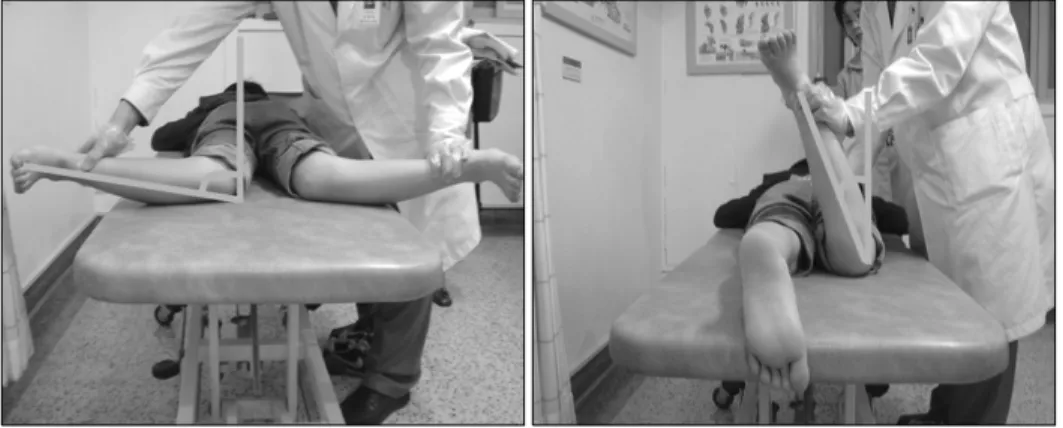
Fig. 1. Hip internal and external rotation which measures angles between tibia and the vertical line of the table.

Fig. 2. Thigh-foot angle which measures angle between the mid-thigh line and the line bisecting mid-heel and mid- forefoot.

them, femoral anteversion and internal tibial torsion are known as the most common causes of in-toeing gaits,

4

and physical exam functions as an indirect measure.

Both imaging and physical examinations help diag- nose the causes of in-toeing gaits and help understand biomechanical rotational disorders of the lower limbs.

In particular, measuring the angles of femoral ante- version and internal tibial torsion using computer to- mography (CT) scans is known most identical to the actual anatomic torsion.

5

Therefore, the authors tried to compare the findings of physical examination and CT images of femoral anteversion and tibial internal tor- sion in in-toeing gait children, and finally to investigate the relationship between physical examination and CT images.

MATERIALS AND METHODS

Subjects

Subjects were chosen among the patients who com- plained of in-toeing gaits and had abnormal angles of femoral and tibial rotation from January of 2007 to November of 2009. Children with in-toeing gaits of gen- uine forefoot adduction did not undergo CT scans, and thus were excluded in the current study. Finally, 116 children signed up for CT scans, and thus 232 lower limbs were encompassed. The sample included 116 child populations (52 boys and 64 girls; mean 6.4±2.7 years old and mean 6.8±2.8 years old, respectively).

Methods

Through physical examinations, internal and external rotational angles of the hip joint were measured by femoral anteversion, and thigh-foot angle (TFA) by ti- bial torsion. TFA was measured with the children in

the prone position fixing their hip to prevent femoral head from dislocating (Fig. 1). Femoral anteversion was diagnosed when the internal angle of femur is over 60

o

.

1,6

In the same position, patients flexed their knees and ankles by 90

o

to locate subtalar articulation in the central position. After the investigator indicated the bi- secting point of mid-heel and mid-forefoot from the feet side of the patient, TFA, the angle between mid-thigh line and the line bisecting mid-heel and mid-forefoot, was measured (Fig. 2). Negative values of TFA were diagnosed as tibial torsion.

7

Positive forefoot adduction was diagnosed when the bisecting line of mid-heel came to lateral section of the second webspace.

8

Physical examinations were done by the same re-

habilitation doctor, and within one week after that, CT

(3)

Table 1. Distribution of Age and 3 Major Causes in Toe-in Gait Age (year) Patient number Femur anteversion

(limb number) Tibial internal torsion

(limb number) Forefoot adductus (limb number)

2 3 3 3 4

3 11 13 8 9

4 13 21 16 6

5 22 28 23 19

6 14 24 13 14

7 14 22 13 11

8 9 16 6 6

9 13 22 8 12

10 5 4 2 6

11 6 9 7 2

12 3 4 6 2

13 2 2 0 0

15 1 2 0 0

Total 116 170/232 105/232 91/232

Fig. 3. Computed tomography of right femur, which meas- ures the angle between the line bisecting femoral head (a) and the tangent line passing posterior cortex of medial and lateral femoral condyle (b).

Fig. 4. Computed tomography of right tibia, which meas- ures the angle between the bisection line of tibia head (a) and the line connecting medial and lateral malleolus at distal tibia (b).

scans were undergone. On taking CT scans, children in supine position were fixed on their hip joint. Patellas faced anterior side and both feet, floor. Femoral ante- version angle was measured between the line bisecting femoral head and the tangent line passing posterior cortex of medial and lateral femoral condyle (Fig. 3).

The angle of tibial torsion was measured by the angle between the bisection line of tibia head and the line connecting medial and lateral malleolus at distal tibia (Fig. 4). Somatom Sensation 64 (SIEMENS, Berlin, Germany) was used for CT scans, and the reading was done by the same radiologist blinded to detailed in-

formation about the child.

Statistical analysis

All tests were performed using SPSS, version 17.0,

with p-value of <0.05 being statistically significant. To

measure the correlations of the angles of internal and

external rotation of the hip and those of femoral ante-

version, and to yield the relationship between TFA and

the angle of tibial internal torsion, Pearson’s correlation

was used among bivariate statistical techniques.

(4)

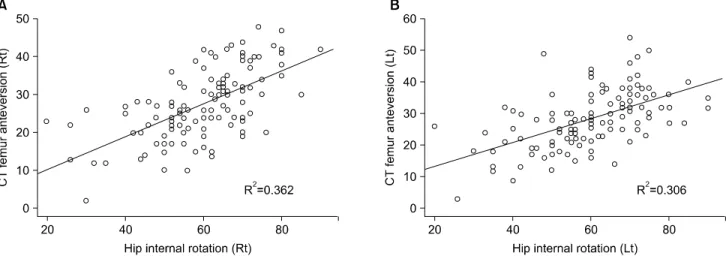
Fig. 5. The relationship between the hip internal rotation and CT femur anteversion of the right (A) and left (B) leg.

Table 2. Mean Angle of the Hip Internal Rotation, Thigh- foot Angle, CT Femur Anteversion and CT Tibial Internal Torsion

Mean angle (

o

) Hip internal rotation Rt. 59.9±13.0

Lt. 59.6±13.5

Thigh-foot angle* Rt. −0.1±8.0

Lt. −3.5±10.0

CT femur anteversion Rt. 27.7±9.1

Lt. 28.1±9.2

CT tibial internal torsion* Rt. 22.0±9.5

Lt. 18.8±8.3

Values are mean±standard deviation.

CT: Computed tomography

*p<0.05 (Rt. vs. Lt.)

Table 3. The Correlation between Hip Internal Rotation and CT Femur Anteversion

CT femur anteversion

Right Left

r p r p

Hip internal Right 0.618* 0.00 0.494* 0.00

rotation Left 0.590* 0.00 0.553* 0.00

Values are correlation coefficient r.

CT: Computed tomography

*p<0.05 (Hip internal rotation vs. CT femur anteversion)

Table 4. The Correlation between Thigh-foot Angle and CT Tibial Internal Torsion

CT tibial internal torsion

Right Left

r p r p

Thigh-foot angle Right 0.500* 0.00 0.383* 0.00 Left 0.407* 0.00 0.416* 0.00 Values are correlation coefficient r.

CT: Computed tomography

*p<0.05 (Thigh-foot angle vs. CT tibial internal torsion)

RESULTS

The majority of in-toeing gaits was 74 children (64%) out of 116 between the age of 3 to 7. Among 232 lower limbs, 170 cases (73%) were caused by femoral internal torsion (Table 1). On physical examina- tion, right- and left-side angles of femoral internal rota- tion were mean 59.9±13.0

o

, and mean 59.6±13.5

o

, re- spectively, and those of femoral external rotation were mean 29.4±8.2

o

, and mean 28.1±7.7

o

. Right side TFA was mean −0.1±8.0

o

and left, mean −3.5±10.0

o

. Accord- ingly, both sides showed a statistically significant corre- lation (p<0.05). On the CT images, right angles of fem- oral anteversion was mean 27.7±9.1

o

and left, mean 28.1±9.2

o

. Right angle of tibial torsion was mean 22.0±9.5

o

and left, mean 18.8±8.3

o

, and therefore, both

sides had a statistically significant correlation (p<0.05)

(Table 2). Pearson’s correlation coefficients between the

angles of internal tibial rotation and femoral ante-

version on CT images were 0.62 on the right side, 0.55

on the left with a statistically significant correlation (p

(5)

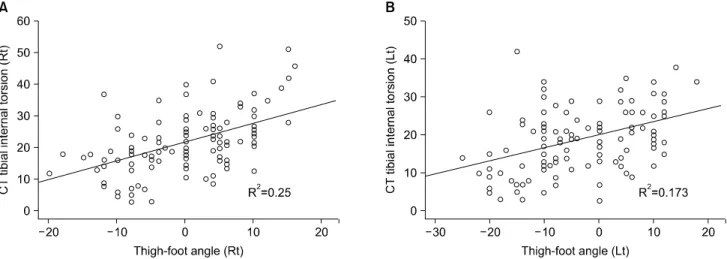
Fig. 6. The relationship between the thigh-foot angle and CT tibial internal torsion of the right (A) and left (B) leg.

< 0.01) (Table 3, Fig. 5). Pearson’s correlation coeffi- cients between TFA and tibial internal torsion meas- ured by CT scans were 0.50 on the right side, 0.42 on the left with a statistically significant correlation (p

< 0.01) (Table 4, Fig. 6).

DISCUSSION

In-toeing gaits are induced from different parts of the lower limbs: from acetabulum and femoral head to foot. Femoral anteversion and tibial torsion are the most common and important causes of in-toeing gaits.

9-12

In the current study, the majority of toe-in gait chil- dren were 3 to 7 years of age, and the age of 5 com- manded an absolute majority. Femoral anteversion showed higher frequency of in-toeing gaits than tibial torsion, which showed a similar result to Rethlefsen et al.

4

Staheli et al.

1

noted that in-toeing gaits are seen in development and usually corrects itself before the age of 8. In the current study, children aged 8 and older were included insomuch as they showed abnormal find- ings on physical examination and in-toeing gaits were diagnosed based upon normal values of 8-year-old children.

Staheli

13

found children with in-toeing gaits showed marked tibial torsion on the left lower limb. However, Jacquemier et al.

14

informed that there was no sig- nificant difference between left and right sides of tibial torsion. In the current study, left tibial torsion angle was bigger than right one with a statistical significance, and these results parallel those reported by Staheli.

13

Measuring femoral anteversion has a high range of error because of 3-dimnsional structure of femur and different measures such as simple X-ray, photo-fluorog- raphy, intra-articular contrast, ultra-sonography, and CT.

Amongst those methods, CT scans are known most accurate. CT scans are more expensive and takes longer than simple X-ray, and furthermore, it is difficult to get cooperation of children. However, it is most accurate and reliable for a unique structure like femur.

15-17

Abel et al.

18

mentioned that the accuracy of a 3-dementional CT is over 99%, and that of an ordinary CT, over 96%.

Measuring the angle of femoral anteversion using 2-de- mentional CT, the more flexion of the hip joint causes the lesser angle of femoral anteversion.

5,18

In the cur- rent study, no children had problems of contracture of the hip joint or extension angle. Children’s posture was fixed to maintain a constant position of femur.

Physical exams of tibial torsion composed of the TFA and transmalleolar angle, and the latter measured 5

o

more than the former.

19-21

Among those two, TFA is easier and faster, and more commonly used in measur- ing youth tibial torsion.

22

To diagnose tibial torsion in children with cerebral palsy, Lee et al.

22

compared the values of transmalle- olar angle or TFA with those on CT images, and veri- fied the reliability and validity of physical exams. The same was true in the current study: correlation co- efficients of CT scans and TFA were 0.50 on the right, 0.42 on the left with a statistical significance.

Clinically, however, findings of physical exam and CT

images were not consistent in some cases. For example,

the value of TFA was negative on physical exam, but

that of CT images showed normal, which exemplified

(6)

that in-toeing gaits might result from problems in soft tissues of joints as well as bones.

Based upon the physical exam of in-toeing gait chil- dren aged 8 and over, Staheli noted the necessity of surgical intervention: when femoral torsion angle of medial rotation is over 85

o

, that of lateral rotation, un- der 10

o

; when tibial torsion angle of medial rotation is over 15

o

, that of lateral rotation, over 30 degrees.

9

Primary surgical intervention indicates the correction of torsion using osteotomy, and is recommended after the age of 8 because in-toeing gaits may resolve sponta- neously with growth.

This study possesses several limitations. Unfortunately, in the current study, the same diagnostician admini- stered physical exam, and a test-retest reliability was not verified. According to Lee et al.,

22

however, the possibility of error between diagnosticians on physical exam had no statistical significance. Furthermore, given the fact that primary and secondary causes of in-toeing gaits were combined, future studies should examine the association between causing factors of femur, tibia, or foot.

CONCLUSION

In the current study, investigators sought to find cor- relation between physical exam and CT images compar- ing the findings of femoral anteversion and tibial torsion. Children with toe-in gaits showed a significant correlation between findings of physical exam (i.e. TFA and femoral internal torsion angle) and those of CT im- ages (i.e. tibial torsion angle and femoral torsion angle).

REFERENCES

1) Staheli LT, Corbett M, Wyss C, King H. Lower-extremity rotational problems in children. Normal values to guide management. J Bone Joint Surg Am 1985; 67: 39-47 2) Hutter CG Jr, Scott W. Tibial torsion. J Bone Joint Surg

Am 1949; 31: 511-518

3) Winter WG Jr, Lafferty JF. The skiing sequelae of tibial torsion. Orthop Clin North Am 1976; 7: 231-240

4) Rethlefsen SA, Healy BS, Wren TA, Skaggs DL, Kay RM.

Causes of intoeing gait in children with cerebral palsy. J Bone Joint Surg Am 2006; 88: 2175-2180

5) Kim SI, Park SB, Lee KM. Measurement of femoral anteversion using 3 dimensional imaging technique. J

Korean PACS Assoc 1995; 1: 53-58

6) Cho IH, Chung CY, Cho TJ, Yoo WJ, Park MS. Duk yong Lee’s pediatric orthopaedics, 3rd ed, Seoul: Koonja, 2009, 70-78, 303-305

7) Valmassy R, Stanton B. Tibial torsion. Normal values in children. J Am Podiatr Med Assoc 1989; 79: 432-435 8) Smith JT, Bleck EE, Gamble JG, Rinsky LA, Pena T. Simple

method of documenting metatarsus adductus. J Pediatr Orthop 1991; 11: 679-680

9) Staheli LT. Torsion-treatment indications. Clin Orthop Relat Res 1989; 247: 61-66

10) Rhee KJ, Park CH, Lee KB, Yang JY. Discriminant analysis between frmoral anteversion, range of motion of lower extremity and intoeing gait. J Korean Orthop Assoc 1993;

28: 1099-1105

11) Engel GM, Staheli LT. The natural history of torsion and other factors influencing gait in childhood. A study of the angle of gait, tibial torsion, knee angle, hip rotation, and development of the arch in normal children. Clin Orthop Relat Res 1974; 99: 12-17

12) Fabry G, Cheng LX, Molenaers G. Normal and abnormal torsional development in children. Clin Orthop Relat Res 1994; 302: 22-26

13) Staheli LT. In-toeing and out-toeing in children. J Fam Pract 1983; 16: 1005-1011

14) Jacquemier M, Glard Y, Pomero V, Viehweger E, Jouve JL, Bollini G. Rotational profile of the lower limb in 1319 healthy children. Gait Posture 2008; 28: 187-193

15) Arnold AS, Komattu AV, Delp SL. Internal rotation gait: a compensatory mechanism to restore abduction capacity decreased by bone deformity. Dev Med Child Neural 1997; 39: 40-44

16) Kitaoka HB, Weiner DS, Cook AJ, Hoyt WA, Askew MJ.

Relationship between femoral anteversion and osteoar- thritis of the hip. J Pediatr Orthop 1989; 9: 396-404 17) Murphy SB, Simon SR, Kijewski PK, Wilkinson RH,

Griscom NT. Femoral anteversion. J Bone Joint Surg AM 1987; 69: 1169-1176

18) Abel MF, Sutherland DH, Wenger DR, Mubarak SJ. Evalua- tion of CT scans and 3-D reformatted images for quan- titive assessment of the hip. J Pediatr Orthop 1994; 14:

48-53

19) Lang LM, Volpe RG. Measurement of tibial torsion. J Am Podiatr Med Assoc 1998; 88: 160-165

20) Stuberg W, Temme J, Kaplan P, Clarke A, Fuchs R.

Measurement of tibial torsion and thigh-foot angle using goniometry and computed tomography. Clin Orthop Relat Res 1991; 272: 208-212

21) Liu X, Kim W, Drerup B, Mahadev A. Tibial torsion measurement by surface curvature. Clin Biomech 2005;

20: 443-450

22) Lee SH, Chung CY, Park MS, Choi IH. Tibial torsion in cerebral palsy: validity and reliability of measurement.

Clin Orthop Relat Res 2009; 467: 2098-2104

수치

Fig. 1.  Hip  internal  and  external  rotation  which  measures  angles  between  tibia  and  the  vertical  line  of  the  table
Table 1. Distribution  of  Age  and  3  Major  Causes  in  Toe-in  Gait Age  (year) Patient  number Femur  anteversion
Table 4. The  Correlation  between  Thigh-foot  Angle  and  CT  Tibial  Internal  Torsion
Fig. 6.  The  relationship  between  the  thigh-foot  angle  and  CT  tibial  internal  torsion  of  the  right  (A)  and  left  (B)  leg.

참조

관련 문서