• 검색 결과가 없습니다.

Outcome of Local Excision Following Preoperative Chemoradiotherapy for Clinically T2 Distal Rectal Cancer: A Multicenter Retrospective Study (KROG 12-06)

N/A
N/A
Protected

Academic year: 2021

Share "Outcome of Local Excision Following Preoperative Chemoradiotherapy for Clinically T2 Distal Rectal Cancer: A Multicenter Retrospective Study (KROG 12-06)"

Copied!
7
0
0

로드 중.... (전체 텍스트 보기)

전체 글

(1)

Outcome of Local Excision Following Preoperative

Chemoradiotherapy for Clinically T2 Distal Rectal Cancer:

A Multicenter Retrospective Study (KROG 12-06)

1

Department of Radiation Oncology, Samsung Medical Center, Sungkyunkwan University School of Medicine, Seoul,

2

Department of Radiation Oncology, Seoul National University Bundang Hospital, Seoul National University College of Medicine, Seongnam,

3

Department of Radiation Oncology, Severance Hospital, Yonsei University College of Medicine, Seoul,

4

Department of Radiation Oncology, Dongsan Medical Center,

Keimyung University School of Medicine, Daegu, Korea

Purpose

The aim of this study was to examine the clinical implications of a pathologically com- plete response after neoadjuvant chemoradiotherapy (CRT) followed by local excision for patients with cT2 rectal cancer who refused radical surgery.

Materials and Methods

Seventeen patients with cT2 primary rectal cancer within 6 cm from the anal verge who received neoadjuvant CRT and local excision because of patient refusal of radical surgery or poor performance status were included. Two patients had clinical involve- ment of a regional lymph node. Preoperative radiotherapy was delivered to the whole pelvis at a dose of 44 to 50.4 Gy in 22 to 28 fractions. All patients underwent transanal excision and eight patients (47%) received postoperative chemotherapy.

Results

Ten patients (59%) achieved ypT0. At a median follow-up period of 75 months (range, 22 to 126 months), four (24%) patients developed recurrence (two locoregional and two distant). The 5-year disease-free survival of all patients was 82%, and was higher in patients with ypT0 (90%) than in patients with ypT1-2 (69%, p=0.1643). Decreased disease-free survival was also observed in patients receiving capecitabine compared with 5-fluorouracil (54% vs. 100%, p=0.0298).

Conclusion

Local excision could be a feasible alternative to radical surgery in patients with ypT0 after neoadjuvant CRT for cT2 distal rectal cancer without further radical surgery.

Key words

Rectal neoplasms, Neoadjuvant therapy, Local excision, Complete remission

Introduction

Neoadjuvant chemoradiotherapy (CRT) followed by total mesorectal excision (TME) is a standard treatment in patients with locally advanced rectal cancer [1,2]. In addition to im- proved local control, reduced toxicity, increased sphincter preservation, and tumor downstaging have been demon- strated after neoadjuvant CRT [1]. Complete pathologic re- sponse (ypCR) of approximately 15% has been reported after

CRT [3,4]. Patients with ypCR after CRT tend to have de- creased local or distant recurrence and improved survival [4- 6]. Some authors have reported that a wait-and-see policy without surgical resection could be possible with strict selec- tion criteria [7,8].

Radical surgery is associated with significant morbidity, especially in cases of low rectal cancer [9,10], therefore, local excision might be an alternative treatment to radical surgery after neoadjuvant CRT in selected cT2-3 cases [11-13].

However, cautious and strict patient selection is crucial in Jae Myoung Noh, MD 1

Won Park, MD, PhD 1 Jae-Sung Kim, MD, PhD 2 Woong Sub Koom, MD 3 Jin Hee Kim, MD, PhD 4 Doo Ho Choi, MD, PhD 1 Hee Chul Park, MD, PhD 1

+ + + + + + + + + + + + + + + + + + + + + + + + + + + + + + + + + + + + + + + + + + + + + + + + + + + + + + + + + + + + + + + + + + + + + + + + + + + + + + + + + + + + + + + + + + + + + + + + + + + + + + + + + + + + + + + + + + + + + + + + + + + + + + + + + + + + + + + + + + + + + + + + + + + + + + + + + + + + + + + + + + + + + + + + + + + + + + + + + + + + + + + + + + + + + + + + + + + + + + + + + + + + + + + + + + + + + + + + + + + + + + + + + + + + + + + + + + + + + + + + + + + + + + + + + + + + + + + + + + + + + + + + + + + + + + + + + + + + + + + + + + + + + + + + + + + + + + + + + + + + + + + + + + + + + + + + + + + + + + + + + + + + + + + + + + + + + + + + + + + +

Correspondence: Won Park, MD, PhD Department of Radiation Oncology, Samsung Medical Center, Sungkyunkwan University School of Medicine, 81 Irwon-ro, Gangnam-gu, Seoul 135-710, Korea

Tel: 82-2-3410-2616 Fax: 82-2-3410-2619

E-mail: [email protected] Received April 5, 2013

Accepted July 3, 2013

(2)

this approach [14]. Higher risk of recurrence has limited the routine application of local excision alone in cT2 rectal cancer [15]. The incidence of local recurrence was 24% in T2 rectal cancer after local excision alone [15]. In addition, salvage treatment for failure after local excision is difficult and is often associated with treatment-related morbidity [16].

Under National Comprehensive Cancer Network (NCCN) guidelines, the standard treatment for cT2N0 rectal cancer is radical surgery, and adjuvant treatments are recommended according to pathological status [17]. For patients with cT2 distal rectal cancer whose sphincteric muscles cannot be pre- served with abdominoperineal resection (APR), local exci- sion after neoadjuvant CRT is an alternative approach to preserving the sphincter with equivalent oncologic outcomes [18,19]. A recent randomized clinical trial of local resection versus TME after neoadjuvant therapy showed equivalent disease-free survival (DFS) in patients with cT2N0, a diame- ter no larger than 3 cm, and histological grade G1-2 rectal cancer [20]. The probability of developing recurrence was 12% after local excision. Recurrence occurred only in low or non-responders to neoadjuvant CRT.

In this study, to elucidate the clinical implication of ypCR after neoadjuvant CRT in patients with cT2 distal rectal can- cer, the Korean Radiation Oncology Group (KROG) con- ducted a multicenter retrospective study that examined the DFS according to ypT status.

Materials and Methods

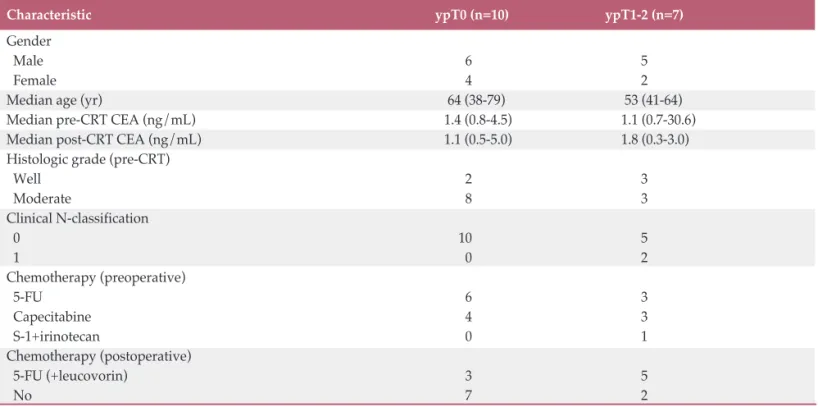
Seventeen patients with cT2 primary rectal adenocarci- noma who were treated by neoadjuvant CRT and local exci- sion between 2002 and 2009 were enrolled from four institutions. After approval by the KROG (KROG 12-06), the medical and radiotherapy (RT) records of the patients were reviewed retrospectively. The median age of patients was 63 years (range, 38 to 79 years). There were 11 (65%) men and six (35%) women. All tumors were located within 6 cm from the anal verge as measured by digital examination. For clinical staging, computed tomography (CT, n=15), magnetic resonance imaging (n=8), or transrectal ultrasound (n=11) was performed. Three patients were diagnosed by CT scan only. When positive lymph node involvement was defined as a lymph node ≥ 0.5 cm in the short-axis diameter, two patients had clinical involvement of a regional lymph node. The tumor characteristics at diagnosis are summarized in Table 1.

Patient refusal of radical surgery (n=16) and poor perform- ance status (n=1) were the reasons for undergoing local excision following neoadjuvant CRT. Patients who chose local excision were fully informed about the tumor response

to neoadjuvant CRT and the options of surgical modalities between radical resection and local excision. RT was deliv- ered to the whole pelvis at a dose of 45 Gy in 25 fractions (n=8), 50.4 Gy in 28 fractions (n=5), or 44 Gy in 22 fractions (n=4) by 6-15 MV photon beams. The regimens of concurrent chemotherapy included 5-fluorouracil (5-FU; n=9, 53%), capecitabine (n=7, 41%), and S-1 plus irinotecan (n=1, 6%).

There was no incidence of grade 3 or higher toxicity associ- ated with neoadjuvant CRT. The median interval between completion of CRT and surgery was 53 days (range, 40 to 75 days). All patients underwent transanal tumor excision. Post- operative chemotherapy was delivered to eight (47%) patients, and six received four cycles of 5-FU.

The median follow-up duration calculated from the initia- tion of CRT was 75 months (range, 24 to 126 months). The primary endpoint of this study was DFS according to ypT- classification, which was divided into ypT0 or not. DFS was defined as the time from the initiation of the CRT to rectal cancer relapse or death, while second primary cancers were not included. DFS was estimated using the Kaplan-Meier test. DFS according to ypT-classification was compared using the log-rank test. The secondary endpoint was pattern of disease recurrence. SAS ver. 9.1.3 (SAS Institute Inc., Cary, NC) was used for statistical analysis. A p < 0.05 was chosen for statistical significance.

Results

1. Surgical pathology after CRT

The primary tumor included ypT0 (n=10, 59%), ypT1 (n=6, 35%), and ypT2 (n=1, 6%). All of the ypT1-2 tumors were adenocarcinoma. Histologic grade was well-differentiated in one tumor, and moderately-differentiated in six tumors.

Lymphovascular invasion, perineural invasion, and involve-

ment of the resection margin were not observed. Resection

margins were not involved in pathologically residual tu-

mors, although the distances of resection margins were not

described, except two patients. There was no pathologic in-

volvement of regional lymph node (n=4). Among the seven

patients with ypT1-2 disease, five received postoperative

chemotherapy, while three of the 10 patients with ypT0

received adjuvant chemotherapy. The clinicopathologic char-

acteristics according to ypT-classification are summarized in

Table 2.

(3)

CRT, chemoradiotherapy; CEA, carcinoembrynonic antigen; 5-FU, 5-fluorouracil.

Table 2. Clinicopathologic characteristics according to ypT-classification

Characteristic ypT0 (n=10) ypT1-2 (n=7)

Gender

Male 6 5

Female 4 2

Median age (yr) 64 (38-79) 53 (41-64)

Median pre-CRT CEA (ng/mL) 1.4 (0.8-4.5) 1.1 (0.7-30.6)

Median post-CRT CEA (ng/mL) 1.1 (0.5-5.0) 1.8 (0.3-3.0)

Histologic grade (pre-CRT)

Well 2 3

Moderate 8 3

Clinical N-classification

0 10 5

1 0 2

Chemotherapy (preoperative)

5-FU 6 3

Capecitabine 4 3

S-1+irinotecan 0 1

Chemotherapy (postoperative)

5-FU (+leucovorin) 3 5

No 7 2

Table 1. Tumor characteristics at diagnosis

Characteristic No. (%)

Distance from anal verge (cm)

Median 3

Range 1-6

Histologic grade

Well 5 (29)

Moderate 11 (65)

Unknown 1 (6)

Clinical N-classification

N0 15 (88)

N1 2 (12)

Tumor size (cm)

Median 2.0

Range 1.4-4.0

Serum carcinoembryonic antigen (ng/mL)

Median 1.3

Range 0.7-30.6

2. Survival rates according to tumor response

During the follow-up period, four patients (24%) experi- enced recurrence (Table 3). Locoregional and distance recur- rences each occurred in two patients, respectively. Among the patients who achieved ypT0 after neoadjuvant CRT, one patient (10%) experienced regional recurrence after 14

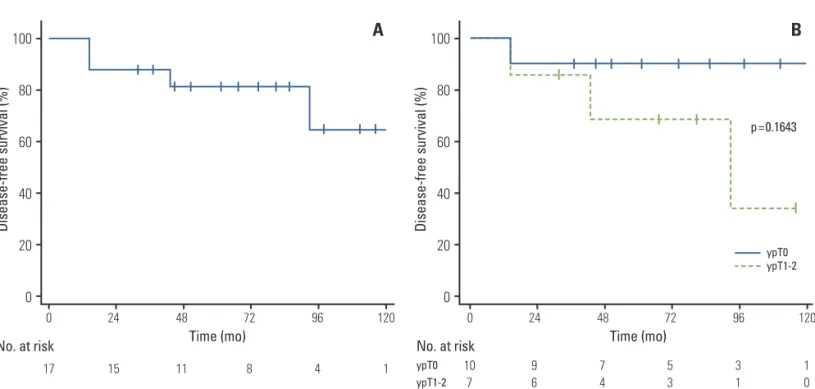
months. Three (43%) out of the seven ypT1-2 patients expe- rienced a recurrence. One patient had locoregional recur- rence and two had distant metastasis. The 5-year DFS of all patients was 82% (Fig. 1A). DFS in patients with ypT0 tumors was higher than in patients with ypT1-2 tumors (90% vs.

69%) (Fig. 1B), however, the difference was not significant

(p=0.1643). Lower DFS was observed in patients who

(4)

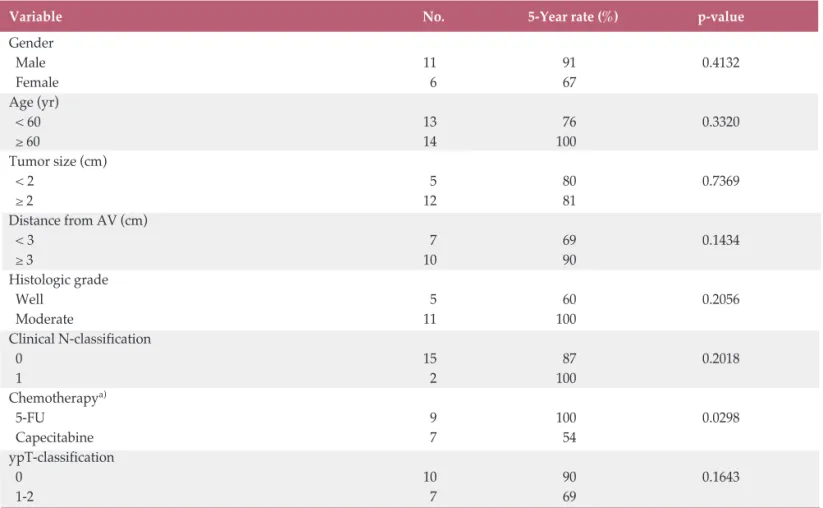
received capecitabine as neoadjuvant CRT, compared with patients treated with 5-FU (54% vs. 100%, p=0.0298). Among the seven patients with tumors close to the anal verge ( < 3 cm), three patients had disease relapse (p=0.1434) (Table 4).

No significant difference in DFS was observed for other clin- icopathologic characteristics (Table 4). None of the patients died during the follow-up period.

Discussion

ypCR after neoadjuvant CRT is known to be associated with favorable long-term oncologic outcomes [4-6]. Accord- ing to results of a pooled analysis, the ypCR rate is 16% [4].

Local control, distant metastasis-free survival, DFS, and over- all survival were favored in patients with ypCR. The adjusted hazard ratio by Cox proportional hazards model was 0.41 (95% confidence interval [CI], 0.21 to 0.81), 0.49 (95%

CI, 0.34 to 0.71), 0.54 (95% CI, 0.40 to 0.73), and 0.65 (95% CI, 0.47 to 0.89) for the outcomes, respectively. However, most studies included patients with cT3 rectal cancer who under- went radical surgery. Similar findings were observed in pa- tients who underwent local excision following neoadjuvant CRT for cT2-3 rectal cancer [12]. The prevalence of ypT0 was 22% (53 of 237). After local excision, none of the patients with ypT0 experienced local recurrence, while 2%, 7%, and 21%

of patients with ypT1, ypT2, and ypT3, respectively, experi- enced local recurrence. Although 34% of the patients had cT2 rectal cancer, the relationship between ypT-classification and clinical outcome in cT2 disease was not evaluated.

Table 3. Characteristics of patients who experienced disease recurrence

Preoperative Postoperative Site of

Age (yr) Gender AV (cm) Grade cN ypT DFS (mo)

chemotherapy chemotherapy failure

53 Male 6 Well 0 Capecitabine 1 5-FU Distant 14

49 Female 1 Well 0 Capecitabine 0 5-FU Locoregional 14

41 Female 2 Unknown 1 Capecitabine 1 5-FU Distant 43

62 Male 2 Moderate 0 5-FU 1 No Locoregional 93

AV, anal verge; DFS, disease-free survival; 5-FU, 5-fluorouracil.

Fig. 1. (A) Disease-free survival of all patients. (B) Disease-free survival according to ypT-classification.

Di se as e- fre e su rv iv al (% )

100 80 60 40 20

0

0 24 48 72 96 120

17 15 11 8 4 1

Time (mo) No. at risk

10 9 7 5 3 1

7 6 4 3 1 0

Time (mo) No. at risk

ypT0 ypT1-2

0 24 48 72 96 120

A

Di se as e- fre e su rv iv al (% )

100 80 60 40 20 0

p = 0.1643

B

ypT0 ypT1-2

(5)

Table 4. Disease-free survival according to clinicopathologic characteristics

Variable No. 5-Year rate (%) p-value

Gender

Male 11 91 0.4132

Female 6 67

Age (yr)

< 60 13 76 0.3320

≥ 60 14 100

Tumor size (cm)

< 2 5 80 0.7369

≥ 2 12 81

Distance from AV (cm)

< 3 7 69 0.1434

≥ 3 10 90

Histologic grade

Well 5 60 0.2056

Moderate 11 100

Clinical N-classification

0 15 87 0.2018

1 2 100

Chemotherapy

a)

5-FU 9 100 0.0298

Capecitabine 7 54

ypT-classification

0 10 90 0.1643

1-2 7 69

AV, anal verge; 5-FU, 5-fluorouracil.

a)

The patient who received S-1 plus irinotecan was excluded from comparison.

A recent randomized trial reported equivalent DFS to TME after local excision following neoadjuvant CRT [20]. The trial included patients with cT2N0, histologic grades 1-2 with tumors < 3 cm in diameter and within 6 cm of the anal verge, similar to the current study. After local resection, ypT0 was observed in 28% of patients, comparable to that of patients who received TME (26%). The probability of developing dis- ease recurrence at the end of follow-up was 12% after local resection, and the corresponding overall survival rate was 72%. Although the duration of follow-up was shorter and the number of patients was smaller, the rate of ypT0 (59%) and overall survival rate were higher in the current study. In ad- dition, the randomized trial did not evaluate the clinical im- plication of ypT0 after local resection. In the current study, ypCR after neoadjuvant CRT for cT2 rectal cancer showed an association with favorable outcomes in patients who un- derwent local excision. After neoadjuvant CRT, ypT0 showed an association with improved DFS compared with ypT1-2 in cT2 distal rectal cancer. The small number of pa- tients limited the power of the study, and higher rate of ypT0

might be influenced by potential selection bias, which could be caused by patient’s choice of local excision after they were informed about the clinical tumor response and the option of avoidance of radical resection. However, local excision could be a feasible alternative to radical surgery in properly selected patients with ypCR after neoadjuvant CRT for cT2 distal rectal cancer, which is located within 6 cm of the anal verge.

Of particular interest, most cases of disease recurrence occurred in patients who had received capecitabine as neoad- juvant therapy, regardless of postoperative chemotherapy.

However, no difference in the proportion of patients with

ypCR after neoadjuvant CRT was observed between the two

chemotherapeutic regimens (67% vs. 57%, p=1). Compared

to 5-FU, oral capecitabine demonstrated comparable or im-

proved tumor response, local control, DFS, and overall sur-

vival in patients who received neoadjuvant CRT for locally

advanced rectal cancer [21,22]. In addition to the convenience

of oral administration and lesser toxicities, capecitabine has

several advantages, including preferential activation in

(6)

tumor tissue and a synergistic effect with X-ray [23]. Oral capecitabine is currently a valid option in neoadjuvant CRT for rectal cancer, as investigated in previous studies [21,22].

However, most previous studies regarding local excision following neoadjuvant CRT used 5-FU as a chemotherapeu- tic regimen [12,13,20]. Efficacy of oral capecitabine in this set- ting has not been well established. Whether capecitabine is still as effective as 5-FU in patients receiving neoadjuvant CRT followed by local excision should be clarified. However, due to the small sample size, different DFS according to neoadjuvant chemotherapeutic regimen in the current study is not sufficient to answer this question.

In the current study, most of the enrolled patients refused radical surgery such as APR because the tumors were located in the distal rectum. Although a meta-analysis showed no difference in general quality of life (QoL) following APR or anterior resection [24], a sphincter-preserving procedure is preferred in terms of QoL for patients [25]. In this regard, local excision combined with neoadjuvant CRT could be the first treatment option in patients with cT2 distal rectal cancer for whom the anal sphincter cannot be preserved. After local excision, patients with residual tumors in the specimen should consider radical surgery. Because local excision alone

is associated with increased risk of disease recurrence, it should be applied cautiously to patients with residual disease after neoadjuvant CRT.

Conclusion

In conclusion, local excision could be a feasible alternative to radical surgery in patients with ypCR after neoadjuvant CRT for cT2 distal rectal cancer. Future studies including a large patient population are needed in order to confirm the efficacy of local excision in this setting.

Conflicts of Interest

Conflict of interest relevant to this article was not reported.

References

1. Sauer R, Becker H, Hohenberger W, Rodel C, Wittekind C, Fietkau R, et al. Preoperative versus postoperative chemoradio- therapy for rectal cancer. N Engl J Med. 2004;351:1731-40.

2. van Gijn W, Marijnen CA, Nagtegaal ID, Kranenbarg EM, Putter H, Wiggers T, et al. Preoperative radiotherapy combined with total mesorectal excision for resectable rectal cancer: 12- year follow-up of the multicentre, randomised controlled TME trial. Lancet Oncol. 2011;12:575-82.

3. Sanghera P, Wong DW, McConkey CC, Geh JI, Hartley A.

Chemoradiotherapy for rectal cancer: an updated analysis of factors affecting pathological response. Clin Oncol (R Coll Ra- diol). 2008;20:176-83.

4. Maas M, Nelemans PJ, Valentini V, Das P, Rodel C, Kuo LJ, et al. Long-term outcome in patients with a pathological complete response after chemoradiation for rectal cancer: a pooled analy- sis of individual patient data. Lancet Oncol. 2010;11:835-44.

5. Belluco C, De Paoli A, Canzonieri V, Sigon R, Fornasarig M, Buonadonna A, et al. Long-term outcome of patients with com- plete pathologic response after neoadjuvant chemoradiation for cT3 rectal cancer: implications for local excision surgical strate- gies. Ann Surg Oncol. 2011;18:3686-93.

6. de Campos-Lobato LF, Stocchi L, da Luz Moreira A, Geisler D, Dietz DW, Lavery IC, et al. Pathologic complete response after neoadjuvant treatment for rectal cancer decreases distant recur- rence and could eradicate local recurrence. Ann Surg Oncol.

2011;18:1590-8.

7. Lambregts DM, Maas M, Bakers FC, Cappendijk VC, Lammer- ing G, Beets GL, et al. Long-term follow-up features on rectal MRI during a wait-and-see approach after a clinical complete response in patients with rectal cancer treated with chemora- diotherapy. Dis Colon Rectum. 2011;54:1521-8.

8. Maas M, Beets-Tan RG, Lambregts DM, Lammering G, Nele- mans PJ, Engelen SM, et al. Wait-and-see policy for clinical complete responders after chemoradiation for rectal cancer. J Clin Oncol. 2011;29:4633-40.

9. Chessin DB, Enker W, Cohen AM, Paty PB, Weiser MR, Saltz L, et al. Complications after preoperative combined modality therapy and radical resection of locally advanced rectal cancer:

a 14-year experience from a specialty service. J Am Coll Surg.

2005;200:876-82.

10. Hendren SK, O'Connor BI, Liu M, Asano T, Cohen Z, Swallow CJ, et al. Prevalence of male and female sexual dysfunction is high following surgery for rectal cancer. Ann Surg.

2005;242:212-23.

11. Bonnen M, Crane C, Vauthey JN, Skibber J, Delclos ME, Rodriguez-Bigas M, et al. Long-term results using local excision after preoperative chemoradiation among selected T3 rectal cancer patients. Int J Radiat Oncol Biol Phys. 2004;60:1098-105.

12. Borschitz T, Wachtlin D, Mohler M, Schmidberger H, Jungin- ger T. Neoadjuvant chemoradiation and local excision for T2- 3 rectal cancer. Ann Surg Oncol. 2008;15:712-20.

13. Nair RM, Siegel EM, Chen DT, Fulp WJ, Yeatman TJ, Malafa

(7)

MP, et al. Long-term results of transanal excision after neoad- juvant chemoradiation for T2 and T3 adenocarcinomas of the rectum. J Gastrointest Surg. 2008;12:1797-805.

14. Perez RO, Habr-Gama A, Lynn PB, Sao Juliao GP, Bianchi R, Proscurshim I, et al. Transanal endoscopic microsurgery for residual rectal cancer (ypT0-2) following neoadjuvant chemoradiation therapy: another word of caution. Dis Colon Rectum. 2013;56:6-13.

15. Gopaul D, Belliveau P, Vuong T, Trudel J, Vasilevsky CA, Corns R, et al. Outcome of local excision of rectal carcinoma.

Dis Colon Rectum. 2004;47:1780-8.

16. You YN, Roses RE, Chang GJ, Rodriguez-Bigas MA, Feig BW, Slack R, et al. Multimodality salvage of recurrent disease after local excision for rectal cancer. Dis Colon Rectum.

2012;55:1213-9.

17. National Comprehensive Cancer Network. NCCN clinical practice guidelines in oncology: rectal cancer. v.4, 2013 [Inter- net]. Fort Washington: National Comprehensive Cancer Net- work; 2013 [cited 2013 Apr 13]. Available from: http://

www.nccn.org/professionals/physician_gls/pdf/rectal.pdf.

18. Rengan R, Paty P, Wong WD, Guillem J, Weiser M, Temple L, et al. Distal cT2N0 rectal cancer: is there an alternative to abdominoperineal resection? J Clin Oncol. 2005;23:4905-12.

19. Hingorani M, Hartley JE, Greenman J, Macfie J. Avoiding radical surgery after pre-operative chemoradiotherapy: a pos- sible therapeutic option in rectal cancer? Acta Oncol.

2012;51:275-84.

20. Lezoche E, Baldarelli M, Lezoche G, Paganini AM, Gesuita R, Guerrieri M. Randomized clinical trial of endoluminal locore- gional resection versus laparoscopic total mesorectal excision for T2 rectal cancer after neoadjuvant therapy. Br J Surg.

2012;99:1211-8.

21. Chan AK, Wong AO, Jenken DA. Preoperative capecitabine and pelvic radiation in locally advanced rectal cancer--is it equivalent to 5-FU infusion plus leucovorin and radiotherapy?

Int J Radiat Oncol Biol Phys. 2010;76:1413-9.

22. Hofheinz RD, Wenz F, Post S, Matzdorff A, Laechelt S, Hart- mann JT, et al. Chemoradiotherapy with capecitabine versus fluorouracil for locally advanced rectal cancer: a randomised, multicentre, non-inferiority, phase 3 trial. Lancet Oncol.

2012;13:579-88.

23. Sawada N, Ishikawa T, Sekiguchi F, Tanaka Y, Ishitsuka H.

X-ray irradiation induces thymidine phosphorylase and en- hances the efficacy of capecitabine (Xeloda) in human cancer xenografts. Clin Cancer Res. 1999;5:2948-53.

24. Cornish JA, Tilney HS, Heriot AG, Lavery IC, Fazio VW, Tekkis PP. A meta-analysis of quality of life for abdominoper- ineal excision of rectum versus anterior resection for rectal cancer. Ann Surg Oncol. 2007;14:2056-68.

25. Di Betta E, D'Hoore A, Filez L, Penninckx F. Sphincter saving

rectum resection is the standard procedure for low rectal

cancer. Int J Colorectal Dis. 2003;18:463-9.

수치

Table 1. Tumor characteristics at diagnosis
Table 3. Characteristics of patients who experienced disease recurrence
Table 4. Disease-free survival according to clinicopathologic characteristics

참조

관련 문서

High complication rate in locking plate fixation of lower periprosthetic distal femur fractures in patients with total knee arthroplasties.. Management and

A Retrospective Study of Prevalence and Risk factors for Neonatal Occipital

The seven steps can be organized in order of selecting local cultural resources of Fujian Province, selecting local design prototypes for character

In the present study, consistent to that report, up-regulation of VEGF mRNA was observed in the colon cancer cell with the acquired resistance to 5-FU and this

In conclusion, as the TDRD7 gene expression levels of the cataract patients found in the test conducted for 70 objects living in local region in this

This study aims to suggest a direction for local broadcasters to be more competitive by examining the level of satisfaction and viewers' grievances and

come true sound local finance and financial autonomy power of local government through abolition of delegation of national tasks to the local government, a new

Permission to reprint or distribute any content from this presentation requires the prior written approval of S&amp;P Capital IQ.. Not for distribution