• 검색 결과가 없습니다.

A Case Study on Architectural Engineering Design Using Action Learning

N/A
N/A
Protected

Academic year: 2021

Share "A Case Study on Architectural Engineering Design Using Action Learning"

Copied!
10
0
0

로드 중.... (전체 텍스트 보기)

전체 글

(1)

pISSN 1598-2033 eISSN 2233-5706

Journal of the Korea Institute of Building Construction, Vol. 13, No. 1

http://dx.doi.org/10.5345/JKIBC.2013.13.1.010 www.jkibc.org

A Case Study on Architectural Engineering Design Using Action Learning

Jang, Myung-Houn Choi, Hee-Bok

*1)

Department of Architectural Engineering, Jeju National University, Jeju, Jeju, 690-756, Korea

Abstract

Companies want universities to produce graduates with creativity and problem-solving skills, and for this reason universities have extended engineering design education, including in the field of architectural engineering. This paper investigates an engineering design class in the Department of Architectural Engineering, J University. The class was taught in 2010 and 2011using an Action Learning (AL) teaching-learning strategy. The students responded that the level of participation and satisfaction was high in the Action Learning classes, and role allocation or responsibility and communication of the project teams were very effective. But it was also found that as Action Learning is such a new method for students of engineering design, an orientation session that describes what to do and what to prepare should be given before the class starts.

Keywords : architectural engineering education, action learning, engineering design, teaching-learning strategy

1. Introduction

To improve the quality of engineering education, an increasing number of universities and engineering programs have been applying for Accreditation of Engineering Education[1].

Accreditation of Engineering Education is an effort to establish and achieve the education goals that are being demanded by employers. As part of this accreditation, engineering design education has been strengthened to cultivate the creativity and problem solving skills required by industry.

Engineering design has three categories, which are basic design, capstone design, and element design.

Basic design introduces the basic concept of

Received : August 7, 2012

Revision received : November 3, 2012 Accepted : November 12, 2012

* Corresponding author : Choi, Hee-Bok

[Tel: 82-64-754-3731 E-mail: [email protected]]

ⓒ2013 The Korea Institute of Building Construction, All rights reserved.

engineering design and cultivates basic creativity.

Capstone design, which is in the higher grades, covers design experience based on knowledge and techniques learned in the lower grades[2]. Element design teaches detailed parts of engineering education through small design projects with limited resources[3].

There are many examples of engineering design

classes in the department of electronic engineering

and mechanical engineering, where experimentation

and the development of products or systems are

active. The importance of engineering design is

increasing in architectural engineering, where cases

and experience of engineering design are not

sufficient. The following is a case study of an

engineering design class required by Accreditation

of Architectural Engineering Education. The case is

an element design class in the Department of

Architectural Engineering of J University, and

shows the result of the application of a new

teaching -learning strategy of Action Learning to

(2)

the class and proposes an improved teaching method.

2. Engineering Design and Action Learning

2.1 Concept of Engineering Design

Engineering design is a process of finding solutions to open -ended problems with several answers, or problems that are ill -defined with the existing scientific knowledge, and applying creative thinking by integrating realistic limits within regions and ages[4]. ABEEK (Accreditation Board for Engineering Education of Korea)[1,2] requires that a systematic curriculum of engineering education related subjects be developed to improve the professional adaptability of a university graduate, and divides engineering design classes into basic design, capstone design, and element design.

Basic design and capstone design should encompass all design factors and realistic design constraints. In particular, capstone design should include design factors such as design objective setup, synthesis, analysis, manufacture, test, and evaluation, and also include most realistic constraints such as economy, environment, society, ethics, aesthetics, health and safety, productivity and durability, and the industry standard based on knowledge and techniques learned in the lower grades. Basic design and element design should be included in the curriculum so that students can experience the design elements and realistic constraints covered in capstone design. Element design needs to be allocated to an area of study, and specific sub -areas need to be covered in order for students to learn about engineering design in those sub -areas. Students should complete a balanced range of element design classes in the specific sub -areas.

2.2 Cases of Engineering Design Class

Engineering design began to emerge in engineering colleges in the mid 2000s, and it has extended continuously along with the accreditation of engineering education. The number of engineering departments that have introduced various engineering design classes, including architectural engineering departments, has been continuously increasing.

The Faculty of Mechanical Engineering in KR University[5] created an overall capstone design course in 2005 with the introduction of Accreditation of Engineering Education through a full -scale restructuring of its curriculum.

Conceptual design, modeling and preliminary evaluation, detailed design, prototyping, performance and economic evaluation, and so on were the components involved in capstone design projects. The school of Mechanical & Automation Engineering in ST University[6] managed a capstone design for 16 years, which was evaluated as having the foundation for strengthening the engineering process, industry participation, student -centered management, and leadership.

The School of Electrical Engineering in SK

University[7] has opened a creative engineering

design class for freshmen since 2005. Students

studied the concept of engineering design, product

development process, design creativity, and design

methodology, and carried out team projects to

understand the concept and knowledge of

engineering design. Another case of electrical

engineering[8] introduced engineering design to

improve a student ’s creativity. Here, it was

proposed that because a teacher ’s detailed lecture

and additional explanation might have the risk of

unifying students ’ thought, and depending

completely on students ’ ideas could not accomplish

the objective of the class, the two situations had

(3)

A Case Study on Architectural Engineering Design Using Action Learning

to be harmonized.

The School of Chemical Engineering in YS University[9] developed basic design (1 subject 2 credits), element design (16 subjects 19 credits), and capstone design (2 subjects 4 credits). It adapted the curriculum structure with many prerequisites in consideration of the ABET (Accreditation Board for Engineering and Technology) of the United States. It concluded that finishing engineering design courses and following the curriculum structure led students to improve their presentation skill and team work by more than 10~30%. One study of a department of metal engineering[10] suggested that effective engineering design should focus on the value of engineering rather than on the special techniques of its major.

One survey[11] on the current state of capstone design -related subjects of architectural engineering program in accreditation of engineering education found that engineering design classes were increasing in departments of architectural engineering. The survey provided an overview of design, design management, and design evaluation of capstone design subjects managed in 18 programs accredited in Dec 2010. The overview of design showed the contents and themes focused on alternative designs and virtual designs. Design management showed that the engineering design classes had pursued the integration of structural engineering, building environment, and construction management. Most of the programs evaluated the results of projects performed by students twice a semester.

2.3 Literature Review

Many departments of engineering adopt engineering design in order for students to improve their creativity, communication skills, and

problem -solving skills. Many studies have been carried out on engineering design. Some have shown that engineering design classes resulted in an improvement in the student ’s skills, while others have shown only the results of the adoption of new teaching -learning strategies on engineering design.

GJ University[12] developed the Introduction to Engineering Design for freshmen and sophomores of the Department of Chemical Engineering, Architectural Engineering, and Civil Engineering.

The class taught students to develop teamwork skills, problem -solving skills, communication skills, and creative thinking. But when common themes were taught in several departments, there were difficulties making the best use of each department ’s characteristics. A College of Engineering[13] developed an interdisciplinary program for engineering design including the features of several major fields of study to improve creative problem -solving skills. The results of the program showed that the level of students ’ creativity increased and their personalities became more sensible and more cognitive. A study[14]

analyzing the current state of capstone designs suggested that capstone design should be creative and systematic. The project proposed by a teacher was easy and suitable for earlier capstone design classes. Practical and industrial problems tended to be used well as time passed. The participants changed from same -grade students to vertical joints of all -grade students and horizontal joints of interdisciplinary majors.

Various teaching -learning strategies are adopted for engineering design classes. One study[15]

compared the problem -based strategy with the

project -based strategy. The study concluded that

there was no meaningful difference between the

two strategies in terms of teamwork skills and

(4)

strategy was more competitive in developing creative problem -solving skills and self-directed learning. Another analysis[16] of a basic design class adopting a problem -based strategy and a project -based strategy divided students into two groups. One group used the problem -based strategy, and another used the project -based strategy. The analysis concluded that overall performance was higher when the problem -based strategy was used. The two studies suggested some teaching -learning strategies, but the strategies were similar to what most contemporary teaching -learning methods had proposed.

2.4 Action Learning

2.4.1 Definition and Process

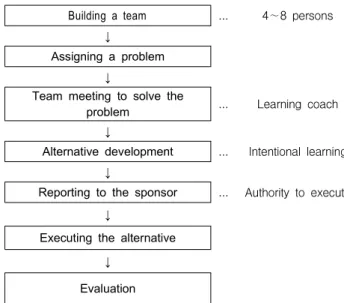
Action Learning is a process in which a team is built and solves a problem within a time frame with a learning coach, learning the contents of the problem and the process of the problem -solving through knowledge acquisition, questions and reflections at the same time. Figure 1 shows the general process of Action Learning. A learning team is built with 4~8 members and is given an important and difficult problem. The team finds solutions through several meetings within the restricted duration, which a learning coach also attends to advise the team on more effective problem -solving. The team discusses the problem with the learning coach and reflects using a variety of powerful techniques, such as problem -solving skills, communication skills, project management skills, and meeting operation skills, to develop an alternative and learn simultaneously. The alternative is evaluated by the sponsor who has a right to execute the alternative.

Building a team … 4∼8 persons

Assigning a problem

Team meeting to solve the

problem … Learning coach

Alternative development … Intentional learning

Reporting to the sponsor … Authority to execute

Executing the alternative

↓ Evaluation

Figure 1. Process of Action Learning Program

Action Learning consists of a team, a problem, a strong will to execute, the acquisition of knowledge from the problem and problem -solving, questions, reflections and feedback, and a learning coach. The problem must be important and difficult, and a real problem that is directly related to the profit or survival of a team/organization, not a virtual one. Appropriate team size is usually 4 -8 people. Having less than four members on a team decreases the diversity of the group, making it difficult for the team to be creative. If a team has more than nine people, it is also too difficult to expect effective team activities because the interactions between the team members are too complex and time is insufficient for comments and reflections to each member.

Because Action Learning is a problem solving

strategy to resolve practical problems where there

is the risk of failure, practice and the strong will

to execute an alternative derived from the

problem -solving process is very important. In

addition, the problem -solving process offers

knowledge and techniques such as team leadership.

(5)

A Case Study on Architectural Engineering Design Using Action Learning

communication skills, presentation skills, project management skills, conflict management, and meeting management skills, among others.

One of the characteristics of Action Learning that is different from other teaching -learning strategies is that learning takes place not when a learning coach leads the team, but when the team finds and analyzes the properties of a problem, solves the problem with various tools and techniques, asks and answers many questions, and reflects what is to be done. That is, wise questions promote creative thinking by shaking the basic assumptions of the team members, by forming new relations among objects or phenomena, and by helping to develop a new thinking model about the existence of objects and their desirable forms.

The problem, a series of actions for problem solving, and careful reflections about team members or a team grant the participants the insight that enables them to ask fresh questions in a situation when nobody knows what to do. They are able to reach a common view on things, and learn from each others ’ experiences. They also establish close relationships.

A learning coach participates in team meetings as a team member to increase effective learning.

He stands at the center of discussions, but has no formal authority to make decisions. He intervenes to help the team members to improve how they recognize problems, how they solve problems, and how they make decisions.

2.4.3 Comparison of Action Learning and other teaching-learning strategies

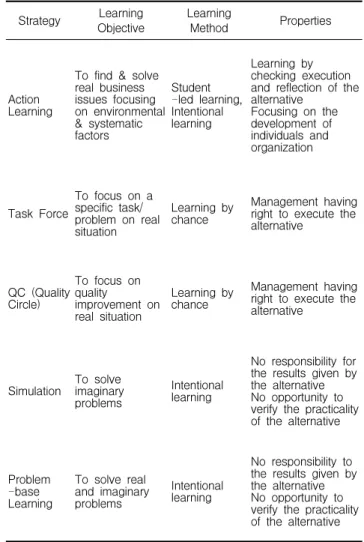
Action Learning is often confused with task force, quality circles, simulation, or problem -based learning. There are differences between them in terms of learning objective and learning method, as shown in Table 1. The objectives used to solve

a problem in a real situation are somewhat similar.

However, the learning method of Action Learning does not pursue learning by chance, but student -led learning and intentional learning.

Problem -based learning and simulation have no responsibility for the alternative and their results, and offer no opportunity to verify the practicality of the alternative. Superior or executive managers have permission to execute the alternative in task force and quality circle. Action Learning evaluates the practical application of a solution, offers the chance to learn by reflection, and focuses on individual development and organizational development.

Table 1. Comparison of Action Learning and other problem-solving strategies

Strategy Learning

Objective Learning

Method Properties

Action Learning

To find & solve real business issues focusing on environmental

& systematic factors

Student -led learning, Intentional learning

Learning by checking execution and reflection of the alternative

Focusing on the development of individuals and organization

Task Force

To focus on a specific task/

problem on real situation

Learning by chance

Management having right to execute the alternative

QC (Quality Circle)

To focus on quality

improvement on real situation

Learning by chance

Management having right to execute the alternative

Simulation To solve imaginary problems

Intentional learning

No responsibility for the results given by the alternative No opportunity to verify the practicality of the alternative

Problem -base Learning

To solve real and imaginary problems

Intentional learning

No responsibility to

the results given by

the alternative

No opportunity to

verify the practicality

of the alternative

(6)

3.1 Objectives and Class Design

3.1.1 Objectives of an engineering design class Construction Safety & Environment Design of Department of Architectural Engineering in J University is a case for this study. It has two credits and four hours a week. The department has all types of engineering design; that is, it includes basic design in the first grade, element designs in the second and the third grades, and capstone design in the first semester of the fourth grade. Element designs have the required contents based on specific study areas of architectural engineering, such as construction management, construction structure, construction environment, and construction material.

The Construction Safety & Environment Design class is an element design class in which a student proposes an alternative to improve the safety and environment of construction sites and gets a chance to experience the role of a safety manager. To make the alternative, the student studies various types of safety accidents, safety facilities, safety tools, and equipment. He/She also reviews environmental factors such as weather, traffic, social and economic situations, and other circumstances. The objective of the class is as follows. (1) A student finds problems in safety facilities or factors of safety and environment, proposes an alternative to eliminate or relieve the problem, and verifies the alternative. (2) The student is able to experience and learn the importance of safety through these actions.

3.1.2 Instructional Design

The Construction Safety & Environment Design class focuses on the importance of construction safety and environment management. In its early

causes and effects of safety accidents. In the class, groups of 4~5 students will perform a project requiring many ideas and various roles, to investigate the factors of safety and the environment and propose alternatives. Their performance is evaluated based on efforts and outputs, to clearly define the problems of the project, and solve it. Role sharing, team coordination, and communication skills in the problem -solving process of the team project are also evaluated.

Teaching -learning strategies such as Problem -Based Learning and Team-based Learning can be adapted to the problem -solving process in the team project. Action Learning strategy was applied to the construction safety and environmental design class to derive more active and diverse alternatives because the construction field has many stakeholders and numerous management methods of safety and environment.

3.2 Class Management

3.2.1 Introduction

The Construction Safety & Environment Design class teaches construction safety and environment management. An internship at a construction site is the ideal way to learn and practice construction management. But since opportunities for internships are scarce, and an internship cannot focus on safety and environment management, this class gives students opportunities to investigate problems threatening construction safety, to propose alternatives and to learn about safety facilities, factors, gear and equipment.

3.2.2 Managing the class

Action Learning was adapted to 2 classes in

(7)

A Case Study on Architectural Engineering Design Using Action Learning

2010 and 2011, respectively. Each class had 2 credits and 4 hours a week in the 2

nd

semester of 2010 and 2011. Table 2 shows that the contents and projects of both classes are similar, and are followed by the Action Learning process. A team was built and the team selected a theme to propose alternatives to safety management as a final objective. The team investigated safety accidents and safety management cases on a construction site, and made two presentations of the final results. The 15 weeks of the semester were too short to investigate cases, visit construction sites and analyze data in a classroom.

The team repeated the performance of most reports and surveys out of the classroom, and discussed its results to find alternatives in the classroom.

Week Contents AL Process

1∼3

Introduction to Construction Safety Introduction to Action Learning Team project orientation & Team building Selecting team subjects

·Team building

·Finding a problem

4∼6

On-site survey of the team subject Presentation (1st)

- Objective, Method, & Cases of the team subject Reflections (1st) – Individuals & Team

·Team meeting for problem- solving

·Reflection

7∼9

Proposal of alternatives

- Building a model and implementing a system with ideas, knowledge, methods, & tools

- Recording the process of model building & system implementation - Presentation, evaluation, &

reflection

Presentation of weekly progress

·Team meeting

·Alternative development Table 2. Syllabus for 2011

1) Analysis of students

15 students were enrolled in 2010, including four seniors and one sophomore. The sophomore had not previously taken part in engineering design, while some of the seniors had participated in engineering design. In 2011, the number enrolled was 14, but one student was absent from most classes. The 13 students had taken construction

management classes that taught some aspects of construction safety in previous semesters. 10 out of the 13 students responded they had learned some of the class content in advance. Most students (12 out of 14) had experienced an engineering design class before.

2) Teaching -learning strategy

The class in 2010 used the Action Learning method to foster team learning and problem solving skills, and the same method was used in 2011 to complement the shortcomings of the previous year class. Team organization, project selection, implementation and evaluation followed the procedure of the Action Learning. It was difficult to select team projects in 2011 that were different from those in 2010 because the classes in 2011 and 2010 were conducted in a similar way.

Site manager interviews, field trips, and investigations of safety management data and patent -related materials were conducted to find more creative themes and projects.

3) Performing the project

Studying the results of the class in 2010 that adapted Action Learning for the first time, it was found that when a member was absent from the class after his/her team was developed, it caused the team slight damage. When teams were formed in 2011, students who might not attend to perform the team project were required to drop the class.

Students taking the class in 2011 had known about the Action Leaning method because some of them took a basic engineering design class in 2010, while others had learned of the method indirectly. The Action Learning method raised the level of participation and level of satisfaction.

Discussing the collected data and the many ideas meant that most of the class hours were required to perform the project.

Every team gave a presentation of the results on

(8)

each member would randomly change from speaker, clerk, or panelist, every week or twice a week. At the end of the class, every team and each member reflected on what the team and the member had done, and what should be done for the team, the members, and the project. In early weeks, team members reflected using emotional words such as ‘fun,’ ‘pleasant,’ and so on. But later, objective words such as ‘useful,’ ‘helpful,’

and so on were used more frequently. The team reflected on what needed to be improved, so the deficiencies became guidelines to develop the team.

Active participation in the team project had resulted in 4 objective alternatives in 2010 and 3 alternatives in 2011. One out of four[17] and two out of three[18,19] results have patents pending.

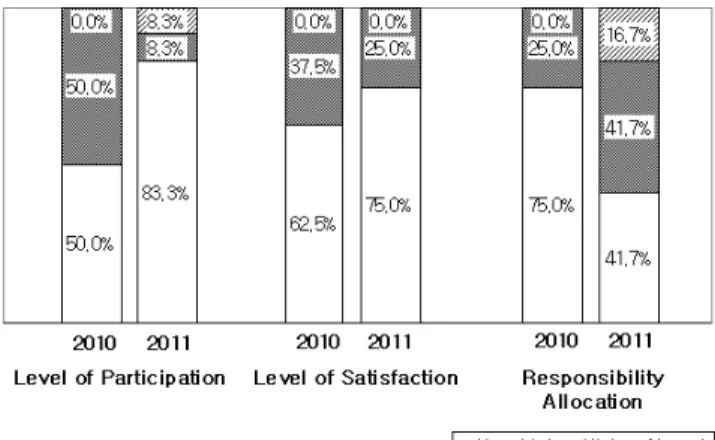
Figure 2. Annual comparison of students’ responses

4. Discussions

4.1 Results of the Case Study

Teacher and students had difficulties adjusting Action Learning to the engineering design class because it was new and hard to understand. Team activities improved the level of participation and the level of satisfaction, though class hours for theory lectures were insufficient. By experiencing

his/her presentation and communication skills.

Surveys were conducted at the end of each class in 2010 and 2011 to investigate the level of participation, the level of satisfaction, and role sharing as shown in Figure 2. 15 students took the class in 2010 and 14 in 2011. Respondents to the surveys in 2010 and 2011 were 8(53.5%) and 12(85.7%) respectively. The results are not statistically significant because the numbers in the results were simply collected from the respondents.

The level of participation is a question about

‘the level of a student’s participation in the class. ’‘Very high’ was given for 50.0% of responses in 2010 and 83.3% in 2011. Most students participated actively in the class because the responses became 100% and 91.7%, including the answer of ‘high.’ 100% of respondents gave answers of either ‘very high’ and ‘high.’ It seemed that the level of satisfaction in 2011 was very high considering the respondent ratio was 83.3%.

Answers to the question of ‘How was the level of role sharing and team communication in the team? ’ showed that role sharing and communications were good in the team because 100% of responses in 2010 and 83.3% in 2011 were ‘very high’ or ‘high.’

A systematic teaching -learning process of Action

Learning introduced to an architectural engineering

design class could raise the level of participation

and the level of satisfaction. It was considered

that role -playing within the team and the

exchange of ideas were both active. The high level

of participation and satisfaction both confirm the

strength of Action Learning ’s intentional learning

and self -led learning. But the first adaptation of

Action Learning in 2010 confused teachers and

students, making it difficult to manage the class

and perform the projects.

(9)

A Case Study on Architectural Engineering Design Using Action Learning

4.2 Points to Improve

The case is one of the element designs required by ABEEK. Students should take basic engineering design in 1

st

or 2

nd

grade to understand the concept, necessity, and process of engineering design. Most students of J University had never taken basic engineering design or element design because J University started to pursue the accreditation of engineering in 2009. For this reason students had difficulties performing their element design projects. To overcome the difficulties, Action Learning was adapted to the element design class in 2010.

Lecture hours on theories of engineering design, construction safety, and environment management decreased as Action Leaning required much time for students to survey, discuss, and make alternatives. The teacher gave class materials to students in advance. The students studied them outside of the classroom, and discussed them in the classroom.

The number of project teams was 5 in 2010 and 4 in 2011, which were suitable for the teacher to coach. But the teacher had some difficulties due to lack of experience with Action Learning. It was eventually found that the teacher could coach more than 4 or 5 teams with the support of a student who had previously taken an Action Learning class.

The students and their team reflected on learning and feeling from the class and the team activity, and how to use them at the end of the class or team activity. They were not familiar enough to express their feelings in the early hours of the class, and gradually became more active.

Reflection is a very important part of Action Learning, but it is difficult to use it in a class, because the student is unaccustomed to expressing his/her feelings and criticizing others. Therefore,

various methods, tools and techniques are needed to inspire students ’ active reflection.

The results of the surveys after the classes showed that Action Learning raised the level of satisfaction with engineering design. But it is not clear that Action Learning is more effective for engineering design classes than other teaching -learning strategies. For this reason, a comparison and analysis are necessary to apply both Action Learning and other strategies to a future class.

5. Conclusions

This paper is a case study on the element design classes required for Accreditation of Engineering Education. The classes adapted an Action Learning teaching -learning strategy for two semesters in 2010 and 2011. The results are as follows.

1) The classes had a systematic engineering design process using Action Learning in 2010 and 2011. Its process and guidelines such as team building, team rules, discussion method and order, and reflections technique produced good results of patent applications.

2) Surveys at the end of the classes showed that the new teaching -learning strategy enabled the students to participate more actively in team activities, to be more satisfied, and to share member roles well and communicate more clearly with each other.

3) The teacher and the students had difficulties

using Action Learning because they had little

experience with it. For this reason, an

orientation is required to give them

information about the concept and process of

Action Learning in the early weeks of class

in order to overcome fear of the new method

and motivate students to perform their

(10)

Though Action Learning provides a systematic process, the role of the teacher is important in order to use it properly. Students will produce much better project results if a student who has experienced Action Leaning in an engineering design class or an Action Learning expert helps them to perform the project.

Acknowledgement

This work was supported by the research grant of Jeju National University in 2011.

References

1. Lee KW, Park JC. The Status and improvement direction of engineering education accreditation program. Review of Architecture and Building Science. 2011 June;55(6):66-70.

2. ABEEK(Accreditation Board for Engineering Education of Korea). KEC(Criteria for Accrediting Engineering Programs).

2005. 2011 July. p. 2

3. ABEEK(Accreditation Board for Engineering Education of Korea). KEC(Criteria for Accrediting Engineering Programs).

2005. 2011 July. p. 14

4. Sim JJ. Construction of systematic engineering design education system. Engineering Education. 2010 March;17(1):25-9.

5. Kim KH. Current state of engineering design education in school of mechanical engineering of korea university.

Engineering Education. 2011 April;18(2):38-40.

6. Kim JY. Current state of capstone design in school of mechanical & automation engineering of seoul national university of science & technology. Engineering Education.

2011 April;18(2):41-4.

7. Kim YS. Creative engineering design for design basic education. Engineering Education. 2011 April;18(2):35-7.

8. Seol SG. Creative engineering design – experience of school of electrical engineering of seoul national university.

Engineering Education. 2001 March;8(1):9-13.

9. Sim JJ. Subject structure and design educational system of chemical engineering. Engineering Education. 2011 August;18(4):18-23.

December;11(4):49-54.

11. Han SW, Kim YS. The current state of the capstone design courses for architectural engineering programs in korea focusing on the depth at the university level. Review of Architecture and Building Science. 2011 June;55(6):39-44.

12. Kim LH, Lee BS. Development of introductory engineering design course to improve creative thinking ability. Journal of Engineering Education Research. 2005 September;8(3) :26-35.

13. Baek YS, Lee JH, Kim ET, Oh KJ, Park CS, Chung JB.

Achievements in the creativity education through freshmen engineering design. Journal of Engineering Education Research. 2006 June;6(6):5-20.

14. Song DJ. Current state and direction of capstone design project. Engineering Education. 2010 March;17(1):18-21.

15. Shin HJ, Son JI, Im YD, Kim JW. A comparative analysis of the problem-based learning and project-based learning strategies on the course of engineering design. Journal of Engineering Education Research. 2009 December;12(4) :142-9.

16. Kim IS, Kang TW, Choi JW. Analysis of teaching and learning strategies in basic engineering courses. Journal of Engineering Education Research. 2011 September;14(5):3-9.

17. Jang MH, Kim BH, Jeong WY, Park SK, Lee SH, inventors;

Jeju National University Industry-Academic Cooperation Foundation, assignee. [Adjustable safety foothold for scaffold]. Korean Patent KP 10 2011 0069322. 2011 July 13.

Korean.

18. Jang MH, Lee HS, Moon SY, Yoon JP, Lee WG, inventors;

Jeju National University Industry-Academic Cooperation Foundation, assignee. [Plate for Control of Angle with Scaffold]. Korean Patent KP 10 2012 0029730. 2012 March 23. Korean.

19. Jang MH, Kang IJ, Lee HS, Ko DJ, Shin SE, inventors; Jeju

National University Industry-Academic Cooperation

Foundation, assignee. [Fence for Protection Against Wind

with Support]. Korean Patent KP 10 2012 0029731. 2012

March 23. Korean.

수치

Figure 1. Process of Action Learning Program
Table 1. Comparison of Action Learning and other problem-solving strategies Strategy Learning Objective LearningMethod Properties Action Learning
Figure 2. Annual comparison of students’ responses

참조

관련 문서

This study is to explain the process of a traditional architecture method of Cheju Island applied to the modern design element and re-composition into the

Given the nature of these curriculums, design classes provide writing courses focusing on science and engineering within specialized fields, but there still

The purpose of this study is to develop capstone design model of gender analysis methods suitable for engineering education field and examine improvements

As results, the relationship between the configuration variables and the performance has been obtained and the basic design concept of the

In this paper, a case study of the teaching method for the ’esearch problem’that means capstone design in engineering education is suggested to improve the teaching skills

Especially, the design project drew from a survey of students majoring in civil and environmental engineering and is well knitted to help students obtain the potential

The purpose of this study is to identify the effects of learning and learning transfer in engineering design program at the university level.. First,

The design experience with LEGO Mindstorm NXT provides students with various aspects of design experiences including defining problem, finding constraints