<연구논문(Original Article)>
초음파 표면개질에 의한 CDI 전극용 술폰화 염화비닐(PVC) 멤브레인의 제조 및 특성
황치원⋅오창민⋅황택성
†충남대학교 화학공학과
(2014년 2월 12일 접수, 2014년 2월 21일 수정, 2014년 2월 25일 채택)
Preparation and Properties of Sulfonated Polyvinylchloride (PVC) Membrane for Capacitive Deionization Electrode by Ultra Sonication Modification
Chi Won Hwang, Chang Min Oh, and Taek Sung Hwang
†Department of Chemical Engineering, College of Engineering, Chungnam National University, Daejeon 305-764, Korea (Received February 12, 2014; February 21, 2014; Accepted February 25, 2014)
요 약 : 이온 교환막은 전기투석, 확산투석, Redox flow 전지, 연료전지 등 다양하고 넓은 분야에서 사용되고 있다. 초음파를 이용하여 만들어진 PVC 양이온 교환막을 시간을 변화시켜 가면서 술폰 화 반응에 의해 제조하였다. 술폰화제로 황산을 사용하였으며, 술폰화 PVC 양이온 교환막의 기본구 조와 특성을 FT-IR, EDX, Water uptake, 이온교환용량(IEC), 전기저항(ER), 전도도, 이온수송수 및 표 면 morphology를 SEM 분석하였다. FT-IR 스펙트럼 분석결과 술폰화 PVC 양이온 교환막에 술폰산기 가 도입되었음을 확인하였으며 멤브레인의 Water uptake, IEC, 전기 저항 및 ion transport number의 최대값은 각각 40.2%, 0.87 meq/g, 35.2 Ω․cm
2및 0.88이었다.
Abstract: Ion exchange membrane is widely used in various fields such as electro dialysis, diffusion dialysis, redox flow battery, fuel cell. PVC cation exchange membrane using ultrasonic modification was prepared by sulfonation reaction in various sulfonation times. Sulfuric acid was used as a sulfonating agent with ultrasonic condition. We’ve characterized basic structure of sulfonated PVC cation exchange membrane by FT-IR, EDX, water uptake, ion exchange capacity (IEC), electrical resistance (ER), conductivity, ion transport number and surface morphology (SEM). The presence of sulfonic groups in the sulfonated PVC cation exchange membrane was confirmed by FT-IR. The maximum values of water uptake, IEC, electrical resistance and ion transport number were 40.2%, 0.87 meq/g, 35.2 Ω․cm
2and 0.88, respectively.
Keywords: cation exchange membrane, sulfonation, PVC, ultrasonic
1. 서 론
1)
Nowadays the ion exchange membrane is widely ap- plied in electro dialysis (ED), diffusion dialysis (DD), ca- pacitive deionization (CDI), fuel cell, manufacturing table salt, valuable metal recovery, and the others. Among the lots of fields, research about ion exchange membrane is possible to solve the water and air pollution. Also it is applicable to energy regeneration and storage field such
†Corresponding author: Taek-Sung Hwang ([email protected])
as fuel cell and redox flow battery[1,2,3]. The Nafion (Du pont, USA) is the most outstanding membrane. But it is too expensive to use for mass-production system. For these reasons, the cheaper and durable membrane is urgently needed[4].
Polyvinylchloride (PVC) is one of the general-purpose
polymer, it is discovered by French chemist V. Regnault
in 1835[5]. Various modification conditions of PVC was
reported in both wet and dry process. The several meth-
ods of PVC modification are followed: phase transfer cat-
alyses, melt, solvent/non-solvent systems, ultrasound, mi-
Properties value Test method Degree of polymerization 700 ± 50 JIS K6720-2
K-value 58 DIN 53726
Apparent bulk density
(g/m
3) 0.56 ± 0.04 ASTM D1895 Volatility (%) Below 0.03 ASTM D3030 Sieve analysis
(42 mesh pass) (%) 100 HCC method Table 1. Basic Properties of Polyvinylchloride (PVC)
Figure 1. Scheme of sulfonation reaction of PVC resin us- ing ultrasonic reactor.
crowave, and swollen state method. Pipe and window flame is produced using PVC due to its excellent dura- bility. And it is a possible material that can resolve the low acidic resistance of hydrocarbon polymer[6].
For enhancing the reaction selectivity, ultrasonication is often applied to chemical reaction and it is well-known means. Improving the traditional reactions, ultrasonication is adapted to several reactions such as longer reaction time, require expensive reagents, high temperatures, strongly acidic conditions, unsatisfactory yields and incompatibility with other functional groups. Also ultrasonic is an envi- ronmental friendly technology due to the minimum pro- duction of waste[7].
In this study, modification of PVC was occurred in ul- trasonic atmosphere by sulfonation reaction. Before the sulfonation, the PVC resin was swollen in two different solvents (DCE, MC) because of their properties to help sulfonation reaction[8]. And after sulfonation reaction, sulfonated PVC was dissolved tetrahydrofuran (THF) for preparing the ion exchange membrane with doctor blade.
Characteristics of ion exchange membrane were inves- tigated by FT-IR, degree of sulfonation (DS), EDX, ion exchange capacity (IEC), electrical properties and surface morphology.
2. Experimental
2.1. Materials
The base material polyvinylchloride (PVC, DP = 700) was supplied by Hanwha petrochemical. The basic properties of PVC resin are shown in Table 1. 1,2-dichloroethane (DCE, 99.0% purity), methylene chloride (MC), tetrahy- drofuran (THF) and sulfuric acid (95% purity) were pur- chased from Aldrich-Korea Co. Ltd. (Seoul, Korea), used as received. Sodium hydroxide, sodium chloride and hy-
drochloric acid were purchased from Duksan reagents and chemicals.
2.2. Membrane Preparation
To prepare the sulfonated PVC cation-exchange mem- branes, PVC was soaked in different solvent (DCE, MC) for 24 h to swell. The electron density would be increa- sed with presence of group such as Cl
-. The swelled PVC resin was put into the 3-neck round flask and reacted with sulfuric acid of silver sulfate as an initiator under ultra- sonic atmosphere[7]. The apparatus of sulfonation is de- scribed in
Figure 1. Reaction temperature and ultrasound frequen-
cy were 50°C and 40 kHz, respectively[9]. The reaction
conditions were shown in Table 2. After reaction, the
resin was washed in isopropyl alcohol and deionized wa-
ter to removed excess sulfuric acid and possible impuri-
ties. The treated sulfonated PVC was dried in room tem-
perature for 24 h. The 10 g of dried sulfonated PVC was
dissolved in 50 mL of THF, it was become a clear sol-
ution at 25°C, was cast into a Teflon-coated plate using
a doctor blade and then remove the solvent for 3 h at
room temperature
No PVC (g)
Solvent Sulfuric acid (mL)
Silver sulfate (g)
Temperature (°C)
Time DCE MC (hr)
1 10 100 - 100 0.35 50 3
2 10 100 - 100 0.35 50 5
3 10 100 - 100 0.35 50 7
4 10 100 - 100 0.35 50 9
5 10 100 - 100 0.35 50 11
6 10 - 100 100 0.35 50 3
7 10 - 100 100 0.35 50 5
8 10 - 100 100 0.35 50 7
9 10 - 100 100 0.35 50 9
10 10 - 100 100 0.35 50 11
Table 2. Sulfonation conditions of PVC resin
2.3. Characterization
2.3.1. Fourier Transform Infrared Spectra (FT-IR)
The chemical structures of the PVC and sulfonated PVC cation exchange membranes before and after the sulfona- tion reaction were characterized by Fourier transform in- frared spectrometry (FT-IR) (Model IR Prestige-21, Shi- madzu, Japan). The PVC membrane’s sample was pre- pared by film casting method. Infrared spectra of the membranes were analyzed in transmittance mode with the IR spectrometer from 400 to 4,000 cm
-1, take natare sol- ution of 4 cm
-1with 20 scans, respectively.
2.3.2. Energy Dispersive X-ray Microanalysis
The elemental analyses of the sulfonated PVC cation exchange membrane were performed with an energy dis- persive X-ray spectrometry (EDX, JSM-6700F EDX spec- trometer) and it was associated to a scanning electron mi- croscope (SEM, model LEO 1455VP). Incident electron beam energies from 3 to 30 keV have been used. In all cases, the beam was at normal incidence to the sample surface and the measurement time was 100 s. All sam- ple’s surface was covered with platinum using the ion sputtering method.
2.3.3. Water Uptake
The swelling behavior of the sulfonated PVC cation exchange membranes were measured by water uptake (WU). Sulfonated PVC membranes were thoroughly dried in 50°C vacuum oven for 12 h. Following by, the mem- branes were measured their weight and soaked in deioni- zed water for 24 h. After that, pulled out the membrane
and removed surface water with filter paper. The weight of the samples was determined, and the samples were then dried in vacuum oven until a constant weight at 50
°C. The water uptake of the membrane was calculated by the equation below[10-12].
× (1)
Here, W
wetand W
dryare the wet and dry weights of the samples, respectively.
2.3.4. Ion Exchange Capacity (IEC)
The ion-exchange capacity (IEC) of the sulfonated PVC membranes was determined by Fisher’s titration method [11]. The sulfonated PVC cation exchange membranes were immersed in 1.0 N hydrochloric acid (HCl) solution for 24 h at room temperature. After previous step, it was washed with deionized water several times. Then, the mem- branes were soaked in 0.1 N sodium hydroxide (NaOH) standard solution with stirring for 24 h. 0.1% phenolph- thalein solution was dropped in 0.1 N NaOH standard solution for indicating pH. And then 0.1 N HCl standard solution was added in the 0.1 N NaOH standard solution.
IEC was calculated by equation (2)[13,14].
× ×
(2)
V
HCland V
NaOHwere the volume of HCl and NaOH.
The concentration of the HCl and NaOH solutionin nor-
mality were expressed as N
NaOHand N
HCl.
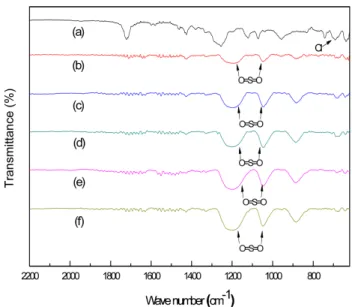
Figure 2. FT-IR spectra of PVC and sulfonated PVC mem- brane with various sulfonation times. (a) PVC, (b) 3 h, (c) 5 h, (d) 7 h, (e) 9 h, and (f) 11 h.
2.3.5. Electrical Properties
The electrical resistance (ER) and conductivity were determined using a clip cell and a LCR meter (model Hioki 5020). Cut The membrane were cut in square form as size of 1 cm × 1 cm and soaked in 0.5 N NaCl sol- ution for 24 h at room temperature. This step was aimed at immerse electrolyte into the membranes. First of all, ER of membrane and electrolyte (R
1) was measured. The immersed membrane was held between the 2-compartment cells, and then the cell was filled with 0.5 N NaCl solution. Following R1 could be measured by LCR tester with a frequency of 100 kHz. Next, ER of electrolyte (R2) was measured in same conditions of before. The ER and conductivity of the membrane was calculated as fol- lows equation (3) and (4), respectively[3,13,15,16].
Ω⋅㎠
× (3) × (4)
Here, R
1is the calculated membrane resistance in the 2-compartment cell, R
2is the calculated resistance of electrolyte solution, and L and A are the distance be- tween the potential-sensing electrodes and the effective membrane area, respectively.
2.3.6. Ion Transport Number
Ion transport number was measured by WEIS 500 po- tentiostat/galvanostat (Wonatech co., Ltd). Sulfonated PVC membrane was cut as size of 1cm x 1cm. And the mem- brane was dipped in 0.1 M NaCl solution for 24 h. The membrane was inserted between 2-compartment cells, then assembled the cell. At the right and left part of cell, same amount of 0.01 M NaCl solution and 0.05 M NaCl solution were added, respectively. Next, Ag/AgCl standard electrode was connected with WEIS 500 potentiostat/gal- vanostat to analyze the ion transport number. The equa- tion below is for calculating ion transport number.
×
× ln
(5)
At this equation, Em and F mean average potential and the Faraday constant. And each C
1, and C
2indicate high concentration of NaCl solution and low concentration of NaCl solution. T is the temperature as Kelvin temperature and R is the universal gas constant. t
mis the desired val-
ue of this experiment that mean ion transport number[1].
2.3.7. Surface Morphology
The surface morphology of the sulfonated PVC cation exchange membranes was measured using atomic force microscope (AFM, Nanoscope-Ⅳ Veeco Instruments, USA).
The area of analyzing was 25 µm
2of membrane surface with the tapping mode.
3. Results and discussion
3.1. FT-IR Spectrum
To confirm the change in the chemical structure of the sulfonated PVC cation exchange membranes, FT-IR spec- tra before and after the sulfonation reaction were ana- lyzed in Figure 2. FT-IR spectra with KBr method were verified to success of sulfonation on the PVC. Figure 2(b), (c), (d), (e), (f) show the SO
3-symmetric stretching vibration bands about 1050 cm-1. And also the asym- metric SO
3-stretching vibration peaks were found out around 1,200 cm
-1. Around the 700 cm
-1the Cl peak was getting decreased with sulfonation time. The hydroxyl group of sulfuric acid group also confirmed around 3,400 cm
-1. With increasing sulfonation time, symmetric and asymmetric SO
3-stretching vibration peaks were getting
stronger. It was indicated that sulfonation reaction was
successfully introduced on the PVC resin.
Figure 3. EDX analysis of sulfonated PVC swelled with DCE. (a) sulfonation time : 3 h, (b) 5 h, (c) 7 h, (d) 9 h and (e) 11 h.
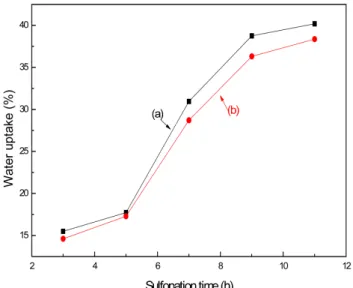
Figure 4. Effect of sulfonation time on the water uptake of sulfonated PVC cation exchange with different solvent. (a) DCE and (b) MC.
3.2. Membrane Property 3.2.1. EDX
Figure 3 showed the results of the EDX for sulfonated PVC cation exchange membranes. These spectra exhibit the presence of peaks from the Cl and S elements be- cause the sulfuric acid group was substituted to chloride with sulfonation reaction. For the sulfonated PVC cation exchange membranes, we observed the peaks of the Cl and S elements. From the data, the Cl content decrease and the sulfur content increased along with the sulfona- tion time, reaching a maximum about 32.76%.
3.2.2. Water Uptake
The water uptake is the most important property for ion exchange membranes in terms of their application. As shown in Figure 4, water uptake was steadily increased 15.5% to 40.2% with increasing sulfonation time. PVC, originally hydrophobic substrate, was changed to hydro- philic substrate with sulfonation. Through the sulfonation, hydroxyl groups were introduced to PVC resin. As pro- gressing in sulfonation reaction, more sulfonyl group is introduced in the PVC. So, water uptake of sulfonated PVC cation exchange membranes were getting higher with sulfonation time.
3.2.3. Ion Exchange Capacity (IEC)
Introducing hydrophilic functional group, sulfuric acid
group, could confirm by IEC value that is one of im-
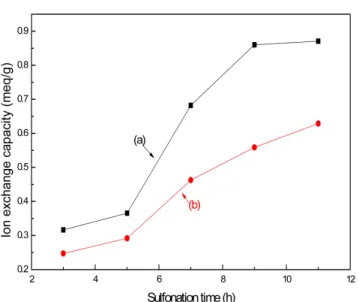
portant factor of ion exchange membrane. Figure 5 show
ion-exchange capacities (IEC) of the sulfonated PVC cati-
on exchange membranes prepared with different sulfona-
tion time and solvent were investigated by the titration
methods. To get a better performance on ion exchange
membrane, IEC value should be high. The higher IEC
value of ion exchange membrane indicates that it has more
ion exchangeable group on the membrane. Therefore,
Figure 5. Effect of sulfonation time on the IEC of sulfo- nated PVC cation exchange membrane swelled with differ- ent solvent. (a) DCE and (b) MC.
Figure 6. Effect of sulfonation time on the electrical prop- erty of sulfonated PVC swelled with DCE. (a) electrical re- sistance and (b) conductivity.
Figure 7. Ion transport number of sulfonated PVC swelled with DCE. (a) ion transport number and (b) average voltage.
having a longer sulfonation time should show the higher IEC value. And DCE and MC have an effect on sulfona- tion reaction because electron density would be increased with ionic group such as Cl
-, OH
-, SH
-. Compared to component of DCE and MC, 1,2-dichloroethane (DCE) has a double Cl
-and methylene chloride (MC) just has a one Cl
-. The membrane were cut in square form as size of 1cm x 1cm and soaked in DCE and MC. In the Figure 5, the highest IEC value was 0.87 meq/g with 11 h sulfonation reaction with DCE solvent.
3.2.4. Electrical Resistance (ER) and Conductivity
Figure 6 showed the relationship between the ER of the PVC membranes and their sulfonation time. Accor- ding to the Figure 6, ER of sulfonated PVC cation ex- change membranes was getting decreased until 35.2 Ω․
cm
2with sulfonation time. And the optical value of membrane conductivity was 2.30 × 10
-4S/cm with 11 h sulfonation. The average thickness of the membranes was 80 µm. Electrical properties of the membranes were im- proved with sulfuric acid group. It was perfectly matched with the tendency of ion exchange capacity.
3.2.5. Ion Transport Number
The ion transport number of the sulfonated PVC cation exchange membranes prepared at different sulfonation times was shown in Figure 7. As shown in this Figure 7.
The ion transport number of the sulfonated PVC cation
exchange membranes ranged from 0.52 to 0.88 and in- creasing the sulfonation time, reaching a maximum about 0.88. The ion transport number was significantly depend- ent upon the sulfonation time, i.e. the contents of acidic SO
3-groups.
3.2.6. Surface Morphology
Sulfonated PVC cation exchange membranes were ana-
lyzed their surface by AFM. AFM was used for explor-
ing the surface morphology of the sulfonated PVC. Fig-
ure 8 showed the AFM image that was captured on the
tapping mode. Based on Figure 8, surface morphology
was completely depended on the sulfonation time. Long
Figure 8. AFM surface images of sulfonated PVC membranes swelled with DCE. (a) sulfonation time : 3 h, (b) 5 h, (c) 7 h, (d) 9 h and (e) 11 h.
time sulfonated membrane surface was rougher than short time sulfonated one. The membrane, which is long time sulfonated one, was exposure to sulfuric acid. While it was exposing to sulfuric acid, the surface of membrane was corrosive and brittle.
4. Conclusion
In this study, PVC modified cation exchange membranes were successfully prepared by sulfonation using con- centrated sulfuric acid in the two different kinds of swel- ling solvent. And ultrasonication affected to sulfonation rate and yielded to PVC modification. The sulfonated PVC cation exchange membranes were characterized by FT-IR, EDX, water uptake, IEC, electrical properties and surface morphology. As the results of this study, we are able to define the feasible ion exchange membrane using PVC modification.
1) The presence of sulfuric acid group and reducing the chlorine contents were confirmed by FT-IR spectra and EDX.
2) Water uptake and IEC had very similar tendency as changing the sulfonation time. The values of water uptake and IEC were increased with sulfonation time. The opti- mum values of water uptake and IEC were 40.2%, and
0.87 meq/g, respectively.
3) The electrical properties had a better value when the PVC reacted with sulfuric acid for longer time. ER, con- ductivity and ion transport number were 35.2 Ω․cm
2, 2.30 × 10
-4S/cm, and 0.88, respectively.
4) The surface morphology of sulfonated PVC cation exchange membrane was observed by AFM. The surface roughness of membrane was increased with sulfonation time.
Acknowledgements
This work was supported by the National Research Foundation of Korea Grant funded by the Korean Govern- ment (MSIP) (2013, Joint Research Corporations Support Program)
Reference