
ISSN 2288-1069 (Online)
http://dx.doi.org/10.12925/jkocs.2021.38.3.903
Preparation and Characterization of a Cross-Linked Anion-Exchange Membrane Based on PVC
for Electrochemical Capacitor
Young-Ji Kim
1,*․Soo-Yeoun Kim
1,✝․Seong-Ho Choi
1,2,✝1
Department of Cosmetic Science, Hannam University, Daejeon 34054, Republic of Korea
2
Department of Chemistry, Hannam University, Daejeon 34054, Republic of Korea (Received June 4, 2021; Revised June 28, 2021; Accepted June 29, 2021)
전기화학 캐퍼시터용 PVC기반 가교 음이온교환 멤브레인의 제조 및 특성김영지1,*․김수연1,✝․최성호1,2,†
1한남대학교 코스메틱사이언스학과
2한남대학교 화학과
(2021년 6월 4일 접수: 2021년 6월 28일 수정: 2021년 6월 29일 채택)
Abstract : Three-type PVC membranes denoted by AEM-1, AEM-2, and AEM-3 with a cross-linked anion-exchange group were prepared by substitution reaction of PVC with triethyldiamine (TEDA), 1,4-dimethylpiperazine (DMP), and 1,4-bis(imidazol-1-ylmethyl)benzene (BIB) in cyclohexanone, respectively. We confirmed the successful preparation of the AEM-1, AEM-2, and AEM-3 via ionic conductivity (S/cm), water uptake (%), contact angle, ion-exchange capacity (meq/g), thermal properties, SEM and XPS analysis, respectively. The electrochemical capacitor experiments using PVC membrane with cross-linked anion-exchange group in organic electrolytes were performed. The prepared AEM-1, AEM-2 AEM-3 have a good stability by charge and discharge performance in organic electrolyte. As a result, the AEM-2 and AEM-3 membrane based on PVC prepared by the solvent casting method after substituent reaction is suitable for the use as a separator in organic electrochemical capacitor (supercapacitor).
Keywords : PVC membrane, cross-linked anion-exchange group, energy storage chemicals, electrochemical capacitor
요 약 : 본 연구에서는 싸이크론 헥산에서 PVC와 트리에틸디아민 (TEDA), 1,4-디메틸피페라진 (DMP) 및 1,4-비스(이미다졸-1-일메틸)벤젠을 각각 치환반응시켜서3가지 형태의 PVC 멤브레인, AEM-1, AEM-2, and AEM-3를 제조하였다. AEM-1, AEM-2, and AEM-3멤브레인의 성공적인 제
✝
Corresponding author
(E-mail: [email protected])
조 여부를 이온전도도(S/cm), 물함수율 (%), 접촉각, 이온교환능력 (meq/g), 열분석, SEM 및 XPS 분석 통하여 확인하였다. 또한, 제조된 가교 음이온 PVC멤브레인을 사용하여 유기전해질에서 전기화학 캐퍼 시터 실험을 수행한 결과, 제조된 AEM-1, AEM-2 AEM-3 멤브레인의 경우 유기전해질에서 충/방전 실험결과 매우 안정적임을 확인 할 수 있었다. 이러한 결과로 치환반응 후에 용매 캐시팅법으로 제조 된 PVC기반 멤브레인 (AEM-1, AEM-2, 및 AEM-3)의 경우 유기전기화학캐퍼시터 (슈퍼캐퍼시터)용 분리막으로 사용될 수 있다.
주제어 : PVC 멤브레인, 가교 음이온교환기, 에너지 저장 화합물, 전기화학 캐퍼시터
1. Introduction
Electrochemical capacitors (supercapacitors) have high power density, long charge- discharge cycle life, and high energy efficiency.
A combined system of electrochemical capacitors and rechargeable batteries or fuel cells is considered to be a potential power source for electric vehicles. In such a system, electrochemical capacitors provide the necessary high power for acceleration and allow for recuperation of brake energy [1-3]. A typical electrochemical capacitor consists of two electrodes, an ion-permeable membrane and an electrolyte, packaged in a sealed container [4,5]. The electrodes are mainly composed of carbon materials with electrical conductivity and energy storage capacity. Activated carbon with many pores is the most commonly used material [6-8]. The separator is mainly made of an insulating polymer (polyethylene, polypropylene, poly[tetrafluoroethylene], etc.) used as a porous thin film [9,10]. The electrolyte is composed of a material with high ionic conductivity along with electrochemical and thermal stability. Commonly used electrolytes are aqueous solutions such as sulfuric acid (H2SO4) [11], potassium hydroxide (KOH) [12], organic electrolytes [13-15] based on propylene carbonate and acetonitrile, and ionic liquids.
On the other hand, the poly(vinyl chloride), PVC, is one of the most insulating polymers in
the world. The PVC is a low cost polymer with good chemical and mechanical properties, which makes a suitable material for fabrication of membranes [16,17]. Its structure is very interesting because PVC has the poly(ethylene) main chain and chloride side chain. Therefore, we selected PVC as base materials because the quaternary amine site could be easily prepared onto PVC polymers by substitution reaction, cross-linked reaction. The PVC membrane with cross linked quaternary amine group could give the good anion-exchange properties in organic electrolyte.
In this study, we synthesized three-type anion-exchange membranes with cross-linked anion-exchange groups based on PVC as a base polymer by the solvent casting after the substitution reaction of PVC with triethyldiamine (TEDA), 1,4-dimethylpiperazine (DMP), and 1,4-bis(imidazol-1-ylmethyl) benzene (BIB) in cyclohexanone, respectively.
Then characteristics, such as ionic conductivity (S/cm), water uptake (%), contact angle, ion-exchange capacity (meq/g), and thermal stability, of the prepared anion exchange membranes were determined. The structure of the prepared membrane also was evaluated via Scanning Electron Microscopy (SEM) and X-ray Photoelectron Spectroscopy (XPS). The electrochemical capacitor performance using the prepared anion exchange membranes in organic electrolytes was also exhibited.
2. Experimental
2.1. Materials
1,4-Diazabicyclo[2,2,2]octane (triethyldiamine, TEDA), vanadium acetylacetonate (V(acac)3), poly(vinyl chloride), cyclohexanone, tetrabutyla- monium hexaflurophosphate, [TBA]+[PF6]-, and 1,4-dimethylpiperazine (DMP) were purchased from Sigma-Aldrich Co., and used without any purification. The commercial anion exchange membrane PEEK-reinforced (fumasep
®FAA-3-PK-130) was obtained from fumatech Co. (Seoul Korea).
2.2. Synthesis of 1,4-bis(imidazol-1- ylmethyl)benzene (BIB)
In
N,N'
-dimethylformamide (DMF) solvent, we dissolved a sodium hydride (NaH) (60percent in oil, 440 mg, 11 mmol) and imidazole (680 mg, 10 mmol) at room temperature for 2hrs.After then, we added the α,α’-dichloro- p-xylene (5 mmol), and reacted at room temperature for 4 hrs. The final product, 1,4-bis(imidazol-1-ylmethyl)benzene, as solid form were obtained via evaporation of dichloromethane after 3 times washing using the distilled water. Spectroscopy data of the obtained products (BIB) was as follows.
1H-NMR (DMSO, TMS): 7.8-7.1 ppm (6H, imidazole), 7.4 ppm (4H, benzene), 5,2 ppm (4H, -CH2-); GC-MS
m/z
238 (M+), 171, 104.2.3. Synthesis of anion exchange membrane (AEM) with cross-linked anion- exchange groups
The quaternary amine modified anion- exchange polymers were prepared by substitution reaction of poly(vinyl chloride) and TEDA, DMP, and BIB with violent stirring in cyclohexanone for 4 hrs and at nitrogen atmosphere, respectively, as shown in Fig. 1. The AEMs with 50~60μm thickness were fabricated by the solvent casting method, and dried in vacuum dry oven at 70℃.
Fig. 1. Schematic synthesis of the cross 1inked anion-exchange membranes based on PVC by substitution reaction.
2.4. Characterizations
The surface morphology of the prepared AEMs was determined by FE-SEM (S-4800, Hitachi Science System Co., Japan). Thermal gravimetric analysis (TGA) was conducted on a Scinco TGA S-1000 (Seoul, Korea) under N2 flow from 25ºC to 700ºC at a heating rate of 20 ºC min-1. The contact angles (°) (PHOENIX-300, Surface Electro Optics Co., Ltd., Korea) for the samples were measured.
The water uptake (%) was determined as follows:
Water uptake (%) =
[(
Ww
/Wg
) ×Wg
-1] × 100 (1)Where
Ww
andWg
are the weights of the polymeric membrane in the wetting and drying conditions, respectively.The ion-exchange capacity (IEC) of the AEMs was determined via Mohr titration method. The AEMs were dried and weighted
before immersing them in 1.0 M NaNO3
solution (50 mL) for 24 hrs in order to obtain NaCl. 2-3 drops of 5% potassium chromate solution (K2CrO4) were added as an indicator, and then standard AgNO3 (0.1M) was added to precipitated reddish brown. The IEC was calculated using the following equation (2);
IEC (meq/g) = (VAgNO3 × CAgNO3) / Wg (2)
Where VAgNO3 and ), CAgNO3 is the volume and the concentration of the standard AgNO3
solution during titration, respectively.
The ion conductivity (S/cm) of the anion exchange membrane was measured by AC impedance (IM-6ex, Zahner, Germany) and calculated using following equation:
(3)
Where σ is proton conductivity of the membrane,
L
andR
are the length between the Pt electrode and the measured value from AC impedance respectively, andA
is the area of the AEM.The electrochemical capacitor performance was done using single cell device with two half cells of carbon papers and separated by the prepared membrane. The charge-discharge performance was performed in acetonitrile electrolytes with V(acac)3 of 0.01 M as energy storage chemicals and tetrabutylamonium hexaflurophosphate, [TBA]+[PF6]-, of 0.1 M by automatic battery cycler (WBCS3000, WonATech, Korea).
3. Results and discussion
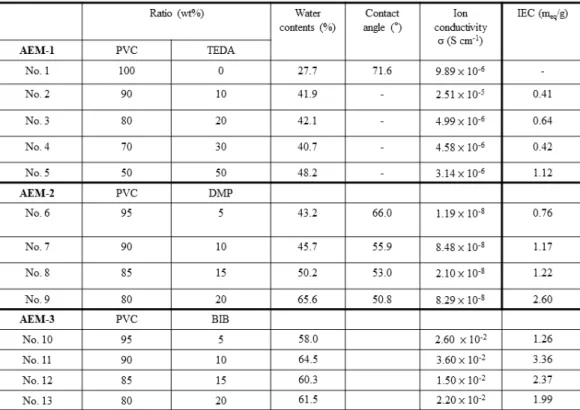
3.1. Characterization of the prepared AEM-1, AEM-2, and AEM-3 with the cross-linked anion-exchange group Table 1 shows the results of physical and electrochemical property of the AEM-1, AEM-2 and AEM-3 based on PVC prepared
by substitution reaction. The water uptake (%) of the AEM-1was in the range of 41% ~ 49% owing to the hydrophilic sites in the polymeric membrane. The ion-exchange capacity (IEC) of the AEM-1 was in the range of 0.41 ~ 1.12 meq/g owing to the quaternary amine groups due to cross-linked bond. The ionic conductivity (S/cm) of the AEM-1 was from 10-6 S/cm to 10-5 S/cm due to the ionic exchange groups. From these results, the anion-exchange groups were successfully introduced between PVC main chain as cross linker via substitution reaction as shown chemical structure (see, Fig. 1).
In the AEM-2 in Table-1, the contact angle (°) of the AEM-2 was in the range of 50.8° ~ 66.0° due to hydrophilic property change. While the water uptake (%) of the AEM-2 was in the range of 43% ~ 66% due to the hydrophilic sites in the polymeric membrane. We expected higher ionic conductivity for the AEM-2 than AEM-1 membranes because of the presence of high ionic exchange content (0.76 ~ 2.60 meq/g).
However, a lower ionic conductivity (10-8 S/cm) was obtained for the AEM-2 membrane because of the presence of methyl group on the cross linker with quaternary amine in the polymer structure (see, the structure in Fig. 1).
In AEM-3, the high contact angle than that of AEM-1 and 2 was observed because of hydrophobic properties owing to aromatic ring of cross linkers, while the ionic exchange group (1.26 ~ 3.36 meq/g) and ionic conductivity (10-2 S/cm) of AEM-3 was higher than that of AEM-1 and AEM-2 due to quaternary amine groups of cross linker.
As results, we expect that the prepared AEM-3 can apply as separator in electrochemical capacitors.
Fig. 2 shows the photos of the prepared AEM-1, AEM-2, and AEM-3 with the cross-linked anion-exchange group. The AEM-1 and AEM-3 have white colors, while the AEM-2 have yellow and light black color owing to cross linker effects. Surface SEM
Table 1. Physical properties of the AEM- 1, AEM-2, and AEM-3 with cross-linked anion- exchanged group
Fig. 2. Photos of the prepared AEM-1, AEM-2, and AEM-3 with the cross-linked nion-exchange group.
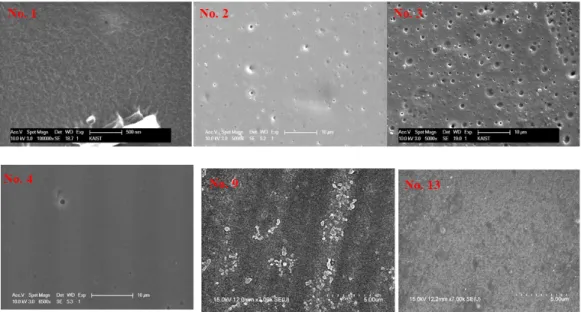
Fig. 3. Surface SEM images of AEM-1, AEM-2, and AEM-3 with cross-linked anion-exchange group.
images (Fig. 3) of the AEM-1, AEM-2 and AEM-3 based on PVC (see Table 1) prepared by the solvent casting method after substitution reaction show amorphous structures. In the AEM-1, the hole existed due to vaporization of the unreacted TEDA during solvent casting (No. 2 ~ No. 4 in Fig. 3). On the surface of the AEM-2, there is no hole, while the particles were observed due to the aggregation of the unreacted DMP generated during solvent casting (No. 9 in Fig. 3). It means that the reactivity of the PVC using quaternary amines such as TEDA and DMP was low in substitution reaction. On the surface of AEM-3 (No. 13), there are no hole and no aggregation particles, and amorphous structure because of good preparation of the membrane.
These results mean the prepared AEM-3 can use as separator in electrochemical capacitor.
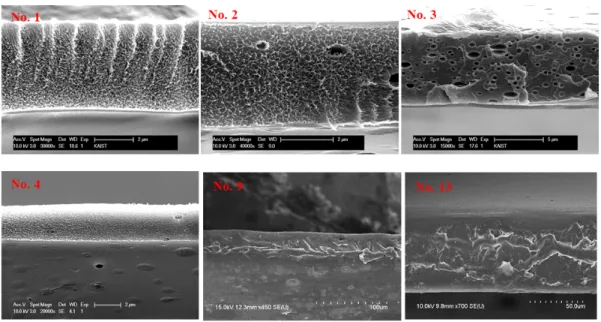
Cross-section SEM images in Fig. 4 shows amorphous structure of the AEM-1, AEM-1 and AEM-3. In 100% PVC membrane (No.
1 in Table 1), the fiber structure was observed due to PVC polymer. By adding 10% TEDA
(No. 2 in Table 1), both the fiber structure and the holes formed due to TEDA vaporization generated during solvent casting.
In No. 3 in Table 1 (PVC/TEDA = 80/20 wt
%), we could observe the amorphous structure and many holes caused by the unreacted TEDA which is produced during solvent casting process. In No. 4 in Table 1, we also could observe the amorphous structure generated from the cross-linking reaction between PVC and TEDA by substitution reaction. Furthermore, we could watch the evidence of the TEDA gas, which is not vaporized because of the cross-linked structure. In No. 9 in Table 1, we could find the amorphous structure without holes due to cross-linked reaction between PVC and DMP by substitution reaction. We could also observe particles, which is considered that the DMP was partially unreacted with PVC by substitution reaction. In No. 13 in Table 1, we also could observe the amorphous structure generated from the cross-linking reaction without no hole and no aggregate particles
Fig. 4. Cross-section images of SEM from AEM-1, AEM-2, and AEM-3 with cross-linked anion-exchange group.
Fig. 5. Contact angle of the prepared AEM-2 with cross-linked anion-exchange group.
between PVC and BIB by substitution reaction.
From these results, the prepared AEM-3 could be expect the use as separator in electrochemical capacitor.
Fig. 5 exhibits contact angle images of the AEM-2 prepared by the solvent casting method after substitution reaction of the PVC with DMP. The surface contact angles slightly
change according to ionic exchange contents (meq/g). We had expected that the surface contact angle of the sample with 2.60 meq/g (No. 9 in Table 1) would be higher than that of sample with 0.76 meq/g (No. 6 in Table 1) because of the higher polarity of the ionic exchange group of the AEM-2. While experimental results are determined the lower
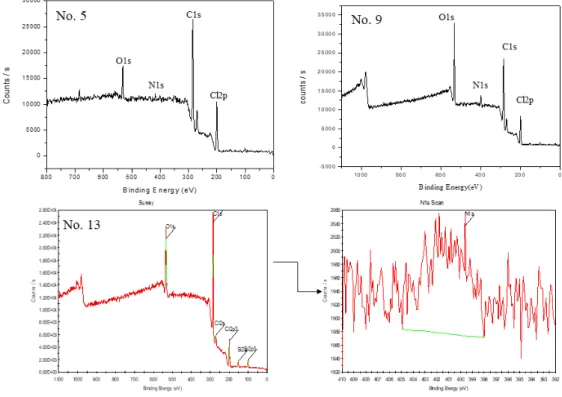
Fig. 6. Survey XPS data of the AEM-1, AEM-2, and AEM-3 with cross-linked anion-exchange group.
surface contact angle because of the hydrophobic surface structure caused by the cross-linked microstructure of AEM-2.
Fig. 6 shows the survey XPS spectra of the AEM-1 (No. 5), AEM-2 (No. 9) and AEM-3 (No. 13 in Table 1) prepared by the solvent casting method after substitution reaction of the PVC with TEDA, DMP, and BIB, respectively. In the survey XPS spectra of the AEM-1 (No. 5), there are three main peaks at 285 eV (C1s), 533 eV (O1s), and 203 eV (Cl2p), and additional one peak at 399 eV (N1s). From these results, the TEDA was expected to be introduced successfully onto PVC main chain by substitution reaction.
In addition, the weak peak for N1s at 399 eV shows that there is PVC onto surface of the AEM-1 due to cross-linked microstructure.
In survey XPS data of the AEM-1, the C1s peak at 285 eV, O1s peak at 533 eV, Cl2p peak at 203 eV, and N1s peak at 399 eV
were also determined. XPS data of the AEM-3 was showed similar pattern to compare that of AEM-1 and AEM-2. From these results, we confirmed that the AEM based on PVC by constitution reaction was successfully prepared.
Fig. 7 displays TGA curves of the AEM-1, AEM-2, and AEM-3 prepared by the solvent casting method after substitution reaction between PVC and TEDA or DMP or BIB, respectively. In TGA curves of AEM-1, first small weight loss (%) at 100ºC is due to the loss of moisture on the PVC with hydrophilic property AEM-1 (No. 1), and degradation of side chain lead to a second weight loss at 230ºC, and 3rd weight loss was appeared at 400ºC due to main chain degradation of the polymer main chain. TGA curve of No. 2 to No. 5 shows a 1st weight loss (%) around 100ºC due to moisture loss, a 2nd weigh loss at 220ºC caused by degradation of side, and
Fig. 7. TGA curves of the AEM-1, AEM-2, and AEM-3 with the cross-linked anion-exchange group.
Fig. 8. Electrochemical capacitor performance for PVC membrane in acetonitrile electrolyte with 0.01M V(acac)3 and 0.1M [TBA]+[PF6]- as electrolyte supporters.
a 3rd degradation at 400ºC owing to degradation of polymer main chain. Similar degradation patterns of the AEM-2 and AEM-3 were also observed. These results show that AEM-1, AEM-2 and AEM-3 were prepared successfully by the solvent casting method after substitution reaction.
3.2. Electrochemical capacitor performance using PVC membrane with cross- linked anion-exchange group.
Fig. 8 displays electrochemical capacitor performance of the commercial fumasep®FAA- 3-PK-130 membrane (left), the prepared No.
5, No. 9, No. 11, and No. 12 of AEM,
respectively. When we used the commercial anion-exchange membrane, the maximum voltages were reached to 1.5 V under the fixed current value of 0.005mA/cm2. When we used the prepared No. 5 of AEM-1, the maximum voltages were measured up to 1.0 V under the fixed current value of 0.005mA/cm2. While we used the prepared No. No. 9 of AEM-2, No. 11 and No. 12 of AEM-3, the maximum voltage was arrived to 2.2 V under the fixed current value of 0.005mA/cm2, respectively. When we compared the voltage efficiency for the commercial anion-exchange membrane and the prepared AEM, the voltage efficiency of the No. 5 of AEM-1 arrives at just ca. 70% because of defects such as holes, which is generated during solvent casting.
However, the voltage efficiency of the AEM-2 (No. 9) and AEM-3 (No. 11 and No. 12) is much higher than that of the commercial fumasep®FAA-3-PK-130 membrane (ca.
147%). On the other hand, we also examined the stability of the prepared AEM-3 (No12), the charge-discharge profile does not change in acetonitrile electrolyte under the fixed current value of 0.005mA/cm2. As a result, the AEM-3 based on PVC prepared by the solvent casting method after substituent reaction is suitable for use as a separator in electrochemical capacitor.
4. Conclusion
Anion exchange membranes AEM-1, AEM-2 and AEM-3 based on PVC were synthesized by the solvent casting method after substitution reaction of the TEDA, DMP, and BIB as tertiary amines, respectively. The physical and electrochemical properties of the AEM-2, AEM-2 and the AEM-3 were evaluated for their suitability as electrochemical capacitor membranes. The voltage efficiency of the AEM-1 (No. 5) against to commercial fumasep®FAA-3-PK-130 membrane was arrived to ca. 70%. While voltage efficiency
of the AEM-2 (No. 5) and AEM-3 (No. 11 and No.12) to commercial fumasep®FAA- 3-PK-130 membrane was arrived to
ca.
7 147%, respectively. Therefore, we could conclude that the AEM-2 and AEM-3 based on PVC prepared by the solvent casting method after substituent reaction is a strong candidate material for the separator in electrochemical capacitor (supercapacitor).Acknowledgements
This work was supported by the Korean Innovation Foundation (2020-DD-RD-0124- 01-201).
References
1. T. Mohammadi, M. Skyllas-Kazacos.
“Characterization of novel composite membrane for redox flow battery applications.”
Journal of Membrane Science
, Vol. 98, pp 77-87, (1995).2. J.Y. Xi, Z.H. Wu, X.P. Qiu ,L.Q. Chen.
“Nafion/SiO2 hybrid membrane for vanadium redox flow battery.
” Journal of Power Sources
, Vol. 166, pp 531-536, (2007).3. X.G. Teng, Y.T. Zhao, J.Y. Xi, Z.H. Wu, X.P. Qiu, L.Q. Chen. “Nafion/organic silica modified TiO2 composite membrane for vanadium redox flow battery via in situ sol–gel reactions.”
Journal of Membrane Science
Vol. 341, pp 149-154, (2009).4. J.Y. Xi, Z.H. Wu, X.G. Teng, Y.T. Zhao, L.Q. Chen, X.P. Qiu. “Self-assembled polyelectrolyte multilayer modified Nafion membrane with suppressed vanadium ion crossover for vanadium redox flow batteries.”
Journal of Materials Chemistry
, Vol. 12, pp 1232-1238, (2008).5. X.L. Luo, Z.Z. Lu, J.Y. Xi, Z.H. Wu, W.T. Zhu, L.Q. Chen, X.P. Qiu.
“nfluences of Permeation of Vanadium Ions through PVDF-g-PSSA Membranes on Performances of Vanadium Redox Flow Batteries.
” Journal of Physical Chemistry B
, Vol. 109, pp 20310-20314, (2005).6. S.H. Lee, S.H. Choi, S. A. Gopalan, K. P.
Lee, A. I. Gopalan. “Preparation of new self-humidifying composite membrane by incorporating graphene and phosphotungstic acid into sulfonated poly(ether ether ketone) film.”
International Journal of Hydrogen Energy
, Vol. 39, pp 17162- 17177, (2014).7. J. Xu, Z. L. Xu, “Poly(vinyl chloride) (PVC) hollow fiber ultrafiltration membranes prepared from PVC/additives/
solvent.”
Journal of Membrane Science
, Vol. 208, pp 203-212, (2002).8. M. Khayet, M.C. G. Payo, F.A. Qusay , M.A. Zubaidy. “Structural and performance studies of poly(vinyl chloride) hollow fiber membranes prepared at different air gap lengths.”
Journal of Membrane Science,
Vol. 330, pp 30-39, (2009).9. S.H. Mei, C.H. Xiao, X. Hu. “Preparation of porous PVC membrane via a phase inversion method from PVC/DMAc/water/
additives.”
Journal of Applied Polymer Science,
Vol. 120, pp 557-562, (2011).10. M. Aghajania, A. R. Greenberg, Y. Ding,
“Thin film composite membranes: Does the porous support truly have negligible resistance?”
Journal of Membrane Science
, Vol. 609, 118207, (2020).11. D. Fraenkel, “Electrolytic Nature of Aqueous Sulfuric Acid. 1. Activity”,
Journal of Physical Chemistry B
, Vol. 116, No.10, pp 11662–11677, (2012).12. T. Han, Y. Shi, Z. Yu, B. Shin, M.
Lanza, “Potassium Hydroxide Mixed with Lithium Hydroxide: An Advanced Electrolyte for Oxygen Evolution Reaction”,
RRL Solar,
Vol. 3, No. 1, pp 1980-2367, (2019).13. L. Xia, L. Yu, D. Hu, G.Z. Chen,
“Electrolytes for electrochemical energy storage”, Materials Chemistry Frontiers”
Materials Chemistry Frontiers
, Vol. 1, No.1, pp 584-618, (2017).
14. E. Kovalska, C. Kocabas, “Organic electrolytes for graphene-based supercapacitor: Liquid, gel or solid”,
Materialstoday Communications
, Vol. 7, No. 1, pp 155-160, (2016).15. J. Q. Huang, X. Guo, X. Lin, Y. Zhu, B.
Zhang, “Hybrid Aqueous/Organic Electrolytes Enable the High-Performance Zn-Ion Batteries”,
A Science Partner Journal,
Vol. 10, No. 1, pp 2639-5274, (2019).16. A. Mohammed, G. A. E. E. Yousif, A. A.
Ahmed, D. S. Ahmed, M. H. Alotaibi,
“Protection of Poly(Vinyl Chloride) Films against Photodegradation Using Various Valsartan Tin Complexes”,
Polymers
, Vol.12, No. 969, pp. 1-8, (2020).
17. Y. Qi, X. Yin, J. Zhang, “Transparent and heat-insulation plasticized polyvinyl chloride (PVC) thin film with solar spectrally selective property”,

![Fig. 8. Electrochemical capacitor performance for PVC membrane in acetonitrile electrolyte with 0.01M V(acac) 3 and 0.1M [TBA] + [PF 6 ] - as electrolyte supporters](https://thumb-ap.123doks.com/thumbv2/123dokinfo/4910374.536176/9.892.153.734.443.811/electrochemical-capacitor-performance-membrane-acetonitrile-electrolyte-electrolyte-supporters.webp)
