서 론
최근 다양한 하천 공사에 의해서 어류의 서식처가 심각하 게 파괴되고 있으며, 외래종의 도입과 하천 간 어류의 이입이 빈번하게 일어나 어류의 분포상에 많은 변화가 있었다(ISK, 2003; Chae, 2007). 따라서 어류상에 대한 주기적 연구는 담수 어류의 변화를 파악하고 파괴된 하천을 복구하거나 종의 복원 에 필요한 기초 자료를 제시할 뿐 아니라, 어류의 지사학적인 변화에 대한 고찰을 가능하게 하므로 매우 중요하다.
회천수계는 고령군과 성주군에 걸쳐 흐르는 하천으로 유 로연장 78.0km, 유역면적 781.41km2의 하천(MOCT, 2000;
MOCT and KOWACO, 2002)이다. 회천은 가야산(1,430m)의 동쪽 백운동계곡의 용기폭포에서 발원하여 덕곡면의 동쪽으 로 흘러 대가천에 합류하는 소가천(유로연장 19.0km)과 김천 시 증산면 수도산(1,316m)에서 발원하여 가야산의 북쪽 계곡 을 서에서 동으로 흘러 성주군 수륜면에서 회천 본류로 합류 하는 대가천수계, 가야산 남쪽 해인사의 홍류동계곡에서 발원 하여 가야천(유로연장 25.8km), 안림천이 차례로 이어져 고령 읍에서 회천에 합류하는 안림천수계로 이루어져 있다. 회천은 고령읍 우곡면을 지나 낙동강에 합류한다. 회천과 인접한 소 하천인 덕곡천(유로연장 8.0km), 차천(유로연장 23.1km), 현 풍천(유로연장 11.46km)은 낙동강에 합류하는 제1지류이다.
회천의 어류에 대한 연구는 Yang(1986)이 12과 29속 34종 을 보고하였고, 그 이후로 가야산 국립공원 일대 종합학술조 사보고(Jeon and Hoang, 1990)와 회천 본류 및 지류(Chae et
—
205 —
http://www.fishkorea.or.kr회천 및 인접 소하천들의 어류상과 군집 구조
채병수
*·
김상기1
·강영훈2
·허남수2
·유동욱·박재민·하헌욱담수생태연구소, 1국립낙동강생물자원관 동식물자원조사부, 2원화여자고등학교
Ichthyofauna and Fish Community Structure in the Hoecheon Stream and Some Adjacent Tributaries of the Nakdonggang River, Korea by Byung Soo Chae*, Sang Ki Kim
1, Yeong Hoon Kang
2, Nam Soo Heo
2, Dong Uk Yoo, Jae Min Park and Heon Uk Ha (Institute of Freshwater Ecology, Daegu 41518, Republic of Korea;
1Nakdonggang National Institute of Biological Resources, Sangju 37242, Republic of Korea;
2Wonhwa Girls’ High School, Daegu 42655, Republic of Korea)
ABSTRACT Fauna of freshwater fish and community structure were investigated at 24 stations in the Hoecheon Stream and some adjacent tributaries of the Nakdonggang River, Korea from July 2016 to August 2017. During the period 42 species and 4 types belonging to 32 genera and 11 families were collected. In this collection fishes of Cyprinidae were 24 species and 4 types, most numerous possessing 59.1% of all. There were 16 Korean endemic species including Acheilognathus yamatsutae and Odontobutis platycephala, 3 endangered species such as Pseudobagrus brevicorpus and Koreocobitis naktongensis (rank I) and Culter brevicauda (rank II) and 2 exotic species such as Micropterus salmoides and Lepomis macrochirus. Fish species transferred from other native rivers were 4 species including Opsariichthys uncirostris amurensis, Hemiculter eigenmanni, Odontobutis interrupta and Tridentiger brevispinis. Dominant species was Zacco koreanus NS type (19.2%) and sub-dominant species was Z. platypus R type (16.1%). The structure of fish community in the Hoecheon Stream was very stable and diverse in having diversity 2.91, evenness 0.77, dominance 0.35 and species richness 4.67. Fish community was divided into 4 groups such as upper, middle, mid- lower and lower reach group based on similarity among surveyed stations.
Key words: Ichthyofauna, community structure, Hoecheon Stream, Nakdonggang River, Korea
* Corresponding author: Byung Soo Chae Tel: 82-10-8569-4311, Fax: 82-53-950-6345, E-mail: [email protected]
ISSN: 1225-8598 (Print), 2288-3371 (Online)
Accepted: September 22, 2017
al., 1996; Hong, 1996)에 대한 조사, 환경부에서 수행하고 있 는 전국자연환경조사(ME, 2000~2002) 등 주기적으로 어류상 조사가 수행되어 왔다. 차천과 현풍천의 어류에 대한 연구는 전국자연환경조사(ME, 1997) 및 비슬산 일대의 어류상(Kang et al., 2005) 조사가 수행되었다.
그러나 최근 낙동강 본류 구간에 축조된 대규모 보에 의한 수생태계의 변동 이후 회천수계 및 낙동강으로 유입하는 소하 천에 대한 어류상의 조사는 아직 이루어지지 않았다. 본 조사 에서는 회천과 그 일대의 소하천에서 자세한 어류의 분포상을 조사하고 군집 구조를 밝히며, 과거에 이루어진 조사 결과와 비교하여 변화 양상을 파악하고자 하였다. 이렇게 얻어진 결 과는 생태계의 변화 양상에 대한 이해를 돕고 종 다양성 보존 을 위한 대책을 강구하는 자료로 이용될 수 있을 것이다.
조사 지점 및 방법
1. 조사 지점
회천과 인접 소하천들의 어류 분포상을 알기 위하여 각 지 류별로 회천 16개, 덕곡천 2개, 차천 4개, 현풍천 2개 지점으로 모두 24개의 조사 지점을 설정하였다(Fig. 1). 조사 지점의 번 호는 상류에서 하류 방향으로 차례로 부여하였다. 각 지점의 행정구역은 다음과 같다.
<회천>
St. 1. 경북 김천시 증산면 유성리, 옥동교 St. 2. 경북 성주군 가천면 법전리, 아전촌교
St. 3. 경북 성주군 수륜면 수륜리, 윤동교 St. 4. 경북 성주군 수륜면 계정리, 사창교 St. 5. 경북 성주군 수륜면 작은리 1187 St. 6. 경북 성주군 운수면 봉평리, 봉평교
St. 7. 경남 합천군 가야면 죽전리 죽전저수지 상방 St. 8. 경남 합천군 야로면 매촌리 482
St. 9. 경남 합천군 묘산면 도옥리, 묘산교 St. 10. 경북 고령군 쌍림면 산주리, 석사교 St. 11. 경북 고령군 쌍림면 귀원리, 귀원교 St. 12. 경북 고령군 대가야읍 외리, 일량교 St. 13. 경북 고령군 개진면 반운리 687-2 St. 14. 경북 고령군 우곡면 야정리, 도진교 St. 15. 경북 고령군 우곡면 월오리 297-23 St. 16. 경북 고령군 우곡면 객기리, 낙동강합류점
<덕곡천>
St. 17. 경남 합천군 덕곡면 장리, 대동교 St. 18. 경남 합천군 덕곡면 병배리, 남재교
<차천>
St. 19. 경북 창녕군 성산면 운봉리, 운봉교
St. 20. 경남 창녕군 성산면 대견리, 달창저수지 하방 St. 21. 대구 달성군 현풍면 신기리, 차천2교 St. 22. 대구 달성군 현풍면 원교리, 차천교
<현풍천>
St. 23. 대구 달성군 유가면 음리, 상성교 St. 24. 대구 달성군 현풍면 원교리, 현풍천교
2. 어류상 조사 및 군집 구조 분석
어류상 조사는 2016년 7월부터 2017년 8월까지 각 지점당 2회씩 실시하였다. 각 조사 지점에서의 채집은 약 200m 정도 의 구간에서 실시하였으며, 가능한 한 다양한 서식처가 포함 되도록 하였다. 채집 도구로는 투망(망목 7×7mm), 족대(망 목 3×3mm), 손그물(망목 1×1mm), 유인어망(새우망)을 사 용하였다.
채집된 어류는 어종을 확인하고 개체수를 기록한 후 대부 분을 즉시 방류하였다. 종의 검색에는 Uchida(1939), Chyung (1977), Son(1987), Kim(1997), Kim et al.(2005a)을 참고하 였으며, 분류체계는 Nelson(2006)을 따랐다. Chae and Yoon (2006) 및 Yoon et al.(2012)에 따라 Z. koreanus와 Z. platypus 를 형별로 구분하여 조사하였고, 이를 어류상에 반영하였다.
하상 재료는 Cummins(1962)의 방법을 변형하여 Mud(M:
<0.1mm), Sand(S: 0.1~2mm), Pebble(P: 2~64mm), Cobble (C: 64~256mm), Boulder(B: >256mm), Rock(R: large stone and bedrock)으로 하고 육안 관찰에 의하여 상대비율을 구하
Fig. 1. Map showing the sampling stations in the Hoecheon Stream
and adjacent tributaries in the middle reach of the Nakdonggang River, Korea.
Nakdong R.
Hoe St. Hyeonpung St.
Deokgok St. Cha St.
였으며, 하천형의 구분은 Kani(1944)에 따랐다.
어류의 군집 구조의 분석에는 각 조사 지점에서 채집된 어 종의 개체수를 기준으로 종다양도, 우점도, 균등도 및 종풍부 도를 산출하여 비교 분석하였다(Simpson, 1949; Shannon and Weaver, 1949; Pielou, 1966; McNaughton, 1967). 조사 지역 전 체에 어떤 종이 얼마나 널리 분포하고 있는지를 나타내는 지 수로서 항존도(Constancy)를 사용하였으며 [각 종의 출현 지 점수/전체 조사 지점수×100(%)]로 표현하였다. 각 지점 간의 유사도 계산과 dendrogram의 작성에는 PRIMER v5(Clarke and Gorley, 2001)를 사용하였다.
결과 및 고찰
1. 조사 지점의 환경
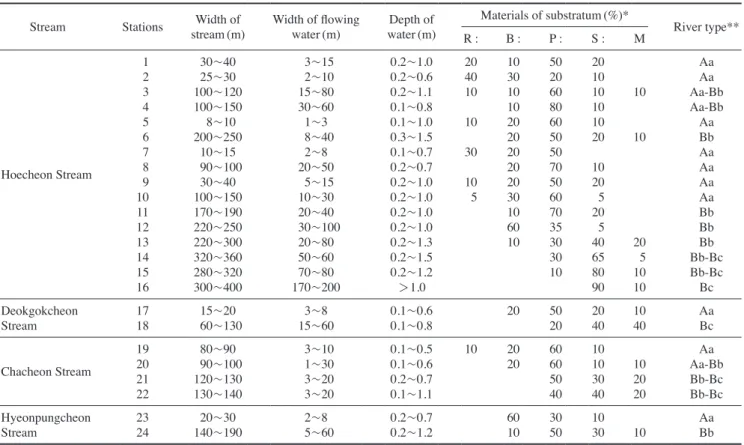
각 조사 지점의 세부적인 물리적 구조는 Table 1에 나타내 었다. 회천의 본류에 해당하는 대가천(유로연장 53.5km)의 상 류에는 1992년 완공된 농업용수용인 성주댐(높이 60m, 면적 35.3km2)이 있는데, 댐 상류부는 전형적인 계류형 자연하천으 로 양호한 수환경을 유지하고 있고, 댐 아래 수역은 유지 수량 이 연중 안정되고 풍부하였다. 성주댐 상류부는 하천의 구조
가 Aa형으로 암반, 호박돌 또는 왕자갈이 많았으며, 댐 하류부 는 Aa-Bb형이었다.
안림천(유로연장 42.8km)의 최상류부는 가야산 국립공원 에 해당되어 수환경이 안정적이고 자연하천 그대로의 모습을 유지하고 있는 반면, 하류부로 갈수록 평야부 농경지와 인구 밀집지대를 지나면서 부영양화가 심해졌다. 상류부의 가야천 과 묘산천은 Aa형, 이 두 하천이 합류하여 내려가는 안림천은 Bb형의 구조였다.
대가천과 안림천이 고령읍에서 합류한 이후 남진하여 낙동 강과 합류하기까지의 하천은 하상에 모래와 진흙이 많았으며 Bb>Bb-Bc>Bc형으로 변하였다. 본 조사 지점 중, 가장 하류 에 해당하는 St. 16은 낙동강과 합류하기 직전의 부분으로 하 폭과 유수폭이 매우 넓고 수심도 깊었다. 회천의 하류 본류부 는 주변에서 들어오는 유기물질로 인해 다소 부영양화 되어 있었으며 탁도가 높았다.
그 외의 낙동강 제1지류인 덕곡천(유로연장 8km), 차천(유 로연장 23.1km), 현풍천(유로연장 11.5km)은 규모가 작고 매 우 부영양화 되어 있었으며, 특히 차천의 경우 달창저수지에 서 낙동강 합류부까지 하상의 평탄화공사로 하천이 심하게 변 형되었다.
Table 1. Details of river structure of each station in the Hoecheon Stream and adjacent tributaries Stream Stations Width of
stream (m) Width of flowing
water (m) Depth of water (m)
Materials of substratum (%)*
River type**
R : B : P : S : M
Hoecheon Stream
1 30~40 3~15 0.2~1.0 20 10 50 20 Aa
2 25~30 2~10 0.2~0.6 40 30 20 10 Aa
3 100~120 15~80 0.2~1.1 10 10 60 10 10 Aa-Bb
4 100~150 30~60 0.1~0.8 10 80 10 Aa-Bb
5 8~10 1~3 0.1~1.0 10 20 60 10 Aa
6 200~250 8~40 0.3~1.5 20 50 20 10 Bb
7 10~15 2~8 0.1~0.7 30 20 50 Aa
8 90~100 20~50 0.2~0.7 20 70 10 Aa
9 30~40 5~15 0.2~1.0 10 20 50 20 Aa
10 100~150 10~30 0.2~1.0 5 30 60 5 Aa
11 170~190 20~40 0.2~1.0 10 70 20 Bb
12 220~250 30~100 0.2~1.0 60 35 5 Bb
13 220~300 20~80 0.2~1.3 10 30 40 20 Bb
14 320~360 50~60 0.2~1.5 30 65 5 Bb-Bc
15 280~320 70~80 0.2~1.2 10 80 10 Bb-Bc
16 300~400 170~200 > 1.0 90 10 Bc
Deokgokcheon
Stream 17 15~20 3~8 0.1~0.6 20 50 20 10 Aa
18 60~130 15~60 0.1~0.8 20 40 40 Bc
Chacheon Stream
19 80~90 3~10 0.1~0.5 10 20 60 10 Aa
20 90~100 1~30 0.1~0.6 20 60 10 10 Aa-Bb
21 120~130 3~20 0.2~0.7 50 30 20 Bb-Bc
22 130~140 3~20 0.1~1.1 40 40 20 Bb-Bc
Hyeonpungcheon
Stream 23 20~30 2~8 0.2~0.7 60 30 10 Aa
24 140~190 5~60 0.2~1.2 10 50 30 10 Bb
*Kani (1944), **R: Rock ( > 256 mm), B: Boulder (64~256 mm), P: Pebble (2~64 mm), S: Sand (0.1~2 mm), M: Mud (~0.1 mm) - modified Cummins (1962).
2. 어류상과 분포
1) 어류상
본 조사 결과, 회천 및 인접 하천 수계에서 밝혀진 어종 은 11과 32속 42종 4형으로 모두 10,012개체가 채집되었다 (Table 2). 과별 어종의 수를 보면 Cyprinidae 어류가 24종 4 형(59.1%)으로 가장 많았으며, Cobitidae 어류가 4종(9.1%), Gobiidae 어류가 3종(6.8%), Centropomidae, Odontobutidae, Centrarchidae 어류는 각각 2종(4.5%)이었고, 1종만 출현한 것 은 5개 과였다. Cyprinidae와 Cobitidae 어류의 구성 비율이 매 우 높은 이 같은 어류상의 특징은 한반도의 서한 및 남한아지 역에서 공통적으로 나타나는 현상이며, 동아시아 담수어류의 분포 특징과 잘 일치한다(Jeon, 1980).
조사 지점별로 채집된 종수는 2종에서 27종까지 다양하였 다. 대가천과 안림천이 합류하는 St. 12에서는 27종으로 종수 가 가장 많았으며, 그 다음은 최하류에 해당하는 St. 15에서 22종으로 많이 출현하였다. 그 외에 중류에 해당하는 St. 3, 4, 6, 11 및 하류에 해당하는 St. 13, 14에서 16~19종이 출현하 여 비교적 다양하였다. 회천 중류의 소지류인 St. 5에서는 2종, 가야천의 상류인 St. 7에서는 3종으로 어류상이 빈약하였다 (Fig. 2).
제1지류 각각의 수계별로 어류상을 보면 회천에서는 38종, 덕곡천에서는 16종, 차천에서는 19종, 현풍천에서는 12종이 출현하여 회천이 많고 현풍천에서 적었다. 이와 같은 결과는 하천의 유로연장과 유역면적에 비례하는 것으로 생각된다.
회천과 인접 하천수계에서 출현한 어류 중 한반도 고유종 은 Rhodeus uyekii, Acheilognathus koreensis, A. yamatsutae, Coreoleuciscus splendidus, Cobitis hankugensis, Koreocobitis naktongensis, Kichulchoia multifasciata, Pseudobagrus brevicorpus 등의 16종으로 이 지역에서 밝혀진 전체 어종수의 36.4%에 해당하는 높은 고유종의 출현을 보였다. 본 지역의 고유종 출현비율은 한반도 전체의 담수어류에 대한 고유종의 빈도인 28.8%(Kim et al., 2005a)보다 더 높았다. 큰 강의 중상 류 1차 지류들인 금호강(14종, 33.3%; Yang and Chae, 1994), 위천(16종, 40.0%; Chae et al., 1998), 내린천(16종, 44.4%;
Nam et al., 1998), 홍천강(23종, 44.2%; Choi and Kim, 2004) 과는 비슷하였다.
본 조사에서 멸종위기야생생물은 I급인 K. naktongensis와 P.
brevicorpus, II급인 Culter brevicauda의 3종이 출현하였다. K.
naktongensis는 5지점에서 17개체가 채집되어 비교적 많았으 나, P. brevicorpus는 1지점에서 3개체, Culter brevicauda는 1 지점에서 1개체가 채집되어 희소하였다.
회천 일대에서 출현한 외래종은 Micropterus salmoides 와 Lepomis macrochirus 2종이었다. M. salmoides와 L.
macrochirus는 회천의 하류부인 St. 13~16과 덕곡천의 하류,
차천의 하류에 서식하고 있었으며 중상류에서는 확인되지 않 았다.
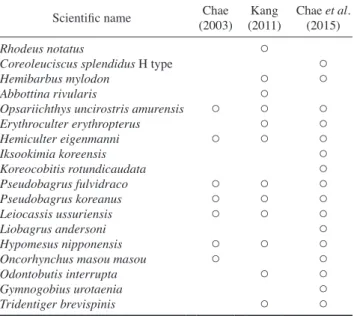
본 조사 지역에 국내이입종은 Opsariichthys uncirostris amurensis, Hemiculter eigenmanni, Odontobutis interrupta, Tridentiger brevispinis의 4종이 확인되었다. 이들 중 O. unci- rostris amurensis는 단기간에 낙동강 중하류의 거의 대부분 의 지역에 퍼져나가 많은 곳에서 우점종의 지위를 차지하 였고, 기존에 서식하던 소형 어류들에게 큰 영향을 미치고 있다(Yang et al., 1997; Jeon, 1999; Chae, 2000; Jang et al., 2001; Kum and Yang, 2002; Kang et al., 2004, 2005). 또 O.
interrupta는 낙동강에서 분포 지역이 계속 넓어지고 있는 추 세이다(Chae, unpublished data). 국내이입종에 대하여 Chae (2003)는 7종, Kang(2011)은 12종, Chae et al.(2015)은 16종 으로 보고하여 계속 증가하고 있으며, 현재까지 낙동강에는 18종의 국내이입종이 보고되었다(Table 3).
2) 우점종
회천과 주변 수계에서는 Zacco koreanus NS(19.16%)가 우점종, Z. platypus R(17.15%)이 아우점종이었다. 그 외에 K. multifasciata(6.71%), C. splendidus(5.36%), Pungtungia herzi(4.54%), O. uncirostris amurensis(4.38%), T. brevispinis (4.14%), Z. koreanus NE형(4.11%) 등은 우세종이었다. 반면에 A. macropterus, Z. temminckii, C. brevicauda, Silurus asotus, P.
brevicorpus, Siniperca scherzeri, O. interrupta, Channa argus, Macropodus ocellatus 등의 9종은 상대풍부도가 0.1% 미만으 로써 희소종이었다(Table 2).
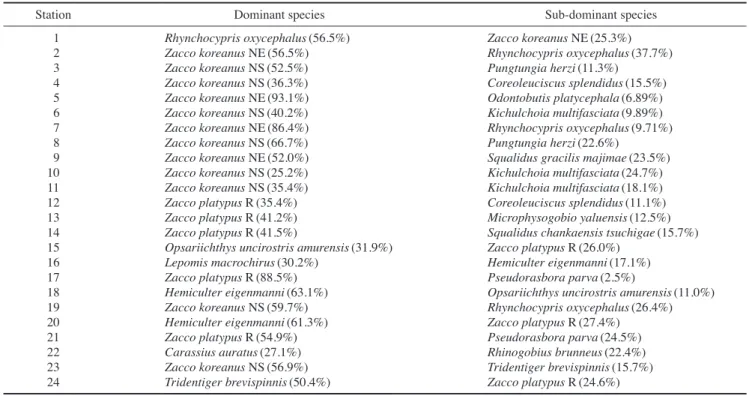
각 조사 지점에서 우점종으로 나타난 어종은 Z. koreanus NS, Z. koreanus NE, Z. platypus R, Rhynchocypris oxycephalus, O. uncirostris amurensis, H. eigenmanni, Carassius auratus, T. brevispinis, L. macrochirus 등의 9종이었으며, Z. koreanus NS가 8개 지점으로 가장 우세하였다. Z. platypus R, R. oxy- cephalus, K. multifasciata 등 15종이 아우점종으로 나타나 각 지점별로 달랐다(Table 4).
O. uncirostris amurensis, H. eigenmanni, L. macrochirus, T.
brevispinis와 같은 국내이입종과 외래종이 우점종이나 아우점 종의 지위를 차지한 지점은 6지점이었다. 이들 지점은 주로 각 하천의 최하류 지역이어서 정수생태계로 변한 낙동강 본류의 영향을 받는 지역이다. L. macrochirus는 흐르는 하천에서는 살지 못하는 어종으로 낙동강 본류 구간에서는 이때까지 발 견되지 않았으나 4대강 사업 이후 낙동강 본류에서 점차 분포 범위가 넓어지고 개체수가 증가하여 우점종의 지위를 차지하 게 되었다(NERC, 2016). 본 조사 지역의 회천 하류 St. 16에 서 L. macrochirus가 우점종으로 나타난 것은 그 영향을 받은 것으로 생각된다. T. brevispinis는 현풍천 하류인 St. 24에서 우 점종으로 출현한 것 외에 회천과 차천의 하류부에 다수가 출
Table 2. List and number of species of freshwater fishes collected in the H oecheon S tream and adjacent tributaries in the middle reach of the Nakdonggang River , Korea Surveyed rivers & stations Species name Hoecheon Stream DG St. Chacheon S tream HP St. Total RA C Remark 1 2 3 4 5 6 7 8 9 10 11 12 13 14 15 16 17 18 19 20 21 22 23 24
Cypriniformes Cyprinidae Cyprinus carpio 2 1 1 5 10 3 14 36 0.36 29.17 Carassius auratus 2 3 1 3 25 38 6 10 8 14 2 7 57 39 215 2.15 58.33 Rhodeus uyekii 11 6 5 22 0.22 12.50 E Acheilognathus kor eensis 5 7 22 14 18 66 0.66 20.83 E Acheilognathus intermedius 8 8 0.08 4.17 Acheilognathus yamatsutae 29 2 31 0.31 8.33 E Acheilognathus r hombeus 3 5 8 0.08 8.33 Acheilognathus macr opterus 4 4 0.04 4.17 Pseudorasbora parva 3 64 11 25 29 9 141 1.41 25.00 Pungtungia herzi 30 89 97 90 4 36 27 26 44 1 5 5 1 455 4.54 54.17 Cor eoleuciscus splendidus 73 148 97 4 73 33 92 17 537 5.36 33.33 E Squalidus chankaensis tsuchigae 1 9 19 22 83 12 7 3 156 1.56 33.33 E Squalidus gracilis majimae 42 8 17 24 32 23 20 3 2 2 3 176 1.76 45.83 E Hemibarbus labeo 9 7 28 66 23 1 16 1 2 153 1.53 37.50 Hemibarbus longir ostris 2 11 8 3 4 4 4 2 6 44 0.44 37.50 Pseudogobio esocinus 21 10 16 8 16 24 95 0.95 25.00 Micr ophysogobio yaluensis 24 62 39 17 36 12 64 1 255 2.55 33.33 E Rhynchocypris oxycephalus 165 26 10 2 15 6 19 22 265 2.65 33.33 Zacco platypus B 35 48 3 132 88 6 312 3.12 25.00 Zacco platypus R 82 99 292 210 219 200 392 17 56 32 11 8 1717 17.15 45.83 Zacco temminckii 4 4 0.04 4.17 Zacco kor eanus NS 414 346 427 106 9 219 233 34 43 87 1918 19.16 41.67 E Zacco kor eanus NE 74 39 54 89 53 102 411 4.1 1 25.00 Opsariichthys uncir ostris amur ensis 73 24 245 43 31 23 439 4.38 25.00 T Hemiculter eigenmanni 8 15 79 178 38 12 330 3.30 25.00 T Culter br evicauda 1 1 0.01 4.17 II
Cobitidae Misgurnus anguillicaudatus
2 1 1 5 1 2 7 19 0.19 29.17 Cobitis hankugensis 9 41 29 12 20 33 144 1.44 25.00 E Kor eocobitis naktongensis 2 1 11 2 1 17 0.17 20.83 I, E Kichulchoia multifasciata 59 96 105 2 215 11 9 74 2 672 6.71 33.33 E
Siluriformes Siluridae Silurus asotus 1 2 3 0.03 8.33
Bagridae Pseudobagrus br
evicorpus 3 3 0.03 4.17 I,E
Amblycipitidae Liobagrus mediadiposalis
1 1 3 2 7 6 3 23 0.23 29.17 E
Perciformes Centropomidae Siniper ca scherzeri 3 1 4 0.04 8.33 Cor eoper ca herzi 2 3 20 26 12 2 10 10 30 2 1 11 8 1.18 45.83 E
현하였는데, 이들 지역은 원래 본 종의 서식처와는 전혀 다른 곳이다. T. brevispinis는 민물과 기수역이 만나는 하천의 최하 류에 서식하는 것으로 알려져 있으나, 이미 각 댐이나 저수지 의 유입하천 하부에 이입되어 서식하고 있었는데 그것이 정수 생태계로 변한 낙동강의 본류를 따라 거꾸로 내려와 서식하게 된 것으로 생각된다.
3) 종별 미세분포
종별 출현 지점 수(항존도)를 보면 O. platycephala가 24 지점 중 16지점(항존도 66.67%)에서 출현하여 본 조사지역
Table 3. Fish species introduced to the Nakdonggang River from other rivers in Korea
Scientific name Chae (2003) Kang
(2011) Chae et al.
(2015)
Rhodeus notatus ○
Coreoleuciscus splendidus H type ○
Hemibarbus mylodon ○ ○
Abbottina rivularis ○
Opsariichthys uncirostris amurensis ○ ○ ○
Erythroculter erythropterus ○ ○
Hemiculter eigenmanni ○ ○ ○
Iksookimia koreensis ○
Koreocobitis rotundicaudata ○
Pseudobagrus fulvidraco ○ ○ ○
Pseudobagrus koreanus ○ ○ ○
Leiocassis ussuriensis ○ ○ ○
Liobagrus andersoni ○
Hypomesus nipponensis ○ ○ ○
Oncorhynchus masou masou ○ ○
Odontobutis interrupta ○ ○
Gymnogobius urotaenia ○
Tridentiger brevispinis ○ ○
Table 2. List and number of species of freshwater fishes collected in the H oecheon S tream and adjacent tributaries in the middle reach of the Nakdonggang River , Korea Surveyed rivers & stations Species name Hoecheon Stream DG St. Chacheon S tream HP St. Total RA C Remark 1 2 3 4 5 6 7 8 9 10 11 12 13 14 15 16 17 18 19 20 21 22 23 24 Odontobutidae Odontobutis platycephala
17 10 18 4 3 4 1 6 7 2 1 9 2 8 3 1 96 0.96 66.67 E Odontobutis interrupta 1 1 0.01 4.17 E, T
Gobiidae Rhinogobius giurinus
2 23 2 27 0.27 12.50 Rhinogobius brunneus 2 23 71 57 40 31 9 3 2 47 17 34 336 3.36 50.00 Tridentiger br evispinis 4 19 22 91 12 24 242 414 4.14 29.17 T
Centrarchidae Micr opterus salmoides 7 12 20 72 17 4 132 1.32 25.00 X Lepomis macr ochirus 13 21 5 140 19 198 1.98 20.83 X
Channidae Channa ar
gus 1 4 5 0.05 8.33
Belontidae Macr
opodus ocellatus 1 1 0.01 4.17 Number of species or types 7 4 16 17 2 20 3 8 5 13 17 27 18 16 22 14 10 8 5 6 6 12 5 9 42 species / 4 types Number of individuals 292 69 789 952 58 1062 103 159 102 869 658 826 510 528 768 463 443 282 72 62 102 210 153 480 10,012 individuals Abbreviations - C: constancy (%), DG St.: Deokgokcheon Stream, E: endemic species, HP St.: Hyeonpungcheon Stream, I & II: endangered species rank I & II, RA: relative abundance (%), T: fish species introduced to the Nakdonggang River from other rivers in Korea, X: exotic species.
Table 2. Continued
Fig. 2. Comparison of the number of species collected at each station in the Hoecheon Stream and adjacent tributaries. Area of the circles is proportional to the number of species.
27 species
20 species
13 species
6 species
에서 가장 널리 분포하고 있었다. 그 다음으로는 C. auratus (14지점, 항존도 58.33%), P. herzi(13지점, 항존도 54.17%), Rhinogobius brunneus(12지점, 항존도 50.00%)의 순으로 분 포가 넓었다(Table 2). O. platycephala는 상대풍부도는 0.96%
로 낮았으나 항존도가 가장 높았다. 이는 개체수는 적지만 넓 은 지역에 분포하고 있음을 나타내는데, 작은 물고기를 포식 하는 종의 생태적 특성과 관련이 있을 것으로 생각된다. 그 외에 Squalidus gracilis majimae, Z. platypus R, Z. koreanus NS, Coreoperca herzi도 비교적 분포가 넓었다. M. ocellatus, C. argus, O. interrupta, S. scherzeri, P. brevicorpus, S. asotus, C. brevicauda, Z. temminckii, A. macropterus, A. rhombeus, A.
yamatsutae, A. intermedius 등의 어종은 1~2지점에서만 출현 하여 분포 범위가 매우 좁았다. 이들 중 Acheilognathinae에 속하는 4종의 어류는 담수이매패의 체내에 산란하는 특성을 지니고 있기 때문에 하천의 평탄화나 수질의 오염에 의하여 산란장 역할을 하는 담수이매패가 살지 못하는 환경이 만들어 지면 함께 감소하거나 소멸된다. 따라서 최근에 더욱 빈번하 게 이루어지고 있는 하천 공사가 Acheilognathinae 어류의 분 포에 악영향을 미치고 있음을 보여주고 있다.
3. 어류 군집 구조
1) 생태학적 특성
다양도지수, 균등도지수, 우점도지수, 종풍부도 등의 군집 구조를 나타내는 생태학적 특성은 Table 5에 나타낸 바와 같 다. 종풍부도는 St. 12에서 3.871로 가장 높았으며, St. 6, 13, 15
에서도 비교적 높았다. St. 5와 7에서는 0.4 이하로 낮았다. 균 등도지수는 St. 22에서 0.784 가장 높았으며, St. 4, 6, 9, 11, 12, 16에서도 0.7 이상으로 높았다. 다양도지수는 St. 12에서 2.372
Table 4. Dominant and subdominant fish species in the Hoecheon Stream and adjacent tributaries
Station Dominant species Sub-dominant species
1 Rhynchocypris oxycephalus (56.5%) Zacco koreanus NE (25.3%)
2 Zacco koreanus NE (56.5%) Rhynchocypris oxycephalus (37.7%)
3 Zacco koreanus NS (52.5%) Pungtungia herzi (11.3%)
4 Zacco koreanus NS (36.3%) Coreoleuciscus splendidus (15.5%)
5 Zacco koreanus NE (93.1%) Odontobutis platycephala (6.89%)
6 Zacco koreanus NS (40.2%) Kichulchoia multifasciata (9.89%)
7 Zacco koreanus NE (86.4%) Rhynchocypris oxycephalus (9.71%)
8 Zacco koreanus NS (66.7%) Pungtungia herzi (22.6%)
9 Zacco koreanus NE (52.0%) Squalidus gracilis majimae (23.5%)
10 Zacco koreanus NS (25.2%) Kichulchoia multifasciata (24.7%)
11 Zacco koreanus NS (35.4%) Kichulchoia multifasciata (18.1%)
12 Zacco platypus R (35.4%) Coreoleuciscus splendidus (11.1%)
13 Zacco platypus R (41.2%) Microphysogobio yaluensis (12.5%)
14 Zacco platypus R (41.5%) Squalidus chankaensis tsuchigae (15.7%)
15 Opsariichthys uncirostris amurensis (31.9%) Zacco platypus R (26.0%)
16 Lepomis macrochirus (30.2%) Hemiculter eigenmanni (17.1%)
17 Zacco platypus R (88.5%) Pseudorasbora parva (2.5%)
18 Hemiculter eigenmanni (63.1%) Opsariichthys uncirostris amurensis (11.0%)
19 Zacco koreanus NS (59.7%) Rhynchocypris oxycephalus (26.4%)
20 Hemiculter eigenmanni (61.3%) Zacco platypus R (27.4%)
21 Zacco platypus R (54.9%) Pseudorasbora parva (24.5%)
22 Carassius auratus (27.1%) Rhinogobius brunneus (22.4%)
23 Zacco koreanus NS (56.9%) Tridentiger brevispinnis (15.7%)
24 Tridentiger brevispinnis (50.4%) Zacco platypus R (24.6%)
Table 5. Some ecological indices of each station in the Hoecheon Stream and adjacent tributaries
Diversity Evenness Dominance Species richness
St. 1 1.172 0.602 0.818 1.057
St. 2 0.888 0.641 0.942 0.709
St. 3 1.699 0.613 0.638 2.249
St. 4 2.011 0.710 0.519 2.333
St. 5 0.251 0.362 1.000 0.246
St. 6 2.123 0.709 0.501 2.727
St. 7 0.479 0.436 0.961 0.432
St. 8 1.032 0.496 0.893 1.381
St. 9 1.222 0.759 0.755 0.865
St. 10 1.999 0.780 0.499 1.773
St. 11 2.102 0.742 0.535 2.466
St. 12 2.372 0.720 0.465 3.871
St. 13 1.937 0.670 0.537 2.727
St. 14 2.006 0.724 0.572 2.393
St. 15 2.038 0.659 0.579 3.161
St. 16 1.975 0.749 0.473 2.118
St. 17 0.595 0.258 0.910 1.477
St. 18 1.305 0.627 0.741 1.241
St. 19 1.077 0.669 0.861 0.935
St. 20 1.045 0.583 0.887 1.211
St. 21 1.200 0.670 0.794 1.081
St. 22 1.949 0.784 0.495 2.057
St. 23 1.212 0.753 0.725 0.795
St. 24 1.441 0.656 0.750 1.296
Total 2.894 0.765 0.353 4.668
로 가장 높았고, St. 4, 6, 11, 14, 15에서도 2.0 이상으로 비교 적 높았다. 안림천의 최상류인 St. 7에서 0.479로 가장 낮았다.
St. 5와 17에서 0.4 이하로 가장 낮았다. 이와는 반대로 우점도 지수는 St. 5에서 1.000, St. 2에서 0.942, St. 17에서 0.910으로 높았으며, St. 16에서는 0.5 이하로 낮았다. 전체적으로는 다양 도 2.894, 균등도 0.765, 우점도 0.353, 종풍부도 4.668이었다.
이와 같은 군집 구조와 출현 어종의 수 등으로 보아 회천 일 대의 하천에서는 St. 12와 St. 11의 두 지점이 있는 회천의 중 류부 일대가 가장 다양하고 안정된 군집 구조를 지니고 있는 것으로 판단되었다.
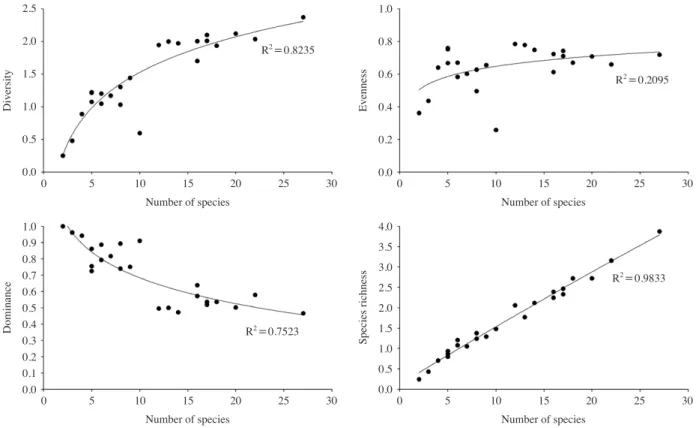
회천과 주변 하천수계에서 각 조사 지점별로 채집된 어종의 수와 군집지수 사이의 상관관계를 나타낸 것은 Fig. 3과 같다.
종풍부도는 어종의 수가 많아짐에 따라 거의 직선적으로 증 가하였는데, 상관계수는 R2=0.9833으로 매우 높았다. 다양도 역시 어종 수의 증가에 따라 지수적인 증가 경향을 보였고 상 관계수는 R2=0.8235로 높았다. 균등도는 종수의 증가에 따라 약간 증가하는 경향을 보였으나 상관계수가 R2=0.2095로 매 우 낮아 큰 경향성은 없었다. 우점도는 다양도 및 균등도와는 반대의 경향을 보였으며, 상관계수는 R2=0.7723으로 비교적 높았다. 이와 같은 어종수와 생태지수의 상관관계는 영강(Chae et al., 2014)과 낙동강 상류(Chae et al., 2015)에서도 보고되어 있는데, 본 조사의 결과도 이들 선행 연구와 비슷하였다.
2) 군집 간의 관계
채집된 어종의 종류, 어종수와 개체수에 근거하여 각 집단 간의 유사도지수를 계산하였고, 이를 바탕으로 작성한 수지도 는 Fig. 4에 나타내었다. 유사도 15%의 수준에서 크게 4개의 집단으로 구분할 수 있었다. 먼저 St. 1, 2, 5 등의 5개 지점이 하나의 집단을 형성하였으며, 주로 상류에 위치하는 지점들이
Fig. 3. Relationships between some ecological indices and number of species collected at each station in the Hoecheon Stream and adjacent trib- utaries.
Diversity Evenness
Dominance Species richness
0 5 10 15 20 25 30 Number of species
0 5 10 15 20 25 30 Number of species
0 5 10 15 20 25 30 Number of species
0 5 10 15 20 25 30 Number of species
R
2= 0.8235
R
2= 0.7523
R
2= 0.2095
R
2= 0.9833 2.5
2.0 1.5 1.0 0.5 0.0
1.0 0.8 0.6 0.4 0.2 0.0
1.0 0.9 0.8 0.7 0.6 0.5 0.4 0.3 0.2 0.1 0.0
4.0 3.5 3.0 2.5 2.0 1.5 1.0 0.5 0.0
Fig. 4. A dendrogram showing the grouping of fish community.
0 20 40 60 80 100
Similarity (%)
Upper reach
95 72 231 198 1110 64 173 1214 1315 2422 2120 1816Mid-lower reach Middle reach
Lower
reach
었다. 다음은 St. 3, 4, 6, 8 등이 포함되는 집단으로 8개 지점이 소속되었으며, 중류 및 중상류에 위치하였다. St. 12와 13을 포 함하여 6개 지점이 또 하나의 집단으로 묶였는데, 이들 지점은 주로 중하류에 위치하였다. 마지막으로 St. 16, 18 등의 6지점 이 하나의 집단으로 묶였으며, 대체로 낙동강과 합류하는 부 분의 최하류에 해당하는 지점들이었다. 이들 4개의 집단을 하 천도 위에 경계선을 그어 표시하고 하천에서의 위치 및 어종 의 구성에 따라서 상류집단, 중상류집단, 중류집단 및 하류집 단으로 구분하였다(Fig. 5).
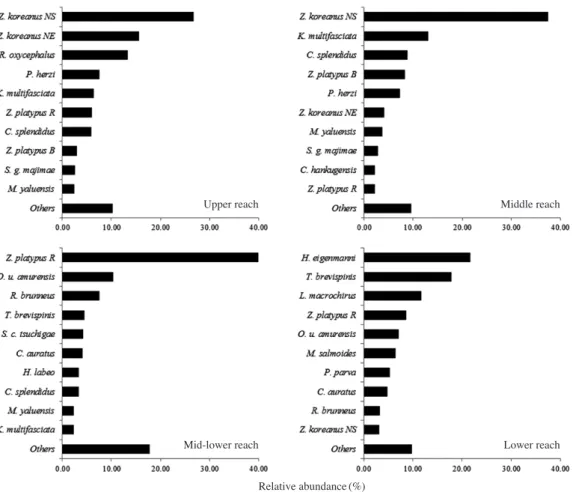
구분된 4개 집단 각각에 대하여 어종별 개체수를 나타 낸 것은 Fig. 6과 같다. 상류집단에서는 Z. koreanus NS, Z.
koreanus NE, R. oxycephalus가 가장 많았고, 다른 어종의 비 율은 낮았다. 중류집단에서는 Z. koreanus NS가 우점종이었 으며, K. multifasciata, C. splendidus, Z. platypus B, P. herzi 가 우세하였다. 중하류집단에서는 Z. platypus R이 우점종이 었으며, O. uncirostris amurensis, R. brunneus, T. brevispinis가 우세하였다. 하류집단에서는 H. eigenmanni가 우점종이었으 며, T. brevispinis, L. macrochirus, Z. platypus R, O. uncirostris amurensis가 우세하였다.
4. 어류상의 장기적 변화
회천의 어류상에 대해서는 1980년대부터 비교적 주기적 으로 조사되었다(Yang, 1986; Hong, 1996; Chae et al., 1996;
ME, 2000-2002). 이들 조사 결과와 본 조사의 결과를 Fig. 7에
Fig. 5. Division of fish community in the Hoecheon Stream and adja- cent tributaries.
Upper reach
Mid-lower reach Middle reach
Middle reach Lower
reach
Fig. 6. Species composition in the four groups in the Hoecheon Stream and adjacent tributaries.
Relative abundance (%) Upper reach
Mid-lower reach
Middle reach
Lower reach
서 비교하였다. 선행조사를 포함한 네 차례의 조사에서 우점 종이 Z. koreanus인 것은 변화가 없었다. 시기에 따라 약간의 차이는 있으나 Z. platypus도 계속 아우점종의 수준으로 우세 하게 출현하고 있었다. 또한 P. herzi와 K. multifasciata도 계속 우세하게 출현하고 있어서 이 지역의 전반적인 특징을 잘 나 타내었다.
C. auratus, R. uyekii, A. yamatsutae, A. koreensis, Pseudo- rasbora parva, S. gracilis majimae, C. hankugensis, P. brevi- corpus, Liobagrus mediadiposalis 등의 어종은 개체수가 계속 감소하는 추세였다. 이들 중 C. auratus, P. parva와 S. gracilis majimae를 제외한 6종은 하천의 바닥 구조와 밀접한 연관을
맺고 있는 종들이다. Acheilognathinae에 속하는 종들은 하천 의 바닥에 사는 담수이매패에 산란을 하는 특성을 지니고 있 으며, C. hankugensis, P. brevicorpus, L. mediadiposalis는 저서 성 어류들이다. 이들의 생존 여부는 하천 바닥의 건강성 유지 가 가장 중요하기 때문에 개체수의 감소는 하천 바닥이 많은 교란을 받았음을 증명하고 있다.
반대로 L. macrochirus, M. salmoides, T. brevispinis, H.
eigenmanni, O. uncirostris amurensis 등의 5종은 2000년대 이 후 출현하기 시작하여 개체수가 증가하고 있는 추세이다. 이 들은 모두 외래종이거나 국내의 다른 하천에서 이입된 종들이 다. 회천에서 L. macrochirus와 M. salmoides가 아직은 St. 13
Fig. 7. Long term change of ichthyofauna in the Hoecheon Stream and adjacent tributaries. The color of the bar means: green bars represent the fish species whose population is decreasing, black bars represent species that have not changed significantly and red bars represent exotic species or introduced species from other rivers in Korea.
Relative abundance (%)
1983~1989 1995 2000~2002 2015
보다 상류로 퍼져나가지 못하고 있는 상황이지만 상류로의 유 입 가능성이 있으므로 면밀한 감시가 필요하다.
멸종위기야생생물 I급에 해당하는 Microphysogobio rapidus 가 회천의 하류지역인 St. 14에서 1995년 조사에서 소수가 출 현하였으나(Chae et al., 1996), 그 이후로는 출현하였다는 보 고가 없다. 이 지역의 현재 상황을 보면 과거에 비하여 잔자갈 이 깔린 여울이 축소되었으며, 대부분 모래로 덮여있고, 하상 에는 많은 녹조류가 부착되어 있어서 부영양화된 것으로 추정 되므로 M. rapidus가 서식하기는 어려울 것으로 보인다.
외래종이나 국내이입종에 의한 어류상의 변화나 고유종의 절멸에 대해서는 많은 연구가 있었다(Maezono et al., 2005;
Küçük et al., 2008; Leunda, 2010; Mirza et al., 2011; Jelić et al., 2016). 그 외의 하천의 변형, 수질의 오염, 부영양화 등과 같은 인간의 활동에 의한 어류상의 변화에 대한 연구도 이루
어지고 있다(Gonçalves and Braga, 2012; Pereira et al., 2014).
이러한 연구들의 결과와 본 연구의 결과를 비교해 보면 회천 에서의 어류상 변화는 하상의 평탄화, 보나 댐의 축조, 직강화 등과 같은 하천의 개수에 의하여 큰 영향을 받은 것으로 평가 되었다.
5. Zacco속 어류의 형별 분포
최근 국내의 Zacco temmincki는 Z. temminckii와 Z.
koreanus의 두 종으로 분리되었고, 그중 Z. koreanus는 다시 3 개의 형으로 구분할 수 있음이 알려졌다. 또한 Z. platypus도 두 개의 형으로 구분되었다(Kim et al., 2005b; Chae and Yoon, 2006, 2010; Yoon et al., 2012)(Fig. 8). 본 조사의 대상 지역인 회천 일대에서 이들의 형별 분포 양상을 지도상에 나타내었다
Fig. 8. The color patterns of each type in Zacco koreanus and Z. platypus.
Fig. 9. Appearance ratios of the types of Zacco koreanus and Z. platypus in each station in the Hoecheon Stream and adjacent tributaries.
Z. koreanus NS
Z. koreanus NE Z. platypus B
Z. platypus R
(Fig. 9).
Z. koreanus는 회천의 중류에서부터 상류에 서식하고 있었 는데, NE형은 상류역에서, NS형은 주로 중류에 단독으로 분 포하고 있었다. 안림천 지역의 상류부에서는 NS형과 NE형이 공서하고 있었다. 한편 차천과 현풍천에는 NS형이 서식하고 있었다.
Z. platypus B형과 R형이 있는데, 전반적으로 보아 Z.
koreanus 만큼 상류로 진출하지 못하고 있었다. 이들 중 B형 은 중상류 지역에 그리고 R형은 중하류 지역에 서식하고 있 었다. B형과 R형이 공서하는 곳은 회천의 St. 6과 현풍천의 St. 24 두 지점이었다. 이러한 분포 양상은 기존에 알려진 Z.
koreanus와 Z. platypus의 형별 분포와 잘 일치하였다(Chae and Yoon, 2006, 2010; Yoon et al., 2012).
한편 본 조사에서 Z. temminckii가 덕곡천에 서식하고 있음 이 처음으로 밝혀졌다. Z. koreanus와 Z. temminckii가 구분된 후, 낙동강에서는 황강(Kim et al., 2005b)과 영강(Chae et al., 2014)에서 서식하는 것이 알려져 있을 뿐이다. 따라서 낙동강 에서 Z. temminckii의 미세 분포에 대한 연구가 필요할 것이다.
요 약
2016년 7월부터 2017년 8월까지 낙동강수계의 1차 지류 인 회천과 인접한 소하천들에서 24개 지점의 어류상을 조사 하였다. 그 결과, 모두 11과 32속 42종 4형의 어류가 확인되 었다. 그중 잉어과 어류가 24종 4형(59.1%)으로 가장 많았다.
한반도 고유종은 A. yamatsutae와 Odontobutis platycephala 등의 16종이었다. 멸종위기야생생물에 해당하는 종은 I급에 Pseudobagrus brevicorpus와 Koreocobitis naktongensis, II급 에 Culter brevicauda로 3종이 출현하였다. 외래종은 Lepomis macrochirus와 Micropterus salmoides의 두 종이 있었으며, 국 내이입종은 Opsariichthys uncirostris amurensis, Hemiculter eigenmanni, O. interrupta, Tridentiger brevispinis의 4종이 확 인되었다. 우점종은 Zacco koreanus NS(19.16%), 아우점종은 Zacco platypus R(17.17%)이었다. 회천과 인접 하천 수계 전 체에서는 다양도 2.894, 균등도 0.765, 우점도 0.353, 종풍부도 4.668로 나타나 다양하고 안정된 어류군집을 이루고 있었다.
어류군집 간의 유사도를 바탕으로 작성한 수지도에서는 상류 집단, 중류집단, 중하류집단, 하류집단의 4집단으로 구분되었다.
사 사
본 논문은 2016~2017년 경상북도수산자원연구소 토속어류 산업화센터의 공기관대행 사업을 국립낙동강생물자원관이 수 행한 “낙동강어자원생태계조사”의 결과임.
REFERENCES
Chae, B.S. 2000. Natural ecological exploration-focusing in Kumho River. Freshwater fishes. Institute of Natural Eco- system, pp. 47-83.(in Korean)
Chae, B.S. 2003. Introduction of native fish species to the other river system. Case study. In: The introduced fishes of Korea. The Ichthyological Society, pp. 65-86.(in Korean)
Chae, B.S. 2007. Chief cause menacing the life of freshwater fishes in Korea. Chuncheon Global Water Forum 2007, 23pp.(in Korean)
Chae, B.S., Y.H. Kang and Y.H. Lee. 1996. Ichthyofauna and com- munity structure in the Nakdong River: focusing on the tributaries. In: Ecological report on the Nakdong River.
Yeongnam Man and Nature Society, Daegu, pp. 287-402.(in Korean)
Chae, B.S., Y.H. Kang, S.K. Kim, D.U. Yoo, J.M. Park, H.U. Ha and U.W. Hwang. 2014. Ichthyofauna and fish community structure in the Yeong River, Nakdong River system, Korea.
Korean J. Ichthyol., 26: 50-69.(in Korean)
Chae, B.S., Y.H. Kang and H.J. Yang. 1998. Fish community struc- ture in the Wicheon River, Nakdong River system, Korea.
Korean J. Ichthyol., 10: 77-86.(in Korean)
Chae, B.S., S.K. Kim, Y.H. Kang, N.S. Heo, J.M. Park, H.U. Ha and U.W. Hwang. 2015. Ichthyofauna and Fish Community Structure in Upper Reach of the Nakdong River, Korea.
Korean J. Ichthyol., 27: 116-132.(in Korean)
Chae, B.S. and H.N. Yoon. 2006. Geographic variation and dis- tribution of nuptial color patterns in Korean chub, Zacco koreanus(Cyprinidae, Pisces). Korean J. Ichthyol., 18: 97- 106.(in Korean)
Chae, B.S. and H.N. Yoon. 2010. Habitat segregation between NE and NS type of Zacco koreanus(Cyprinidae). Korean J. Ich- thyol., 22: 49-55.(in Korean)
Choi, J.S. and J.K. Kim. 2004. Ichthyofauna and fish community in Hongcheon River, Korea. Korean J. Environ. Biol., 18:
446-455.(in Korean)
Chyung, M.K. 1977. The fishes of Korea. Iljisa, Seoul, 727pp.(in Korean)
Clarke, K.R. and R.N. Gorley. 2001. PRIMER v5: User Manual/
Tutorial. PRIMER-E, Plymouth.
Cummins, K.W. 1962. An evolution of some techniques for the col- lection and analysis of benthic samples with special empha- sis on lotic waters. Am. Midl. Nat., 67: 477-504.
Gonçalves, C.S. and F.M.S. Braga. 2012. Changes in ichthyofauna composition along a gradient from clearwaters to black- waters in coastal streams of Atlantic forest(southeastern Brazil) in relation to environmental variables. Neotropical Ichthyology, 10: 675-684.
Hong, Y.P. 1996. Ecosystem research of Kayasan National Park -Ichthyofauna around Mount Kaya. Academic Series of National Science Museum 13: 77-101.(in Korean)
Ichthyological Soceity of Korea(ISK). 2003. The introduced fishes
of Korea. Proceedings of 2002 Symposium of the Ichthyo- logical Society, 128pp.(in Korean)
Jang, M.H., G.I. Cho and G.J. Joo. 2001. Fish fauna of the main channel in the Nakdong River. Korean J. Limnol., 34: 223- 238.(in Korean)
Jelić, D., I. Špelić and P. Žutinić. 2016. Introduced species com- munity over-dominates endemic ichthyofauna of high Lika Plateau(central Croatia) over a 100 year period. Acta Zool.
Acad. Sci. Hungaricae, 62: 191-216.
Jeon, S.R. 1980. Studies on the distribution of freshwater fishes from Korea. Doctoral Dissertation of the Chungang Univer- sity, 91pp.(in Korean)
Jeon, S.R. 1999. First Record of the Opsariichthys uncirostris amu- rensis(Pisces: Cyprinidae) from Panbyon-river of Nak tong- River System, Korea. Korean. J. Environ. Biol., 17: 499- 501.(in Korean)
Jeon, S.R. and C.S. Hoang. 1990. Freshwater fish fauna of the streams of Kayasan National Park area. Rep. Korea. Assoc.
Conserv. Nat., 28: 143-151.(in Korean)
Kang, Y.H. 2011. Fish fauna and structural change of the fish com- munity in the Nakdong River. Doctoral Dissertation of Kyungpook National University, 371pp.(in Korean) Kang, Y.H., J.W. Seo, J.D. Keum and H.J. Yang. 2004. The Fish
Community Structure in the middle of Nakdong River.
Korean J. Limnol., 37: 227-235.(in Korean)
Kang, Y.H., B.S. Chae, M.M. Nam and H.S. Kim. 2005. Fish fauna and community structure on the mountain streams in the Mt. Biseul. Korean J. Limnol., 38: 289-296.(in Korean) Kani, T. 1944. Ecology of torrent-inhabiting insects, pp. 171-317.
In: Insect 1(Furukawa, H. ed.). Kenkyu-sha, Tokyo.(in Jap- anese)
Kim, I.S. 1997. Illustrated encyclopedia of fauna and flora of Korea.
vol. 37. Freshwater fishes. Ministry of Education, 629pp.(in Korean)
Kim, I.S., Y. Choi, C.L. Lee, Y.J. Lee, B.J. Kim and J.H. Kim.
2005a. Illustrated book of Korean fishes. Kyohak Publ. Co.
Ltd., Seoul, 615pp.(in Korean)
Kim, I.S., M.K. Oh and K. Hosoya. 2005b. A new species of cypri- nid fish, Zacco koreanus with redescription of Z. temminckii (Cyprinidae) from Korea. Korean J. Ichthyol., 17: 1-7.
Küçük, F., H.M. Sari, O. Demir and I. Gülle. 2008. Review of the ichthyofaunal changes in Lake Eğirdir between 1915 and 2007. Turk J. Zool., 33: 277-286.
Kum, J.D. and H.J. Yang. 2002. The fish fauna and its community structure in the Nam River, Nakdong River system, Korea.
Korean J. Limnol., 35: 220-231.(in Korean)
Leunda, P.M. 2010. Impacts of non-native fishes on Iberian fresh- water ichthyofauna: current knowledge and gaps. Aquatic Invasion, 5: 239-262.
Maezono, Y., R. Kobayashi, M. Kusahara and T. Miyashita. 2005.
Direct and indirect effects of exotic bass and bluegill on exotic and native organisms in farm ponds. Ecol. Appl., 15:
638-650.
McNaughton, S.J. 1967. Relationship among functional properties of Californian Grassland. Nature, 216: 168-169.
Ministry of Environment(ME). 1997, 2000, 2001, 2002. Reports of 2nd survey of national natural environtment.(in Korean) Ministry of Construction and Transportation(MOCT). 2000. Syn-
opsis of Korean rivers. 11-1500000-000519-01, 748pp.(in Korean)
Ministry of Construction and Transportation(MOCT) and Korea Water Resources Corporation(KOWACO). 2002. Uri garam gilajabi. Jungang Jido Munwhasa, 343pp.(in Korean) Mirza, Z.S., M.R. Mirza, M.A. Mirza and Q.K. Sulehria. 2011. Ich-
thyofaunal diversity of the River Jhelum, Pakistan. Biologia (Pakistan), 57: 23-32.
Nakdong River Environment Research Center(NERC). 2016.
Aquatic ecosystem monitoring in weir of the Nakdong Riv- er. 4th annual report.(in Korean)
Nam, M.M., H.J. Yang, B.S. Chae and Y.H. Kang. 1998. The fish fauna and community structure in the Naerin Stream. Kore- an J. Ichthyol., 10: 61-66.(in Korean)
Nelson, J.S. 2006. Fishes of the World. John Wiley & Sons. New York, 601pp.
Pereira, A.L., V.R. Ribeiro, É.A. Gubiani, C.E. Zacarkim and A.M.
Cunico. 2014. Ichthyofauna of urban streams in the western region of Paraná State, Brazil. Check List, 10: 550-555.
Pielou, E.C. 1966. The measurement of diversity in different types of biological collections. J. Theoret. Biol., 13: 131-144.
Shannon, C.E. and W. Weaver. 1949. The mathematical theory of communication. Univ. Illinois Press, Urbana, 177pp.
Simpson, E.H. 1949. Measurement of diversity. Nature, 163: 688.
Son, Y.M. 1987. Systematic studies on the torrent catfish, family Amblycipitidae(Pisces: Siluriformes) from Korea. Doctoral Dissertation of Chungang University, 81pp.(in Korean) Uchida, K. 1939. The fishes of Korea. Part I. Nemathognathi,
Eventhognathi. Bull. Fish. Exp. Station Govern. Gen. of Tyosen, Husan, No. 6, 458pp.(in Japanese)
Yang, H.J. 1986. Conservation of Gaya cultural heritage and natural resource development plan. 3. Distribution of freshwater fishes. Kyungpook National University Museum, pp. 455- 494.(in Korean)
Yang, H.J. and B.S. Chae. 1994. The water environment and lim- nological study of the river system around the megalopolis.
The ichthyofauna and structure of fish community in the Kumho River(II). Korean J. Limnol., 27: 177-188.(in Ko- rean)
Yang, H.J., B.S. Chae and S.O. Hwang. 1997. Ichthyofauna and fish community structure in the Imha-dam Reservoir, Korea.
Korean J. Limnol., 30: 145-154.(in Korean)
Yoon, H.N., B.S. Chae and Y.S. Bae. 2012. Geographic variation of body color and morphological characteristics of pale chub, Zacco platypus(Cyprinidae, Pisces). Korean J. Ichthyol., 24: 167-176.(in Korean)