• 검색 결과가 없습니다.

A Framework for Emerging Clusters: Focus on Regional Industrial Policy and Strategic Perspective

N/A
N/A
Protected

Academic year: 2021

Share "A Framework for Emerging Clusters: Focus on Regional Industrial Policy and Strategic Perspective"

Copied!
8
0
0

로드 중.... (전체 텍스트 보기)

전체 글

(1)

A Framework for Emerging Clusters:

Focus on Regional Industrial Policy and Strategic Perspective

Eun-Mi Park

1

, Joung-Hae Seo

2*

1

Complete a Doctorate, School of Business Administration, Kyungpook National University

2

Professor, School of Business Administration, Kyungpook National University

클러스터 출현분석을 위한 프레임워크:

지역산업정책 및 전략적 관점으로

박은미

1

, 서정해

2*

1

경북대학교 경영학부 박사수료,

2

경북대학교 경영학부 교수

Abstract In order to sustainably develop economy of regions and countries, it is necessary to pay attention to formation of new clusters from a long-term perspective. This study examined concepts and characteristics of clusters, and analyzed conditions related to emergence of clusters based on previous studies. Then, this study derived important factors and intended to propose a framework that is possible to help analyze clusters in the future. The development stages were divided into four stages of occurrence, growth, maturity, and decline. As for emergence conditions, entrepreneurship, institutional support, decision factors by development stages, and requirements for the future cluster success were presented. This study has academic significance in that it presents an integrated framework to analyze cluster emergence, and based on it, this study also presents directions of future studies and the regional and national policy implications. However, this study has many limitations in that it is difficult to generalize because it has not considered all variables in various dimensions and environments.

Key Words : Framework, Cluster, Emerging Clusters, Regional Industrial Policy, Strategic Perspective 요 약 지역과 국가의 지속가능한 경제발전을 위해서는 장기적 관점에서의 새로운 클러스터 형성에 관심을 기울여야 하는 것이 필요하다. 본 연구에서는 클러스터의 개념과 특징들을 살펴보고, 선행연구들을 토대로 클러스터의 출현과 관련한 조건들을 분석하고 중요요인들을 도출한 후 향후 클러스터를 분석하는데 도움이 될 수 있는 프레임워크를 제안 하고자 하였다. 발전단계로는 발생, 성장, 성숙, 쇠퇴의 4단계로 구분하였으며, 출현조건으로는 기업가정신, 제도적지원 과 발전단계별 결정요인들과 미래 클러스터 성공요건들을 제시하였다. 본 연구는 클러스터 출현분석을 위한 통합 프레 임워크를 제시하였다는 점에서 학문적 의의가 있으며, 또한 이를 통해 향후 연구의 방향과 지역 및 국가 차원에서의 정책적 시사점을 제시하고 있다. 그러나 다양한 차원과 환경에서의 변수들을 모두 고려하지 못하였기 때문에 일반화를 하기엔 어려움이 많은 한계점이 있다.

주제어 : 프레임워크, 클러스터, 클러스터 출현, 지역산업정책, 전략관점

*Corresponding Author : Joung-Hae Seo([email protected]) Received July 7, 2020

Accepted August 20, 2020 Revised August 4, 2020

Published August 28, 2020

(2)

1. Introduction

Thought the 4th industrial revolution, the technology has been rapidly developed [1]. In the past, a company created a competitive edge through its own internal capabilities. However, a rapidly changing recent environment made it possible to create a competitive edge only when external competencies through a network are actively used in addition to internal competencies[2-4]. As the innovation clusters in Silicon Valley in the US have indicated effects, interests in industrial clusters have increased as a new strategy to respond to environments of the 4th industrial revolution. In these situations, the US and Germany are putting a great deal of efforts to achieve advancement based on the manufacturing innovation and China based on a special economic zone[5].

As South Korea have valued regional innovation to strengthen national competitiveness, various policies have been promoted to develop regional industries and strengthen capabilities. In particular, clusters have received a lot of attention and supports to strengthen regional competitiveness and nurture strategic industries[6].

The core of regional industrial policies is how the policy can be intended to have competitiveness in the public sector. During the rapid growth period in the industrial capitalist era, the focus of the regional industrial policies is infrastructure and government tax benefits. Then, in the 1970s (under the regime of Park, Jung-Hee), if the country invested in companies or industries with good development prospects(electronics, automobile steel manufacturing, etc.) and universities(mechanical engineering, electronic engineering, etc.), companies were able to increase competitiveness by reducing costs, and talents cultivated through universities were able to be input to directly companies. Therefore, if a low input cost caused a decline in market prices,

which immediately enhanced competitiveness of companies, increasing exports. During this period, South Korea rose suddenly to an export country and a virtuous cycle of the economy became possible.

In the Post Fordism (post-industrial capitalism) period, since advantages of existing cost savings had limitations, the attention began to focus on the importance of quality and there were characteristics of a knowledge-based economic society. Knowledge is necessary to enhance competitiveness by innovating new things (R&D activities), and the regional industrial policies during this period are focused on the government's policy supports for technological innovation of competitive companies. However, international organizations such as WTO imposed sanctions against government's support policies. In order to avoid it and support R&D of South Korean companies, RIS (Regional Innovation System) was the possible way. In other words, it means that the government supports the building of regional RIS. It makes it possible to take place local technological innovation mechanisms.

For example, subjects of innovation are corporations and universities, and these have visible characteristics, but another important element, the network, has invisible characteristics of exchange and knowledge creation. According the analysis, it is a well-established but invisible (hidden) so it is a way to support corporations through policies by avoiding sanctions of international organizations.

This implementation of RIS (built one) is a

cluster. This cluster is based on that RIS should

be established well. In other words, clusters

refers to a state where many companies with

mutually organic division of labor and

cooperative relationships are located in a certain

region in the relationship among value

chain-related industries in the characteristic

industry[7), and Storper (1995) said that networks

(3)

among cluster companies form economy of scale and maximize effectiveness of resource utilization[8].

In addition, it is possible to judge competitiveness of clusters by analyzing whether the RIS is well established. In South Korea, various policies related to clusters have been performed since the 2000s. The government's active support policy along with continuous studies on the cluster in the future will be essential as an important policy to encourage not only the national economy development but also the regional economy development.

Clusters are areas where knowledge through innovation can continuously generate, and it is important to support existing clusters for economic development of regions and countries, but the more important thing to consider in the long term is that it should be interested in formation (composition) of new clusters.

Although it is a very important issue, the number of studies related to emergence of clusters has been very rare so far, and most of the studies deal with ones after the emergence of clusters.

Hence, this study examined concepts and characteristics of clusters, analyzed conditions related to emergence of clusters based on previous studies, derived important factors, and aims to propose a framework that is helpful for analyzing clusters in the future. If reasons or conditions for emergence of clusters become clear, it may be possible to promote a cluster by intent in the future.

2. Theoretical Background 2.1 What is a Cluster?

A cluster is that many companies and related organizations and institutions in a specific (or related) industrial field are geographically integrated, are forming a very close network and are creating a variety of integrated economy in

production, logistics costs, technological innovation and diffusion. There is regional/technical uncertainty in the areas before the emergence of clusters, and clusters tend to show patterns of emergence in areas where they can succeed (where uncertainty can be dealt with) in this competitive process.

The term cluster began in 1990 when Michael Porter mentioned the importance of geographical agglomeration effects in his book[9], 'The Competitive Advantage of Nature', and discussions on industrial aggregation in competition with clusters began in earnest in the 'On Competition' published in 1998[10].

The above mentioned industrial clusters belong to certain sectors, consist of interrelated companies and organizations, and are geographically adjacent groups. These are combined through commonality or supplementation. Sometimes, a cluster has a geographic scope ranging from regions to networks in the whole area of a country or adjacent countries. A cluster is generally defined as what companies and related organizations are geographically concentrated with each other. The cluster defined by the OECD means a network among independent companies, knowledge-creating organizations (universities, research institutes, corporate research institutes), intermediary agencies (providers of technology and consulting services) and holders connected in a production chain that creates added value.

Sometimes, clusters are classified into industrial clusters and semi-industrial clusters.

However, these terms are misused. It is possible

to be aware that other clusters exist through use

of the term the industrial cluster, but others do

not exist in reality. The industry cluster that

Michael Porter first presented is the present

cluster, so it would be desirable to use one

uniform term cluster through the term

unification.

(4)

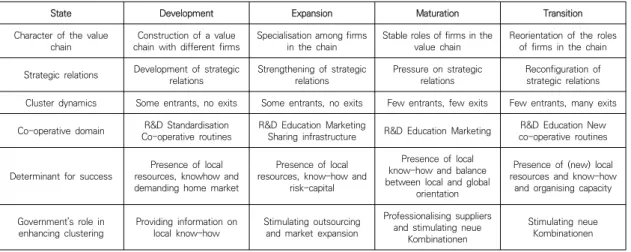
Table 1. A cluster life-cycle

State Development Expansion Maturation Transition

Character of the value

chain Construction of a value

chain with different firms Specialisation among firms

in the chain Stable roles of firms in the

value chain Reorientation of the roles of firms in the chain Strategic relations Development of strategic

relations Strengthening of strategic

relations Pressure on strategic

relations Reconfiguration of strategic relations Cluster dynamics Some entrants, no exits Some entrants, no exits Few entrants, few exits Few entrants, many exits Co-operative domain R&D Standardisation

Co-operative routines R&D Education Marketing

Sharing infrastructure R&D Education Marketing R&D Education New co-operative routines Determinant for success Presence of local

resources, knowhow and demanding home market

Presence of local resources, know-how and

risk-capital

Presence of local know-how and balance between local and global

orientation

Presence of (new) local resources and know-how

and organising capacity Government’s role in

enhancing clustering Providing information on

local know-how Stimulating outsourcing and market expansion

Professionalising suppliers and stimulating neue

Kombinationen

Stimulating neue Kombinationen

2.2 Study Flow on Clusters

Since most of existing studies on clusters consider clusters as pre-formed and successful structures, and put focus on understanding the functionality of clusters and processes occurring within the local clusters. On the other hand, present studies put focus on how space concentration occurs and deepens. The broadest concept of the cluster is the industrial cluster, which can be classified as a Marshall industrial district, a satellite industrial district, hub and spoke, and a state-of-the-art industrial district.

3. Evolution of Clusters - Development Stages

3.1 Evolution Model of Clusters

Economic advantages of any cluster at one point are not lasting, and factors that acted once as an advantage may become reasons of decline over time.

According to Van Klink and Langen(2001), the cluster life cycle is categorized into stages of development, expansion, maturity, and transition[11]. Han and Yoo (2008) proposed a cluster development stage model classified into

the beginning stage, group formation stage, system establishment stage, and stabilization stage, which has important administrative implications at each stage[12].

3.2 Life Cycle Theory at the development stage

The life cycle perspective explains the development stage of a cluster using data such as the number of companies, innovation, heterogeneity of technology, and market share, and has advantages of explaining general dynamics to generate cluster evolution or setting the hypothesis for an environment that makes it possible to have a specific cluster trajectory.

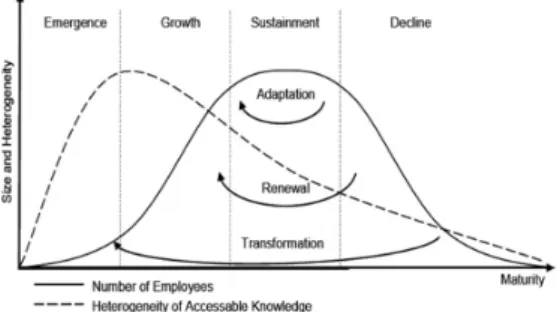
Menzel and . Fornahl (2010) insisted that a path of technology has one cycle[13]. They also said that the cluster life cycle has four stages of development, growth, sustainment, and decline, and that it does not just linearly evolve in one direction, and can go back to previous stages through adaptation, regeneration, and transformation in the middle of evolution. The characteristics at each stage are as follows.

1) Stage 1: Occurrence - As the company

approaches a new technology area,

heterogeneity is increased so that it is

difficult to be recognized as a cluster.

(5)

Fig. 1. Knowledge-based cluster life cycle

2) Stage 2: Growth - The number of employees is increased, and concentration of the technology paths is made.

3) Stage 3: Maturity (Sustainment) - Heterogeneity is decreased, and development of unique paths is made.

4) Step 4: Decline - As the cluster deteriorates, the recovery capacity is decreased.

Martin and Sunley (2011) pointed out limitations of the cluster life cycle perspective, and emphasized that diverse growth paths in the economic space that the life cycle perspective is not able to explain[14]. They insisted that the evolution proposed by studies performed from the life cycle perspective has an ontogenetic development form where given objects with unchanged characteristics inevitably advance from the previous stage to the next stage. In reality, the inside of the actual cluster has changing composition as various companies experience the entry and exit process, so that the cluster properties are constantly changing. In addition, in this process, they suggested that it is necessary to have complex adaptive thinking in order to understand how actors and economic spaces resonate with each other[15].

4. Framework for Analyzing the Emergence of Clusters

4.1 Prerequisites of Clusters (Reasons for Emergence)

In the analysis method of clusters, there are static analysis and dynamic analysis (life cycle).

Static analysis means to fill and strengthen missing components based on the internal mechanism, and the life cycle is categorized into 4 stages of adaptation, growth, sustainment, and decline, generates the development process of the cluster. It means and grasping each stage and leading it to the next stage. All stages have their own characteristics, but do not necessarily go through all the four stages. In addition, external conditions and internal mechanisms interact to evolve the cluster. If so, what are steps and requirements at each step? This study aims to propose a step-by-step framework to analyze emergence of clusters. A lot of studies claim that emergence of clusters is not satisfied with a single factor, the followings are factors that have an effect emergence of clusters through previous studies.

1) Innovation (Knowledge)

The central government's role on knowledge is creation of knowledge, provision of knowledge, re-creation of knowledge, and inflow of knowledge. It should be possible to create knowledge and transfer knowledge because knowledge itself is insufficient. The local governments require a transition policy that turns knowledge into technology. In addition, technology does not spontaneously develop the industry so companies should be able to industrialize these technologies (such as product development).

2) Existing Resources

These mean technical or regional (regional

competencies) resources. If a cluster emerges in

specific regions, certain prerequisites (universal

condition, local condition) are required, which

(6)

can be different from each other. In addition, accidental conditions are close to universal condition (conditions, resources), and the intentional conditions are close to local conditions.

3) Entrepreneurship

Resources and governmental supports do not necessarily emerge clusters. Only if an entrepreneur produces a product, resources and policy supports are able to have values through the necessary and sufficient condition relation. Entrepreneurship can be divided into conservative (passive) entrepreneurship and progressive entrepreneurship.

As for conservative entrepreneurship, a negative aspect is strong, and as for progressive entrepreneurship, a positive side is strong. In general, entrepreneurship does not seem to be related to culture, but in a broad sense, it is associated with local culture, and the very innovative entrepreneurship and region are not entirely separate, and they are very closely related to each other according to locality.

Entrepreneurs are active agencies, not passive drivers in the economy. In the past, entrepreneurship was not related to regions, but recently industrial psychology shows that entrepreneurship has an inseparable relationship with regions. A very adventurous, venture-oriented, and innovative entrepreneurship has a large effect, when it interacts with related organizations. It is because the development of a group of experts and information networks related to policy-making has a significant impact on revelation of the entrepreneurial spirit.

In the past, if a person with a certain entrepreneurship had an effect on starting-up business, recently, it has become important to identify reasons and factors that create such entrepreneurship in studying clusters. In the past, even though public officials retired, cases where they started venture business were rare, but now

they have relevant expertise and can actually have influence on policy-making or planning.

Therefore, a lot of public officials start venture business after they retire.

Entrepreneurship is summarized as follows:

entrepreneurship (very adventurous) that intents to actively utilize government policy funds, entrepreneurship, and state-of-the-art technology orientation.

4) Demand

The requirement for new demand can have influence on emergence of clusters.

5) Institutional Support

The clusters have subjects of information, corporations, and universities, and pursue hybridization of functions through an endless network. In participate, cluster phenomenon in high-tech industry field places a greate importance on the role of government. In regard to emergence of clusters, policies mostly have had an influence on a lot of regions, although there was not intention.

6) Interactions of Regional and Technological Processes

The long-term evolution and survival chance of a cluster depend on resonantization of interrelated factors.

In addition, the mentioned main elements of cluster emergence are government's establishment infrastructure(government policies) and initiatives, coincidence, path dependence and strategic behaviors, and institutions and endogenous driving forces. Cluster emergence mechanisms propose resource effects, imitation effects, and network effects.

4.2 Framework to analyze emergence of

clusters

(7)

Table 2. Integrated Framework for Analyzing Emergency of Clusters

Step Condition Step 1: Occurence Step 2: Growth Step 3: Maturity Step 4: Decline

Entrepreneurship Entrepreneurship Innovation Orientation Cutting-Edge Technology

Orientation Progressive

Institutional Support Provision of Funding and Study Performance of Public Sector information

M&A, Outsourcing, Market Expansion

Promotion of Supplier Expertise and Technology Protection

Support Policies

Network support policy

Decision factors by each development stage

Existing resources (Regional, technical),

Intention (Premise conditions)/ Coincidence

(Trigger events)

Establishment and reinforcement of organic industry-academia-related networks by mutual respect among innovation

subjects

Joint Studies and Technology Development

and Commercialization, Fostering Local talent

Pursuing previous steps through improvement and

coordination (Separate start-ups, urban

and industrial regeneration) Decision factors of

necessary /sufficient characteristics of initial

clusters

Government policy factors (R&D costs, Regional technology policies, Government policies, etc.), Demand factors (Public demand for technology-intensive new products, etc.), Supply factors (Convenience facilities-environment, culture, living conditions, etc., Research and education infrastructure, Roles of Key Figures (Leadership, etc.), Decentralization process innovation center in large-scale cohesion, Corporate Activities and corporate attitudes,

Entrepreneurial behavior-startups, etc.) Success Requirements of

Future Cluster

Organizational culture that respects free communication and creativity, Innovative and voluntary efforts of participating objects for change, Regional/technical reciprocal actions, resilience, and dynamic dynamics of companies (absorption ability, network changes, abilities to reproduce effective routines in new places, etc.), Network support policies

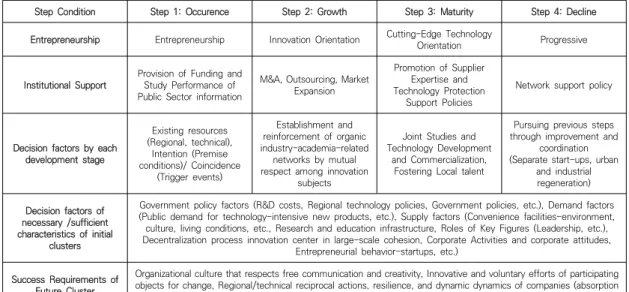
This study aims to propose an integrated framework to analyze emergence of future clusters that reflect current business and national economic environment based on important factors related to emergence of past clusters derived from previous studies(Table 2).

5. Conclusion

Clusters are essential strategies and policies to develop the local economy, but the studies related to them are very insufficient Hence, this study reviewed previous studies to analyze conditions associated with emergence of clusters, to derive important factors, and to present a framework that is helpful for analyzing clusters in the future.

The emergence of clusters is also achieved through a complex competitive process of technology and regional environments, i.e.

through mutual co-evolution, so it would be necessary for future cluster analyses to have complex and adaptive thinking and approaches.

In addition, it would be very important to secure

cluster's resilience with regard to cluster studies and policy measures.

This study was an attempt to identify conditions for emergence and reasons in cluster studies, and in order to achieve these, an academic significance of this study promoted continuation and expansion of future studies by proposing an integrated framework. However, this study did not consider all variables in various dimensions and environments and did not perform empirical verification so that there is a limitation that there are many difficulties in generalizing.

The Korean government said industrial clusters

will be formed by attracting companies to

innovative cities in the provinces created by

relocations of public institutions to industrial

clusters, but sunk costs make it difficult to

relocate them. Therefore, it is necessary to

identify characteristics of companies already

entered in the innovative cities, support

industries that can be started separately and

promote urban regeneration and industrial

complexes regeneration. In addition, the same

national policy cannot properly reflect regional

(8)

characteristics, so insufficient effects are inevitable. Therefore, policies and supports that can properly identify and reflect regional characteristics can contribute to cluster's evolution and survival, the regional economy and by extension the national economy.

REFERENCES

[1] Lee, Y. K. & Hyun, B. H. (2018). A Study on the Impact of Innovation Cluster Activity on Enterprise Performance-Focused on Daejeon. Journal of Digital Convergence, 16(10), 155-167.

[2] Park, S. T., Kim, D. Y. & Li, G. (2020). An analysis of environmental big data through the establishment of emotional classification system model based on machine learning: focus on multimedia contents for portal applications. Multimedia Tools and Applications, 1-19.

[3] Park, S. T., Li, G. & Hong, J. C. (2020). A study on smart factory-based ambient intelligence context-aware intrusion detection system using machine learning. Journal of Ambient Intelligence and Humanized Computing, 11(4), 1405-1412.

[4] Park, S. T., Jung, J. R. & Liu, C. (2019). A study on policy measure for knowledge-based management in ICT companies: focused on appropriability mechanisms.

Information Technology and Management, 1-13.

[5] Hong, J. U., Yoon, B. S. & Seo, Y. T. (2020). The Formation of Clusters in Free Economic Zones and the Analysis of the Management Performance of the Companies in Free Economic Zones : The Role of Central and Local Governments. The Journal of Business Education, 34(1), 149-178.

[6] Cho, E. S. (2018). Policy Consistency Assessment of Regional Industrial Policy and Cluster Development Policy. The Journal of Korean Policy Studies, 18(2), 127-152.

[7] Porter, M. E. (1998). Clusters and the new economics of competition (Vol. 76, No. 6, pp. 77-90). Boston:

Harvard Business Review.

[8] Storper, M. (1995). Competitiveness policy options:

the technology‐regions connection. Growth and Change, 26(2), 285-308.

[9] Porter, M. E. (1990). The competitive advantage of nations. Harvard business review, 68(2), 73-93.

[10] Porter, M. E. (2008). On competition. Harvard Business Press.

[11] Van Klink, A. & De Langen, P. (2001). Cycles in industrial clusters: the case of the shipbuilding industry in the Northern Netherlands. Tijdschrift voor economische en sociale geografie, 92(4), 449-463.

[12] Han, S. L. & Yu, P. J. (2008). The Development and Collective Strategies of innovative Cluster: The Case of Wonju Medical Instrument Cluster. Journal of Governmental Studies, 14(2), 73-102.

[13] Menzel, M. P. & Fornahl, D. (2010). Cluster life cycles

—dimensions and rationales of cluster evolution.

Industrial and corporate change, 19(1), 205-238.

[14] Martin, R. & Sunley, P. (2011). Conceptualizing cluster evolution: beyond the life cycle model?. Regional studies, 45(10), 1299-1318.

[15] Brenner, T. & Schlump, C. (2011). Policy measures and their effects in the different phases of the cluster life cycle. Regional Studies, 45(10), 1363-1386.

박 은 미(Park, Eun Mi) [정회원]

․ 2018년 2월 : 경북대학교 경영학부 (경영학석사)

․ 2018년 3월 ~ 현재 : 경북대학교 경영 학부 박사과정

․ 관심분야 : 경영전략, 인사조직, 기술혁 신, 혁신, 빅데이터 등

․ E-Mail : [email protected]

서 정 해(Seo, Joung Hae) [정회원]

․ 1983년 8월 : 경북대학교 경영학과(경 영학사)

․ 1989년 3월 : 일본 히토츠바시대학 상 학연구과(석사)

․ 1992년 3월 : 일본 히토츠바시대학 상 학연구과(박사)

․ 1998년 3월 ~ 현재 : 경북대학교 경영 학부 교수

․ 관심분야 : 경영전략, 인사조직, 기술혁신 등

․ E-Mail : [email protected]

수치

Table  1.  A  cluster  life-cycle
Fig.  1.  Knowledge-based  cluster  life  cycle
Table  2.  Integrated  Framework  for  Analyzing  Emergency  of  Clusters

참조

관련 문서

In addition, the thermal flow analysis and imaging ultrasonic thermography detection method are comparatively analyzed to improve the detection reliability for

A A A A Study Study Study Study Analysis Analysis Analysis Analysis of of of of the the the the J. Bach, a representative composer in Baroque period. Composed

Also, for verifying the study hypothesis, unitary multi-variant analysis, correlation analysis and structural equation model analysis were carried out. The

For establishing appropriate treatment plans and prognosis, the estimated value of the correlation between the change in hard and soft tissues is required,

Krough-Poul sen 5) reported that occl usalcontact was resul ted from afferent i mpul seoftheperi odontall i gamentandotherorofaci almuscl eacti vi ty andthe

period was prolonged unavoidably, (3) by explaining the risk factors associated with the failure to patients honestly, and subsequently performing

The resolved-rate control method [9] is based on the manipulator velocity equation kX = kje where kj is the Jacobian matrix, e is the vector of relative joint rates, kX is the

The correct typing results for the DNA samples are listed in Table 1 for all STR loci in the Powerplex 16 multiplexes.(Table 1.) The multiplex typing results based on the