상백피 추출물의 항산화 활성 및 미백효과
지선옥*
중부대학교 화장품과학과
Antioxidant Activities and Whitening Effect of the Mulberry (Morus alba L.) Root Bark Extracts
Sun-Ok Jee*
Department of Cosmetic Science, Joongbu University, 101 Daehack-ro, Chubu-Myeon, Kumsan-Gun, Chungnam 312-702, Korea
Abstract - This study was performed to investigate the antioxidant activities and the whitening effect of mulberry (Morus alba L.) root bark extracts. The antioxidant activities of water and 70% ethanol extracts of mulberry root bark were 65.8%
and 87.0% in the DPPH assay at 1,000 μg/ml ; 89.3% and 77.1% in the ABTS assay at 1,000 μg/ml. Xanthine oxidase inhibition of water and 70% ethanol extracts were 100% and 96.2% at 1,000 μg/ml. Nitric oxide radical inhibition of water and 70% ethanol extracts showed 43.5% and 53.0% at 500 μg/ml, and it was similar to the BHA effect(43.8%). Tyrosinase inhibitory activities of water and 70% ethanol extracts were 79.6% and 93.5% at 1,000 μg/ml. These results confirm that mulberry root bark has the great potential to be a cosmeceutical ingredient with a natural antioxidant and a skin-whitening effect.
Key words -Morus alba L. DPPH, ABTS, Nitric oxide, Xanthine oxidase, Tyrosinase
*
교신저자(E-mail) : [email protected]서 언
생체내에서 생성되는 다양한 활성산소(free radical oxygen)는 세포 생체막의 구성물질인 불포화지방산을 공 격하여 과산화반응을 일으켜 체내 과산화 지질을 축적함으 로써 생체기능이 저하되고 동시에 노화 및 성인병 질환을 유발하는 요인 (Halliwell et al.,1992; Reiter, 1995; Yang et al., 2006)으로 만성기관지염, 천식 등의 기관지 질환, 위궤양 등의 소화기 질환, 국소빈혈, 동맥경화, 고혈압 등 의 심장질환, 파킨슨씨병, 알츠하이머 병 등의 뇌 및 신경 질환, 아토피성 피부염 및 여러 가지 암 등의 질병을 일으 키는 것으로 알려져 있다(Peter, 1998; Li et al., 2000).
이러한 free radical을 제거하기 위해 지금까지 BHA 및 BHT 등의 합성 항산화제가 개발되어 식품, 화장품 등에 산 화방지제로 많이 사용되어 왔으나 안전성에 논란이 있어
허용대상 식품이나 사용량이 엄격히 규제되고 있으므로 (Choe and Yang, 1982) 보다 안전하고 강한 항산화제의 개발이 요구되고 있는 실정이다.
한편, Melanin은 생물체에 널리 분포되어 있는 색소로 인체에서는 표피층에 있는 melanocyte에서 합성된다. 이 러한 melanin의 생합성 과정에 작용하는 주요 효소가 tyrosinase이다. Tyrosinase는 polyphenol oxidase의 일 종이며 구리를 함유한 효소로써 색소 세포에서 tyrosine 을 L-3,4-dihydroxyphenylalanine (DOPA)으로 변환하 고 효소적 산화 반응에 의한 단계를 거쳐 dopaquinone, dopachrome으로 변환하여 melanin을 생합성 한다(Lerner and Fitzpatrick, 1950; Swan, 1974; Korner and Pawelek, 1982). 세포내 melanin이 과잉 생산되면 기미, 주근께, 점, 검버섯 등의 색소 침착이 일어나 피부노화 및 손상을 초래하므로 천연의 식물 추출물을 대상으로 미백 기능성 화장품에 이용 가능한 유효추출물을 찾아내는 것은 중요하 다. 따라서 최근에는 각종 천연소재에서 보다 안전한 항산
화제를 개발하여 이를 이용한 미백, 주름 및 자외선 차단 기능을 가진 기능성 화장품의 개발이 이루어지고 있다 (Jung et al., 2005).
상백피는 뽕나무과(Moraceae)에 속한 낙엽교목인 뽕나 무속 식물의 근피로, 예로부터 해열, 항경련, 항알러지, 항 염증작용과 더불어 이뇨촉진 등의 효과가 있는 것으로 알 려져 왔다(Kim et al., 1995). 상백피로부터 혈당강하 물 질인 moran A가 보고(Hikino et al., 1985)된 이래 상백 피의 혈당강하 작용(Kim et al., 1999; Yoon et al., 2001), 간보호 작용(Kim et al., 1999), 및 항암작용(Park et al., 1998) 등이 있음이 보고 되었고, Yoon 등(1998)은 capsaicin에 의한 신경성 염증반응을 상백피가 억제한다고 하였다. 또한 상백피에 rutin과 같은 oxyresveratrol 이 있어 기능성 화장품의 원료로 사용 가능하다(Ikeda and Tsutsumi, 1990)고 알려지면서 상백피의 tyrosinase 활 성 저해 효과(Jung et al., 1995), 항균 및 여드름 균억제 효과(Park et al., 1995; Yoo et al., 2003), 탈모증에 대 한 모발 성장효과(Lee et al., 2000)가 있음이 검증되었으 며, 이외에도 꾸지뽕나무(Cudrania tricuspidata)의 잎, 열매, 줄기 및 뿌리의 과산화 지질 함량(Park et al., 1995) 과 여러 종의 뽕잎(Morus alba L.) 추출물에 대한 항산화 효과(Cho et al., 2006)에 대한 보고 등 다양한 식 물자원으로서 이용가치가 있는 것으로 밝혀지고 있다.
이에 본 연구에서는 상백피의 열수 및 알코올 추출물을 사용하여 화장품 약리활성인 항산화 활성을 다양한 방법으 로 검증하여 천연 항산화제로서의 효과와 tyrosinase 저해 활성 측정을 통한 미백효과를 동시에 검토하여 기능성화장 품 등의 산업적 응용 가능성을 확인하기 위하여 수행하였다.
재료 및 방법
공시재료
본 실험에 사용한 상백피는 금산의 약제 시장에 있는 동 진제약에서 구입하여 사용하였으며, 열수추출은 시료에 10 배 양의 증류수를 가하여 85℃에서 3시간 환류냉각 추출하 여 상등액과 침전물을 분리하여 3회 반복 추출하였다. 에 탄올추출은 시료에 70% 에탄올 10배의 양을 가하여 실온 에서 24시간 침지하여 상등액과 침전물을 분리하여 동일한 방법으로 3회 반복 추출하였다. 각 추출물을 원심분리 및 여과, 농축하여 동결 건조 후 냉장실에 보관하면서 본 실험
의 시료로 사용하였다.
사용시약 및 기기
실험에 사용된 시약은 1.1-diphenyl-2-picrylhydrazyl (DPPH, Sigma chemical Co., USA), Butylated hydrox- yanisole (BHA), 2,2'-Azino-bis(3-ethylbenzothiazoline -6-sulfonic acid) (ABTS), Sodium nitrite, Griess reagent, Xanthine, Xanthine Oxidase, Pyrogallol, Mushroom tyrosinase, L-3,4-dihydroxyphenyl-alanine (L-DOPA)을 구입하여 사용하였으며, 그 외의 기타 시약 은 특급시약을 사용하였다.
실험에 사용된 기기는 UV/vis spectrophotometer (Hitachi 200-10, Japan), ELISA reader, Centrifuge, 회전농축기, 냉동건조기 등을 사용하여 측정하였다.
전자공여능 측정
전자공여능(EDA: electron donating abilities)은 Blois (1958)의 방법을 따라 측정하였다. 각 시료 용액 100 ㎕에 0.2 mM의 DPPH용액을 50 ㎕를 넣고 교반한 후 실온에서 차광한 상태로 30분간 방치한 다음 517 nm에서 흡광도를 측정하였다. 전자공여능은 시료용액의 첨가구와 무첨가구 의 흡광도 감소율로 나타내었다.
전자공여능(%)=(1- 시료첨가구 흡광도/무첨가구 흡광도)
×100
ABTS radical caution decolorization의 측정 ABTS radical caution decolorization의 측정은 Re 등 (1999)의 방법에 의해 측정하였다. 7 mM ABTS와 2.4 mM K2S2O2를 썩어 어두운 곳에 12시간 방치시킨 후, 이 용액 5.6 ml와 absolute alcohol 60 ml를 섞어 734 nm에 서 대조구의 흡광도 값이 0.706± 0.001 이 되도록 조절한 ABTS solution을 사용하였다. 시료용액 100 ㎕와 ABTS solution 100 ㎕를 혼합하여 7분간 실온에서 차광한 상태 로 반응시키고 734 nm에서 흡광도를 측정하여 아래의 식 에 의해 라디칼 소거활성을 계산하였다.
Radical scavenging activity(%)=(1- 시료첨가구 흡광도/
무첨가구 흡광도)×100
Xanthine oxide 저해활성 측정
Xanthine oxide 저해활성은 Stirpe와 Corte(1969)의
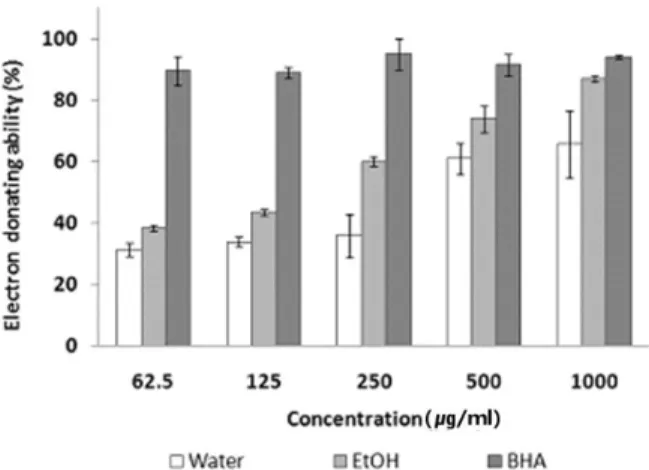
Fig. 1. Electron donating ability of M. alba L. root bark extracts. Results are means ± S.D of triplicate data.
방법을 변형하여 측정하였다. 각 시료용액에 0.1 M potassium phosphate buffer (pH 7.5) 0.6 ml를 넣은 후, 여기에 xanthine oxide (0.2 unit/ml) 100 ㎕와 1 mM 의 xanthine 기질 200 ㎕을 첨가하여 37℃에서 15분간 반응 시켰다. 반응물에 1 N HCl 1 ml 를 가하여 반응을 종료시 킨 다음 반응액 중에 생성된 uric acid를 292 nm에서 흡광 도를 측정하였다. Xanthine oxide 저해활성은 시료용액의 첨가구와 무첨가구의 흡광도 감소율로 나타내었다.
저해율(%)=(1- 반응구의 uric acid 생성량/대조구의 uric acid 생성량)×100
Nitric oxide radical 소거능 측정
Nitric oxide radical 소거능은 Marcocci 등(1994)의 방법으로 측정하였다. 10 mM Sodium nitroprusside solution에 20 mM phosphate buffer (pH 7.4)에 녹인 각 시료를 넣고 25℃에서 150분간 반응시켰다. 이 반응액 에 griess reagent를 넣고 542 nm에서 흡광도를 측정하 여 nitrite 저해활성을 확인하였다. 저해활성은 시료용액 의 첨가구와 무첨가구의 흡광도 감소율로 나타내었다.
소거능(%)=(1-시료첨가구 흡광도/무첨가구 흡광도)×100
Tyrosinase 저해활성 측정
Tyrosinase 저해활성은 DOPA oxidase의 방법을 변형 하여 측정하였다. 37℃ 수조에서 온도를 미리 조정한 67 mM sodium phosphate buffer (pH 6.8) 80 ㎕, 25 mM L-DOPA 40 ㎕ 및 추출시료 용액 40 ㎕의 혼합용액에 mushroom tyrosinase (125unit/ml)용액 40 ㎕를 첨가 하여 37℃에서 30분간 반응시켜 반응액 중에 생성된 DOPA chrome을 ELISA reader를 이용하여 492 nm에서 흡광도를 측정하였다(Jin et al., 2005). Tyrosinase 저해 활성은 시료용액의 첨가구와 무첨가구의 흡광도 감소율로 나타내었다.
저해활성(%)=(1-시료첨가군 흡광도/무첨가구 흡광도)×100
결과 및 고찰
전자공여능
상백피 추출물을 62.5, 125, 250, 500 및 1,000 μg/ml 농도로 처리하였을때 DPPH 라디칼 소거능 활성은 시료의 농도에 의존적으로 활성이 증가되었으며, 1,000 μg/ml에
서 열수추출물은 65.8%, 에탄올추출물은 87.0%의 DPPH radical 소거능을 나타내어 에탄올 추출물의 DPPH radical 소거능이 열수추출물의 전자공여능 보다 높았는데 이는 대조구인 BHA(94%)의 DPPH radical 소거능과 유사 하였다(Fig. 1).
Kang 등(1995)은 전자공여능이 phenolic acid와 flavonoids 및 기타 phenol성 물질에 대한 항산화의 지표 라 하였으며 환원력이 큰 물질일수록 전자공여능이 높다고 하였다. 특히 DPPH 라디칼 소거법은 항산화 물질의 전자 공여능으로 인해 방향족 화합물 및 방향족 아민류에 의해 환원되어 자색이 탈색에 의해 나타내는 정도를 지표로 하 여 항산화능을 측정하는 방법이다(Choi et al., 2003).
Kim 등(1995)은 목단, 황금, 산수유, 작약 추출물 100 μg/ml 에서 각각 65.0%, 57.1%, 45.8%, 36.7% 로 나타났다고 했고, Kim 등(2001)은 하수오, 오미자, 행인 등의 DPPH radical 소거능이 50% 이상이었으며, 에탄올 추출물이 열 수 추출물보다 전자 공여능이 높다고 했는데 이와 비교해 볼 때 본 실험에 사용한 상백피의 전자공여능이 우수하여 항산화능이 높은 것으로 사료된다.
ABTS radical caution decolorization
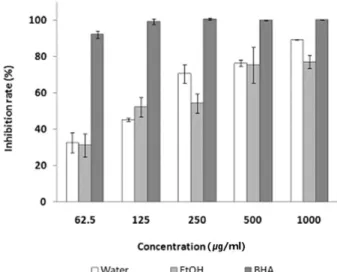
ABTS 라디칼 소거능 활성에서도 DPPH 라디칼 소거능 에서처럼 시료 농도에 의존적으로 활성이 증대되었으며, ABTS radical 소거능 활성은 500 μg/ml에서 열수추출물 과 에탄올추출물이 76.5%, 75.5%로 비슷하였으나, 1,000 μg/ml에서는 89.3%, 77.1%로 각각 나타나 열수추출물이 에탄올추출물에 비해 다소 높은 ABTS 라디칼 소거능 활성 을 보였다(Fig. 2).
Fig. 2. ABTS radical caution decolorization of M. alba L. root bark extracts. Results are means ± S.D of triplicate data.
Fig. 3. Xanthine oxidase inhibition of M. alba L. root bark extracts. Results are means ± S.D of triplicate data.
Fig. 4. Nitric oxide scavenging ability of M. alba L. root bark extracts. Results are means ± S.D of triplicate data.
Cho 등(2008)은 쇠비름(Portulaca oleracea)의 ABTS 라디칼 소거능이 물추출물보다 에탄올추출물에서 높은 억 제효과를 나타내었으며, 시료농도 50,000 μg/ml에서 80%
에탄올 추출물이 96.5%의 라디칼 소거능을 보였다고 했는 데 이는 본 실험에 사용한 시료농도 보다 훨씬 높은 농도를 사용하였고, 추출물의 용매에 따른 차이는 다소 보였지만 ABTS 라디칼 소거능은 유사하였다.
Xanthine oxide 저해활성
항산화능을 측정하는 방법의 하나로써 xanthine oxide 저해활성을 수행하였다(Fig. 3). 상백피의 열수추출물과 에탄올추출물 모두 농도 의존적으로 xanthine oxide의 저 해활성이 증가하였는데, 시료농도 500 μg/ml에서 열수추 출물이 40.4%, 에탄올추출물이 62.8%의 저해활성을 보였 으나, 1,000 μg/ml에서는 열수추출물이 100%, 에탄올추 출물이 96.2%를 나타내어 높은 항산화능을 보였다.
Xanthine oxide는 xanthine을 기질로 하여 uric acid 를 생성하는 과정에서 superoxide radical을 생성하고 (Ziegler et al., 1971; Duke et al., 1973), 생체내 퓨린대 사에 관여하는 효소로 xanthine 또는 hypoxanthine으로 부터 요소를 형성하며 요소가 혈장 내에 증가되면 골절에 축적되므로 통증을 동반할 뿐 만 아니라, 신장에 침착되어 신장질환을 일으키기도 한다(Wyngaarden and Holmes, 1977; Hatano et al., 1989; Yoon et al., 2001). Cho 등 (2006)은 여러 종의 뽕잎(Morus alba L.) 추출물을 열수 추출시 5,000 μg/ml, 에탄올추출시 10,000 μg/ml를 처 리 했을 때 50% 이상의 xanthine oxide 저해활성을 보였다 고 했는데 본 실험에 사용한 뽕나무 근피인 상백피가 뽕잎에 비해 xanthine oxide 저해활성이 더 높은 것으로 나타났다.
Nitric oxide radical 소거능
활성산소의 하나인 nitric oxide(NO) 소거능을 측정한 결과는 Fig. 4와 같다. NO 소거능은 시료농도 500 μg/ml 에서 열수 추출물은 43.5%, 에탄올 추출물은 53.0%를 나 타내었는데 이는 같은 농도에서 대조구인 BHA의 43.8%와 유사하였다.
Nitric oxide는 생체내에서 NO synthase(NOS)라는 효 소의 촉매작용을 통해 L-arginine으로부터 생성되는 반응 성이 강한 자유라디칼이며, 생리적인 현상과 신경전달 매 개체로 작용하고, 면역반응에 중추적인 역할을 하고 있다
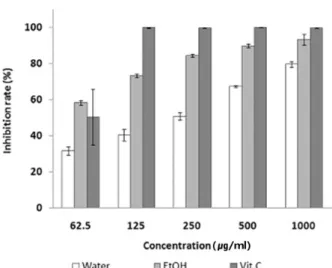
Fig. 5. Tyrosinase inhibition of M. alba L. root bark extracts.
Results are means ± S.D of triplicate data.
(Ding et al., 1988). 그러나 최근에 과량의 NO 생성이 염 증반응을 일으키고, 조직의 파괴 및 면역체계의 이상을 일 으킨다고 보고 되었다(Liang et al., 1999). Jang 등 (2008)은 리기다소나무 수피추출물 50 μg/ml에서 ethyl acetate 추출물은 48.8%, 열수추출물은 46.6%의 NO 소 거능을 보였다고 했으며, Min 등(2003)은 포도추출물 50 μg/ml에서 NO 생성을 50% 정도 저해하였다고 했는데 이 는 본 실험의 결과와 유사하였다.
Tyrosinase 저해활성
상백피로부터 tyrosinase 활성 억제효과를 검토하여 미 백 기능성 화장품 소재로 활용하기 위해 실험한 결과는 Fig. 5와 같다.
시료농도 1,000 μg/ml에서 열수추출물은 79.6%, 에탄 올추출물은 93.3%의 저해활성을 나타내었는데, 이는 대조 구인 비타민 C와 유사하였으며, 에탄올추출물이 열수추출 물에 비해 tyrosinase 저해활성이 높았다. Jung 등(1995) 은 계피, 상백피, 갈근 추출물이 20,000 μg/ml 첨가 되었 을 때 각각 81%, 63%, 59% 등의 tyrosinase 저해활성을 나타냈다고 했는데, 이 결과와 비교해 볼 때 본 실험에서 보다 낮은 시료농도에서 tyrosinase 저해 활성이 훨씬 더 높게 나타났다.
이상의 결과에서 상백피 추출물은 항산화 활성과 미백효 과가 우수하여 기능성 화장품의 천연 소재로 활용 가능성 이 높은 것으로 판단되어, 현재 에탄올추출물로 화장품 로 션에 대한 안정성 및 피부감각에 대한 안전성 등의 연구가
진행되고 있으며, 향후 국내 자생식물인 상백피를 이용한 다양한 기능성화장품 개발이 가능할 것으로 사료된다.
적 요
본 연구는 상백피 추출물의 화장품 약리활성인 항산화 활성과 미백 효과를 탐색하기 위해 열수추출물과 에탄올추 출물을 사용하여 전자공여능, ABTS, xanthine oxidase 저해활성, nitric oxide radical 소거능 및 tyrosinase 저 해 활성을 측정하였다.
상백피 추출물의 전자공여능 측정결과 1,000 μg/ml에서 열수추출물은 65.8%, 에탄올추출물은 87%의 DPPH radical 소거능을 보였다. ABTS 라디칼 소거능은 1,000 μg/ml에서 열 수추출물은 89.3%, 에탄올추출물은 77.1%로 높은 소거능 을 보였다. Xanthine oxide 저해활성은 1,000 μg/ml에서 열수추출물은 100%, 에탄올추출물은 96.2%를 보여 높은 항산화 효과를 나타내었다. NO 소거능은 500 μg/ml에서 열수추출물은 43.5%, 에탄올추출물은 53%를 나타내었는 데 이는 같은 농도에서 대조구인 BHA의 43.8%와 유사하 였다. Tyrosinase 저해활성은 1,000 μg/ml에서 열수추출 물은 79.6%, 에탄올추출물은 93.5%로 나타나 대조구인 비 타민 C와 유사한 활성을 보여 미백효과가 우수하였다. 모 든 실험에서 활성정도가 시료 농도가 증가함에 따라 유의 적으로 증가하는 경향이었으며, ABTS 저해활성을 제외하 고 대부분의 실험에서 에탄올추출물이 열수추출물에 비해 다소 높은 활성을 보였다.
인용문헌
Blois, M. S. 1958. Antioxidant determination by the use of a stable free radical. Nature 181:1199-1200.
Cho, Y.J., I.S. Ju, O.J. Kwon, S.S. Chun, B.J. An and J.H. Kim.
2008. Biological and antimicrobial activity of Portulaca oleracea. J. Korean Soc. Appl. biol. Chem. 51:49-54.
Cho, Y.J., S.S. Chun, H.J. Kwon, J.H. Kim, K.H. Lee, B.J. An and J.W. Choo. 2006. Inhibitory effects of water and 80%
Ethanol extracts from Mulberry leaves(Morus alba L.) on angiotensin converting enzyme and xanthine oxidase. J.
Korean Soc. Appl. Biol. Chem. 49:114-124.
Choe, S.Y. and K.H. Yang. 1982. Toxicological studies of antioxidants, butylated hydroxytoluene(BHT) and butylated
hydroxyanisole(BHA). Korean J. Hood Sci. Technol.
12:283-288.
Choi, C.H., E.S. Song, J.S. Kim and M.H. Kang. 2003.
Antioxidative activities of Castanea crenata Flos. methanol extracts. Korean J. Food Sci. Technol. 35:1216-1220.
Ding, A.H., C.F. Nathan and D.J. Stuhr. 1988. Release of reactive nitrogen intermediates and active oxygen intermediates from mouse peritoneal macrophages. J. Imuno. 141:2407-2412.
Duke, E.J., P. Joyce and J.P. Ryan. 1973. Characterization of alternative molecular forms of xanthine oxidase in the mouse. Eur. J. Biochem. 187:131-140.
Halliwell, B., J.M.C. Gutteridge and C.E. Cross. 1992. Free radicals, antioxidants and human disease. J. Lab. Clin. Med.
119:598-620.
Hatano, T., T. Tasuhara, T. Fukuda, T. Noro and T. Okuda.
1989. Phenolic constituents of licoricell. Structures of licopyranocoumarin, licoarylcoumarin and glisoflavone, and inhibitory effects of licorice phenolics on xanthine oxidase.
Chemical & Pamaceutical Bulletin 37:3005-3009.
Hikino, H., Y. Mizuno, T. Oshima and C. Konno. 1985.
Isolation and hypoglycemic activity of Moran A, a glycoprotein of Morus alba root barks. Plant Medica. 51:159-163.
Ikeda, T. and T. Tsutsumi. 1990. Function and skin depimental activity of crude drugs. Fragrance Journal 6:59-62.
Jang, M.J., B.J. An, C.E. Lee, J.T. Lee, B.G. Lee and D.H. Lee.
2008. Study on the anti-oxidant effect of Pinus rigida Mill.
inner bark extract. Jour. Korean For. Soc. 97:88-94.
Jin, Y.Z., S.Y. Ahn, S.S. Hong, G.H. Li, E.K. Kim and K.H.
Row. 2005. Extraction of whitening agents from natural plants and whitening effect. Korean Ind. Eng. Chem. 16:348-353.
Jung, S.H., W.A. Jo, J.H. Son, E.Y. Choi, C.I. Park, I.C. Lee, B.J. An, A.R. Son, S.K. Kim, Y.S. Kim and J.T. Lee. 2005. A study on the application of cosmetic materials and the physiological activities of Forsythia koreana Nakai. Kor. J.
Herbology 20:61-68.
Jung, S.W., N.K. Lee, S.J. Kim and D. Han. 1995. Screening of tyrosinase inhibitor from plants. Korean J. Food Sci.
Technol. 27:891-896.
Kang Y.H., Y.K. Park, S.R. Oh and K.D. Moon. 1995. Studies on the physiological functionality of ine needle and mugwort extracts. Korean J. Food Sci. Technol. 27:978-984.
Kim, A.K., H. Ha and S.H. Yoon. 1995. Liver protective effects of Mori Radicis Cortex in isolated hepatocytes. J. Korea Soc.
Hygienic Sciences 1:16-20.
Kim, H.K., Y.E. Kim, J.R. Do, Y.C. Lee and B.Y. Lee. 1995.
Antioxidative activity and physiological activity of some Korean medical plants. Korean J. Food Sci. Technol. 27:80-85.
Kim, S.M., Y.S. Cho and S.K. Sung. 2001. The antioxidant ability and nitrite scavenging ability of plant extracts.
Korean J. Food Sci. Technol. 33:626-632.
Kim, Y.Y., R.W. Choue, S.Y. Chung and S.J. Koo. 1999.
Anti-hyperglycemic effect of Cortex Mori radics in db/db mice. Korean J. Food Sci. Technol. 31:1057-1064.
Korner, A. and J. Pawelek. 1982. Mammalian tyrosinase catalyzes three reaction in the biosynthesis of melanin. Science 217:1163-1165.
Lee, H.S., S.J. Yun, Y.K. Moon and J.Y. Moon. 2000. Hair growth effects of Mori Cortex Radicis mixture on the hair of rat. Korean J. Seric. Sci. 42:83-86.
Lerner, A.B. and T.B. Fitzpatrick. 1950. Biochemistry of melanin formation. Physiological reviews 30:91-126.
Li, H.C., S. Yashiki, J. Sonda, H. Lou, S.K. Gosh, J.J. Byrnes and C. Lema, T. Fujiyoshi, M. Karasuyama and S. Sonoda.
2000. Green tea polyphenols induce apoptosis in vitro in peripheral blood T lymphocytes of adult T-cell leukemia patients. Jpn. J. Cancer Res. 91:34-40.
Liang, Y.C., Y.T. Huang, S.H. Tsai, S.Y. Lin-shiau, C.F. Chen and J.K. Lin. 1999. Suppression of inducible cyclooxygenase and inducible nitric oxide synthase by apigenin and relted flavonoids in mouse macrophase. Carcinogenesis 20:1945- 1952.
Marcocci, L., J.J. Maguire, M.T. Droylefaix and L. Packer.
1994. The nitric oxide scavenging properties of Ginkgo biloba extract EGb 761. Biochem Biophys Res Commun.
201:748-755.
Min, H.Y., E.J. Park, S.K. Lee and Y.J. Cho. 2003. Effects of grape extraction free radical scaverging activity and inhibition of pro-inflammatory mediator production in mouse macrophage cells. Korean J. food Sci. Technol. 35:132-137.
Park, I.K. , J.O. Lee, H.S. Lee, K.Y. Seol and Y.J. Ahn. 1998.
Cytotoxic activity of Bombyx mori and Morus alba derived materials against human tumor cell lines. J. Korean Soc.
Appl. Biol. Chem. 41:187-190.
Park, J.C., J.S. Choi and J.W. Choi. 1995. Effects of the fractions from the leaves, fruits, stems and roots of Cudrania tricuspidata and flavonoids on lipid peroxidation. Kor. J.
Pharmacogn. 26:377-384.
Park, U.Y., S.H. Kim, J.H. Kim, Y.G. Kim, and D.S. Chang.
1995. Purification of antimicrobial substance for the extract from the root bark of Morus alba. J. Fd Hyg-Safety 10:225-230.
Peter, T.P. 1998. The skin’s antioxidant systems. Dermatol.
Nurs. 10:401-406.
Re, R., N. Pellegrin, R. A. Proteggente, A. Pannala, M. Yang and R.E. Catherine. 1999. Antioxidant activities applying an approved ABTS radical caution decolorization assay. Free radical Biology & Medicine 26:1231-1237.
Reiter, R.J. 1995. Oxidative process and antioxidative defense mechanism in the aging brain. FASEB J. 9:526-533.
Stirpe, F. and E.D. Corte. 1969. The regulation of rat liver xanthine oxidase. J Biochem. 244:3855-3861.
Swan, G.A. 1974. Structure, chemistry, and biosynthesis of the melanins. Fortschritte Chemie. Organischer Naturstoffe 31:521-582.
Wyngaarden, J.B. and E.W. Jr. Holmes. 1977. Molecular nature of enzyme regulation in purine biosynthesis. Ciba Foundation Symposium 48:43-64.
Yang, J.H., D.K. Kim, M.Y. Yun and J.K. An. 2006.
Antioxidative activity and therapeutic effect of the hydrogel
preparations of Scutellariae Radix and Zingiberis Rhizoma on dermatitis. J. Kor. Pharm. Sci. 36:253-262.
Yoo J.Y. S.H. Park, I.A. Hwang, S.J. Jo, C.H. Huh, S.W. Youn and K.C. Park. 2003. A clinical study on the effect of a cream cotaining Ramulus Mori extract and tea tree oil on Acne Vulgaris and aerobic skin flora. Korean J. Dermatol.
41:1136-1141.
Yoon, C.Y. , D.H. Shin, C.M. Hong, W.K. Lee, D.D. Jang, J.C.
Cho and J.K. Ahn. 1998. The suppressive effects of Cortex mori on No, TNF-α and IL-1 production by macrophage.
Kor. J. Vet. Publ. Hlth. 22:281-292.
Yoon, S.H., S.Y. Jung and H. Ha. 2001. Hypoglycemic and enzyme effects of the water extract of Mori Rodicis Cortex in streptozotocin-induced diabetic rats. J. Korean Soc. Hygienic Sciences 7:119-123.
Ziegler, D. W., H.D. Hutchison and R.E. Kissing. 1971. Induction of xanthine oxidase by virus infections in newborn mice.
Infect. and Immun. 3:237.
(접수일 2009.2.9; 수락일 2009.3.14)