September 2014 | Vol. 42 | No. 3 Korean J. Microbiol. Biotechnol. (2014), 42(3), 293–296
http://dx.doi.org/10.4014/kjmb.1407.07004 pISSN 1598-642X eISSN 2234-7305
Korean Journal of Microbiology and Biotechnology
극지 미생물들의 배양온도에 따른 성장률 및 protease activity 영향 연구
김현도, 최종일*
전남대학교생물공학과
Received: July 10, 2014 / Revised: August 5, 2014 / Accepted: August 6, 2014
산업적인효소의생산은새로운다양한효소들과더욱활 성이좋은효소들의발견에의하여급격히증가하였다[5]. 최 근에는저온활성효소의발견및새로운효소개발이이루 어지면서극지방에서유래한효소의연구가활발히진행되 고있다[1, 11, 16].
극지환경과같은특수한환경에서생장하는많은미생물 들은다양한효소를생산하는것으로알려져있다. 극지미생 물들은낮은온도에서도생장이가능하며, 저온에서활성을 갖는효소를생산하기때문에활용공정의생산비용에절감 을가져옴에따라식품, 섬유산업및의약품산업등에이용 가치가클것으로예상된다. 또한, 저온활성효소는저온및 중온에서높은활성을가지며온도를높이면쉽게반응을중 지시킬수있다. 이러한속성은여러분야에서매우유용하 게사용될수있으며획기적인것이다[9].
Protease는 peptide bond의가수분해에촉매작용을하는 효소로써미생물에서부터동·식물에이르기까지모든환경
에널리분포되어있는효소이다. 3000종이넘는효소들가
운데약 60%의산업효소시장을차지하고있는 protease는 넓은범위의산업적프로세스에의응용에중심적인역할을 하고있으며, 그범위는제빵공업, 화학공업, 제지공업, 주류 의혼탁방지, 세제산업, 소화제, 가죽가공, 환경정화, 의약품 산업등에이르기까지다양하다[5-7, 10]. 현재미생물로부터 생산되어산업적으로 이용되고있는 protease는 alkaline, neutral protease가대부분이며작용 pH에따라분류한것 이다[4, 8]. 저온활성 protease는세제첨가물에사용하여세 탁수의온도를감소시킴으로써효과는동일하지만이전보다 에너지소비에따른비용을절감시킬수있으며, 유제품가 공및치즈숙성과같은식품산업에서맛의개선및비용의 절감을가져올수있다[2, 9, 11, 17].
본논문에서는저온활성효소들중에현재산업적으로가
장넓은범위에이용되고있는 protease에관하여관심을가
지고연구를진행하였으며, 극지방에서채취된미생물들가 Effect of Temperature on Growth Rate and Protease Activity of Antarctic Microorganisms
Hyun-do Kim and Jong-il Choi*
Department of Biotechnology and Bioengineering, Chonnam National University, Gwangju 500-757, Republic of Korea This study was conducted to investigate the effect of culture temperature on the growth rate and protease activity of Antarctic microorganisms. The Antarctic microorganisms PAMC 25641, 25614, 25719 and 25617 were obtained from the Polar and Alpine Microbial Collection (PAMC) at the Korea Polar Research Institute. These microorganisms were confirmed for the excre- tion of protease on a plate with skim milk. The identification of microorganisms was carried out using the 16S rDNA sequencing method. PAMC 25641 showed the highest protease activity among the subjects tested, and PAMC 25617 exhibited the highest growth rate. The growth rates of the microorganisms were not affected by temperature, except for PAMC 25617. However, pro- tease activities were increased for all strains in a temperature dependent fashion. These results suggest the possible applica- tion of Antarctic microorganisms for the efficient production of low temperature proteases.
Keywords: Protease, growth rate, Antarctic microorganisms, culture temperature
*Corresponding author
Tel: +82-62-530-1846, Fax: +82-62-530-1949 E-mail: [email protected]
© 2014, The Korean Society for Microbiology and Biotechnology
294
Kim and Choihttp://dx.doi.org/10.4014/kjmb.1407.07004
운데 protease 생산력이 우수한 미생물을 확인하고 여러
protease 이용산업에활용가능성을알아보고자그들이생
산하는 protease의기초적인온도조건에관한실험에서얻
은결과들을보고하고자작성되었다. 미생물 및 배양 배지
실험에서사용된 PAMC 25641, 25614, 25719, 25617의 미생물들은 극지연구소(Korea Polar Research Institute, Incheon, South Korea)로부터분양받았다. 이들 미생물은 PAMC 등록정보에 protease 활성을갖는것으로확인이되 어있다. PAMC 25641, 25614는 Nutrient agar (Becton, Dickinson and Company, USA), Nutrient broth (Becton) 을사용하였고, PAMC 25719는 R2A 배지를이용하였다. 또 한, PAMC 25617은 YM 배지를사용하였다.
미생물 동정
각각의 미생물들은 universal primer인 27F (5'-AGA GTT TGA TCM TGG CTC AG-3')과 1492R (5'-CGG TTA CCT TGT TAC GAC TT-3')를이용하여 16S rRNA 유전자 를 증폭하였다[13]. PCR 결과물은 QIAquick® PCR Purification Kit (Qiagen, Venlo, Netherlands)를이용하여 정제한 후 (주)마크로젠(Seoul, South Korea)에 의뢰하여 16S rDNA 염기서열을확인한후 NCBI blast를통하여동 정하였다.
배양 조건
각각의미생물들은전배양한천배지에접종하여 15oC에 서 7일간 배양하여 사용하였으며, 액체 배양은 50 ml씩 250 ml triangular flask에넣고멸균한후미생물을접종하 여각각 5, 10, 15, 20oC에서 150 rpm으로교반하여 4일간 배양하였다.
성장률 측정
각각의미생물들의성장률은 UV/Vis spectrophotometer (Mecasys Co., Seoul, South Korea)를사용하여 600 nm에 서흡광도를측정하였다. 배양액을 200µl 취하여멸균된각 각의액체배지 800µl에넣어 5배희석하여흡광도를측정 하였고, 멸균된각각의액체배지를 blank로사용하였다.
Protease 활성 측정
Protease 활성측정은배양액을 4oC에서원심분리(14,000 rpm, 10 min)한 후 상등액을 회수하여 50 mM sodium phosphate (Daejung Chemical & Metal Co., Sheung, South Korea) 200µl에배양상등액 100µl, 기질인 10 mM AAPF (Sigma-Aldrich, St. Louis, MO) 10µl, 증류수
690µl를혼합하여 25oC에서 10분간반응시킨후 60oC에서 20분간불활성하여 UV/Vis spectrophotometer를이용하여
410 nm에서흡광도를측정하였고, 기질대신증류수를첨가
한혼합액을 blank로사용하였다.
Protease의 unit은 extinction coefficient = 8,800으로하 여다음식에의하여계산하였다.
unit (µmole/min)/L =
배양및활성실험은 3차례반복하여평균값으로표시하 였다.
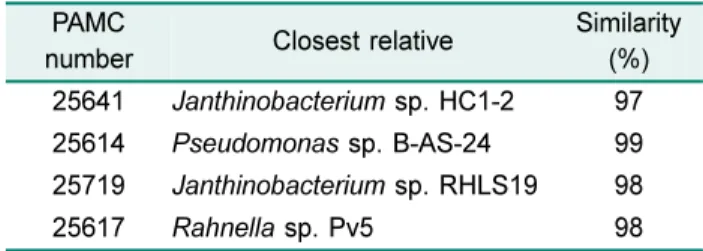
미생물 동정 결과
Protease 생산균주들의 16S rDNA 유전자정보의염기서
열을 확인한 후, NCBI blast를 통하여 동정해본 결과
PAMC 25641은 Janthinobacterium sp. HC1-2 (GenBank:
JF312914.1) 등과 97% 유사성을 보였다. PAMC 25614은 Pseudomonas sp. B-AS-24 (GenBank: JF901704.1) 등과 99%
의유사성보였다. 또한, PAMC 25719는 Janthinobacterium sp. RHLS19 (GenBank: JX949460.1)와 PAMC 25617은 Rahnella sp. Pv5 (GenBank: JQ522978.1)와각각 98%의 유사성을보였다. 정확히어떤특정종과의연관성은명확하 지않았다(Table 1).
성장률 확인
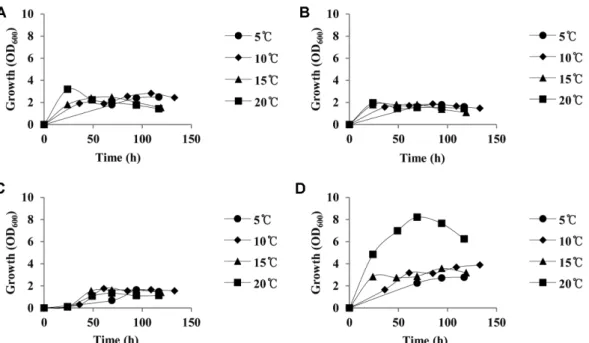
본연구에서는각미생물들의최적생장온도를확인하기 위하여다양한온도(5oC, 10oC, 15oC, 20oC)에서 4일간생장 을비교하였다. 다른균주들과다르게 PAMC 25617은다른 온도조건에서는평이한성장을보였으나, 20oC에서급격한 성장률증가및 maximum growth도크게높아진것을확인 할수있었다(Fig. 1).
위의미생물들은모두 5-20oC에서성장이가능하였으며, 대 부분 20oC에서가장잘성장하였다. 이러한결과를볼때본 연구에서사용된미생물들은모두내냉성(psychrotolerant)의
net OD410
( ) 반응액 부피 L×( , )×106 ε 반응시간 min×( , )×(반응에 사용된 배양액 L, ) ---
Table 1. Identification of strains obtained from PAMC 25641, 25614, 25719, 25617 by 16s rDNA sequencing.
PAMC
number Closest relative Similarity
(%) 25641 Janthinobacterium sp. HC1-2 97
25614 Pseudomonas sp. B-AS-24 99
25719 Janthinobacterium sp. RHLS19 98
25617 Rahnella sp. Pv5 98
Temperature Effect on Antarctic Microorganisms
295
September 2014 | Vol. 42 | No. 3
특성을지니고있는것을알수있다[3]. 이것은대부분의극
지미생물들이지닌특성으로극지의극한환경, 특히저온의 환경에서적응, 진화해온극지미생물들의고유한특징이다 [1, 11, 16]. 이전에발표된논문들에서도극지미생물들에대 한 growth temperature에대하여연구가많이보고되었다.
Janthinobacterium은 30oC의온도에서 maximum growth를 갖는것이확인되었으며, Pseudomonas 역시 30oC에서가장 잘성장하는것으로확인되었다. 또한, 두미생물은 5oC에서 도성장이가능한저온적응성미생물이라는것역시보고되
었다[14, 15]. 그이외에도여러종의극지미생물들이연구
Fig. 1. Effect of temperature on growth of Antarctic microorganisms. (A) PAMC 25641, (B) PAMC 25614, (C) PAMC 25719, (D) PAMC 25617.
Fig. 2. Effect of temperature on protease activity of Antarctic microorganisms. (A) PAMC 25641, (B) PAMC 25614, (C) PAMC 25719, (D) PAMC 25617.
296
Kim and Choihttp://dx.doi.org/10.4014/kjmb.1407.07004
되고있으며, 대부분의극지미생물들은 5-30oC의다양한온
도에서성장이가능한것으로확인되고있다[12].
Protease 활성 확인
본연구에서는저온활성효소들중에현재산업적으로가
장넓은범위에이용되고있는 protease에관하여관심을가
지고연구를진행하였다.
본연구에서의각미생물들의 protease activity maximum 값을 Unit으로 환산하면 25641, 25617은 38.523 U/L, 16.477 U/L의값을가졌으며, 25719는 2.727 U/L, 25614는 17.841 U/L의 maximum 값을보였다(Fig. 2).
본연구에의해극지방에서채취된 4종의 protease 생산 균주들을확인하였고, 그중높은활성을가지며, 효소활성 이안정적인균주를확인하였다. 이에따라효소산업에서
가장넓은범위에이용되고있는 protease 중가장큰이슈
가되고있는저온활성 protease를산업적으로다양한분야
에서유용하게이용할수있을것으로판단된다.
요 약
본논문에서는극지미생물의저온활성 protease 생산에 관한연구를수행하였다. 먼저 protease를생산하는극지미 생물인 PAMC 25641, 25614, 25719, 25617을 16s rDNA 염기서열분석을이용하여동정하였다. 그후, 다양한온도 (5oC, 10oC, 15oC, 20oC)에서의성장률및 protease activity, specific activity를확인하였다. 각미생물의온도별성장률 은대체로비슷한경향을보였으나 25617은 20oC에서급격 한성장률증가를확인할수있었다. 또한, specific activity 는 25641이 5, 15, 20oC에서 가장 높은 specific activity를 갖는것을확인하였다.
Acknowledgments
This research was supported by Golden Seed Project, Ministry of Agriculture, Food and Rural Affairs (MAFRA), Ministry of Oceans and Fisheries (MOF), Rural Development Administration (RDA) and Korea Forest Service (KFS), by the research supporting pro- gram by Chonnam National University, 2013.
References
1. Antranikian G, Egorova K. 2007. Extremophiles, a unique resource of biocatalysts for industrial biotechnology, pp. 361- 406. Physiology and biochemistry of extremophiles. ASM Press. Washington, D.C.
2. Cavicchioli R, Siddiqui KS, Andrews D, Sowers KR. 2002.
Low-temperature extremophiles and their application. Curr.
Opin. Biotechnol. 13: 253-261.
3. Cavicchioli R. 2006. Cold-adapted archaea. Nat. Rev. Nicro- biol. 4: 331-343.
4. Chun DS, Kang DK, Kim HK. 2002. Isolation and enzyme pro- duction of a neutral protease-strain, Bacillus sp. DS-1. Korean J. Microbiol. Biotechnol. 30: 346-351.
5. Dastager SG, Dayanand A, Li WJ, Kim CJ, Lee JC, Park DJ.
et al. 2008. Proteolytic activity from an alkali-thermotolerant Streptomyces gulbargensis sp. nov. Curr. Microbiol. 57: 638- 642.
6. Decedue CJ, Broussard EA, Larson AD, Braymer HD. 1979.
Purification and characterization of the extracellular protein- ase of Serratia marcescens. Biochemica et Biophysica Acta (BBA)-Enzymology 569: 293-301.
7. Fox PE. 1982. Proteolysis in milk and dairy products. Bio- chemical Society Transactions 10: 282.
8. Fujii M, Takagi M, Imanaka T, Aiba S. 1983. Molecular cloning of a thermostable neutral protease gene from Bacillus stearo- thermophilus in vector plasmid and its expression in Bacillus stearothermophilus and Bacillus subtilis. J. Bacteriol. 154:
831-837.
9. Gerday C, Aittaleb M, Bentahir M, Chessa JP, Claverie P, Col- lins T. et al. 2000. Cold-adapted enzymes: from fundamentals to biotechnology. Trends. Biotechnol. 18: 103-107.
10. Gusek TW, Grimmont F. 1978. Properties and potential appli- cations of a unique heat-stable protease. Food Tech. 42: 102.
11. Huston AL. 2008. Biotechnological aspects of cold-adapted enzymes, pp. 347-363. In Psychrophiles: from biodiversity to biotechnology. Springer. Berlin. Heidelberg.
12. Kim DK, Park HJ, Lee YM, Hong SG, Lee HK, Yim JH. 2010.
Screening for cold-active protease-producing bacteria from the culture collection of polar microorganisms and characteri- zation of proteolytic activities. Korean J. Microbiol. 46: 73-79.
13. Lane DJ. 1991. 16S-23S rRNA sequencing, pp. 115-175. In Stackebrandt E, Goodfellow M (eds.), Nucleic Acid Tech- niques in Bacterial Systematics. Wiley, New York.
14. Lee HJ, Rho JK, Yoon SC. 2004. Growth temperature-depen- dent conversion of de novo-synthesized unsaturated fatty acids into polyhydroxyalkanoic acid and membrane cyclopro- pane fatty acids in the psychrotrophic bacterium Pseudomo- nas fluorescens BM07. J. Microbiol. Biotechnol. 14: 1217-1226.
15. Lee YM, Kim SY, Jung J, Kim EH, Cho KH, Schinner F. et al.
2011. Cultured bacterial diversity and human impact on alpine glacier cryoconite. J. Microbiol. 49: 355-362.
16. Nichols D, Bowman J, Sanderson K, Nichols CM, Lewis T, McMeekin T. et al. 1999. Developments with Antarctic micro- organisms: culture collections, bioactivity screening, taxon- omy, PUFA production and cold-adapted enzymes. Curr.
Opin. Biotechnol. 10: 240-246.
17. Peng Y, Yang X, Zhang Y. 2005. Microbial fibrinolytic enzymes: an overview of source, production, properties, and thrombolytic activity in vivo. Appl. Microbiol. Biotechnol. 69:
126-132.