• 검색 결과가 없습니다.

Improvement in Tensile Strength, Scratch Resistance and Tribological Performance of Cu-based Bimetals by Surface Modification Technology

N/A
N/A
Protected

Academic year: 2021

Share "Improvement in Tensile Strength, Scratch Resistance and Tribological Performance of Cu-based Bimetals by Surface Modification Technology"

Copied!
8
0
0

로드 중.... (전체 텍스트 보기)

전체 글

(1)

DOI https://doi.org/10.9725/kts.2021.37.3.83

표면개질 기술에 의한 Cu 기반 바이메탈의 인장강도, 스크래치 저항성 및 트라이볼로지 성능 향상

카림바예프 루슬란1ㆍ아마노프 아웨즈한2†

1

선문대학교 대학원 융합과학기술학과 박사과정생

2

선문대학교 기계공학과/융합과학기술학과 부교수

Improvement in Tensile Strength, Scratch Resistance and Tribological Performance of Cu-based Bimetals by Surface Modification Technology

R. Karimbaev

1

and A. Amanov

2†

1

Ph.D. Student, Graduate School, Dept. of Fusion Science and Technology, Sun Moon University

2

Associate Professor, Depts. of Mechanical Engineering/Fusion Science and Technology, Sun Moon University

(Received May 3, 2021 ; Revised May 21, 2021 ; Accepted June 7, 2021)

Abstract − In this study, an ultrasonic nanocrystal surface modification (UNSM) was used to improve the mechanical properties, scratch resistance and tribological performance of Cu-based bimetals, which are usually used to manufacture sliding bearings and bushings for internal combustion engines (ICEs). Two different Cu- based bimetals, namely CuPb10Sn10 and CuSn10Bi7, were sintered onto a low carbon steel substrate. The mechanical properties and dry tribological performance using a tensile tester and micro-tribo tester were eval- uated, respectively. The scratch resistance was assessed using a micro-scratch tester at an incremental load. The tensile test results showed that the yield strength (YS) and ultimate tensile strength (UTS) of both Cu-based bimetals increased after UNSM. Furthermore, the scratch and tribological tests results revealed that the scratch resistance and tribological performance of both Cu-based bimetals were improved by the application of UNSM.

These improvements were mainly attributed to the eliminated pores, increased hardness and reduced roughness after UNSM. CuSn10Bi7 demonstrated better mechanical properties, scratch resistance and tribological per- formance than CuPb10Sn10. It was found that the presence of Bi in CuSn10Bi7 formed a Cu

11

Bi

7

intermetallic phase, which is harder than Cu

3

Sn. Hence, CuSn10Bi7 demonstrated higher strength and wear resistance than CuPb10Sn10. In addition, a CuSn10Bi7 formed both SnO

2

and Bi

2

O

3

that prevented adhesion and improved the tribological performance. It can be expected that under dry tribological conditions, ICEs can utilize UNSM bear- ings and bushings made of CuSn10Bi7 instead of CuPb10Sn10 under oil-lubricated conditions.

Keywords − bimetal(바이메탈), porosity(기공), tensile strength(인장강도), sliding friction(미끄럼마찰), sliding wear( 미끄럼마모), surface modification(표면개질)

Corresponding author: A. Amanov Tel: +82-41-530-2892, Fax: +82-41-530-8018 E-mail: [email protected]

https://orcid.org/0000-0002-8695-7430

ⓒ Korean Tribology Society 2021. This is an open access article distributed under the terms of the Creative Commons Attribution License(CC BY, https://creativecommons.org/

licenses/by/4.0/), which permits unrestricted use, distribution, and reproduction of the work in any medium, provided the original authors and source are properly cited.

1. 서 론

내연기관(internal combustion engine; ICE)의 마찰,

마모 및 스크래치 특성 향상은 자동차 산업이 당면한 과

(2)

제 중 하나이다. 피스톤링과 실린더 사이의 마찰 상호작 용(friction interaction)과 함께 ICE의 내구성은 주로 ICE 의 슬라이딩 베어링(sliding bearing)과 부싱(bushing) 의 마찰 거동에 의해 결정된다[1]. 따라서 ICE의 베어링 과 부싱의 마찰 특성은 전력 손실, 연료 및 오일 소비, 유 해한 배기 가스 배출로 인해 ICE 성능에 상당한 영향을 미치기 때문에 광범위하게 연구되어 있다. ICE의 슬라 이딩 베어링 및 부싱의 마찰 특성 개선을 위해 적용 가 능한 접근 방식은 우수한 표면 특성을 가진 재료를 개발 하는 것이며, 최근 소결 공정도 활용되고 있는 추세이다.

다만, 소결 공정은 마찰 거동을 악화시키는 단점이 있다 [2]. 그러나 소결된 부품의 강점은 분말 재료의 유형, 조 성 및 표면처리 기술을 최적화하여 마찰 특성을 더욱 향 상시킬 수 있다는 점이다.

Cu 기반 바이메탈은 화학적 조성이 우수하고 상대적으 로 저렴한 비용으로 제조가 가능하다. 재료 비용을 극복 하기 위한 해결책으로는 벌크재 베어링과 부싱을 내마 모성을 가진 Cu 기반 바이메탈층으로 소결하는 것이 다. 그러나 Cu 기반 바이메탈은 일반적인 Cu 기반 합금 에 C 및 Sn과 같은 원소가 존재하고 있음에도 마찰 및 내마모성이 부족하다[3]. 또한 Pb는 독성이 강한 금속이 며, Pb 오염은 환경에 큰 피해를 가져온다. 따라서 Cu 기 반 소결 합금으로 만든 슬라이딩 베어링과 부싱은 표면 개질 없이 ICE에서 거의 사용되지 않는다. 따라서 기계 적 및 트라이볼로지 특성을 더욱 향상시키기 위해서는 소 결된 Cu 기반 바이메탈의 초기 표면을 개질하는 것이 중 요하다.

이전의 여러 연구에서 SMAT(surface mechanical attrition treatment), LST(laser surface texturing), SP(shot peening) [4,5] 와 같은 다양한 표면 개질 기술이 나노구조를 생성 하여 금속 재료의 기계적 및 트라이볼로지 특성을 크게 향상시킬 수 있음을 입증했지만, 이러한 모든 기술들을 정기적으로 점검과 보수에 대한 기술적 문제들이 있으 며 표면 개질 기술의 적용에는 높은 비용이 들기 때문에 비용 효율적인 공정의 기술 개발은 산업적 적용을 위해 높은 수요가 있다.

본 연구에서는 두 종류 Cu 기반 바이메탈(CuPb 10Sn10 및 CuSn10Bi7)의 거칠기, 경도, 인장강도, 스크 래치 저항성 및 트라이볼로지 성능을 향상시키기 위하 여 초음파나노표면개질 기술(ultrasonic nanocrystal surface modification, UNSM)을 적용하였으며 인장강 도, 스크래치 저항성 및 트라이볼로지 거동에 대한 Bi 의 영향이 논의되었다. 본 연구의 목적은 CuSn10Bi7 합 금의 인장강도, 스크래치 저항성 및 트라이볼로지 성능

에 대한 UNSM 기술의 효과를 입증하여 CuPb10Sn10를 CuSn10Bi7 로 대체하기 위한 가능성을 확인하는 것이 다. 이를 위해 UNSM 처리된 시편의 표면 거칠기, 표면 및 깊이별 경도, 기계적 특성, 스크래치 저항성 및 트라 이볼로지 거동을 UNSM 처리되지 않은 (소결된) 시편과 비교하였다.

2. 연구방법 및 내용

2-1. 시편 준비

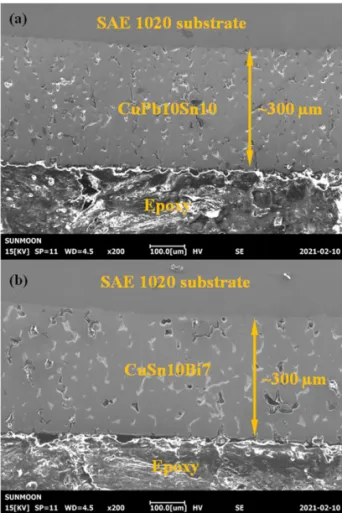
분말야금(powder metallurgy; PM) 기술을 사용하여 Cu 기반 바이메탈 시편을 준비하였다. 저탄소 강 SAE 1020 에 소결된 Cu 기반 합금의 두께는 Fig. 1과 같이 약 300 μm 이다. 스크래치 저항성 및 트라이볼로지 시험에 사 용된 시편의 치수는 20 × 20 × 5 mm

3

이며, PM 공정에 대한 자세한 내용은 이전 논문에 나타내었다[3]. 두 종 류의 Cu 기반 합금의 화학적 조성은 Table 1과 같다.

Fig. 1. Cross-sectional SEM images of CuPb10Sn10 (a)

and CuSn10Bi7 (b) alloys.

(3)

2-2. UNSM 처리 조건

UNSM 기술은 초음파 진동 에너지를 응용하여 정적 및 동적 하중이 부가된 강구로 초당 20,000번 이상의 타 격을 가하여 표면강소성 변형(S

2

PD-surface severe plastic deformation) 을 금속에 발생시켜 표면을 나노조직으로 개 질한다[6,7]. UNSM 공구가 시편 표편에 접촉된 상태에 서 이동하면서 가한 타격에 의해 연속적인 소성 변형이 발생되며 결과적으로 공구의 이동 방향을 따라 표면에 있는 미세한 기공을 제거한다. UNSM 기술의 처리 조건 은 Table 2와 같다.

2-3. 측정 및 시험 조건

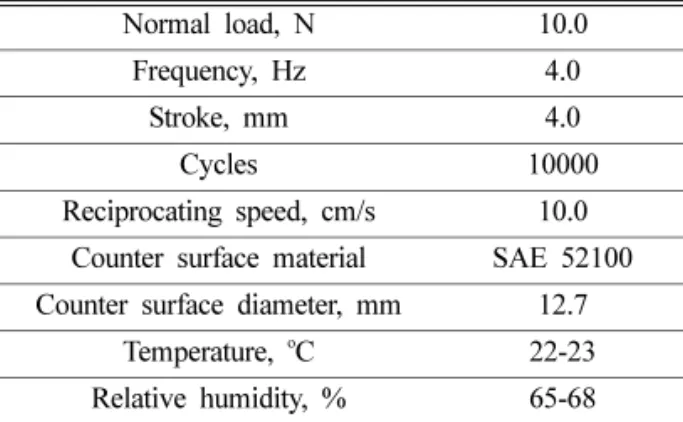
거칠기 측정기(SJ-210, Mitutoyo, Japan) 및 비커스 경도 시험기(MVK-E3, Mitutoyo, Japan) 로 미처리 시편 과 UNSM 처리된 시편의 표면 거칠기 및 경도를 측정하 였다. 기계적 특성 시험은 5 mm/min 속도로 1000 MPa 하중에서 인장 시험기(130-10, QMESYS, Korea)를 사 용하여 ASTM E8 표준에 따라 수행하였다. 트라이볼로 지 시험은 ball-on-disc 시험기에서 윤활유 없이 왕복 미 끄럼 운동으로 수행하였다. 시험 조건은 Table 3과 같 다. 스크래치 시험은 4 mm/min 속도로 10 mm의 스크 래치 거리에 걸쳐 40 N에서 140 N의 증분하중(incre- mental load) 에서 직경 200 마이크로 미터의 원뿔형 다 이아몬드 팁이 장착된 스크래치 시험기(CSEM Instru- ments, Switzerland) 를 사용하여 수행하였다. 각 시편별

측정 및 시험을 나타난 결과에 따라 2회 이상 수행하였 다. 표준 편차(error bar)는 평균을 구성하는 측정 횟수의 제곱근으로 나누어 계산하였다.

3. 결과 및 고찰

3-1. 표면거칠기 및 표면/깊이별 경도

표면 거칠기 및 표면과 깊이별 경도 측정 결과는 Fig.

2 에 나타내었다. Fig. 2(a)를 보면 UNSM 처리 후 표면 거칠기는 감소되었으며, 이는 표면의 돌기들(asperities) 이 연마되었기 때문이다. UNSM 처리 후 봉우리와 계 곡(peak-and-valley)의 높이도 감소되었다. 결과적으로, UNSM 기술은 CuPb10Sn10 및 CuSn10Bi7 합금의 평 균 표면 거칠기를 R

a

= 1.92 µm 에서 0.24 µm로, R

a

= 1.96 µm 에서 0.23 µm로 각각 감소시켰다. 표면 거칠기 는 낮은 마찰을 얻기 위해 최적화해야 하는 중요한 문 제이며 거친 표면은 일반적으로 매끄러운 표면보다 빠 르게 마모되고 마찰이 높다.

Fig. 2(b) 를 보면 UNSM 처리 후 표면 경도는 증가 되었다. UNSM 기술은 CuPb10Sn10 및 CuSn10Bi7 합금의 표면 경도를 103 HV에서 162 HV로, 121 HV에 서 174 HV로 각각 증가시켰다. 원래 표면 경도는 시편 표면의 미세한 돌기들 간의 탄성 혹은 소성 접촉에 따 른 마찰 계수 차이에 영향을 줄 수 있다. 표면 경도 증 가는 Hall-Petch 관계식에 따른 정제된 입자 크기 때문 이다[8]. UNSM 처리 후 CuPb10Sn10 및 CuSn10Bi7 합금의 깊이별 경도는 Fig. 2(c)에 나타내었으며, 경화 층(hardened layer) 두께는 약 150 µm이다.

3-2. 인장 강도

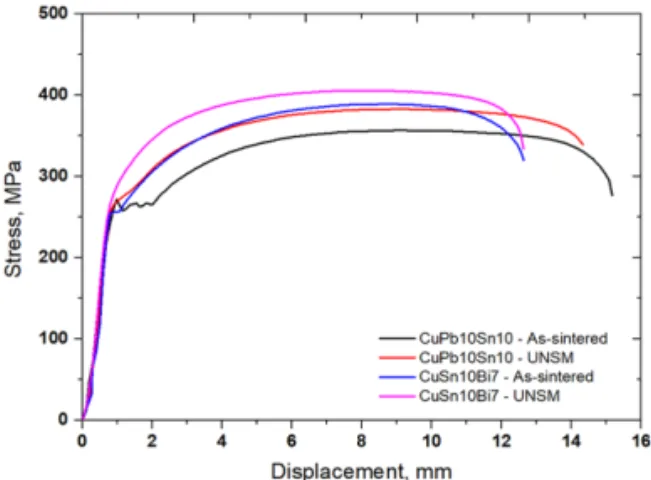
Fig. 3 은 인장 시험 후 얻은 응력-변형 곡선이다.

UNSM 처리 후 두 종류 Cu 기반 합금 (CuPb10Sn10 및 CuSn10Bi7) 의 항복강도(yield strength; YS)와 인장강도 Table 1. Chemical composition in wt.%.

CuPb10Sn10 CuSn10Bi7

Cu 78-82

Pb 8-11 -

Sn 9-11

Bi - 3-7

Zn max 2

Ni max 2

Table 2. UNSM treatment parameters

Frequency, kHz 20

Amplitude, µm 30

Speed, mm/min 2000

Load, N 20

Interval, µm 70

Ball diameter, mm 2.38

Ball material WC

Table 3. Reciprocating tribo-test conditions Normal load, N 10.0

Frequency, Hz 4.0

Stroke, mm 4.0

Cycles 10000

Reciprocating speed, cm/s 10.0 Counter surface material SAE 52100 Counter surface diameter, mm 12.7

Temperature,

o

C 22-23

Relative humidity, % 65-68

(4)

(ultimate tensile strength; UTS)가 증가하는 것으로 나 타났다. YS와 UTS의 증가는 경도의 증가와 전위를 이 동하는데 우수한 에너지를 수반하는 높은 입자 경계 (grain boundary) 수와 관련이 있다고 판단된다. UNSM 처리 후 전형적인 변형 거동이 발생하여 CuPb10Sn10 합금의 변위가 손실되었으며, CuSn10Bi7 합금은 YS와

UTS 가 증가함에 따라 동일한 변위를 가지는 것으로 발 견되었다. UNSM 처리 후 입자 크기 정제(grain size refinement) 가 강도를 높이는 주요 메커니즘이지만, 제거 된 기공은 YS와 UTS 특성 증가에 대한 근거가 될 것으 로 생각된다. 또한, CuSn10Bi7 합금에 Bi의 존재는 CuPb10Sn10 합금의 Cu

3

Sn 내부 금속 위상(inter- metallic phase) 보다 단단한 Cu

11

Bi

7

내부 금속 위상을 형성 했으며, CuSn10Bi7 합금은 CuPb10Sn10 보다 더 높은 강도를 가졌다[9,10].

3-3. 마찰 계수 및 마모율

트라이볼로지 시험의 결과는 Fig. 4와 같다. 소결된 CuPb10Sn10 합금의 평균 마찰 계수는 약 0.231이며, UNSM 처리된 합금의 경우 평균 마찰 계수는 약 0.054 로 나타났다. 소결된 CuSn10Bi7 합금의 평균 마찰 계수 는 약 0.193이며 UNSM 처리된 합금의 경우 평균 마찰 계 수는 약 0.047로 나타났다. CuSn10Bi7 합금의 평균 마찰 계수는 CuPb10Sn10 합금의 평균 마찰 계수 보다 감소 하는 경향을 보였다. UNSM 처리된 CuSn10Bi7 합금의 평균 마찰 계수는 약 0.047로 가장 낮은 마찰 계수를 보 였다. UNSM 처리된 두 종류 Cu 기반 합금의 마찰 거 동은 시험 종료까지 매우 안정적으로 나타났다. 그러나, 소결된 두 종류 Cu 기반 합금의 마찰 거동은 시험 수행 동안 불안정하여 진입(running-in) 및 정상(steady-state) 구간 마찰 거동을 나타내었다. UNSM 처리 후 마찰 계수 감소는 주로 표면 거칠기 감소 때문이며, 또한 CuSn 10Bi7 합금은 SnO

2

와 Bi

2

O

3

를 형성하여 마찰 성능을 향상시켰다. SnO

2

와 Bi

2

O

3

의 형성은 3-4에서 EDX 분 석 결과에 의해 제시할 것이다.

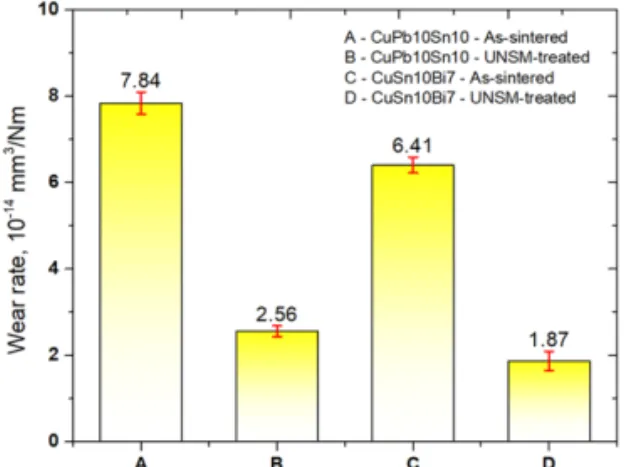
CuPb10Sn10 및 CuSn10Bi7 합금의 마모율(wear rate, Fig. 2. Comparison in surface roughness (a), top sur-

face hardness (b) and hardness depth profile of (c) CuPb10Sn10 and CuSn10Bi7 alloys.

Fig. 3. Comparison in stress-displacement curves of

CuPb10Sn10 (a) and CuSn10Bi7 alloys.

(5)

W)은 마모부피 손실(wear volume loss, V), 정상 하중 (normal load, N) 및 슬라이딩 거리(d)를 고려하여 다음 공식으로 계산되었다[11]:

W = V/N × d

계산된 마모율 결과는 Fig. 5와 같다. UNSM 처리된 합금은 소결된 시편에 비해 약 3배 낮은 마모율을 나타 내었다. UNSM 기술이 Cu 기반 합금의 내마모성에 상당 한 영향을 끼쳤다고 판단된다. 소결된 합금과 비교하여 UNSM 처리된 합금의 마모율이 향상되는 것은 증가된 기 계적 특성과 미세구조 변경 때문이다. 또한 표면 거칠기는 CuPb10Sn10 및 CuSn10Bi7 합금의 마찰 및 마모 거동을 향상하는 데 중요한 역할을 하였다. 소결된 합금에 비해 마찰 계수가 낮은 UNSM 처리된 합금은 횡력(lateral force) 이 낮아졌다. 연질금속 원소 Bi의 Brinell 경도(94.2 MPa) 가 Pb의 Brinell 경도(38.3 MPa)보다 높기 때문에 CuSn10Bi7 합금은 CuPb10Sn10 합금보다 높은 경도 ( 강도)를 갖고 있으며 CuSn10Bi7 합금이 더 좋은 내마

모성을 보였다. UNSM 처리된 CuSn10Bi7 합금은 ICE의 슬라이딩 베어링과 부싱에서 마찰 감소 코팅 재료로 사 용할 수 있을 것이다.

3-4. 마모 트랙 및 마모 메커니즘

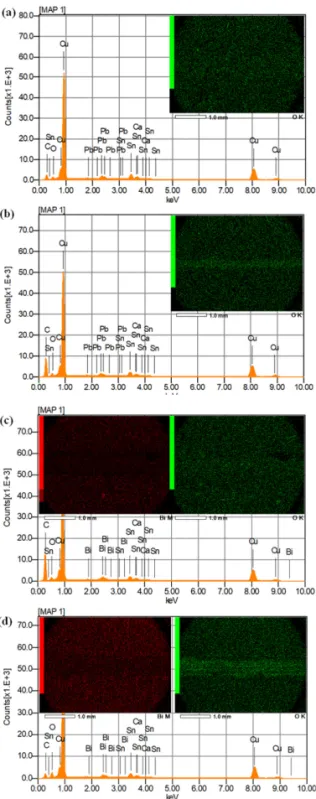
두 종류 Cu 기반 합금의 마모 거동에 대한 UNSM 기술의 효과에 대한 통찰력을 제공하기 위해 소결된 합 금 및 UNSM 처리된 합금의 마모 특성을 주사 전자 현 미경(scanning electron microscope; SEM)을 사용하여 분석하였으며, 결과는 Fig. 6과 같다. 왕복 미끄럼 (reciprocating sliding) 트라이볼로지 시험 후 소결된 합 금은 심하게 마모된 반면, UNSM 처리된 합금은 표면 거칠기 감소, 경도 증가 및 기공 제거로 인해 소결된 합 금에 비해 상대적으로 경미한 마모가 있음을 확인하였 다. Fig. 6과 같이 UNSM 처리된 합금은 소결된 합금 에 비해 더 작고 얕고 좁은 마모 트랙을 가졌다. 따라 서 상대면 베어링강 볼이 UNSM 처리된 합금에 비해 소결된 합금에 훨씬 더 깊게 침투했을 것으로 사료된 다. Fig. 7(a and b)과 같이 소결된 CuPb 10Sn10 합금 의 비해 UNSM 처리된 CuPb10Sn10 합금의 마찰 계수 및 마모율이 낮은 것은 UNSM 처리된 합금 표면 에 산소가 풍부한 트라이보 층(oxygen-rich tribo layer)이 형성 되었기 때문이다. Fig. 7(a and b)의 삽도(inset)와 같이 마모트랙 내의 트라이보 층 형성은 에너지 분산형 엑스선 분광기(energy-dispersive X-ray spectroscopy;

EDX) 매핑으로 확인되었으며, 소결된 및 UNSM 처리 된 CuPb10Sn10 합금의 산소량은 각각 1.80 in wt.%와 3.92 in wt.% 였다. 소결된 Cu 기반 합금에서는 상대 운동 에서 두 개의 결합 표면 사이에 마모분(wear debris) 이 갇히기 때문에 삼체 마모(three-body wear) 메커니즘이 Fig. 4. Comparison in friction coefficient of CuPb10Sn10

(a) and CuSn10Bi7 (b) alloys.

Fig. 5. Comparison in wear rate of CuPb10Sn10 and

CuSn10Bi7 alloys.

(6)

발생할 가능성이 있지만, CuSn10Bi7 합금에서는 스크래 치 같은 연삭마모(abrasive wear) 및 산소마모(oxidative wear) 메커니즘이 발생하였다. Fig. 7(c and d)과 같이 소 결된 CuSn10Bi7 합금에 비해 UNSM 처리된 CuSn10Bi7 Fig. 6. SEM images of the wear tracks formed on the

surface of sintered (a and c) and UNSM-treated (b and d) CuPb10Sn10 and CuSn10Bi7 alloys, respectively.

Fig. 7. EDX results of the wear tracks formed on the

surface of sintered (a and c) and UNSM-treated (b and

d) CuPb10Sn10 and CuSn10Bi7 alloys, respectively.

(7)

합금의 마찰 계수 및 마모율이 낮은 것은UNSM 처리된 합금 표면에 형성된 SnO

2

와 Bi

2

O

3

때문이라고 판단된다 (Fig. 7(c and d) 의 삽도). 또한, UNSM 처리된 합금의 거칠기 감소, 경도 증가 및 기공 제거로 인한 것으로 생 각된다.

3-5. 스크래치 저항성

Fig. 8 은 스크래치 시험 결과이다. 두 종류 Cu 기반 시편의 마찰력(friction force)은 선형적으로 증가하여 UNSM 처리된 합금은 소결된 합금에 비해 높은 변동과 함께 낮은 마찰력을 나타내었다. 따라서 UNSM 처리된 합금은 소결된 합금에 비해 접착력(adhesive strength)이 더 강하다는 결론을 내릴 수 있다. 두 종류 소결된 합 금에 비해 UNSM 처리된 합금의 마찰력이 낮게 나타났 다. CuSn10Bi7 합금은 우수한 마찰과 소착성(seizure) 을 가질 뿐만 아니라 접착(adhesion) 성능을 동시에 가지 고 있어 최근 개발된 엔진 베어링과 부싱의 요구 사항 을 충족한다. 스크래치 메커니즘은 일반적으로 연삭 마 모에서 발생하는 손상 메커니즘과 매우 연관성이 있다.

CuPb10Sn10 합금의 내 스크래치 성이 좋지 않은 것은 주로 약하게 통합된 기공이 존재하기 때문이며, UNSM 처 리된 CuPb10Sn10 합금의 내 스크래치 성이 더 높은 것 은 기공이 제거되었기 때문이다. 반면, UNSM 처리된 CuSn10Bi7 합금의 가장 높은 내 스크래치 성은 높은 접 착력, 경도 및 낮은 다공성 때문이다. 전체적으로 본 연 구에서 UNSM 처리 후 합금의 표면 거칠기가 감소되고 경도(강도)가 증가된 주요한 원인은 제거된 기공 및 정 제된 입자 크기 때문으로 판단된다. 이전 연구에서도 Cu 기반 합금(CuPbSn)의 트라이볼로지 거동에 대한 표면나 노결정화(surface nano-crystallization)가 마찰, 마모 및 접착 특성을 향상시켰다[12].

4. 결 론

소결된 합금과 UNSM 처리된 합금 사이의 트라이볼 로지 성능 비교는 왕복 슬라이딩 트라이볼로지 시험에 의해 수행되었다. UNSM 처리된 합금은 소결된 합금에 비해 향상된 트라이볼로지 및 증가된 기계적 특성을 나 타내었다. 기계적 특성의 향상은 정제된 입자 크기와 기 공 제거로 인한 것이다. 결과적으로 경도 증가와 표면거 칠기 감소는 트라이볼로지 특성을 향상하는데 중요하게 작용되었다. 얻어진 결과에 따르면 UNSM 기술은 Cu 기 반 합금의 기계적 및 트라이볼로지 특성을 향상시키기 위한 적합한 기술로 확인되었다. 따라서 이 기술을 ICE

부품, 특히 Cu 기반 바이메탈로 만들어진 슬라이딩 베 어링과 부싱에 적용 가능할 것이며, 성능 및 비용 측면 에서도 효율적인 기술 적용이 될 것이다.

Acknowledgements

이 논문은 2020년도 정부(교육부)의 재원으로 한국연 구재단의 지원을 받아 수행된 기초연구사업임(No.2020 R1I1A3074119).

References

[1] Roy, R., Souchoroukov, P., Shehab, E., “Detailed Cost Estimating in the Automotive Industry: Data and Information Requirements”, Int. J. Prod. Econom., 2011, https://doi.org/10.1016/j.ijpe.2011.05.018 [2] Xiong, X., Chen, J., Yao, P., Li, S., Huang, B.,

“Friction and Wear Behaviors and Mechanisms of Fe and SiO

2

in Cu-based P/M Friction Materials”, Wear, 2007, https://doi.org/10.1016/j.wear.2006.11.001 [3] Amanov, A., Pyun, Y.S., Sasaki, S., “Effects of Ultra-

sonic Nanocrystalline Srface Modification (UNSM)

Fig. 8. Comparison in friction force of CuPb10Sn10 (a)

and CuSn10Bi7 (b) alloys derived from scratch test.

(8)

Technique on the Tribological Behavior of Sintered Cu-based Alloy”, Tribol. Int., 2014, https://doi.org/

10.1016/j.triboint.2013.12.003.

[4] Arifvianto, B., Suyitno, M., Mahardika, M., “Effects of Surface Mechanical Attrition Treatment (SMAT) on a Rough Surface of AISI 316L Stainless Steel”, Appl. Surf. Sci., 2012, https://doi.org/10.1016/j.apsusc.

2012.01.021

[5] Bagherifard, S., Ghelichi, R., Guagliano, M., “On the Shot Peening Surface Coverage and Its Assess- ment by Means of Finite Element Simulation: A Critical Review and Some Original Developments”, Appl. Surf. Sci., 2012, https://doi.org/10.1016/j.apsusc.

2012.07.017

[6] Ro, J.S., Amanov, A., “Effect of Micro-grooves Manu- factured via Ultrasonic Nanocrystalline Surface Modi- fication on Sliding Friction”, Tribol. Lubr., Vol. 37, No.1, pp.25-30, 2021, https://doi.org/10.9725/kts.2021.

37.1.25

[7] Sanseong, C.H., Ro, J.S., Pyun, Y.S., Amanov, A.,

“Effects of High-temperature UNSM Treatment on Wear Resistance of Ti-6Al-4V Alloy Prepared by Selective Laser Melting”, Tribol. Lubr., Vol.36, No.1, pp.47-54, 2020, https://doi.org/10.9725/kts.2020.36.1.47

[8] Oliver, W.C., Pharr, G.M., “An Improved Technique for Determining Hardness and Elastic Modulus using Load and Displacement Sensing Indentation Experi- ments”, J. Mater. Res., 1992, https://doi.org/10.1557/

JMR.1992.1564

[9] Walsh, J.P.S., Freedman, D.E., “High-pressure Syn- thesis: A New Frontier in the Search for Next-Gen- eration Intermetallic Compound”, Acc. Chem. Res., 2018, https:doi.org/10.1021/acs.accounts.8b00143.

[10] Amsler, M., Wolverton, C., “Dense Superconducting Phases of Copper-bismuth at High Pressure”, Phys.

Rev. Mater., 2017, https://doi.org/10.1103/PhysRevMate- rials. 1.031801

[11] Amanov, A., “Effect of Local Treatment Temperature of Ultrasonic Nanocrystalline Surface Modification on Tribological Behavior and Corrosion Resistance of Stainless Steel 316L Produced by Selective Laser Melting”, Surf. Coat. Technol., 2020, https://doi.org/

10.1016/j.surfcoat.2020.126080

[12] Gencer, G.M., Yolcu, C., Kahraman, F ., Saklako- glu, N., “Effect of the Surface Nanocrystallization on Tribological Behavior of the Cu based Bimetallic Materials (CuPbSn)”, Mater. Res. Exp., 2019, https:/

/doi.org/10.1088/2053-1591/ab43b3

수치

Fig. 1. Cross-sectional SEM images of CuPb10Sn10 (a)  and CuSn10Bi7 (b) alloys.
Table 2. UNSM treatment parameters
Fig. 3. Comparison in stress-displacement curves of  CuPb10Sn10 (a) and CuSn10Bi7 alloys.
Fig. 5. Comparison in wear rate of CuPb10Sn10 and  CuSn10Bi7 alloys.
+2

참조

관련 문서

Objectives: The present study was conducted to determine the relationship between degree of work performance and job satisfaction in NICU nurses.. Methods: The subjects of

In this study, we fabricated the three-dimentional (3D) polycaprolactone (PCL) scaffolds via bio-extruder equipment and then treated surface modification of

The effects of recycling on the tensile bond strength of new and clinically used stainless steel orthodontic brackets: an in vitro study. Material testing of

Various studies have been performed to improve properties of material, electrical and mechanical properties of railway train according to the increase of the speed in the

6 Miscellaneous Applications: The high strength and wear resistance of BMGs along with their biocompatiability, smooth surface finish, and aesthetic appearance determine the

The improvement factors of the performance showed significant increase in muscle strength, muscle endurance, cardiovascular endurance, power, agility and

In the hydrogen production by steam reforming of LNG, the catalytic performance of NA and M/NA catalysts was well correlated with the nickel surface area of the

In this study the various modification of configurations of piston crown and spray impingement was attempted to attain a geometry that realize the two