DOI 10.17480/psk.2019.63.2.103
국내외 의약품 유익성-위해성 평가 기법에 대한 고찰
정소현·장선미#
가천대학교 약학대학 가천약학연구소
Current State of Drug Benefit-Risk Assessment (BRA) Worldwide
Sohyun Jeong and Sunmee Jang#
College of Pharmacy and Gachon Institute of Pharmaceutical Sciences, Gachon University
(Received November 21, 2018; Revised April 2, 2019; Accepted April 11, 2019)
Abstract The development of systematic and structural tool evaluating drug Benefit-Risk Assessment (BRA) has long been a hot issue in pharmaceutical and regulatory division worldwide. It has been proposed to conduct drug BRA during the whole drug life due to the unknown adverse events by long term drug use or unconfirmed drug efficacy and safety in specific groups of people by the golden rule of drug approval evidence, randomized controlled trials being widely comprehended. We aimed to collect and review BRA tools and strategies in the advanced countries, international organizations, and Korea in order to get the trends and knowledges of BRA to advance the BRA system in Korea. ICH and WHO did not support a specific BRA model but stated the basic principles and formats. EMA & IMI conducted a rigorous project to present and suggest quantitative and qualitative BRA methods. They highlighted using ProACT-URL and Effects Table in regulatory decision process and suggested to utilize quantitative Multiple Criteria Decision Analysis in BRA. FDA suggested simple and qualitative approach of Benefit Risk Framework (BRF), in the concern of potential bias induced by quantitative approach. Korea also has been following up the advanced BRA tools consistently but requires establishment of localized BRA strategy satisfying its own perspectives. From these contexts, Korea needs to build up a task force or tangible environment to actively discuss and implement BRA tools.
Keywords Benefit-Risk Assessment, Multiple Criteria Decision Analysis
서 론(Introduction)
2017 년 식품의약품안전평가원에서는 국내의 의약품 허가신고 신청시 사용하는 문서의 질과 내용을 국제적 수준으로 높이기 위해 ‘의약품의 유익성-위해성 평가 작성 가이드라인’을 개정한 다고 밝혔다. 이는 2016년에 한국이 국제의약품규제조화위원회 (The International Council for Harmonisation, ICH) 정회원 자격 으로 가입한 이후, 국내 제약업체 등이 제출하는 의약품 허가신 고 신청시 사용하는 문서인 ICH의 국제공통기술문서(Common Technical Document, CTD)내의 ‘2.5.6 유익성과 위해성에 관한 결론’항의 작성 내용을 국제수준으로 향상시키기 위한 조치였 다.
1)또한, 2018년 6월 의약품 임상부터 최종 사용까지 전주기 안전정보를 총괄하는 통합정보시스템 구축의 근거를 마련하는 입법안이 발의되어
2)의약품의 유익성과 위해성평가(Benefit-Risk
Assessment, BRA) 를 전주기적으로 과학적으로 수행할 수 있는 기반을 마련하였다. 전 세계적으로 의약품 BRA를 위한 방법론 을 구조적, 체계적으로 접근하고 도출한 결과물에 근거하여 의 약품 사용을 결정하는 일련의 과정의 강건함(robustness) 여부는 의약품 규제당국, 제약업계, 보건의료인 등 관련자들에게는 핵 심 논점이었다.
3,4)“ 유익성”과 위해성”은 주로 임상시험을 통해 확인된 의약품의
“효능(efficacy)”과 “안전성(safety)”이 확장된 개념이다.
5)의약품의
“효능(efficacy)”과 “안전성(safety)”외에 “유익성(benefit)”과 “위해 성(risk)”이라는 확장된 개념이 필요하게 된 것은 허가 자료의 기반이 되는 무작위 임상시험 자체의 제한점을 인식하게 되었 고, 그 외에도 무작위 임상시험을 수행하기 어려운 경우, 무작 위 임상시험으로 확인하기 어려운 장기 부작용 등이 발생했기 때문이다. Institute of Medicine (IOM)에서는 무작위 임상시험 자 료가 있는 경우에도 의약품 시판이 허가되기 전에 유익성-위해 성 균형에 대한 많은 요소들이 아래와 같은 이유로 명확하지 않 다고 보았다.
초기 임상연구에 포함된 인원과 기간이 불충분하고(eg, meto- clopramide를 위장관 장애(오심, 구토)에 장기간 사용한 경우
#
Corresponding author
Sunmee Jang, College of Pharmacy, Gachon University, 191 Ham- bakmoei-ro, Yeonsu-gu, Incheon, 21936, Korea
Tel: +82-32-820-4941, Fax: +82-32-820-4829
E-mail: [email protected]
tardive dyskinesia 라는 이상반응 유발), 넓은 인구군에 안정적으 로 사용하기 위한 주요 유익성과 위해성을 평가하기에는 적용 된 치료범위가 협소하며, 대리표지인자의 사용으로 장기사용에 대한 결과예측에는 정밀성이 떨어져 임상시험에서 측적된 성과 지표의 최적성에 의문이 있으며 다양한 임상시험에서 생성된 근 거의 측정방법, 자료수집 방법의 일관성 없음 등이 문제가 됨을 열거하고 있다.
6)이러한 측면에서, 의약품의 평가와 허가 시점 또는 허가 이후 에 추가된 정보를 모두 고려하여 의약품의 전주기적 유익성과 위해성을 종합적이고 체계적으로 평가하는 정형화된 BRA 도구 (tool)를 개발하는 것에 대한 요구도는 전세계적으로 높다. 이에, 다수의 선진외국과 국외기구에서는 BRA기법과 규정에 대한 논 의와 프로젝트를 활발하게 진행하면서 그 결과물을 보건당국의 의약품 평가와 규제에 활용하고 있다.
7,8)본 연구에서는 연구대상으로 선정된 각 기구 및 규제기관의 BRA 기법 연구현황과 BRA를 수행하기 위해 활용되는 도구(tool) 의 종류 및 내용을 조사하고 비교하고자 하였다.
연구방법(Research Methods)
의약품의 시판허가 단계부터 시판 후까지의 전세계의 의약품 BRA 기법의 현황을 고찰하기 위해 자료검색 기관으로 우선, 국 제적으로 의약품과 보건의료의 주요사안에 대한 규제조화 및 가 이드라인 제시에서 선도적 역할을 담당하고 있는 기구인 국제 의약품규제조화위원회(ICH)와 세계보건기구(WHO)를 선정했다.
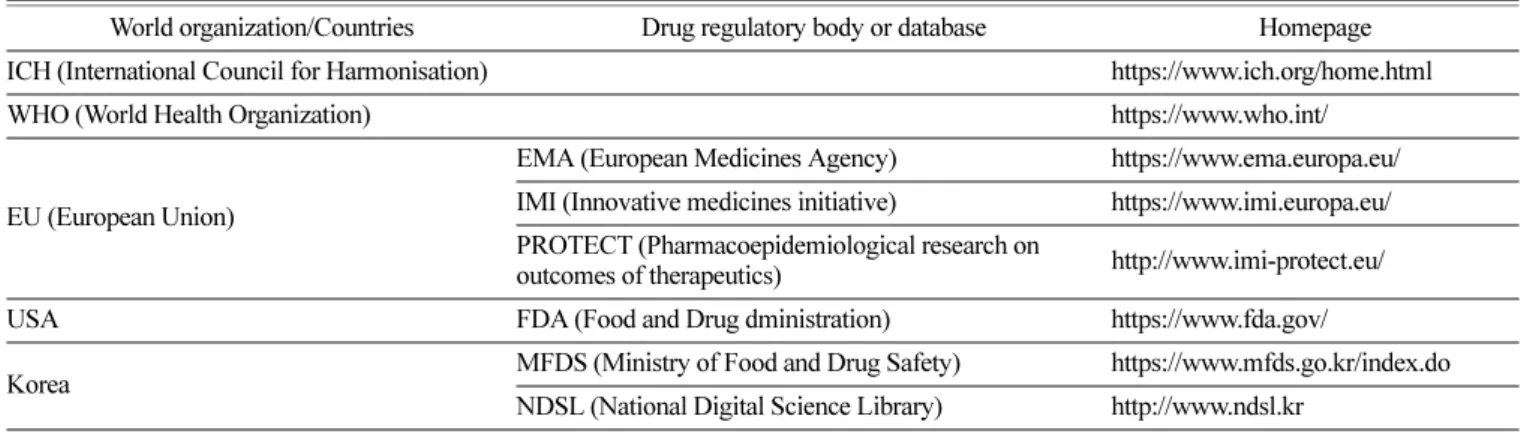
그리고 유럽연합(EU)과 미국을 대표적인 의약품 제도 선진화 주 요국가로서 선정하여 자료 검색의 대상으로 선정하였다. 선정된 국제기구인 ICH, WHO의 공식 웹사이트와 유럽연합과 미국, 그 리고 대한민국의 의약품 규제기관인 EMA (European Medicines Agency), US FDA (Food and Drug Administration) 와 KMFDS (Korea Ministry of Food and Drug Safety) 의 공식 웹사이트를 위주로 검색하였다. 국내의 연구현황을 검색하기 위해 NDSL (National Digital Science Library) 사이트에서 제공하고 있는 연 구보고서들을 검색하였다(Table 1). 비교 연구대상 항목은 BRA 연구의 전반적인 현황, BRA 기법의 질적양적 종류, 활용되는
도구의 종류, 그리고 약물규제정책에 적용여부 등이었다. 연구 자료 검색은 2017년 7월1일부터 2017년 11월30일까지 수행되었다.
결 과(Results)
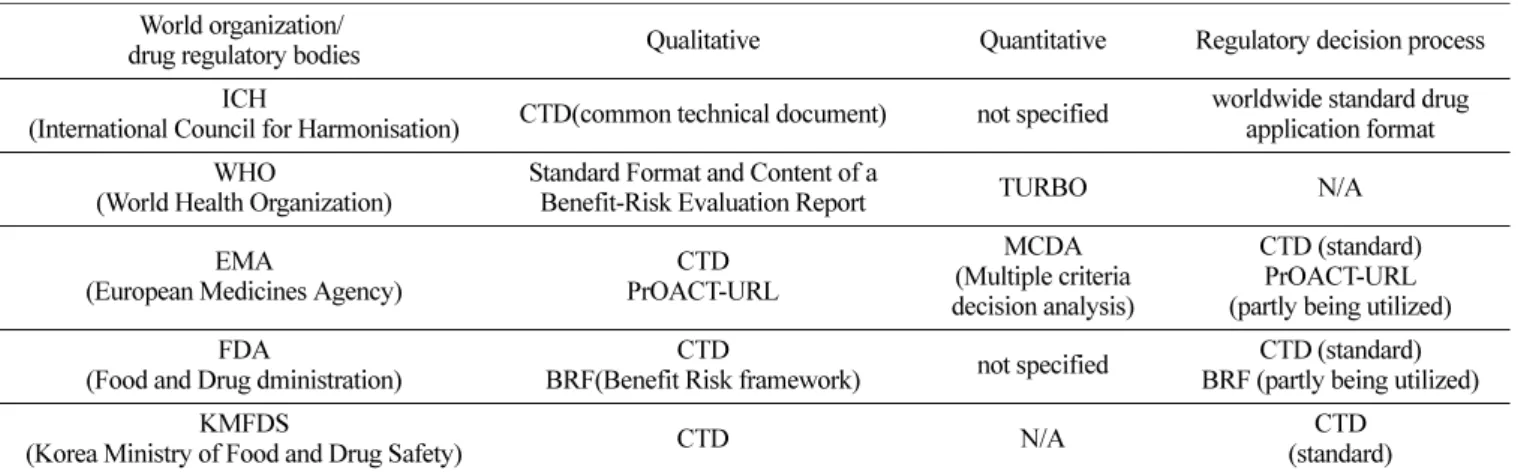
전 세계적으로 연구되고 적용되고 있는 BRA 평가기법은 크 게 정성적(기술적)기법과 정량적 기법으로 구분할 수 있다. 세 부적으로 계량지료, 추정지표, 효용조사기법 등의 방법론들이 다 각적으로 생산되고 점검되고 있었다. 유럽연합이 연구주체를 결 성하고 주도적으로 BRA 논의와 연구를 적극적으로 수행하여 포괄적이면서도 세부적인 BRA기법 결과물들을 제시하고 있었 다. 반면, 미국은 상대적으로 전통적이며 보수적인 입장을 견지 하고 있는 상황이지만 점차 규제정책에 BRA 기법을 적용하는 범위를 확대하고 있다. ICH는 원론적인 입장을 견지하며 특정 방법론을 제시하고 있지 않으며 WHO 또한 정성적(기술적) 평 가를 원칙으로 하고 있었으며 최신 연구근황은 알려져 있지 않 다. 국내 규제 및 연구주체도 지속적 관심을 가지고 연구결과들 을 보고하고 있지만 규제정책에 접목할 만한 실질적인 결과들 로 도출되지는 못하고 있었다(Table 2).
국제의약품규제조화위원회(International Council for Harmoni- sation, ICH)
ICH 에서는 신약허가 신청 시 국제적으로 통일된 자료제출을 위해 만든 공통문서(common technical document: CTD)내에 의 약품의 안전성, 유효성 정보가 종합적으로 제시되도록 규정하고 있다. ICH에서 2016년에 발표한 M4E (R2)가이드라인『인체 대 상 의약품 등록을 위한 공통기술문서(안전성)』 (The Common Technical Document for the Registration of Pharmaceuticals for Human Use: Safety Nonclinical Overview and Nonclinical Summaries of Module 2; Organization of Module 4) 는 2001년 작성되어 국제공통기술문서로서 신약 허가 시 국제적으로 통용 되던 CTD 작성에 대한 M4E 가이드라인을 개정한 것이다. 이 는 규제기관과 제약업체와의 의사소통을 용이하게 함이며 의약 품 유익성-위해성 정보의 구조와 포맷에 특이성을 부여하여 정 보제출 과정을 표준화하였다.
9)Table 1. The organizations or drug regulatory body included for the study
World organization/Countries Drug regulatory body or database Homepage ICH (International Council for Harmonisation) https://www.ich.org/home.html
WHO (World Health Organization) https://www.who.int/
EU (European Union)
EMA (European Medicines Agency) https://www.ema.europa.eu/
IMI (Innovative medicines initiative) https://www.imi.europa.eu/
PROTECT (Pharmacoepidemiological research on
outcomes of therapeutics) http://www.imi-protect.eu/
USA FDA (Food and Drug dministration) https://www.fda.gov/
Korea MFDS (Ministry of Food and Drug Safety) https://www.mfds.go.kr/index.do
NDSL (National Digital Science Library) http://www.ndsl.kr
M4E (R2) 가이드라인에서는
10)BRA 를 위한 많은 접근법들 가 운데 특정의 접근법을 명시하지 않고 있다. 일반적으로 기술적 (descriptive) 방법이 데이터 해석과 BRA를 수행하는 적절한 방 법이라고 제시하고 있다. 그리고 의약품 허가신청자가 특정의 분석방법을 사용하고자 하면 그 방법의 유용성, 복잡성과 결과 해석의 용이성을 고려해야 하고 결론에 대한 요약설명을 제공 해야만 한다고 명시하고 있다.
유럽연합(EMA, European Medicines Agency & IMI, Inno- vative Medicines Initiative)
European Medicines Agency (EMA) 는 의약품 허가신청 시 제 출하는 공통문서내의 BRA 내용 작성은 ICH 가이드라인을 따 른다. 제약회사가 BRA를 평가하는 특정의 방법론을 사용하려 면 신청서를 제출할 때 그 특정 방법론을 설명해야 하지만 현 재는 기술적 접근법(descriptive approach)외에 다른 방법론을 요 구하는 사항은 없다. CTD는 EU내에서 의약품 판매승인 신청 시 반드시 제출해야 하는 자료이다.
11)한편, EMA는 의약품의 유익성-유해성 균형을 유지하기 위해 공공기관과 제약업계가 공동 참여하여 구성한 Innovative Medicines Initiative (IMI)
12)을 조직하였고 산하에 유럽연합 약물역학 연구 회(Pharmaco epidemiological Research on Outcomes of Thera- peutics by a European Consortium; 이하 PROTECT)를 구성하여 유익성-위해성 관련 연구를 수행하였다.
13)학계, 규제기관과 제 약회사 등 32개 다중기관에 의한 협력이 이루어졌고
14), 2009 년 부터 2015년까지 유익성-위해성 방법론 프로젝트(Benefit-Risk Methodology Project)
13)7 단계의 Workprogram (WP)을수행하였다.
15)WP 총 연구결과로, 정성적(기술적) 방법으로도 BRA를 수행 할 수 있지만, 보다 효율적인 의사결정을 위해서는 정량적 평가 방법이 좀 더 논의되어야 한다는 결론을 내리게 되었다.
연구 참여자들은 유익성-위해성 균형에 관한 여러 요소들의 영향을 쉽게 평가할 수 있는 모델링(Modeling) 접근방법이 불확
실성에 대한 영향을 예측하고, 명백하고 확실한 구조를 제공하 기 때문에 임상적 유의성에 관한 판단과 근거를 결합하는데 유 용하다는 합의를 하였다. 이에, 다기준 의사결정분석(Multi-Criteria Decision Analysis, MCDA)이 유익성-위해성을 평가하는데 제일 적절한 정량적 도구임을 확인 하였고 2009년부터 2016년까지 16개 약품을 대상으로 MCDA를 이용하여 BRA를 진행하였다.
16)의약품의 유익성-위해성 균형을 내리기 위한 단계(Step)별 조사 를 진행하기에 적합한 정성적 프레임워크로는 PrOACT-URL
1)을 선택하게 되었다.
17)PrOACT-URL 평가과정에서 우호적 영향 (Favorable Effect)과 비우호적 영향(Unfavorable Effect)을 정리하 는 효과표(Effects table)가 핵심 유익성과 위해성을 요약하는 도 구로서 작성된다. 2014년 PrOACT-URL 프레임워크가 Committe for Medicinal Products for Human Use (CHMP)에 의해 승인이 이루어져서 2015년 EMA [EMA/90842/2015]는 Effects table을
“80일-주요 평가 리포트”(Effects Table for Day 80 Critical Assessment Report)에 사용할 것을 권고하고 있다.
18,19)또한, IMI PROTECT는 유익성- 위해성 평가를 위한 전체 방 법론을 아래와 같이 총 4가지 영역으로 분류하여 IMI PROTECT 웹사이트에서 소개하고 있다. 이에 속하는 것은 크게 프레임워 크, 계량지표, 추정기법, 효용 조사기법으로 분류되며, 이 방법 들은 한 의약품의 BRA에서 모두 사용될 수 있다.
프레임워크(분석틀)
프레임워크(분석틀)는 유익성-위해성 균형판단 이전에 의사결 정의 전반적인 과정을 정리하고 방향을 제시하는 역할을 하는 것으로, 어떤 문제의 유익성-위해성의 근거를 이해하고 요약하 는 틀로서 크게 정성적(기술적)프레임워크, 정량적 프레임워크 2 가지로 나눌 수 있다.
20)① 기술적(Descriptive)/정성적(qualitative) 프레임워크
EMA 에서 개발한 PrOACT-URL과
13,17)미국의 PhRMA (Phar-
1) PrOACT-URL: Problem, Objectives, ALternatives, Consequences, Trade-Offs, Uncertainty, Risk tolerance, Linked Decisions
Table 2. List of drug Benefit-Risk Assessment method suggested/utilized by drug regulatory agencies or international organization World organization/
drug regulatory bodies Qualitative Quantitative Regulatory decision process ICH
(International Council for Harmonisation) CTD(common technical document) not specified worldwide standard drug application format WHO
(World Health Organization)
Standard Format and Content of a
Benefit-Risk Evaluation Report TURBO N/A EMA
(European Medicines Agency)
CTD PrOACT-URL
MCDA (Multiple criteria decision analysis)
CTD (standard) PrOACT-URL (partly being utilized) FDA
(Food and Drug dministration)
CTD
BRF(Benefit Risk framework) not specified CTD (standard) BRF (partly being utilized) KMFDS
(Korea Ministry of Food and Drug Safety) CTD N/A CTD
(standard)
maceutical Research and Multiple criteria Acceptability Analy- sis) 의 BRAT (Benefit Risk Action Team) 프레임워크가
3,21,22)대표 적으로 많이 사용되고 있다. 그 외에 서술식이지만 model 제안 성격을 가지고 있는 ASF (Ashby and Smith Framework)
3,23), 구 조화된 질적 접근법으로 고등도의 짤막한 묘사 및 요약된 핵심 서술이 특징인 FDA BRF (The US FDA Benefit-Risk Frame- work)
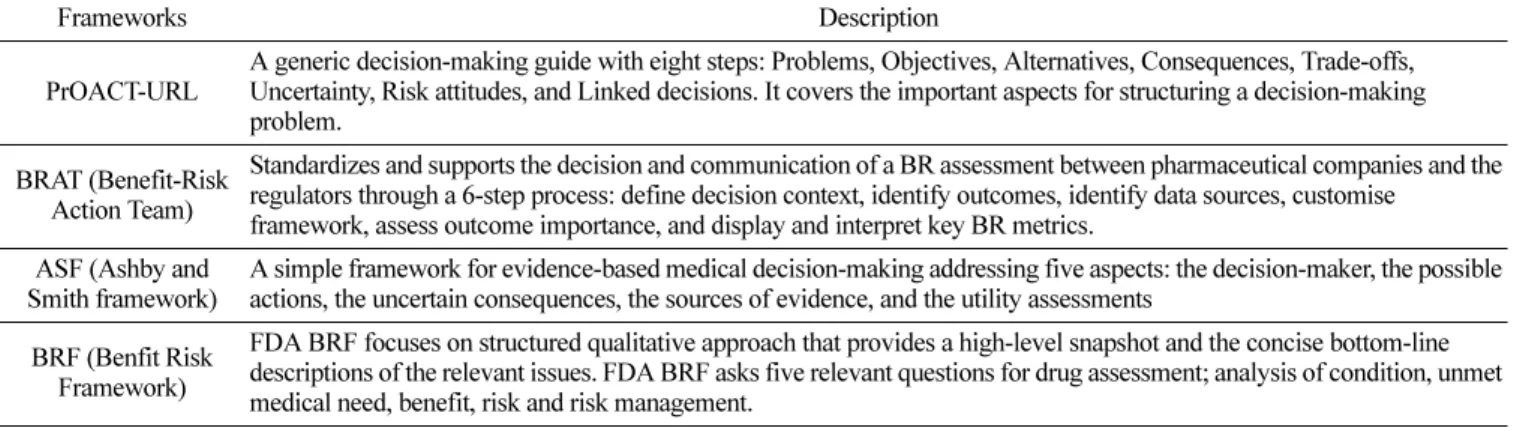
24,25)등 다양한 모델이 제시되고 있다(Table 3).
그 중 PrOACT-URL은 총 8단계로 구성되어 있으며, 각 단계 를 거쳐 최종적으로 효과표(Effect Table)를 작성하게 된다. 효과 표는 의약품의 유익성-위해성 평가에 영향을 미치는 모든 요소 를 종합적으로 보여 주도록 작성하게 되어 있다(Table 4).
② 정량적(Quantitative) 프레임워크
정량적 프레임워크에 속하는 MCDA는 유익성-위해성 균형을 정량적으로 평가, 분석할 수 있는 방법으로 종합적인 접근방법으 로 평가된다. 보통 평가목표가 다수이거나 하나의 목표라도 평가 기준이 여러 개 일 때 사용하고 평가 기준에 가중치를 할당하고 모든 데이터를 점수화시켜 값을 전환한다. 유익성과 위험성 사이
의 trade-off를 체계적으로 결정할 수 있게 하는 방법이며 가장 선 호하는 옵션(most preferred option)으로부터 가장 선호하지 않는 옵션(least preferred option)까지의 일련의 순서를 정하고 유익성- 위해성 기준 각각의 점수에 가중치(weight)를 할당하기 때문에 인 지적 판단(mental assessment)과 실질데이터 평가(practical assess- ment)를 계량적, 복합적으로 적용할 수 있는 장점이 있다.
반면, 임상시험에서 수집한 데이터는 그 임상 시험 자체의 기 준에 따라 도출된 자료이므로 평가기준이 그 임상 시험에만 제 한이 있으며, 단일 값을 평면적으로 합하는 방법이므로 가중치 에 대한 다른 평가자의 판단과 같은 다양성을 포함시키지 못하 는 단점이 있다.
26)또한, 복잡하고 정교한 모델 을 구축하는 데 는 시간이 너무 많이 소요되며, 각각의 치료 영역이나 의약품 적응증별로 서로 다른 모델을 필요로 하기 때문에 현실적으로 는 불가능하다는 문제점이 발생한다.
27,28)Efalizumab, Natalizumab, Rimonabant, Rosiglitazone과 Telithromycin case studies에 시범 적용되었으며 Hiview 3 (http://www.catalyze.co.uk), V.I.S.A (http://
www.visadecisions.com), In-telligent Decision System (http://www.
e-ids.co.uk), Logical Decisions (http://www.logicaldecisions.com) 과 Table 3. Qualitative frameworks utilized for Benefit-Risk (BR) Assessment
Frameworks Description
PrOACT-URL
A generic decision-making guide with eight steps: Problems, Objectives, Alternatives, Consequences, Trade-offs, Uncertainty, Risk attitudes, and Linked decisions. It covers the important aspects for structuring a decision-making problem.
BRAT (Benefit-Risk Action Team)
Standardizes and supports the decision and communication of a BR assessment between pharmaceutical companies and the regulators through a 6-step process: define decision context, identify outcomes, identify data sources, customise
framework, assess outcome importance, and display and interpret key BR metrics.
ASF (Ashby and Smith framework)
A simple framework for evidence-based medical decision-making addressing five aspects: the decision-maker, the possible actions, the uncertain consequences, the sources of evidence, and the utility assessments
BRF (Benfit Risk Framework)
FDA BRF focuses on structured qualitative approach that provides a high-level snapshot and the concise bottom-line descriptions of the relevant issues. FDA BRF asks five relevant questions for drug assessment; analysis of condition, unmet medical need, benefit, risk and risk management.
Table 4. Qualitative framework for Benefit-Risk Assessment adopted by EMA: PrOACT-URL
Steps Components
Problem Determine the nature of the problem and its context Frame the problem
Objectives Establish objectives that indicate the overall purposes to be achieved Identify criteria for (a) favourable effects, and (b) unfavourable effects Alternatives Identify the options to be evaluated against the criteria
Consequences Describe how the alternatives perform for each of the criteria, i.e., the magnitudes of all effects, and their desirability or severity, and the incidence of all effects
Trade-Offs Assess the balance between favourable and unfavourable effects
Uncertainty Report the uncertainty associated with the favourable and unfavourable effects
Consider how the balance between favourable and unfavourable effects is affected by uncertainty Risk tolerance Judges the relative importance of the decision maker's risk attitude for this product
Report how thiw affected the balance reported in step 9
Linked Decisions Consider the consistency of this decision with similar past decisions and assess whether taking this decision could impact future decisions
EMA: European Medicines Agency
같은 software를 사용할 수 있다.
27,29)SMAA (Stochastic Multi-attribute Acceptability Analysis)는 MCDA의 한 방법이며 점수주기와 가중치 계산은 같으나 불확 실성(uncertainty)에 대한 점수를 시뮬레이션으로 생성하여 유익 성-위해성 균형에 대한 가장 선호되는 선택사항에 등급 결과를 보여준다.
30-32)Decision Tree: 는 수평적인 나무 그림(가치 수형)으 로 결정과 각 성과지표 등을 그림으로 도식화할 수 있다.
16,33,34)MDP (Markov Decision Process)는 Markov chain과 decision tree를 결합해서 Marcov Decision Process를 생성한다.
35,36)BLRA (Benefit-Less-Risk Analysis) 는 개인의 데이터 수준에서 MCDA를 수행할 수 있고
35,36), NCB (Net Clinical Benefit) 는 대 안 의약품과 비교하여 전반적인 유익성과 위해성의 변화를 나 타낸다.
35)SBRAM (Sarac’s Benefit-Risk Assessment Method) 은 MCDA의 기초이론을 활용한 다기준 방법
37)이며, CUI (Clinical Utility Index) 는 일정 시간이나 용량의 범주 안에서 유익성-위해 성 균형을 결정할 수 있도록 개발되었다(Table 5).
38,39)계량지표(Metric Index)
계량 지표란 의약품의 유익성과 위해성을 정량적으로 표현할 수 있는 측정값으로서 이런 계량지표를 사용하면 사람들이 의 약품의 유익성이나 위해성을 비교적 쉽게 이해할 수 있기 때문 에 의사결정에 도움이 된다. 계량지표는 크게 임계지표, 보건지 표, 교환지표 3가지로 나눌 수 있다(Table 6).
40)추정기법(Estimation Techniques)
DAGs (Directed Acyclic Graphs), PSM (Probabilistic Simula-
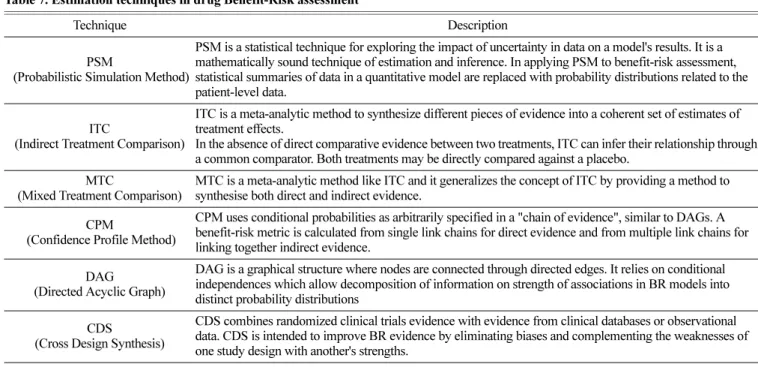
tion Method), CPM (Confidence Profile Method), ITC (Indirect Treatment Comparison), MTC (Mixed Treatment Comparison), CDS (Cross Design Synthesis) 등은 여러 데이터베이스에서 얻 어진 약물의 유익성과 위해성에 관한 데이터를 통합, 처리, 분 석하는 방법이며 여러 통계기법이 여기에 속한다. MTC는 메타 분석 방법 중 하나로 다양한 데이터를 합성하는 방법으로 보통 여러 개의 치료 군을 동시에 비교하고자 할 때 사용한다. 직접 적인 증거와 간접적인 증거를 모두 포함하여 치료 효과에 대한 판단 강화에 도움을 준다(Table 7).
41)효용조사기법(Utility Survey Techniques)
효용 조사기법은 이해관계자의 가치판단을 의사결정에 반영 하여 대안 선정 시 가중치를 부여하고 데이터를 수집하는 방법 론에 관한 기법들로 방법으로 환자들과 일반 대중의 의사를 반 영하는 적극적인 과정이다. 현재로선 의약품 BRA에서 특별히 선호되는 방법은 없다. Conjoint Analysis (CA), Discrete choice experiment (DCE), Stated Preference Method (SM) 등의 방법들 이 제시되어 있다(Table 8).
42)미국(Food and Drug Administration, FDA)
미국에서도 의약품 허가과정에서 표준화된 문서는 공통기술 문서(CTD)가 유일하며 신약허가, 개정, 보조자료 그리고 리포트 등에 사용된다. 2017년 5월 이후에는 New Drug Applications (NDAs), Abbreviated NDAs (ANDAs), Biologics License Appli- cations (BLAs) 등이 반드시 전자 eCTD 형태로 CDER (Center for Drug Evaluation and Research)와 CBER (Center for Bio- Table 5. Quantitative frameworks for Benefit-Risk Assessment
Framework Description
MCDA
(Multi-Criteria Decision Analysis)
MCDA quantifies the overall performance of two or more alternatives. Performance of the alternative drugs on the favourable and unfavourable effects are judged for their clinical relevance and all effects are weighted to create a common unit of preference value(utility). Summing those common units of benefit and risk provides an overall benefit-risk preference value for each alternative.
SMAA(Stochastic multi-attribute Acceptability Analysis)
SMAA is a family of MCDA dealing with statistical uncertainty. The uncertainty about scores can be accommodated through simulations.
Decision Tree A decision tree is a horizontal tree diagram, with decisions as roots, uncertain events with their outcomes, and further decisions and outcomes as branches, ending with consequences.
MDP(Markov Decision Process) Markov chain combined with decision tree produces MDP,
It requires estimates of the transition probabilities associated with each option.
BLRA(Benefit Less Risk Analysis) BLRA requires estimates of the transition probabilities associated with each option. It helps to increase transparency in decision- making through a seven-step process.
NCB(Net Clinical Benefit)
NCB is a quantitative framework that compares the overall change in the benefits and risks of a drug over a comparator. It is the sum of the change in expected benefits minus the change in expected risks as a result of treatment.
SBRAM(Sarac’s Benefit-Risk Assessment Method)
SBRAM is a method based on MCDA. To allow comparison across different benefit-risk categories, criteria are weighted on a scale of 1 (low), 2 (medium), and 3 (high) according to their importance.
CUI(Clinical Utility Index) CUI provides a framework in assessing drugs under development when measured over a range of doses or time. It was developed to assess the therapeutic index of new drugs.
DI(Desirability Index) DI provides a similar framework to CUI. in assessing drugs under development. It originates from the
industrial quality management field.
logics Evaluation and Research) 로 제출되어야 한다.
43)FDA 의 의약품 심사평가 관련 센터인 CDER와 CBER에서는 각각 유익성-위해성 자문단(Benefit-Risk Advisory Group)을 구성 하여 운영하고 있다. 이 자문단은 의약품 심사과정에서 BRA와 관련된 의사결정을 지원하기 위해 각각의 평가센터에서 제시하 는 BRA 및 임상 심사 조정안을 검토하고 승인하는 역할을 담 당하고 있다.
2009년 미국 FDA의 CDER는 BRA를 정량적 방법으로만 접 근할 경우, 의사결정에 필요한 다양한 근거들이 간과될 것을 우 려하여 정성적 평가 방법인 ‘유익성-위해성 분석틀(Benefit-Risk Framework: BRF)’을 사용하도록 제시하였다. BRF의 평가 양식 은 5가지 의사결정요인(치료대상 질병의 중증도, 현 시점에서 활 용 가능한 치료대안, 유익성, 위해성, 위해관리)에 관한 근거 수 준과 불확실성, 결론과 그 이유에 대해 기술하고, 최종 BRA 결 Table 6. Metric indices for Benefit-Risk assessment
Indices Description
Threshold Indices NNT
(Number Needed to Treat)
NNT is derived from the probabilities of a favourable effect (benefits) for the treatment and comparator. It can be interpreted as the number of patients that need to be treated (on average) for one favourable event.
NNH (Number Needed to Harm) NNH is defined similar to NNT but is based on the probabilities of unfavourable effects (risks) versus comparator.
Impact numbers Impact numbers are a group of metrics that generalize the NNT concept to the population level.
AE-NNT (Adverse Event Adjusted- NNT)
AE-NNT estimates the number of patients to be treated to observe one patient in whom treatment was successful without inducing treatment-related adverse events.
RV-NNH (Relative Value adjusted NNH) RV-NNH incorporates stakeholders' value preferences or "relative values" on the importance of AEs into NNH
MCE (Minimum Clinical Efficacy) MCE determines the minimal therapeutic benefit for a treatment to be worth considering, accounting for the event probability when untreated.
RV-MCE (Relative value adjusted
Minimum Clinical Efficacy) RV-MCE incorporates stakeholders' value preferences on the importance of AEs into MCE
MAR (Maximum Acceptable Risk) MAR explicitly assumes that benefits only occur when the risk does not i.e. the rates of risk occurring is multiplied by its utility and is multiplied by the utilities of benefits.
NEAR(Net Efficacy Adjusted for Risk) NEAR uses benefit or risk event and non-event count data for two comparative treatments in a 2×2 table.
It estimates NEAR odds ratio (OR) or relative risk (RR) using the standard formulae for OR and RR.
Trade-off Indices UT-NNT (Utility and Time adjusted
Number Needed to Treat)
UT-NNT adjusts the BR event probabilities in NNT for the time saved or lost due to treatment and the utilities associated with the treatment
INHB (Incremental Net Health Benefit) INHB calculates the difference in the "incremental" change of benefits to that of risks
BRR (Benefit Risk Ratio) BRR is a simple trade-off metric which divides benefits by risks, therefore assumes equal importance of benefits and risks.
GBR (Global Benefit Risk) GBR refers to three trade-off metrics constructed around individual patients' outcomes in clinical trials:
linear, ratio and composite ratio scores.
Principle of three Principle of threes assesses BR balance using three criteria (disease, effectiveness, and adverse drug reactions) on three attributes (seriousness, duration, and incidence), each scored on three levels.
Beckmann Model Beckmann Model is a simple multi-criteria model, which scores benefits and risks in three aspects; benefit socre= efficacy* response rate*evidence, risk score=seriousness*incidence*evidence
TURBO (Transparent Uniform Benefit Risk Overview)
TURBO prioritises only two most important benefit and risk criteria. The second criterion in each dimension is regarded as the correction factor to the first and scored on a shorter scale than the first.
Health Indices
QALY (Quality Adjusted Life Years)
QALY is the most used health index, where the time spent in a particular health state is multiplied by the Quality of Life (QoL) score in that state. The total QALY is simply the sum of all QALYs in all health states
DALY (Disability Adjusted Life Years), DALY is an index quantifying number of years lost from treatment compared to the national life expectancy.
HALE (Health Adjusted Life Years) HALE is a simple summary of all individual QALYs in a population.
Q-Twist (Quality-adjusted Time Without Symptoms and Toxicity)
Q-TWiST is a QALY metric, with explicit definitions of the discrete health states in cancer therapy:
toxicity, time without symptoms and toxicity, and relapse.
과를 요약하는 형식으로 구성되어 있다.
44)미국 FDA는 2012년 BRF에 대한 시범 프로젝트 시행으로 6 개의 신물질신약(New Molecular Entity, NME)에 대해 NDA (New Drug Application) 또는 BLA (Biological License Appli- cation) 으로 평가하였다. 시범 프로젝트의 결과 심사자들은 BRF 가 의약품 유익성-위해성 평가의 핵심 고려 사항을 간결한 형식 을 통해 성공적으로 나타냈다고 평가하였다.
43)2013년 2월에 발 표된 ‘전문의약품 허가신청자 비용부담 개정법(Prescription Drug User Fee Act V: PDUFA V)’ 5 개년(2013-2017) 세부 실행 계획 에 따르면, BRA 양식을 추가 보완하여 단계적으로 의약품 관 련 의사결정 자료로 활용하고자 하고 있다. 또한, 인간 의약품 및 생물학적 제제의 검토 과정에 대한 프레임워크의 추가 개발 및 적용을 하고자 하는 내용이 포함되어 있으며 2014년부터는 신약과 생물학적 물질을 기원으로 하는 의약품허가 신청 시 BRF 를 활용하고 있다.
47)약품 관리 전주기에 BRF를 사용하고자 하는 제조사는 의약
품 초기 과정(Pre-IND to phase 1), 중기-후기(phase 2 to pre- NDA/BLA) 그리고 NDA/BLA 제출 시와 시판후 허가까지 BRF 를 사용할 수 있다.
44)세계보건기구(World Health Organization, WHO)
CIOMS (Council for International Organization of Medical Sciences)는 1949년에 WHO와 UN에 의해 설립된 윤리, 의약품 개발 그리고 안전을 포함하는 건강관련 연구에 대한 지침을 통 해 공중보건을 향상시키는 것을 목표로 하는 비영리, 비정부 기 구이다. CIOMS는 1998년 발간된 “Benefit-Risk Balance for Marketed Drugs. Evaluating Safety Signals”라는 보고서를 통하 여, 시판 후 새로운 안전 문제가 발생했을 시 시판 의약품의 유 익성-위해성 관계를 재평가하기 위한 표준화된 방법론을 제시하였다.
6)WHO의 관련 내용은 정해진 평가 틀 없이 여러 사례 연구를 통해 유익성-위해성 평가를 설명하면서 기술적, 반정량(Semi- Quantitative) 방법을 이용한 분석법도 사용 가능하며, 유익성-위 Table 7. Estimation techniques in drug Benefit-Risk assessment
Technique Description
PSM
(Probabilistic Simulation Method)
PSM is a statistical technique for exploring the impact of uncertainty in data on a model's results. It is a mathematically sound technique of estimation and inference. In applying PSM to benefit-risk assessment, statistical summaries of data in a quantitative model are replaced with probability distributions related to the patient-level data.
ITC
(Indirect Treatment Comparison)
ITC is a meta-analytic method to synthesize different pieces of evidence into a coherent set of estimates of treatment effects.
In the absence of direct comparative evidence between two treatments, ITC can infer their relationship through a common comparator. Both treatments may be directly compared against a placebo.
MTC
(Mixed Treatment Comparison)
MTC is a meta-analytic method like ITC and it generalizes the concept of ITC by providing a method to synthesise both direct and indirect evidence.
CPM
(Confidence Profile Method)
CPM uses conditional probabilities as arbitrarily specified in a "chain of evidence", similar to DAGs. A benefit-risk metric is calculated from single link chains for direct evidence and from multiple link chains for linking together indirect evidence.
DAG
(Directed Acyclic Graph)
DAG is a graphical structure where nodes are connected through directed edges. It relies on conditional independences which allow decomposition of information on strength of associations in BR models into distinct probability distributions
CDS
(Cross Design Synthesis)
CDS combines randomized clinical trials evidence with evidence from clinical databases or observational data. CDS is intended to improve BR evidence by eliminating biases and complementing the weaknesses of one study design with another's strengths.
Table 8. Utility Survey Techniques in drug Benefit-Risk assessment
Technique Description
CA (Conjoint Analysis)
CA breaks down hypothetical scenarios into a set of characteristics and attributes to ease the utility elicitation process, and mathematically combine them to produce the overall expected utility.
DCE
(Discrete Choice Experiment)
DCE uses exactly the same principles as CA with a more structured guideline to generating the hypothetical scenarios to be used in the elicitation process. Each attribute is assigned levels which can be cardinal, ordinal, or categorical. The attributes and levels are then systematically varied to explore all potential configurations of attributes.
SPM
(Stated Preference Method)
SPM explores how stakeholders respond to decision problems in hypothetical scenarios. SPM is an umbrella term for a variety of utility elicitation techniques and no specific set of methodological steps and mathematical techniques for SPM has been ascribed.
CV (Contingent Valuation)
CV is an SPM approach where stakeholders are asked about their willingness to pay (WTP) for a more beneficial
option. Conversely, CV asks about willingness to accept compensation (WTAC) for a less beneficial option
해성에 대해 사용할 수 있는 정보가 충분한 경우 정량적 방법 을 수행할 수 있다고 언급하고 있다. 다양한 옵션의 유익성이 동일하다고 가정한다면, 유익성-위해성 평가는 상대적 위해성 (relative risk) 척도에 의존할 수 있으며 유익성과 위해성 사이에 서 구할 수 있는 정량적인 관계가 없는 경우, 대개 간접적이고 비공식적이고 주관적인 프로세스에 의존하는 분석과 결론이 도 출된다. 그러나 유익성과 위해성의 상대적 척도는 거의 정량적 으로 비교되지 않는다고 설명하고 있다. Working Group은 BRA 의 결과를 기술하기 위한 서면 보고서(Standard Format and Content of a Benefit-Risk Evaluation Report)의 표준 개요에 A.
Introduction, B. Benefit evaluation, C. Risk evaluation, D. Ben- efit-risk evaluation 과 E. Options analysis를 포함하도록 권고하고 있다.
45)의약품 BRA 기법으로 Dr Willem Amery에 의해 “TURBO”
Model 을 제안하기도 하였다. 이 모델은 단순한 다중 기준 결정 모델로 정량적이고 그래픽적인 접근법이다. 유익성에 해당하는 점수와 위해성 해당하는 점수를 각각 매기고 전체 “치료” 점수 로 합산하는데, 이 모델의 궁극적 목표는 유익성-위해성 스펙트 럼(Benefit-Risk Spectrum)에 각 약물을 합산된 점수에 따라 배 치하여, 상대적으로 유익한 의약품을 선택하기 위해 유익성과 위해성을 정량화 하여 그래프에 표시하는 것이다.
6)대한민국(Ministry of Food and Drug Safety, MFDS) 국내 식품의약품안전처는 2017년 개정된 의약품의 BRA 작성 가이드라인
5)에 아래와 같이 명시하고 있다. “의약품의 품목허가 신고 심사규정 제6조(국제공통기술문서 작성)에 따라 해당품목 의 국제공통기술문서(CTD, Common Technical Document) 작성 시 ‘2.5.6 유익성과 위해성에 관한 결론’항에 유익성-위해성에 대 해 종합적으로 평가하여 고찰하도록 하고 있다.”
허가 후 국내 의약품 BRA는 ICH E2C [정기적인 유익성-위해 성 평가 보고: PBRER (Periodic Benefit-Risk Evaluation Report)]
가이드라인
46)을 따른다고 명시하고 있어서, ICH의 가이드라인을 준수하며 일정 의약품 BRA의 특별 유형을 따르지 않고 정성적 인 평가로 BRA를 진행함을 알 수 있다.
그러나 국외의 의약품 BRA연구의 흐름에 발맞추어 국내 식 품의약품안전처에서도 국외의 다양한 유익성-위해성 정량화 평 가 기법을 요약 망라한 “의약품의 유익성-위해성 정량평가 방법”
보고서를 2010년에 발간한 바 있다.
26)이 보고서에서는 MCDA, Q-TWiST (quality-adjusted time without symptoms and toxicity), IRBR (incremental risk benefit ratio), NNT (number needed to treat) 와 Turbo model을 설명하 고 있다(Table 6).
국내에서도 국외의 선진사례들을 적용하여 의약품 BRA 모델 을 적용하고 실무적및 의약품 허가방안 적용 가능성을 모의한 연구를 수행하였다. 2013년부터 2014년 사이, 미국 FDA의 BRF 와 EMA의 Effect table의 정성적 평가, MCDA의 정량적 평가 방법을 적용하여 statins (atorvastatin, simvastatin, cerivastatin)과
Cox-2 inhibitors (celecoxib, Etoricoxib, rofecoxib)를 대상으로 한 유익성-위해성 시범평가가 이루어졌다.
47-50)2014년에는 심혈관계 용약인 rosuvastatin과 simvastatin을 최종 평가 대상약으로 선정 하여 베이지안 단순 랜덤모형을 이용한 네트워크 메타분석, 환 자, 의사, 심사자, 제약회사를 대상으로 한 DCE 가중치 조사값 을 이용한 선호도 조사, 그리고 MCDA 모델을 시뮬레이션 하 는 방법을 적용하였다.
51)가장 최근인 2017년도에도 EMA PrO- ACT-URL 프레임워크, effect table, 베이지안 메타분석법, 전통적 메타분석법, MCDA 정량법과 환자 선호도를 접목하기 위한 DCE, AHP 와 Swing weight 설문조사를 통한 선호도 조사 기법 활용 등으로 임산부 대상 인플루엔자 백신 사용에 대한 BRA를 통한 백신 허가 방안 연구가 수행되었다.
52)고 찰(Discussion)
주요 선진국와 국제 의약기구에서는 활발하게 BRA기법을 연 구해왔으며 연구의 결과물들을 의약품 안전관리에 활용하고 있 었다. 또한 우리나라에서도 선진 의약국으로 발돋음하는 과정으 로 선진외국의 BRA 기법을 국내 의약품 평가에 활용하고자 지 속적으로 노력하고 있었다.
전 세계적으로 의약품 BRA의 기본 문서는 ICH의 공통기술
문서(CTD, 혹은 eCTD)를 활용하고 있으며 ICH가이드라인에서
제시하는 의약품 허가와 사후 모니터링의 보고규정을 따르고 있
었다. ICH에서는 공식적으로 특정 모델을 확정해서 제시하지 않
으면서 궁극적으로는 종합적인 접근방법을 활용한 후에 전문가
의 정성적 판단이 최종 결정에서 주요 역할을 해야 하는 원론
적인 내용을 제시하고 있었다. 가장 먼저 1998년 WHO 의 국
제의학 조화위원회(CIOMS)에서 BRA 평가기법에 대한 정량적
인 방법론들을 제시한 이후 EMA의 IMI가 선도적이고 적극적
으로 논의를 주도하여 다양한 정성적, 정량적 접근법에 관한 모
델들을 제시하였다. 이에, ProACT-URL 정성적 프레임과 MCDA
정량적인 기법 그리고 효용조사를 통한 이해관계자의 선호도를
반영하는 분야까지 포괄하는 세부적인 방법론과 내용을 제시하
는 PROTECT 사업을 성공적으로 수행하였다. 결론적으로 EMA
의 BRA 평가시 ProACT-URL 정성적 프레임과 Effect Table을
규제당국의 평가 내용에 접목을 시켰고 MCDA 기법의 정량정
성적 접근법을 보급하는데 일조하였다. FDA에서도 BRA를 과
학적이고 종합적으로 수행하기 위하여 BRF를 규제당국의 공식
적인 평가 tool로 확정하여 활용범위를 확대하고 있다. FDA에
서는 부분적으로 정량적 혹은 계량적 방법을 활용하지만 정량
적 방법으로 도출된 결과로 발생할 수 있는 편견과 비뚤림에 대
한 우려로 정성적 프레임인 BRF로 의약품 BRA를 시행하는 데
에 우선순위를 두고 있었다. 국내에서도 국외의 선진적인 모델
을 적용한 실험적인 의약품 BRA 연구를 수차례 지속적으로 수
행하여 실질적인 의약품 평가와 허가방안 등에 적용하고자 하
는 연구결과를 축적해 오고 있다. 그러나 이 연구 방법론들은
거의 EMA의 주요 연구방향들을 그대로 적용하는 수준이며 동
일한 패턴의 방법론들만 실험된 경향이 있었다. BRA 기법과 도 구들을 실제 국내 의약품 평가와 허가방안에 적용하기까지에는 더 많은 지식, 경험과 논의가 필요한 단계임을 알 수 있다.
본 연구의 제한점으로는 BRA 기법에 관한 자료를 검색하는 과정에서 EMA의 IMI를 제외하고는, 각 기관과 국가에서 BRA 관련 연구나 보고 자료를 축적하고 관리하고 있는 특정 사이트 나 기관이 없어서 집중적인 검색의 어려움이 있었으며 이로 인 해 검색되지 못한 자료가 있을 수 있음이다. 또 다른 제한점은 EU나 미국 FDA이외, 캐나다, 호주, 일본 및 아시아 국가들에 대한 정보를 같이 제시할 수 없어서 연구범위가 상대적으로 협 소했다는 점이며 이는 추후에 연구할 대상이 될 수 있을 것이다.
결 론(Conclusion)
결론적으로, 국제적으로 BRA 기법의 개발은 주요한 관심사 이며 활발한 논의가 이루어지고 있으며 국내에서도 지속적인 연 구를 수행하고 있으나 자국 상황에 맞는 BRA기법의 발전과 규 제적용을 위해서는 학계, 제약업계와 규제당국을 아우르는 전문 성이 담보된 연구역량 마련이 절실하다.
감사의 말씀(Acknowledgment)
본 연구는 2017년 식품의약품안전처(17171예방안278)의 연구 기금으로 진행되어 이에 감사의 말씀을 전합니다.
References