• 검색 결과가 없습니다.

Outcomes of Second-Line Chemotherapy for Advanced Non-Small Cell Lung Cancer in One Institution

N/A
N/A
Protected

Academic year: 2021

Share "Outcomes of Second-Line Chemotherapy for Advanced Non-Small Cell Lung Cancer in One Institution"

Copied!
5
0
0

로드 중.... (전체 텍스트 보기)

전체 글

(1)

Outcomes of Second-Line Chemotherapy for Advanced Non-Small Cell Lung Cancer in One Institution

Seok Jeong Lee, M.D.

1

, Hyun Ju Kang, M.D.

1

, Seo Woo Kim, M.D.

1

, Yon Ju Ryu, M.D., Ph.D.

1

, Jin Hwa Lee, M.D., Ph.D.

1

, Yookyung Kim, M.D., Ph.D.

2

and Jung Hyun Chang, M.D., Ph.D.

1

Departments of

1

Internal Medicine and

2

Radiology, Ewha Womans University School of Medicine, Seoul, Korea

Background: This study analyzed the negative prognostic factors in patients who received second-line chemotherapy for advanced inoperable non-small cell lung cancer (NSCLC).

Methods: We retrospectively reviewed the records of 137 patients with inoperable stage III−IV NSCLC who received second-line chemotherapy. The effects of clinical parameters on survival were analyzed and the hazard ratios (HR) for mortality were identified by a Cox regression analysis.

Results: Sex, age older than 65 years, smoking history, cell type, T-stage, best response to first-line chemotherapy and first-line chemotherapy regimen were significant negative predictors in univariate analysis. The multivariate analysis showed that patients older than 65 years (HR, 1.530; 95% confidence interval [CI], 1.020−2.297), advanced T stage (T4 vs.

T1; HR, 2.273; 95% CI, 1.010−5.114) and non-responders who showed progression with first-line chemotherapy (HR, 1.530;

95% CI, 1.063−2.203) had higher HR for death.

Conclusion: The age factor, T stage and responsiveness to first-line chemotherapy were important factors in predicting the outcome of patients with advanced NSCLC who received second-line chemotherapy. The results may help to predict outcomes for these patients in the future.

Keywords: Age Groups; Carcinoma, Non-Small-Cell Lung; Drug Therapy; Survival

vanced stages, leading to high mortality rates with unfavor- able prognoses

1

. Although chemotherapy for advanced lung cancer is known to improve survival and quality of life compared with symptomatic treatment, lung cancers usually still progress after chemotherapy and are often aggravated by treatment-related complications

2,3

. Second-line chemo- therapy could be carried out by altering other regimens in patients who stop first-line chemotherapy, allowing a greater survival rate compared with patients given symptomatic treat- ment only

4,5

. However, extension of overall survival (OS) is not guaranteed for all patients; some patients suffer from reduced survival or are overwhelmed by side effects of chemotherapy.

Clinical predictors of the relative advantages of chemotherapy and likelihood of complications could reduce unnecessary medical expenses and prevent unexpected deaths. Although the prognostic determinants of first-line chemotherapy have been widely studied, relatively few studies have been conduct- ed on prognostic determinants of second-line chemotherapy.

Copyright © 2014

The Korean Academy of Tuberculosis and Respiratory Diseases.

All rights reserved.

Introduction

Two thirds of lung cancers are diagnosed in late or ad-

Address for correspondence: Jung Hyun Chang, M.D., Ph.D.

Department of Internal Medicine, Respiratory Center, Ewha Womans University School of Medicine, 1071 Anyangcheon-ro, Yangcheon-gu, Seoul 158-710, Korea

Phone: 82-2-2650-5686, Fax: 82-2-2655-2076 E-mail: [email protected]

Received: Mar. 6, 2014 Revised: Mar. 31, 2014 Accepted: May 21, 2014

cc
It is identical to the Creative Commons Attribution Non-Commercial

License (http://creativecommons.org/licenses/by-nc/3.0/).

(2)

Reports on clinical factors that affect OS in patients who undergo second-line chemotherapy do not clearly agree

6-10

. Here, we analyzed clinical determinants of survival in second- line chemotherapy.

Materials and Methods

1. Patients and variables

This study retrospectively reviewed patients diagnosed with stage III−IV non-small cell lung cancer (NSCLC) who re- ceived second-line chemotherapy from 2000 to 2009 in Ewha University Mokdong Hospital. The study was conducted after gaining institutional review board approval (ECT 12-38A-07).

We reviewed subjects’ records, including sex, age, body mass index, smoking, lactate dehydrogenase, albumin, hemoglobin, pathology, clinical stage, radiation treatment in chest, regi- mens and best response to first-line chemotherapy, adverse effect of first-line chemotherapy, regimens of second-line che- motherapy, and other baseline demographic parameters. Sur- vival period was defined from the date of starting second-line chemotherapy to the date of death or last hospital visit before May 31, 2012, whichever came first.

2. Treatment discipline

First-line chemotherapy was based on National Compre- hensive Cancer Network guidelines. Patients who progressed during first-line chemotherapy or some period after complet- ing first-line chemotherapy, or who stopped chemotherapy because of adverse effects underwent second-line chemo- therapy. Second-line chemotherapy was changed to a cyto- toxic duplet regimen, or a cytotoxic single agent parenterally or oral tyrosine kinase inhibitor with the consideration of patients’ clinical conditions and tumor status in previous first- line chemotherapy. Response to chemotherapy was evaluated by the Response Evaluation Criteria in Solid Tumor (RECIST) guidelines version 1.1

11

.

3. Statistics

A Cox regression was used to analyze hazard ratio of death for each variables. Multivariate analysis was performed with significant variables from the above analysis and estimated risk factors. p<0.05 was considered statistically significant. The SPSS version 16.0 (SPSS Inc., Chicago, IL, USA) was used for statistical analysis.

Results

Of total 853 patients confirmed with lung cancer, 748 pa-

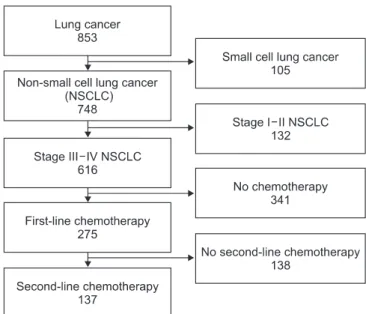
tients were diagnosed with NSCLC. First-line chemotherapy was undergone by 275 patients with stage III−IV, pathologi- cally proven NSCLC who were inoperable or who had re- jected surgery. Second-line chemotherapy was undergone by 137 patients who showed progression during first-line chemotherapy (n=98), or some time after completing first-line chemotherapy (n=7), or who stop receiving chemotherapy because of adverse effects, performance, or their own decision (n=32) (Figure 1). The median age was 63 years old (range, 39−86 years); 96 (70%) were male and 41 (30%) were female.

Adenocarcinoma was the most common cell type (46%), fol- lowed by squamous cell carcinoma (34%). Best response to first-line chemotherapy was partial remission (PR) in 42% of patients, stable disease (SD) in 17%, and progressive disease (PD) in 41%. Platinum-based chemotherapeutics were used in 49% of patients for second-line chemotherapy. Tyrosine kinase inhibitors, pemetrexed, and docetaxel were prescribed as single agents (Table 1).

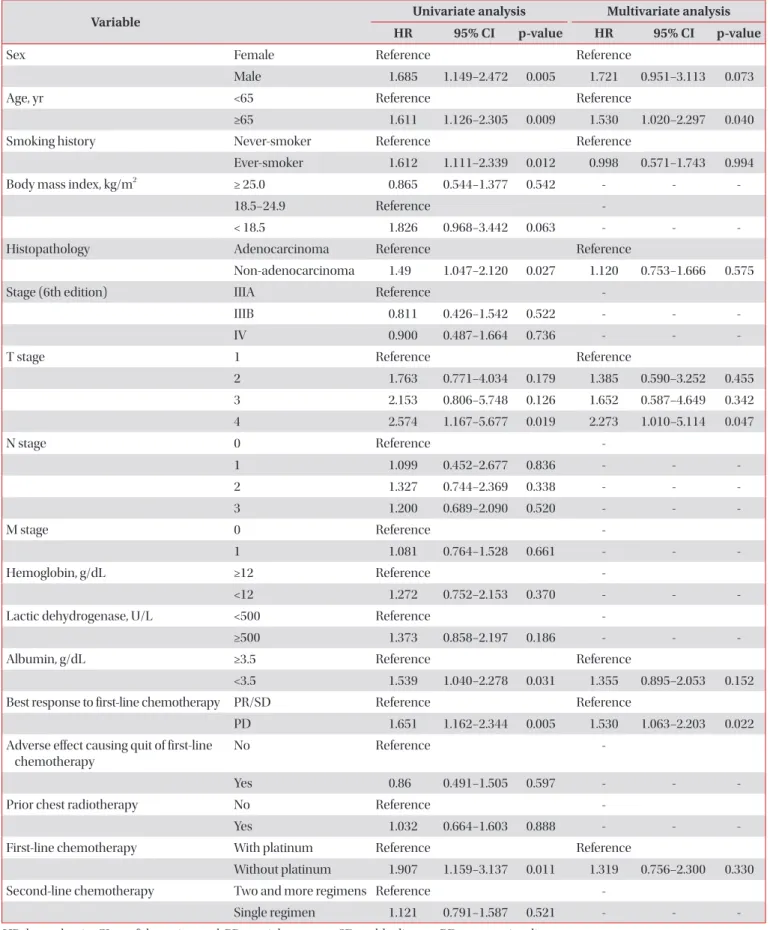
When we analyzed clinical indicators that affect survival, significant variables were sex, age>65 years, smoking, patho- logical classification, T-stage, albumin level, and best response to first-line chemotherapy in univariate analysis (Table 2). Cox regression was analyzed on significant prognostic determi- nants of the primary analysis. Patients aged 65 or older had 1.53 times higher risk of death than those younger than 65 years (confidence interval [CI], 1.02−2.30; p=0.040). Moreover, patients whose best response to first-line chemotherapy was PD showed 1.53 times higher risk of death than the SD and PR groups (CI, 1.06−2.20; p=0.022). In terms of T stage, stage T4 presented 2.27 times higher risk than stage T1 (CI, 1.01−5.11;

p=0.047).

Figure 1. Flow diagram showing the enrollment process.

(3)

Discussion

Age over 65 years, T4 tumor stage, and poor response to first-line chemotherapy were the most influential predic-

tors of survival after second-line chemotherapy in this study.

Second-line chemotherapy is performed in cases of PD dur- ing first-line chemotherapy or during follow-up period after completing first-line chemotherapy. Although second-line chemotherapy is implemented to improve the survival rate of cancer patients

2,5

, it can raise the hazard ratio in high risk groups

8

. The indication of second-line chemotherapy and se- lection of proper chemotherapeutic should be clearly defined, which necessitates identification of factors that predict the outcome of second-line chemotherapy. Earlier studies report- ed poor performance status, advanced clinical stage, longer intervals between completion of first-line chemotherapy and initiation of second-line chemotherapy, poor response during first-line chemotherapy, male sex, and histological type of non- adenocarcinoma as significant prognostic determinants

6-9

.

Our finding that outcomes of second-line chemotherapy rely on response to first-line chemotherapy aligned with re- sults of previous studies

7,8,10,12

. Di Maio et al.

7,10

reported that among patients with advanced NSCLC who undergo second- line chemotherapy, the hazard ratio of death in patients who did not respond to first-line chemotherapy was 1.25, similar to the 1.53 in the non-responding group in our study. Response to first-line chemotherapy seems to be an important predictor of response to second-line chemotherapy.

Unlike previous studies, we found higher risk of death in pa- tients aged 65 or older than in patients aged younger than 65 years. Studies that compared prognosis between younger and elderly patients found no significant differences in response, time to progression, and OS in elderly patients (i.e., older than 70 years) compared with younger patients

13,14

. The discrepan- cy between our results and the earlier reports might be from differences in chemotherapy regimens and clinical setting. El- derly patients usually show more hematologic adverse effects during cytotoxic chemotherapy

14

.

Initial clinical stage affects the success of second-line che- motherapy

6,7,9

. Our multivariate analysis showed clinical T4 stage to be a significant risk factor compared with T1. Initial tumor stage appears to be a more important predictor of response to second-line chemotherapy than nodal stage or presence of metastasis in advanced lung cancer. Previous reports found that combination chemotherapy in second-line chemotherapy did not increase patients’ survival rate, which accords with our results

15-17

.

This study had some limitations. It was a single-center retro- spective study with a small sample size. During the enrollment period, treatment models and approaches to chemotherapy selection changed, especially with the introduction of mo- lecular target agents. Although this study did not reflect these recent changes, it was analyzed in the light of mainly cytotoxic second-line agents. Additionally, this study did not include performance status at the time of second-line chemotherapy because of incomplete records.

Conclusively, age younger than 65 years, early T stage and Table 1. Baseline characteristics of patients

Variable No. (%)

Male 96 (70)

Age

Median age (range), yr 63 (39–86)

≥65 yr 59 (43)

Smoking

Current smoker 55 (40)

Ex-smoker 28 (21)

Never smoker 54 (39)

Histopathology

Adenocarcinoma 63 (46)

Squamous cell carcinoma 47 (34)

Others* 27 (20)

Stage (6th edition)

IIIA 12 (9)

IIIB 48 (35)

IV 77 (56)

First-line chemotherapy regimen

Platinum+gemcitabine 32 (23)

Platinum+docetaxel 19 (14)

Platinum+paclitaxel 63 (46)

Platinum+others 4 (3)

Single regimen 19 (14)

Best response to first-line chemotherapy

PR 58 (42)

SD 23 (17)

PD 56 (41)

Prior radiotherapy on chest 33 (34)

Second-line chemotherapy regimen

Platinum-based doublets 67 (49)

Tyrosine kinase inhibitor 25 (18)

Pemetrexed 14 (10)

Docetaxel 8 (6)

Others 23 (17)

*Large cell carcinoma, adenosquamous cell carcinoma, unspeci- fied non-small cell carcinoma.

PR: partial response; SD: stable disease; PD: progressive disease.

(4)

Table 2. Prognostic factors for mortality by Cox-regression analysis

Variable Univariate analysis Multivariate analysis

HR 95% CI p-value HR 95% CI p-value

Sex Female Reference Reference

Male 1.685 1.149−2.472 0.005 1.721 0.951−3.113 0.073

Age, yr <65 Reference Reference

≥65 1.611 1.126−2.305 0.009 1.530 1.020−2.297 0.040

Smoking history Never-smoker Reference Reference

Ever-smoker 1.612 1.111−2.339 0.012 0.998 0.571−1.743 0.994

Body mass index, kg/m

2

≥ 25.0 0.865 0.544−1.377 0.542 - - -

18.5−24.9 Reference -

< 18.5 1.826 0.968−3.442 0.063 - - -

Histopathology Adenocarcinoma Reference Reference

Non-adenocarcinoma 1.49 1.047−2.120 0.027 1.120 0.753−1.666 0.575

Stage (6th edition) IIIA Reference -

IIIB 0.811 0.426−1.542 0.522 - - -

IV 0.900 0.487−1.664 0.736 - - -

T stage 1 Reference Reference

2 1.763 0.771−4.034 0.179 1.385 0.590−3.252 0.455

3 2.153 0.806−5.748 0.126 1.652 0.587−4.649 0.342

4 2.574 1.167−5.677 0.019 2.273 1.010−5.114 0.047

N stage 0 Reference -

1 1.099 0.452−2.677 0.836 - - -

2 1.327 0.744−2.369 0.338 - - -

3 1.200 0.689−2.090 0.520 - - -

M stage 0 Reference -

1 1.081 0.764−1.528 0.661 - - -

Hemoglobin, g/dL ≥12 Reference -

<12 1.272 0.752−2.153 0.370 - - -

Lactic dehydrogenase, U/L <500 Reference -

≥500 1.373 0.858−2.197 0.186 - - -

Albumin, g/dL ≥3.5 Reference Reference

<3.5 1.539 1.040−2.278 0.031 1.355 0.895−2.053 0.152

Best response to first-line chemotherapy PR/SD Reference Reference

PD 1.651 1.162−2.344 0.005 1.530 1.063−2.203 0.022

Adverse effect causing quit of first-line chemotherapy

No Reference -

Yes 0.86 0.491−1.505 0.597 - - -

Prior chest radiotherapy No Reference -

Yes 1.032 0.664−1.603 0.888 - - -

First-line chemotherapy With platinum Reference Reference

Without platinum 1.907 1.159−3.137 0.011 1.319 0.756−2.300 0.330

Second-line chemotherapy Two and more regimens Reference -

Single regimen 1.121 0.791−1.587 0.521 - - -

HR: hazard ratio; CI: confidence interval; PR: partial response; SD: stable disease; PD: progressive disease.

(5)

good therapeutic responsive to initial chemotherapy predict favorable outcome of second-line chemotherapy. However, determinants of response to salvage chemotherapies should be further analyzed in a multicenter study.

Conflicts of Interest

No potential conflict of interest relevant to this article was reported.

Acknowledgements

There was no financial support. We thank Kyoung Ae Kong, M.D., Ph.D. for her statistical support.

References

1. Ihde DC. Chemotherapy of lung cancer. N Engl J Med 1992;

327:1434-41.

2. Shepherd FA, Dancey J, Ramlau R, Mattson K, Gralla R, O’Rourke M, et al. Prospective randomized trial of docetaxel versus best supportive care in patients with non-small-cell lung cancer previously treated with platinum-based chemo- therapy. J Clin Oncol 2000;18:2095-103.

3. Chemotherapy in non-small cell lung cancer: a meta-analysis using updated data on individual patients from 52 ran- domised clinical trials. Non-small Cell Lung Cancer Collab- orative Group. BMJ 1995;311:899-909.

4. Tassinari D, Scarpi E, Sartori S, Tamburini E, Santelmo C, Tombesi P, et al. Second-line treatments in non-small cell lung cancer. A systematic review of literature and metaanaly- sis of randomized clinical trials. Chest 2009;135:1596-609.

5. Barlesi F, Jacot W, Astoul P, Pujol JL. Second-line treatment for advanced non-small cell lung cancer: a systematic review.

Lung Cancer 2006;51:159-72.

6. Hanna N, Shepherd FA, Fossella FV, Pereira JR, De Marinis F, von Pawel J, et al. Randomized phase III trial of pemetrexed versus docetaxel in patients with non-small-cell lung cancer previously treated with chemotherapy. J Clin Oncol 2004;22:

1589-97.

7. Di Maio M, Lama N, Morabito A, Smit EF, Georgoulias V, Takeda K, et al. Clinical assessment of patients with advanced non-small-cell lung cancer eligible for second-line chemo- therapy: a prognostic score from individual data of nine ran- domised trials. Eur J Cancer 2010;46:735-43.

8. Florescu M, Hasan B, Seymour L, Ding K, Shepherd FA; Na- tional Cancer Institute of Canada Clinical Trials Group. A clinical prognostic index for patients treated with erlotinib in National Cancer Institute of Canada Clinical Trials Group study BR.21. J Thorac Oncol 2008;3:590-8.

9. Weiss GJ, Rosell R, Fossella F, Perry M, Stahel R, Barata F, et al. The impact of induction chemotherapy on the outcome of second-line therapy with pemetrexed or docetaxel in patients with advanced non-small-cell lung cancer. Ann Oncol 2007;

18:453-60.

10. Di Maio M, Krzakowski M, Fougeray R, Kowalski DM, Gridelli C. Prognostic score for second-line chemotherapy of ad- vanced non-small-cell lung cancer: external validation in a phase III trial comparing vinflunine with docetaxel. Lung Cancer 2012;77:116-20.

11. Eisenhauer EA, Therasse P, Bogaerts J, Schwartz LH, Sargent D, Ford R, et al. New response evaluation criteria in solid tu- mours: revised RECIST guideline (version 1.1). Eur J Cancer 2009;45:228-47.

12. Inal A, Kaplan MA, Kucukoner M, Urakci Z, Karakus A, Isik- dogan A. Prognostic factors for second-line treatment of ad- vanced non-small-cell lung cancer: retrospective analysis at a single institution. Asian Pac J Cancer Prev 2012;13:1281-4.

13. Weiss GJ, Langer C, Rosell R, Hanna N, Shepherd F, Einhorn LH, et al. Elderly patients benefit from second-line cytotoxic chemotherapy: a subset analysis of a randomized phase III trial of pemetrexed compared with docetaxel in patients with previously treated advanced non-small-cell lung cancer. J Clin Oncol 2006;24:4405-11.

14. Wu CH, Fan WC, Chen YM, Chou KT, Shih JF, Tsai CM, et al.

Second-line therapy for elderly patients with non-small cell lung cancer who failed previous chemotherapy is as effective as for younger patients. J Thorac Oncol 2010;5:376-9.

15. Takeda K, Negoro S, Tamura T, Nishiwaki Y, Kudoh S, Yokota S, et al. Phase III trial of docetaxel plus gemcitabine versus docetaxel in second-line treatment for non-small-cell lung cancer: results of a Japan Clinical Oncology Group trial (JCOG0104). Ann Oncol 2009;20:835-41.

16. Wachters FM, Groen HJ, Biesma B, Schramel FM, Postmus PE, Stigt JA, et al. A randomised phase II trial of docetaxel vs docetaxel and irinotecan in patients with stage IIIb-IV non- small-cell lung cancer who failed first-line treatment. Br J Cancer 2005;92:15-20.

17. Pectasides D, Pectasides M, Farmakis D, Kostopoulou V,

Nikolaou M, Gaglia A, et al. Comparison of docetaxel and

docetaxel-irinotecan combination as second-line chemother-

apy in advanced non-small-cell lung cancer: a randomized

phase II trial. Ann Oncol 2005;16:294-9.

수치

Figure 1. Flow diagram showing the enrollment process.
Table 2. Prognostic factors for mortality by Cox-regression analysis

참조

관련 문서

Phase III trial of docetaxel plus gem- citabine versus docetaxel in second-line treatment for non-small-cell lung cancer: results of a Japan Clinical Oncology

Phase II study of pemetrexed disodium, a multitargeted antifolate, and cisplatin as first-line therapy in patients with advanced nonsmall cell lung carcinoma:

Final results of phase III trial in regionally advanced unresectable non-small cell lung cancer: Radiation Therapy Oncology Group, Eastern Cooperative Oncology

A randomized open-label study of gefitinib versus docetaxel in patients with advanced/me- tastatic non-small cell lung cancer (NSCLC) who have previously received

A Randomized, Open-Label, Phase II Study Comparing Pemetrexed Plus Cisplatin Followed by Maintenance Pemetrexed versus Pemetrexed Alone in Patients with Epidermal

FLEX: a randomized, multicenter, phase III study of cetuximab in combination with cisplatin/vinorelbine (CV) versus CV alone in the first-line treatment of patients with

Although docetaxel monotherapy has shown clinical benefits for previously treated patients with advanced non-small cell lung cancer (NSCLC), the efficacy of salvage

On the contrary, CheckMate026 trial, a phase III study of nivolumab versus platinum-based chemotherapy in patients with treatment-naïve advanced NSCLC with a PD-L1 TPS of ≥1%, did