Ethanol Production from Seaweed, Enteromorpha intestinalis, by Sepa- rate Hydrolysis and Fermentation (SHF) and Simultaneous Saccharifi- cation and Fermentation (SSF) with Saccharomyces cerevisiae
YuKyeong Cho, Min-Ji Kim, and Sung-Koo Kim
*접수: 2013년 6월 15일 / 게재승인: 2013년 10월 18일
© 2013 The Korean Society for Biotechnology and Bioengineering
Abstract: Ethanol productions were performed by separate hydrolysis and fermentation (SHF) and simultaneous saccha- rification and fermentation (SSF) processes using seaweed, Enteromorpha intestinalis (sea lettuce). Pretreatment condi- tions were optimized by the performing thermal acid hydroly- sis and enzymatic hydrolysis for the increase of ethanol yield.
The pretreatment by thermal acid hydrolysis was carried out with different sulfuric acid concentrations in the range of 25 mM to 75 mM H2SO4, pretreatment time from 30 to 90 min- utes and solid contents of seaweed powder in the range of 10~
16% (w/v). Optimal pretreatment conditions were determined as 75 mM H2SO4 and 13% (w/v) slurry at 121oC for 60 min.
For the further saccharification, enzymatic hydrolysis was per- formed by the addition of commercial enzymes, Celluclast 1.5 L and Viscozyme L, after the neutralization. A maximum reducing sugar concentration of 40.4 g/L was obtained with 73% of theoretical yield from total carbohydrate. The ethanol concentration of 8.6 g/L of SHF process and 7.6 g/L of SSF process were obtained by the yeast, Saccharomyces cerevisiae KCTC 1126, with the inoculation cell density of 0.2 g dcw/L.
Keywords: Bioethanol, Fermentation, Enteromorpha intesti- nalis, Saccharomyces cerevisiae
1. Introduction
Biomass can serve as the excellent resource to meet the present and future energy demands [1]. Biofuels including bioethanol, biodiesel, biohydrogen and biogas can provide the alternative
transportation fuels. Bioethanol is a promising transportation fuel as it can replace the fossil fuels.
Current production of bioethanol relies on ethanol from starch and sugars but there has been considerable debate about its sustainability [2]. Lignocellulosic biomass has been regarded as the one of the most prospective biomass because it could be used as inexpensive biomass and there is no competition with food directly or indirectly. However, ethanol production from lignocellulosic biomass tends to require pretreatment under severe conditions due to lignin degradation. Lignin is an aro- matic polymer synthesized from phenylpropanoid precursors and it is one of the drawbacks in fermentation, as it makes lignocellulosic biomass resistant to chemical and biological degradation [3].
Seaweed is a third generation biomass for the bioethanol pro- duction since it has been known for the lignin-free composition and high carbohydrate content. Seaweed can be grown rapidly comparing to land-based biomass and have been harvested in worldwide. Enteromorpha (sea lettuce) are green macroalgae distributed widely in inter-tidal zones and its growth rate can reach 12.7% per day [4]. Enteromorpha also features the rich- ness in polysaccharides containing a large amount of glucose, xylose, galactose, glucuronic acid, and rhamnose [4]. Thus, the green algae, Enteromorpha, is great potential resource for bio- ethanol production.
Bioethanol production requires three major processes for the conversion of polysaccharides into ethanol through pretreat- ment, saccharification and fermentation. The first-step is ther- mal acid pretreatment which alter structural integrity of biomass and increase the enzymatic accessibility prior to enzymatic hydrolysis. Enzymatic hydrolysis is second process to hydrolyze the cellulose to oligomeric and monosaccharide as well as decrease the viscosity of hydrolysates, which enables easier
Department of Biotechnology, Pukyong National University, Busan
608-737, Korea
Tel: +82-51-629-5868, Fax: +82-51-629-7398 e-mail: [email protected]
연구논문
pumping and stirring [5]. The enzymatic hydrolysis currently has monomeric sugar yields of 75~80% and improvements are still projected to 85~95% [3]. After the pretreatment and the enzymatic hydrolysis, fermentation was carried out to produce ethanol by yeasts. When two processes, enzymatic hydrolysis and fermentation, were separately performed, it is referred to the separate hydrolysis and fermentation (SHF). However, each process can be simultaneously carried out, which is referred to simultaneous saccharification and fermentation (SSF) process.
SSF process has been regarded as the major option due to high overall yields and process integration [6]. SSF process is favor- able because it requires low energy consumption and short pro- cess time. The researchers implement both SHF and SSF pro- cesses to compare the ethanol production efficiency.
In this study, reducing sugar production was optimized by thermal acid hydrolysis and/or dual enzyme treatment. And ethanol production by SHF and SSF processes were compared to demonstrate the potential of alternative process to produce ethanol from seaweed, E. intestinalis.
2. Materials and Methods
2.1. Raw materials and characterization
The seaweed, E. intestinalis, harvested in October 2010, was obtained from Wan-do in Jeon-nam, Korea. Samples were oven- dried at 55oC and milled by hammer mill. The crude protein content of seaweed was estimated by Kjeldahl method. Crude lipid was determined by using an ether extraction procedure (Soxtec System 1046, foss, Hoganas, Sweden) after freeze-dry- ing for 12 h. Determination of crude ash was done by incinera- tion at 550oC for 3 h. The total carbohydrate content was de- termined by the calculation.
2.2. Thermal acid hydrolysis
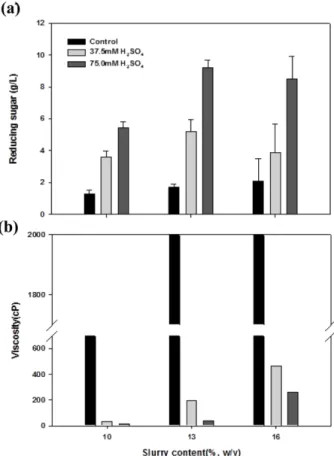
The thermal acid hydrolysis condition of E. intestinalis was optimized with three factors of sulfuric acid concentration (37.5, 75 mM), treatment time (30~90 min) and solid contents (10~16%, w/v) [10]. The slurry was treated by autoclave at 121oC in accordance with each condition and the treatment was performed in triplicate. Samples were filtered and stored at 4oC for the determination of reducing sugar content and viscosity.
2.3. Enzymatic hydrolysis of pretreated seaweed slurry Commercial enzymes, Celluclast 1.5 L and Viscozyme L were purchased from Sigma (Novozymes, Bagsvaerd, Denmark) [14].
The pH of pretreated seaweed slurry was adjusted to 4.5 before the treatment of enzyme mixture of Celluclast 1.5 L (8.4 filter paper unit FPU/ml) and Viscozyme L (1.2 endo-glucanase unit
EGU/ml). Enzymatic hydrolysis was carried out at 55oC in water bath shaker with 120 rpm for 54 h. Enzymatic hydroly- zates were evalulated by reducing sugar contents measurement using DNS method [7].
2.4. Yeast cultivation
Yeast, Saccharomyces cerevisiae KCTC 1126 obtained from KCTC was used for the fermentation in this study. The ino- culum culture was prepared on YPD agar plate containing yeast extract 10 g/L, peptone 20 g/L, dextrose 20 g/L and agar 5%
(w/v). Yeast suspension was incubated at 30±2oC with 220 rpm in a shaking incubator.
2.5. Ethanol fermentation
2.5.1. Separate hydrolysis and fermentation (SHF)
Pretreatment of seaweed slurry was performed with sulfuric acid and enzymatic hydrolysis. The pH hydrolysate slurry was then adjusted to 5.5 for the fermentation. The fermentation me- dium was supplemented with 0.5 g/L (NH4)2HPO4, 0.025 g/L MgSO4•7H2O and 1.0 g/L yeast extract [17]. Fermentation was carried out by the inoculation of yeast suspension with a final cell concentration of 0.2 g dcw/L. Samples were withdrawn at 12 h of interval during the experiment and used for the analysis of sugars, ethanol and organic acid.
2.5.2. Simultaneous saccharification and fermentation (SSF) SSF was carried out in 250 ml flask with working volume 100 ml of pretreated seaweed slurry. Nutrients were added to the medium; 0.5 g/L (NH4)2HPO4, 0.025 g/L MgSO4•7H2O and 1.0 g/L yeast extract. Fermentation was started by the addition of enzymes mixture and yeast, S. cerevisiae KCTC 1126 suspen- sion (0.2 g dcw/L). Fermentation was carried out at 30±2oC for 120 h and the stirrer speed of 220 rpm. Sampling and analysis were performed as described above.
2.6. Analysis of reducing sugar, monosaccharide and viscosity
Reducing sugar contents were determined by the 3, 5-dinitrosa- licyclic acid (DNS) method with glucose (Sigma Chemical Co.
USA) as the standard [7]. Sugars, ethanol and other organic acid were analyzed by HPLC (Agilent 1100 Series, Agilent.
Inc., USA) fitted with Agilent G1362A refractive index detec- tor (RID). Ethanol, acetic acid and 5-hydroxyl methyl furfural (5-HMF) were analyzed with Bio-rad Aminex HPX-87H column (300×7.8 mm) and Superguard C610H column (50×4.6 mm) at 65oC with eluent of 5 mM sulfuric acid and the flow rate of 0.6 ml/min. Samples were filtered through a 0.2 µm filter prior to analysis to remove particles.
Viscosity was measured by Brookfield viscometer (BROOK-
FIELD DV-III Rheometer v3.1, Brookfield Eng. Inc., USA) equipped with spindle No. ULA, SC4-18 and SC4-34 at 30oC.
Yeast cell growth for the inoculation was measured by UV-Vis spectrophotometer at OD600 and converted to dcw using stand- ard curve.
3. Results and Discussions
3.1. Composition and characterization of E. intestinalis The composition of E. intestinalis was determined. E. intesti- nalis contains 31.6% of crude protein, 1.3% of crude lipid, 24.3% of crude ash and 42.8% of total carbohydrate. In other studies with green seaweeds, Ulva and Enteromorpha carbohy- drate contents were approximately 30~40% as glucose, xylose, galactose, rhamnose and glucuronic acid [4].
3.2. Effect of pretreatment condition
Seaweed, Enteromorpha, requires pretreatment in order to make the carbohydrate accessible to enzymes. The pretreatment of seaweed slurry with sulfuric acid increases the enzymatic digestibility of biomass, giving the higher sugar yield than that without sulfuric acid treatment [8]. Therefore, three different variables of solid content, treatment time and sulfuric acid concentration, were selected as the determinant factors for the pretreatment condition.
The results of reducing sugar yield (g/L) by 37.5 mm and 75.0 mm H2SO4 concentrations at 121oC for 30 min in E. intes- tinalis are shown in Fig. 1(a). Yield of reducing sugar (g/L) increased with the increases of sulfuric acid concentration and slurry content in pretreatment. The increase of sulfuric acid concentration from 37.5 mM to 75 mM produced higher redu- cing sugar content of 9.2 g/L and the maximum yield of 16.5%
was achieved with the 75 mM H2SO4 at the slurry content of 13% (w/v).
However, the increase of slurry content decreases reducing sugar production causing difficulty with rotation. Fig. 1(b) shows the effect of slurry contents and sulfuric acid concentrations on viscosity of slurry. The viscosities of slurry were decreased when solid contents decreased and sulfuric acid concentration increased. It has been reported that increased slurry content led to high viscosity which inhibited the cell growth and medium handling although high solid content provided economic ad- vantages [9,10]. High solid content also results in processing problems including high power consumption and reduced conversion [11]. In this experiment, 13% (w/v) solid content showed maximum hydrolysis yield, however, further increase in solid content decreased the hydrolysis yield. Therefore, 13%
(w/v) slurry content was used for the ethanol production process.
Seaweed, E. intestinalis, slurry were treated with time varia- tion and the result of reducing sugar yield were shown in Fig.
2. Using the solid content of 13% (w/v), the yield of reducing sugar increased from 9.2 g/L to 14.7 g/L by increasing the treat- ment time from 30 min to 60 min. However, a slight increase
Fig. 1. Evaluation of optimal condition for the thermal acid hydro- lysis using concentrations of H
2SO
4and seaweed slurry contents.
(a) Production of reducing sugar (g/L) and (b) viscosity (g/L) depen- ding on concentrations of H
2SO
4and seaweed slurry contents (w/v).
Fig. 2. Production of reducing sugar (g/L) treated with 75 mM H
2SO
4and 13% (w/v) E. intestinalis slurry depending on the treatment time.
of reducing sugar yield was observed when treatment time was extended from 60 min to 90 min. Lu et al. (2007) reported that the increase of treatment time led to the decrease of reducing sugar production which caused sugar decomposition with pro- duction of furfural and 5-HMF [10]. Considering the pretreat- ment efficiency and cost, 13% (w/v) of solid contents, 75 mM of H2SO4 and treatment time of 60 min were selected for further experiments.
3.3. Hydrolysis of E. intestinalis by commercial enzymes Enzymatic hydrolysis of green seaweed, E. intestinalis, with commercial enzyme mixture was performed after the thermal acid hydrolysis. E. intestinalis was further hydrolyzed by the addition of commercial enzymes, Celluclast 1.5 L and Visco- zyme L, to increase the saccharification yield of seaweed.
The enzymatic hydrolysis with commercial enzymes is shown in Fig. 3. The reducing sugar of 20.9 g/L with 37.7% of theore- tical yield was obtained using Celluclast 1.5 L only. Viscozyme L treatment showed hydrolysis, showing maximum reducing sugar content of 24.2 g/L with 43.7% of theoretical yield. Vis- cozyme L, a multi-enzyme complex including arabinase, cellu- lase, beta-glucanase, hemicellulase and xylanase could degrade diverse polysaccharides containing in E. intestinalis whereas Celluclast 1.5 L degraded cellulose. The hydrolysis efficiency of the mixed two enzymes, Celluclast 1.5 L and Viscozyme L, was higher than that of individual enzyme treatment. A maxi- mum reducing sugar of 40.4 g/L corresponding to 73.0% of theoretical yield was obtained at the incubation of 36 h with the mixture of two enzymes. It has been reported that mixed enzy- mes treatment increased the release of reducing sugar content comparing to individual enzyme treatment [12].
3.4. SSF and SHF
Fermentation was carried out using SHF and SSF methods. In order to compare SHF and SSF, fermentation yields were cal- culated by assuming that all monosaccharides in the slurry are available for the fermentation. Based on the assumption, etha- nol concentration of 8.6 g/L, corresponding to 30.5% of theo- retical case was obtained at 48 h in SHF process as shown in Fig. 4(a). The ethanol concentration of 7.6 g/L with an ethanol yield of 26.9% of theoretical case was observed by SSF pro- cess as shown in Fig. 4(b). Fig. 4 also shows the time course of reducing sugar consumption, ethanol and inhibitor productions in each process.
In the SHF, reducing sugar was rapidly decreased from 40 g/L to 14.7 g/L during 24 h of fermentation. During the same period, a rapid increase of ethanol concentration was observed. How- ever, 10 g/L of reducing sugar was still remained at the end of the SHF process. This indicates that non-fermentable sugar monomers in E. intestinalis were not utilized by S. cerevisiae during fermentation since the glucose was consumed as a carbon source by the yeast. Similar pattern of reducing sugar consumption and ethanol production was also observed in case
Fig. 3. Reducing sugar production (g/L) by enzymatic hydrolysis of pretreated E. intestinalis slurry with enzymes, Celluclast 1.5 L and/
or Viscozyme L.
Fig. 4. Fermentation of reducing sugars from thermal acid hydroly- sis and enzyme treated E. intestinalis to produce bioethanol Changes of reducing sugar, ethanol, acetic acid and HMF concentrations (g/
L) in (a) SHF (b) SSF processes.
of SSF. The concentration of reducing sugar remained under 10 g/L after 36 h of fermentation. In the SSF, the extent of car- bohydrate conversion into reducing sugar was lower than that obtained in the SHF process. This might be the difference in process temperatures of fermentation and enzymatic hydrolysis of treatment. The overall process of SSF was carried out at temperature of 32oC, which is lower than the optimal tempera- ture of 55oC for the action of each enzyme. Although the com- mercial enzymes had quite different specific activities, SSF process worked better than SHF process, considering the effi- ciencies of ethanol production and time required for separate enzymatic hydrolysis of 36 h and fermentation of 48 h.
The ethanol concentrations decreased after reaching maximum ethanol concentrations at 48 h and 36 h in SHF and SSF proce- sses, respectively. The decrease of ethanol concentration might be related to the conversion of ethanol to acetic acid. It has been reported that the microbial population was adapted to consume sugar and ethanol when the ethanol was accumulated in the medium thus resulted in reduction of ethanol concentra- tion [13]. Similar result of decline in ethanol production after maximum ethanol production was reported in other study [14].
The changes of fermentation inhibitor concentration during SHF and SSF process are shown in Fig. 4. The increase of acetic acid was observed with the decrease of ethanol concen- tration as shown in Fig. 4(a) and (b). Acetic acid concentration less than 3 g/L, lower than inhibitory concentration of fermen- tation was observed throughout all experiment in SSF and SHF processes [15]. HMF was also major by-product derived from hexoses. However, 5-HMF was not detected in both processes.
Despite the 70% of hydrolysis, results showed low ethanol production. It showed that all of reducing sugars produced from thermal acid hydrolysis and enzymatic hydrolysis were not uti- lized during fermentation process. The yeast, S. cerevisiae, can utilize C6-monosaccharides as substrate and hardly metabolize other types of saccharide that such as xylose, arabinose [5]. In this study, various types of monosaccharides hydrolyzed from E. intestinalis were not utilized because of the limitation of sub- strate uptake by the yeast. Hsu et al. [5] reported that xyolse in lignocellulosic biomass cannot be efficiently utilized due to the same reason. However, our result shows that the ethanol pro- duction amount and yield were higher than other study although the ethanol fermentation was carried out with only S. cerevisiae not combination with other yeasts which can metabolize C5- monosaccharides [16]. Another reason related to low ethanol conversion was due to rhamnose and glucuronic acid which were handly converted into ethanol by fermentation. Thus, im- provement of yeast strains capable of fermenting both hexose and pentose sugars should be applied for the improvement of ethanol production from seaweeds.
4. Conclusions
Seaweed, E. intestinalis, is an attractive biomass for bioethanol production due to lignin-free composition and its high carbo- hydrate contents. The study of bioethanol production process and improvement of saccharification step from E. intestinalis was described in this paper. The application of dual-enzymes, Celluclast 1.5 L and Viscozyme L, can improve enzymatic digestibility and the conversion of polysaccharide to reducing sugar reached about 73.4% after 36 h. This results are based on the further studies to increase saccharification yield from sea- weed, E. intestinalis.
The highest ethanol concentration of 8.6 g/L corresponding to 30.5% of theoretical yield was achieved in SHF process whereas 7.6 g/L of ethanol concentration corresponding to 26.9%
in SSF process was obtained with S. cerevisiae. It was concluded that SSF process showed a better efficiency than SHF process, considering fermentation yield and time required for all process.
ACKNOWLEDGEMENTS
This research was supported by Basic Science Research Pro- gram through the National Research Foundation of Korea (NRF) funded by the Ministry of Education (2013R1A1A2059095).