Journal of the Pharmaceutical Society of Korea 21, 173-176 (1977)
Studies on the Anti-inflammatory Agents. Synthesis of Carboxamides and Their Anti-inflammatory A ctivity
D o n g K y u Chae
College o f Pharm acy,Seoul N atio n al U niversity, Seoul 151
(Received October 18, 1977)
Abstract—Four compounds, N-(.2t 3-dimethylphenyl)benzamide, 부 (3-trifluoromethylphenyl) benzamide, N-(.2t 3-dimethylphenyl) cinnamamide and ^-O-trifluoromethylphenyOcinnamamide, were synthesized and evaluated their activity by the method of the inhibi
tory effect on the carrageenin-induced rat paw edema, compared with phenylbutazone. A ll of these exhibited anti-inflammatory acti
vity, and N-C2, 3-dimethylphenyl)benzamide exhibited 45.7% edema inhibition vs. control when 100 mg/kg of dosage was administered, whereas phenylbutazone, 51.4% for 50은 mg/kg.
A m ong the compounds exhibiting anti-inflammatory activity which have appeared in recent years, iV-substituted anthranilic acid derivatives were described to exhibit high potencies in anti
inflammatory activity1, 2〉 and there were some carboxamides3, 4) exhibiting anti-inflammatory activity, but there were no reports on the carboxamides of 2, 3-xylidine and 3-aminobenzotri- fluoride. W e intended to prepare carboxamides belonging to 2, 3-xylidine and 3-aminobenzotri - fluoride which expected to exhibit the activity. F ou r compounds of these series were synthe- sized and evaluated for their activity by the method of the inhibitory effect on the carragee- nin-induced rat paw edema.
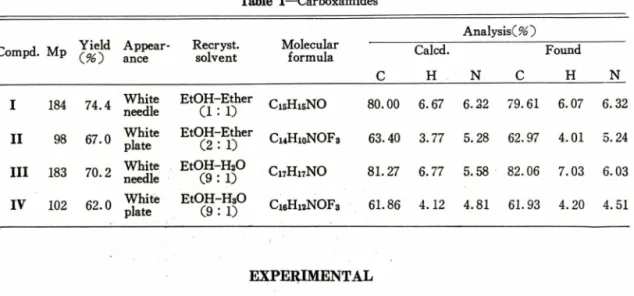
Chemistry_ The compounds described in Table I were synthesized by the reaction of appro
priate amines with benzoyl chloride and cinnamoyl chloride in the modified condition of Schotten5) and Baumann6). The starting cinnamoyl chloride was synthesized from cinnamic acid and thionyl chloride by the method previously described7).
Anti-inflam m atory activity— The carrageenin-induced rat paw edema assay was carried out
using a modified W inte r’s method8, 9) as a preliminary screening test. The rats, in groups of
four animals weighing 15ᄋ〜 200 g, young adult female Sprague-Dawley strain, were fasted 16
hours prior to administration of the test compounds. The test compounds and saline (as a
control) were administered orally. One hour later, the volume of the right hind paw was
C15H15NO 80.00 6.67 6.22 79.61 6.07 6.32 C14H10NOF3 63.40 3.77 5.28 62.97 4.01 5.24 C17H17NO 81.27 6.77 5.58 82.06 7.03 6.03 C16H12NOF3 61.86 4.12 4.81 61.93 4.20 4.51
E X P E R IM E N T A L
Unless otherwise specified m elting points were determined in a Thomas-Hoover capillary m elting point apparatus and uncorrected. Infrared spectra were determined in a tablet o f K B r with a Beckmann Model 20 A double beam I R spectrophotometer.
N - ( 2 ,
3 - d i m e t h y l p h e n y l ) b e n z a m i d e ( I ) — -Placed
2 . 4 2 g ( 0 . 0 2mole)
o f 2 ,3_xy
1idine, 20 m l of 10% N a O H solution in a three-necked flask, added 2. 82 g (0. 02 mole) of benzoyl chlo
ride, stoppered and stirred vigorously for 15〜 20 min. Made sure the reaction m ixture was alkaline. Diluted with water,filtered off the product, and washed well with water. (M ethod A ) . Recrystallized from E tO H and ether (1 : 1). I R 组 cm-1 ; 3420 (N H , s), 2000-1667(1,
2 , 3-trisubstd. phenyl, overtone or combination bands), 1649 (sec. amide I , C = O t s), 1520 (sec. amide I I , N H , s), 1450 (C H
3, s), 1300 (sec. amide II, C-N, s), 1280 (amide III, s),
775, 710 ( 1 ,2 ,3-trisubstd. phenyl, s).
3-trifluoromethylphenyl)benzamide ( I I ) ■ 一 The modified procedure of C hun11) was employed. 2.12 g (0.015 m ole) of benzoyl chloride was added to a suspension of 2. 42 g (0.015 mole) of 3-aminobenzotrifluoride in 10 m l of pyridine with stirring for 30 min. on the cooling bath. A llow to stand the reaction mixture at room temperature for 30 min. Added 20 m l of water, discarded the water layer, and evaporated on water bath. (M ethod B ). Recrystallized from E tO H and ether (2 : 1). IR S K cm —1 ; 3290(NH, s), 2000-1667 (1, 3-disubstd. phenyl, overtone or combination bands), 1655 (sec. amide I, C = 0 , s), 1550 (sec. amide II, N H , s), 1320, 1262 (sec. amide III, C-N, s), 1320, 1180,1140 (C-F, broad, s), 795, 690 (1, 3- disubstd. phenyl, s).
measured plethysmometrically10),and 0. lm l of a \% solution of carrageenin in sterile pyro
gen-free 0. 9% NaCl solution as a phlogistic agent was injected into the paw. Three hours after the injection of carrageenin, the volume of the paw was again measured. Degree of edema was expressed as the rate of volume increased after carrageenin injection to the uninjected paw volume. Phenylbutazone was used as a reference compound.
Table I
ᅳCarboxamides
Analysis(%)
Compd. Mp ™ S 厂 - S n t ^ ™
C H N C H N
1
0
E th
e o h2o
q
t I
:
I :
I :
I:
OHa
§ C2 OH
C9 toH s Et Et Et Et
|1 I!
|1 麻 !
^ n v p ^ n v p
4
0
2
0 4. 7. 0. 2. 7
6
7
6 4
8
3
2 189
18 10 I
IIV
IIII