DOI http://dx.doi.org/10.12791/KSBEC.2015.24.4.317 eISSN 2288-100X
A Review of Greenhouse Energy Management by Using Building Energy Simulation
Adnan Rasheed
1, Jong Won Lee
2, and Hyun Woo Lee
1*
1Department of Agricultural Engg, Kyungpook National Univ., Daegu, 702-701, Republic of Korea
2Institute Agricultural Science & Technology, Kyungpook National University, Daegu 702-701, Republic of Korea
Abstract. This paper attempts to present a review about simulation of different greenhouse parameters and energy supplying techniques by using building energy simulation, to find out the optimal solution for keeping greenhouse microclimate favorable for the crop production. The objectives of conducting this study were, to describe the various energy systems and techniques used for the greenhouse energy management and efficiency analysis of these technol- ogies by using building energy simulation. We describe different models to understand the behavior of the energy saving technologies with respect to the resources available and different outside climatic conditions. We identified main features of the building energy simulation software, that enable users, to simulate hybrid agricultural building projects by using user defined parameters. At the end of the paper we draw some important concluding remarks on the basis of reviewing all the investigators contributions for the developments of simulation model of agricultural greenhouse energy management, using a building energy simulation software specifically TRNSYS. In conclusion, this paper provides information that TRNSYS have great potential for agricultural buildings energy simulation along with the renewable energy resources and energy saving techniques. This review paper provides aid to greenhouse researcher and energy planner for the future studies of greenhouses energy planning.
Additional Key words : energy saving, heating, microclimate, TRNSYS
Introduction
During recent years as demand of energy is increased, researchers attracts towards energy production, consump- tions, storage, management and saving (Carlini et al., 2010). Likewise, agriculture energy management of green- house is one of the most important aspects of the green- house farming is to be considered. Due to higher energy demand for greenhouse heating, and continuously increas- ing price of the fossil fuel, there is much interest to develop efficient technologies to save energy. In all over the world many technologies have been developed for cooling and heating of greenhouses to maintain the optimum inside greenhouse temperature (Xamán et al., 2014). In the mod- ern greenhouse heating cost of the greenhouse reached 49.5% of the total production cost (Yang et al., 2012).
Various energy saving measures are being used to reduce heating cost of the greenhouse (Arinze et al., 1986) like use of thermal insulation, solar energy, earth to air heat exchanger, geothermal energy and different heat storage
systems. These energy management techniques are under consideration of researchers and they are working on analy- sis of these technologies for greenhouse energy manage- ment (Sethi et al., 2013). Analysis of energy management techniques in real greenhouses by experiments will no doubt provide the most reliable data; the results obtained from such tests are site-specific and so are only valid for that particular greenhouse and its local climatic conditions. Investigators are doing research by making experiments, numerical simulations and using different computer programs for greenhouse energy management analysis (Kolokotsa et al., 2010). The Presence of building energy simulation tools for energy analysis of dif- ferent buildings, allows greater opportunity towards energy management and saving (Fitz-Rodriguez et al., 2010). The effort is to inform the reader about feasibility of building energy simulation of agricultural buildings by using TRNSYS software that allows greater opportunity to simulate all green- house parameters efficiently.
In this paper we present a review of TRNSYS software used by researchers to find out the optimal solution for the energy saving and better productivity. The papers provide information who and how many people were using this software for the specific focus on agricultural greenhouse.
*Corresponding author: [email protected]
*Received November 18, 2015; Revised December 22, 2015;
*Accepted Decmeber 22, 2015
TRNSYS
TRNSYS stands for TRaNsient SYstem Simulation pro- gram. A versatile, component based and extensible energy simulation tool for simple and complex systems as well as complete energy analysis of single/multi-zone buildings.
This program was designed by University of Wisconsin’s Solar Energy Lab and has been commercially available since 1975, since then this program has been under contin- uous development (Patil, 2010). Initially TRNSYS was developed for the thermal system simulations only but now after passing 35 years of continuous up gradation it becomes a hybrid simulator by including, photovoltaic, thermal solar and other systems. (Sinha and Chandel, 2014). TRNSYS consists of series of programs and add- ons to enable it for the simulations of complex designed projects. Main features of the program are, TRNSYS simu- lation studio, simulation engine (TRNDLL) executer (TRNExe), building input interference (TRNBuild), Editor (TRNSEdit), with add-ons Google sketch up for 3D model- ling. Moreover in agriculture, software demonstrates extreme flexibility to improve various case studies to con- tinue work for structure and energy analysis and allows
simulation of best situation by adding different compo- nents (Carlini et al., 2010).
Categories of TRNSYS usage
Referring to introduction section, TRNSYS software is available commercially since 1975, and after continuous development, it becomes hybrid simulator. The software provides greater opportunity to agriculture researchers for the agriculture building energy analysis. Since recent years, agriculture researchers are taking interest in use of TRN- SYS for the, greenhouse structure design and environment analysis and energy resources analysis.
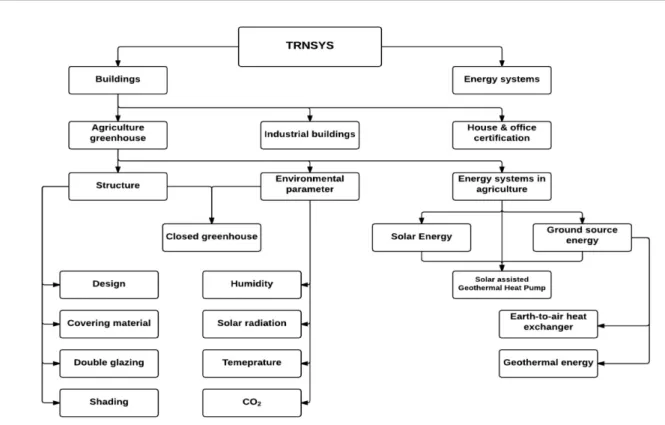
Fig. 1 shows the overall view of TRNSYS usage in agri- culture, designing of structure, environment, and use of dif- ferent energy technologies. Based upon the literature review researcher’s work in the field of agricultural green- houses is shown in the Fig. 1, with all the parameters they studied until now.
Data summary
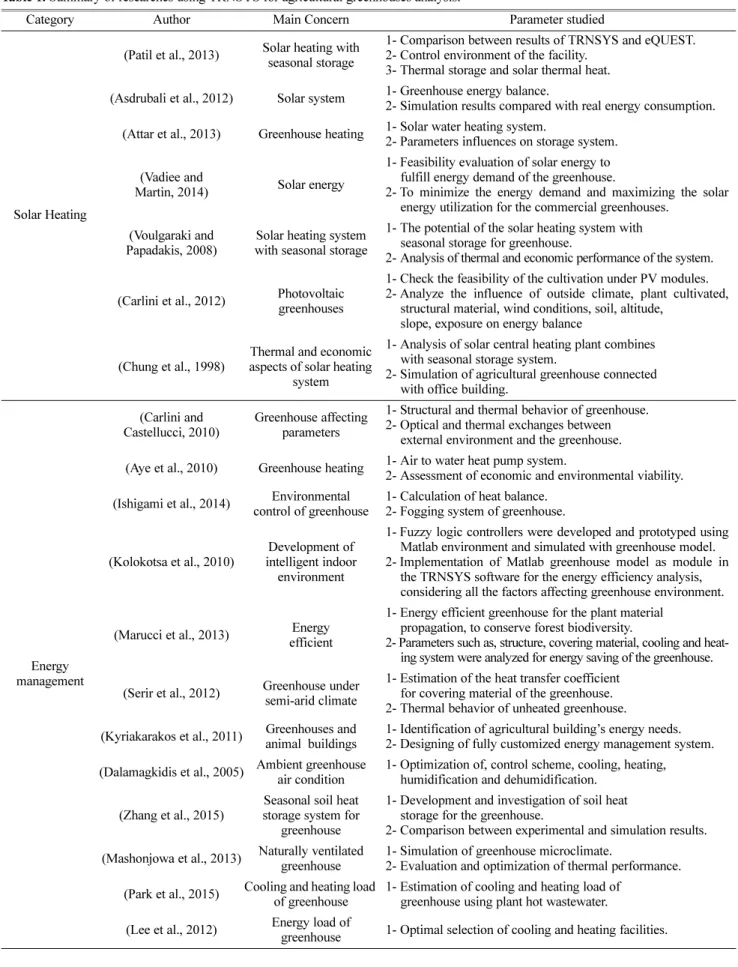
Table 1 is a summary of, recent increasing trend of build-
Fig. 1. Application of TRNSYS in agricultural greenhouses.
Table 1. Summary of researches using TRNSYS for agricultural greenhouses analysis.
Category Author Main Concern Parameter studied
Solar Heating
(Patil et al., 2013) Solar heating with seasonal storage
1- Comparison between results of TRNSYS and eQUEST.
2- Control environment of the facility.
3- Thermal storage and solar thermal heat.
(Asdrubali et al., 2012) Solar system 1- Greenhouse energy balance.
2- Simulation results compared with real energy consumption.
(Attar et al., 2013) Greenhouse heating 1- Solar water heating system.
2- Parameters influences on storage system.
(Vadiee and
Martin, 2014) Solar energy
1- Feasibility evaluation of solar energy to fulfill energy demand of the greenhouse.
2- To minimize the energy demand and maximizing the solar energy utilization for the commercial greenhouses.
(Voulgaraki and Papadakis, 2008)
Solar heating system with seasonal storage
1- The potential of the solar heating system with seasonal storage for greenhouse.
2- Analysis of thermal and economic performance of the system.
(Carlini et al., 2012) Photovoltaic greenhouses
1- Check the feasibility of the cultivation under PV modules.
2- Analyze the influence of outside climate, plant cultivated, structural material, wind conditions, soil, altitude,
slope, exposure on energy balance
(Chung et al., 1998)
Thermal and economic aspects of solar heating
system
1- Analysis of solar central heating plant combines with seasonal storage system.
2- Simulation of agricultural greenhouse connected with office building.
Energy management
(Carlini and Castellucci, 2010)
Greenhouse affecting parameters
1- Structural and thermal behavior of greenhouse.
2- Optical and thermal exchanges between external environment and the greenhouse.
(Aye et al., 2010) Greenhouse heating 1- Air to water heat pump system.
2- Assessment of economic and environmental viability.
(Ishigami et al., 2014) Environmental control of greenhouse
1- Calculation of heat balance.
2- Fogging system of greenhouse.
(Kolokotsa et al., 2010)
Development of intelligent indoor
environment
1- Fuzzy logic controllers were developed and prototyped using Matlab environment and simulated with greenhouse model.
2- Implementation of Matlab greenhouse model as module in the TRNSYS software for the energy efficiency analysis, considering all the factors affecting greenhouse environment.
(Marucci et al., 2013) Energy efficient
1- Energy efficient greenhouse for the plant material propagation, to conserve forest biodiversity.
2- Parameters such as, structure, covering material, cooling and heat- ing system were analyzed for energy saving of the greenhouse.
(Serir et al., 2012) Greenhouse under semi-arid climate
1- Estimation of the heat transfer coefficient for covering material of the greenhouse.
2- Thermal behavior of unheated greenhouse.
(Kyriakarakos et al., 2011) Greenhouses and animal buildings
1- Identification of agricultural building’s energy needs.
2- Designing of fully customized energy management system.
(Dalamagkidis et al., 2005) Ambient greenhouse air condition
1- Optimization of, control scheme, cooling, heating, humidification and dehumidification.
(Zhang et al., 2015)
Seasonal soil heat storage system for
greenhouse
1- Development and investigation of soil heat storage for the greenhouse.
2- Comparison between experimental and simulation results.
(Mashonjowa et al., 2013) Naturally ventilated greenhouse
1- Simulation of greenhouse microclimate.
2- Evaluation and optimization of thermal performance.
(Park et al., 2015) Cooling and heating load of greenhouse
1- Estimation of cooling and heating load of greenhouse using plant hot wastewater.
(Lee et al., 2012) Energy load of
greenhouse 1- Optimal selection of cooling and heating facilities.
ing energy simulation in agricultural greenhouses by using TRNSYS software. Moreover, provides existing studies completed for agricultural greenhouse energy management by using building energy simulation. The parameters stud- ied for the energy management of the greenhouses were, utilization of renewable energy resources and different energy management techniques. The focus of the previ- ously done work shown in the table 1 was towards follow- ing four categories
1) Solar heating system, 2) Energy saving /management, 3) Closed greenhouse, 4) Geothermal energy
1. Solar heating system
Increasing demand of energy in, industrial production, urban facilities as well as in agriculture required new energy sources (Carlini et al., 2010). In all over the world direct solar radiations and high annual sunshine are consid- ered the most promising source of energy (Attar et al., 2013). There are many studies for maximizing the use of solar energy for greenhouse heating, to get the desired greenhouse microclimate for crop production with reduc- tion in energy cost (Imtiaz Hussain et al., 2015). The Simu- lation of hybrid photovoltaic-thermal (PV/T) solar energy system was done by using TRNSYS. System consists of PV panels embedded with heat exchanger with fins; this type of system can operate on lower temperature. Perfor- mance of hybrid PV/T system was investigated on daily and monthly basis. The hybrid system increases the mean annual efficiency of the PV solar system from 2.8% to 7.7% (Kalogirou, 2001).
Usually solar irradiations are high in summer and low in winter (Calise, 2012). Voulgaraki and Papadakis (2008)
used idea of seasonal storage to compensate the seasonal demand of energy supply for greenhouse heating. In his research he evaluated solar heating with seasonal storage by using medium size solar heating plants with seasonal storage (SHPSS) and simulated the system with TRNSYS- 16 to check the system’s thermal and economic perfor- mance. The simulation results shows, by storage tank we can get high temperature for long time, 90oC for about 4000 hours (Voulgaraki and Papadakis, 2008).
Investigation of solar heating system combined with the seasonal storage facility was done with TRNSYS, for a under construction agricultural greenhouse connected with the office building in Korea. The prediction was that 39%
of the total energy demand can be fulfilled by the system.
Low cost solar heating and storage system can be con- structed anywhere in Korea with the suitable greenhouse size (Chung et al., 1998).
The design of photovoltaic technology with integrated system was evaluated for the estimation of cooling and heating load of common commercially used plastic green- house. Plant hot wastewater was used as a power source, pro- cess was simulated with TRNSYS. Experimental and TRNSYS results shows good match (Park et al., 2015). TRN- SYS modelling and simulations were done to evaluate the optical and thermal behavior of the PV solar greenhouse.
Three different greenhouse cultivation locations in Italy hav- ing different climate conditions were selected for the simula- tion. Results show the 30% of summer cooling and 11% of winter heating saving (Carlini et al., 2012). Another research was done to investigate the solar energy during heating period of greenhouse, alone and attached with the building in both cases energy balance, energy losses and behavior of the entire Table 1. Continued.
Category Author Main Concern Parameter studied
Geothermal energy
(Carlini et al., 2010)
Geo- thermal plant for energy management in
greenhouse
1- Efficiency of geothermal heating and cooling.
2- Energy requirement of greenhouse.
(Chargui et al., 2012) Geothermal heat pumps
1- Performance evaluation of geothermal heat pumps on heating mode of greenhouse.
2- Comparison between numerical and simulation results.
Closed greenhouse
(Hoes et al., 2008) Closed greenhouse 1- Greenhouse Crop behavior towards environment.
2- Climate and energy interaction.
(Vadiee and Martin, 2012) Energy analysis of closed greenhouse
1- Energy analysis of closed greenhouse.
2- Simulated with climate data, building components, user defined components and control system.
(Hellmuller and
Lachal, 1998) Closed greenhouse 1- Energy analysis of closed greenhouse 2- Short-term heat storage system.
greenhouse environment was evaluated by using TRNSYS simulation tools, 20% of reduction in energy demand was reported (Asdrubali et al., 2012).
2. Energy saving/ Management
There is always demand of high crop yield and low energy use, many of the researchers started working to achieve this goal (Bronchart et al., 2013). A low cost sea- sonal soil storage system was developed and investigated experimentally, and by using TRNSYS. The purpose was to use stored solar energy during high demand period of greenhouse heating (Zhang et al., 2015). University of Tus- cia research group by uses TRNSYS software for analyz- ing detailed greenhouse structure designs, resources used to get optimal greenhouse environment (Carlini and Castel- lucci, 2010). A project was done to develop a greenhouse model and different simulation were run for the green- house structural and temperature, relative humidity, solar radiation, Co2 concentration, cooling, heating, humidifica- tion, dehumidification. All parameters were calculated to achieve the desired greenhouse microclimate. And then model was tested with real greenhouse situation and com- pare results (Dalamagkidis et al., 2005). A fully custom- ized energy management system was design by using computer simulation programs 1) TRNSYS, 2) MATLAB for the greenhouse and animal buildings energy simula- tions. Both electrical and thermal consumption of the build- ing were investigated to fulfill their energy needs by the feasible cost effective energy technology (Kyriakarakos et al., 2011). Factors affecting on energy balance of the greenhouse are; conduction heat loss or gain, solar input, thermal radia- tion to sky, heat of ventilation, heat loss or gain to ground, infiltration heat, equipment heat, heat of respiration, heat of photosynthesis. For evaluation of these factors, a dynamic cli- mate model of greenhouse was simulated by using TRNSYS and experimental results were obtained for the comparison and validation of computer model. The model was optimized for the ventilation rate, crop evapotranspiration, humidity, cover- ing material properties and control system of climate manage- ment. Experimental and simulation results shows good accuracy of the model (Mashonjowa et al., 2013).
The energy department of National institute of rural engi- neering Japan developed a simulation model for large and combined agriculture project (100 acres of land covered with greenhouses and adjacent buildings) to evaluate envi- ronmental control by using TRNSYS. Local conditions
were selected and model was modified for various parame- ters i.e. ventilation, fog cooling module, evapotranspiration module. They analyzed heat balance, necessary to predict the inside air temperature and humidity, to control green- house microclimate. Comparison of TRNSYS and experi- mental results, were found good and accurate enough (Ishigami et al., 2014). Grow green power research group developed individual energy systems and attached with greenhouse for energy supply and then simulated together with greenhouse design model to get the results for the best energy efficiency and energy need of the greenhouse and concluded that TRNSYS shows extreme flexibility for the development of greenhouse project (Patil et al., 2013).
3. Closed greenhouse
In agriculture sector, greenhouse has highest demand of energy. The Closed greenhouse integrated with thermal storage is an innovation for sustainable energy manage- ment to maximize the utilization of solar energy through seasonal storage. In a fully closed greenhouse, there is no ventilation, which means that removal of excess sensible and latent heat. Then, this heat can be stored using thermal energy storage and used later in order to satisfy the green- house heating demand (Vadiee and Martin, 2012). The con- cept of closed greenhouse is, a controlled environment, circulation of air, air conditioning, dehumidifying, heating of air, and air distribution inside greenhouse after treat- ment (Opdam et al., 2005). A vegetable production research group in Belgium made an analysis between closed greenhouses and traditionally widely used open greenhouse with TRNSYS. Climate control and energy bal- ance simulations of greenhouses were performed by three ways; 1) air side simulation, 2) water side simulation by providing hot and cold water, 3) innovative energy supply systems simulation (Hoes et al., 2008).
Energy department in Sweden assessed energy use in open and closed greenhouse by using TRNSYS. The results of theoretical and TRNSYS models were compared for vali- dation purpose. And concluded that an ideally closed green- house heating requirement is much lower than the congenitally constructed greenhouse (Vadiee and Martin, 2013). University of Genève conducts a research on closed greenhouse combine with energy storage system. Simula- tions were run for feasibility evaluation, among these three systems; 1) Energy storage in water tank, 2) energy storage in buried pipes for short-term energy saving, 3) fuel heating
system combined with closed greenhouse. And concluded, energy storage in buried pipes is most efficient system among these three (Hollmuller and Lachal, 1998).
4. Geothermal energy
Geothermal energy is one of the fastest growing renew- able energy source, in the last one decade geothermal energy widely spread over 30 countries with annual increase of 10% (Curtis et al., 2005). Worldwide use of geothermal energy for greenhouse heating is also increas- ing, 34 countries are reported using geothermal energy in greenhouse sector (Lund et al., 2011). Geothermal energy is defined as heat inside the earth, not only energy extracted from the earth also energy stored in the earth (Hyun et al., 2014). An experimental research conducted on geothermal source for greenhouse heating, research con- cluded following advantages that, making perforation for geothermal source is not necessary because farm already contains a well for irrigation, although efficiency is low but water comes freely without any pumping requirement, complete system is easy to assemble maintenance and operation is very simple (Adaro et al., 1999). Many grow- ers reports 80% of saving in fuel cost and 5 to 8% saving in total operating cost by using geothermal energy in their agribusiness (Lund et al., 2005). Energy analysis is very important tool to understand the thermodynamic of the any energy system (Ozgener et al., 2005). Researchers from all over the world are doing experimental analysis as well as computer modelling of geothermal energy for best utiliza- tion of the energy. As use of geothermal energy in agricul- tural greenhouses is increasing, energy analysis can give the best estimate about its feasibility in agricultural green- house according to available conditions and crop needs.
University of Tunsia, Italy did work on simulation of geo- thermal energy use in greenhouse sector. Approach of the modelling was carried out by using TYRNSYS. Automatic construction of the model was achieved by putting user data for measuring the effect of the outside climate on greenhouse. Main objective to run this simulation was the exploitation of the geothermal heat pumps systems in greenhouse sector (Carlini et al., 2010). Geothermal energy is used for the both heating and cooling of the greenhouse.
A research was done for the evaluation of geothermal energy on heating mode using geothermal heat pumps.
Simulation was completed with TRNSYS by presenting a mathematical description of the heat pump on TRNSYS
model. And study the numerical and thermodynamic phe- nomena of heat pumps including power consumption (Chargui et al., 2012).
Conclusion
Proper management of all parameters influencing green- house environment is very necessary. Energy management plays a decisive role in the greenhouse cultivation.
Researchers have been evaluating different energy alter- nates and greenhouse energy balance for the efficient and cost effective greenhouse farming. Firstly, we need to man- age available heat energy saving for greenhouse by analyz- ing all parameters that can reduce energy losses. Main factor affecting on greenhouse energy balance is solar radi- ation which is affected by greenhouse orientation, struc- tural design, thermal insulation and covering materials.
Form energy saving point of view evaluation of these fac- tors is very important. Moreover, as whole world is look- ing for the renewable energy sources, which are long-term source of energy, after payback period, it can be used free of cost but a little maintenance cost. Agricultural research- ers are also paying attention towards these resources to use it for minimizing energy cost for greenhouse farming. How- ever, in recent situation, building energy simulation for agri- cultural greenhouse is limited, but literature review shows the increasing trend of TRNSYS use for agricultural build- ings energy simulation. TRNSYS use is increasing in all over the world for the building energy simulation, many researchers compare experimental and TRNSYS results for its validation. Use of TRNSYS can be a wise choice for the agricultural building analysis. Greenhouse models can be used to enhance our understanding of the physical green- house climate and can provide help for making designing and climate management strategies for greenhouse, and thus to control greenhouse microclimate optimally. As a general conclusion, most of the researchers successfully simulated solar energy for its feasibility evaluation to minimize the energy demand especially during heating season by joining solar energy with seasonal storage system.
Acknowledgement
This work was supported by Korean Institute of Plan- ning and Evaluation for Technology in Food, Agriculture, Forestry, and Fisheries (IPET) through Advanced Produc-
tion Technology Development Program, funded by Minis- try of Agriculture, Food, and Rural Affairs (MAFRA) (312039-3).
Literature Cited
Adaro, J.A., P.D. Galimberti, A.I. Lema, A.L. Fasulo and J.R.
Barral. 1999. Geothermal contribution to greenhouse heat- ing. Applied Energy. 64(1): 241-249.
Arinze, E.A., G.J. Schoenau and R.W. Besant. 1986. Experi- mental and computer performance evaluation of a movable thermal insulation for energy conservation in greenhouses.
Journal of Agricultural Engineering Research. 34(2): 97- 113.
Asdrubali, F., F. Cotana and A. Messineo. 2012. On the evalu- ation of solar greenhouse efficiency in building simulation during the heating period. Energies. 5(6): 1864.
Attar, I., N. Naili, N. Khalifa, M. Hazami and A. Farhat. 2013.
Parametric and numerical study of a solar system for heat- ing a greenhouse equipped with a buried exchanger. Energy Conversion and Management. 70: 163-173.
Aye, L., R.J. Fuller and A. Canal. 2010. Evaluation of a heat pump system for greenhouse heating. International Journal of Thermal Sciences. 49(1): 202-208.
Bronchart, F., M. De Paepe, J. Dewulf, E. Schrevens and P.
Demeyer. 2013. Thermodynamics of greenhouse systems for the northern latitudes: Analysis, evaluation and pros- pects for primary energy saving. Journal of Environmental Management. 119: 121-133.
Calise, F. 2012. High temperature solar heating and cooling systems for different mediterranean climates: Dynamic sim- ulation and economic assessment. Applied Thermal Engi- neering. 32: 108-124.
Carlini, M. and S. Castellucci. 2010. Modelling and simula- tion for energy production parametric dependence in green- houses. Mathematical Problems in Engineering. 2010.
Carlini, M., T. Honorati and S. Castellucci. 2012. Photovol- taic greenhouses: Comparison of optical and thermal behav- iour for energy savings. Mathematical Problems in Engineering. 2012.
Carlini, M., D. Monarca, P. Biondi, T. Honorati and S. Castel- lucci. 2010. A simulation model for the exploitation of geo- thermal energy for a greenhouse in the viterbo province.
Work safety and risk prevention in agro-food and forest sys- tems. International Conference Ragusa SHWA. 16-18.
Chargui, R., H. Sammouda and A. Farhat. 2012. Geothermal heat pump in heating mode: Modeling and simulation on trnsys. International Journal of Refrigeration. 35(7): 1824- 1832.
Chung, M., J.-U. Park and H.-K. Yoon. 1998. Simulation of a central solar heating system with seasonal storage in korea.
Solar Energy. 64(4-6): 163-178.
Curtis, R., J. Lund, B. Sanner, L. Rybach and G. Hellström.
2005. Ground source heat pumps–geothermal energy for anyone, anywhere: Current worldwide activity. Proceedings World Geothermal Congress, Antalya, Turkey. 24-29.
Dalamagkidis, K., G. Saridakis and D. Kolokotsa 2005. Devel- opment of simulation algorithms for control scheme optimi- zation in greenhouses. Dynastee Scientific Conference.
Athens, Greece.
Fitz-Rodriguez, E., C. Kubota, G.A. Giacomelli, M.E. Tignor, S.B. Wilson and M. Mcmahon. 2010. Dynamic modeling and simulation of greenhouse environments under several scenarios: A web-based application. Computers and elec- tronics in agriculture. 70(1): 105-116.
Hoes, H., J. Desmedt, K. Goen and L. Wittemans. 2008. The geskas project, closed greenhouse as energy source and opti- mal growing environment. International Society for Horti- cultural Science (ISHS), Leuven, Belgium, 1355-1362.
Hollmuller, P. and B.M. Lachal 1998. Trnsys compatible moist air hypocaust model.
Hyun, I.T., J.H. Lee, Y.B. Yoon, K.H. Lee and Y. Nam. 2014.
The potential and utilization of unused energy sources for large-scale horticulture facility applications under korean climatic conditions. Energies (19961073). 7(8).
Imtiaz Hussain, M., A. Ali and G.H. Lee. 2015. Performance and economic analyses of linear and spot fresnel lens solar collectors used for greenhouse heating in south korea.
Energy. 90(2): 1522-1531.
Ishigami, Y., E. Goto, M. Watanabe, T. Takahashi and L.
Okushima 2014. Development of a simulation model to evaluate environmental controls in a tomato greenhouse.
Acta Horticulturae.
Kalogirou, S.A. 2001. Use of trnsys for modelling and simula- tion of a hybrid pv-thermal solar system for cyprus. Renew- able Energy. 23(2): 247-260.
Kolokotsa, D., G. Saridakis, K. Dalamagkidis, S. Dolianitis and I. Kaliakatsos. 2010. Development of an intelligent indoor environment and energy management system for greenhouses. Energy Conversion and Management. 51(1):
155-168.
Kyriakarakos, G., A.I. Dounis, C. Alafodimos and D. Tseles 2011. Design of an autonomous agricultural installation.
International Scientific Conference eRA-6. Greece.
Lee, S.-B., I.-B. Lee, S.-W. Homg, I.-H. Seo, P.J. Bitog, K.-S.
Kwon, T.-H. Ha and C.-P. Han. 2012. Prediction of green- house energy loads using building energy simulation (bes).
Journal of The Korean Society of Agricultural Engineers.
54(3): 113-124 (in Korean).
Lund, J.W., D.H. Freeston and T.L. Boyd. 2005. Direct appli- cation of geothermal energy: 2005 worldwide review. Geo- thermics. 34(6): 691-727.
Lund, J.W., D.H. Freeston and T.L. Boyd. 2011. Direct utiliza- tion of geothermal energy 2010 worldwide review. Geother- mics. 40(3): 159-180.
Marucci, A., M. Carlini, S. Castellucci and A. Cappuccini.
2013. Energy efficiency of a greenhouse for the conserva- tion of forestry biodiversity. Mathematical Problems in Engineering. 2013: 7.
Mashonjowa, E., F. Ronsse, J.R. Milford and J.G. Pieters.
2013. Modelling the thermal performance of a naturally ventilated greenhouse in zimbabwe using a dynamic green- house climate model. Solar Energy. 91: 381-393.
Opdam, J.J.G., G.G. Schoonderbeek, E.M.B. Heller and A. De Gelder. 2005. Closed greenhouse: A starting point for sus- tainable entrepreneurship in horticulture. International Soci- ety for Horticultural Science (ISHS), Leuven, Belgium, 517- 524.
Ozgener, O., A. Hepbasli, I. Dincer and M.A. Rosen. 2005.
Modelling and assessment of ground-source heat pump sys- tems using exergoeconomic analysis for building applica- tions.
Park, S.J., S.N. Lee and I.B. Lee. 2015. Calculation of heating and cooling loads for plastic film greenhouse utilizing power plant hot water by using building energy simulation.
Proceedings of the Korean Society for Bio-Environment Control Conference. 24(2): 31-32 (in Korean).
Patil, R. 2010. Impact of climate change on an r-2000 and a net zero energy home. Masters, Concordia University.
Patil, R., U. Atre, M. Nicklas, G. Bailey and G. Power. 2013.
An integrated sustainable food production and renewable energy system with solar & biomass chp. American Solar Energy Society.
Serir, L., P.E. Bournet, H. Benmoussa and K. Mesmoudi.
2012. Thermal simulation of a greenhouse under a semi-arid climate. International Society for Horticultural Science (ISHS), Leuven, Belgium, 635-642.
Sethi, V.P., K. Sumathy, C. Lee and D.S. Pal. 2013. Thermal modeling aspects of solar greenhouse microclimate control:
A review on heating technologies. Solar Energy. 96: 56-82.
Sinha, S. and S.S. Chandel. 2014. Review of software tools for hybrid renewable energy systems. Renewable and Sustain- able Energy Reviews. 32: 192-205.
Vadiee, A. and V. Martin. 2012. Energy management in horti- cultural applications through the closed greenhouse con- cept, state of the art. Renewable and Sustainable Energy Reviews. 16(7): 5087-5100.
Vadiee, A. and V. Martin. 2013. Energy analysis and thermo- economic assessment of the closed greenhouse - the largest commercial solar building. Applied Energy. 102: 1256-1266.
Vadiee, A. and V. Martin. 2014. Solar blind system- solar energy utilization and climate mitigation in glassed build- ings. Energy Procedia. 57: 2023-2032.
Voulgaraki, S.I. and G. Papadakis. 2008. Simulation of a greenhouse solar heating system with seasonal storage in greece. International Society for Horticultural Science (ISHS), Leuven, Belgium, 757-764.
Xamán, J., I. Hernández-Pérez, J. Arce, G. Álvarez, L.
Ramírez-Dávila and F. Noh-Pat. 2014. Numerical study of earth-to-air heat exchanger: The effect of thermal insula- tion. Energy and Buildings. 85(0): 356-361.
Yang, S.-H., C.-G. Lee, W.-K. Lee, A.A. Ashtiani, J.-Y. Kim, S.-D. Lee and J.-Y. Rhee. 2012. Heating and cooling sys- tem for utilization of surplus air thermal energy in green- house and its control logic. Journal of Biosystems Engineering. 37(1): 19-27.
Zhang, L., P. Xu, J. Mao, X. Tang, Z. Li and J. Shi. 2015. A low cost seasonal solar soil heat storage system for green- house heating: Design and pilot study. Applied Energy. 156:
213-222.
BES 프로그램을 이용한 온실의 에너지 관리
아드난 라쉬드
1·이종원
2·이현우
1*
1경북대학교 농업토목공학과, 2경북대학교 농업과학기술연구소
적 요. 본 논문에서는 온실작물 생육에 적절한 미기상환경을 제공하기 위한 최적의 조건을 찾아내기 위하 여 TRNSYS 프로그램을 이용하여 온실의 구조 및 환경인자와 에너지공급기술들에 대하여 시뮬레이션을 실시 한 연구논문들을 분석하였다. 본 연구의 목적은 온실에너지 관리를 위해 사용되고 있는 여러 가지 에너지시스 템과 기술들에 관하여 검토하고 이들에 대해 TRNSYS 시뮬레이션을 통해 실시한 효율분석에 관하여 검토하는 것이다. 사용가능한 에너지자원과 다양한 외부기상조건에 따른 에너지절감기술들의 성능을 분석하기 위한 여러 가지 시뮬레이션 모델들에 대해서도 검토하였다. 사용자가 정의하는 인자들을 사용하여 하이브리드 농업시설을 시뮬레이션 할 수 있는 TRNSYS 프로그램의 주요 구조들을 찾아내었다. 문헌검토에서 얻어진 결과를 토대로 TRNSYS 프로그램을 이용하여 온실의 에너지관리를 위한 시뮬레이션 모델을 개발하는데 필요한 몇 가지 중요 한 결론들을 도출하였다. TRNSYS 프로그램은 앞으로 온실의 에너지 시뮬레이션을 수행하는데 크게 활용될 것으로 기대된다.
추가주제어 : 난방, 미기상, 에너지절감, 트랜시스