1. INTRODUCTION
Vector map is a vector–based collection of Geographic Information System (GIS) data about earth at various levels of detail. Vector map is cre- ated and developed by the merging system of car- tography, statistical analysis, and database tech- nology based on vector model [1]. Vector map data is used in many domains but the producing process of vector maps consumes a lot of money and hu- man resources. And any company can buy it, make illegal copies and distribute them easily many times without taking any permission from original providers. So the protection for vector map is nec- essary to prevent the illegal duplication and dis- tribution of it.
Looking for the recent security techniques of vector map, the network security techniques for secure transmission or storage and copyright pro- tection of vector map data have been mainly re- searched [2-10]. Researchers worked based on the vector map database files using the cryptography and the watermarking vector map for copyright protection. In fact, the watermarking is only useful for identifying ownership, copyright while pro- viders desiderate unauthorized users or pirate can- not see and attack to extract the content of vector map in the most cases. Thus, data encryption is necessary to protect vector map. But the full en- cryption techniques often encrypt the entire data, which includes data that does not need to be encrypted. This lead to the full encryption process
Selective Encryption Algorithm for Vector Map using Geometric Objects in Frequency Domain
Ngoc-Giao Pham†, Ki-Ryong Kwon††, Suk-Hwan Lee†††, Chong-Ho Woo††††
ABSTRACT
Recently, vector map data is developed and used in many domains widely. In the most cases, vector map data contains confidential information which must be kept away from unauthorized users. Moreover, the production process of vector maps is considerably complex and consumes a lot of money and human resources. Therefore, the secured storage and transmission are necessary to prevent the illegal copying and distribution from hacker. This paper presents a selective encryption algorithm using geometric objects in frequency domain for vector map data. In the proposed algorithm, polyline and polygon data in vector map is the target of the selective encryption process. Experimental results verified that proposed algorithm is effectively and adaptive the requirements of security.
Key words: Vector Map Data, Selective Encryption, Geometric Object and Discrete Cosine Transformation
※ Corresponding Author : Chong-Ho Woo, Address:
(48513) 45, Yongso-ro, Nam-gu, Busan, Pukyong National University, Daeyon Campus, # A.13, No. 2309 TEL : +82-51-629-6250, FAX : +82-51- 629-6230, E-mail : [email protected]
Receipt date : Apr. 4, 2017 Revision date : Jun. 9, 2017 Approval date : Jun. 27, 2017
†Dept. of IT Convergence and Application Engineering, Pukyong National University
(E-mail : [email protected])
††††Dept. of IT Convergence and Application Engineering, Pukyong National University
(E-mail : [email protected])
††††Dept. of Information Security, Tongmyong University (E-mail : [email protected])
††††Dept. of Computer Engineering, Pukyong National University
※ This research was supported by a Research Grant of Pukyong National University (2016 year).
form selective encryption in the frequency domain of discrete cosine transformation (DCT domain).
To clarify the proposed algorithm, we look into the vector map security techniques and discuss the re- lated works in Sec. 2. In Sec. 3, we explain the pro- posed algorithm in detail. The experimental results, performance evaluation and conclusion will be de- scribed in Sec. 4 and Sec. 5.
2. Related Works
2.1 Vector map security
Bertino et al. [5], Chena et al. [6], and Rybalov et al. [7] presented approaches to the definition of an access control system for spatial data on the Web. But access control and management on Web or database do not maintain security in the outflow of an authenticated user. Relating storage and transmission of vector map, data should be en- crypted before storing and transmitting. Wu et al.
[8] proposed a compound chaos-based encryption algorithm for vector map data by considering the storage characteristics and the parameters of cha- os-based systems. This algorithm is not available to various data formats and object indexing. Li et al. [9] encrypted the vector dataset in external Oracle DBMS by using DES and an R-Tree spatial index. This algorithm encrypts the spatial index when the GIS dataset is transmitted to the client and designs the key management of public and pri- vate keys on a PKI system. Yasser et al. [10] also
all contents of vector maps. Moreover, this method did not show the performance evaluation, the se- curity evaluation.
2.2 Vector map data
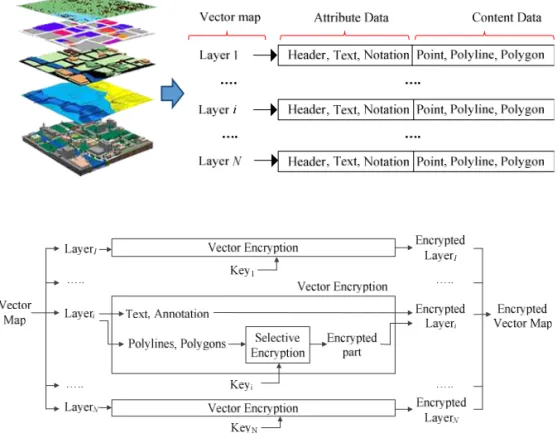
Vector map data is stored in layers. Each layer contains geometric objects as point, polyline and polygon. Point is used to represent simple objects while polygon and polyline are used for represent- ing complex objects. Thus, polyline and polygon are considered to be very important components of vector map. Beside the geographical information, vector map also includes attribute, display in- formation as header, text and notation. They are attributed data. Fig. 1 shows vector map data mod- el and the components of vector map data. Due to the fact that, attribute data does not contain geo- graphical information. Thus, it does not determine the content of vector maps. We only need to select geometric objects to perform selective encryption process.
3. THE PROPOSED ALGORITHM
3.1 Definition
Fig. 2 shows the general selective encryption for vector map data. Polyline and polygon are ex- tracted from vector map to perform selective encryption. To simple notation, we consider poly- line and polygon as an object with a series of verti- ces which polyline and polygon are denoted as the
same object. Let us look over main notations in the following section and then describe proposed algo- rithm in detail in next sections. Main notations for describing vector map in our paper are defined as following.
∙ An original vector map includes a set of layers. Each layer is a set of objects of polylines and polygons
∙ An object consists of a series of vertices . Each vertex is represented by a pair
of coordinates is an object
with the maximum number of vertices in . The total number of vertices in a layeris is . The followings are main notation for describing the encryption process:
∙ is random vector for ran-
domizing vertices, created by key value
∙ Randomized object is
∙ Encrypted DCT coefficients of
∙ Encrypted layer is a set of encrypted objects
3.2 Selective encryption
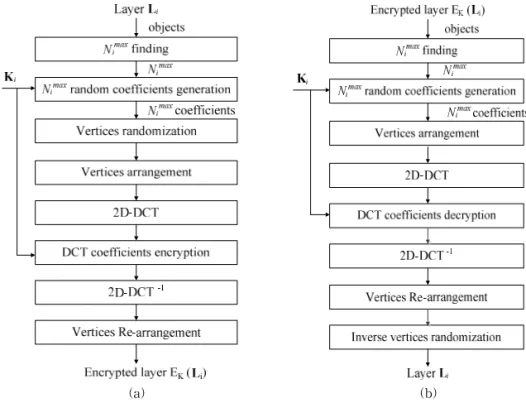
Fig. 3 shows the proposed algorithm. First of all, we find to generate random coefficients for random vector ri. After vertices randomization, all coordinates of objects in a layer are arranged into 2D arrayAm×nto perform 2D-DCT [12]. The size of Am×n is determined by the arrangement algo- rithm relating the total number of objectsNi and the total number of verticesNvi in a layer Li. In DCT domain, we select DC value and some low AC values in 2D-DCT coefficients matrix to en- crypt selectivity by random values using Ki. 2D- DCT-1process continuously changes all 2D-DCT coefficients matrix because some DCT coefficients are changed by encrypting selectivity. The purpose of arrangement all coordinates of vertices into 2D array is to increase high security because the size
Fig. 1. Vector map data model.
Fig. 2: General selective encryption for vector map data.
of 2D array is dynamic and decided by private al- gorithm depending on total number of objects and total number of vertices.
The purpose of finding is to generate ran- dom vector ri. is the maximum number of vertices of an object among objects in a layer Li: (1) Key Ki is used as a seed of pseudo-random function Rk( ) to create random coefficients of random vector riand encrypt DC values in DCT coefficients. It is randomly generated by the SHA- 512 algorithm with user key input [13]. The random vector ri= is used to randomize the vertices of objects withrikbe calculated by the pseudo-random function Rk( ) using Ki:
(2) In vertices randomization step, we randomize vertices in an object by the randomized function Rv( ):
(3) In vertices arrangement step, to order the total
coordinates of the randomized objects in a layer Li
into a 2D array we computed the total number of vertices Nvi in a layer Li:
(4) Because each vertex is presented by a pair of coordinates, thus we have total 2×Nvi coordinates in a layer, and we need to determine the size of 2D arrayAm×nfor arranging total coordinates into it. We firstly verify remainder of division (2×Nvi) forNi. If the remainder is zero, we determine the size of 2D array as follow:
(5) If remainder is different zero, we continue find- ing a set of divisors of (2×Nvi) which are higher than 2 and smaller than Ni. Then, we find max- imum divisor among those divisors. Suppose max- imum divisor is , we determine the size of 2D array as follow:
(6) In 2D-DCT domain, we have 2D – DCT co- efficients matrix by forward DCT:
(a) (b)
Fig. 3. The proposed algorithm. (a) Selective encryption, and (b) Decryption.
(7) And encrypt DC value and some low DCT co- efficients in FA by Ki. Assume we select D co- efficients including DC value for encryption, DC value and some low DCT coefficients are en- crypted as equation (8):
(8) After DC value and some low AC values en- cryption, we have a 2D array of coefficientsEK(FA) as Fig. 4. We perform inverse 2D-DCT forEK(FA)
to have EK(F-1A)= and
re-order it to get the encrypted object EK(Pij)=
to obtain encrypted layer .
3.3 Decryption
Following steps in the selective decryption in Fig. 3b, after the 2D-DCT process we receive the encrypted DCT coefficients of objectEK(FA). Refer to Eq. (8), in the DCT coefficients decryption we only need to divide DC value and some low AC values for the corresponding key value Ki. After the inverse 2D-DCT and re-arrangement process we get the randomized object P'ij, and the de- crypted objectis Pij recovered by the vertices in- verse randomization using the random coefficients of random vector ri varying the total number of
vertices in an object.
4. EXPERIMENTAL RESULTS
4.1 Visualization
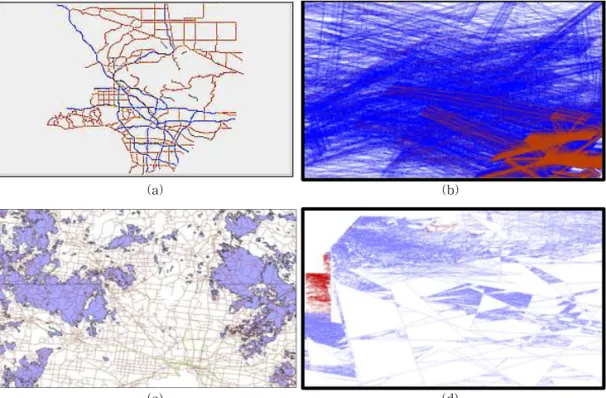
We used the vector maps of Los Angeles city with the different layers in visualization experi- ments. The proposed algorithm is applied to poly- lines and polygons in vector map. The data format of vector map data is the shape-file (SHP) format [14]. Experimental results are shown in Fig. 5. The contents of railway map and waterway map (Fig.
5a) is polylines. After the encryption process, all polylines are changed. Similar result is shown in Fig. 5c with polygons. Maps are changed entirely after the selective encryption process. Due to the fact that the proposed algorithm only manipulates with the value of vertices, thus the number of ver- tices does not change. So, the proposed algorithm does not alter the size of the encrypted file and loss data.
4.2 Security Evaluation
In order to extract information from the percep- tual encrypted map, any pirate has to extract all encrypted objects of map without the knowledge of keys. If the randomness of perceptual encryption is high, it will be so difficult to attack encrypted Fig. 4. Selective encryption in DCT domain.
objects. Therefore, we will calculate the entropy of perceptual encrypted map to evaluate the security of proposed method.
From equations in Sec. 3, we can see that en- crypted object be dependent on secret key K and the selected number of DCT coefficients D. Both secret key K and D are random variables. Thus, entropy HPiof encrypted object P'i is the sum of entropies of random variables above:
(9) And thus, the entropyHMof the encrypted map from original map M will be the sum of entropies of encrypted object P'i:
(10) Fig. 6 shows the increasing of entropy of map according to the number of the selected DCT coefficients. We only select some DCT coefficients but the entropy of the encrypted map is very high.
We choose Yasser’s method [10] and Bang’s method [11] for comparison because the issues presented in those papers are similar to those in
our method. Previous methods also used the shape-file format in their experiments. In Yasser’s method, Yasser used only the AES-256 cipher op- erator to encrypt the entire data stream of a shape- file. This is the conventional work. The shape-file is converted to data stream and it is then encrypted by the AES-256 function. Thus, the entropy of this method is dependent on the length of the secret key and the length of data stream. In Bang’s method,
(c) (d)
Fig. 5. Visualization experimental results, (a) and (b) Original and encrypted railway map layer, (c) and (d) Original and encrypted nature map layer.
Fig. 6. The entropy of proposed algorithm.
about 70% polylines/polygons are selected for the encryption process. This mean 30% polylines/pol- ygons are not encrypted and they are could be ex- tracted without the secrete key and the decryption process. Moreover, Bang used a common secret key to encrypt all DC values in a vector map in DWT, DFT domains. The length of the secret key is 512 bits. Thus, the entropy of this method is only dependent on the length of the secret key. Fig. 7 shows the difference between the entropy of our method and the entropy of Yasser’s method, the entropy of Bang’s method according to the number of objects. The entropy of our method is much higher than Yasser’s method and Bang’s method.
4.3 Computation Time Evaluation
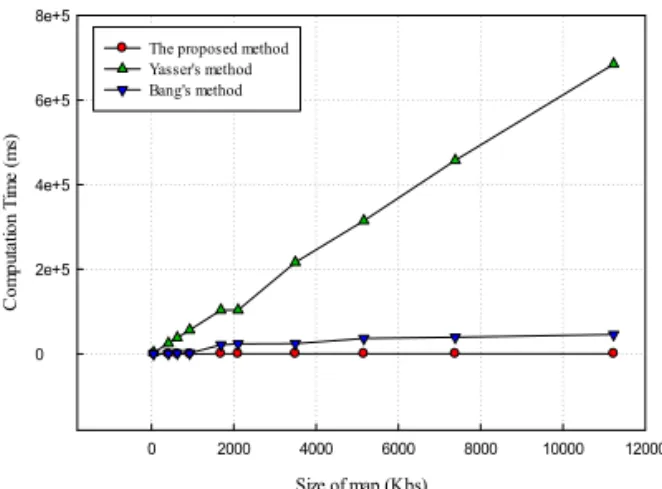
In our experiments, we used an Intel Core i7 Quad 3.5–GHz, 8 GB of RAM, Windows 7 64-bits, and C# on Visual Studio 2013. From Sec. 3, we can see that the computation time of the proposed method is dependent on the number of objects in vector maps. In Yasser’s method, Yasser per- formed full encryption for vector maps, and the computation time of Yasser’s method is dependent on the size of vector maps which includes both no- tation, header, text and all geometric objects. In Bang’s method, the computation time is dependent on the computation time of the selection process, the number of the selected objects and the compu- tation time of DWT/DFT and inverse DWT/DFT
processes. Fig. 8 shows the computation times of the proposed method, Yasser’s method and Bang’s method according to the size of vector maps. Our method’s time is much shorter than previous methods.
5. CONCLUSION
In this paper, we proposed the selective en- cryption algorithm for vector map data based on DCT domain. Experimental results showed that the proposed algorithm is very effective with a large volume of vector map dataset. Comparing to pre- vious algorithms, the proposed method has high security and it can be applied to the security of map service on/off-lines. Furthermore, our algorithm can be applied to various vector contents such as CAD and 3D content fields.
REFERENCE
[ 1 ] K.E. Foote and M. Lynch,Geographic Infor- mation Systems as an Integrating Technol- ogy: Context, Concepts, and Definitions, Online Book, 2009.
[ 2 ] S.H. Lee and K.R. Kwon, “Vector Water- Marking Scheme for GIS Vector Map Mana- gement,“ Journal of Multimedia Tools and Applications, Vol. 63, No. 3, pp. 757-790, 2011.
[ 3 ] V. Solachidis and I. Pitas, “Watermarking
Number of objects
0 2e+4 4e+4 6e+4 8e+4 1e+5
Entropy
0.0 2.0e+5 4.0e+5 6.0e+5 8.0e+5 1.0e+6 1.2e+6 1.4e+6
The proposed method Yasser's method Bang's method
Fig. 7: Entropy according the number of objects. Size of map (Kbs)
0 2000 4000 6000 8000 10000 12000
Computation Time (ms)
0 2e+5 4e+5 6e+5 8e+5
The proposed method Yasser's method Bang's method
Fig. 8. Computation time.
of Conference on Geographic Information Science, pp. 369-377, 2004.
[ 6 ] S.C. Chena, X. Wangb, N. Rishea, and M.A.
Weiss, “A Web-Based Spatial Data Access System Using Semantic R-Trees,“Journal of Information Sciences, Vol. 167, No. 1-4, pp.
41-61, 2003.
[ 7 ] N.B. Rybalov and O.I. Zhukovsky, “Access to the Spatial Data in the Web-Oriented GIS,“
Proceeding of Siberian Conference on Control and Communications, pp. 104-107, 2007.
[ 8 ] F. Wu, W. Cui, and H. Chen, “A Compound Chaos-Based Encryption Algorithm for Vector Geographic Data Under Network Circum-
Security, Vol. 10, No. 1, pp. 75-84, 2010.
[11] N.V. Bang, S.H. Lee, K.S. Moon, and K.R.
Kwon, “Encryption Algorithm Using Polyline Simplification for GIS Vector Map,“ Journal of Korea Multimedia Society, Vol. 19, No. 8, pp. 1453-1459, 2016.
[12] G. Strang, “Discrete Cosine Transform,“
Journal of Society for Industrial and Applied Mathematics, Vol. 41, No. 1, pp. 135-147, 1999.
[13] RSA Laboratories, PKCS: Password-Based Cryptography Standard, #5, v2.1, 2006.
[14] Environmental Systems Research Institute,A White Paper: ESRI Shape-File Technical Description, CA 92373-8100, 1998.
Ngoc-Giao Pham
received the Degree of Engin- eering in School of Electronic &
Telecommunica-tion in Hanoi University of Science & Tech- nology (HUST) in 2011, and Master degree from Pukyong National University (PKNU), Busan, South Korea in 2014. Currently, he is Ph.D can- didate in PKNU. His research interests include digital image processing applica-tion, GIS visualization, mul- timedia data security and smart system.
Suk-Hwan Lee
received a B.S., a M.S., and a Ph.
D. Degrees in Electrical Engin- eering from Kyungpook National University, Korea in 1999, 2001, and 2004 respectively. He is currently an associate professor in Department of Information Security at Tongmyong University. His research in- terests include multimedia security, digital image processing, and computer graphics.
Ki-Ryong Kwon
received the B.S., M.S., and Ph.
D. degrees in electronics en- gineering from Kyungpook Na- tional University in 1986, 1990, and 1994 respectively. He worked at Hyundai Motor Company from 1986-1988 and at Pusan University of Foreign Language from 1996-2006. He is currently a professor in Dept. of IT Convergence
& Application Engineering at the Pukyong National University. He has researched University of Minnesota in USA on 2000-2002 with Post-Doc, and Colorado State University on 2011-2012 with visiting professor.
He was the General President of Korea Multimedia Society on 2015-2016, also was a director of IEEE R10 Changwon section on 2012-2016. His research inter- ests are in the area of digital image processing, multi- media security and watermarking, bioinformatics, weather radar information processing.
Chong-Ho Woo
received the B.S., M.S., and Ph.D. degrees in Computer Engineering from Kyungpook National University in 1978, 1981, and 1990 respectively. He is currently a professor in Dept.
of Computer Engineering at the Pukyong National University. He has researched Lehman College CUNY, New York in 2008-2009 and LSU Baton Rouge, Louisiana in 2001-2002 as visiting professor. His research interests include Digital Image Processing, Embedded Systems, and IoT with WiFi Module.