ORIGINAL ARTICLE
Journal of the Korean Surgical Society
JKSS
pISSN 2233-7903ㆍeISSN 2093-0488 J Korean Surg Soc 2011;81:187-194
http://dx.doi.org/10.4174/jkss.2011.81.3.187
Received April 11, 2011, Revised May 22, 2011, Accepted May 31, 2011 Correspondence to: Jin Seok Heo
Department of Surgery, Samsung Medical Center, Sungkyunkwan University School of Medicine, 50 Irwon-dong, Gangnam-gu, Seoul 135-710, Korea
Tel: +82-2-3410-0262, Fax: +82-2-3410-6980, E-mail: [email protected]
cc Journal of the Korean Surgical Society is an Open Access Journal. All articles are distributed under the terms of the Creative Commons Attribution Non-Commercial License (http://creativecommons.org/licenses/by-nc/3.0/) which permits unrestricted non-commercial use, distribution, and reproduction in any medium, provided the original work is properly cited.
Survival benefits of surgical resection in recurrent cholangiocarcinoma
Sun Choon Song, Jin Seok Heo, Dong Wook Choi, Seong Ho Choi, Woo Seok Kim, Min Jung Kim
Department of Surgery, Samsung Medical Center, Sungkyunkwan University School of Medicine, Seoul, Korea
Purpose: Attempt to identify the beneficial effects associated with surgical procedures on survival outcome of patients with recurrent cholangiocarcinoma. Methods: 921 patients diagnosed with cholangiocarcinoma underwent surgical resection with curative intent in a single institute during the last 15 years. Patients with recurrent disease were divided into two groups according to whether surgical procedures were performed for the treatment of recurrence. Clinicopathologic variables, rang- es of survival based on sites of recurrence, and types of treatment were analyzed retrospectively. Results: The median fol- low-up period was 21.8 months and 316 (34.3%) patients had recurrence. 27 (group A) patients with recurrent disease were treated surgically and 289 patients (group B) were not treated. Liver resection, metastasectomy, pancreaticoduodenectomy, partial pancreatectomy, and regional lymph node dissection were performed on the patients in group A. The overall survival rate was statistically higher in group A (P = 0.001). Among the surgical procedures, resection of locoregional recurrences (except liver) in abdominal cavity (4.0 to 101.8 months vs. 0.6 to 71.6 months) and metastasectomy of abdominal or chest wall (3.5 to 18.9 months vs. 1.9 to 2.2 months) showed remarkable differences with respect to the range of survival. Conclusion:
Better survival outcomes can be expected by performing surgical resection of locoregional recurrences (except liver) in ab- dominal cavity and abdominal or chest wall metastatic lesions in recurrent cholangiocarcinoma.
Key Words: Recurrence, Range of survival, Cholangiocarcinoma, Radiofrequency ablation
INTRODUCTION
Cholangiocarcinoma is the second most common pri- mary hepatobiliary malignancy originating from the epi- thelium of the intrahepatic, perihilar, or extrahepatic bile ducts, with the frequencies of 5 to 30%, 40 to 50%, and 20 to 30%, respectively [1-5]. The incidence of intrahepatic chol- angiocarcinoma is increasing worldwide, especially in Asia, while the incidence of extrahepatic cholangiocar-
cinoma is somewhat stable or declining [6-11]. Surgical re- section remains the only curative treatment option for cholangiocarcinoma, but most patients are far advanced at the time of presentation, which leads to a poor survival outcome [12-16]. In addition, spreading widely through bile ductules and extensive invasion to adjacent organs, cholangiocarcinoma has frequent locoregional or distant recurrences via lymphatic chains or hematogenous meta- stasis [4,5,12,17,18]. Kobayashi et al. [19] reported distant
metastases were more common than locoregional recur- rence after R0 resection in patients with perihilar cholan- giocarcinoma.
The 5-year overall survival rate after surgical resection of cholangiocarinoma is reported to be 5 to 40%, and the median overall survival time and median recurrence-free survival time is 27 to 33 and 9 to 27 months, respectively [6-8,10,13,15,18-20]. Many published series have reported the risk factors for poor survival and recurrence; peri- neural invasion via lymphatic pathway and the proximity to the peripheral nerve plexus, presence of lymph node metastasis, poor differentiation, higher T stage, positive surgical resection margin and high level of carbohydrate antigen (CA) 19-9 [12,15,17,19-21]. The recurrence sites vary from local or locoregional recurrence in abdominal cavity to distance metastasis including abdominal or chest wall, skeletal muscles, lung, bone or brain [1,6,5,22,23].
Repeated hepatic resection for large, resectable tumors or radiofrequency ablation (RFA) for several small nod- ules have demonstrated their effectiveness on survival for the treatment of recurrent intrahepatic cholangiocar- cinoma in some series [17,18,24].
However, there is no large-scale series to verify benefi- cial effects in terms of survival through surgical treat- ments including other types of recurrent cholangiocar- cinomas. Thus, we attempted to identify whether or not there is a survival benefit to patients with recurrent chol- angiocarcinoma who had undergone surgical resection with curative intent according to the recurrent sites and the types of resection.
METHODS
Study patients
Nine hundred forty-nine patients who underwent sur- gical treatment for cholangiocarcinoma in a single in- stitute between May 1995 and July 2010 were reviewed ret- rospectively based on electronic medical records with pathologic reports. They proved to be primary adeno- carcinomas pathologically arising from the bile duct epi- thelium. With the exception of 28 patients who had pallia- tive resection, 921 patients underwent curative-intent sur-
gical resection (R0 = 830, R1 = 91).
Cholangiocarcinoma was classified according to the tu- mor location according to preoperative radiologic and fi- nal pathologic findings, which included intrahepatic (n = 226), perihilar (n = 222), and extrahepatic (n = 474). Cholan- giocarcinoma of gallbladder was not included in this series. 74, 78 and 164 patients had recurrent diseases dur- ing the study period, respectively. These 316 patients were divided into the following 2 groups: patients who under- went surgical resection for recurrence (group A) and pa- tients who were not treated (group B).
Initial procedures and managements
To the patients with intrahepatic cholangiocarcinomas, anatomic liver resection, including segmentectomy, hemi- hepatectomy, extended hemi-hepatectomy, or tri-sectio- nectomy (with or without caudate lobectomy) were pri- marily considered. Wedge resection was also considered for small tumors located at the liver dome. Variable proce- dures, such as major hepatectomy with bile duct resection, hepatopancreaticoduodenectomy, pancreaticoduodenec- tomy, segmental bile duct resection, or liver transplan- tation were performed for perihilar cholangiocarcinoma according to Bismuth-Corlette type, tumor location and degree of infiltration. Finally, segmental bile duct re- section or pancreaticoduodenectomy was primarily con- sidered for extrahepatic cholangiocarcinoma based on the location of the tumor (upper-, middle-, and lower-third).
Hepatopancreaticoduodenectomy was applied to the pa- tient with widespread cholangiocarcinoma and suspected invasion to the hepatoduodenal ligaments considering the medical condition of the patient.
Routine frozen-sectional biopsy of ductal resectional margin was carried out to confirm microscopic extension during surgery. When the proximal or distal margin was proved to be tumor positive, additional resection of bile or hepatic ducts was performed. The regional lymph nodes in the hepatoduodenal ligament, peri-pancreatic, celiac, and along the common hepatic artery were dissected, but the degree of lymph node dissection was determined by the attending surgeon. If the pathologic evaluation re- vealed lymph node metastasis or positive resection mar- gins, the patient was recommended to receive adjuvant
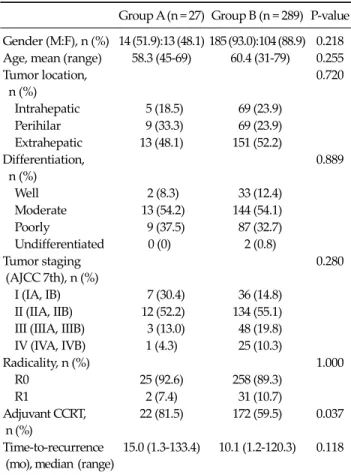
Group A (n = 27) Group B (n = 289) P-value Gender (M:F), n (%) 14 (51.9):13 (48.1) 185 (93.0):104 (88.9) 0.218 Age, mean (range) 58.3 (45-69) 60.4 (31-79) 0.255 Tumor location,
n (%)
0.720
Intrahepatic 5 (18.5) 69 (23.9) Perihilar 9 (33.3) 69 (23.9) Extrahepatic 13 (48.1) 151 (52.2) Differentiation,
n (%)
0.889
Well 2 (8.3) 33 (12.4)
Moderate 13 (54.2) 144 (54.1)
Poorly 9 (37.5) 87 (32.7) Undifferentiated 0 (0) 2 (0.8) Tumor staging
(AJCC 7th), n (%)
0.280
I (IA, IB) 7 (30.4) 36 (14.8) II (IIA, IIB) 12 (52.2) 134 (55.1) III (IIIA, IIIB) 3 (13.0) 48 (19.8) IV (IVA, IVB) 1 (4.3) 25 (10.3)
Radicality, n (%) 1.000
R0 25 (92.6) 258 (89.3)
R1 2 (7.4) 31 (10.7)
Adjuvant CCRT, n (%)
22 (81.5) 172 (59.5) 0.037
Time-to-recurrence (mo), median (range)
15.0 (1.3-133.4) 10.1 (1.2-120.3) 0.118
AJCC, American Joint Committee on Cancer; CCRT, concurrent chemoradiotherapy.
Table 1. Demographics and clinicopathologic variables treatment. 5-fluorouracil-based chemotherapy and radio-
therapy (44-54 Gy) were generally applied, although there were differences in the dose and treatment period accord- ing to the individual.
Types of treatment for recurrence
Patients were routinely followed in the outpatient de- partment with CA 19-9 levels and abdominal con- trast-enhanced computed tomography (CT) every 3 to 6 months. Recurrence was highly suspected when the level of serum CA 19-9 increased, and confirmed with CT with or without 18F-fluorodeoxyglucose positron emission to- mography by experienced radiologists. It was classified as one of followings; intrahepatic recurrence, locoregional recurrence except liver, distant metastasis.
The inclusion criteria for RFA generally followed the in- dications for hepatocellular carcinoma; <3 tumor lesions with a maximum diameter <3 cm, single nodular lesions with a maximum diameter <5 cm, no major vessel or bile duct involvement, and no uncorrectable coagulopathy [25]. The technical effectiveness was verified with a CT af- ter 1 month with no residual unablated tumors.
Further hepatic resection was considered according to the anatomic location, size, and number of lesions when RFA could not be performed. Metastasectomy was consid- ered for metastatic lesions of the abdominal wall, chest wall, peritoneum, and solitary pulmonary nodules.
Pylorus-preserving pancreaticoduodenectomy or Whip- ple’s procedure was performed to treat locoregional re- currence after segmental bile duct resection for extra- hepatic cholangiocarcinoma.
Statistical analysis
A Student’s t test (two-tailed) and χ2 test or Fisher’s ex- act test were used to analyze continuous or categorical var- iables, respectively. Overall survival was calculated using the Kaplan-Meier method and differences in survival were determined using the log-rank test. Prognostic factors on overall survival were indentified using multivariate Cox proportional hazards models. Statistical calculations were performed using SPSS ver. 16.0 (SPSS Inc., Chicago, IL, USA). P-values < 0.05 were considered statistically significant.
RESULTS
Demographics
The median follow-up period was 21.8 months (range, 1.8 to 153.0 months) and the number of patients was 27 and 289 in group A and B, respectively. There were no stat- istical differences in gender, age and pre-operative carci- noembryonic antigen and CA 19-9 levels. In addition, tu- mor size, location, differentiation, radicality, the ratio of lymph node metastasis, tumor staging and time-to-re- currence did not have significant differences, except the rate of patients receiving adjuvant concurrent chemo- radiotherapy, which was shown to be statistically higher in group A (P = 0.037, Table 1).
Recurrence after surgical resection
5, 9 and 13 patients underwent surgical treatment for re-
Types Recurrent rates (%)
Surgical resection
(n)
RFA treatment
(n)
Intrahepatic 74/226 (32.7) 5 3
Perihilar 78/222 (35.1) 9 1
Extrahepatic Segmental bile duct resection
33/120 (27.5) 8 1
Pancreaticoduodenectomy 131/354 (37.0) 5 2
Total 316/921 (34.3) 27 7
RFA, Radiofrequency ablation.
Table 2. Recurrent rates according to the tumor types after R0, R1 resection
Treatment (n) Comments
Liver resection (7) Right hemi-hepatectomy (1), Left hemi-hepatectomy (1), Wedge resection (1), Sectionectomy (2), Tumorectomy (2a))
Metastasectomy (10) Chest wall (3), Abdominal wall (2), Peritoneum (2), VATs-WR of lung (3b)) Pancreaticoduodenectomy (8) Whipple’s procedure (4), PPPD (4)
Partial pancreatectomy (1) This patient previously underwent right trisegmentectomy due to hilar cholangiocarcinoma. After 14 months, he underwent intra-operative RFA due to second recurrence at hepatic resection margin Regional lymph node dissection (1) Intrahepatic cholangiocarcinoma with lymph node metastasis
RFA (7) All were percutaneous RFA
VATs-WR, video-assisted thoracic surgery-wedge resection, PPPD, pylorus-preserving pancreaticoduodenectomy, RFA, radiofrequency ablation.
a)One patient underwent RFA after 2 months due to second hepatic recurrence. b)One patient underwent hepatic tumorectomy after 1 month due to second hepatic recurrence.
Table 3. Treatment types for recurrence
Recurrent sites
Time-to-recurrence (treatment case/total) Within 1 yr From 1 to 2 yr Above 2 yr
Liver, solitary 7/52 1/21 1/10
Liver, multiple 0/14 0/3 0/0
Locoregional except liver
3/48 3/40 7/30
Lung or pleura 1/10 1/5 0/5
Abdominal or chest wall 3/5 1/1 1/1
Peritoneum, solitary 1/1 1/1 0/0
Peritoneal seeding 0/36 0/5 0/6
Bone 0/4 0/0 0/1
Brain 0/1 0/1 0/0
Supraclavicular lymph nodes
0/1 0/1 0/0
Multiple sites 0/8 1/2 2/3
Total 15/180 8/80 11/56
Table 4. Patterns of recurrence according to the recurrent sites and time-to-recurrence
current disease in the case of intrahepatic, perihilar, and extrahepatic cholangiocarcinoma, respectively (Table 2).
The recurrent rate was highest after pancreaticoduo- denectomy (37.0%) for extrahepatic cholangiocarcinoma.
The recurrent sites were as follows; solitary (n = 83) or mul- tiple (n = 17) hepatic recurrence, locoregional recurrence except liver (n = 118), peritoneal seeding (n = 49), lung or pleura (n = 20), abdominal or chest wall (n = 7), bone (n = 5), brain (n = 2), supraclavicular lymph node (n = 2) and multi- ple site recurrence (n = 13).
Hepatic resection or RFA was performed for liver metastasis. Pancreaticoduodenectomy, partial pancrea- tectomy, and regional lymph node dissection were per- formed for locoregional recurrent lesions. Metastasecto- my was performed for recurrent masses in the abdominal or chest wall, lung or pleura, and peritoneal solitary metastasis. Partial pancreatectomy was performed on one
patient who had a locoregional recurrence in the pancreas after right tri-segmentectomy for type IIIA hilar cholan- giocarcinoma. One patient had a recurrence in regional lymph nodes 17.4 months after left lateral sectionectomy for intrahepatic cholangiocarcinoma located at segments II and III (Table 3). In the current study, we did not perform surgical resection or RFA for multiple hepatic metastatic lesions, and surgical procedures for peritoneal seeding, supraclavicular lymph node and bone or brain metastasis.
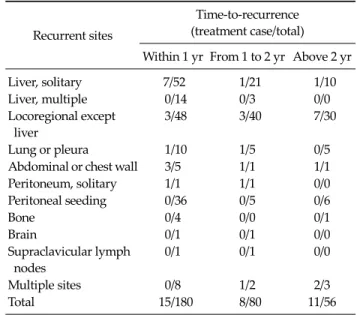
180, 80 and 56 patients had recurrence within 1 year, from 1 to 2 years, and above 2 years, respectively. During these periods, various treatments for recurrence were per-
Fig. 1. Overall survival rate after recurrence according to surgical treatment and concurrent chemoradiotherapy (CCRT) for recur- rent cholangiocarcinoma (group A; patients treated surgically for recurrence, group B; patients not treated, P-value between the two groups = 0.001).
Group A (n = 27) Group B (n = 289)
Recurrent sites (n) Ranges of survival (mo) Recurrent sites (n) Ranges of survival (mo)
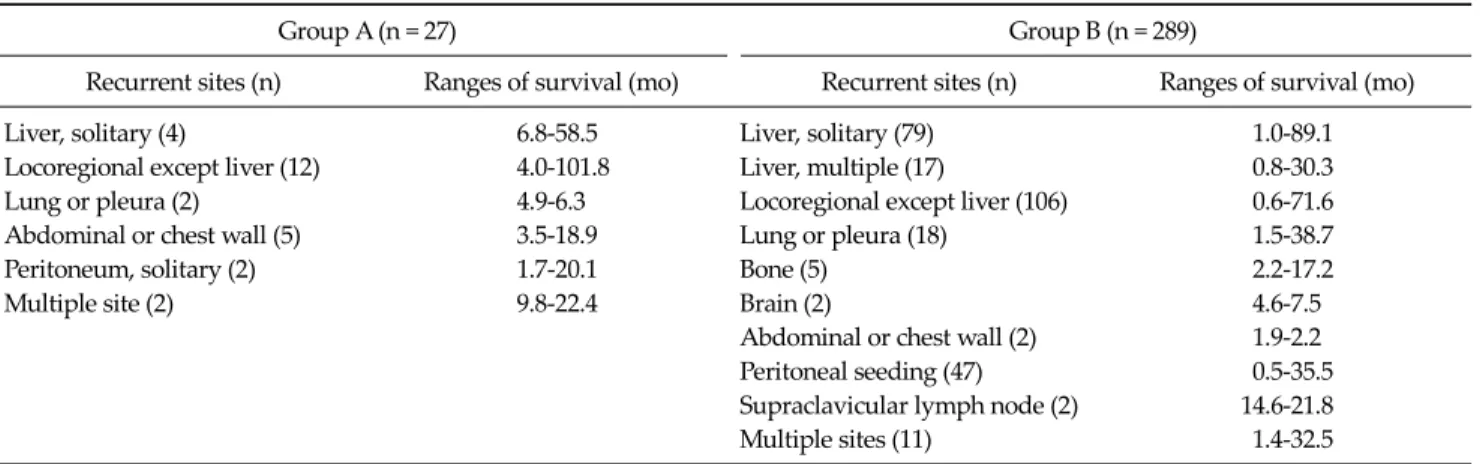
Liver, solitary (4) 6.8-58.5 Liver, solitary (79) 1.0-89.1
Locoregional except liver (12) 4.0-101.8 Liver, multiple (17) 0.8-30.3
Lung or pleura (2) 4.9-6.3 Locoregional except liver (106) 0.6-71.6
Abdominal or chest wall (5) 3.5-18.9 Lung or pleura (18) 1.5-38.7
Peritoneum, solitary (2) 1.7-20.1 Bone (5) 2.2-17.2
Multiple site (2) 9.8-22.4 Brain (2) 4.6-7.5
Abdominal or chest wall (2) 1.9-2.2 Peritoneal seeding (47) 0.5-35.5 Supraclavicular lymph node (2) 14.6-21.8
Multiple sites (11) 1.4-32.5
Table 5. Recurrent sites and ranges of survival after recurrence
Variables Hazard
ratio
95%
confidence interval
P-value
No surgical resection 2.308 1.112-4.787 0.025
R1 resection 1.576 1.003-2.476 0.049
Not performed adjuvant CCRT 1.140 0.826-1.573 0.426 Lymph node metastasis 0.863 0.628-1.187 0.366 CCRT, concurrent chemoradiotherapy.
Table 6. Multivariate analysis of prognostic factors on overall survival after recurrence
formed to 9.3%, 10.0% and 19.6% of the recurrent patients, respectively (Table 4).
Overall survival and range of survival after re- currence
The median times to recurrence were 15.0 and 10.1 months in group A and B, respectively (P = 0.118). The me- dian times from recurrence to surgical treatment for re- current disease in group A was 27 days (range, 14 to 182 days). The median survival times after recurrence were 18.9 months (range, 1.7 to 101.8 months) and 7.7 months (range, 0.5 to 89.1 months) in group A and B, respectively.
The cumulative overall survival rate after recurrence was significantly higher in group A than group B (P = 0.001,
Fig. 1). The additional chemoradiotherapy did not show significant survival benefits in either group. The beneficial effect of surgical treatment for recurrent disease with re- spect to the ranges of survival was remarkable in the case of locoregional recurrence except liver and abdominal or chest wall metastasis (Table 5). Surgical resection for re- current cholangiocarcinoma was identified as an in- dependent prognostic factor on overall survival according to multivariate analysis (HR = 2.308, P = 0.025) (Table 6).
DISCUSSION
The long-term survival outcomes of patients who un- dergo surgical treatment for cholangiocarcinoma is still disappointing, although there have been recent advances in imaging modalities, peri-operative treatment, and sur- gical techniques. Additionally, because of the advanced stage at presentation, inadequate identification of anatom- ic location, and/or poor medical conditions, surgical re-
section is often non-curative [10]. To this end, therapeutic strategies for advanced or metastatic cholangiocarcinoma have been developed, such as systemic chemotherapy, brachytherapy, photodynamic therapy and hepatic-ar- terial embolization or cryoablation [7,10,19,26]. However, most have limited roles in representing satisfactory out- comes on survival.
It is reported that liver and abdominal lymph nodes around the hepatoduodenal ligament, periportal, com- mon hepatic artery, and posterior pancreatoduodenal areas are common sites of recurrence in patients with chol- angiocarcinoma [5,19,27,28]. Occasionally, distant lymph nodes in the posterior mediastinum or supraclavicular area can be involved. These findings have commonly been accepted to reflect disease progression and are associated with a poor prognosis.
Repeated liver resection in intrahepatic cholangio- carcinoma, repeated RFA, or a combination for locore- gional recurrent tumor have been reported to be effective with respect to survival in highly selected patients [9,17,18,25]. However, our study extended the concept of repeated resection beyond the liver to extrahepatic in- tra-abdominal locoregional recurrences, abdominal or chest wall and lung or pleura. In addition to performing repeated hepatectomy or RFA for recurrent hepatic le- sions, resection of recurrences in the abdominal cavity and abdominal or chest wall were attempted. In our experi- ence, there were two of five cases showing positive re- section margins after metastasectomy of the abdominal wall. Second recurrences occurred in these two patients, so they underwent repeated resection around the previous area of resection. Thus, wider excision must be considered during metastasectomy of the abdominal or chest wall, and mesh could be useful for covering large fascial defects in these cases.
In this series, the recurrence rate of cholangiocarcinoma showed 34.3%, and about 57% of recurrence occurred within 1 year. However, only 8.3% of patients with re- currence were treated surgically in this period, while 10.0% and 19.6% of patients were treated from 1 to 2 years and above 2 years, respectively. Thus, early surgical re- section should be considered to acquire greater survival benefits.
There are some drawbacks in this retrospective study.
First, differences in the clinical course and pathogenesis among the three types of cholangiocarcinoma may exist.
But it was reported that there were no significant differ- ences in clinical presentation, disease stage and survival between intra- and extra-hepatic cholangiocarcinoma [6].
Second, a relatively smaller incidence of recurrence than in previous studies was identified. It might be influenced not by the development of the palliative treatment op- tions, but also missed patients who were previously treat- ed surgically. In fact, patients with cholangiocarcinoma have been increasing recently who were treated surgically or with RFA. Therefore, further follow-up studies for these patients are warranted to understand tumor biology and diverse patterns of tumor recurrence to make up for these limitations. Francis et al. [9] and Zhang et al. [4] in- troduced regulation of cholangiocarcinoma from a bio- logic point of view. Their reviews suggested that genetic hypermethylation, interleukin-6, growth factors, gastro- intestinal hormones, neuroregulatory molecules, angio- genesis, or E-cadherin-mediated cell-to-cell adhesion ex- pressed by the Slug gene are related to growth or invasive- ness of the tumor. Third, although most of the clin- icopathologic characteristics were similar in our two groups, the rate of patients who underwent adjuvant CCRT was higher in group A. This selection bias could be an interference factor in drawing our conclusion. Finally, overall survival has room for modification because the re- currence patterns between the two groups were not similar. Thus, further prospective controlled study is needed to overcome this limitation.
In conclusion, according to this large-series study in a single center, we have to consider surgical procedures to resectable recurrent lesions to prolong survival in patients with recurrent cholangiocarcinoma. Moreover, adjuvant chemoradiotherapy alone could not acquire a meaningful beneficial outcome on survival without resection of re- current lesions. Although this series did not confirm any beneficial effect of surgical procedures to recurrent masses in the liver, lung, pleura, or multiple sites on survival, sur- gical resection of locoregional recurrence in the abdominal cavity and of the abdominal or chest wall metastatic le- sions showed remarkable benefits in terms of range of
survival. This consideration might help to determine pat- terns of recurrence and adequate therapeutic options for recurrent cholangiocarcinoma.
CONFLICTS OF INTEREST
No potential conflict of interest relevant to this article was reported.
REFERENCES
1. Kwon OS, Jun DW, Kim SH, Chung MY, Kim NI, Song MH, et al. Distant skeletal muscle metastasis from intra- hepatic cholangiocarcinoma presenting as Budd-Chiari syndrome. World J Gastroenterol 2007;13:3141-3.
2. Tao LY, He XD, Qu Q, Cai L, Liu W, Zhou L, et al. Risk fac- tors for intrahepatic and extrahepatic cholangiocarcinoma:
a case-control study in China. Liver Int 2010;30:215-21.
3. Park SK, Kim YS, Kim SG, Jang JY, Moon JH, Lee MS, et al.
Detection of distant metastasis to skeletal muscle by 18F-FDG-PET in a case of intrahepatic cholangiocar- cinoma. Korean J Hepatol 2010;16:325-8.
4. Zhang KJ, Wang DS, Zhang SY, Jiao XL, Li CW, Wang XS, et al. The E-cadherin repressor slug and progression of hu- man extrahepatic hilar cholangiocarcinoma. J Exp Clin Cancer Res 2010;29:88.
5. Ito Y, Tajima Y, Fujita F, Tsutsumi R, Kuroki T, Kanematsu T. Solitary recurrence of hilar cholangiocarcinoma in a me- diastinal lymph node two years after curative resection.
World J Gastroenterol 2007;13:2243-6.
6. Singal AG, Rakoski MO, Salgia R, Pelletier S, Welling TH, Fontana RJ, et al. The clinical presentation and prognostic factors for intrahepatic and extrahepatic cholangiocarci- noma in a tertiary care centre. Aliment Pharmacol Ther 2010;31:625-33.
7. Endo I, Gonen M, Yopp AC, Dalal KM, Zhou Q, Klimstra D, et al. Intrahepatic cholangiocarcinoma: rising frequency, improved survival, and determinants of outcome after resection. Ann Surg 2008;248:84-96.
8. Ito K, Ito H, Allen PJ, Gonen M, Klimstra D, D'Angelica MI, et al. Adequate lymph node assessment for extra- hepatic bile duct adenocarcinoma. Ann Surg 2010;251:
675-81.
9. Francis H, Alpini G, DeMorrow S. Recent advances in the regulation of cholangiocarcinoma growth. Am J Physiol Gastrointest Liver Physiol 2010;299:G1-9.
10. Tamandl D, Herberger B, Gruenberger B, Puhalla H, Klinger M, Gruenberger T. Influence of hepatic resection margin on recurrence and survival in intrahepatic cholangiocarcinoma. Ann Surg Oncol 2008;15:2787-94.
11. Yamamoto Y, Shimada K, Sakamoto Y, Esaki M, Nara S, Ban D, et al. Clinicopathological characteristics of intra- hepatic cholangiocellular carcinoma presenting intra- hepatic bile duct growth. J Surg Oncol 2009;99:161-5.
12. Saxena A, Chua TC, Sarkar A, Chu F, Morris DL.
Clinicopathologic and treatment-related factors influenc- ing recurrence and survival after hepatic resection of intra- hepatic cholangiocarcinoma: a 19-year experience from an established Australian hepatobiliary unit. J Gastrointest Surg 2010;14:1128-38.
13. Shen FZ, Zhang BY, Feng YJ, Jia ZX, An B, Liu CC, et al.
Current research in perineural invasion of cholangio- carcinoma. J Exp Clin Cancer Res 2010;29:24.
14. Park J, Kim MH, Kim KP, Park do H, Moon SH, Song TJ, et al. Natural history and prognostic factors of advanced cholangiocarcinoma without surgery, chemotherapy, or ra- diotherapy: a large-scale observational study. Gut Liver 2009;3:298-305.
15. Carrafiello G, Laganà D, Cotta E, Mangini M, Fontana F, Bandiera F, et al. Radiofrequency ablation of intrahepatic cholangiocarcinoma: preliminary experience. Cardiovasc Intervent Radiol 2010;33:835-9.
16. Nagahashi M, Shirai Y, Wakai T, Sakata J, Ajioka Y, Nomura T, et al. Depth of invasion determines the post- resectional prognosis for patients with T1 extrahepatic cholangiocarcinoma. Cancer 2010;116:400-5.
17. Kurosaki I, Hatakeyama K. Repeated hepatectomy for re- current intrahepatic cholangiocarcinoma: report of two cases. Eur J Gastroenterol Hepatol 2005;17:125-30.
18. Kamphues C, Seehofer D, Eisele RM, Denecke T, Pratschke J, Neumann UP, et al. Recurrent intrahepatic cholangio- carcinoma: single-center experience using repeated hep- atectomy and radiofrequency ablation. J Hepatobiliary Pancreat Sci 2010;17:509-15.
19. Kobayashi A, Miwa S, Nakata T, Miyagawa S. Disease re- currence patterns after R0 resection of hilar cholangio- carcinoma. Br J Surg 2010;97:56-64.
20. Sakamoto Y, Shimada K, Nara S, Esaki M, Ojima H, Sano T, et al. Surgical management of infrahilar/suprapancreatic cholangiocarcinoma: an analysis of the surgical proce- dures, surgical margins, and survivals of 77 patients. J Gastrointest Surg 2010;14:335-43.
21. Kim SJ, Lee CY, Kim DG. Analysis of the clinical outcome and prognostic factors of patients with hilar cholangio- carcinoma. J Korean Surg Soc 2007;73:156-64.
22. Takahashi Y, Nagino M, Nishio H, Ebata T, Igami T, Nimura Y. Percutaneous transhepatic biliary drainage catheter tract recurrence in cholangiocarcinoma. Br J Surg 2010;97:1860-6.
23. Stergiopoulos C, Kountouras J, Kapetanakis N, Katsinelos P, Kokkali S, Tsapournas G, et al. Distant cutaneous meta- stasis preceding the diagnosis of ductal cholangiocar- cinoma. J Eur Acad Dermatol Venereol 2009;23:242-3.
24. Ohtsuka M, Kimura F, Shimizu H, Yoshidome H, Kato A, Yoshitomi H, et al. Significance of repeated resection for re- current intrahepatic cholangiocarcinoma. Hepatogastroen- terology 2009;56:1-5.
25. Choi D, Lim HK, Rhim H, Kim YS, Yoo BC, Paik SW, et al.
Percutaneous radiofrequency ablation for recurrent hep- atocellular carcinoma after hepatectomy: long-term results and prognostic factors. Ann Surg Oncol 2007;14:2319-29.
26. Valle J, Wasan H, Palmer DH, Cunningham D, Anthoney A, Maraveyas A, et al. Cisplatin plus gemcitabine versus gemcitabine for biliary tract cancer. N Engl J Med 2010;
362:1273-81.
27. Buell JF, Rosen S, Yoshida A, Labow D, Limsrichamrern S, Cronin DC, et al. Hepatic resection: effective treatment for primary and secondary tumors. Surgery 2000;128:686-93.
28. Konishi M, Iwasaki M, Ochiai A, Hasebe T, Ojima H, Yanagisawa A. Clinical impact of intraoperative histo- logical examination of the ductal resection margin in extra- hepatic cholangiocarcinoma. Br J Surg 2010;97:1363-8.