ISSN 2234-3806 • eISSN 2234-3814
https://doi.org/10.3343/alm.2018.38.3.271 www.annlabmed.org 271
Ann Lab Med 2018;38:271-273
https://doi.org/10.3343/alm.2018.38.3.271
Brief Communication
Clinical Microbiology
Prevalence of Escherichia coli Carrying pks Islands in Bacteremia Patients
Eunyoung Lee, B.S. and Yangsoon Lee, M.D., Ph.D.
Department of Laboratory Medicine, Hanyang University College of Medicine, Seoul, Korea
Escherichia coli can harbor genomic pks islands that code for a polyketide-peptide geno- toxin known as colibactin. E. coli strains carrying pks islands trigger genetic instability. pks islands have been significantly associated with bacteremia. We investigated the molecular epidemiology of bacteremic E. coli isolates and the prevalence of bacteremia-causing E.
coli carrying pks islands. A total of 146 E. coli isolates were collected at a tertiary-care hos- pital from January 2015 to December 2016. The phylogenetic groups were determined by multiplex PCR. All isolates were screened by PCR for sequence type 131 (ST131)-associ- ated single-nucleotide polymorphisms (SNPs) in mdh and gyrB. For detection of pks is- lands, we performed PCR for the clbB and clbN genes as colibactin system markers. Phy- logenetic group B2 was the most common, accounting for 54.1% (N=79) of the isolates, followed by group D with 29.5% (N=43), group A with 11.6% (N=17), and group B1 with 4.8%. Of the group B2 isolates, 40.5% were ST131 strains and 32.9% carried pks islands. Only three ST131 isolates in group B2 carried the clbB and clbN genes, while the other 23 ST131 isolates did not. The pks gene might not be associated with ST131 strains.
Key Words: Escherichia coli, pks islands, clbB, Bacteremia, ST131
Received: May 22, 2017 Revision received: June 19, 2017 Accepted: December 28, 2017 Corresponding author: Yangsoon Lee Department of Laboratory Medicine, Hanyang University Seoul Hospital, Hanyang University College of Medicine, 222-1 Wangsimni-ro, Seongdong-gu, Seoul 04763, Korea
Tel: +82-2-2290-9655 Fax: +82-2-2290-9193 E-mail: [email protected]
© Korean Society for Laboratory Medicine This is an Open Access article distributed under the terms of the Creative Commons Attribution Non-Commercial License (http://creativecom- mons.org/licenses/by-nc/4.0) which permits unrestricted non-commercial use, distribution, and reproduction in any medium, provided the original work is properly cited.
Escherichia coli is one of the most common bacteremia-causing pathogens; it has several virulence factors associated with blood- stream invasion and infection [1, 2]. Of these, the papG class II gene is thought to play a more important role in the development of E. coli bacteremia in patients with an upper urinary tract in- fection (UTI) than in patients with acute cholangitis [2]. How- ever, the role of E. coli virulence factors in the pathogenesis of bloodstream infections remains unclear. Among its virulence factors, E. coli can harbor genomic pks islands that code for a polyketide-peptide genotoxin known as colibactin. E. coli strains carrying pks islands induce DNA damage and trigger genetic instability [3], and pks islands were significantly associated with bacteremia [4]. Therefore, we investigated the molecular epide- miology of bacteremic E. coli isolates and the prevalence of bac- teremia-causing E. coli carrying pks islands in Korea.
A total of 146 E. coli isolates (one isolate per patient) were col- lected from blood samples consecutively at a tertiary-care hos-
pital from January 2015 to December 2016. Blood cultures were incubated in the BacT/ALERT system (bioMérieux, Marcy-l’Etoile, France). Each isolate was identified using the MicroScan Walk- away (Beckman Coulter, Brea, CA, USA) or Bruker Biotyper (Bru- ker Daltonics, Bremen, Germany) matrix-assisted laser desorp- tion ionization-time of flight (MALDI-TOF) mass spectrometry sys- tems. Antimicrobial susceptibility testing (AST) was performed using the MicroScan Walkaway system (Beckman Coulter). The AST results were interpreted based on the CLSI guidelines [5].
Phylogenetic groups were determined by multiplex PCR using a combination of three genes (chuA, yjaA, and TSPE4.C2), as pre- viously described; the isolates clustered into four main phyloge- netic groups, A, B1, B2, and D [6]. All isolates were screened by PCR for sequence type 131 (ST131)-associated single-nu- cleotide polymorphisms (SNPs) in mdh and gyrB [7]. For detec- tion of pks islands, we performed PCR for the clbB and clbN genes as colibactin system markers, as previously described [4].
1 / 1 CROSSMARK_logo_3_Test
2017-03-16 https://crossmark-cdn.crossref.org/widget/v2.0/logos/CROSSMARK_Color_square.svg
Lee E, et al.
Prevalence of pks island-carrying E. coli
272 www.annlabmed.org https://doi.org/10.3343/alm.2018.38.3.271 The primary source of bacteremia was determined according to
clinical presentation and/or evidence of an identical strain cul- tured near or on the same date as the onset of bacteremia. If the source of bacteremia could not be identified, it was classi- fied as unknown origin.
Of the 146 bacteremic E. coli isolates, 107 (73.3%) were iso- lated from the bloodstream of patients with UTIs, and 13 (8.9%) were isolated from the bloodstream of patients with biliary tract infections (Table 1). An association with the source of infection was found for the resulting phylogenetic E. coli groups. Groups B2 and D were detected exclusively in UTIs (98/107, 91.6%), whereas group A was predominantly implicated in biliary tract infections (5/13, 38.5%). Twenty-eight isolates (group A=6, B2=
14, and D=8) were recovered from patients with cancer.
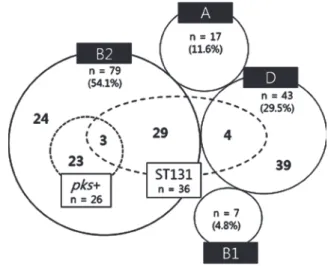
Phylogenetic group B2 was the most common, accounting for 54.1% (N=79) of the isolates, followed by group D with 29.5%
(N=43), group A with 11.6% (N=17), and group B1 with 4.8%
(N=7; Fig. 1). Many strains belonging to group B2 are known to cause extraintestinal infections [8]. Phylogenetic analysis in a previous Korean study revealed that the majority of strains re- sponsible for UTIs belonged to phylogenetic groups B2 (79%) and D (15%) [9]. Group B2 was also the dominant group caus- ing bacteremia in the present study.
E. coli ST131 represents a recently emerging, globally dissem- inated cause of multidrug-resistant extraintestinal infections [10].
In this study, ST131 strains accounted for 24.7% (36/146) of all isolates tested. ST131 was found in groups B2 (N=32) and D (N=4), but not in groups A and B1. ST131 strains comprised 29.5% (36/122) of group B2 and D isolates.
Of the 146 bacterial isolates, 17.8% (26/146) carried pks is- lands, all of which belonged to group B2. Only three ST131 strains carrying pks islands were identified (2.1%). A number of studies
have reported that pks islands are confined to group B2 strains [4, 8]. Similarly, in this study, the clbB and clbN genes were de- tected only in group B2 isolates. This suggests that clbB is an excellent marker for group B2. Johnson et al [4] have suggested that group B2 E. coli isolates carrying pks islands increase the likelihood of bacteremia. They found that these isolates were present in 58% of blood samples, but only in 32% of fecal sam- ples. In our study, 32.9% of the group B2 isolates from blood contained the clbB and clbN genes. Thus, the overall pks prev- alence was lower than that reported in the previous study (17.8%
vs 58%) [4]. We found that only three ST131 isolates in group B2 carried the clbB and clbN genes, whereas the other 23 ST131
Table 1. Primary source of bacteremia classified according to phylogenetic group
Source of infection Phylogenetic group
Total
A B1 B2 D
Urinary tract 6 (5.6)* 3 (2.8) 67 (62.6) 31 (29.0) 107
Biliary tract 5 (38.5) 1 (7.7) 4 (30.8) 3 (23.1) 13
GI tract 1 (14.3) 0 3 (42.9) 3 (42.9) 7
Respiratory tract 0 0 4 (80.0) 1 (20.0) 5
Unknown 5 (20.8) 3 (12.5) 8 (33.3) 8 (33.3) 24
Total 17 (11.6) 7 (4.8) 79 (54.1) 43 (29.5) 146
Phylogenetic groups were determined by multiplex PCR using a combination of three genes (chuA, yjaA, and TSPE4.C2), and the isolates were clustered into four main phylogenetic groups, A, B1, B2, and D.
*Data are presented as number (%) of isolates.
Abbreviation: GI, gastrointestinal.
Fig. 1. Isolates carrying pks islands and those identified as strain ST131, arranged by phylogenetic group. Phylogenetic groups were determined by multiplex PCR using a combination of three genes (chuA, yjaA, and TSPE4.C2), and the isolates were clustered into four main phylogenetic groups, A, B1, B2, and D. The numbers in the dotted circle and the small dotted circle indicate ST131 positive isolates and pks-carrying isolates, respectively.
Lee E, et al.
Prevalence of pks island-carrying E. coli
https://doi.org/10.3343/alm.2018.38.3.271 www.annlabmed.org 273
isolates did not. These results suggest that the pks gene might not be associated with ST131 strains.
Our results describe the molecular characteristics of E. coli isolated from bloodstream infections in a Korean hospital. Ap- proximately 54.1% of bacteremic E. coli isolates belonged to phylogenetic group B2. Of the group B2 isolates, 40.5% were ST131 strains and 32.9% carried pks islands.
Authors’ Disclosures of Potential Conflicts of Interest
No potential conflicts of interest relevant to this article were re- ported.
Acknowledgements
This study was supported by the research fund of Hanyang Uni- versity (HY-201600000002782).
REFERENCES
1. Bonacorsi S, Houdouin V, Mariani-Kurkdjian P, Mahjoub-Messai F, Bin- gen E. Comparative prevalence of virulence factors in Escherichia coli causing urinary tract infection in male infants with and without bactere- mia. J Clin Microbiol 2006;44:1156-8.
2. Wang MC, Tseng CC, Chen CY, Wu JJ, Huang JJ. The role of bacterial virulence and host factors in patients with Escherichia coli bacteremia who have acute cholangitis or upper urinary tract infection. Clin Infect Dis 2002;35:1161-6.
3. Cuevas-Ramos G, Petit CR, Marcq I, Boury M, Oswald E, Nougayrede JP. Escherichia coli induces DNA damage in vivo and triggers genomic instability in mammalian cells. Proc Natl Acad Sci USA 2010;107:11537- 42.
4. Johnson JR, Johnston B, Kuskowski MA, Nougayrede JP, Oswald E. Mo- lecular epidemiology and phylogenetic distribution of the Escherichia coli pks genomic island. J Clin Microbiol 2008;46:3906-11.
5. CLSI. Performance standards for antimicrobial susceptibility testing. 25th ed. CLSI document M100-S25. Wayne, PA: Clinical and Laboratory Stan- dards Institute; 2015.
6. Doumith M, Day MJ, Hope R, Wain J, Woodford N. Improved multiplex PCR strategy for rapid assignment of the four major Escherichia coli phy- logenetic groups. J Clin Microbiol 2012;50:3108-10.
7. Johnson JR, Menard M, Johnston B, Kuskowski MA, Nichol K, Zhanel GG. Epidemic clonal groups of Escherichia coli as a cause of antimicro- bial-resistanturinary tract infections in Canada, 2002 to 2004. Antimi- crob Agents Chemother 2009;53:2733-9.
8. Nougayrede JP, Homburg S, Taieb F, Boury M, Brzuszkiewicz E, Gott- schalk G, et al. Escherichia coli induces DNA double-strand breaks in eukaryotic cells. Science 2006;313:848-51.
9. Lee JH, Subhadra B, Son YJ, Kim DH, Park HS, Kim JM, et al. Phylo- genetic group distributions, virulence factors and antimicrobial resis- tance properties of uropathogenic Escherichia coli strains isolated from patients with urinary tract infections in South Korea. Lett Appl Microbiol 2016;62:84-90.
10. Nicolas-Chanoine MH, Bertrand X, Madec JY. Escherichia coli ST131, an intriguing clonal group. Clin Microbiol Rev 2014;27:543-74.