ISSN 2234-3806 • eISSN 2234-3814
http://dx.doi.org/10.3343/alm.2015.35.2.233
Incidence, Clinical Features, and Prognostic Impact of CALR Exon 9 Mutations in Essential Thrombocythemia
and Primary Myelofibrosis: An Experience of a Single Tertiary Hospital in Korea
Sang Hyuk Park, M.D.1,2, Shine Young Kim, M.D.1,2, Sun Min Lee, M.D.3, Jongyoun Yi, M.D.1,2, In-Suk Kim, M.D.3,
Hyung Hoi Kim, M.D.1,2, Chulhun Ludgerus Chang, M.D.3, Eun Yup Lee, M.D.1,2, Moo-Kon Song, M.D.2,4, Ho-Jin Shin, M.D.2,4, and Joo Seop Chung, M.D.2,4
Department of Laboratory Medicine1, Pusan National University School of Medicine, Pusan National University Hospital, Busan; Biomedical Research Institute2, Pusan National University Hospital, Busan; Department of Laboratory Medicine3, Pusan National University School of Medicine, Pusan National University Yangsan Hospital, Yangsan; Division of Hematology-Oncology4, Department of Internal Medicine, Pusan National University School of Medicine, Pusan National University Hospital, Busan, Korea
We evaluated the incidence, clinical characteristics, and prognostic impact of calreticulin (CALR) mutations in essential thrombocythemia (ET) and primary myelofibrosis (PMF) patients. In all, 48 ET and 14 PMF patients were enrolled, and the presence of CALR mu- tations was analyzed by direct sequencing. Patients were classified into three subgroups according to Janus kinase 2 (JAK2) V617F and CALR mutation status, and their clinical features and prognosis were compared. CALR mutations were detected in 15 (24.2%) patients, and the incidence increased to 50.0% in 30 JAK2 V617F mutation-negative cases. These included 11 patients with three known mutations (c.1092_1143del [seven cases], c.1154_1155insTTGTC [three cases], and c.1102_1135del [one case]) and 4 pa- tients with novel mutations. ET patients carrying CALR mutation were younger, had lower white blood cell counts, and experienced less thrombosis during follow-up than those car- rying JAK2 V617F mutation, while both patient groups showed similar clinical features and prognosis. In ET patients without JAK2 V617F mutation, CALR mutation did not sig- nificantly affect clinical manifestation and prognosis. In conclusion, CALR mutation analy- sis could be a useful diagnostic tool for ET and PMF in 50% of the cases without JAK2 V617F mutations. The prognostic impact of CALR mutations needs further investigation.
Key Words: CALR, Clinical feature, Essential thrombocythemia, Incidence, Mutation, Pri- mary myelofibrosis, Prognosis
Received: July 23, 2014
Revision received: September 18, 2014 Accepted: December 16, 2014 Corresponding author: Eun Yup Lee Department of Laboratory Medicine, Pusan National University School of Medicine, Pusan National University Hospital, 179 Gudeok-ro, Seo-gu, Busan 602-739, Korea Tel: +82-51-240-7419
Fax: +82-51-247-6560 E-mail: [email protected]
© The Korean Society for Laboratory Medicine This is an Open Access article distributed under the terms of the Creative Commons Attribution Non-Commercial License (http://creativecom- mons.org/licenses/by-nc/3.0) which permits unrestricted non-commercial use, distribution, and reproduction in any medium, provided the original work is properly cited.
The diagnosis of Philadelphia-negative myeloproliferative neo- plasm (MPN) depends on bone marrow (BM) examination and Janus kinase 2 (JAK2) V617F mutation analysis [1-5]. JAK2 exon 12 mutations and thrombopoietin receptor (MPL) muta- tions are useful markers to diagnose JAK2 V617F-negative MPN. However, since these mutations occur in <5% of JAK2 V617F-negative MPNs, they have limited clinical relevance [6- 8]. Recently, somatic mutations in exon 9 of calreticulin (CALR)
were identified as a new diagnostic tool in JAK2 V617F-negative MPNs, which were detected in 67% of the patients with essen- tial thrombocythemia (ET) and 88% of patients with primary myelofibrosis (PMF) without JAK2 V617F mutation [9]. Subse- quent studies reported a trend of lower white blood cell (WBC) counts and hemoglobin levels, higher platelet counts, and more indolent clinical course in ET and PMF patients carrying CALR mutations than those carrying the JAK2 V617F mutation [10-
15]. Furthermore, CALR mutations were proposed as a new di- agnostic tool for ET and PMF in the revised WHO classification system [16].
However, favorable clinical outcome in MPN patients carrying CALR mutations has not been confirmed since myelofibrosis progression is also reported to have high incidence in ET patients with CALR mutations [15]. Moreover, studies in Asian popula- tions are currently outnumbered since only 3 studies have evalu- ated this issue, but these studies have not included the Korean population [17-19]. Therefore, we analyzed the incidence, clini- cal features, and prognostic impact of CALR mutations in pa- tients diagnosed as having ET and PMF at a single tertiary hospi- tal in Korea.
Forty-eight patients diagnosed as having ET and 14 diag- nosed as having PMF at Pusan National University Hospital from May 2007 to June 2014, according to the WHO diagnostic criteria classifications of 2008 [1] were included in this study.
ET patients were managed with hydroxyurea only (32 patients), hydroxyurea and anagrelide (four patients), anagrelide only (six patients), or close monitoring without treatment (six patients).
PMF patients were managed with hydroxyurea only (five pa- tients), hydroxyurea and anagrelide (two patients), anagrelide only (two patients), oxymetholone only (two patients), or close monitoring without treatment (three patients). JAK2 V617F mu- tation analysis was performed by using Seeplex JAK2 ACE Ge- notyping kit (Seegene, Seoul, Korea), and the median follow-up period in 62 patients was 7.73 months (range, 0.03-76.63 months). In 30 ET and PMF patients without JAK2 V617F mu- tation, both JAK2 exon 12 and MPL exon 9 mutation analyses were performed retrospectively by direct sequencing using in- house designed primers (JAK2-12-F, 5´-CTCCTCTTTGGAG- CAATTCA-3´; JAK2-12-R, 5´-CCAATGTCACATGAATGTAAAT- CAA-3´; MPL-F, 5´-CCGAAGTCTGACCCTTTTTG-3´; MPL-R, 5´-ACAGAGCGAACCAAGAATGC-3´).
For CALR mutation analyses, PCR (F, 5´-GGCAAGGCCCT- GAGGTGT-3´; R, 5´-CAGGCCTCAGTCCAGCCCTG-3´; 95°C for 1 min, 35 cycles at 95°C for 15 sec, 60°C for 15 sec, and 72°C for 30 sec, followed by extension at 72°C for 7 min) was fol- lowed by direct sequencing. After confirming the presence of a single 267-base pair band (wild type) and multiple bands (mu- tation) in electrophoresis, direct sequencing was performed by using an ABI 3130 genetic analyzer (Applied Biosystems Inc., Foster city, CA, USA). Identified mutations were aligned with a reference sequence (NM_004343.3, c.1054_1254), while the novelty of the mutations was determined by screening a pub- lished database [9].
Clinical data of patients was obtained through retrospective review of electronic medical records, including gender, age, complete blood cell counts, BM cellularity, megakaryocyte counts, BM fibrosis grade, history of thrombosis, bleeding or acute myeloid leukemia transformation, survival rates at one year, overall survival (OS, the period between the initial diagno- sis and last follow-up or death), and karyotype. Thus, prognostic scores according to Dynamic International Prognostic Scoring System (DIPSS) [20] were measured in 14 PMF patients. Both 48 ET and 14 PMF patients were classified into the following three subgroups according to JAK2 V617F and CALR mutation status: (1), JAK2(-)/CALR(-); (2), JAK2(+)/CALR(-); (3), JAK2(-)/
CALR(+). The clinical features, DIPSS scores (in PMF cases), and prognosis were compared among the three subgroups. This study was approved by the review board of the Pusan National University Hospital, and informed consent was obtained from all patients.
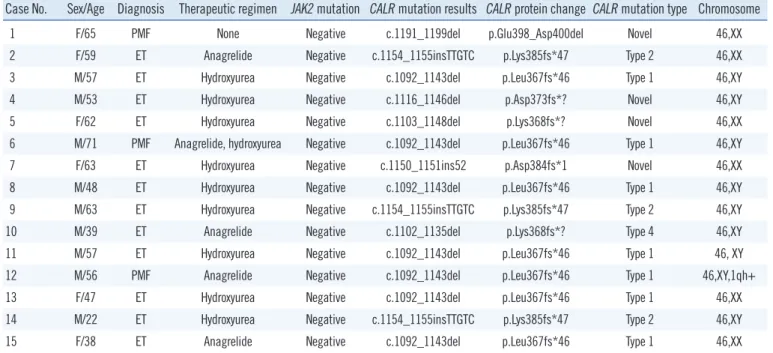
Among 62 patients, JAK2 V617F mutation was detected in 32 (51.6%) patients, while CALR mutations were identified in 15 (24.2%) patients. Fifteen (24.2%) patients did not have JAK2 or CALR mutations, while there were no patients with both mutations. Among 30 patients without the JAK2 V617F muta- tion, CALR mutations were detected in 15 (50.0%) patients but JAK2 exon 12 or MPL exon 9 mutations were not found in these patients (Table 1). Among 15 patients carrying CALR mutations, seven patients showed a 52-base pair deletion (c.1092_
1143del), defined as the most frequent mutation (type 1) [9], three patients showed a 5-base pair insertion (c.1154_ 1155in- sTTGTC), defined as a frequently detected mutation (type 2) [9], while one patient showed a previously defined mutation type 4 (c.1102_1135del) [9]. Four patients were identified with novel mutations (c.1191_1199del, c.1116_1146del, c.1103_1148del, and c.1150_1151ins52) (Table 2).
Among 48 ET patients, those carrying CALR mutations were significantly younger (P =0.036) but had lower WBC counts
Table 1. Summary of JAK2 V617F and CALR mutation profiles in a total of 62 ET and PMF patients
Patient subgroups N of patients (%)
ET (N=48) PMF (N=14) Total (N=62) JAK2(-)/CALR(-) 11 (22.9) 4 (28.6) 15 (24.2) JAK2(-)/CALR(+) 12 (25.0) 3 (21.4) 15 (24.2) JAK2(+)/CALR(-) 25 (52.1) 7 (50.0) 32 (51.6)
JAK2(+)/CALR(+) 0 (0.0) 0 (0.0) 0 (0.0)
Abbreviations: JAK2, Janus kinase 2; CALR, calreticulin; ET, essential thrombocythemia; PMF, primary myelofibrosis.
(P =0.022) and less thrombosis development during follow-up (P =0.036) than those with the JAK2 V617F mutation. Patients carrying CALR mutations did not show significant differences in
platelet counts, 1-yr survival rates, death rates, and OS (P = 0.341) compared with those carrying the JAK2 V617F mutation.
Among the 23 ET patients without the JAK2 V617F mutation, the Table 2. Demographic features and mutation profiles in 15 ET and PMF patients carrying CALR mutations
Case No. Sex/Age Diagnosis Therapeutic regimen JAK2 mutation CALR mutation results CALR protein change CALR mutation type Chromosome
1 F/65 PMF None Negative c.1191_1199del p.Glu398_Asp400del Novel 46,XX
2 F/59 ET Anagrelide Negative c.1154_1155insTTGTC p.Lys385fs*47 Type 2 46,XX
3 M/57 ET Hydroxyurea Negative c.1092_1143del p.Leu367fs*46 Type 1 46,XY
4 M/53 ET Hydroxyurea Negative c.1116_1146del p.Asp373fs*? Novel 46,XY
5 F/62 ET Hydroxyurea Negative c.1103_1148del p.Lys368fs*? Novel 46,XX
6 M/71 PMF Anagrelide, hydroxyurea Negative c.1092_1143del p.Leu367fs*46 Type 1 46,XY
7 F/63 ET Hydroxyurea Negative c.1150_1151ins52 p.Asp384fs*1 Novel 46,XX
8 M/48 ET Hydroxyurea Negative c.1092_1143del p.Leu367fs*46 Type 1 46,XY
9 M/63 ET Hydroxyurea Negative c.1154_1155insTTGTC p.Lys385fs*47 Type 2 46,XY
10 M/39 ET Anagrelide Negative c.1102_1135del p.Lys368fs*? Type 4 46,XY
11 M/57 ET Hydroxyurea Negative c.1092_1143del p.Leu367fs*46 Type 1 46, XY
12 M/56 PMF Anagrelide Negative c.1092_1143del p.Leu367fs*46 Type 1 46,XY,1qh+
13 F/47 ET Hydroxyurea Negative c.1092_1143del p.Leu367fs*46 Type 1 46,XX
14 M/22 ET Hydroxyurea Negative c.1154_1155insTTGTC p.Lys385fs*47 Type 2 46,XY
15 F/38 ET Anagrelide Negative c.1092_1143del p.Leu367fs*46 Type 1 46,XX
Classification of CALR mutation type and novelty was determined through searches in a recently published mutation database (Klampfl et al. [9], N Engl J Med 2013;369:2379-90).
Abbreviations: F, female; M, male; PMF, primary myelofibrosis; ET, essential thrombocythemia; JAK2, Janus kinase 2; CALR, calreticulin; fs, frameshift; del, deletion; ins, insertion.
Table 3. Demographic and clinical features of 48 essential thrombocythemia patients with respect to JAK2 V617F and CALR mutation status Variables
Mutation status (1) JAK2(-)/CALR(-)
(N=11) (2) JAK2(+)/CALR(-)
(N=25) (3) JAK2(-)/CALR(+) (N=12)
Sex (M:F)* 6:05 12:13 7:05
Age, median (range)† 46.0 (19.0-85.0) 71.0 (33.0-81.0)§ 55.0 (22.0-63.0)
WBC, ×109/L, median (range)† 9.54 (6.47-18.33) 13.28 (2.56-100.00)§ 8.47 (6.95-14.93)
Hb, g/dL, median (range)† 12.1 (7.9-17.0) 13.3 (7.2-18.1) 13.5 (9.6-15.9)
PLT, ×109/L, median (range)† 698.0 (553.0-2251.0) 873.0 (557.0-1737.0) 965.0 (588.0-1530.0)
BM cellularity, median (range)† 60.0 (40.0 -100.0) 70.0 (60.0-100.0) 67.5 (40.0-90.0)
Megakaryocyte counts in BM biopsy, median (range)† 8.0 (5.0-13.0)§ 12.0 (4.0-15.0) 10.5 (8.0-15.0)
BM fibrosis grade* (0/1/2/3/4) 3/8/0/0/0 2/16/6/1/0 1/10/1/0/0
Thrombosis developed at follow up* 2/11 (18.2%) 8/25 (32.0%)§ 0/12 (0.0%)
AML transformation at follow up* 0/11 (0.0%) 0/25 (0.0%) 0/12 (0.0%)
Karyotype at diagnosis (normal/abnormal)* 11 (100.0%)/0 (0.0%) 23 (92.0%)/2 (8.0%) 12 (100.0%)/0 (0.0%)
Death at follow up* 1/11 (9.1%) 2/25 (8.0%) 0/12 (0.0%)
Estimated 1 yr survival rates‡ 75.00% 84.20% 100.00%
P values were obtained from Chi-square test or Fisher’s exact test*, Mann-Whitney U test† and Log rank test‡.
Statistical comparisons ([1] vs.[3] and [2] vs.[3]) were performed and those which showed statistical significances (P <0.05) were indicated with the super- script (§).
Abbreviations: JAK2, Janus kinase 2; CALR, calreticulin; WBC, white blood cells; PLT, platelet; BM, bone marrow.
clinical features and OS (P =0.221) of the patients carrying CALR mutations were not significantly different from those without CALR mutations, although higher megakaryocyte counts in BM biopsy (P =0.020) were observed in the former group (Table 3).
In PMF, three patients carrying CALR mutations showed sig- nificantly lower WBC counts (median 4.30 ×10⁹/L vs. 22.77 × 10⁹/L, P =0.016) and tended to have lower hemoglobin levels (median 8.3 g/dL vs. 11.0 g/dL, P =0.087) than did seven pa- tients carrying the JAK2 V617F mutation. No significant differ- ences in other clinical features, prognosis, and DIPSS scores (median 2.0 [0.0-3.0] in patients carrying CALR mutations vs.
1.0 [0.0-3.0] in those carrying the JAK2 V617F mutation, P = 0.400) were observed between the two subgroups. Among pa- tients without the JAK2 V617F mutation, no significant differ- ences in clinical features, prognosis, and DIPSS scores (median 2.0 [0.0-3.0] vs. 2.5 [2.0-4.0], P =0.999) were observed be- tween three patients with CALR mutations and four without CALR mutations, although significantly higher WBC counts were detected in the former group (median 4.30×10⁹/L vs. 2.31×10⁹/ L, P =0.034).
Our data evidenced that the incidence of CALR mutations is 24.2% in ET and PMF, while the mutation frequency increased to 50.0% in patients without the JAK2 V617F mutation, irre- spective of the specific disease subtype. The incidence of CALR mutations reported herein is slightly lower than that reported by Klampfl et al. [9], while it is similar to the results in other studies (24% and 31% in ET and 20% in PMF) [10, 15]. Our results are also similar to previous reports on Asian populations (22.5%
and 26.3% in ET and 21% in PMF) [17-19]; hence, the fre- quency of CALR mutation in ET and PMF is suggested to be in- dependent of ethnic variations. Our data indicated that by intro- ducing a CALR mutation analysis, 50% of the patients sus- pected of having ET and PMF but without the JAK2 V617F mu- tation could be diagnosed correctly.
Consistent with previous reports, we demonstrated that ET patients carrying CALR mutations have distinct clinical features such as younger age, lower WBC counts, and lower thrombosis risk than those carrying the JAK2 V617F mutation [9, 10, 14, 15]. In contrast with previous studies, we did not find significant differences in hemoglobin levels and platelet counts in ET pa- tients with respect to their JAK2 V617F and CALR mutation sta- tus [9-15]. Additionally, our data indicated that the CALR muta- tion status has no influence on clinical features, including prog- nosis in ET patients without the JAK2 V617F mutation. Consid- ering the small size of each subgroup, lack of statistical power might be a major limitation of our study, thus explaining the dis-
crepancy with previous data. Similarly, the comparison of clini- cal features in PMF patients with respect to JAK2 V617F and CALR mutation status might have been affected by the small size of each subgroup. Therefore, additional large-scale studies are required to confirm the clinical relevance of CALR mutations in ET and especially in PMF patients.
In conclusion, the incidence of CALR mutations in ET and PMF was 24.2% and increased to 50.0% in JAK2 V617F-nega- tive cases. ET patients carrying CALR mutations were younger, showed lower WBC counts, and experienced less thrombosis than did those carrying the JAK2 V617F mutation, although no differences in other clinical features and prognosis were dem- onstrated. Furthermore, in ET patients without the JAK2 V617F mutation, the presence of CALR mutations had no influence on clinical manifestation and prognosis. CALR mutation analysis can therefore be a useful additional diagnostic tool for ET and PMF, although the prognostic impact of CALR mutations should be addressed in more detail in future studies.
Authors’ Disclosures of Potential Conflicts of Interest
No conflicts of interest relevant to this article were reported.
Acknowledgments
This work was supported by the year 2014 clinical research grant from Pusan National University Hospital.
REFERENCES
1. Swerdlow SH, Campo E. eds. WHO classification of tumours of haema- topoietic and lymphoid tissues. 4th ed. Lyon: IARC, 2008.
2. Scott LM, Tong W, Levine RL, Scott MA, Beer PA, Stratton MR, et al.
JAK2 exon 12 mutations in polycythemia vera and idiopathic erythrocy- tosis. N Engl J Med 2007;356:459-68.
3. Butcher CM, Hahn U, To LB, Gecz J, Wilkins EJ, Scott HS, et al. Two novel JAK2 exon 12 mutations in JAK2V617F-negative polycythaemia vera patients. Leukemia 2008;22:870-3.
4. Campbell PJ, Scott LM, Buck G, Wheatley K, East CL, Marsden JT, et al. Definition of subtypes of essential thrombocythaemia and relation to polycythaemia vera based on JAK2 V617F mutation status: a prospec- tive study. Lancet 2005;366:1945-53.
5. Campbell PJ, Griesshammer M, Döhner K, Döhner H, Kusec R, Hassel- balch HC, et al. V617F mutation in JAK2 is associated with poorer sur- vival in idiopathic myelofibrosis. Blood 2006;107:2098-100.
6. Bench AJ, White HE, Foroni L, Godfrey AL, Gerrard G, Akiki S, et al.
Molecular diagnosis of the myeloproliferative neoplasms: UK guidelines for the detection of JAK2 V617F and other relevant mutations. Br J Hae- matol 2013;160:25-34.
7. Passamonti F, Elena C, Schnittger S, Skoda RC, Green AR, Girodon F,
et al. Molecular and clinical features of the myeloproliferative neoplasm associated with JAK2 exon 12 mutations. Blood 2011;117:2813-6.
8. Rumi E, Pietra D, Guglielmelli P, Bordoni R, Casetti I, Milanesi C, et al.
Associazione Italiana per la Ricerca sul Cancro Gruppo Italiano Malattie Mieloproliferative. Acquired copy-neutral loss of heterozygosity of chro- mosome 1p as a molecular event associated with marrow fibrosis in MPL-mutated myeloproliferative neoplasms. Blood 2013;121:4388-95.
9. Klampfl T, Gisslinger H, Harutyunyan AS, Nivarthi H, Rumi E, Milosevic JD, et al. Somatic mutations of calreticulin in myeloproliferative neo- plasms. N Engl J Med 2013;369:2379-90.
10. Rumi E, Pietra D, Ferretti V, Klampfl T, Harutyunyan AS, Milosevic JD, et al. JAK2 or CALR mutation status defines subtypes of essential throm- bocythemia with substantially different clinical course and outcomes.
Blood 2014;123:1544-51.
11. Tefferi A, Lasho TL, Finke CM, Knudson RA, Ketterling R, Hanson CH, et al. CALR vs JAK2 vs MPL-mutated or triple-negative myelofibrosis:
clinical, cytogenetic and molecular comparisons. Leukemia 2014;28:
1472-7.
12. Tefferi A, Guglielmelli P, Lasho TL, Rotunno G, Finke C, Mannarelli C, et al. CALR and ASXL1 mutations-based molecular prognostication in pri- mary myelofibrosis: an international study of 570 patients. Leukemia 2014;28:1494-500.
13. Rumi E, Harutyunyan AS, Pietra D, Milosevic JD, Casetti IC, Bellini M, et al. CALR exon 9 mutations are somatically acquired events in familial cases of essential thrombocythemia or primary myelofibrosis. Blood
2014;123:2416-9.
14. Gangat N, Wassie EA, Lasho TL, Finke C, Ketterling RP, Hanson CA, et al. Mutations and thrombosis in essential thrombocythemia: prognostic interaction with age and thrombosis history. Eur J Haematol 2014 Jun 3.
doi: 10.1111/ejh.12389. [Epub ahead of print].
15. Nangalia J, Massie CE, Baxter EJ, Nice FL, Gundem G, Wedge DC, et al. Somatic CALR mutations in myeloproliferative neoplasms with non- mutated JAK2. N Engl J Med 2013;369:2391-405.
16. Tefferi A, Thiele J, Vannucchi AM, Barbui T. An overview on CALR and CSF3R mutations and a proposal for revision of WHO diagnostic criteria for myeloproliferative neoplasms. Leukemia 2014;28:1407-13.
17. Li B, Xu J, Wang J, Gale RP, Xu Z, Cui Y, et al. Calreticulin mutations in Chinese with primary myelofibrosis. Haematologica 2014;99:1697-700.
18. Shen H, Chao H, Ding Z, Feng Y, Cen J, Pan J, et al. CALR and ASXL1 mutation analysis in 190 patients with essential thrombocythemia. Leuk Lymphoma 2014 Aug 13:1-3. [Epub ahead of print].
19. Chen CC, Gau JP, Chou HJ, You JY, Huang CE, Chen YY, et al. Frequen- cies, clinical characteristics, and outcome of somatic CALR mutations in JAK2-unmutated essential thrombocythemia. Ann Hematol 2014 Jul 13. [Epub ahead of print].
20. Passamonti F, Cervantes F, Vannucchi AM, Morra E, Rumi E, Pereira A, et al. A dynamic prognostic model to predict survival in primary myelofi- brosis: a study by the IWG-MRT (International Working Group for My- eloproliferative Neoplasms Research and Treatment). Blood 2010;115:
1703-8.