Journal of Bacteriology and Virology 2016. Vol. 46, No. 3 p.142 – 151 http://dx.doi.org/10.4167/jbv.2016.46.3.142
The Genetic Diversity of Norovirus from Children with Diarrhea in Gwangju Metropolitan City, Korea: 2008-2012
Hye-Young Kee
1, Min Ji Kim
1, Sun Hee Kim
1, Dong-Ryong Ha
1, Eun Sun Kim
1, Hye Sook Jeong
2, Jae Keun Chung
1and Kye Won Seo
1*1Health and Environment Institute of Gwangju; 2Korea Centers for Disease Control & Prevection, Gwangju, Korea
In order to study the characteristics of norovirus in Gwangju metropolitan city, We examined norovirus in 13,931 fecal specimens collected through five years (2008-2012) from children admitted with a chief complain of acute diarrhea.
Among a total of norovirus (NoV) was most frequently detected (3,025 cases, 21.7%). Concerning the frequency of virus detected by month, NoV tended to break out frequently from October to March in the following year. NoV was detected most highly in 0~3 year infants. Through examinations on NoV genotypes, among 3,025 cases that turned out to be positive, the genotypes of 2,652 cases were determined with various results including 13 types of GI and 17 types of GII. The results of analysis on GI genotypes were as follows: GI-4 (21.9%), GI-2 (15.2%), and GI-6 (10.5%). GII genotypes were as follows: GII-4 (63.9%), GII-3 (18.9%), GII-8 (4.2%), GII-2 (3.9%), GII-6 (3.3%), and GII-1 (1.9%). Eight types of variants for GII-4 genotype (427 cases) were identified. The majority of the GII-4 variants was GII-4_Farmington (181 cases, 42.4%), which peaked in 2012, while GII-4_2008b (173 cases, 40.5%) showed a high prevalence in 2011. Concerning the circulation of variants, as many as eight types of GII-4 variants were identified in 2012, showing more varieties than in other years. Therefore, this study can be used as fundamental data for the development of vaccine candidate for the prevention of viral diarrheal diseases with high-incidence.
Key Words: Norovirus, Genotype, GII-4, Gwangju metropolitan city
INTRODUCTION
급성 위장관염은 주로 어린 아이들에 발생하는 일반적 인 기능장애 질환으로, 특히 후진국에서는 병원 입원 횟 수를 증가시켜 사망을 유발하는 것으로 알려져 있고, 주 로 저소득 국가에서는 매년 140만 명이 급성 위장관염으 로 사망하는 것으로 보고되고 있어 (1, 2), 사회 경제적으 로 많은 피해를 초래하고 있는 실정이다.
노로바이러스는 Caliciviridae에 속하는 27 nm 크기의
구형 바이러스로써 7.5~7.7 kb의 single-stranded RNA 바이 러스로 (3, 4), 5개의 genogroups (G)으로 분류되며 이 중 GI, GII, GIV는 주로 사람에서 위장관염을 일으키고, GIII 와 GV는 소와 쥐에서 검출되는 것으로 알려져 있다 (5).
이들 genogroups은 적어도 32개 이상의 유전자형으로 분 류가 되며, 특히 GII-4 유전자형은 전세계적으로 가장 우 세하게 출현하는 유전자형으로 지난 20년 동안 노로바이 러스 감염증의 70~80%가 GII-4 유전자형이 원인으로 밝 혀졌다 (6~9).
전파경로는 매우 다양하여 접촉감염, 분변-경구감염, 에
142
Received: March 16, 2016/ Revised: June 30, 2016/ Accepted: July 7, 2016
*Corresponding author: Kye Won Seo. Health and Environment Institute of Gwangju, 149 Hwajeong-ro, Seo-gu, Gwangju 61986, Korea.
Phone: +82-62-613-7540, Fax: +82-62-613-7567, e-mail: [email protected]
**This research as a part of the laboratory investigations of acute diarrhea, managed by the National Institute of Health, Republic of Korea and supported by Health & Environment Institute of Gwangju Metropolitan city.
○CCThis is an Open Access article distributed under the terms of the Creative Commons Attribution Non-Commercial License (http://creativecommons.org/license/by-nc/3.0/).
Original Article
어로졸, 오염된 물과 음식물을 통해 사람간의 전파가 가능 하며, 바이러스의 전염력이 매우 강하여 100개 미만의 적 은 개수로도 감염이 될 수 있다 (10). 임상증상으로는 어 린 아이에서는 설사보다 구토가 주로 발생하고, 성인은 설사가 주 증상인 경우가 많으며 전 연령층에서 발생하 는 특징이 있다. 지역적 발생 양상은 전 세계의 모든 지 역에서 발생하며, 계절적으로는 가을부터 이듬해 봄철까 지 기온이 낮은 시기에 주로 유행하는 것으로 알려져 있다 (11). 노로바이러스의 주요 발생은 특히 레스토랑, 요양시설, 학교, 유람선 등과 같은 서로 다른 환경에서 대 규모의 급성 위장관염을 일으키며 (10, 12~14), 최근 연구 에 따르면 급성 위장관염으로 병원에 입원한 청소년들에 서 노로바이러스가 원인체인 경우의 비중이 점점 높아지 고 있음이 밝혀지고 있다 (15~17).
노로바이러스의 진단은 유전자 증폭을 이용한 Reverse Transcriptase Polymerase chain Reaction법이 개발되어 신속 하고 민감도가 높아 위장관염의 집단발병 등 역학조사에 널리 사용되고 있으며 (18, 19), 식중독 관련 검체인 물, 해 산물, 생굴 같은 식품에서도 바이러스의 검출이 가능하게 되어 환경 검체에서도 원인바이러스를 추적할 수 있게 되었다 (20, 21).
대체적으로 RNA 바이러스는 한번 복제될 때마다 104 개의 nucleotide당 1개씩의 돌연변이가 발생하여 지역적으 로나 국가간에 유전자적 다양성이 발생하는 것으로 알려 져 있고 (22~24), 노로바이러스도 2~3년의 주기를 갖고 변이주가 계속적으로 보고 (25, 26)되고 있어 이에 대한 근절이 어려우므로 지속적인 연구가 필요하다.
따라서 본 연구에서는 2008년부터 2012년까지 5년간 광 주광역시 소재 협력병원에 설사증상으로 내원 또는 입원 한 환자 중 20세 이하의 소아청소년을 대상으로 성별, 연 령별 발생 양상 등 노로바이러스의 발생현황을 살펴보고, 노로바이러스의 유전자형 분포조사를 통해 대규모 설사 질환의 집단발병 시 신속 차단 및 확산 방지 등 예방대책 수립의 기초자료로 활용하고자 한다.
MATERIALS AND METHODS
실험재료 및 시료 전처리 방법
2008년부터 2012년까지 광주광역시 종합 병 · 의원에 급 성설사를 증상으로 입원 혹은 내원한 20세 이하의 환자 분변시료 13,931건에 대하여 노로바이러스를 검사하였다.
병원에서 채취된 분변은 환자 인적사항 등을 적은 참여동 의서와 함께 4℃ 냉장을 유지하여 실험실로 운반한 즉시 바이러스 검출을 실시하였다. 분변시료 1 g에 PBS (phos- phate buffered saline 7.2, Sigma, St, Louis, MO, USA)를 사용 하여 10배 희석액을 만든 후, 4℃에서 20분간 3,000 rpm으 로 원심분리하여 상층액을 시험에 사용하였다.
바이러스 RNA 추출
바이러스 RNA 추출은 viral nucleic acid prep kit (Green mate, Korea)을 사용하였다. 분변부유액 150 μl에 lysis &
binding 용액 300 μl를 넣고 진탕하여 섞어준 후 다시 magnetic bead를 20 μl 넣고 진탕하여 섞어준다. 상층액을 제거한 후 washing solution I, II, III를 순서대로 각각의 용 량에 맞게 넣어준 후 진탕하여 세척한 후 상층액을 완벽 하게 제거한다. Elution solution을 200 μl 넣고 섞어준 후 상온에서 5분간, 60℃에서 10분간 정체시키고 상층액을 수 거하여 실험에 사용하였다.
노로바이러스 유전자 검사
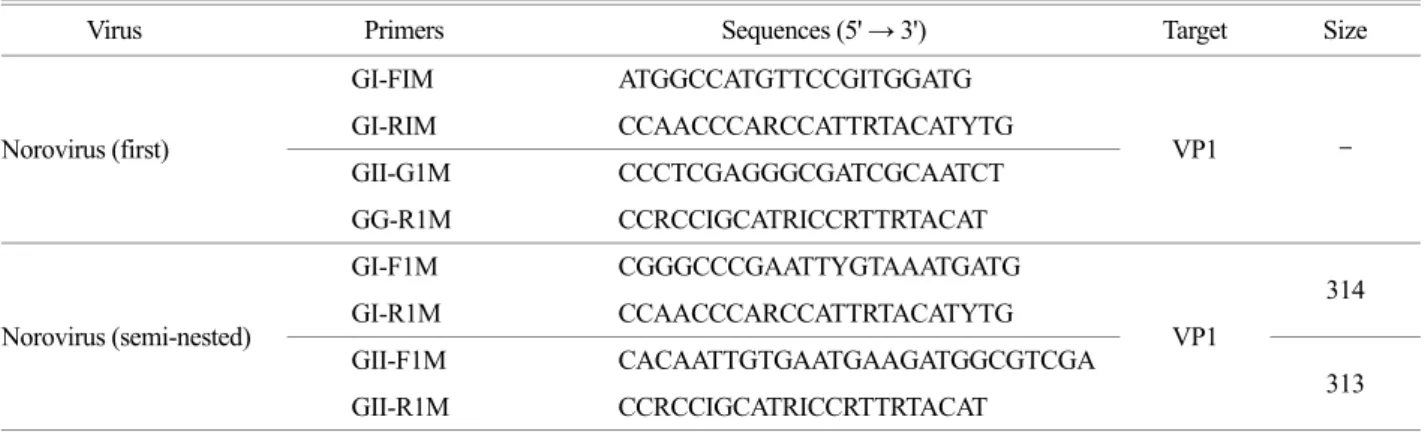
추출한 RNA를 국립보건연구원에서 분양받은 프라이머 조건(Table 1)으로 1st one-step RT PCR Mix-GI/GII 20 μl에 각각 넣어 잘 섞어주고 반응액이 완전히 섞이도록 한 후, PCR machine (9700 Thermal cycler, Appled Biosystems, USA) 을 이용하여 반응을 실시하였다. PCR 조건은 47℃/40분간 역전사반응을 실시하였고, 94℃/15분간 변성 후, 94℃/60초, 50℃/60초, 72℃/60초의 과정을 35회 실시하고, 72℃에서 7분간 반응시켰다. 그 후 RNA tube (2nd PCR Mix-GI/GII)에 멸균 증류수를 18 μl씩 넣고 1차 one-step RT PCR 산물(GI/
GII) 2 μl 씩을 각각 취하여 완전히 섞이도록 하였다. 간 단히 원심분리를 실시한 후 PCR 반응을 실시하였고, PCR 조건은 94℃/3분간 변성 후, 94℃/30초, 56℃/30초, 72℃/45 초의 과정을 25회 실시한 후, 72℃에서 7분간 반응시켰다.
PCR 산물 5 μl을 1.5% agarose gel (Gibco, USA)에 전기영 동한 후, EtBr로 염색하여 ultra violet (UV)하에서 관찰하여 특이적인 크기의 유전자 산물을 확인하였다.
유전자형 분석 PCR 산물의 정제
노로바이러스 양성 검체 중 유전자형이 확인된 2,652건 을 대상으로 유전자형을 분석하였다. 즉, 증폭된 PCR 산 물은 2% agarose gel (Gibco, USA)로 전기영동하여 확인하
였고, DNA 절편을 절단한 후 gel purification kit (Bioneer, Korea)를 사용하여 정제하였다. 절편을 1.5 ml 튜브에 넣 고 3배의 젤 용해용 완충용액(Buffer GB)을 첨가하고 50℃
에서 젤을 용해시킨 뒤, spin column으로 옮겨 4℃에서 14,000 rpm으로 1시간 원심분리한 후 세척용 완충용액 750 μl을 첨가하고 14,000 rpm에서 1분간 원심분리하였다.
상층액을 취해 잔여 세척용 완충용액을 제거하고 30~50 μl의 증류수로 DNA를 회수하여 노로바이러스 유전자형 분포와 계통유전학적 분석 실험에 사용하였다.
염기서열 분석
염기서열 분석을 위하여 각 PCR 산물을 이용하여 각 각의 nested PCR에 사용한 프라이머를 사용하여 양쪽방 향으로 big dye sequencing kit (Applied Biosystems)을 사용 하여 염기서열을 결정하였고, big dye removal kit (Amer-
sham Pharmacia Biotech., Little Chalfont, UK)로 정제한 다 음, automated DNA sequencer (Applied Biosystems, USA)는 ABI PRISM Dye terminator (Applied Biosystems, USA)를 이용하여 염기서열을 분석하였다. 염기서열은 Lasergene (Copyrightc 1997 by DNASTAR, Inc., Madison, WI, USA)의 MegAlign Program을 사용한 phylogenetic analysis를 통해서 prototype strain과 비교하여 유전자형을 결정하였다.
통계 분석
기온이 바이러스 검출률에 영향을 미치는지를 알아보기 위해 SPSS 21.0 (Statistical package for the social sciences, USA)을 이용하여 회귀 분석을 실시하였고, 다음과 같은 검증모형을 설정하였다.
NORORAT(월별 노로바이러스 검출율) = α + β*TEMP + ε TEMP(월별 평균기온)
RESULTS
노로바이러스의 검출빈도
2008년~2012년까지 5년간 광주광역시 소재 병 · 의원에 입원 또는 내원한 급성설사환자 대변에서 노로바이러스 검사 결과 21.7% (3,025/13,931)의 검출률을 보였다. 연도별 노로바이러스의 검출률은, 2008년 21.1%, 2009년 14.5%, 2010년 27.6%, 2011년 22.0%, 2012년 25.0%였다(Table 2).
월별 검출률은 10월에 19.8%로 바이러스 검출률이 증 가하기 시작하여 11월 46.6%, 12월 49.2%로 가장 높게 검 출되었으며, 1월 36.7%, 2월 24.4%, 3월 22.2%였으나, 4월 에 16.2%로 감소하기 시작하여 9월까지 10% 이하로 낮 Table 2. Prevalence of norovirus infection detected from diarrheal
patients in Gwangju metropolitan city during 5 years (2008~
2012)
Year No. of
cases No. of
detected Detection rate (%)
2008 2,971 626 21.1
2009 3,147 455 14.5
2010 2,844 785 27.6
2011 2,812 619 22.0
2012 2,157 540 25.0
Total 13,931 3,025 21.7
Table 1. RT-PCR primers for the detection of diarrheal patients in this study
Virus Primers Sequences (5' → 3') Target Size
Norovirus (first)
GI-FIM ATGGCCATGTTCCGITGGATG
VP1 -
GI-RIM CCAACCCARCCATTRTACATYTG
GII-G1M CCCTCGAGGGCGATCGCAATCT
GG-R1M CCRCCIGCATRICCRTTRTACAT
Norovirus (semi-nested)
GI-F1M CGGGCCCGAATTYGTAAATGATG
VP1
GI-R1M CCAACCCARCCATTRTACATYTG 314
GII-F1M CACAATTGTGAATGAAGATGGCGTCGA
GII-R1M CCRCCIGCATRICCRTTRTACAT 313
게 검출되었다(Fig. 1). 이를 연도별로 살펴보면 2008년 10월~1월, 2009년 11월~2월, 2010년 10월~3월, 2011년 11월~4월, 그리고 2012년에는 10월~1월까지가 평균 검출 률보다 높게 나타났으며, 기온과 바이러스 검출률과의 관 계를 살펴본 결과, 광주광역시 월 평균기온은 매년 11월 부터 10℃ 이하로 낮아지기 시작하여 12월과 1월에 가장 낮은 기온을 보였고 매년 5℃ 이하의 기온이 3달 정도 유 지되었으며, 노로바이러스가 가장 높은 검출률을 보인 시 기인 12월의 평균기온은 0.4~4.1℃의 기온분포를 보였다
(Fig. 2). 기온이 노로바이러스 검출률에 영향을 미치는지 를 검증하는 회귀식의 설명력은 유의적으로 높게 나타났 으며(수정 R2, 0.575), 기온의 회귀계수도 유의적으로 나 타났다(T 값 -8.99, p < 0.05). 따라서 기온이 낮을수록 노 로바이러스의 발생가능성이 높음을 알 수 있었다.
연령별 검출률은 활동영역에 따른 연령대로 분류하였 으며 분포는 0~3세 24.7% (2,543/10,290), 4~7세 14.9%
(347/2,322), 8~13세 11.2% (126/1,124), 14~20세 4.6% (9/
195)를 보였다.
Figure 1. Seasonal distribution of norovirus infection from diarrheal patients in Gwangju metropolitan city during 5 years (2008~2012)
Figure 2. Relationship between monthly distribution of norovirus from diarrheal patients and mean monthly temperature in Gwangju metropolitan city during 5 years (2008~2012)
노로바이러스의 유전자형
노로바이러스 양성으로 판정된 3,025건에서 genogroup I 85건(2.8%), genogroup II 2,902건(95.9%), genogroup I &
II 혼합감염이 38건(1.3%)을 차지하였다(Table 3). 그 중 2,652건(87.7%)에서 유전자형이 결정되었는데, 유전자형
분석 결과 genogroup I 13종, genogroup II 17종으로 30종의 유전자형이 검출되어 다양한 유전자형의 노로바이러스들 이 존재함을 알 수 있었다.
Genogroup I 유전자형 분석 결과 GI-4 23건(21.9%), GI-2 16건(15.2%), GI-6와 GI-1이 11건(10.5%)순으로 검출되었 으며, 연도별로는 2008년에 GI-4형이 15건(46.9%), GI-5형 4건(12.5%)으로 가장 높은 분포를 보였다. 2009년에는 GI- 3, GI-4, GI-7, GI-9 유전자형이 모두 3건(21.4%)으로 동일 하게 검출되었고, 2010년에는 GI-2 8건(29.6%), GI-6 6건 (22.2%)이 검출되었다. 또한 2011년에는 GI-1, GI-3 유전자 형이 4건(16.7%), GI-2, GI-12 유전자형이 3건(12.5%)이었 으며, 2012년에는 GI-4형이 3건(37.5%)으로 가장 많이 검 출되었다(Table 4).
Genogroup II 유전자형은 GII-4 1,628건(63.9%), GII-3 482건(18.9%), GII-8 106건(4.2%), GII-2 100건(3.9%), GII-6 85건(3.3%), GII-1 48건(1.9%) 순으로 검출되었다. 연도별 분포현황으로는 매년 GII-4 유전자형이 가장 높게 검출되 었고, GII-4를 제외한 주요 유전자형은 2008년 GII-3 101 건(17.2%), GII-7 11건(1.9%), 2009년 GII-8 61건(16.3%),
Table 4. Annual genotypic distribution of norovirus GI in Gwangju metropolitan city during 5 years (2008~2012) Year
genotype
No. of samples (%)
Total
2008 2009 2010 2011 2012
GI-1 2 (6.3) 3 (11.1) 4 (16.7) 2 (25.0) 11 (10.5)
GI-2 3 (9.4) 1 (7.1) 8 (29.6) 3 (12.5) 1 (12.5) 16 (15.2)
GI-3 1 (3.1) 3 (21.4) 2 (7.4) 4 (16.7) 10 (9.5)
GI-4 15 (46.9) 3 (21.4) 2 (8.3) 3 (37.5) 23 (21.9)
GI-5 4 (12.5) 1 (3.7) 5 (4.8)
GI-6 3 (9.4) 6 (22.2) 2 (8.3) 11 (10.5)
GI-7 3 (21.4) 1 (3.7) 1 (4.2) 5 (4.8)
GI-8 1 (4.2) 1 (1.0)
GI-9 2 (6.3) 3 (21.4) 1 (3.7) 2 (8.3) 8 (7.6)
GI-10 1 (3.7) 1 (1.7)
GI-12 3 (11.1) 3 (12.5) 6 (5.7)
GI-13 1 (12.5) 1 (1.0)
GI-14 2 (6.3) 1 (7.1) 1 (3.7) 2 (8.3) 1 (12.5) 7 (6.7)
Total 32 14 27 24 8 105
Table 3. Proportion of norovirus genogroup GI and GII detected in Gwangju metropolitan city during 5 years (2008~2012)
Genogroup Year
Total 2008 2009 2010 2011 2012
GI 27
(4.3) 12 (2.6) 23
(2.9) 16 (2.6) 7
(1.3) 85 (2.8)
GII 593
(94.7) 438 (96.3) 750
(95.6) 591 (95.5) 530
(98.1) 2,902 (95.9) GI & GII 6
(1.0) 5 (1.1) 12
(1.5) 12 (1.9) 3
(0.6) 38 (1.3)
Total 626 455 785 619 540 3,025
GII-2 30건(8.0%), 2010년 GII-3 140건(22.1%), GII-6 25건 (3.9%), 2011년 GII-3 93건(20.6%), GII-2 38건(8.4%), 2012년 GII-3 127건(25.3%), GII-6 29건(5.8%)의 순으로 분포하였다 (Table 5).
GII-4 유전자형의 변이주는 8종 427건(26.2%)이 확인되 었으며 가장 많이 검출된 GII-4 변이주는 GII-4_Farmington 으로 181건(42.4%), GII-4_2008b 173건(40.5%), GII-4_2006b 54건(12.6%), GII-4_2006a 6건(1.4%), GII-4_Bristol과 GII-4_
Outlier 4건(0.9%), GII-4_Hunter 3건(0.7%), GII-4_Sakai 2건 (0.5%) 순으로 나타났고, 변이주는 2009년과 2010년 2종 이 검출되었으나 2011년 6종으로 다양해졌으며, 2012년에 는 8종의 변이주가 검출되었다(Table 6).
DISCUSSION
본 연구에서 광주광역시의 소아청소년 설사환자를 대 상으로 노로바이러스 감염현황 조사 결과 21.7% (3,025/
13,931)의 검출률을 보였는데, 연도별로는 2008년 21.1%, 2009년 14.5%로 감소하였다가 2010년 27.6%, 2011년 22.0%
그리고 2012년에는 25.0%의 검출률을 보였다. 이는 2007년
~2011년의 서울지역 16.6% (27), 2006년~2013년의 경기지 역 12.0% (28) 보다는 높은 검출률을 보였고, 2008년~
2010년 제주지역 30.7% (29)보다는 낮게 나타났다. 다른 연도에 비해 2009년에 노로바이러스 검출률이 낮은 것은 신종플루의 전국적인 유행으로 손씻기의 중요성이 강화 되어 소화기바이러스 감염증의 발병률이 낮아진 때문으 로 생각된다 (30). 노로바이러스의 월별 검출률은 10월에 Table 5. Annual genotypic distribution of norovirus GII in Gwangju metropolitan city during 5 years (2008~2012)
Year genotype
No. of samples (%)
Total
2008 2009 2010 2011 2012
GII-1 5 (1.3) 23 (3.6) 3 (0.7) 17 (3.4) 48 (1.9)
GII-2 7 (1.2) 30 (8.0) 2 (0.3) 38 (8.4) 23 (4.6) 100 (3.9)
GII-3 101 (17.2) 21 (5.6) 140 (22.1) 93 (20.6) 127 (25.3) 482 (18.9)
GII-4 456 (77.6) 226 (60.4) 405 (64.0) 256 (56.8) 285 (56.9) 1,628 (63.9)
GII-5 5 (1.1) 4 (0.8) 9 (0.4)
GII-6 3 (0.5) 6 (1.6) 25 (3.9) 22 (4.9) 29 (5.8) 85 (3.3)
GII-7 1 1(1.9) 17 (4.5) 10 (1.6) 3 (0.7) 2 (0.4) 43 (1.7)
GII-8 3 (0.5) 61 (16.3) 19 (3.0) 21 (4.7) 2 (0.4) 106 (4.2)
GII-9 1 (0.2) 1 (0.0)
GII-10 1 (0.3) 1 (0.0)
GII-11 1 (0.2) 8 (1.6) 9 (0.4)
GII-12 2 (0.3) 4 (1.1) 5 (0.8) 2 (0.4) 2 (0.4) 15 (0.6)
GII-13 1 (0.2) 1 (0.2) 1 (0.2) 3 (0.1)
GII-15 1 (0.2) 1 (0.0)
GII-16 2 (0.3) 3 (0.8) 1 (0.2) 4 (0.9) 2 (0.4) 12 (0.5)
GII-17 1 (0.2) 2 (0.3) 3 (0.1)
GII-18 1 (0.2) 1 (0.0)
Total 588 374 633 451 501 2,547
19.8%로 증가하기 시작하여, 11월 46.6%로 높아졌다가, 12월에 49.2%로 가장 높게 검출되었으며, 1월 36.7%, 2월 24.2%, 3월 22.2%로 감소하기 시작하여, 4월에 16.2%로 큰 폭으로 감소하여 5월부터는 10% 미만의 검출률을 보 였다. 이와 같은 결과는 제주지역이 12월에 18.8%로 가장 높았다는 결과 (29)와 유사한 반면, Lee 등 (31)이 2004년
~2007년까지 서울지역에서 조사한 결과인 11월에 57.2%
로 가장 높았다는 결과에 비해 1달 정도 늦은 경향을 보 였으나, Ham 등 (27)은 2007년~2011년의 보고에서 1월에 35.6%로 가장 높았음을 보고하여 노로바이러스는 주로 한 겨울에 유행한다는 결과와 동일하였다. 연도별로 노로바 이러스의 검출률이 높은 시기로는 2008년에는 10월~1월, 2009년은 11월~2월, 2010년에는 10월~3월, 2011년 11월
~4월까지였고, 2012년에는 10월~1월까지 높은 검출률을 보여 노로바이러스 유행은 주로 10월~3월까지인 것으로 나타났다.
연령별 검출빈도는 0~3세에서 24.7%로 가장 높은 검 출률을 보여 서울지역 (31)의 연구 결과와 동일한 결과를 보였으며, 어린이집이나 유치원에 다니는 시기인 4~7세 에서도 14.9%의 검출률을 보여 노로바이러스 감염에 대 한 주의가 필요하다고 판단되었다. 노로바이러스가 영 · 유 아에서 높은 검출률을 보이는 경우가 특히 많았는데 이 는 선천적 면역이 낮고 질병 발생 시 병원출입이 빈번한 것과도 연관성이 있을 것으로 보고 (32)된 경우가 있어 감 염 예방을 위해 홍보 실시 등 적극적인 노력을 기울여야
한다.
노로바이러스 유전자형 조사 결과 genogroup I 85건 (2.8%), genogroup II 2,902건(95.9%), genogroup I & II 혼합 감염 38건(1.3%)으로 genogroup II가 대부분을 차지하였다.
이는 1999년~2004년 일본 (33), 1999년~2005년 중국 (34), 2000년~2004년 미국 (35), 2010년 중국 (36)의 경우와 동 일하였고, 국내 다른 지역의 발생현황인 2008년~2010년 부산지역 (37), 제주지역 (29)과 2005년~2007년의 인천지 역 (38) 등의 결과와도 유사하였다.
유전자형 분석 결과 genogroup I은 GI-4 21.9%, GI-2 15.2%, GI-6와 GI-1 10.5%였고, genogroup II는 GII-4 유전 자형이 63.9%로 가장 높은 분포를 보였고 다음은 GII-3 유전자형이 18.9%로 광주광역시에서 가장 우세하게 나타 난 주요 유전자형임을 알 수 있었다. 또한 검출된 유전자 형은 30종으로 2008년~2011년 제주지역 (29)에서 보고된 유전자형 21종과 비교하여 다양한 유전자형이 존재하였고, 유전자형의 다양성이 증가추세에 있음을 보고하여 이에 대한 지속적인 연구가 수행되어야 할 것으로 생각되었다.
연도별 분포는 매년 GII-4 유전자형이 가장 높게 검출 되었고, GII-4를 제외한 주요 유전자형은 2008년 GII-3 17.2%, GII-7 1.9%, 2009년 GII-8 16.3%, GII-2 8.0%, 2010년 GII-3 22.1%, GII-6 3.9%, 2011년 GII-3 20.6%, GII-2 8.4%, 2012년 GII-3 25.3%, GII-6 5.8%의 순으로 분포하였다. 즉, 주요 유전자형인 GII-4를 제외한 주요 유전자형은 2009년 에 GII-8 유전자형이 16.3%인 것을 제외하고 매년 GII_3 Table 6. Change in relative frequencies of GII-4 variants in Gwangju metropolitan city during 5 years (2008~2012)
Year No. of samples (%)
2008 2009 2010 2011 2012 Total
GII-4 456 226 405 256 285 1,628
GII-4 variant (%) 10 (4.4) 5 (1.2) 128 (50.0) 284 (99.7) 427 (26.2)
GII-4_Bristol 4 (1.4) 4 (0.9)
GII-4_Farmington 1 (10) 3 (2.3) 177 (62.3) 181 (42.4)
GII-4_Hunter 1 (10) 1 (0.8) 1 (0.4) 3 (0.7)
GII-4_Sakai 1 (0.8) 1 (0.4) 2 (0.5)
GII-4_2006a 4 (3.1) 2 (0.7) 6 (1.4)
GII-4_2006b 4 (3.1) 50 (17.6) 54 (12.6)
GII-4_2008b 9 (90) 4 (90) 115 (89.8) 45 (15.8) 173 (40.5)
GII-4_Outlier 4 (1.4) 4 (0.9)
유전자형이 17~21%의 분포를 보여 GII_4 유전자형 다음 으로 많이 분포함을 확인하였다. 또한 기타 유전자형으로 GII-2와 GII-6 유전자형이 10% 미만으로 분포하였고, 나머 지 유전자형들은 낮은 수준으로 검출되었다. 이와 같은 결과는 국내보고 (37~39)뿐만 아니라 세계 여러나라에서 도 유행하는 주요 유전자형이 GII-4형이라는 보고와 일치 하였다 (34, 40~43). 그리고 2010년 중국 Chongqing 지역 의 연구 (36)에서는 GII-4 63.6%, GII-6 13.6%, GII-2 9.1%, GII-3 9.1%, GII-7 4.6%의 분포 결과와 2011년~2012년의 중국 (44)에서도 주요 유전자형이 GII-4 61.2%, GII-3 33.8%, GII-6 5.0%의 결과를 보여 본 연구와 일치하였다. 또한 GII-4 유전자형 이외에 많은 분포를 보인 유전자형으로 는 부산지역 (37)은 2008년 GII-5 21.6%, 2009년 GII-8 4.8%, 2010년 GII-3 14.3%형이었고, 서울지역 (39)은 2004년 GII- 3 23.3%, 2005년 GII-8 17.6%, 2006년 GII-2 1.3%, 2007년 GII-3 1.7%가 검출됨을 보고하여 본 연구 결과와 유사하였 다. 세계적 발생현황 조사 결과 GII-4 유전자형이 월등히 유행 양상을 보이는 기전에 대해서 GII-4 유전자형의 빠 른 진화속도, 재조합 등의 방법을 통해 집단면역을 피할 수 있는 새로운 변이주가 만들어지는데 유리하다는 점 등 이 보고된 바 있다 (45, 46).
GII-4 유전자형은 노로바이러스의 집단발병과 산발적 발생에 관여하는 것으로 알려져 있으며, 급성 위장관염 의 발생에 GII-4 변이주가 주요 원인으로 작용하고 있 음을 보고하였다. 본 연구에서 GII-4 변이주는 연도별로 건수와 변이주의 종류가 점차 증가하는 양상을 보였는 데, 이는 2006년~2013년 경기지역 (28)과 비교하여 GII-4 변이주 5종 461건보다 변이주의 종류가 다양한 것을 확 인하였다. 또한 경기지역의 주요 변이주는 GII-4_2006b 67.5%, GII-4_2012 14.8%, GII-4_2009 9.1%, GII-4_2007 7.4%, GII-4_2006a 1.3%이었으며, 시기적으로도 GII-4_2006b 변이주가 2007년~2009년에 가장 많이 검출되었다고 보고 하여 본 연구에서 확인된 주요 변이주와 상이한 결과를 보였다. 또한 베트남 (47)의 연구 결과 2009년 5월~11월 까지는 GII-4_2006b 변이주가 유행하였고, 2009년 12월 부터는 GII-4_2010 변이주가 출현하였으며, GII-4_2006b 변이주의 분포가 감소하였다고 보고하였으나, 본 연구에 서는 GII-4_2006b 변이주가 2011년에 검출되기 시작하여 2012년에 17.6%로 크게 증가한 양상을 보여 유행시기가 차이가 있음을 확인하였다. 따라서 GII-4 변이주 출현 양 상이 다른 지역과 상이하므로 지속적인 연구를 통하여
GII-4 변이주의 변화 양상을 확인함으로써 노로이러스에 의한 집단발병을 예방할 수 있을 것으로 생각한다.
이상과 같이 광주광역시 설사환자를 대상으로 노로바 이러스 유전자형에 대한 조사 결과 세계적으로 유행하 고 있는 GII-4 유전자형이 가장 우세하게 유행하였으며, GII-4_Farmington 변이주 (48)를 비롯한 여러 변이주들이 유행함을 확인하였다. 그러나 본 연구에서는 최신 변이주 로 보고되고 있는 GII-4_Sydney 변이주 (46, 49, 50)에 대한 조사가 시행되지 못한 것이 미흡한 점으로 생각되며 향후 추가적인 연구를 통하여 보완해야 할 것으로 생각된다. 또 한 인플루엔자바이러스와 유사하게 노로바이러스는 유전 자 재조합에 의한 새로운 유전자형이 출현할 경우 학교와 병원 등 집단생활을 하는 곳에서 폭발적 유행을 보일 가 능성도 고려해야 한다. 따라서 이상의 연구 결과를 통해 새롭게 출현하는 노로바이러스 유전자형과 변이주에 대한 신속한 규명과 차단이 기대되며 더 나아가 백신 개발을 위한 자료로 활용할 수 있을 것으로 생각된다.
REFERENCES
1)Black RE, Cousens S, Johnson HL, Lawn JE, Rudan I, Bassani DG, et al. Global, regional, and national causes of child mortality in 2008: a systematic analysis. Lancet 2010;
375:1969-87.
2) Wardlaw T, Salama P, Brocklehurst C, Chopra M, Mason E. Diarrhoea: why children are still dying and what can be done. Lancet 2010;375:870-2.
3) Green KY, Ando T, Balayan MS, Berke T, Clarke IN, Estes MK, et al. Taxonomy of the Caliciviruses. J Infect Dis 2000;181:322-30.
4) Koopmans M. Food-borne norovirus outbreaks:a nuisance or more than that?. Wien Klin Wochenschr, 2005;117:789 -91.
5)Vinje J, Hamidjaja RA, Sobsey MD. Development and application of a capsid VP1 (region D) based reverse tran- scription PCR assay for genotyping of genogroup I and II noroviruses. J Virol Methods 2004;116:109-17.
6)Green KY. Caliciviridae: the noroviruses. In: Knipe DM, Howley PM, editors. Fields Virology. Philadelphia: Lippin- cott Williams & Wilkins; 2007. pp. 949-78.
7) Siebenga JJ, Vennema H, Zheng DP, Vinjé J, Lee BE, Pang XL, et al. Norovirus illness is a global problem: emergence
and spread of Norovirus GII.4 Variants, 2001-2007. J Infect Dis 2009;200:802-12.
8) Donaldson EF, Lindesmith LC, Lobue AD, Baric RS. Viral shape-shifting: norovirus evasion of the human immune system. Nat Rev Microbiol 2010;8:231-41.
9) Zheng DP, Widdowson MA, Glass RI, Vinjé J. Molecular epidemiology of genogroup II-genotype 4 noroviruses in the United States between 1994 and 2006. J Clin Microbiol 2010;48:168-77.
10)Karst SM. Pathogenesis of noroviruses, emerging RNA viruses. Viruses 2010;2:748-81.
11) Marshall JA, Hellard ME, Sinclair MI, Fairley CK, Cox BJ, Catton MG, et al. Incidence and characteristics of endemic Norwalk-like virus-associated gastroenteritis. J Med Virol 2003;69:568-78.
12)Blanton LH, Adams SM, Beard RS, Wei G, Bulens SN, Widdowson MA, et al. Molecular and epidemiologic trends of caliciviruses associated with outbreaks of acute gastro- enteritis in the United States, 2000-2004. J Infect Dis 2006;
193:413-21.
13) Svraka S, Duizer E, Vennema H, de Bruin E, van der Veer B, Dorresteijn B, et al. Etiological role of viruses in out- breaks of acute gastroenteritis in the Netherlands from 1994 through 2005. J Clin Microbiol 2007;45:1389-94.
14)Bruggink L, Sameer R, Marshall J. Molecular and epi- demiological characteristics of norovirus associated with community-based sporadic gastroenteritis incidents and norovirus outbreaks in Victoria, Australia, 2002-2007. In- tervirology 2010;53:167-72.
15) Gonzalez-Galan V, Sánchez-Fauqier A, Obando I, Montero V, Fernandez M, Torres MJ, et al. High prevalence of community-acquired norovirus gastroenteritis among hos- pitalized children: a prospective study. Clin Microbiol Infect 2011;17:1895-9.
16) Lopman BA, Hall AJ, Curns AT, Parashar UD. Increasing rates of gastroenteritis hospital discharges in US adults and the contribution of norovirus, 1996-2007. Clin Infect Dis 2011;52:466-74.
17) Wiegering V, Kaiser J, Tappe D, Weissbrich B, Morbach H, Girschick HJ. Gastroenteritis in childhood: a retrospective study of 650 hospitalized pediatric patients. Int J Infect Dis 2011;15:401-7.
18) De Leon R, Matsui SM, Baric RS, Herrmann JE, Blacklow NR, Greenberg HB, et al. Detection of Norwalk virus in
stool specimens by reverse transcriptase-polymerase chain reaction and nonradioactive oligoprobes. Clin Microbiol 1992;30:3151-7.
19)Burton-MacLeod JA, Kane EM, Beard RS, Hadley LA, Glass RI, Ando T. Evaluation and comparison of two commercial enzyme linked immunosorbent assay kits for detection of antigenically diverse human noroviruses in stool samples. J Clin Microbiol 2004;42:2587-95.
20) Schwab KJ, Neill FH, Le Guyader F, Estes MK. Atmar RL.
Development of a reverse transcription-PCR-DNA enzyme immunoassay for detection of Norwalk-like viruses and hepatitis A virus in stool and shellfish. Appl Environ Microbiol 2001;67:742-9.
21)Yoda T, Suzuki Y, Terano Y, Yamazaki K, Sakon N, Kuzuguchi T, et al. Precise characterization of norovirus (Norwalk-like virus)-specific monoclonal antibodies with broad reactivity. J Clin Microbiol 2003;41:2367-71.
22) Nilsson M, Hedlund KO, Thorhagen M, Larson G, Johansen K, Ekspong A, et al. Evolution of human calicivirus RNA in vivo: accumulation of mutations in the protruding P2 domain of the capsid leads to structural changes and pos- sibly a new phenotype. J Virol 2003;77:13117-24.
23) Gallimore CI, Green J, Lewis D, Richards AF, Lopman BA, Hale AD, et al. Diversity of noroviruses cocirculating in the north of England from 1998 to 2001. J Clin Microbiol 2004;42:1396-401.
24)Dingle KE. Mutation in a Lordsdale norovirus epidemic strain as a potential indicator of transmission routes. J Clin Microbiol 2004;42:3950-7.
25) Siebenga JJ, Vennema H, Zheng DP, Vinjé J, Lee BE, Pang XL, et al. Norovirus illness is a global problem: emergence and spread of norovirus GII.4 variants, 2001-2007. J Infect Dis 2009;200:802-12.
26) Zheng DP, Widdowson MA, Glass RI, Vinjé J. Molecular epidemiology of genogroup II-genotype 4 noroviruses in the United States between 1994 and 2006. J Clin Microbiol 2010;48:168-77.
27)Ham HJ, Oh SA, Kim CK, Jang JI, Jo SJ, Choi SM.
Molecular Characteristics of Human Noroviruses Geno- group I and Genogroup II Detected in Acute Gastroenteritis Patients in Seoul. J Environ Health Sci 2012;38:57-65.
28) Cho HG, Lee SG, Kim JE, Yu KS, Lee DY, Park PH, et al.
Molecular Epidemiology of norovirus GII.4 variants in children under 5 years with sporadic acute gastroenteritis
in South Korea during 2006-2013. J Clin Virol 2014;61:
340-4.
29) Kim YJ, Lee MG, Kam SK. Characteristics of norovirus occurrence in Jeju. J of Environ Sci Inter 2014;23:219-29.
30) Curtis V, Cairncross S. Effect of washing hands with soap on diarrhoea risk in the community: A systematic review.
Lancet Infect Dis 2003;3:275-81.
31) Lee JI, Park SH, Kim MS, Oh YH, Yu IS, Choi BH, et al.
Surveillance of acute gastroenteritis in Seoul, Korea, During May 2004 and June 2007. J Bacteriol Virol 2009;39:363-71.
32) Vantarakis A, Mellou K, Spala G, Kokkinos P, Alamanos Y. A gastroenteritis outbreak caused by noroviruses in Greece. Int J Environ Res Public Health 2011;8:3468-78.
33) Okada M, Ogawa T, Kaiho I, Shinozaki K. Genetic analysis of noroviruses in Chiba Prefecture, Japan, between 1999 and 2004. J Clin Microbiol 2005;43:4391-401.
34) Fang ZY, Xie HP, Lv HX, Zhang Q, Duan ZJ, Steele D, et al. Investigation of human calicivirus (HuCV) diarrhea among infantile and young children in China, 1999~2005.
Bing Du Xue Bao 2007;23:9-15.
35)Blanton LH, Adams SM, Beard RS, Wei G, Bulens SN, Widdowson MA, et al. Molecular and epidemiologic trends of caliciviruses associated with outbreaks of acute gastro- enteritis in the United States, 2000-2004. J Infet Dis 2006;
193:413-21.
36) Ren Z, kong Y, Wang J, Wang Q, Huang A, Xu H. Etio- logical study of enteric viruses and the genetic diversity of norovirus, sapovirus, adenovirus and astrovirus in children with diarrhea in Chongqing, China. BMC Infect Dis 2013;
13:412.
37) Kim NH, Park EH, Park YK, Min SK, Jin SH, Park SH.
Study on norovirus genotypes in Busan, Korea. J life Sci 2011;21:845-50.
38) Gong YW, Oh BY, Kim HY, Lee MY, Kim YH, Go JM, et al. Molecular epidemiologic investigation of norovirus infections in Incheon city, Korea, from 2005 to 2007. J Bacteriol Virol 2008;38:249-57.
39) Kim EJ, Park SH, Song MO, Kim MS, Kim MS, Kim MY, et al. Genetic distribution of human noroviruses detected from acute gastroenteritis patients in Seoul. Kor J Microbiol 2008;44:135-9.
40) Hansman GS, Doan LT, Kguyen TA, Okitsu S, Katayama
K, Ogawa S, et al. Detection of norovirus and sapovirus infection among children with gastroenteritis in Ho Chi Minh City, Vietnam. Arch Virol 2004;149:1673-88.
41) Hansman GS, Katayama K, Maneekarn N, Peerakome S, Khamrin P, Tonusin S, et al. Genetic diversity of norovirus and sapovirus in hospitalized infants with sporadic cases of acute gastroenteritis in Chiang Mai, Thailand. J Clin Microbiol 2004;42:1305-7.
42)Wu FT, Oka T, Katayama K, Wu HS, Donald Jiang DS, Miyamura T, et al. Genetic diversity of noroviruses in Taiwan between November 2004 March 2005. Arch Virol 2006;151:1319-27.
43)Dey SK, Nguyen TA, Phan TG, Nishio O, Salim AF, Rahman M, et al. Molecular and epidemiological trend of norovirus associated gastroenteritis in Dhaka Ciry, Ban- gladesh. J Clin Virol 2007;40:218-23.
44) Sai L, Sun J, Shao L, Chen S, Liu H, Ma L. Epidemiology and clinical features of rotavirus and norovirus infection among children in Ji'nan, China. Virol J 2013;10:302.
45) Patel MM, Hall AJ, Vinjé J, Parashar UD. Noroviruses: a comprehensive review. J Clin Virol 2009;44:1-8.
46)van Beek J, Ambert-balay K, Botteldoorn N, Eden JS, Fonager J, Hewitt J, et al. Indications for worldwide in- creased norovius activity associated with emergence of a new variant of genotype II.4, late 2012. Euro Surveill 2013;
18:8-9.
47) Tra My PV, Lam HM, Thompson CN, Phuc HL, Tuyet PT, Vinh H, et al. The dynamics of GII. 4 Norovirus in Ho Chi Mihn City, Vietnam. Infect Genet Evol 2013;18:335-43.
48) Widdowson MA, Cramer EH, Hadley L, Bresee JS, Beard RS, Bulens SN, et al. Outbreaks of acute gastroenteritis on cruise ships and on land: identification of a predominant circulating strain of norovirus United States, 2002. J Infect Dis 2004;190:27-36.
49) Bennett S, MacLean A, Miller RS, Aitken C, Gunson RN.
Increased norovirus activity in Scotland in 2012 is asso- ciated with the emergence of a new norovirus GII.4 variant.
Euro Surveill 2013;18.
50)Fonager J, Hindbaek LS, Fischer TK. Rapid emergence and antigenic diversification of the norovirus 2012 Sydney variant in Denmark, October to December, 2012. Euro Surveill 2013;18.