H.-T. Kim ・ E.-J. Park ( ) 국립산림과학원 산림생명공학과
(Division of Forest Biotechnology, Korea Forest Research Institute, Suwon 441-847, Korea)
e-mail: [email protected]
수확시기와 자마의 특성별 천마의 아미노산 함량 변화
김현태 ・ 박응준
Change of amino acids contents of Gastrodia elata Blume with harvest times and seed tuber
Hyun-Tae Kim ・ Eung-Jun Park
Received: 16 October 2014 / Revised: 15 December 2014 / Accepted: 20 December 2014
ⓒKorean Society for Plant Biotechnology
Abstract Gastrodia elata Blume, an achlorophyllous orchid plant, has been used in traditional medicine and harvests in spring and fall. Here we investigated the quantitative changes of amino acids in G. elata by harvest times and seed tubers.
In the results, we found that there was not big difference in contents of total amino acids but the distribution of amino acids differed depending on harvest times. 19% of total amino acids were asparagin and valine, an essential amino acid, occupied 10% within total amino acids in the tubers harvested in October. Among amino acids in the tubers harvested in April, serine occupied 23% and arginine, an essential amino acid, occupied 10% within total amino acids in tuber. Interestingly, the use of sexually propagated seed tubers produced high concentration of total amino acids compared to vegetatively propagated seed tubers. As for sexually propagated seed tubers, essential amino acids contents similar to the tubes harvested in October and nonessential amino acids contents similar to the tubers harvested in April. In this study, we found that amino acids contents in G. elata tubers altered depending on various cultivation practices. Therefore if these results can be applied to food industry, the value of G. elata as a natural food resource will be enhanced to a great extent.
Keywords Amino acids, Gastrodia elata, Harvest times, Seed tuber
서 론
생활수준의 향상에 따른 안전하고 기능성이 높은 식품에 대한 수요가 증가하고 있다(Choi et al. 2012). 이러한 경향 은 다양한 식품소재를 활용한 건강식품과 기능성 식품생 산으로 이어지고 있다. 이러한 기능 식품의 재료로 기존 의 농산자원뿐만 아니라 산림자원들이 활용되며, 그들의 기능성물질 분석과 동시에 그에 따른 약리 효과에 대한 연구가 활발히 진행되고 있다(Nugroho et al. 2011). 특히 인삼, 음나무, 오미자, 천마와 같은 약용식물들이 식품분 야에 활용되면서 이들의 기능성물질과 아미노산 함량에 관한 많은 연구들이 진행 되고 있다(Choi et al. 2011; Choi et al. 2012; Kim and Park 2013; Lee et al. 2010).
천마(Gastrodia eleta Blume)는 고등식물로 다년생 난과 식물에 속하지만 잎과 뿌리가 퇴화되어 독립적인 생육이 불가능하다. 광합성을 통한 탄소동화 작용이 불가능하고 담자균류인 뽕나무 버섯균(Armillaria sp.)과 공생하여 영 양을 공급 받아 생장하는 기생식물이다(Kim et al. 2012).
천마의 수확은 가을이나 봄에 이루어진다. 천마는 봄과 가을에 수확하는데 봄에 수확하면 꽃대가 성장하면서 천 마의 저장 영양분이 괴경에서 소모되어 영양이 소실되어 무게가 감소하고 품질 저하가 일어나며 건조 수율이 크 게 떨어지고 상품성도 낮아 대부분 가을에 수확을 한다 (Lee 2007).
천마는 탄수화물이 89.8%이며 조 단백질 6.2%로서 타 작물에 비해 단백질 함량이 높고, 칼륨의 함량이 높으며, 인, 칼슘, 나트륨, 마그네슘으로 구성되어 있다(Kim et al.
2012). 주요 기능성물질로는 gastrodin (GA), ergothioneine (ERG), vanillyl alcohol (VA), alkaloid, phenolglycoside, β-sitosterol, citric acid, palmitic acid 등이 있는 것으로 알려져 있다(Bin and Chen 2004; Hayashi et al. 2002; Lee et al. 2002). 최근 DOI:http://dx.doi.org/10.5010/JPB.2014.41.4.229
Research Article
ISSN 1598-6365
Fig. 1 HPLC chromatogram profiles of standard amino acids and extracted amino acids from Gastrodia elata. (A): Standard of amino acids, (B): Extract of Gastrodia elata. (1); asparagin (Asp), (2); glutamine (Glu), (3); serine (Ser), (4); glycine (Gly), (5); histidine (His), (6); arginine (Arg), (7); threonine (Thr) (8); alanine (Ala), (9); proline (Pro), (10); tyrosine (Tyr), (11); valine (Val), (12);
methionine (Met), (13); Cysteine (Cys), (14); isoleucine (Ile), (15); leucine (Leu), (16); phenylalanine (Phe), (17); lysine (Lys) 천마의 재배지 별 유전적 변이 분석 결과 재배지역에 따
라 유전형질을 비롯하여 기능성 물질인 GA과 ERG 함량 과 아미노산의 함량 또한 다름이 보고되었다(Kim et al.
2012). 최근 수확시기별, 재배 방법, 번식용으로 사용하는 자마의 종류에 따라 천마의 기능성물질 함량 또한 크게 차이 남이 보고 되어 있으나 아미노산에 대한 분석은 미 흡한 실정이다(Kim and Park 2013).
아미노산은 생물의 몸을 구성하는 중요한 단백질 구성 요소이며 신진 대사를 원활하게 하는데 절대적으로 필요 한 영양소이다. 최근 건강 기능성분으로 아미노산이 부 각되면서 여러 나라에서 차세대 기능성 식품소재로 크게 성장하고 있으며, 국내에서도 제약뿐만 아니라 식품산업 분야에서 크게 관심을 끌고 있는 추세이다(Kim et al. 2004).
따라서 천마의 수확시기별 천마의 아미노산 함량의 변 화를 비교하며, 같은 시기에 수확한 천마의 자마 특성에 따른 아미노산 함량의 변화를 알기 위하여 본 연구를 수 행하였다.
재료 및 방법 천마 재배 방법
본 연구를 위하여 동일한 노지 재배지에 무성증식자마와
종자를 이용하여 기내 발아 및 무균 자마생산방법을 통 하여 생산된 유성증식자마를 이용하여 식재하였다(Park et al. 2012). 재배 원목으로 참나무를 사용하였으며, 원목 종균 접종 방법으로는 종균 접착법을 사용하였다(Jang 2008).
재배토양은 모래를 이용하였으며, 4월에 식재하여 2년 동안 재배하였다.
실험 재료
수확 시기별 아미노산 함량 변화를 관찰하기 위해 무성 증식자마를 이용하여 노지에서 재배 되었으며 유전적으 로 동일한 천마를 봄(4월)과 가을(10월)에 수확하였다. 자 마의 특성에 따른 아마노산 함량 변화를 위해 무성증식 자마와 유성증식자마를 노지에서 재배하여 가을(10월)에 수확한 것으로 아미노산을 분석하였다. 분석에 사용된 천마는 100 ± 10 g 천마를 이용하였다.
Amino acids 함량 측정
동결 건조된 천마 50 mg 시료를 1 ml 5% Perchloric acid (PCA)용액을 넣고 vortex하고 3분 동안 sonication한 후 – 20°C에 서서히 얼렸다 녹였다를 3회 반복한 후 하루 동 안 정치한다. 4°C 13000 rpm에 10분 동안 원심 분리하여 상등액 30 ㎕에 동일한 양의 40 mM Norleucin (NIE)를 첨
Table 1 Contents of total amino acids in Gastrodia elata by harvest times and seed tuber
Amino acids
Harvest time/Seed tuber Content (nmoles/mg DW)
October/Asexually April/Asexually October/Sexually Essential 5.69±1.17a 7.91±1.68ab 8.34±1.71b Nonessential 15.90±4.22a 23.81±4.43ab 26.13±3.33b
Total 21.59±5.38a 31.72±6.11ab 34.48±5.04b Tubers (approximately 100 g fresh weight per tuber) of G. elata were produced in the field by using either asexually or sexually propagated seed tubers and were collected from October and April, which were used for measuring amino acids. The data represent mean value ± SD (n=12). The same superscript letters indicate the corresponding components that do not differ statistically (p<0.05;
Duncan’s test).
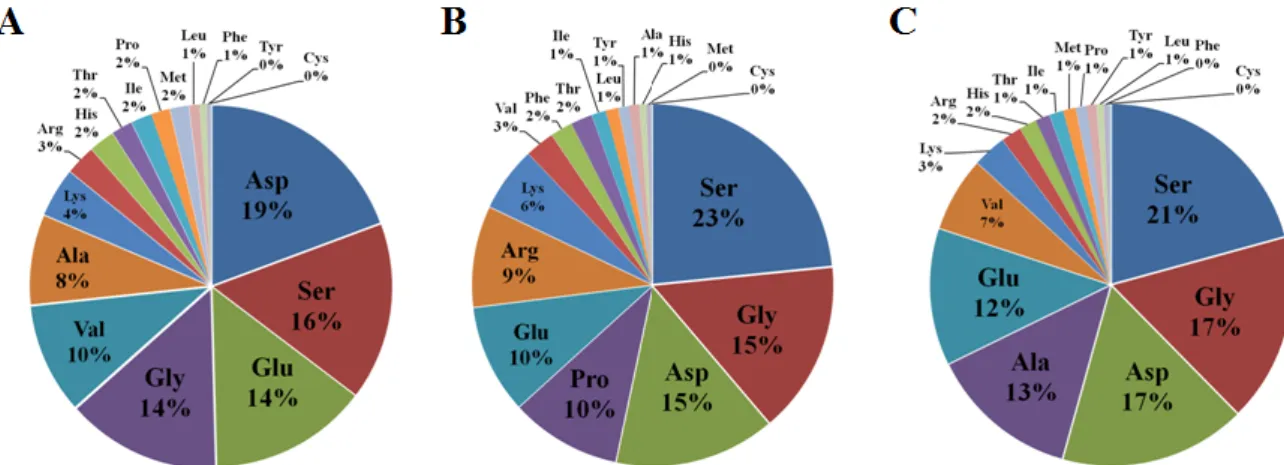
Fig. 2 Distribution of amino acids in G. elata. Tubers (approximately 100 g fresh weight per tuber) originated from the same vegetative stem were collected in October (A) and April (B), respectively, and then were produced in the field by using either asexually propagated seed tubers. Tubers of G. elata were harvested in October by using sexually propagated seed tubers (C) 가하여 농축 후 재 건조시약(0.5%NaAC:Methanol:Triethy-
lamine=4:4:3) 20 μl를 첨가 후 농축하였다. PITC buffer 20 μl를 넣고 농축하고 Methanol 20 μl를 첨가 후 농축하였 다. HPLC analysis buffer (Pico-tag:Methanol=4:1) 200 μl를 첨가 후 용해시킨 다음 원심분리 후 상등액을 이용하여 HPLC (Thermo Electron Co, Finnigan Surveyor System, MA, USA) 분석에 사용하였다. 이동상은 0.05% triethylamine를 포함한 0.14 M sodium acetate trihydrate water (pH. 6.4, Acetic acid)와 60% Acetonitrile 두 가지 용매를 사용하였으며, 유 속은 0.8 ml/min, 흡광도는 254 nm이며, HPLC column으로 Pico-Tag (3.9 x 150 mm) 사용하였다(Cohen et al. 1989). 추 출물은 표준 아미노산의 분리된 peak의 retention time과 비 교하였다. 표준 아미노산(Amino Acid Standard H, PIERCE) 은 4가지 농도(5, 10, 15, 20 nmoles/㎖)를 이용하여 검량선 을 작성한 후 정량 하였다(Fig. 1A, B).
통계분석
모든 측정값은 한 실험 당 12개의 천마를 이용하여 측정 값의 평균과 표준편차(mean±SD)로 표시하였다. 통계분석 은 window용 SPSS 12.0 (SPSS Inc., Chicago, USA)을 이용 하여 Duncan’s Multiple Range Test (DMRT)과 t-test로 유의 성 검정을 하였다.
결과 및 고찰
수확 시기에 따른 천마의 아미노산 구성 비율
본 연구의 결과 총 아미노산 함량은 가을에 수확한 천마 (21.59 nmoles/mg DW)와 봄에 수확한 천마(31.72 nmoles/mg DW) 사이에 큰 차이를 보이지 않았으며, 필수 아미노산
과 비필수 아미노산의 함량 또한 차이가 없는 것으로 나 타났다(Table 1). 가을에 수확한 천마의 아미노산 구성 비 율은 산성 아미노산 중 무색결정이며 식품의 신맛을 나 타내는 asparagin (Asp)의 함량이 총 아미노산 함량 중 19%
로 제일 높고 serine (Ser) (16%) > glutamine (Glu) (14%), glycine (Gly) (14%) 순으로 함유하고 있다(Fig. 2A). 필수 아미노산 중에는 valine (Val)이 총 아미노산 함량의 10%
이며 lysine (Lys) (4%) > arginine (Arg) (3%) > histidine (His), threonine (Thr), isoleucine (Ile), methionine (Met) (2%) 순으 로 나타났다(Fig. 2A). 가장 낮을 구성 비율로는 Cysteine (Cys)로서 -SH기가 2개 연결되어 있는 아미노산으로 모 발 중에 많이 함유되어 있는 물질로 17종의 분석 아미노 산 중 0.14%로 구성 비율이 가장 낮게 나타났다(Fig. 2A).
봄에 수확한 천마의 경우 식품의 단맛을 나타내는 아미 노산인 Ser의 함량이 총 아미노산 함량 중 23%로 제일 높 고 glycine (Gly), Asp (15%) > proline (Pro), Glu (10%) 순으 로 함유하고 있다. 필수 아미노산 중에는 Arg이 총 아미
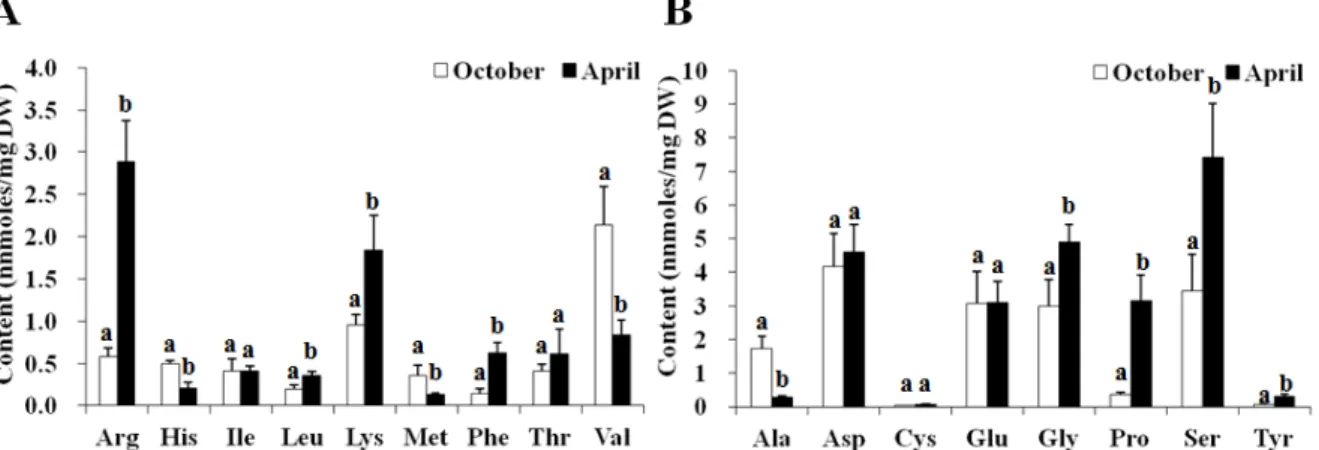
Fig. 3 Effect of different harvest time on amino acid contents in G. elata. Tubers (approximately 100 g fresh weight per tuber) originated from the same vegetative stem were collected in October and April. (A); Essential amino acids, (B); Nonessential amino acids. The data represent mean value ± SD (n=12). The same superscript letters indicate the corresponding components that do not differ statistically (p<0.05; t-test)
노산 함량의 9%이며, Lys (6%) > Val (3%) > phenylalanine (Phe), Thr (2%) > Ile, leucine (Leu) (1%) 순으로 나타났다 (Fig. 2B). Cys는 0.19%로 가을 천마에서와 같이 가장 낮 은 구성 비율을 나타냈다(Fig. 2B). 본 연구 결과로 볼 때 천마는 17개의 아미노산을 고루 가지고 있는 것으로 나 타났으며, 특히 Ser, Asp, Glu, Gly과 같은 비필수 아미노 산의 함유율이 높은 것으로 나타났다.
일반적으로 각종 스트레스 환경에 노출 된 식물체의 경우 Asp, Glu 같은 화합물이 축척이 되며, 특히 낮은 토 양 수분 퍼텐셜에 의해 저해 받는 식물은 Ser, Arg, Lys, His, Gly 같은 화합물을 많이 축척하는 것으로 알려져 있 다(Flores and Galston 1984; Pulich 1986; Rabc 1994; Smirnoff 1995). 천마는 잎이 퇴화 되어 잎을 통한 급격한 환경변 화에 대응할 수 있는 기작이 없으므로 땅속의 환경 스트 레스에 대응하기 위하여 Ser, Asp, Glu, Gly 와 같은 아미 노산들을 많이 함유하고 있는 것으로 추측이 된다. Ser, Asp는 생체내의 대사계 순환을 원활하게 도우며, Glu은 혈류와 골격근에 풍부한 아미노산으로 단백질 전환에 중 요한 역할을 하며, 장점막 수복작용, 뇌신경세포의 에너 지원, 수술상의 회복, 면역기능의 강화 등 체내조직의 항 산화 물질로서 필수적인 역할을 하는 것으로 보고되었다 (Lee et al. 2014; Na, 1999). Gly은 근육의 기능에 필수적인 성분으로 무력증 치료에 도움이 되며 중추신경계 작동에 필수적인 성분으로 조울증, 과잉행동장애, 간질발작을 예 방할수 있게 되며, 저혈당치료, 수면의 질의 개선에 효과 적인 아미노산으로 알려져있다(Chung 2005; Curtis et al.
1968; Young and Mc Donald 1983). 이러한 아미노산의 기 능들을 천마의 약리적인 효과를 검증할 수 있는 자료가 될 것이라 추측 된다. 천마의 경우 쓴맛, 단맛 신맛, 짠맛, 비린맛 등 여러 가지 맛이 복합적으로 이루어져 있다고 알려져 있다. 본 연구에 따르면 두 시기 모두 공통으로
신맛을 나타내는 Asp, Glu과 단맛을 나타내는 Ser, 쓴맛 을 나타내는 Arg의 함량이 높은 것으로 보아 이들이 천 마의 복합적인 맛에 영향을 미쳤을 것이라 추측 된다 (Kim et al. 2004).
수확시기별 아미노산의 함량 차이
수확시기에 따라 총 아미노산 함량은 차이가 나지 않았 지만, 각 아미노산의 함량에는 큰 차이를 보였다. 가을에 수확한 천마에서는 필수 아미노산 중 Met의 함량이 2.8 배 많은 것으로 나타났으며, Val, His 2.5배 많은 것으로 나타났다(Fig. 3A). 비필수 아미노산의 경우 alanine (Ala) 이 6.2배로 많은 것으로 나타났다(Fig. 3B). 봄에 수확한 천마에서는 필수 아미노산 중 Arg의 함량이 4.9배로 많은 것으로 나타났으며, Phe 4.3배, Lys 1.9배, Leu 1.7배 많은 것으로 나타났다(Fig. 3A). 비필수 아미노산에서는 Pro의 함량이 8.6배 많은 것으로 나타났으며, tyrosine (Tyr) 5.0 배, Ser 2.1배, Gly 1.6배 많은 것으로 나타났다(Fig. 3B).
식물은 빙점 이하의 온도에서 일어나는 피해를 막기 위 하여 당, 유기산, 아미노산, 단백질 등의 용질을 세포에 축적하여 빙점을 낮춘다. 특히, 수분포텐셜(water potential) 을 낮추기 위해 이온의 유입과 출입을 조절하게 되는데 세포질에 유기물질인 osmoprotectants의 하나인 아미노산 Pro의 축적을 통하여 수분포텐셜의 균형을 조절하게 된 다(Choo et al. 1999; Samaras et al. 1995). 호박의 경우 저온 스트레스 일 때 Pro의 함량이 저온에 약한 품종의 경우 22배, 강한 품종의 경우 26.6배 증가함을 보였다(Kang et al. 2007). 봄에 수확한 천마에서 Arg과 Pro함량의 증가하 는 것은 겨울 동안의 건조와 저온 스트레스에 견디기 위 한 방어기작이라 할 수 있다. 필수 아미노산인 Ile, Thr는 수확 시기에 따라 큰 차이를 보이지 않았으며, 비필수 아
Fig. 4 Changes in contents of amino acids from asexully and sexully propagated tubers of G. elata. Tubers of G. elata were produced in the field by using either asexully or sexually propagated seed tubers. Approximately 100 g fresh weight tubers were collected and used to measure essential (A) and nonessential (B) amino acids. The data represent mean value ± SD (n=12). The same superscript letters indicate the corresponding components that do not differ statistically (p<0.05; t-test)
미노산인 Glu, Asp 또한 총 아미노산에서 분포 비율은 높 았으나 수확 시기에 따라 아미노산의 함량은 큰 차이를 보이지 않았다(Fig. 3A, B).
섬오갈피의 경우 수확시기에 따라 총 아미노산의 함량 이 차이가 남이 보고되었고, Arg의 함량이 40% 함유 되 어있다(Jwa et al. 2000). 율금의 경우 가을에 채취한 것 보 다 봄철에 채취한 율금에서 총 아미노산에 대한 필수 아 미노산의 구성 비율 증가하는 것으로 보고 되어있다(Kang 2007). 본 연구에서 아미노산의 함량 차이로 보았을 때 필수 아미노산인 Arg이 봄에 수확한 천마에 매우 높은 것으로 보아 항암작용, 항종양작용, 고혈압과 같은 뇌 순 환질환, 혈관 확장 작용으로 남성 발기 부전 치료, 뼈나 조직 손상 치료에는 봄에 수확한 천마가 효과적일 것으 로 추측할 수 있다(Chang et al. 2002; Choi 2007; Lee et al.
2012; Woo and Paik 2002). 봄에 수확한 천마에서 흥분성 신경성 전달 물질인 Phe과 진통과 최면, 정신적인 안정의 효과를 높이는 Tyr 또한 의 함유량이 매우 높은 것으로 나타나 우울증 불안증과 같은 질환에 봄에 수확한 천마 가 효과적일 것으로 추측할 수 있다(Kim 2009). 가을에 수 확한 천마에는 Met, Val, His 함량이 많음으로 항히스타민 역할, 혈액속의 질소 밸런스를 조절, 성장촉진, 식욕억제 지방 연소에 봄에 수확한 천마 보다 효과적일 것으로 추 측할 수 있다(Kim 2009).
자마에 따른 아미노산의 구성 비율과 함량 차이
천마는 자마의 특성에 따라 생산량과 함유하고 있는 기 능성 물질이 차이가 남이 이미 보고되었다(Kim and Park 2013). 본 연구 결과, 유성증식천마의 경우 총 아미노산 함량이 무성증식 자마보다 1.6배 많은 것으로 확인 되었 으며 구성 비율 또한 상이하게 다른 것으로 나타났다. 유
성증식천마에서 생산된 천마의 아미노산의 구성 비율은 필수아미노산은 가을에 수확한 천마의 아미노산 구성 비 율과 비슷하며, 비필수 아미노산은 봄에 수확한 천마의 아미노산 구성 비율과 비슷한 것으로 확인 되었다(Fig. 2C).
유성증식천마는 Ser의 함량이 총 아미노산 함량 중 21%
로 제일 높고 Gly, Asp (17%) > Ala (13%) > Glu (12%) 순 으로 비필수 아미노산이 구성되어 있으며, 필수아미노산 은 Val이 총 아미노산 함량의 7%이며 Lys (3%) > Arg, His (2%) 순으로 분포되어 있다(Fig. 2C). 필수 아미노산의 경 우, Phe이 무성증식천마의 4.8배로 가장 높은 차이를 보 였으며, Arg (4.6배), Thr (2배), Lys (1.9배), Leu (1.8배)로 유성증식천마가 많음이 확인 되었다(Fig. 4A). 비필수 아 미노산은 Tyr이 4.5배로 높은 차이 보였으며, Ala (2.5배), Cys (2.0배), Ser (1.9배)로 유성증식천마가 많음이 확인 되 었다(Fig. 4B). 필수 아미노산중 Val, Met (2.3배)의 함량은 무성증식 천마가 더 많은 것을 확인 되었다(Fig. 4A). 본 연구 결과에 따르면 같은 시기에 수확한 유성증식천마는 무성증식천마 보다 총 아미노산의 함량이 높은 것으로 나타났으며, 9개의 필수 아미노산중 5개의 아미노산이 유성증식에 더 많이 있는 것으로 나타났다. 이런 결과는 오랜 재배기간으로 인한 토양, 골목 등으로부터 유래된 병원균 오염으로 인하여 생장이 저해되며 그로 인한 생 리적 활성이 떨어짐에 의한 결과로 추측이 된다(Kim and Park 2013).
천마에 대한 관심이 높아짐으로 인해 천마의 물질에 대한 관심 또한 높아지고 있지만 식품으로서의 정확한 연구결과는 미흡한 상황이다. 본 연구를 통하여 천마의 수확시기별 총 아미노산의 함량의 변화는 크게 나타나지 않았으며 두 시기 모두 Asp, Glu, Ser, Arg의 함량이 높고 이러한 아미노산들이 천마의 다양한 맛을 나타내는 주요 아미노산으로 추측 할 수 있다. 가을에 수확한 천마는
Asp 분포비율이 높음으로 인하여 신맛이 강할 것이며 봄 에 수확한 천마는 Ser의 분포 비율이 높음으로 인하여 단 맛이 강할 것으로 추측할 수 있다. 아미노산의 구성 비율 만 본다면 봄에 수확한 천마가 가을에 수확한 천마보다 Arg, Phe, Pro, Tyr과 같은 아미노산이 많은 것으로 보아 봄에 수확한 천마가 좀 더 높은 생리적 효과가 있을 것으 로 추측이 된다. 유성증식 천마는 총 아미노산의 함량이 무성증식 천마에 비해 높으며, 비필수 아미노산은 봄에 수확한 천마의 아미노산과 구성 비율이 비슷하며 필수아 미노산은 가을에 천마와 비슷함을 확인 되었다. 9개의 필 수 아미노산 중에 5개의 아미노산의 함량이 높은 것으로 나타나 유성증식 천마가 좀 더 높은 생리적인 효과가 있 을 것으로 추측이 된다. 천마의 복합적인 맛이 아미노산 에서 기인되었을 것으로 추측되며, 아미노산의 분포비율 에 따른 생리적 효과를 식품에 활용한다면 천마의 식품 소재로서의 가치가 더욱 높아 질 것이며 국민의 건강증 진은 물론 농가의 소득 향상에도 크게 기여할 수 있을 것 이다.
적 요
천마는 난초과 식물로서 예로부터 약용으로 사용되어 왔 으며, 봄과 가을에 수확을 한다. 본 연구에서는 천마의 수확시기와 자마의 특성에 따른 아미노산의 함량을 조사 하였다. 결론적으로 수확시기에 따른 총 아미노산 함량 에는 변화가 없었지만 각 아미노산의 함량은 차이가 있 음을 확인하였다. 가을에 수확한 천마에서는 아스파라긴 이 19%로 함량이 제일 높았으며, 필수 아미노산으로는 발린인 10%를 차지하였다. 봄에 수확한 천마에서는 세린 이 23%로 가장 높은 함량을 보였으며, 필수 아미노산 중 에는 아르기닌(10%)로 가장 높은 함량을 보였다. 자마의 특성별 아미노산 함량을 조사 했을 때, 유성증식 천마가 무성증식 천마에 비하여 총 아미노산 함량이 높은 것으 로 나타났다. 유성증식 천마의 필수 아미노산은 가을에 수확한 무성증식 천마와 함량이 비슷한 것으로 나왔으 며, 비필수 아미노산은 봄에 수확한 무성증식 천마와 함 량이 비슷한 것으로 나왔다. 본 연구를 통하여서 천마의 다양한 재배 환경에 대한 아미노산 함량의 변화를 알 수 있었으며, 더 나아가 자연 식품 재료로서의 가치가 높아 질것으로 판단이 된다.
References
Bin H, Chen F (2004) Preparative isolation and purification of gastrodin from the Chinese medicinal plant Gastrodia elata
by high-speed counter current chromatography. Journal of Chromatography A. 1052:229-232
Chang MJ, Kim YJ, Kim MH (2002) Effect of dietary fat sources and L - arginine supplementation on endothelial function and lipid metabolism in streptozotocin - Induced Diabetic Rats. J Nutr Health 35:5-14
Choi HJ, Kim DH, Chung HS, Moon KD (2012) Food nutritional composition of castor aralia (Kalopanax pictus N) sprouts.
Korean J Food Preserv 19:720-726
Choi MJ (2007) Effects of arginine supplementation on bone mineral density in growing female rats. J Nutr Health 40:235-241 Choi SR, Kim CS, Kim JY, You DH, Kim JM, Kim YS, Song EJ,
Kim YG, Ahn YS, Choi DG (2011) Changes of antioxidant activity and lignan contents in Schisandra chinensis by harvesting times. Korean J Medicinal Crop Sci 19:414-420
Choo YS, Do JW, Song SD (1999) Free amino acid and nitrogen contents of the coastal plants in Korea. Korean J Ecol 22:109-117 Chung SJ (2006) Motor control during sleep. J Korean Sleep Res
Soc 3:11-21
Cohen SA, Meys M, Tarvin TL (1989) The pico-tag method: A manual of advanced techniques for amino acid analysis. Millipore Corp, Milford. Massachusetts, USA. p.11-52
Curtis DR, Hosli L, Johnston GA, Johnston IH (1968) The hyperpolarization of spinal motoneurones by glycine and related amino acides. Exp Brain Res 5:235-258
Flores HE, Galston AW (1984) Osmotic stress-induced polymine accumulation in cereal leaves. II. Relation to amino acid pools. Plant Physiol 75:110-113
Hayashi J, Sekine T, Deguchi S, Lin Q, Horie S, Tsuchiya S, Yano S, Watanabe K, Ikegami F (2002) Phenolic compounds from Gastrodia rhizome and relaxant effects of related compounds on isolated smooth muscle preparation. Phytochemistry 59:
513-519
Jang SH, Yu EA, Han KS, Shin SC, Kim HK, Lee SG (2008) Changes in total polyphenol contents and DPPH radical scavenging activity of Agrimonia pilosa according to harvest time and various part. Korean J Medicinal Crop Sci 16:397-401 Jwa CS, Yang YT, Koh JS (2000) Changes in free sugars, organic acids, free amino acids and minerals by harvest time and parts of Acanthopanax koreanum. J Korean Soc Agric Chem Biotechnol 43:106-109
Kang SH (2007) Changes in proximate composition, free amino acid, free sugar and vitamin of Curcuma longa L. and Curcuma atomatica Salib according to picking time. Korean J Food Preserv 14:624-632
Kang NJ, Cho MW, Choi YH, Um YC (2007) Responses in osmolyte accumulation to chilling stress in cucurbits plants.
Protected Horticulture and Plant Factory 16:303-308 Kim HB, Kim SL, Kang SW (2004) Varietal analysis and quantification
of amino acid in mulberry fruits. Korea J Sericul Sci 46:47-53 Kim HT, Kim JA, Park EJ (2012) Genetic diversity and metabolite analysis of Gastrodia elata by Inter-Simple Sequence Repeats (ISSR). markers. Korean J Medicinal Crop Sci 20:440-446 Kim HT, Park EJ (2013) Change of major functional components
of Gastrodia elata Blume with cultivation conditions and
harvest times. Korean J Medicinal Crop Sci 21:282-288 Kim JH. (2009). Amino acid, Save our body. Moabooks, Korea p
40-55
Lee BY, Choi HS, Hwang JB (2002) Analysis of food components of Gastrodiae Rhizoma and changes in several characteristics at the various drying conditions. Korean J Food Sci Technol 34:37-42
Lee HS, Kim ST, Min YS, Sohn DU (2014) Change of clinical effect upon use of glutamine to critically ill patients over age 60 receiving TPN. Korean J Clin Pharm 24:9-13
Lee HW, Choi DY, Ko YH (2012) The effects of Korean dancing- oriented gymnastics and supplement L-arginine on nitric oxide and inflammatory factors middle and old aged women.
Official Journal of the Korean Society of Dance Science 28:153-166
Lee MY (2007) Important medicinal crop characteristics and cultivation technologies. Dongguk University p 64-287
Lee SW, Moon HK, Moon JN, Yoon WJ, Kim GY (2010) Quality characteristics of Chun Ma (Gastrodiae rhizoma) beverage prepared using concentrated extracts. Korean J Food Preserv 17(1):58-65
Na JC (1999) The effect of capsule L-glutamine administration after a submaximal exercise on lymphocyte subpopulations in men. The Korean Journal of Physical Education 38:397-407 Nugroho A, Kim MH, Lee JH, Kim JD, Lee KR, Choi JS, Yoo YM,
Park HJ (2011) Polyphenol analysis and peroxynitrite scavenging effect of the extracts from eight Korean mountainous vegetable.
Korean J Pharmacogn 42:38-45
Park EJ, Lee WY, Ahn JK (2012) In vitro propagation of myco- heterotrophic Gastrodia elata. Hort Environ Biotechnol 53:415-420
Pulich WM (1986) Variation in leaf solute amino acid and ammoni content in subtropical grasses related to salinity stress. Plant Physiol 80:283-286
Rabe E (1994) Altered nitrogen metabolism under environmental stress conditions. In M. Pessarakli(ed.), Plant and Crop Stress.
Marcel Dekker, New York, USA. p 261-176
Samaras Y, Bressan RA, Csonka LN, Garcia-Rios MG, Paino D’Urzo M, Fhodes D (1995) Proline accumulation during drought and salinity. In N. Smirnoff(ed.), Environment and Plant Metabolism. Bios, Oxford, UK. p 161-187
Smirnoff N (1995) Environment and plant metabolism. BIOS Scientific, Oxford, UK. p 270
Woo JH, Paik IY (2002) The effects of training and L-arginine supplementation on oxidation-antioxidation responses and nitric oxide synthesis mechanism in SHR. The Korean Journal of Physical Education. 41:635-643
Yang JK, Kim JC, Lee JG, Jo JS (2012) The changes of chemical composition of green tea by picking periods. Journal of Agriculture and Life Sciences 46:49-61
Young A, McDonald R (1983) Glycine as a spinal neurotransmitter.
In:Davidoff R, ed. Handbook of the Spinal Cord, Marcel Dekker, New York, USA. p 1