Anti-aging Effects of Solvent Fraction from Agrimonia pilosa L. Extracts
Ji-Young Yoon · Soo-Yeon Lee · Hye-Ji Jun · Jin-Young Lee
선학초 용매 분획물의 항노화 효과
윤지영 · 이수연 · 전혜지 · 이진영
Received: 13 October 2011 / Accepted: 6 December 2011 / Published Online: 31 March 2012
© The Korean Society for Applied Biological Chemistry 2012
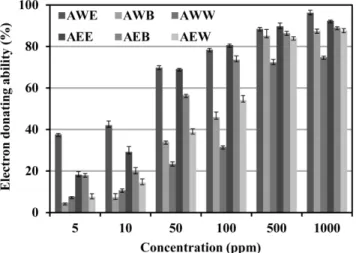
Abstract The purpose of this study was to research about the ingredients for anti-oxidation and anti-wrinkle effects of the solvent fractions from Agrimonia pilosa L. hot water (AW) and 70% ethanol (AE) extracts. The electron donating ability of the solvent fractions from AW and AE extracts showed 84.9, 92.5%
in ethyl acetate layer of AW and AE at 1,000 ppm. The superoxide dismutase like activity of solvent fractions from AW and AE extracts showed 61.8% in ethyl acetate layer of AW extracts and 58.0% in buthanol layer of AE extracts at 1,000 ppm.
For anti-wrinkle effect, elastase inhibition effect of the solvent fractions from AW and AE extracts showed 55.2, 70.1% in ethyl acetate layer of AW and AE extracts at 1,000 ppm. And collagenase inhibition effect of the solvent fractions from AW and AE extracts showed highest inhibition effect as 90.6% in ethyl acetate layer of AW extract and 88.6% in n-butyl alcohol layer of AE extract at 1,000 ppm. All these findings suggested that solvent fractions from AW and AE extracts has an anti-oxidation and anti- wrinkle effects.
Keywords Agrimonia pilosa L. · anti-oxidation · anti-wrinkle
서 론
최근 여성들의 직장생활과 야외활동 증가로 인해 유해 자외선 에 장기적으로 노출되고 환경오염과 바쁜 현대생활로 인한 스
트레스 증가는 활성산소를 발생시켜 노화의 원인이 되고 있다 (Lim과 Kim, 2009). 이러한 노화의 징후로 현저하게 눈에 띄는 현상 중 하나는 주름으로서 주름의 예방과 관리에 많은 관심이 집중되고 있다(Cho 등, 2009). 또한 나이가 들어감에 따라 생 리적·신체적으로 다양한 변화를 겪게 되어 collagen, elastin 등 의 생성이 감소되고, 피부가 얇아지면서 피부의 탄력이 감소하 는 내적인 노화와 피부가 두꺼워지고 변형된 탄력섬유가 증가 하는 외적인 노화로 나뉘어진다. 자외선에 피부가 노출되면 superoxide anion radical, hydroxyl radical과 같은 활성산소의 생성을 유도하여 이로 인해 세포의 단백질, 지방, 핵산 등이 산 화되어 궁극적으로 피부노화의 대표적인 징후인 주름이 생성된 다(Kim 등, 2006; Gang 등, 2009). 또한 최근 천연물을 중심 으로한 학문의 발전 및 식품이나 의약품에 있어서 자연지향 추 세에 따라 천연물 유래의 2차 대사산물인 생리활성 물질에 대 한 학문적 및 산업적 응용의 관심이 증대되고 있다. 그 중에서 도 외부 환경으로부터 피부를 보호하기 위해 또는 주름, 노화 등을 억제시키기 위해 여러 가지 효능을 가진 천연물 응용에 대한 다양한 방법으로 항노화 화장품을 개발하려는 연구가 활 발히 진행되고 있다(Oh 등, 2009; Kim, 2010; Seo, 2010).
선학초(Agrimonia pilosa)는 장미과에 속하는 다년생 숙근초 로서 용아초, 황아초, 지선초, 짚신나물 등으로 부르기도 한다.
선학초의 추출물은 예부터 민간요법, 녹즙 등으로 널리 이용되 어 왔고, 폐암, 간암, 식도암, 종양, 통증제거, 지사, 토혈, 혈뇨, 자궁출혈 등에 치료 약물로서 널리 이용되어 왔다(Song, 2007).
한의학에서는 수렴작용이 강하여 지사제 및 지혈제로 사용되어 왔으며, 민간에서는 간암, 폐암, 통증에 효과가 있다고 알려져 민간요법으로 활용되고 있다(Lee 등, 2009). 주요 성분으로는 전 초에 agrimonin, agrimonolide, tormentic acid, ellagic acid 등 이 있고, 잎과 줄기에는 luteolin-7-glucoside가 함유되어 있음이 알려져 있으며, 최근 연구에서는 항바이러스 효과, 당뇨치료 효 과, 혈관이완 효과, 항균효과(Kim 등, 2010), 항산화 및 항암활 성(Min 등, 2008) 등이 보고되었다. 이에 본 연구에서는 선학 J.-Y. Yoon · S.-Y. Lee · H.-J. Jun · J.-Y. Lee ( )
Department of Herbal Cosmetic Science, Hoseo University, Chungnam, 336-795, Republic of Korea
E-mail: [email protected]
ORIGINAL ARTICLE
성을 검토하여 식품 및 화장품소재로서의 가능성을 검토하였다.
재료 및 방법
재료 및 추출. 시료의 추출은 열수 및 에탄올 추출을 하였다.
열수 추출물의 경우 시료 100 g에 증류수 10배 양을 가하여 85oC에서 3시간 환류냉각 추출하여 상등액과 침전물을 분리하 여 3회 반복 추출하였으며, 에탄올 추출물의 경우 70% 에탄올 을 시료 중량의 10배 양을 가하여 실온에서 24시간 침지하여 상등액과 침전물을 분리하여 동일한 방법으로 3회 반복 추출하 였다. 각 추출물들은 원심분리 및 여과, 농축 후 동결 건조하여 얻은 선학초의 열수 추출물과 에탄올 추출물 20 g에 증류수를 넣어 시료를 모두 녹인 후에 극성차를 이용해 ethyl acetate, n- butyl alcohol을 순차적으로 가하여 각각의 분획물을 얻었으며, 남은 하층부를 수충 분획물로 하였다. 분획법은 열수 추출물의 ethyl acetate층은 5.0%, n-butyl alcohol층은 10.5%, 물층은 32.7%의 수율을 얻었으며, 에탄올 추출물의 경우 ethyl acetate 층 9.2%, n-butyl alcohol층은 16.5%, 물층은 31.9%의 수율을 얻었다. 이들 분획물을 농축 후 동결 건조하여 냉동실에 보관 하면서 본 실험의 시료로 사용하였다.
시약 및 기기. 항산화 효과 측정에 사용된 시약인 1,1-diphenyl- 1-picrylhydrazyl (DPPH), pyrogallol, xanthine oxidase, 2.6- dihydroxy purine과 미백 및 주름억제 효과 측정에 사용된 시약 인 elastase, N-succinyl-(L-Ala)3-p-nitroanilide, collagenase 및 4- phenylazobenzyloxycarbonyl-Pro-Leu-Gly-Pro-D-Arg 등은 Sigma Chemical Co. (St. Louis, MO)에서 구입하여 사용하였다.
DPPH 전자공여능 측정. 전자공여능(EDA: electron donating ability)은 Blois(1958)의 방법을 변형하여 측정하였다. 각 시료 용액 120 µL에 0.2 mM의 DPPH 60 µL 넣고 교반한 후 15분 간 방치한 다음 517 nm에서 흡광도를 측정하였다. 전자공여능 은 시료용액의 첨가군과 무첨가군의 흡광도 감소율로 나타내었다.
전자공여능(%)=
Superoxide dismutase (SOD) 유사활성 측정. SOD 유사활성은 Marklund와 Marklund(1974)의 방법에 따라 측정하였다. 각 시 료용액 20 µL에 Tris-HCl 완충용액(50 mM Tris, pH 8.5) 130µL과 7.2 mM pyrogallol 20 µL을 가하여 37oC에서 10분간 반응시킨 후 반응액 중 산화된 pyrogallol의 양을 420 nm에서 흡광도를 측정하였다. SOD 유사활성은 시료용액의 첨가군과 무 첨가군의 흡광도 감소율로 나타내었다.
SOD 유사활성능(%)=
Xanthine oxidase 저해활성 측정. Xanthine oxidase 저해활성은 Stirpe와 Corte (1969)의 방법에 따라 측정하였다. 각 시료용액 0.1 mL와 0.1 M potassium phosphate buffer (pH 7.5) 0.6 mL 에 xanthine (2 mM)을 녹인 기질액 0.2 mL를 첨가하고 xanthine oxidase (0.2 U/mL) 0.1 mL를 가하여 37oC에서 15분 간 반응시킨 후 1 N HCl 1 mL를 가하여 반응을 종료시킨 다 음, 반응액 중에 생성된 uric acid의 양을 292 nm에서 흡광도를 측정하였다. Xanthine oxidase 저해활성은 시료용액의 첨가군과
저해율(%)=
Elastase 저해활성 측정. Elastase 저해활성 측정은 Cannell 등 (1988)의 방법에 따라 측정하였다. 즉, 각 시험용액을 일정 농 도가 되도록 조제하여 40 µL씩 취하고, 50 mM Tris-HCl buffer (pH 8.6)에 녹인 porcine pancreas elastase (2.5 U/mL)용액 40 µL을 가한 후 기질로 50 mM Tris-HCl buffer (pH 8.6)에 녹 인 N-succinyl-(L-Ala)3-p-nitroanilide (0.5 mg/mL)을 80 µL첨가 하여 37oC에서 30분간 반응시켜 기질로부터 생성되는 p- nitroanilide의 생성량을 445 nm에서 측정하였다. Elastase 저해 활성은 시료용액의 첨가구와 무첨가구의 흡광도 감소율로 나타 내었다.
저해율(%)=
Collagenase 저해활성 측정. Collagenase 저해활성 측정은 Wünsch와 Heindrich (1963)의 방법에 따라 측정하였다. 즉 반 응구는 0.1 M Tris-HCl buffer (pH 7.5)에 4 mM CaCl2를 첨 가하여, 4-phenylazobenzyloxycarbonyl-Pro-Leu-Gly-Pro-D-Arg (0.3 mg/mL)를 녹인 기질액 0.25 mL 및 시료용액 0.1 mL의 혼 합액에 collagenase (0.2 mg/mL) 0.15 mL를 첨가하여 실온에서 20분간 방치한 후 6% citric acid 0.5 mL을 넣어 반응을 정지 시킨 후, ethyl acetate 1.5 mL을 첨가하여 320 nm에서 흡광도 를 측정하였다. Collagenase 저해활성은 시료용액의 첨가구와 무 첨가구의 흡광도 감소율로 나타내었다.
저해율(%)=
결과 및 고찰
DPPH 전자공여능 확인. 전자공여능 측정에 사용된 DPPH는 안 정한 자유라디칼로서, 만일 시료가 항산화 활성을 가지고 있다 면 DPPH가 갖고 있는 지질산화에 관여하는 자유라디칼의 비 공유 결합을 소거하여 DPPH의 환원성을 높인다(Kim, 2010).
이러한 전자공여능을 확인하기 위하여 선학초 분획물을 이용하 여 측정한 결과 Fig. 1과 같이 나타내었다. 선학초 열수 추출물 의 ethyl acetate, n-butyl alcohol, water층은 500 ppm에서 각 각 88.4, 85.2, 72.2%의 효과를 나타내었으며, 에탄올 추출물의 분획물의 경우 ethyl acetate, n-butyl alcohol, water층이 같은 농도인 500 ppm에서 89.6, 86.4, 84.0%의 효과를 나타내었다.
이 결과는 Kwak 등(2010)의 자색고구마 연구에서 5,000 ppm일 때 46.85%의 활성보다 훨씬 높은 활성을 보였으며, 또한 Min 등(2008)의 선학초 메탄올 추출물의 ethyl acetate, n-butyl alcohol 분획물에서 92.9, 93.7%의 활성과 비슷한 활성을 나타 내었다.
SOD 유사활성 확인. SOD는 superoxide를 정상상태의 산소로 환원시킴으로서 superoxide가 관여하는 각종 질병이나 노화를 억제할 수 있는 효소이다(Kwon 등, 2007). 이러한 SOD 유사 활성능을 선학초 분획물을 이용하여 확인한 결과 Fig. 2와 같 이 나타내었다. 선학초 열수 추출물의 분획물은 ethyl acetate, n-butyl alcohol, water층 각각 1,000 ppm에서 61.8, 51.9, 1 시료첨가군의 흡광도
무첨가군의 흡광도 ---
⎝ – ⎠
⎛ ⎞ 100×
1 시료첨가군의 흡광도 무첨가군의 흡광도 ---
⎝ – ⎠
⎛ ⎞ 100×
1 시료첨가군의 uric 생성량 무첨가군의 uric 생성량 ---
⎝ – ⎠
⎛ ⎞ 100×
1 시료첨가군의 흡광도 무첨가군의 흡광도 ---
⎝ – ⎠
⎛ ⎞ 100×
1 시료첨가군의 흡광도 무첨가군의 흡광도 ---
⎝ – ⎠
⎛ ⎞ 100×
28.4%의 활성을 나타내어 ethyl acetate층이 가장 높은 활성을 나타내었으며, 에탄올 추출물의 분획물 ethyl acetate, n-butyl alcohol, water층은 같은 농도에서 각각 45.4, 58.0, 38.3%의 활 성을 나타내어 n-butyl alcohol 층이 가장 높은 활성을 보였다.
이는 Lim 등(2004)에서 한국산 약용작물 중 의이인 추출물의 경우 1,000 ppm에서 5.53%, 결명자 추출물은 17.73%의 활성을
나타내어 선학초 분획물에 비해 낮은 결과를 나타내었다. 이러 한 결과로 미루어 보아 선학초 분획물은 기존에 보고된 여러 종류의 천연물보다 SOD 유사활성능에서 유의적인 결과를 나타 내었다.
Xanthine oxidase 저해활성 확인. Xanthine oxidase는 생체 내 purine 대사에 관여하는 효소로 xanthine 혹은 hypoxanthine으로 부터 uric acid를 형성하여 혈장 내 uric acid가 증가되면 낮은 용해성으로 인하여 골격에 축적되어 심한 통증을 유발하는 통 풍을 일으킨다(Cha 등, 2009). 이러한 xanthine oxidase 저해활 성을 측정해 본 결과 Fig. 3과 같이 나타내었다. 선학초 열수 추출물의 분획물은 ethyl acetate, n-butyl alcohol, water층 각각 1,000 ppm에서 84.9, 38.5, 54.5%의 활성을 나타내어 ethyl acetate층이 가장 높은 저해활성을 나타내었으며, 에탄올 추출물 의 분획물인 ethyl acetate, n-butyl alcohol, water층을 확인한 결과 같은 농도에서 ethyl acetate층이 92.4%로 가장 높은 저해 율을 나타내었고, n-butyl alcohol 및 water층의 순서로 55.2, 49.7%의 저해율을 나타내었다. 이는 Yoon 등(2007)의 뜰보리수 를 이용한 xanthine oxidase 저해활성을 확인한 결과에서 미숙 뜰 보리수의 저해율이 1,000 ppm일 때 30.0%를 나타낸 결과와 비교하여 선학초 분획물의 활성이 우수함을 확인할 수 있었다.
Elastase 저해활성 확인. 인체의 중성구 과립구내에 존재하는 elastase는 동물 결합 조직의 불용성 탄성 섬유 단백질인 elastin 을 분해시켜 피부의 진피조직의 그물망 구조 결합을 끊어 줌으 로서 주름생성의 주원인 효소로 알려져 있다(Kwak 등, 2005).
노화억제에 관련이 있다고 추정되는 선학초의 분획물에 대한 elastase 저해활성을 조사한 결과 Fig. 4와 같이 나타내었다. 선 학초 열수 추출물의 분획물은 ethyl acetate, n-butyl alcohol, water층 각각 1,000 ppm에서 55.2, 17.5, 38.3%의 저해활성을 Fig. 3 Inhibition rate of solvent fractions from A. pilosa L. on xanthine oxidase.
AWE: Ethyl acetate layer of water extracted Agrimonia pilosa L.
AWB: n-butyl alcohol layer of water extracted A. pilosa L.
AWW: Water layer of water extracted A. pilosa L.
AEE: Ethyl acetate layer of ethanol extracted A. pilosa L.
AEB: n-butyl alcohol layer of ethanol extracted A. pilosa L.
AEW: Water layer of ethanol extracted A. pilosa L.
Result are means ± SD of triplicate data.
Fig. 1 EDA of solvent fractions from A. pilosa L.
AWE: Ethyl acetate layer of water extracted A. pilosa L.
AWB: n-butyl alcohol layer of water extracted A. pilosa L.
AWW: Water layer of water extracted A. pilosa L.
AEE: Ethyl acetate layer of ethanol extracted A. pilosa L.
AEB: n-butyl alcohol layer of ethanol extracted A. pilosa L.
AEW: Water layer of ethanol extracted A. pilosa L.
Result are means ± SD of triplicate data.
Fig. 2 SOD-like activity of solvent fractions from A. pilosa L.
AWE: Ethyl acetate layer of water extracted A. pilosa L.
AWB: n-butyl alcohol layer of water extracted A. pilosa L.
AWW: Water layer of water extracted A. pilosa L.
AEE: Ethyl acetate layer of ethanol extracted A. pilosa L.
AEB: n-butyl alcohol layer of ethanol extracted A. pilosa L.
AEW: Water layer of ethanol extracted A. pilosa L.
Result are means ± SD of triplicate data.
나타내었으며, 에탄올 추출물의 분획물인 ethyl acetate, n-butyl alcohol, water층은 같은 농도에서 70.1, 45.6, 69.1%의 저해율 을 나타내어 열수추출물 및 에탄올추출물의 ethyl acetate층이 가장 높은 저해율을 나타내었다. 이는 Kwak 등(2005)의 각종 약용 식물로부터 elastase 저해활성을 측정한 결과, 대부분이 1,000 ppm의 농도에서 30.0% 미만의 저해활성을 나타내었으며, Lee 등(2008)의 결과에서 각 분획물이 16.0% 이하의 저해율을 나타낸 결과와 비교하여 선학초 에탄올 추출물 분획물의 활성 이 우수함을 확인할 수 있었다.
Collagenase 저해활성 확인. 피부세포의 결합 조직을 구성하는 성분 중 collagen은 피부 건조중량의 90% 정도를 차지하는 주 요 구성 단백질이다. 따라서 collagen 분해는 결합조직의 탄력 저하와 주름생성 등에 직접적인 영향을 미친다(Kim 등, 2008).
이러한 collagen의 주된 기능으로는 피부의 기계적 견고성, 결 합조직의 저항력과 조직의 결합력, 세포 접착의 지탱, 세포 분 할과 분화의 유도 등이 알려져 있다(Jeroma 등, 1998; Seo, 2010). 선학초 분획물의 collagenase 저해활성을 측정한 결과 Fig. 5와 같이 나타내었다. 선학초 열수 추출물의 ethyl acetate, n-butyl alcohol, water층 각각 1,000 ppm에서 90.6, 57.8, 56.2%의 저해활성을 나타내었으며, ethyl acetate 층은 500 ppm 에서도 78.1%의 저해율을 나타내어 가장 높은 활성을 확인할 수 있었다. 또한 에탄올 추출물의 분획물인 ethyl acetate, n- butyl alcohol, water층은 1,000 ppm에서 70.4, 88.6, 72.8%의 저해율을 나타내어 n-butyl alcohol 층이 가장 높은 저해효과를 나타내었다. 이는 Kim(2010)의 카카오 분획물을 이용한 실험에 서 1,000 ppm일 때 chloroform 분획물이 58.0%의 저해율을 나 타낸 결과를 볼 때, 선학초 분획물이 비교적 높은 collagenase 저해활성을 확인할 수 있었다.
초 록
선학초 열수 추출물과 에탄올 추출물의 분획물을 항산화 및 주 름개선의 소재로 이용하기 위하여 생리활성을 검증하였다. 항산 화효과를 확인하기 위하여 전자공여능을 측정한 결과 선학초 열 수추출물(AW)과 에탄올추출물(AE) 모두 ethyl acetate층 1,000 ppm에서 각각 96.2, 92.3%의 효과를 나타내었고, SOD 유사활 성능을 측정한 결과 AW의 ethyl acetate층에서 61.8%의 활성을 AE의 n-butyl alcohol 층에서 58.0%의 높은 활성을 각각 나타 내었다. 또한 xanthine oxidase저해활성을 측정한 결과 AW와 AE에서 모두 ethyl acetate층 1,000 ppm일 때, 각각 84.9, 92.5%의 가장 높은 저해율을 나타내었다. 주름개선 효능 확인 을 위해 elastase 저해활성을 측정한 결과 이 또한 AW와 AE 모두에서 ethyl acetate층이 각각 55.2, 70.1%의 효능을 나타내 었으며, collagenase 저해활성을 측정한 결과 AW의 ethyl acetate층이 90.6%로 가장 높은 저해율을, AE는 88.6%로 n- butyl alcohol 층이 가장 높은 저해율을 나타내었다. 이상의 결 과로 미루어 보아 선학초의 열수 추출물과 에탄올 추출물의 분 획물이 in vitro상에서 항산화 및 주름개선의 활성이 있음을 확 인할 수 있었다.
Keywords: 선학초, 주름개선효과, 항산화 효과
감사의 글 본 연구는 보건복지부 보건의료연구개발사업의 지원에 의하여 이루어진 것임(과제고유번호: A103017).
Fig. 5 Inhibition rate of solvent fractions from A. pilosa L. on collagenase.
AWE: Ethyl acetate layer of water extracted Agrimonia pilosa L.
AWB: n-butyl alcohol layer of water extracted A. pilosa L.
AWW: Water layer of water extracted A. pilosa L.
AEE: Ethyl acetate layer of ethanol extracted A. pilosa L.
AEB: n-butyl alcohol layer of ethanol extracted A. pilosa L.
AEW: Water layer of ethanol extracted A. pilosa L.
Result are means ± SD of triplicate data.
Fig. 4 Inhibition rate of solvent fractions from A. pilosa L. on elastase.
AWE: Ethyl acetate layer of water extracted A. pilosa L.
AWB: n-butyl alcohol layer of water extracted A. pilosa L.
AWW: Water layer of water extracted A. pilosa L.
AEE: Ethyl acetate layer of ethanol extracted A. pilosa L.
AEB: n-butyl alcohol layer of ethanol extracted A. pilosa L.
AEW: Water layer of ethanol extracted A. pilosa L.
Result are means ± SD of triplicate data.
참고문헌
Blois MS (1958) Antioxidant determination by the use of a stable free radical.
Nature 26, 1199–1120.
Cannell RJP, Kellan SJ, Owsianks AM, and Walker JM (1988) Results of a large scale screen of microalgae for the production of protease inhibitors.
Planta Med 54, 10–14.
Cha WS, Ju IS, Yun DH, Chun SS, Kim JH, and Cho YJ (2009) Biological activity of extracts from Cherry sage. J Life Sci 19, 390–396.
Cho WG, Kyung KY, and Yu SM (2009) Stability of paeoniflorin used as anti- wrinkle agents in emulsions. J Korean Oil Chemists Soc 26, 191–198.
Gang SR, Min KJ, and Kim YC (2009) The inhibitory effect of Saururus chinensis water extract on skin wrinkle in hairless mice. J Korean Soc Cosm 15, 1389–1398.
Jeroma SP, Gabrielle L, and Raul F (1998) Identification of collagen fibrils in scleroderma skin. J Invent Dermatol 90, 48–54.
Kim DS, Kim YM, Woo WH, and Mun YJ (2010) Study of inhibitory effect of melanogenesis and antioxidant activity of Agrimonia pilosa Ledeb.
Korean J Oriental Physiology & Pathology 24, 236–241.
Kim ID, Kwon RH, Heo YY, Jung HJ, Kang HY, and Ha BJ (2008) Supercritical extraction of oriental herb: Anti-aging and anti-wrinkle effects. Korean J Biotechnol Bioeng 23, 529–534.
Kim JC (2010) Study on cosmeceutical activities of Pharbitis nil Choisy. MS Thesis, Daegu Haany University, Gyeongsan, Korea.
Kim MJ, Kim JY, Jung TK, Choi SW, and Yoon KS (2006) Skin anti-aging effect of Forsythia viridissima L. extract. Korean J Biotechnol Bioeng 21, 444–450.
Kim YS (2010) A study on verification of cosmeceutical activities from Theobroma cacao L. and cosmeceutical application. Ph. D Thesis, Daegu Haany University, Gyeongsan, Korea.
Kwak JH, Choi GN, Park JH, Kim JH, Jeong HR, Jeong CH, and Heo HJ (2010) Antioxidant and neuronal cell protective effect of purple sweet potato extract. J Agric Life Sci 44, 57–66.
Kwak YJ, Lee DH, Kim NM, and Lee JS (2005) Screening and extraction condition of anti-skin aging elastase inhibitor from medicinal plants.
Korean J Medicinal Crop Sci 13, 213–216.
Kwon GJ, Choi DS, and Wang MH (2007) Biological activities of hot water extracts from Euonymus alatus Leaf. Korean J Food Sci Technol 39, 569–574.
Lee JW, Lee JS, and Lee JS (2008) Extraction and characterization of an anti- wrinkle elastase inhibitor from Rheum undulatum L. Korean J Food &
Nutr 21, 143–147.
Lee SH, Jung H, Lee JA, Go HY, Choi YK, Park JH, Kim JH, Ko SK, and Jun CY (2009) The anticancer effects and drug metabolic enzyme change by oral intake of Agrimonia Pilosa Ledeb. Korean J Orient Prev Med Soc13, 51–64.
Lee YS, Choi BD, Joo EY, Shin SR, and Kim NW (2009) Antioxidative activities and tyrosinase inhibition ability in various extracts of the Vitex rotundifolia seeds. Korea J Food Preserv 16, 101–108.
Lim JD, Yu CY, Kim MJ, Yun SJ, Lee SJ, Kim NY, and Chung IM (2004) Comparision of SOD activity and phenolic compound contents in various Korean medicinal plants. Korean J Medicinal Crop Sci 12, 191−
202.
Lim SJ and Kim JD (2009) Skin-whitening awareness and whitening-care behavior in women. J Korean Soc Cosm 15, 463–474.
Marklund S and Marklund G (1974) Involvement of the superoxide anion radical in the autoxidation of pyrogallol and a convenient assay for superoxide dismutase. Eur J Biochem 47, 469–474.
Min KJ, Song JW, and Cha CG (2008) The antioxidative and antitumor activity of extracts of Agrimonia pilosa. J Fd Hyg Safety 23, 149–156.
Oh MH, Lee JE, Kim SY, Kim SY, Park KC, Yun HY, Baek KJ, Kwon NS, and Kim DS (2009) Screening system establishment for potential anti- wrinkle agents using human fibroblast elastase. J Soc Cosmet Scientists Korea 35, 19–25.
Seo IA (2010) Studies on cosmeceutical of Phaseolus radiatus. MS Thesis, Daegu Haany University, Gyeongsan, Korea.
Song JW (2007) Antioxidative and antitumor activities of extracts from Saussurea lappa, Agrimonia pilosa and Prunnella vulgaris. MS Thesis, Keimyung University, Daegu, Korea.
Stirpe F and Della Corte E (1969) The regulation of rat liver xanthine oxidase.
conversion in vitro of the enzyme activity from dehydrogenase (type D) to oxidase (type O). J Biol Chem 244, 3855–3863.
Wünsch E and Heindrich HG (1963) Zur quantitativen bestimmung der collagenase. Hoppe-Seyler’s Physiol Chem 333, 149–151.
Yoon KY, Hong JY, Nam HS, Moon YS, and Shin SR (2007) Antioxidant activities and xanthine oxidase inhibitory effects of hot-water extracts from fruits of Elaeagnus multiflora Thunb. in maturity. J Korean Soc Food Sci Nutr 36, 14–19.