Vol. 70, No. 11, November 2020, pp. 951∼961 http://dx.doi.org/10.3938/NPSM.70.951
The Implication of Korea’s high School Integrated Science Curriculum: An Analysis Based on the History of its Implementation
Bokyoung Lee
University College, Yonsei University, Seoul 03722, Korea
Jean Soo Chung
∗Department of Physics, Chungbuk National University, Chungbuk 28644, Korea (Received 17 July 2020 : revised 26 August 2020 : accepted 18 September 2020)
The background of curricular reforms, the educational goals, and the issues on the high school integrated science curriculum in South Korea are analyzed. After the introduction of the ‘2009 Revised Curriculum’, high school integrated science successfully dealt with the relationship between the core concepts in various disciplines, focusing on themes or cutting across ideas. However, teachers, scientists, and science educators have not agreed whether to emphasize the conceptual hierarchy or theme-oriented contextual approaches with regard to the way and the extent of integration. Although many teachers agree with the necessity for integrated science, they still feel uncomfortable with teaching areas outside their majors. More effort is needed to make the contents and structure of integrated science better. In particular, training and support systems for science teachers are crucial for successful implementation of high school integrated science.
Keywords: Integrated science, High school, Context-based learning, Theme based integra- tion, Core concept, Cross-cutting idea, South Korea
I. Introduction
Science provides rational and effective explanations of nature. Therefore, scientific methods and theories are es- sential in discussing many important and contemporary issues. As todays’ civilization is led by science and tech- nology, science education has become more substantial.
Science education should be transformed accordingly and provide effective learning environment for the students.
The key in science education is to enhance the students’ scientific literacy. In short, scientific literacy has two ingredients; knowing concurrent knowledge and ideas of science, and ability to use them to solve real-life problems. School science has helped students recognize the role of science and acquire a basic understanding of nature and life as well as modern civilization. However,
∗E-mail: [email protected]
there is also a growing concern that the interests of stu- dents are moving away from science [1,2].
1. Backgrounds
Traditionally, science education emphasized the acqui- sition of fundamental concepts since science teachers be- lieved that understanding of scientific concepts can help students solve real-life problems [3,4]. This concept- oriented science education began to be criticized, how- ever, as students began turn away from science due to the burden of learning so many concepts. Some students per- ceive science as irrelevant to their lives since what they learned in class was difficult to apply in a new context [5].
As a result, in the 1980s, context-based learning (CBL) was proposed to increase students’ interest and motiva- tion in science, focusing on the relationship between sci-
This is an Open Access article distributed under the terms of the Creative Commons Attribution Non-Commercial License (http://creativecommons.org/licenses/by-nc/3.0) which permits unrestricted non-commercial use, distribution, and reproduction in any medium, provided the original work is properly cited.
ence and life [6,7]. CBL has been influencing science ed- ucation in many countries after the 2000s [4]. Although the controversy on the definition of context has not fully resolved yet, context-based education aims on giving a clearer picture of the relationship between concepts and contexts. In a context-based curriculum, teachers show explicitly the relationship between real-life problems and concepts by introducing appropriate applications, every- day experiences, problem solving tasks, and laboratory experiments. These require students to recognize the im- portance of science in the process of learning [5,8].
The emphasis on an integrated approach in school sci- ence is based on the belief that real life problems are related more than just one academic discipline [9,10].
Nature is so complex that it is difficult to understand within the framework of only one discipline, namely, physics, chemistry or biology. Integrated approach also has advantage of not repeating similar epistemological premises [10,11], which are common to interconnected disciplines. Integrated aspects of problems the students will encounter requires school science taught in inte- grated manner. However, there are views that physics, chemistry, and biology should be taught separately in high school, while integrated science approach should be appropriate in elementary and junior high school [1].
Although the method and level of integration may be different, the integrated science assimilates the con- cepts from one or more disciplines when explaining nat- ural phenomena [12]. It also emphasizes the transfer of knowledge that can be applied to real-life problems [10].
Advocates of integrated science argue that integrated ap- proach works well across disciplinary boundaries to illus- trate the interconnected natural world, while disciplinary approach limits the learner’s view of science and is not good for efficient learning [10,12–14]. Integrated science opponents believe that physics, chemistry, and biology have their own highly structured conceptual system and argue that it is difficult to assimilate the fundamental concepts [10,15]. These critics also argue that practi- cal problems prevent integrated science from being suc- cessfully implemented in schools. For example, Venville et al. [10] pointed out that school organization, tests, department-based teachers, and parents’ preferences on traditional academic standard were barriers to curricu- lum integration. It is common to teach physics, chem- istry, and biology separately in high school, but there
are both positive and negative opinions about teaching integrated science [1,11].
Some countries have adopted integrated science curric- ula in their lower high school years. With the proposal of the 1994 Scientific Advisory Group in the Nether- lands, ‘Algemene Natuurwetenschappen (General Nat- ural Sciences)’ was introduced as a subject in order to make all citizens aware of the basic ideas, origins, na- ture and effects of scientific knowledge in the 10th grade [16]. In Japan, ‘Basic Science’, a high school integrated science subject, was introduced to acquire not only basic knowledge of science but also scientific process and scien- tific literacy in 1972, which was later changed to ‘Science I’ and ‘Science II’ in 1982 [17]. The United States’ Next Generation Science Standards (NGSS) incorporates sci- entific processes as well as domain contents in 2012 [18], and the adoption of NGSS in most states in the United States has highlighted the global trend of an integrated approach in science education.
2. Purpose of the Study
South Korea started to build its own educational sys- tem since the first national curriculum was established in 1954. The national curriculum lead by the govern- ment defines the goals of the overall education as well as many details of teaching, such as the name of the sub- ject, its contents, and even the time duration of teaching for each subject. Korea Ministry of Education (MOE), the principal agent leading the reform, has changed the curriculum eleven times [19].
In the beginning, the reform of the national curricu- lum was named with ordinal numbers, such as the ‘1st National Curriculum’ or ‘the 2nd National Curriculum’
(‘2nd Curriculum’, hereafter). After the on demand re- vision system was established in 2003, the nomenclature was changed to putting the year of revision in the front such as ‘2007 Revised Curriculum’ (‘2007 Curriculum’, hereafter).
From the ‘1st Curriculum’ to the ‘2007 Curriculum’, school science was taught as a common curriculum from 1st grade to 10th grade, and was mandatory for all stu- dents. It was elective from 11th grade to 12th grade.
Since the ‘2009 Curriculum’, the common curriculum was
revised to cover only from the 1st grade to 9th grade, and sciences became electives from 10th grade to 12th grade. Although elementary and middle school science had been taught as integrated sciences, high school inte- grated science was first introduced in 1988 [19,20]. Be- fore then, high school science was taught separately as physics, chemistry, biology, and earth science in Korea.
The purpose of this paper is to examine the change of high school integrated science curriculum in Korea, the background of curricular reforms and educational goals and their implications. In order to achieve this, we an- alyzed the contents of the integrated science curriculum after the introduction of high school integrated science for the first time in 1988. In particular, we focused on the first context-based integrated science, adapted in high school in 2011, and concept-based integrated sci- ence, newly introduced in 2018, and then analyzed the problems faced during the implementation processes. In this paper, we tried to overview the perspectives of stake- holders on major issues related to integrated science ed- ucation in Korea.
II. High School Integrated Science Curriculum in South Korea
Prior to the implementation of the ‘5th Curriculum’, high school science was taught as four independent sub- jects: physics, chemistry, biology, and earth science. The idea of integrated science in high school was introduced for the first time in the ‘5th Curriculum’. However, there had been a period of turmoil to settle down to provide the students with real integrated approach of science. The importance of each subject can be measured by the time duration the subject is taught to students. In Korea’s high school educational system, one unit of credit refers to a 50-minute class per week for a semester of 17 weeks.
1. The ‘5th Curriculum(1988)’ through ‘2007 Curriculum’
In 1988, the integrated science subjects, ‘Science I’
and ‘Science II’ were introduced for the first time in high school. Since then, the integrated science courses have
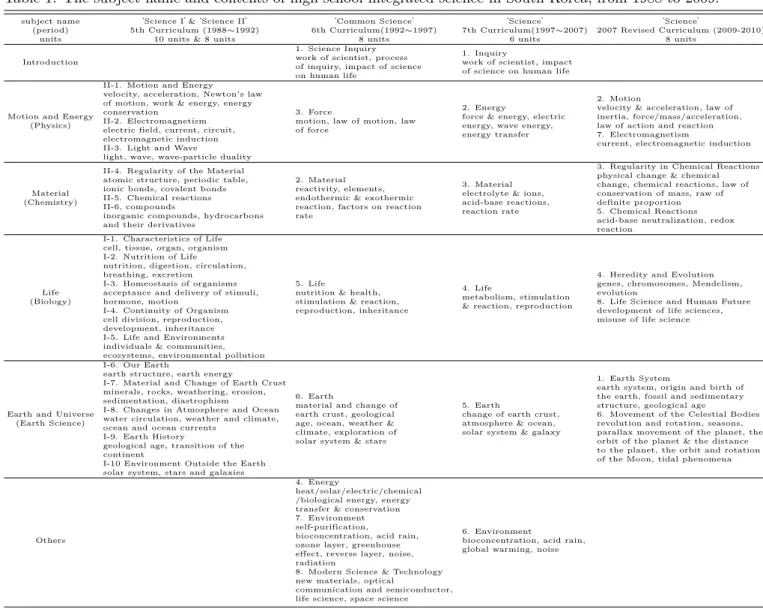
been offered as core compulsory subjects for the 10th grade (first year of high school). Physics, chemistry, bi- ology, and earth science were offered as optional courses for the 11th and 12th grades. The rationale for intro- ducing the integrated science curriculum in high school in Korea was two-fold. One is that an integrated ap- proach is more advantageous in explaining natural phe- nomena than a fragmentary approach through individual subjects such as physics or chemistry [21]. The other is that integrated education should be emphasized until the 10th grade, which is general education for all [22]. The names and contents of the subjects that correspond to the integrated science curriculum, from the 5th to ‘2007 Curriculum’, are summarized in Table 1.
The integrated science of the ‘5th Curriculum’ con- sisted of 10 units of ’Science I’ and 8 units ’Science II’.
’Science I’ consisted of five chapters of biology and five chapters of earth science. ’Science II’ consisted of three chapters of physics and three chapters of chemistry. ’Sci- ence I’ was a common core subject for all 10th graders.
’Science II’ was a mandatory subject for 10th graders who chose not to major in science and engineering. Stu- dents who wanted to major in science and engineering were required to take 8 units of physics, 8 units of chem- istry, and additional 8 units either from biology or earth science, during 11 – 12th grades. ’Science I’ and ’Science II’ in the ‘5th Curriculum’ were aimed at integrated sci- ence, but in reality, ‘Science I’ was a simple combination of biology and earth science and ‘Science II’ was a simple combination of physics and chemistry. For that some re- searchers argue that the integrated science curriculum in Korea’s high schools started from the 6th national cur- riculum in 1992 [22,23].
The integrated science from the ‘6th Curriculum’ was 8 units of ’Common Science’, which consists of eight chapters: scientific inquiry, material, force, energy, life, earth, environment, and modern science and technology.
Among these titles, material, force, life, and earth were still mere combinations of chemistry, physics, biology, and earth science, respectively as depicted in Table 1.
However, we could find a progress in the direction of in- tegration in the remaining four chapters. For example, in ‘Scientific Inquiry’, the work habits of scientists, the process of inquiry in science, and the impact of science on
Table 1. The subject name and contents of high school integrated science in South Korea, from 1988 to 2009.
subject name (period)
units
‘Science I’ & ‘Science II’
5th Curriculum (1988∼1992) 10 units & 8 units
‘Common Science’
6th Curriculum(1992∼1997) 8 units
‘Science’
7th Curriculum(1997∼2007) 6 units
‘Science’
2007 Revised Curriculum (2009-2010) 8 units
Introduction
1. Science Inquiry work of scientist, process of inquiry, impact of science on human life
1. Inquiry
work of scientist, impact of science on human life
Motion and Energy (Physics)
II-1. Motion and Energy velocity, acceleration, Newton’s law of motion, work & energy, energy conservation
II-2. Electromagnetism electric field, current, circuit, electromagnetic induction II-3. Light and Wave
light, wave, wave-particle duality
3. Force
motion, law of motion, law of force
2. Energy
force & energy, electric energy, wave energy, energy transfer
2. Motion
velocity & acceleration, law of inertia, force/mass/acceleration, law of action and reaction 7. Electromagnetism
current, electromagnetic induction
Material (Chemistry)
II-4. Regularity of the Material atomic structure, periodic table, ionic bonds, covalent bonds II-5. Chemical reactions II-6, compounds
inorganic compounds, hydrocarbons and their derivatives
2. Material reactivity, elements, endothermic & exothermic reaction, factors on reaction rate
3. Material electrolyte & ions, acid-base reactions, reaction rate
3. Regularity in Chemical Reactions physical change & chemical change, chemical reactions, law of conservation of mass, raw of definite proportion 5. Chemical Reactions acid-base neutralization, redox reaction
Life (Biology)
I-1. Characteristics of Life cell, tissue, organ, organism I-2. Nutrition of Life nutrition, digestion, circulation, breathing, excretion
I-3. Homeostasis of organisms acceptance and delivery of stimuli, hormone, motion
I-4. Continuity of Organism cell division, reproduction, development, inheritance I-5. Life and Environments individuals & communities, ecosystems, environmental pollution
5. Life
nutrition & health, stimulation & reaction, reproduction, inheritance
4. Life
metabolism, stimulation
& reaction, reproduction
4. Heredity and Evolution genes, chromosomes, Mendelism, evolution
8. Life Science and Human Future development of life sciences, misuse of life science
Earth and Universe (Earth Science)
I-6. Our Earth
earth structure, earth energy
I-7. Material and Change of Earth Crust minerals, rocks, weathering, erosion, sedimentation, diastrophism
I-8. Changes in Atmosphere and Ocean water circulation, weather and climate, ocean and ocean currents
I-9. Earth History
geological age, transition of the continent
I-10 Environment Outside the Earth solar system, stars and galaxies
6. Earth
material and change of earth crust, geological age, ocean, weather &
climate, exploration of solar system & stars
5. Earth
change of earth crust, atmosphere & ocean, solar system & galaxy
1. Earth System
earth system, origin and birth of the earth, fossil and sedimentary structure, geological age
6. Movement of the Celestial Bodies revolution and rotation, seasons, parallax movement of the planet, the orbit of the planet & the distance to the planet, the orbit and rotation of the Moon, tidal phenomena
Others
4. Energy
heat/solar/electric/chemical /biological energy, energy transfer & conservation 7. Environment self-purification,
bioconcentration, acid rain, ozone layer, greenhouse effect, reverse layer, noise, radiation
8. Modern Science & Technology new materials, optical
communication and semiconductor, life science, space science
6. Environment
bioconcentration, acid rain, global warming, noise
human life were discussed. In the chapter ‘Energy’, vari- ous energy forms, energy conservation, and energy trans- formations were dealt with mixed contexts of physics, chemistry, and biology. Various applications in every- day life and modern industry were introduced in the
‘Modern Science and Technology’ chapter. In terms of an integrated approach or contextual approach, ‘Common Science’ is considered to be a significantly improved sub- ject compared to previous ‘Science I’ or ‘Science II’.
In the ‘7th Curriculum’, the integrated science was re- duced to 6 units of ‘Science’, the chapter ‘Force’ from the ‘6th Curriculum’ was reduced and discussed in the
‘Energy’ chapter, along with traditional energy concepts in physics such as electrical energy, wave energy, and energy conversion. In ‘Inquiry’ and ‘Environment’ chap- ters, students were required to discuss related topics in
an integrated manner. The decreased number of units of ’Science’ resulted in a decrease in the contents of an integrated approach.
In the ‘2007 Curriculum’ the units of ‘Science’ was brought back to 8 units. Physics, chemistry, biology, and earth science were described in two chapters each.
It did not have any integrated approach. Each individ- ual chapter was devoted to each individual discipline.
Therefore, this can be regarded as a return to the ‘5th Curriculum’, in which the integrated science textbook was merely a combination of textbooks for individual science subjects.
Since the integrated science subject was first intro- duced in 1988, integrated approach was attempted in the sense that the concepts and methodologies of various sci- entific fields were combined to deal with applications of
modern science and technology. However, the attempt of integration was not sufficient; on the one hand, major contents were mainly based on single discipline; on the other hand, the attempt to reveal the connection between different disciplines in an integrated manner was insuf- ficient. In this regard, science educators in Korea have assessed that high school integrated science described so far was not successful integration but rather a segmental combination. Overall scheme still maintained the frame- work of compartmentalized curriculum [20,22,24]. The main reason for this was that teachers were reluctant to teach integrated science due to lack of contents knowl- edge in fields other than their majors [12,24,25]. It was a common practice that 2 to 4 teachers teach science to cover only their own majors. Therefore, it was diffi- cult for students to experience an integrated approach to natural phenomena by learning integrated science.
2. The first context-based, integrated science curriculum(2009)
Since the mid-2000s, scientists and science educators had strongly addressed the need of high school integrated science. They criticized that school science did not sat- isfy students’ interests and failed to show the importance of science in modern society [26]. They also indicated that school science did not help to improve understand- ing of the holistic aspects of nature, scientific inquiry, and the process of developments in scientific knowledge [27]. To this end, The Ministry of Education, Science and Technology (MOEST) initiated another reform in 2009, just two years after the 2007 Curriculum. A com- mittee of 34 scientists and science educators was formed by the recommendation of the Korean Physical Society, the Korean Chemical Society, the Korean Association of Biological Science, the Korean Earth Science Society, and Korean Association of Science Teachers [29]. In fact, this is the first case scientists have participated in the na- tional curriculum development at the institutional level.
The research team submitted a final draft of the cur- riculum and Korea MOEST announced it at the end of 2009. They announced that the purposes of the high school ‘Science’ were to learn not only the basic con- cepts necessary to understand life and the universe, but
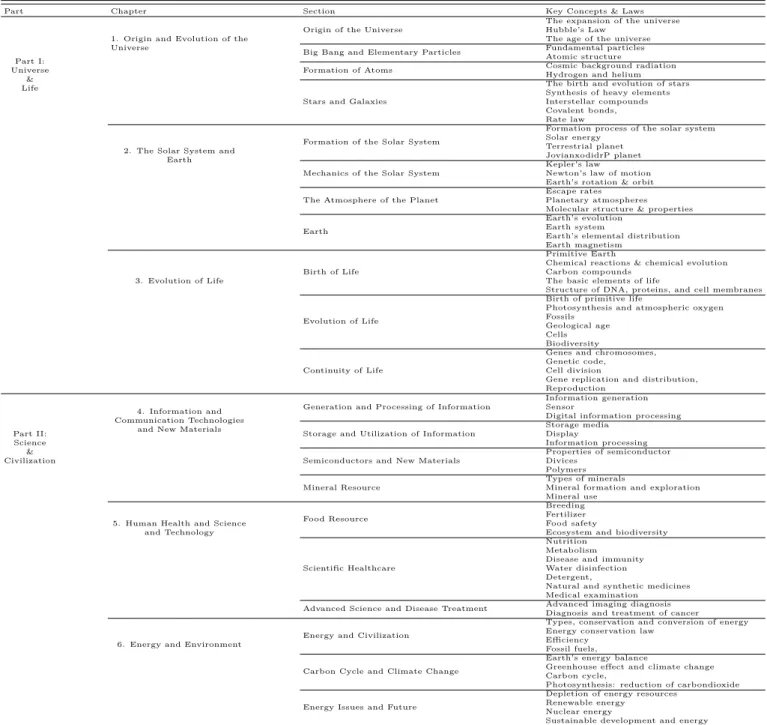
also scientific methods, to know how science has con- tributed to modern civilization and technological devel- opment, and to have scientific curiosity [30]. The con- tents of ‘Science’ are shown in Table 2. The high school
‘Science’ of the ‘2009 Curriculum’ was composed of two parts: ‘Universe and Life’ and ‘Science and Civilization’.
The ‘Science’ tried to deliver the important scientific themes in space, life, and modern civilization and reor- ganized key concepts in a novel manner [31,32]. In or- der to ensure the successful implementation of ‘Science’
in schools, MOEST supported the development of the
‘Model Science Textbook’ [33] in conjunction with the Korean Physical Society and the Korean Chemical Soci- ety. ‘Science’ was taught in 5 – 9 units at the discretion of the principal. Beginning in 2011, ‘Science’ had been adapted by a majority of high schools across the country, mainly for the 10th graders.
Part I ‘Universe and Life’ contains the universe, the solar system, and the life. Universe introduced the ideas of big bang, formation of nuclei and matter. Solar sys- tem explained the formation of planets and the reason behind their motion. Life described how life evolved on earth and how they survived. In order to let students un- derstand what science is all about, the key concepts and methodologies were explained that scientists discovered to explore and explain the natural phenomena.
Part 2 ‘Science and Civilization’ discussed technol- ogy, health and medicine, and the energy and the en- vironment. Technology explained how science had con- tributed to modern technology and introduced a few modern sensors which mimics the human sensors. Health and medicine described how science elongated the life ex- pectancy and future medical techniques will make it even longer. Energy and environment addressed the most ur- gent issues that mankind needed to solve to survive. It helps students to appreciate why we have to support sci- entific researches for a better life in the future.
Part I included the concepts, theories and scientific methodology involved in telling the big history from the birth of the universe. It was closer to a Forgaty’s inte- grated model or a Drake’s interdisciplinary or transdis- ciplinary approach introducing various related concepts beyond the boundaries of disciplines [34,35]. Part II em- phasized the science, technology, and society(STS) per- spectives, in that it covered important issues related to
Table 2. Contents of ’Science’ of ‘2009 Revised Curriculum’ for high school in South Korea.
Part Chapter Section Key Concepts & Laws
Part I:
Universe
&
Life
1. Origin and Evolution of the Universe
Origin of the Universe
The expansion of the universe Hubble’s Law
The age of the universe Big Bang and Elementary Particles Fundamental particles
Atomic structure
Formation of Atoms Cosmic background radiation
Hydrogen and helium
Stars and Galaxies
The birth and evolution of stars Synthesis of heavy elements Interstellar compounds Covalent bonds, Rate law
2. The Solar System and Earth
Formation of the Solar System
Formation process of the solar system Solar energy
Terrestrial planet JovianxodidrP planet
Mechanics of the Solar System
Kepler’s law
Newton’s law of motion Earth’s rotation & orbit
The Atmosphere of the Planet
Escape rates Planetary atmospheres Molecular structure & properties
Earth
Earth’s evolution Earth system
Earth’s elemental distribution Earth magnetism
3. Evolution of Life
Birth of Life
Primitive Earth
Chemical reactions & chemical evolution Carbon compounds
The basic elements of life
Structure of DNA, proteins, and cell membranes
Evolution of Life
Birth of primitive life
Photosynthesis and atmospheric oxygen Fossils
Geological age Cells Biodiversity
Continuity of Life
Genes and chromosomes, Genetic code, Cell division
Gene replication and distribution, Reproduction
Part II:
Science
&
Civilization
4. Information and Communication Technologies
and New Materials
Generation and Processing of Information
Information generation Sensor
Digital information processing
Storage and Utilization of Information
Storage media Display
Information processing
Semiconductors and New Materials
Properties of semiconductor Divices
Polymers
Mineral Resource
Types of minerals
Mineral formation and exploration Mineral use
5. Human Health and Science and Technology
Food Resource
Breeding Fertilizer Food safety
Ecosystem and biodiversity
Scientific Healthcare
Nutrition Metabolism Disease and immunity Water disinfection Detergent,
Natural and synthetic medicines Medical examination
Advanced Science and Disease Treatment Advanced imaging diagnosis Diagnosis and treatment of cancer
6. Energy and Environment
Energy and Civilization
Types, conservation and conversion of energy Energy conservation law
Efficiency Fossil fuels,
Carbon Cycle and Climate Change
Earth’s energy balance
Greenhouse effect and climate change Carbon cycle,
Photosynthesis: reduction of carbondioxide
Energy Issues and Future
Depletion of energy resources Renewable energy
Nuclear energy
Sustainable development and energy
science and technology in modern societies such as infor- mation and communication technology, new materials, health, food and energy.
Previously, the lack of contemporary science and ad- vanced technology in school science had been criticized for leading students to feel that science was not relevant to their lives [36]. Science educators generally claimed that modern science and high technology were not easy to deal with in school science because they had diffi-
cult concepts. However, MOEST [28] suggested: ”If it is necessary to meet students’ interest, even if there are difficult scientific concepts, they should be taught at an appropriate level”. Accordingly, ‘Science’ introduced ad- vanced science and technology and related topics, includ- ing band theory and principles of various medical equip- ment. It also included a variety of activities to help stu- dents understand the interactions of STS and to develop decision-making skills using scientific knowledge and in-
quiry [30,33].
The positive feedback said ‘Science’ induced students’
interests by introducing contents and activities related to recent issues on science and technology [32], pursuing comprehensive understanding of concepts through an in- tegrated approach [24,37], and attempting to approach STS with advanced science [38]. On the other hand, negative response indicated that the contents were too much [23,39], too difficult [23,32], and too much em- phasis on earth science [32]. Teachers admitted that they were uncomfortable with teaching the fields outside their major. They also pointed that excessive theme- oriented integration degraded the hierarchy of scientific concepts. Therefore, in most high schools 2 to 4 teachers co-teach ‘Science’, which detracted from the ideas of the integrated curriculum [24,37,38,40,41].
Results of the studies on students’ perception of the subject varies. The academic achievement and scientific attitude of 383 students in two high schools with and without ‘Science’ showed that the academic achievement did not show a significant difference, but the students’
attitudes toward science such as interest and career pref- erence showed a statistically significant higher score with
‘Science’ [42]. A nationwide survey of 4,183 high school students showed that students did not feel any improve- ment in their motivation, interest, and curiosity toward science [43]. In-depth interviews with 96 students from 32 high schools revealed students’ positive evaluation of
‘Science’ [44]; students admitted that science was indeed related with life and occupation. They also liked the narrative and historical storytelling, but felt difficult and questioned the hierarchy of concepts. It also suggested that teacher training programs were essential for suc- cessful implementation of ‘Science’ in schools because students’ perception of science was mainly affected by teachers [44].
Although ‘2009 Curriculum’ was hasty without preparing the teachers for reform, ‘Science’ was the first case of a totally reconstructed, integrated approach [45, 46]. It also started a wide-ranging debate on the need and standards of high school integrated science in Korea [23].
3. Core concept-based integrated science cur- riculum(2015)
‘Science’ having too much contents and being too diffi- cult demanded another reform. Korea Institute for Cur- riculum and Evaluation revealed that more than a half of the science teachers agreed on the necessity of an inte- grated approach [46]. However, teachers wanted science curriculum to focus on fostering learning ability and to integrate knowledge without largely perturbing the con- ceptual framework of individual disciplines. There were also demands in the Korean society to define core compe- tencies for future citizens and to improve students’ abil- ity to develop their core competencies through education [46,47].
MOE released the guidelines [48] for ‘2015 Curriculum’
announcing that the purpose of science curriculum re- form was “to reconstruct the contents of education centering on core concepts and to implement core competence-based education.” ‘2015 Curriculum’ focused on the core concepts and avoided unnecessary duplica- tion of contents, thus reducing the learning burden of students [47,49]. They defined scientific thinking, scien- tific inquiry, problem solving, communication and life- long learning abilities as core competencies that can be cultivated in the science curriculum [50]. They proposed 8 units of ‘Integrated Science’ and 2 units of ‘Science In- quiry Experiment’ as a common subject in order to de- velop the core competencies. The ‘Integrated Science’ of the ‘2015 Curriculum’ reorganized motion, energy, mate- rial, life, earth, and the universe, traditional constituents of high school science, in order to give students “an in- tegrated understanding of fundamental concepts” [51].
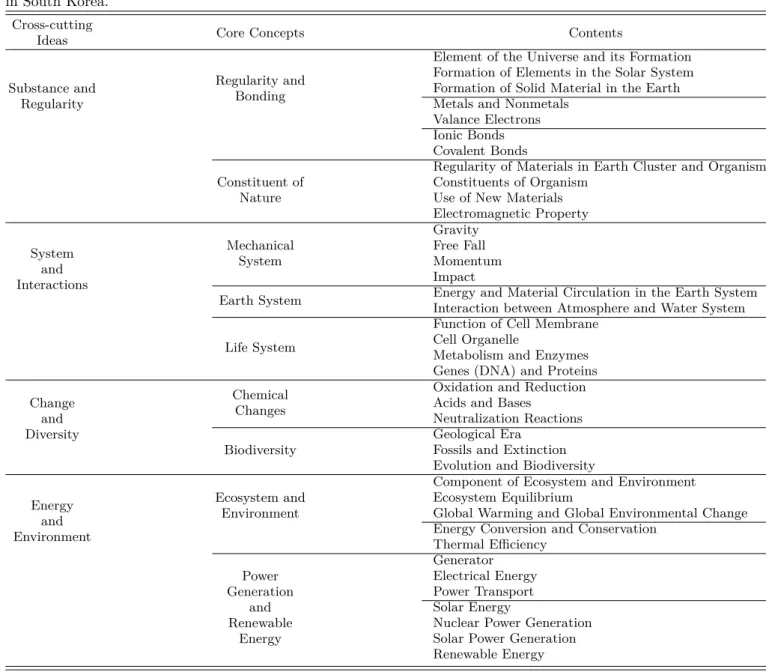
The contents of ‘Integrated Science’ are shown in Table 3. The ‘Integrated Science’ was a concept-based inte- gration, which combined core concepts of physics, chem- istry, biology, and earth science with cross-cutting ideas, while the ‘Science’ of the ‘2009 Curriculum’ was a story- telling narrative and a contextual approach. Most of the
‘Integrated Science’ textbooks contained cross-cutting idea. For example, the ‘Substance and Regularity’ chap- ter explained that ‘materials such as proteins and min- erals that make up living organisms are made of atoms through chemical bonds’ and ‘elements form compounds through covalent bonds or ionic bonds’.
Table 3. Cross-cutting ideas, core concepts and contents of ‘Integrated Science’ of ‘2015 Curriculum’ for high school in South Korea.
Cross-cutting
Ideas Core Concepts Contents
Substance and Regularity
Regularity and Bonding
� Element of the Universe and its Formation
� Formation of Elements in the Solar System
� Formation of Solid Material in the Earth
� Metals and Nonmetals
� Valance Electrons
� Ionic Bonds
� Covalent Bonds Constituent of
Nature
� Regularity of Materials in Earth Cluster and Organism
� Constituents of Organism
� Use of New Materials
� Electromagnetic Property
System and Interactions
Mechanical System
� Gravity
� Free Fall
� Momentum
� Impact
Earth System � Energy and Material Circulation in the Earth System
� Interaction between Atmosphere and Water System
Life System
� Function of Cell Membrane
� Cell Organelle
� Metabolism and Enzymes
� Genes (DNA) and Proteins Change
and Diversity
Chemical Changes
� Oxidation and Reduction
� Acids and Bases
� Neutralization Reactions Biodiversity
� Geological Era
� Fossils and Extinction
� Evolution and Biodiversity
Energy and Environment
Ecosystem and Environment
� Component of Ecosystem and Environment
� Ecosystem Equilibrium
� Global Warming and Global Environmental Change
� Energy Conversion and Conservation
� Thermal Efficiency Power
Generation and Renewable
Energy
� Generator
� Electrical Energy
� Power Transport
� Solar Energy
� Nuclear Power Generation
� Solar Power Generation
� Renewable Energy
‘Integrated Science’ closely followed the ideas of Foga- rty’s integrated model and Drake’s interdisciplinary ap- proach since it connected the core concepts of physics, chemistry, and biology with the framework of cross- cutting ideas [34, 35]. However, ‘Integrated Science’ of
‘2015 Curriculum’ was a less thorough integration com- pared to ‘Science’ of ‘2009 Curriculum’. In ‘Science’, the concepts from physics and chemistry were discussed in the same section. In ‘Integrated Science’, on the other hand, the concepts of the mechanical system, the earth system, and the life system are dealt with in different sections. This was the result of the criticism of excessive
theme-oriented integration of ‘2009 Curriculum’.
A comparative analysis of ‘Science’ and ‘Integrated Science’ reported that the degree of interdisciplinary in- tegration and the number of concepts was significantly decreased in ‘Integrated Science’ compared to ‘Science’
[20]. “The big ideas with large educational value” was emphasized in ‘Integrated Science’ because it “avoided integrating contents which are not systematic, prioritiz- ing big ideas that are well transposed”. The core concept at the beginning of curriculum development was the same meaning as the ‘disciplinary core ideas’ of NGSS in the US. Another study, however, pointed out that the mean-
ing of core concepts became ambiguous in ‘Integrated Science’ [52], in the process of redefining the meaning core concepts.
‘Integrated Science’ of ‘2015 Curriculum’ was first im- plemented in 2018 and is still in its early stage. It may be too early to discuss strength and weakness of the course.
A recent survey, however, showed that one third of sci- ence teachers still feel uncomfortable with teaching inte- grated subjects, and thus 2 to 4 teachers teach their own expertise in many high schools [50].
III. Discussion
To help students to understand the role of science in solving problems in everyday life, it is necessary to emphasize the context in learning environments, and to teach the connection between concepts in school science.
This is the background of emphasis on integrated sci- ence. In addition, there is a global trend of emphasizing the students’ activities in the process of knowledge for- mation in school science.
In Korea, the integrated science curriculum for high school began in 1988. During the first two decades, the integrated science curriculum mainly described motion, energy, material, life, earth and the universe, which are the traditional themes of physics, chemistry, biology, and earth science, with little connection to each other. Start- ing with ‘2009 Curriculum’, different levels of integration were introduced to connect various concepts beyond aca- demic boundaries using various themes or core concepts.
Although there is broad consensus on the need for an in- tegrated approach, there are also debates upon the way and degree of integration: one group prefers a theme- oriented contextual approach while the other group fa- vors a conceptual framework that focuses on core con- cepts.
The group emphasizing the conceptual framework ar- gues that theme-oriented approach disturbs the hierar- chy of concepts and hinders the effective learning of stu- dents [20]. They consider high school education as a preparing process for college and argue that high school science should prioritize the fundamental concepts, and a number of science teachers agree with this. It reflects the viewpoint of a traditional science education in which
students learn concepts and theories first and then solve real life problems. On the other hand, the group that emphasizes a theme-based contextual approach believes high school science curriculum should prioritize drawing attention and motivation toward science of all students.
They think that school science needs to start with prob- lems that are faced in everyday life, and that scientific literacy must be developed through learning skills and theories in the process of solving problems [4]. They argue that through integrated science, students’ inter- est and motivation in science can be increased, leading to more students in science-related majors [28]. Korea’s school science may fluctuate between these two stand- points for the next decades.
The ‘Science’ of ‘2009 Curriculum’ and the ‘Integrated Science’ of ‘2015 Curriculum’ can be seen as integrated science curriculum focusing on context and conceptual framework, respectively. Although they have different depth of integration, both approaches are improvements compared to previous ‘Sciences’ that simply aggregate the contents of individual subjects without explaining the relationship.
Even though successful integration in the high school curriculum is achieved, there still remain challenges of implementation in schools for effective teaching. As shown in many researches, the success of the inte- grated science mainly depends on the teacher’s atti- tude toward the subject, content knowledge, teaching skills and preparation [12]. After more than 30 years of integrated science in high school, teachers still feel difficulty in teaching topics beyond their own majors, leading to a negative attitude toward integrated sci- ence. We need to remember that teachers’ anxiety about the content knowledge of integrated science remains the same for ‘2015 Curriculum’, which significantly re- duced the degree and amount of integration compared to
‘2009 Curriculum’ [50]. The anxiety of teachers’ content knowledge is mainly due to the fact that most teachers are trained through a department-based programs in col- leges, which is pointed out by other countries as well [12, 53]. Teachers’ negative attitudes directly influence stu- dent attitudes and learning outcomes. Therefore, for the success of integrated science at the high school, contents knowledge of teachers needs to be strengthened through on-job training programs.
Assessment is another problem that impedes the suc- cess of integrated science. When physics, chemistry, and biology are taught separately, assessment is relatively easy because they evaluate learning outcomes through disciplinary concepts. Learning outcomes are relatively not well defined in integrated science. Teachers who ini- tially attempted a contextual approach tend to return to teaching concepts and principles over time for easy evaluation [54]. There is still debate as to how many contents to be covered in areas such as advanced tech- nology or modern science. The ‘2009 Curriculum’ has dealt with a number of high-tech science-related topics from the standpoint of “even if it is difficult, we have to deal with what we need to” [29,30].
The preference of the traditional concept-based disci- plinary education in Korea is partly due to the fact that students, teachers and parents think that it is beneficial to the college entrance examination. It is also preferred by teachers who think that meaningful learning is pos- sible only by learning basic concept of subjects such as physics and chemistry before learning integrated science.
They think that integration without basic knowledge is nothing but “amorphous mass” [10,20]. On the contrary, integrated science education even at high school level is inevitable for cultivating students’ ability to deal with matters of life in a sophisticated world in the future.
Considering the fact that students learn effectively when they have interests [5], integrated science is far more ad- vantageous than concept-based education. Teachers play a crucial role in setting out proper learning conditions to elicit students’ interest.
Over three decades, we have witnessed variations in integrated science curriculum and their implementation in Korea. No matter how the national curriculum is set, the success implementation of the curriculum depends highly on the passion and cooperation of stakeholders, especially teachers. Integrated science teachers’ anxiety can be resolved by helping them through teaching ma- terial supports and on-job training programs for science teachers. These are just bare necessities for successful science education in high school, and a lot more must be discussed and found for better future of Korea and its people.
ACKNOWLEDGEMENTS
This work was supported by the Ministry of Educa- tion of the Republic of Korea and the National Research Foundation of Korea (NRF- 2019S1A5C2A04083293).
REFERENCES
[1] D. Hodson, Sci. Educ. 72, 19 (1988).
[2] M. Stuckey, A. Hofstein, R. Mamlok-Naaman and I.
Eilks, Stud. Sci. Educ. 49, 1 (2013).
[3] H. Bartholomew, J. Osborne and M. Ratcliffe, Sci.
Educ. 88, 655 (2004).
[4] H. Sevian, Y. J. Dori and I. Parchmann, Int. J. Sci.
Educ. 40, 1095 (2018).
[5] J. K. Gilbert, A. M. W. Bulte and A. Pilot, Int. J.
Sci. Educ. 33, 817 (2011).
[6] J. Bennett, F. Lubben and S. Hogarth, Sci. Educ.
91, 347 (2007).
[7] A. Pilot, A. M. W. Bulte, Int. J. Sci. Educ. 28, 953 (2006).
[8] D. A. Roberts, Sci. Educ. 66, 243 (1982).
[9] B. Rogers, J. Curriculum Stud. 29, 683 (1997).
[10] G. J. Venville, J. Wallace, L. J. Rennie and J. A.
Malone, Stud. Sci. Educ. 37, 43 (2002).
[11] R. Case, Can. J. Educ. 16, 215 (1991).
[12] P. E. Harrell, Iss. Teacher Educ.19, 145 (2010).
[13] G. F. Vars, Educ. Leadersh.49, 14 (1991).
[14] R. E. Yager, M. V. Lutz, Sch. Sci. Math. 94, 338 (1994).
[15] N. G. Lederman, M. L. Niess, Sch. Sci. Math. 98, 281 (1998).
[16] W. D. Vos, J. Reiding, Int. J. Sci. Educ. 21, 711 (1999).
[17] J. Nishikawa, M. Kobayashi, Sci. Educ. 70, 123 (1986).
[18] R. P. William, J. H.Christopher and H. D. Angela, Phi Delta Kappan 96, 45 (2015).
[19] National Curriculum Information Center homepage, http://ncic.go.kr/
[20] G. -G. Lee, H. -G. Hong, J. Korean Assoc. Sci.
Educ. 37, 981 (2017).
[21] J. -S. Kwon, B. -I. Park, J. Korean Assoc. Sci. Educ.
1, 35 (1978).
[22] M. H. Choi, B. S. Choi, J. Korean Assoc. Sci.
Educ.19, 204 (1999).
[23] H. Lee, K. Lee and B. Choi, J. Sci. Educ. 39, 209 (2015).
[24] Y. -O. Shin, B. -S. Choi, J. Korean Assoc. Sci. Educ.
32, 1599 (2012).
[25] T. -H. Noh, H. -S. Kwon, H. -K. Kim and S. -J.
Park, J. Korean Assoc. Sci. Educ. 20, 20 (2000).
[26] K. H. Choi, S. S. Song, Report of Korea Science &
Technology Policy Institute No. 2002-05 (2002).
[27] H. Kang, Report of National Science and Technology Advisory of Korea (2010).
[28] Korea Ministry of Education, Science and Technol- ogy, Korea MOEST Notice No. 2009-41 (Separate issue 9, 2009).
[29] H. J. Kim, Report of Korea Foundation for the Ad- vancement of Science & Creativity (2011).
[30] Korea Ministry of Education, Science and Technol- ogy, Korea MOEST Notice #2011-361 (Separate is- sue 9, 2011).
[31] H. J. Jaw, Master’s thesis (Ewha Womans Universy, 2010).
[32] H. Yoon, W. W. Yoon and A. J. Woo, Subjective Educ. Res. 15, 757 (2011).
[33] D. Lee, Report of Korea Foundation for the Advance- ment of Science & Creativity No. 2010-27 (2010).
[34] S. M. Drake, Educ. Leadersh. 49, 20 (1991).
[35] R. Fogarty, Educ. Leadersh. 49, 61 (1991).
[36] J. Osborne, J. Dillon, Science education in Europe:
Critical reflections (the Nuffield Foundation, Lon- don, 2008), p8.
[37] H. -S. Eoum, S. -B. Moon, Journal of the Korean Society of Earth Science Education 7, 203 (2014).
[38] S. C. Song, B. Hong, N. H. Kim, H. J. Han and K.
C. Shim, J. Sci. Educ. 36, 130 (2012).
[39] H. Ha, H. Park, J. Kim, J. Son and Y. Kim, Biol.
Educ. 40, 267 (2012).
[40] K. Lee, H. Cho, S. Kwon, H. Kim and H.Yoon, J.
Sci. Educ. 37, 278 (2013).
[41] C. Yang, M. Kim and T. Noh, J. Korean Assoc. Sci.
Educ. 35, 549 (2015).
[42] J. Chung, Master’s thesis (Yonsei Universy, 2013).
[43] G. S. Kang, Master’s thesis (Korea National Uni- versity of Education, 2013).
[44] J. -S. Jung, D. -W. Kim, J. -K. Lim, Y. -J. Lee and E. -A. Kim et al., Journal of the Korean Society of Earth Science Education 5, 189 (2012).
[45] C. Gim, The Journal of Curriculum Studies 28, 57 (2010).
[46] Y. Kwak, J. Son, M. -Y. Kim and J. Ku, J. Korean Assoc. Sci. Educ. 34, 321 (2014).
[47] K. Lee, Y, Jeong, J. Learner-Centered Curriculum and Instruction 17, 597 (2017).
[48] Korea Ministry of Education, Commentary on the General Guideline of the 2015 Revised National Cur- riculum (Korea MOE, Seoul, 2017).
[49] S. M. Lee, J. Y. Chun and H. K. Hong, J.
Learner-Centered Curriculum and Instruction 17, 261 (2017).
[50] H. K. Kim, J. Na, J. Learner-Centered Curriculum and Instruction 17, 565 (2018).
[51] Korea Ministry of Education, Korea MOE Notice No. 2015-74 (Separated issue 9, 2015).
[52] G. -G. Lee, H. -G. Hong, J. Curric. Eval. 20, 1 (2017).
[53] J. W. Mcbride, E. L. Silverman, Sch. Sci. Math. 91, 285 (1991).
[54] H. Wildy, J. Wallace , J. Res. Sci. Teach. 32, 143 (1995).