T
he record base in fabricating procedures of the complete denture, as a temporary form for repro- ducing denture base, is used to record upper and lower jaw relation and to align artificial teeth and try-in it in the mouth1. The function of the record base is to record jaw relation for carrying occlusion rim, to maintain the artificial teeth on the wax rim during try-in, and to verify the accu-racy of the recorded jaw relation2. Elder3mentioned accuracy and border form like as final denture base, strength against occlusion force, dimensional stability, easy fabrication, quickness and eco- nomical efficiency as the requirements for record base. Heartwell and Rahn4also said that the accuracy of jaw relation record is affected by the accuracy, stiffness and stability of the record J Korean Acad Prosthodont : Volume 38, Number 3, 2000
A Study on the Accuracy of the record base of the Complete Denture to the Master Cast according to Kinds of Resin and Polymerization Method
Hyo-Jin Choi, DDS, MS, Ju-Hwan Lim, DDS, MS, PhD, In-Ho Cho, DDS, MS, PhD Department of Prosthodontics, College of Dentistry, Dankook University
Statement of the problem. The record base in fabricating procedures of the complete denture, as a temporary form for reproducing denture base, is used to record upper and lower jaw rela- tion and to align artificial teeth and try-in it in the mouth. The accuracy of jaw relation record is affected by the accuracy, stiffness and stability of the record base. So, the accuracy of record base is the most important requirements of jaw relation records.
Purpose of study. The purpose of this study was to evaluate the gap that occurred over the palatal area of a maxillary record base fabricated with autopolymerizing resin and light-cur- ing resin.
Methods/material. The maxillary record bases were fabricated out of autopolymerizing resin that is used the most frequently in clinics and light-curing resin that attracts special atten- tion for its several merits. The light-curing resin was made by two kinds of polymerization meth- ods, which are one step curing method and multiple step curing method. All record bases were cut in certain positions of the master cast 1 hour and 1 day later after fabrication and the accu- racy of the master cast was measured and analyzed with a microscope.
Results. A pattern of gap formation between the record base and the maxillary cast was observed in all specimens. According to kinds of resins, autopolymerizing resin was significantly more accurate than light-curing resin. There was no statistical difference according to time lapse, and in all three groups, the maximum discrepancy occurred at the posterior border in the mid- palatal region.
Concluslon. The autopolymerizing resin is better than light-curing resin, and multiple step curing method is more accurate than one step curing method when using light-curing resin.
base. Therefore, the accuracy of the record base can be emphasized as one of the most important requirements that the record base should meet5. Among the various methods and materials for fabricating record base, there are two types which are commonly used. One is the temporary record base made out of autopolymerizing resin or light-curing resin and the other is the perma- nent record base made out of heat-curing resin, or noble metal, base metal4,6. When choosing record base material, price, strength, stability, easy fab- rication method and colors should be consid- ered. Recently the commonly used record base is the room temperature autopolymerizing resin, which has features of being thin but strong, fitted accurately and not easily changed.
Also the light-curing resin has attracted special attention recently as new record base material.
After adaptation light-curing resin on the cast, the light-curing resin is made by polymerization it in the light curing unit. This method is easier and more economical because there is no need to mix powder and liquid. Also, it gives enough time for work, generates less setting heat and it is very easy to grind off the excessive resin around the border after polymerization.
For this study, the record base was fabricated out of autopolymerizing resin that is used the most fre-
quently in clinics and light-curing resin that attracts special attention for its several merits. The light-curing resin was made by two kinds of polymerization methods, which are one step curing method and multiple step curing method.
All record bases were cut in certain positions of the master cast 1 hour and 1 day later after fab- rication and the accuracy of the master cast was measured and analyzed with a microscope. Some significant differences were observed and now I report the results of this study.
EXPERIMENTAL MATERIALS AND METHODS
Experimental materials and equipments Materials and equipments used for this study are :
(1) Upper edentulous silicone mould
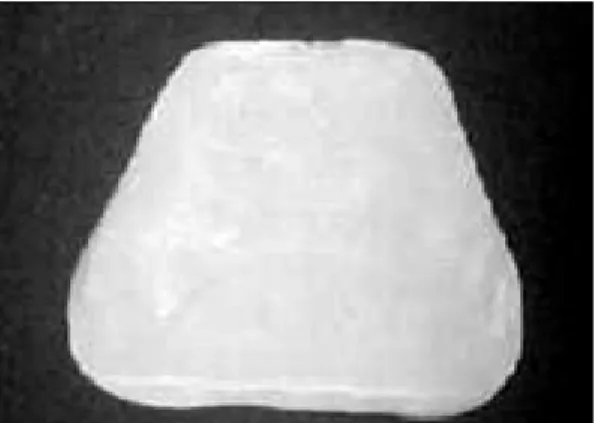
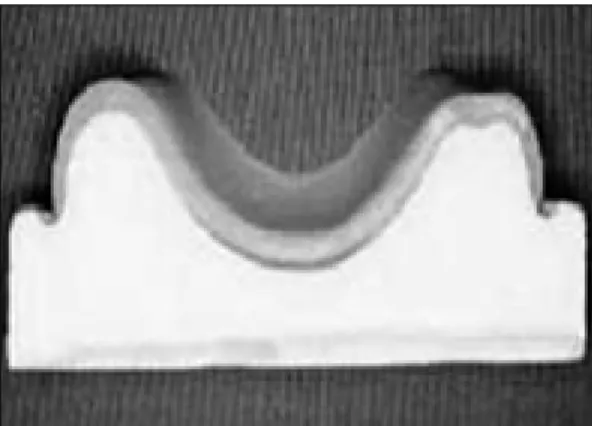
Upper edentulous master casts were made by pouring improved stone into silicone mould (Fig. 1).
(2) FujiRock�(GC Belgium, Belgium)
(3) Quicky�(NISSIN DENTAL PRODUCTS, Japan)
For autopolymerizing resin, powder and liquid were mixed (Fig. 2).
(4) Lightplast-Platten�(DREVE-DENTAMID GMBH, Germany)
Fig. 1. Silicone mould and master cast. Fig. 2.Quicky�self-curing resin (NISSIN DENTAL PRODUCTS, Japan).
For light-curing resin, this plate-shaped material was hardened in a light-curing unit (Fig. 3).
(5) Ostron mould�(GC Co., Japan)
It was used to make the constanst thick- ness of the resin 2mm.
(6) POLYLUX-PT�(DREVE-DENTAMID GM BH, Germany)
This light-curing unit, recommended by the Lightplast-Platten�manufacturer, was used for light-curing resin (Fig. 4).
(7) VC-50 precision diamond saw�(LECO Co., U.S.A.)
The master cast and the resin record base were cut in three positions of the posterior border, 15mm anterior and 30mm anterior using the saw (Fig. 5).
(8) Stereomicroscope SZ-ST�(Olympus, Japan) The gap between the master cast and the record base was measured on each cutting planes with the rate of 40times (Fig. 9).
Experimental methods
(1) Fabricating the upper master cast
60 master casts were fabricated by mixing improved stone (FujiRock�, GC Belgium, Belgium) according to the directions of the manufacturer and pouring it into the upper edentulous silicone mould.
(2) Fabricating the record base
After applying lubricant on the cast, 20 record bases for each experimental groups were fabricated by using autopolymeriz- ing and light-curing resin as follows.
① Group Ⅰ
Quicky�(NISSIN DENTAL PRODUCTS, Japan), autopolymerizing resin, was mixed according to the directions at the rate of 10g polymer and 5㎖ monomer, and formed in the constant thickness of 2mm in Ostron Fig. 3. Lightplast-Platten�light-curing resin (DREVE-
DENTAMID GMBH, Germany).
Fig. 4.POLYLUX-PT�(DREVE-DENTAMID GMBH, Germany) light curing unit.
Fig. 5.VC-50 precision diamond saw�(LECO Co., U.S.A.).
Table 1. Classification of experimental groups.
(Total : n=60)
Lightplast- Lightplast- Quicky Platten�(one- Platten�(multi-
step curing) step curing)
1 hour n=10 n=10 n=10
1 day n=10 n=10 n=10
GroupⅠ GroupⅡ GroupⅢ
Fig. 8.Diagram of all measuring points.
mould�(GC Co., Japan), and then adapt- ed on the cast. The materials were carefully adapted that it should not be thinned and air should not be included, and the excessive materials around the border were cut with a dental laboratory knife.
② Group Ⅱ
Lightplast-Platten�(DREVE-DENTAMID GMBH, Germany), light-curing resin, was adapted on the cast and the excessive materials around the border were cut with a dental laboratory knife. This was polymerized for 5 minutes according to the directions of the manufacturer in POLY- LUX-PT�(DREVE-DENTAMID GMBH, Germany) curing unit and the inside of it Fig. 7. Measuring points of master cast.
Fig. 9. Stereomicroscope SZ-ST�(Olympus, Japan).
Fig. 6. Master cast sectioned three pieces.
was polymerized for 3 minutes afters eparating the record base from the master cast.
③ Group Ⅲ
Lightplast-Platten�, light-curing resin, was adapted on the cast and the excessive materials around the border were cut.
After the palatal area inside the alveolar crest was covered to the bottom of the cast with aluminum foil lest the light should pass through it, the resin was polymerized in POLYLUX-PT�for 1.5 minutes. The aluminum foil around the palatal area was eliminated and unpoly- merized resin was readapted on the cast.
The second aluminum foil of the size as half as the first one was adapted on the palate and then polymerized for 1.5 min- utes. The aluminum foil was eliminated and unpolymerized resin was readapt- ed on the cast, and then polymerized for 2 minutes. The record base was separated from the cast and the inside was poly- merized again for 3 minutes.
The gap between the record base and the cast was measured 1 hour later for one half (10 record bases) and 1 day later for the other half (10 record bases) of each group. Table 1 shows the classification of the experimental groups according to resin types, fabrica- tion methods and polymerizing time.
(3) Cutting of master cast and record base The master cast and the record base were cut in 2 positions of 15mm anterior and 30mm anterior from the posterior border using VC-50 precision diamond saw (LECO Co., USA), a low-speed rotary saw�(Fig. 6). On the posterior border, 15mm anterior and 30mm anterior cutting planes, left alveolar crest, mid- palate, and right alveolar crest were marked as the measuring points of A, B, C.(Fig. 7). Fig.
8 shows the locations of all measuring
points.
(4) Measuring the accuracy
The gap between the master cast and the record base was measured on each mea- suring point with the rate of 40 times using Stereomicroscope SZ-ST�(Olympus, Japan), which is three-dimensional, light micro- scope.
(5) Statistics
SPSS V8.0 for win(SPSS Inc., USA) was used for the statistical procedure of the study results, and the statistics was veri- fied to 95% of significant standard using one-way ANOVA test and independent t-test.
EXPERIMENTAL RESULTS
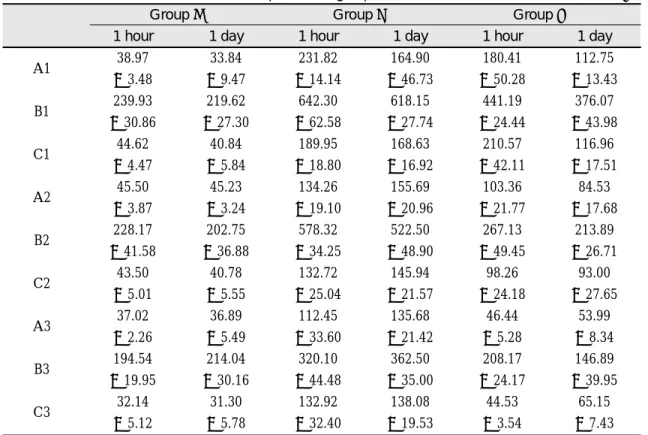
The mean and standard deviation of all experimental groups
Point C3 of the GroupⅠ measured 1 day later showed the highest accuracy (31.30±5.78 ㎛), and point B1 of the GroupⅡ measured 1 hour lat- er showed the lowest accuracy (642.30±62.58
㎛). Table 2 shows the mean and standard devi- ation of all experimental groups.
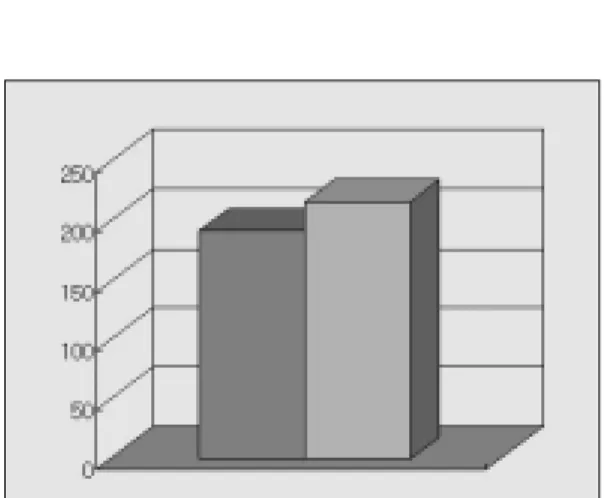
The accuracy according to kinds of resins The mean of the gaps between autopolymerizing resin and the master cast was 127.76±85.99㎛ and for the light-curing resin it was 243.36±176.23
㎛. The independent t-test of the accuracy accord- ing to kinds of resins showed that the autopoly- merizing resin was significantly more accurate than light-curing resin(p<0.05) (Table 3, Fig. 10).
The accuracy according to polymerizing method of light-curing resin
Of light-curing resin, the mean of GroupⅡ was 293.97±215.50㎛ and Group Ⅲ was 192.43±
150.70㎛. The results of independent t-test for the accuracy according to polymerizing method of light-curing resin showed that multiple step cur- ing method(Group Ⅲ) was significantly more
accurate than one step curing method(Group
Ⅱ) (p<0.05) (Table 4, Fig. 11).
The accuracy according to time lapse after fabricating record base
The mean of the gaps was 192.58±178.00㎛ 1 day later after fabricating record base and 216.86
±179.24㎛ 1 hour later. The results of indepen- dent t-test for the accuracy according to time lapse after fabricating record base showed there was no statistical difference according to time lapse (Table 5, Fig. 12).
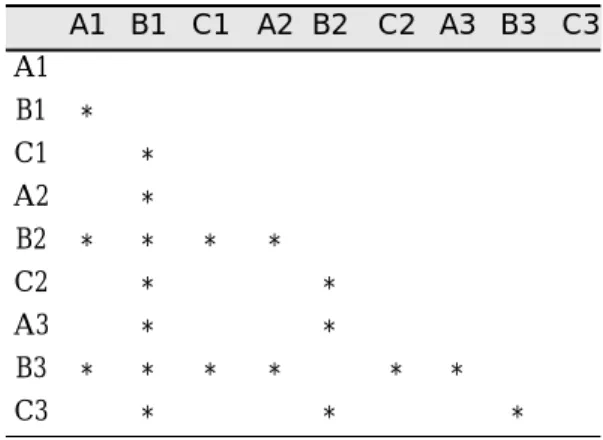
The accuracy according to positions The results of one-way ANOVA test and mul- tiple range test for accuracy according to positions showed significantly less accuracy in the midpalatal region (B) than the left and right alveolar crest region (A, C), and no statistical difference between Table 3. Mean, standard deviation and significance
of independent t-test for accuracy according to experimented resins. (unit : ㎛)
GroupⅠ 180 127.76 85.99 Group
360 243.36 176.23 .000
Ⅱ+Ⅲ
Resin N Mean S.D. Sig.
Table 2. Mean and standard deviation of experimental groups. (unit : ㎛)
A1 38.97 33.84 231.82 164.90 180.41 112.75
±3.48 ±9.47 ±14.14 ±46.73 ±50.28 ±13.43
B1 239.93 219.62 642.30 618.15 441.19 376.07
±30.86 ±27.30 ±62.58 ±27.74 ±24.44 ±43.98
C1 44.62 40.84 189.95 168.63 210.57 116.96
±4.47 ±5.84 ±18.80 ±16.92 ±42.11 ±17.51
A2 45.50 45.23 134.26 155.69 103.36 84.53
±3.87 ±3.24 ±19.10 ±20.96 ±21.77 ±17.68
B2 228.17 202.75 578.32 522.50 267.13 213.89
±41.58 ±36.88 ±34.25 ±48.90 ±49.45 ±26.71
C2 43.50 40.78 132.72 145.94 98.26 93.00
±5.01 ±5.55 ±25.04 ±21.57 ±24.18 ±27.65
A3 37.02 36.89 112.45 135.68 46.44 53.99
±2.26 ±5.49 ±33.60 ±21.42 ±5.28 ±8.34
B3 194.54 214.04 320.10 362.50 208.17 146.89
±19.95 ±30.16 ±44.48 ±35.00 ±24.17 ±39.95
C3 32.14 31.30 132.92 138.08 44.53 65.15
±5.12 ±5.78 ±32.40 ±19.53 ±3.54 ±7.43
Group Ⅰ Group Ⅱ Group Ⅲ
1 hour 1 day 1 hour 1 day 1 hour 1 day
Fig. 10. The mean value of Group Ⅰand Group Ⅱ+Ⅲ
Table 4. Mean, standard deviation and significance of independent t-test for accuracy according to polymerizing method of light-curing resins. (unit : ㎛)
Group Ⅱ 180 293.97 215.50 Group Ⅲ 180 192.43 150.70 .000 Polymerizing
N Mean S.D. Sig.
method
Fig. 11.The mean value of Group Ⅱ and Group Ⅲ.
Table 5. Mean, standard deviation and significance of independent t-test for accuracy according to time.
(unit : ㎛) 1 hour 270 192.58 178.00
1 hour 270 216.86 179.24 .485
Time N Mean S.D. Sig.
Fig. 12.The mean value of 1 day and 1 hour.
A and C. In all three groups, the maximum dis- crepancy occurred at the posterior border in the midpalatal region (B1) (p<0.05) (Table 6, 7).
DISCUSSION
The maxillo-mandibular jaw relation record using record base is the most difficult proce- dure during which dentists make more errors than any other steps in fabricating complete dentures.
It is partly because they haven’t realized that the fabricating record base is so important. The accu- racy and strength of record base decides the accuracy of jaw relation record.
The function of record base from diagnostic views is to check previously the border length resulted from the final impression, the accuracy of the denture base and the possible adjustabili- ty related to the final denture base. From the therapeutical views, the record base is needed to acquire determination of vertical dimension of
occlusion, decision of centric relation record, transferring of accurate jaw relation to articulator, and the proper alignment of artificial teeth for tri- al denture base. Therefore fabrication the record base7would be the most important procedure in dental techniques and clinics as well.
Hence the record base should be fabricated in order to be accurately fitted and it should not be changed but remain stable. Even the inaccurate record bases can look well fitted in the palate because of elasticity of soft tissue, but it doesn’t mean that it fits accurately in reality. The inaccurate record base incurs errors in the final occlusion of complete denture due to the inaccurate jaw rela- tion record8,9.
For record base material, temporary record bases are made out of shellac, baseplatewax, autopolymerizing resin, light-curing resin and vac- uum-adapted resin. Permanent record base are made out of heat-curing resin and metal10.
The commonly used record base material in clinics is autopolymerizing acrylic resin. This type of resin doesn’t need outside heat but it needs activator and catalyst for polymer. Among the 3 fabrication methods, the sprinkle-on method is by spreading powder and liquid alternately. The finger-adapted dough method is by mixing pow- der and liquid according to the directions of the manufacturer to get viscosity of dough and then adapting it on the master cast with fingers. The confined-dough method is by polymerizing under pressure in a flask11,12like as heat-curing resin.
Autopolymerinzing resin costs less, is hardened firmly and easy to fabricate. In addition to that, it is so strong, stable, accurate and hardly changed that is suitable for jaw relation record. It has been reported that autopolymerizing resin is more accurate than heat-curing resin13,14. But it occupies the space for arranging teeth so some trim- ming is needed and the undercut relief of the mas- ter cast can make it less accurate15, and also the monomer of the resin gives harmful effect on people who handle it. Because of these disad- vantages, people have looked for material which is safer, more economical and easier to make16. To meet this demand, the light-curing resin, which can be used more conveniently than autopoly- merizing resin, has been newly introduced.
The light-curing resin is composed of urethane dimethacrylate matrix and a small amount of silica which adjusts flow17,18. There is no need to mix
powder and liquid, therefore it gives no harm on human bodies due to inhaling poisonous smell and powder. Also it can be dealt with hands harmlessly because it needs no liquid. It is easy to make and economical due to less waste of material19. It is not polymerized until light-curing so it secures enough time for work and produces less setting heat20. But it has its disadvantages that it needs a special light-curing unit and occurs setting con- traction.
In this study, record bases were made out of the commonly used autopolymerizing resin and light-curing resin to measure the accuracy of the record base to the master cast. A pattern of gap for- mation between the master cast and the record base was observed in all experimental groups.
According to kinds of resins, autopolymerizing resin was significantly more accurate than light- curing resin.
Many studies on the stability of resin has been made for so long. For autopolymerizing resin, there have been introduced to the market various kinds of products, but most of them are reported no dimensional changes after 9 hours21-23. But light-curing resin acquires dimensional stability right after polymerization only if it is complete- Table 6. Results of one-way ANOVA test for
accuracy according to position.
Between
Groups 11323371.5 8 1415421.43 Within
Groups 5844143.85 531 11005.921 128.605 .000 Total 17167515.3 539
Sum of
df Mean
F Sig.
Squares Square
Table 7. Results of multiple range test for accuracy according to position.
A1 B1 *
C1 *
A2 *
B2 * * * *
C2 * *
A3 * *
B3 * * * * * *
C3 * * *
*Denotes pairs of groups significantly different at the 0.05 level.
A1 B1 C1 A2 B2 C2 A3 B3 C3
ly polymerized with proper light source and exposure time24, and can be used right away, which is believed to be clinically useful. However, another study on the light-curing resin25showed that exposed to polymerizing light, the closest mate- rial would be polymerized first, which causes the formation of gap due to transformation and con- traction. The reason of such formation of gap with the master cast is the contraction because of polymerization and cooling26, and being lifted by internal stress during polymerization27. A part of the internal stress is alleviated through the flow of resin material. So although polymerizing contraction occurs to autopolymerizing resin28,29, the gap can be minimized by manufacturing the resin continuously on the cast until the final polymerization. But for the light-curing resin, the first polymerized surface directly receiving light limits the flow of material22,30,31, which makes it impossible to adapt it continuously on the cast with fingers3to prevent the resin from being lifted until the final polymerization like autopolymer- izing resin and as the result, it shows low accuracy.
I conjectured that it would be possible to minimize the gap formation resulted from polymerization transformation by limiting the amount of mate- rial exposed to light at a time when using light- curing resin. So for this study, Group Ⅱ was polymerized at once according to the directions of the manufacturer, and Group Ⅲ was poly- merized in multiple steps by separating the palatal region. In the comparison of polymerizing method of light-curing resin, multiple step curing (Group Ⅲ) method was significantly more accu- rate. We can infer from this result that fabrication method is very important when using light-cur- ing resin. In all three groups for this study, the max- imum discrepancy occurred on B point at the posterior border of the record base in Group Ⅱ, which was fabricated by exposing the whole material to the light according to the directions of the manufacturer. According to the study by
Elahi and Abdullah29, the average change of size at the posterior border of the maxillary record base fabricated by 5 kinds of polymerization methods using autopolymerizing resin was 203�293㎛, and the record base with such change of size could be made up for through the elasticity of its pressed tissue. But when light-curing resin is polymerized at once like Group Ⅱ, it cannot be made up for through the elasticity of its pressed tissue because gap size was large. Therefore it is recommended that the accuracy of the light-curing resin should be improved through multiple step curing method like Group Ⅲ when using light-curing resin.
Skinner32, reported that resin was not con- tracted by the same amount in all directions during polymerization, and Shaaban33and Chen34 reported that the posterior of palate showed the maximum discrepancy. Also some study report- ed that the accuracy of the record base in the same cast could be different according to the cutting planes, and it could be different accord- ing to the positions even on the same cutting plane35. In comparison of accuracy according to the positions, the midpalatal region showed less accuracy than left and right alveolar crest in all three groups of this study28, and the maximum dis- crepancy occurred on point B at the posterior border. So a proper method of sealing posterior palatal border should be used.
Therefore it is recommended that autopoly- merizing resin should be used because it is more accurate when fabricating the resin record base of the complete denture, and when using light- curing resin for its advantages which is easy to make and possible to use right after fabrication, the multiple step light-curing method should be used like in this study.
CONCLUSION
For this study, the resin record base was fabri- cated with autopolymerizing resin, Quicky�, and light-curing resin, Lightplast-Platten�, divid-
ed into three experimental groups according to the kinds of resin and the polymerization methods of light-curing resin. These master casts and record bases were cut in three positions with a low speed rotary saw 1 hour and 1 day later respec- tively and then the gap was measured by a stere- omicroscope.
The results were as follows:
1. A pattern of gap formation between the record base and the maxillary cast was observed in all specimens. According to kinds of resins, autopolymerizing resin was significantly more accurate than light-curing resin (p<0.05).
2. In the comparison of polymerization method of light-curing resin, multiple step curing (Group Ⅲ) method was significantly more accurate than one step curing method (Group
Ⅱ) (p<0.05).
3. In the comparison according to time lapse, there was no statistical difference of accuracy between the two groups of 1 hour lapse and 1 day lapse in all three groups.
4. In all groups, the maximum discrepancy occurred on point B at the posterior border, which showed statistical difference from oth- er positions (p<0.05).
From the results as above it can be concluded that autopolymerizing resin is better than light-curing resin, and multiple step curing method is more accurate than one step curing method when using light-curing resin.
REFERENCES
1. Academy of Prosthodontics : The glossary of prosthodontic terms. 6th ed. J Prosthet Dent 1994;72:41.
2. Keyworth R G : Monson technic for full denture con- struction. J Am Dent Assoc 1929;16:130.
3. Elder S T : Stabilized base plates. J Prosthet Dent 1955;52:162.
4. Heartwell C M and Rahn A O : Syllabus of complete denture. 4th ed. Philadelphia, Lea and Febiger 1986;253.
5. McCracken W L : Auxiliary uses of cold-curing acrylic resins in prosthetic dentistry. J Am Dent Assoc 1953;47:29.
6. Zarb G A, Bolender C L, Hickey J C and Carlsson G E : Boucher’s prosthodontic treatment for eden- tulous patient. 10th ed. St. Louis. CV Mosby Co.
1990;296.
7. Chung J H : Complete denture 1993;230.
8. Schoen P E and Steart J L : The effect of temporary denture bases on the accuracy of centric jaw rela- tionship. J Prosthet Dent 1967;18:211.
9. Yurkstas A A and Kapur K K : Factors influencing centric relation records in edentulous patients. J Prosthet Dent 1985;53:53.
10. Sheldon W : Essentials of Complete Denture Prosthodontics. 2nd ed. Ishiyaku EuroAmerica, Inc.
1998;127.
11. Chick A O : Use of cold curing acrylic for record bases. Dent. Practic. and Dent. Rec. 1961; 12:91.
12. Song Y D∙Cho I H : A study on the accuracy of the baseplate of the complete denture to the master cast.
Journals of Dankook University of dentistry 1996.
13. Craig R, O’Brien W and Power J : Dental materi- als, properties, and manipulations. 5th ed. St.
Louis. Mosby-Year Book. 1992;267.
14. Anderson J N : Applied dental materials. 5th ed.
Oxford. Blackwell scientific. 1976;271.
15. John D J : A qualitative comparison of various record base materials. J Prosthet Dent 1983;49:130.
16. Larry C B, Donna L D and Jon P M : Custom im- pression trays. J Prosthet Dent 1994;71:31.
17. Ogle R E, Sorensen S E and Lewis E A : A new vis- ible light-cured resin system applied to removable prosthodontics. J Prosthet Dent 1986;56:497.
18. Philips R W : Skinner’s Science of Dental Materials.
9th ed. Philadelphia, WB Saunders 1991;193.
19. Brudvik J S, Nicholls J I and Smith D E : Adaptation of a visible light-cured denture base material. J Prosthet Dent 1989;61:326.
20. Christensen G J : Now is the time to change to cus- tom impression trays. J Am Dent Assoc 1994;125:619.
21. Pagniano R D, Scherd R C, Clowson R L, Dagefoerde R O and Zardiackes L D : Linear di- mensional change of acrylic custom trays. J Prosthet Dent 1982;47:279.
22. Craig R G : Restorative dental materials. 8th ed. St.
Louis. CV Mosby Co. 1989;553.
23. Fehling A W, Hesby R A and Pelleu G B : Dimensional stability of autopolymerizing acrylic resin impression trays. J Prosthet Dent 1986;55:592.
24. Wirz J, Jaeger K and Schmidli F : Light-polymer- ized materials for custom impression trays. Int J Prosthodont 1990;3:64.
25. Payne J A and Pereira B P : Bond strength of three nonaqueous elastomeric impression materials to a light-activated resin tray. Int J Prosthodont 1992;5:55.
26. Philips R W : Skinner’s science of dental materials.
9th ed. Philadelphia, WB Saunders 1991;157.
27. Mohammed H and Tsutsumi S : Material sys- tems in dentistry II. Gainesville, The University of Florida, College of Dentistry 1981;121.
28. Kyun Y W∙Cho I H : A study on the physical na-
ture of the denture reliner. Journals of Dankook University of dentistry 1990.
29. Elahi J M and Abdullah M A : Effect of different polymerization techniques on dimensional sta- bility of record bases. J Prosthet Dent 1994;71:150.
30. Feizer A J, DeGee A J and Davidson C L : Quantitative determination of stress by flow in com- posite restorations. Dent Mater. 1990;6:167.
31. Feizer A J, DeGee A J and Davidson C L : Curing Contraction of Composite and Glass-ionomer ce- ments. J Prosthet Dent 1988;59:297.
32. Skinner E W : Acrylic denture base materials - Their physical properties and manipulation. J Prosthet Dent 1951;1:161.
33. Shaaban S A : The heat-cured and the self-cured types of acrylic resins regarding strength, hardness and dimensional stability before and after recur-
ing. Alexandria, Dental School, Alexandria University, Egypt. 1969;238.
34. Chen J C, Lancefield W R and Castleberry D J : Effect of denture thickness and curing cycle on the di- mensional stability of acrylic resin denture bases.
Dent Mater. 1988;4:20.
35. Hanaa A E and Adel M A : Accuracy of freely adapted resin record bases. J Prosthet Dent 1995;73:348.
Reprint request to:
DR. In-HoCho
DEPARTMENT OFPROSTHODONTICS,COLLEGE OFDENTISTRY, DANKOOK UNIVERSITY
7-1, SHINBOO-DONG-GHUNAN,CHUNGNAM,330-716, KOREA TEL:82-041-550-1971 FAX:82-041-553-2472