450
©The Korean Society of Food Science and Technology
체계적 문헌 고찰을 통한 인지기능 개선에 도움을 주는 식사 관리에 대한 연구
박영숙
1·이현정
1·최귀정
1·허 림
1·남예림
1·김윤하
1·김민지
1·신원선
1,*
한양대학교 식품영양학과
Criteria for diet pattern and meal management to improve cognitive function:
A systematic review
Young-Sook Park1, Hyun-Jung Lee1, Kui-Jeong Choi1, Lin Xu1, Ye-Rim Nam1, Yoon-Ha Kim1, Min-Ji Kim1, and Weon-Sun Shin1
Department of Food & Nutrition, Hanyang University
Abstract The purpose of this study was to conduct a systematic review of the current published research related to improvement in cognitive function. A systematic search was performed in three bibliographic databases (PubMed, Cochrane Library, and EMBASE) using “dementia”, “memory”, “food”, “diet”, and “nutrition” as keywords. Meal management intervention, including Dietary Approaches to Stop Hypertension (DASH) diet, Mediterranean (Med) diet, Diet Mediterranean-DASH Intervention for Neurodegenerative Delay (MIND) diet, and other studies, was also included in the analysis. Through extensive screening, 21 articles, out of 2101 papers retrieved, were used for the final systematic review. The methodological quality of the randomized controlled clinical trials (RCTs) was assessed using the Cochrane Risk of Bias tool. These articles recommended vegetables, fruits, whole grains, olive oil, fish, berries, nuts, and beans. In conclusion, this study suggests the potential use of meal management to improve cognitive function.
Keywords: systematic review, dietary interventions, meal management, cognition enhancing, recommendable diets
서
론
2020년 현재 우리나라는 만 65세 이상 노인 인구가 전체 인구 의 15.7%를 차지하고 있으며 2029년에는 24.1%로 증가할 것으 로 예상되고, 2039년에는 33.2%까지 증가하여 초고령사회로 진 입 될 전망이다(통계청, 2020). 초고령사회로 진행되면서 많은 문 제점들이 나타나는데 그 중 고령자의 건강이 가장 큰 사회적인 문제로 대두되고 있다. 고령자 건강의 문제점은 만성 질환이 증 가하며, 신체기능이 약화되고, 이로 인해 일상생활에 불편함을 겪 게 된다는 점이다. 이처럼 노화에 따른 다양한 질병 중 가장 우 려되는 질환은 인지적 과제 수행 능력이 저하된다는 것이다. 인 지기능의 저하는 노인의 삶의 질과 직접적인 관련이 있다고 볼 수 있다(Choi와 Youn, 2019; Lee와 Bin, 2011).노년기의 다양한 질환 중 치매는 행동심리증상(Behavioral and Psychological Symptom of Dementia, BPSD)이 동반되는 노년기의 대표적 정신 장애이며 다양한 원인으로 인해 뇌기능이 손상되면 서 기억력 장애를 시작으로 지적, 인지기능이 지속적으로 저하되 고, 일상생활 수행능력의 장애까지 생기게 되는 질병이다(Cerejeira 등, 2019; Kim과 Jo, 2018). 이러한 치매의 발생원인은 다양하며 알츠하이머형 치매, 혈관성 치매 등의 종류가 있고, 이 중 알츠 하이머형 치매가 71.3%, 혈관성 치매는 16.9%, 그 밖의 치매는 11.8%로 보고되고 있다(Jeong 등, 2019). 전체 치매환자 중 절반 이상을 차지하는 알츠하이머형 치매는 대표적인 퇴행성 신경 질 환이며 전세계적으로 알츠하이머형 치매는 증가하고 있는 추세 이다(Iranshahi와 Javadi, 2019). 선행연구(Morris 등, 2015)에 따르 면 인지기능 손상을 입은 고령자들이 지속적으로 늘고 있고 치 매로 진행되면 완치 될 수 없다. 치매는 한번 발병하면 완치가 불가능한 퇴행성 질환이지만, 선행연구들(Morris 등, 2015; Vizuete 등, 2010)에 따르면 치매의 발생 위험을 줄이고 예방할 수 있다 고 보고되고 있다. 따라서 치매에 대한 체계적인 예방 관리가 미 래 치매 환자 발생 및 관리 부담 증가를 줄일 수 있는 가장 효 과적 방안으로 제기되고 있다. 최근 영국, 네덜란드, 스웨덴, 미국 등 우리보다 먼저 고령화가 진행된 선진국에서 지난 20년간 꾸 준히 치매 환자수가 증가하기는 하였으나, 일차예방 활동 등으로 인한 건강수명의 증가로 1990년대에 예측했던 것보다는 치매 환 자 수 증가폭이 줄었다는 보고가 잇따르고 있다(Langa 등, 2017; Matthews 등, 2013). 치매를 예방할 수 있는 인지기능 개선에 대한 국외, 국내 중 재연구는 단일식품, 단일영양소, 식이보충제, 신체활동, 사회활동 등의 중재방법이 있다(Shatenstein 등, 2012; Vizuete 등, 2010). 그 러나 선행연구들(Vizuete 등, 2010; Wengreen 등, 2009)에 따르면 단일영양소의 섭취만으로는 인지의 기능을 개선하는 데는 한계 가 있다고 보고되고 있는 가운데 국외의 식사중재 중 대시 식단 (DASH diet), 지중해 식단(Mediferranean diet, Med diet), 마인드 식단(MIND diet)등이 인지기능 개선에 효과적이었다는 선행연구 결과가 있으며 그 유효성이 입증되고 있다. 따라서 식사관리중재 *Corresponding author: Weon-Sun Shin, Department of Food and
Nutrition, Hanyang university, 222 Wangsimni-ro, Seongdong-gu, Seoul 133-791, Korea
Tel: +82-2-2220-4204 Fax: +82-2-2220-1856 E-mail: [email protected]
Received June 23, 2020; revised July 29, 2020; accepted August 20, 2020
프로그램의 인지기능 개선에 대한 식사구성과 식사관리 중재 연 구들의 체계적 문헌 고찰을 통해 과학적인 근거를 제공하여 그 근거에 기반한 한국형 식사 관리 중재 프로그램의 기초자료를 마 련하고자 한다.
재료 및 방법
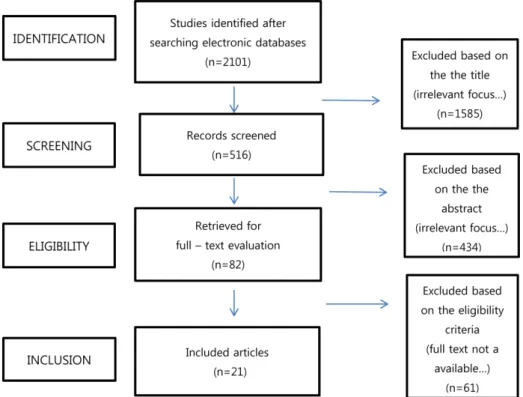
자료 선정 및 자료 검색 본 연구는 국내외 데이터를 기반으로 식품소재 중 인지능력, 기억력개선, 치매와 관련한 과학적 근거가 보고된 문헌조사를 수 행하고 이를 심층 분석하였다. 사람을 대상으로 진행한 연구에 한정하며, 연구 대상은 60세 이상의 남녀로서 임상연구의 형태나 대상 인구, 중재 기간 등에는 제한을 두지 않았다. 식단중재의 임 상 연구를 위주로 문헌을 분석하였다. 문헌검색 시점은 2018년 11월부터 2019년 02월이였고 데이터 베이스는 국외 자료의 경우 Pubmed, Cochrane Library, EMBASE, PsycArticles를 이용하였으며, 국내 자료 검색 시에는 KoreaMed, Koreascholar를 이용하였다. 전문가 접촉, 수기검색, 주제별로 특 성화된 데이터베이스, 학회 초록, 출판되지 않는 논문, 철회된 논 문, 진행 중인 임상시험 등은 배제함을 원칙으로 하였다. 검색어 는 치매(dementia), 기억(memory), 식이(diet), 영양(nutrient), 음식 (food)을 조합하여 구성하였다. 문헌 선택 및 자료 추출 자료의 수집 및 선별 과정에서는 제목을 기준으로 검색어 설 정 및 필터를 거쳐 총 2,101개의 논문이 1차 선발되었다. 이 중 제목을 검토하여 1,585개의 논문을 배제하였고, 2차 문헌선택 과 정에서는 초록을 기준으로 하여 연구주제와 관련성이 없다고 판 단되는 문헌들을 배제하였다. 이 후 문헌 초록을 검토하여 516개 의 문헌을 선택하였다. 3차 문헌선택 과정에서는 2차 문헌선택 과정에서 배제되지 않은 모든 문헌의 전문을 검토하여 본 연구 의 문헌 선택배제 기준에 적합한 문헌을 최종 선정하였다. 4차 문헌선택은 연구 총설 및 전문을 제공하지 않는 연구논문을 배 제하고 최근 10년의 연구와 인체를 대상으로 한 문헌을 선정하 였다. 516개의 문헌 중 총 21개의 논문이 최종 선발되었다(Fig. 1). 상기 모든 과정은 1인의 보조연구원과 1인의 연구보조원이 독 립적으로 실행하였다. 각기 시행하여 엔드노트(Endnote)와 엑셀 (Excel)에 정리하고 중복된 문헌을 검색하여 제거하였다(Fig. 1). 연구자 간 문헌선택에 불일치가 발생할 시 연구책임자, 책임연구 원, 보조연구원 3인의 집단토론을 거쳐 최종 결정하였다. 자료의 추출은 한국보건의료연구원(National Evidence-based healthcare Collaborating Agency, NECA) 가이드라인을 활용하여 진행하였으며, 2명의 연구자가 독립적으로 추출을 진행하여 추후 병합하고 연구자 간 상이한 의견 발생 시 문헌선택에서 적용한 규칙을 동일하게 적용하여 토론 후 합의하였다.비뚤림 위험 평가(Cochrane’s Risk of Bias, RoB)
두 명의 독립된 연구자가 최종 선별한 21건의 문헌을 대상으 로 무작위 대조 시험(randomized controlled trial, RCT)의 연구는 코크란 비뚤림 위험(Cochrane’s Risk of Bias, RoB) 도구를 이용 하여 평가하였고, 무작위배정 비교 임상시험(Non-randomized Study, nRCT)은 비무작위 임상연구(Risk of Bias Assessment tool for Non-randomized Study, RoBANS) 도구를 사용하여 비뚤림 위험 평가를 시행하였다. 비뚤림 위험의 평가는 무작위 배정 순서 생 성, 배정순서 은폐, 참여자와 연구자의 눈가림, 결과 평가자의 눈 가림, 불완전한 결과의 처리, 선택적 결과 보고, 잠재적인 다른 비뚤림 위험 항목에 대해서 비뚤림 위험 측정으로 시행되었다. 비뚤림 위험을 평가 할 때 의견불일치가 발생한 경우 제 3의 다 른 연구자와 함께 재논의 하였다(Gu 등, 2018). 비뚤림 위험 평가는 제목 또는 초록에 연구 디자인이 명시되 고 연구 수행방법과 주요 결과가 잘 요약되어있는지, 서론에 연 구의 이론적 근거와 배경이 잘 설명되어 있는지 연구 목적을 명
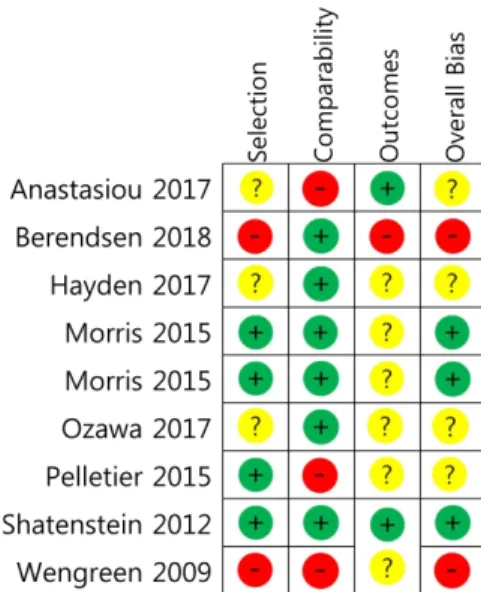
확히 명시하였는지에 대한 확인을 기준으로 수행되었다. 연구방 법에서는 연구 디자인, 결과의 일치성과 관련된 주요 요소를 제 시하고 연구기간, 연구지역, 대상자 모집, 기간 데이터 수집 분석 에 대해 명확히 표현했는지 확인하였다. 연구 디자인한 계획대로 결과를 나타내었는지, 토론부분에서는 목적과 주요결과를 잘 요 약하였는지 확인하였다. 그리고 연구의 일반화에 대해 논의하였 는지를 전반적으로 평가하여 비뚤림 위험 점수를 채점하였다. 인지기능 개선에 도움을 주는 식사관리 연구 중 선정된 21편 의 문헌을 비뚤림 위험 기준(Cochrane Risk of Bias Criteria)을 적 용하여 비뚤림 위험을 평가한 결과, 무작위대조시험(RCT)의 연 구는 4편(Fig. 2), 코호트 연구(Cohort) 9편(Fig. 3)과 횡단면연구 (cross sectional)는 8편이였다(Fig. 4). 선정된 문헌 중 10편의 연 구는 비뚤림 위험 ‘낮음’으로 평가하였고 7편은 비뚤림 위험 ‘불 확실’로 평가하였고 4편은 비뚤림 위험 ‘높음’으로 평가하였다. 무작위대조시험(RCT) 문헌 검색 후 최종 선정된 4개편의 무작위대조시험(RCT) 문헌 을 코크란(Cochrane) 비뚤림 위험 평가표(RoB)를 이용하여 평가 하였다. 무작위 배정 순서 방법(randomization process)에 대한 언 급이 없거나 충분한 무작위 배정을 하지 않은 논문 2편에 대하 여 각각 ‘불확실’, 비뚤림 위험의 ‘높음’으로 평가하였다. 따라서 논문 2편은 종합적인 비뚤림 평가에서도 ‘불확실’로 분류되었다. 반면 선행연구 2편(Lehtisalo 등, 2017; Lehtisalo 등, 2019)은 핀란 드에서 수행된 중재로 식단에 대한 상담, 신체 운동 프로그램, 인 지기능훈련, 신진대사와 혈관질환 위험 관리를 2년 동안 수행하 였고, 이러한 다각도의 생활방식 중재(multidomain lifestyle inter-vention)는 실행 가능성이 높은 항목으로 구성되었고 효율적인 비 용으로 높은 참여도를 보여 비뚤림 ‘낮음’으로 평가하였다(Fig. 2). 무작위배정 비교임상시험(nRct) 무작위배정 비교임상시험(nRCT)은 비무작위 임상연구(RoBANS) 도구를 사용하여 코호트 연구(Cohort)와 횡단면 연구(cross-sectional) 를 각각 평가하였다. 코호트 연구의 경우 총 9개의 논문의 비뚤 림을 평가하였으며 비교 가능성(comparability)의 항목에서 33.3% 의 논문을 비뚤림 위험 ‘높음’으로 평가하였다. 반면 66.7%의 논 문은 비뚤림위험 ‘낮음’으로 평가하였다. 또한 건강지표가 발생 할 만큼 충분한 추적기간을 가졌는지와 탈락자에 대한 설명이 없 거나 추적완료 비율이 언급되지 않음을 확인하는 결과(outcomes) 에서 66.7%의 논문을 비뚤림 평가 ‘불확실’로 분류하였다. 종합 적인 평가의 결과 22.2%의 비뚤림 ‘높음’, 44.4%의 ‘불확실’, 33.4% 의 비뚤림 ‘낮음’으로 평가되었다. 횡단면 연구는 총 8개 논문이 비뚤림 평가가 수행되었다. 방법 (Methods) 부분의 잠재적인 바이어스(bias)를 감소시키려는 방법 에 대한 설명, 대상자 수 산출방법에 대한 설명, 정량적인 변수 를 분석에서 어떻게 다루었는지의 설명이 누락된 논문이 많아 62.5%의 ‘불확실’로 평가되었고, 종합적인 평가의 결과 25%의 비 뚤림 ‘높음’, 12.5%의 ‘불확실’, 62.5%의 비뚤림 ‘낮음’으로 평가 하였다. 실험 연구디자인 21편의 논문 중에서 연구 디자인은 무작위 대조 시험(randomized controlled trial, RCT)의 연구, 코호트 연구(cohort)와 횡단면 연구 Fig. 2. Risk of Bias summary (RCT). +: low risk of bias, -: high
risk of bias, ?: unclear risk of bias.
Fig. 3. Risk of Bias summary (cohort). +: low risk of bias, -: high risk of bias, ?: unclear risk of bias.
Fig. 4. Risk of Bias summary (cross-sectional). +: low risk of bias, -: high risk of bias, ?: unclear risk of bias.
(cross-sectional) 연구를 평가하였다. 무작위 대조 시험(RCT)은 피 험자를 무작위로 실험군과 대조군으로 나누어 비교하여 임상시 험(clinical trial)을 설계하고, 코호트 연구는 특정 질환이 발생하 기 전에 연구 대상집단인 코호트에 대해 위험하다고 의심되는 요 인에 대한 노출 여부에 대해 미리 조사하고 장기적으로 집단을 관찰한 후 발생하는 질환과 의심되는 요인과의 상관성을 조사하 는 설계방법이다. 그리고 횡단면 연구(cross sectional)는 위험인자 에 대한 노출과 질병발생이 거의 동시에 이뤄지는 경우에 적용 되는 연구설계이다(Ha와 Cho, 2016).
결과 및 고찰
비뚤림 위험 평가(Cochrane’s Risk of Bias, RoB)
선행연구(Morris 등, 2015)에서는 시카고 지역에서 거주하는 은 퇴한 지원자들을 대상으로 이루어졌고, 이는 1997년에 시작된 코 호트 연구로써 기억력과 연령의 프로젝트(Memory and Aging Project, MAP)로 불려진다. 마인드 식단의 점수(MIND diet score) 를 측정하며 알츠하이머 질환, 노화에 의한 인지기능의 감소와의 연관성을 관찰하였다. 그 결과 마인드 식단 점수가 높은 식습관 이 알츠하이머의 발병을 예방한다는 유의미한 증거가 도출되었 다. 따라서 선행연구(Morris 등, 2015) 두 개의 논문 모두 비뚤림 위험 ‘낮음’으로 평가되었다. 또한 지중해 식단(Med diet)에 관한 논문 8개 중 선행연구 (Brouwer 등, 2018; Karstens 등, 2019; Masana 등, 2018; Staubo 등, 2017) 4개의 논문이 비뚤림 위험 ‘낮음’으로 평가되었고, 결 과 또한 지중해 식단(Med diet)과 인지기능 개선의 연관성이 유 의하게 나타났다. 나머지 4개의 비뚤림 위험은 비뚤림 ‘높음’ 2 개, ‘불확실’ 2개 였으나 모두 지중해 식단(Med diet)에 대한 준 수가 높을수록 기억력, 우울증, 인지기능의 개선에 영향을 준다 는 결론을 제시하였다(Fig. 3-5). 중재 연구 분석 인지개선을 위해 식사관리를 수행한 중재연구 문헌의 수집, 분 석한 결과 고혈압 예방 식사인 대시 식단(Dietary Approaches to Stop Hypertension, DASH diet) 1편, 지중해 식단(Med diet) 8편, 마인드 식단(Mediterranean-DASH Intervention for Neurodegenera-tive Delay , MIND diet) 2편이었다(Table 1).
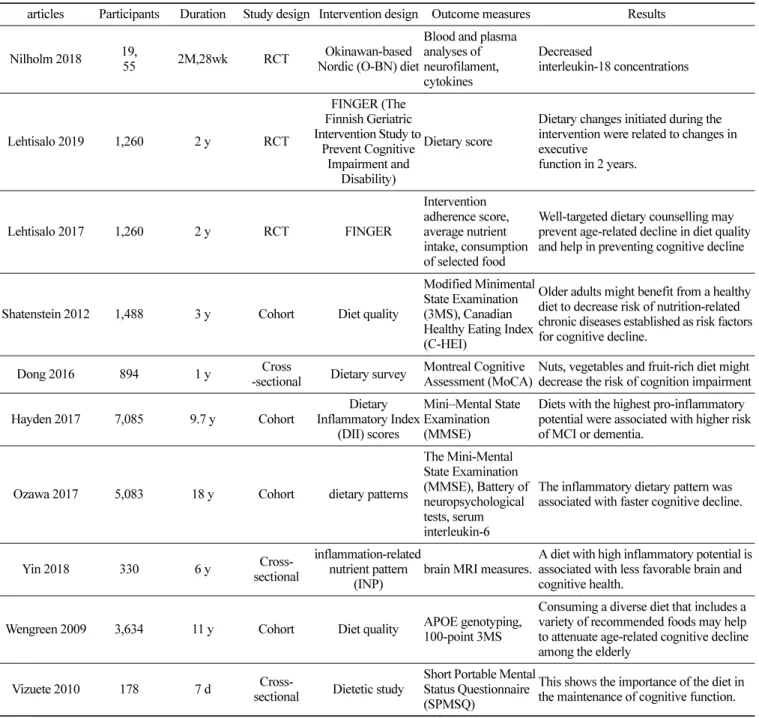
그 외의 식이중재는 10편으로 국가마다 식단의 중재 내용이 지중해 식단과 비슷하지만 각자의 나라에 적합한 식단을 연구한 5편의 논문을 분석하였다. 또한 염증성 식이와 인지기능과의 관 계를 연구한 3편의 논문을 분석하였으며, 2편의 논문은 인지기능 과의 관계를 분석하였다. 그 결과 단일 영양소의 섭취가 아닌 추 천 식품으로 구성된 식단을 섭취함으로 인지기능 개선의 효과를 확인하였다(Table 2). 식이중재의 인지개선 효과 인지개선 효과가 있는 대표적인 식단인 대시 식단(DASH diet), 지중해 식단(Med diet), 마인드 식단(MIND diet)의 권장 식품을 Table 3에 정리하였다. 대시 식단(DASH diet)은 7가지의 식품군 (채소, 과일, 유제품, 육류와 생선, 너트와 콩류, 과자류)과 3가지 의 식이 구성요소들(총 지질, 포화 지방산, 그리고 나트륨)에 기 반을 두었다(Berendsen 등, 2018). 지중해 식단의 특징은 단순히 지방의 섭취가 아닌 어떤 유형의 지방을 섭취하는가를 중요하게 강조하고 있다는 것이다. 포화지방과 트랜스지방을 제한하고, 오 메가 3(ω-3) 함량이 높은 생선과 견과류, 오메가 9(ω-9) 함량이 높은 엑스트라 버진 올리브유(olive oil)를 권장한다(Anastasiou 등, 2017; Brouwer 등, 2018; Karstens 등, 2019; Natanasi 등, 2018; Pelletier 등, 2015; Staubo 등, 2017; Tussing 등, 2017). 마 인드 식단(MIND diet)은 10가지 섭취를 권장하는 식품군(녹색 잎 채소, 다른 채소들, 견과류, 베리류, 콩류, 통곡물, 생선, 가금류, 올리브유, 포도주), 5가지 섭취를 제한하는 식품군(붉은 고기, 버 터, 고체 마가린, 치즈, 패스트리와 사탕, 튀긴 음식/패스트푸드) 을 포함한 15개의 구성요소들을 가지고 있다(Morris 등, 2015). 다국적 지중해 섬 연구(multinational MEditerranean Islands Study, MEDIS study)는 지중해 식단에서 추천하는 식사를 하고 또한 매 일 차(tea)를 섭취함으로 인해 우울증에 유리한 영향을 미쳤다 (Masana 등, 2018).
그 외의 식사와 인지기능 관련의 논문을 분석해 본 결과 오키 나와 기반 북유럽 식사(Okinawan-based Nordic, O-BN diet)는 지 중해 식단과 비슷하고 탄수화물 함량은 낮게 지방과 단백질은 높 게 매일 섬유질 섭취량을 35 g 식이중재 동안 과일, 베리류, 씨 앗 섭취를 권장하였다(Nilholm 등, 2018). 인지 장애 및 장애 예 방을 위한 핀란드 노인 중재 연구(Finnish Geriatric Intervention Study to Prevent Cognitive Impairment and Disability, FINGER) 는 야채, 생선, 베리류의 섭취를 권장하고 영양상담을 진행하였 다. 9개의 식이중재 목표는 포화지방산과 트랜스 지방산의 에너 지 비율, 다중불포화지방산 비율, 자당, 단백질, 알코올, 식이섬유 소, 야채, 과일과 베리, 생선섭취를 중재한다(Lehtisalo 등, 2017; Lehtisalo 등, 2019). 영양과 성공적인 노화에 대한 퀘벡 종단 연 구(Québec Longitudinal Study on Nutrition and Successful Aging, NuAge)의 연구에서 건강한 식단으로 인지기능 저하, 영양관련 만 성질환의 위험을 줄일 수 있음을 확인하였다(Shatenstein 등 2012). 이 논문에서 활용한 캐나다 건강 식사지수(Canadian Healthy Eating Index. C-HEI) 또한 야채와 과일, 너트와 콩류를 강조하였 고 요거트 섭취의 점수를 측정하였다(Lafrenière 등, 2019). 중국 영양학회(Chinese Nutrition Society, CNS)의 설문으로 조사한 연 구결과 야채, 과일, 너트의 섭취는 인지 손상의 위험을 감소시킴 을 확인하였다(Dong 등, 2016).
식이인자가 염증에 영향을 미칠 수 있다는 증거를 바탕으로 식 이성 염증지수(Dietary Inflammatory Index, DII)를 만들었고 DII 은 45가지의 식이인자로 구성된다. 염증 유발 가능성이 가장 높 은 식단은 경도인지장애(mild cognitive impairment, MCI) 또는 치 매 위험 또한 높았다(Hayden 등, 2017). 또한, 염증과 관련된 식 Fig. 5. Dietary components for improving cognitive function
이패턴과 기능 저하와 관련 여부를 조사한 결과 붉은 육류, 가공 육, 튀긴 음식의 섭취량이 많고 전체 통곡물의 섭취량이 적을수 록 염증의 수치가 더 올라갔다(Ozawa 등, 2017). Yin 등(2018)은 염증관련 영양(inflammation- related nutrient pattern, INP)이 뇌영 상의 신경 영상 및 인지 측정과 관련이 있는지 여부를 조사한 결 과 인지건강과 관련이 있음을 확인하였다. 선행 연구들(Wengreen 등, 2009)은 단일 영양소의 추천보다 전 반적인 식사의 질과 인지기능의 연관성을 살펴보았다. 야채, 과 일, 너트, 튀기지 않은 생선의 섭취를 추천하여 식이패턴과 추천 식품으로 구성된 식사를 하였을 때 인지개선의 효과가 있다는 것 을 확인하였다. 그리고 선행 연구(Vizuete 등, 2010)에 따르면 인 지기능 유지를 위해 식단 작성시 야채, 생선과 계란으로 구성된 추천 식품의 꾸준한 섭취를 강조하였다. 혈압을 낮추는 식사요법인 대시 식단(DASH diet)은 심혈관 질 환의 예방 및 개선이 가능한 식단이고, 지중해 식단(Med diet)과 마인드 식단(MIND diet)은 식사와 뇌와 관련이 있는 과학적 문 헌을 바탕으로 제시된 수정방안이다. 지중해 식단의 중재연구를 이용한 다수의 선행 연구에서 오메가 3(ω-3)는 염증 완화, 중성 지질과 LDL-콜레스테롤 및 혈압 조절, 혈액응고 저해에 도움을 주는 것으로 보고되었다(Jeong 등, 2019; Staubo 등 2017). 따라 서 오메가 3가 풍부한 고등어, 연어의 생선을 섭취하는 것을 추 천한다(Lopez 등, 2011). 마인드 식단의 식사관리를 적절히 준수 하면 알츠하이머(Alzheimer’s disease, AD)의 발병 위험도 낮출 수 있고 식사요인과 인지 사이의 복잡한 연관관계를 바탕으로 한국 맞춤형 인지개선 식단을 제공하여야 한다. 마인드 식단(MIND Diet)은 곡물류 중 현미와 같은 전곡물을 먹으며 정제된 것은 피 하고, 야채를 매일 섭취하고 항산화 성분이 많은 베리류는 주에 2회 이상 섭취를 권장한다. 동물성 단백질은 닭고기와 생선 위주 로 섭취하며 소고기 같은 붉은 살 육류는 피하도록 권고하고 있 다. 아울러, 견과류와 콩류를 적극적으로 섭취하고 당분과 지방 의 섭취를 최소화한다(Morris 등, 2015). 혈압을 낮추는 식사인 대 시 식단, 지중해 식단, 마인드 식단 세 가지 식사프로그램에서 공 Table 1. Characteristics of articles included in systematic reviews (DASH, Med, and MIND diet)
Articles Participants Duration Study design Intervention design Outcome measures Results
Morris 2015 923 4.5y Cohort MIND diet
MIND diet score, DASH diet score, Med diet score
High adherence to all three diets may reduce AD risk. Moderate adherence to the MIND diet may also decrease AD risk.
Morris 2015 960 16y Cohort MIND diet
MIND diet score, DASH diet score, Med diet score
MIND diet substantially slows cognitive decline with age.
Berendsen 2018 16,144 32y Cohort DASH diet
DASH 9-point score, The Mini-Mental State Examination
(MMSE)
Greater adherence to long-term DASH score was associated with better average cognitive function
Ntanasi 2018 1,740 6y
Cross-sectional Med diet Med dietscore
High adherence
to the Mediterranean diet pattern is linked to lower presence of frailty.
Anastasiou 2017 1,865 3y Cohort Med diet Med dietscore
Adherence to the MeDi was associated with better performance in memory, language, visuospatial perception and the composite cognitive score
Brouwer 2018 1,607 2y
Cross-sectional Med diet
Food Frequency Questionnaire, Med
diet scale
Higher Med diet adherence was associated with
poorer everyday memory.
Karstens 2019 82 3y
Cross-sectional Med diet MRI, Med diet scores
The High Med diet group was associated with better L&M(learning and memory) performance and
larger dentate gyri.
Pelletier 2015 146 10y Cohort Med diet
MeDi 9-point score, MRI, battery of neuropsychological
tests
The MeDi appears to benefit brain health through preservation of structural connectivity.
Masana 2018 2,687 6y
Cross-sectional Med diet
Med diet score
Greater adherence to the Med diet and daily tea drinking seem to have a beneficial effect on depressive symptoms in older adults.
Staubo 2017 672 2y
Cross-sectional Med diet MRI, MeDi score
Higher adherence to MeDi was associated with larger cortical thickness
Tussing 2017 180 14m RCT Med diet Diet behavior The primary outcome is cognitive functioning;
통적으로 권유하는 식품은 정제되지 않은 전곡물과 야채 및 과 일, 견과류와 콩류를 적극 권장한다.
인지기능개선 예방, 인지 기능 개선을 위해 대표적인 지중해 식단(Med diet), 마인드 식단(MIND diet)을 비교해 본 결과 공통 적으로 야채류, 너트류, 생선의 섭취를 권장하고 붉은색 육류의 섭취는 제한하고 있다. 야채, 과일, 생선은 뇌의 노화에 장기적으 로 지속되는 산화스트레스에 대한 보호력을 지닌다. 포화지방산 의 증가는 인지기능에 부정적인 영향을 미치며, 다가불포화 지방 산과 단일불포화지방산의 증가는 인지기능의 저하를 막는다고 알 려져 있다(Cheon, 2019). 지중해 식단(Med diet), 마인드 식단 (MIND diet)은 여러가지 식품 중 특히 올리브오일을 추천한다. 따라서 한국형 식사 관리 중재 프로그램의 실천을 위해 우리나 라 실정에 맞게 고령자에게 낯설지 않은 친숙한 나물로 대체할 수 있으며 나물을 무칠 때 리놀렌산(linolenic acid)이 풍부한 들
기름을 첨가한다면 훌륭한 대체제가 될 수 있다(Torri 등, 2019). 오키나와 기반 북유럽 식사(Okinawan-based Nordic, O-BN diet)(Nilholm 등, 2018)와 인지 장애 및 장애 예방을 위한 핀란드 노인 중재 연구(Finnish Geriatric Intervention Study to Prevent Cognitive Impairment and Disability, FINGER)(Lehtisalo 등, 2017; Lehtisalo 등, 2019)는 지중해 식사의 식품 구성과 비슷하게 야채, 베리류의 섭취를 권장한다. 중재 과정 중 식이상담이 함께 진행되었고 이 연구의 결과를 통하여 건강한 고령자의 인지기능 저하 방지에 기여하는 다각도의 생활방식 중재(multidomain life-style intervention) 전략 개발의 필요성이 요구되며, 그 중에서도 양질의 영양섭취와 개개인에 최적화된 영양상담은 매우 중요한 것으로 판단된다. 건강한 생활습관이 인지기능의 저하를 직접적 으로 예방하거나, 인지기능 장애와 관련된 질환을 예방할 수 있 었다.
Table 2. Characteristics of articles included in systematic review, interventions and duration
articles Participants Duration Study design Intervention design Outcome measures Results
Nilholm 2018 19,
55 2M,28wk RCT
Okinawan-based Nordic (O-BN) diet
Blood and plasma analyses of neurofilament, cytokines Decreased interleukin-18 concentrations Lehtisalo 2019 1,260 2 y RCT FINGER (The Finnish Geriatric Intervention Study to Prevent Cognitive Impairment and Disability) Dietary score
Dietary changes initiated during the intervention were related to changes in executive function in 2 years. Lehtisalo 2017 1,260 2 y RCT FINGER Intervention adherence score, average nutrient intake, consumption of selected food
Well-targeted dietary counselling may prevent age-related decline in diet quality and help in preventing cognitive decline
Shatenstein 2012 1,488 3 y Cohort Diet quality
Modified Minimental State Examination (3MS), Canadian Healthy Eating Index (C-HEI)
Older adults might benefit from a healthy diet to decrease risk of nutrition-related chronic diseases established as risk factors for cognitive decline.
Dong 2016 894 1 y Cross
-sectional Dietary survey
Montreal Cognitive Assessment (MoCA)
Nuts, vegetables and fruit-rich diet might decrease the risk of cognition impairment
Hayden 2017 7,085 9.7 y Cohort Dietary Inflammatory Index (DII) scores Mini–Mental State Examination (MMSE)
Diets with the highest pro-inflammatory potential were associated with higher risk of MCI or dementia.
Ozawa 2017 5,083 18 y Cohort dietary patterns
The Mini-Mental State Examination (MMSE), Battery of neuropsychological tests, serum interleukin-6
The inflammatory dietary pattern was associated with faster cognitive decline.
Yin 2018 330 6 y
Cross-sectional
inflammation-related nutrient pattern
(INP)
brain MRI measures.
A diet with high inflammatory potential is associated with less favorable brain and cognitive health.
Wengreen 2009 3,634 11 y Cohort Diet quality APOE genotyping, 100-point 3MS
Consuming a diverse diet that includes a variety of recommended foods may help to attenuate age-related cognitive decline among the elderly
Vizuete 2010 178 7 d
Cross-sectional Dietetic study
Short Portable Mental Status Questionnaire (SPMSQ)
This shows the importance of the diet in the maintenance of cognitive function.
각 국가마다 고령자의 인지 개선을 위한 조사가 실행되고 있 으며 캐나다, 중국의 조사 결과 야채, 과일, 너트의 섭취는 인지 손상의 위험을 감소시킴을 확인하였다. 그 외의 선행연구들의 결과 견과류, 채소 및 과일이 풍부한 식 단은 인지장애의 위험을 감소시킬 수 있고 식사의 질과 인지 인 자 사이 간의 양의 관계를 보여준다. 공통적으로 야채, 과일류 특 히 베리류의 섭취를 권장하며 포화지방산을 억제하며 불포화지 방산이 많이 함유되어 있는 식단으로 구성하고 간식으로 너트, 씨앗을 섭취하면 인지개선 효과나 치매 예방 또는 치매로의 진 행을 억제할 수 있다. 그러나 염증 유발 가능성이 가장 높은 식 단인 트랜스지방(trans fat), 포화지방(Saturated fat) 등은 경도인지 장애(MCI) 또는 치매 위험도를 높혔다(Hayden 등, 2017; Ozawa 등, 2017; Yin 등, 2018). 이 연구의 체계적 고찰을 통해 분석한 인지기능에 영향을 미 치는 음식을 모식도로 나타냈다(Fig. 5). Fig. 5에서 보는 바와 같 이 식단 구성 시 정제되지 않은 통곡물, 야채, 과일, 베리류, 생 선, 올리브유, 너트류, 콩류 섭취를 권장한다. 선행연구의 식이와 인지의 연관성에 관한 연구는 단일 영양소(Agnew 등, 2015; Raszewski 등, 2016; Vijayakumar 등, 2017)와 단일 식품에 초점 을 둔 연구(Choi 등, 2018; Kato 등, 2010)가 많았고 기존의 중재 프로그램은 영양에 초점을 맞추어서 진행되었다. 한국인에서 이 루어진 인지기능 개선 식사관리의 선행연구(Bae 등, 2013; Choi 등, 2007; Kang 등, 2009)는 변형된 대시 식단(modified DASH diet) 중심으로 연구 하였고, 종합병원의 중년 및 노년기 심혈관 질환 환자를 대상으로 영양교육 프로그램을 시행한 선행연구(Lee 등, 2004)가 있다. 또한, 지중해 식단을 한국형 지중해 식단의 메 뉴로 변형해 연구한 선행 연구(Jeong 등, 2019)가 최근 진행되었 다. 식이패턴과 식사의 질을 높이는 것이 중요하고 높은 효과를 보인다는 것을 확인할 수 있었고(Vizuete 등, 2010; Wengreen 등 , 2009) 추후 우리나라 실정에 맞는 메뉴를 개발하여 단순히 하 나의 영양소가 아닌 전체적인 식생활, 식단관리를 통한 중재연구 가 필요하다. 식사 요인과 인지 기능 사이의 복잡한 연관 패턴이 명백해졌으며, 식이패턴 생활 양식을 개선하고 식이상담, 교육을 통해 식생활이 개선된다면 경도치매환자(mild cognitive impairment, MCI)의 위험을 줄이는 데 도움이 될 수 있다. 세계적으로 많은 중재연구가 수행되었으나, 한국인의 위험인자 와 보건, 사회, 문화 여건에 맞는 한국형 인지기능개선 식사관리 중재 프로그램은 없는 실정이다. 식사중재 프로그램의 효과에 대 한 과학적 근거를 바탕으로 한국형 식사관리중재 프로그램에 도 입 가능한 요소를 파악하고 인지개선에 효과가 있는 한국형 중 재 식사모델을 개발하는 것이 필요하므로 문헌 고찰을 통해 체 계적으로 파악하는 것이 우선 되어야한다. 기존 식이중재 프로그램의 인지기능에 대한 효과를 체계적으 로 고찰하여, 근거에 기반한 한국형 맞춤형 식사관리 중재 프로 그램이 필요하다. 노인기의 식이습관은 오랜기간 형성되어 온 개 인적 식습관과 사회적 식문화로 개인 건강과 밀접한 관련이 있 다. 따라서, 고령자의 인지기능 개선을 위해 이 연구의 체계적고 찰을 통한 객관적인 식생활 교육의 기초인 식이지침을 마련해야 한다. 그리고 고령자의 경우 오랫동안 익숙해져 온 식습관이 있 으므로 단기간에 끝나는 교육이 아니라 장기간 지속되는 교육을 통해 식사 관리를 철저히 하여 실생활에 접목하여 실천도를 높 이는 것이 매우 중요하다. 단기간의 집약적인 교육을 통해 식습 관을 파악하고 생애주기 동안 평생교육을 통해 장기간 식사관리 의 고도화방안이 필요하다. 이상에서 기술한 권장식품과 인지능 력간의 상관성 결과를 근거로 볼 때 식이요법의 중요성을 보여 주고 적절한 식이교육은 식이 질 저하를 예방하고 인지 기능 저 하를 예방하며 삶의 질 향상에 기여할 수 있다.
요
약
본 논문에서는 인지기능과 식사중재 프로그램의 관련 효과를 확인하고자 체계적 고찰을 시행하였다. 2019년 데이터베이스 검 Table 3. Dietary components and maximum scores for the DASH, Mediterranean, and MIND diet scoresDASH Med diet MIND diet
DASH components Max score Mediterranean diet components Max score MIND components Max score Total grains 7/d 1 Nonrefined grains >4/d 5 Whole grains ≥3/d 1
Vegetables 4/d 1 Vegetables >4/d Potatoes >2/d 5 5 Green leafy ≥6/wk Other vegetables ≥1/d 1 1
Fruits 4/d 1 Fruits >3/d 5 Berries ≥2/wk 1
Nuts, seeds & legumes 4/wk 1 Legumes, nuts, & beans >6/wk 5 Beans ≥3/wk Nuts ≥5/wk
1 1 Dairy 2/d 1 Full-fat Dairy ≤10/wk 5
Fish >6/wk 5 Fish ≥1/wk 1
Poultry ≤3/wk 5 Poultry ≥2/wk 1
Meat, poultry and fish 2/d 1 Red meat ≤1/wk 5 Red meats and products <4/wk 1 Fast/fried food <1/wk 1 Total fat 27% of kcal 1
Saturated fat 6% of kcal 1
Olive oil ≥1/d 5 Olive Oil primary oil 1 Butter & margarine< 1 T/d 1 Cheese <1/wk 1
Sweets 5/wk 1 Pastries & sweets <5/wk 1
Sodium 2400 mg/d 1
Alcohol, 300 mL/d but >0 5 Alcohol/wine 1/d 1 Total DASH Score 10 Total Med diet Score 55 Total MIND Score 15
색, 선별을 통해 총 21편의 연구를 비뚤림 평가하였다. 고혈압 예 방 식사인 대시 식단(Dietary Approaches to Stop Hypertension, DASH diet) 1편, 지중해 식단(Med diet) 8편, 마인드 식단(Medi-terranean-DASH Intervention for Neurodegenerative Delay, MIND diet) 2편이었다(Table 1). 그리고 그 외의 식이중재는 10편이였다 (Table 2). 인지 기능 개선을 위해 대표되는 식단 대시 식단(DASH diet), 지중해 식단(Med diet), 마인드 식단(MIND diet) 비교해 본 결과 공통적으로 야채류, 너트류를 권장하고 붉은 육류는 제한한 다. 전세계적으로 각 나라마다 고령자의 인지 개선을 위한 연구 가 실행되고 있으며 중재 식사관리는 지중해 식단과 비슷한 식 단으로 구성되어 있으며 연구 결과 식이교육, 식이중재 시 인지 개선 효과가 있었다. 이 연구를 통해 식이패턴과 식사의 질을 높 이는 것이 중요하고 인지기능 개선에 높은 효과를 보인다는 것 을 확인할 수 있었고 치매의 치료법은 아직 개발되지 않았으므 로 치매의 진행을 예방하고 발병을 지연시키기 위해 식단 구성 시 정제되지 않은 통곡물, 야채, 과일, 베리류, 생선, 올리브유, 너 트류, 콩류 섭취를 권장한다. 이 고찰을 통해 인지기능 개선을 위 해 단일 영양소, 단일 식품의 섭취의 한계를 확인하였고 한국 고 령자에게 맞는 맞춤형 식사교육을 통한 식사관리 중재 프로그램 이 필요하다는 것을 확인하였다. 그리고, 이 연구의 결과를 바탕 으로 한국형 식사관리 중재 프로그램의 기초를 마련하고자 한다.
감사의 글
본 고찰은 2019년 오뚜기 함태호 재단(OTTOGI HAM TAIHO FOUNDATION)의 연구비 지원을 받아 수행되었으며, 이에 감사 드립니다.
References
Agnew-Blais JC, Wassertheil-Smoller S, Kang JH, Hogan PE, Coker LH, Snetselaar LG, Smoller JW. Folate, vitamin B-6, and vitamin B-12 intake and mild cognitive impairment and probable demen-tia in the Women’s Health Inidemen-tiative Memory Study. J. Acad. Nutr. Diet. 115: 231-241 (2015)
Amadieu C, Lefèvre-Arbogast S, Delcourt C, Dartigues JF, Helmer C, Féart C, Samieri C. Nutrient biomarker patterns and long-term risk of dementia in older adults. Alzheimers Dement. 13: 1125-1132 (2017)
Anastasiou CA, Yannakoulia M, Kosmidis MH, Dardiotis E, Hadji-georgiou GM, Sakka P, Scarmeas N. Mediterranean diet and cog-nitive health: Initial results from the hellenic longitudinal investigation of ageing and diet. J. Australasian College Nutr. Environ. Med. 37: 21-32 (2018)
Bae JS, Kim MH, Kim SB. Effects of Nutrition Education and Per-sonalized Lunch Service Program for Elderly at Senior Welfare-Center in Jeonju. Korean J. Community Nutr. 18: 65-76 (2013) Berendsen AA, Kang JH, van de Rest O, Feskens EJ, de Groot LC,
Grodstein F. The dietary approaches to stop hypertension diet, cognitive function, and cognitive decline in american older women. J. Am. Med. Dir. Assoc. 18: 427-432 (2017)
Brouwer-Brolsma EM, Benati A, van de Wiel A, van Lee L, de Vries JH, Feskens EJ, van de Rest O. Higher Mediterranean Diet scores are not cross-sectionally associated with better cognitive scores in 20-to 70-year-old Dutch adults: The NQplus study. Nutr. Res. 59: 80-89 (2018)
Cerejeira J, Lagarto L, Mukaetova-Ladinska E. Behavioral and psy-chological symptoms of dementia. Front Neurol. 3:73-94 (2012) Cheon JS, Longevity and Dementia Prevention. J Korean
Neuropsy-chiatr Assoc. 48: 307-313 (2009)
Choi EK, Lee J, Park SH, Jung ES, Lim SH, Jang JH, Chae SW, Ko MH. Wheat Bran Improves Cognition in Older Adults with Memory Impairment: A Randomized Controlled Trial.
Pharmacol-ogy, 14(7): 922-928 (2018)
Choi YH, Youn GH. Effect of cognitive rehabilitation program for community-dwelling older adults with mild cognitive impairment. Kor. J. Res. Geront. 28(1): 15-26 (2019)
Choi YJ, Kim C, Park YS. The Effect of Nutrition Education Pro-gram in Physical Health, Nutritional Status and Health-Related Quality of Life of the Elderly in Seoul. J. Nutr. Health 40(3): 270-280 (2007)
Dong L, Xiao R, Cai C, Xu Z, Wang S, Pan L, Yuan L. Diet, life-style and cognitive function in old Chinese adults. Arch Gerontol Geriatr. 63: 36-42 (2016)
Gu Y, Manly JJ, Mayeux RP, Brickman AM. An Inflammation-related Nutrient Pattern is Associated with Both Brain and Cogni-tive Measures in a Multiethnic Elderly Population. Curr. Alzhe-imer Res. 15(5): 493-501 (2018)
Ha RY, Cho HS. Pros and Cons of Various Research Designs in Clinical Psychiatry. Korean J Biol Psychiatry. 19: 159-163 (2012) Hayden KM, Beavers DP, Steck SE, Hebert JR, Tabung FK,
Shivappa N, Snetselaar LG. The association between an inflam-matory diet and global cognitive function and incident dementia in older women: The women’s health initiative memory study. Alzheimers Dement. 13: 1187-1196 (2017)
Iranshahi M, Javadi B. Diet therapy for the treatment of Alzheimer’s disease in view of traditional Persian medicine: A review. IRAN J. Basic. Med. Sci. 22: 1102-1117 (2019)
Jeong EH, Kim E, Hong CH, Moon SY, Park HK, Jeong JH, Na HR, Choi SH, Park YK. Practicability of six weeks of korean-style mediterranean diet for elderly koreans with high risk for dementia. J. Korean Diet. Assoc. 25: 237-256 (2019)
Kang HJ, Shin EM, Kim KW. Evaluation of nutrition education for diabetes mellitus management of older adults. Korean J. Commu-nity Nutr. 14: 734-745(2009)
Kang JY, Kang KW, Jeong MJ, Kim HJ, Jang IS. The effect of korean herbal medicine that function by inducing diuresis for hypertension: Systematic review and meta-analysis of randomized controlled trials. J. Int. Korean Med. 38: 902-916 (2017)
Karstens AJ, Tussing-Humphreys L, Zhan L, Rajendran N, Cohen J, Dion C, Lamar M. Associations of the mediterranean diet with cognitive and neuroimaging phenotypes of dementia in healthy older adults. Am. J. Clin. Nutr. 109: 361-368 (2019)
Kato-Kataoka A, Sakai M, Ebina R, Nonaka C, Asano T,Miyamori T. Soybean-derived phosphatidylserine improves memory function of the elderly Japanese subjects with memory complaints. J Clin. Biochem. Nutr. 47: 246-255 (2010)
Kim SS, Jo HM. Dementia Prevention Programs among Koreans: A Systematic Review. J. Korea Contents Assoc. 18: 89-98 (2018) Kim J, Kim JY, Kwak JS, Paek JE, Jeong S, Kwon O. Systematic
review of the effect of glucosamine on joint health while focused on the evaluation of claims for health functional food. J. Korean Soc. Food Sci. Nutr. 43: 293-299 (2014)
Lafrenière J, Carbonneau É, Laramée C, Corneau L, Robitaille J, Labonté MÈ, Lamarche B, Lemieux S. Is the canadian healthy eating index 2007 an appropriate diet indicator of metabolic health? insights from dietary pattern analysis in the predise study. Nutrients 11: 1597 (2019)
Langa KM, Larson EB, Crimmins EM, Faul JD, Levine DA, Kabeto MU, Weir DR. A comparison of the prevalence of dementia in the United States in 2000 and 2012. JAMA Intern. Med. 177: 51-8 (2017)
Lee DH, Bin SO. Structure Relationships for Diseased and Health-related Quality of Life in the Elderly. J. Korea Contents Assoc. 11: 216-224 (2011)
Lee SM, Chung HK, Kang JH, Yoon YW, Kim HS. Effects of modi-fied dash diet education program on korean middle-aged and eld-erly cardiovascular disease patients. Korean J. Clin. Geri. 5: 199-207 (2004)
Lehtisalo J, Levälahti E, Lindström J, Hänninen T, Paajanen T, Pel-tonen M, Tuomilehto J. Dietary changes and cognition over 2 years within a multidomain intervention trial-The finnish geriatric intervention study to prevent cognitive impairment and disability (finger). Alzheimers Dement. 15: 410-417 (2019)
plasma levels of the omega-3 fatty acid docosahexaenoic acid are associated with decreased dementia risk: the Rancho Bernardo study. J. Nutr. Health Aging. 15: 25-31 (2011)
Matthews FE, Arthur A, Barnes LE, Bond J, Jagger C, Robinson L, Brayne C. A two-decade comparison of prevalence of dementia in individuals aged 65 years and older from three geographical areas of England: results of the Cognitive Function and Ageing Study I and II. Lancent 382: 1405-1412 (2013)
Morris MC, Tangney CC, Wang Y, Sacks FM, Bennett DA, Aggar-wal NT. MIND diet associated with reduced incidence of Alzhe-imer’s disease. Alzheimers Dement. 11: 1007-1014 (2015). Morris MC, Tangney CC, Wang Y, Sacks FM, Barnes LL, Bennett
DA, Aggarwal NT. MIND diet slows cognitive decline with aging. Alzheimers Dement. 11: 1015-1022 (2015)
Nilholm C, Roth B, Höglund P, Blennow K, Englund E, Hansson O, Ohlsson B. Dietary intervention with an Okinawan-based Nordic diet in type 2 diabetes renders decreased interleukin-18 concentra-tions and increased neurofilament light concentraconcentra-tions in plasma. Nutr. Res. 60: 13-25 (2018)
Ntanasi E, Yannakoulia M, Kosmidis MH, Anastasiou CA, Dardiotis E, Hadjigeorgiou G, Scarmeas N. Adherence to mediterranean diet and frailty. J. Am. Med. Dir. Assoc. 19: 315-322 (2018) Ozawa M, Shipley M, Kivimaki M, Singh-Manoux A, Brunner EJ.
Dietary pattern, inflammation and cognitive decline: the Whitehall II prospective cohort study. Clin. Nutr. 36: 506-512 (2017)
Park YS, Kim MJ, Park BM, Kim SB, Shin WS. Study of demands on new home meal replacement products for active silver. J Korean Soc Food Sci Nutr. 48: 83-96 (2019)
Pelletier A, Barul C, Féart C, Helmer C, Bernard C, Periot O, Cathe-line G. Mediterranean diet and preserved brain structural connec-tivity in older subjects. Alzheimers Dement. 11: 1023-1031 (2015)
Raszewski G, Chwedorowicz R, Chwedorowicz A, Rothenberg KG. Homocysteine, antioxidant vitamins and lipids as biomarkers of neurodegeneration in Alzheimer’s disease versus non-Alzheimer’s dementia. Ann. Agr. Env. Med. 23: 193-196 (2016)
Shatenstein B, Ferland G, Belleville S, Gray-Donald K, Kergoat MJ,
Morais J, Gaudreau P, Payette H, Greenwood C. Diet quality and cognition among older adults from the NuAge study. Exp. Geron-tol. 47: 353-360 (2012)
Staubo SC, Aakre JA, Vemuri P, Syrjanen JA, Mielke MM, Geda Y.E, Jack Jr CR. Mediterranean diet, micronutrients and macronu-trients, and MRI measures of cortical thickness. Alzheimers Dement. 13: 168-177 (2017)
Statistics Korea(2019). population statistical data. Available from: http://www.kostat.go.kr. Accessed May. 20, (2020)
Kim SY, Park HE, Seo HJ, Lee YJ, Jang BH, Son HJ, Suh HS, Shin CM. NECA’s guidance for undertaking systematic reviews and meta-anaylses for intervention. National Evidence-based Health-care Collaborating Agency (2011)
Torri L, Bondioli P, Folegatti L, Rovellini P, Piochi M, Morini G. Development of Perilla seed oil and extra virgin olive oil blends for nutritional, oxidative stability and consumer acceptance improvements. Food chem. 286: 584-591 (2019)
Tussing-Humphreys L, Lamar M, Blumenthal JA, Babyak M, Fan-tuzzi G, Blumstein L, Fitzgibbon ML. Building research in diet and cognition: The BRIDGE randomized controlled trial. Con-temp. Clin. Trials. 59: 87-97 (2017)
Vijayakumar TM, Pavitra K, Muthunarayanan L. Comparative assess-ment of methylcobalamin and ascorbic acid on cognitive function in post-menopausal women-A randomized, double-blind trial. Contemp. Clin. Trials Commun. 8: 175-180 (2017)
Vizuete AA, Robles F, Rodríguez-Rodríguez E, López-Sobaler AM, Ortega RM. Association between food and nutrient intakes and cognitive capacity in a group of institutionalized elderly people. Eur. J. Nutr. 49: 293–300 (2010)
Wengreen HJ, Neilson C, Munger R, Corcoran C. Diet quality is associated with better cognitive test performance among aging men and women. J. Nutr. 139: 1944-1949 (2009)
Yuan L, Liu J, Ma W, Dong L, Wang W, Che R, Xiao R. Dietary pattern and antioxidants in plasma and erythrocyte in patients with mild cognitive impairment from China. Nutrients 32: 193-198 (2016)