565
©The Korean Society of Food Science and Technology
콩기름과 들기름 내 polycyclic aromatic hydrocarbons 저감화를 위한
활성탄 처리조건 및 분석법 확립
박영애
1,*·정소영
1·김남훈
1·이영주
1·조주연
1·김욱희
1·김진경
1·
황인숙
1·홍미선
1·이상미
1·오영희
1·정 권
1 1서울시보건환경연구원Establishment of activated carbon treatment conditions and
analytical methods to reduce polycyclic aromatic hydrocarbons
contents in soybean oil and perilla oil
Young-Ae Park1,*, So-Young Jung1, Nam-Hoon Kim1, Young-Ju Lee1, Ju-Yeon Jo1, Ouk-Hee Kim1, Jin-Kyung Kim1, In-Sook Hwang1, Mi-Sun Hong1, Sang-Me Lee1, Young-Hee Oh1, and Kwon Jeong1
1
Seoul Metropolitan Government Research Institute of Public Health and Environment
Abstract After adding eight different kinds of PAHs to soybean oil and perilla oil samples, changes of PAHs contents after activated carbon treatment with different conditions of activated carbon concentration, temperature, and time were investigated. PAHs contents decreased in both soybean oil and perilla oil with increasing activated carbon concentrations. Neither of the PAHs were detected in the soybean oil samples after the addition of only 0.05% of activated carbon, while the contents of most kinds of PAHs decreased below the limit of quantification in the perilla oil samples after the addition of up to 0.4% of activated carbon. PAHs contents decreased as the temperature of the activated carbon treatment increased, and most PAHs were not detected in the soybean oil samples at temperatures above 80oC. With regards to the activated carbon treatment time, the PAHs contents also decreased as the treatment time increased. In case of soybean oil, four kinds of PAHs were not detected after treatment with 0.05% of activated carbon at 70oC for 10 min.
Keywords: polycyclic aromatic hydrocarbons (PAHs), activated carbon, soybean oil, perilla oil
서
론
다환방향족탄화수소(polycyclic aromatic hydrocarbons, PAHs)는 2개 이상의 벤젠고리가 융합된 유기화합물로서, 200여종 이상의 유도체 화합물들로 이루어져 있다. 이중 일부는 인체에 유해한 내분비계 장애물질로 돌연변이원성과 발암성이 있는 것으로 알 려져 있다(EC, 2002; Pelkonene과 Nebert, 1982; WHO, 2000). PAHs는 화석연료 사용, 자동차 매연 및 쓰레기 불완전 연소 등 에 의해 환경에 상당량 존재하고 있고 식품 중에는 주로 고온가 열시 탄수화물, 단백질, 지방 등의 열분해에 의해 생성되며 굽기, 튀김, 볶음 등의 식품 조리가공과정에 의해 그 함량이 증가된다 (Asenni와 Fischbach, 1972; Hu 등, 2007).
2006년 국제암연구소(International Agency for Research on Cancer, IARC)에서는 PAHs의 발암성과 관련하여 benzo(a)pyrene (BaP) 은 발암물질(Group 1), dibenzo(a,h)anthracene (DahA) 등 3종은
발암가능물질(Group 2A), benzo(a)anthracene (BaA) 등 11종은 발 암우려물질(Group 2B), benzo(g,h,i)perylene(BghiP) 등 45종은 발 암물질로 분류되지 않은 물질(Group 3) 등 4그룹으로 분류하여 발표하였다(IARC, 2006). 식용유지 같은 지방함량이 높은 식품은 PAHs에 오염될 가능성이 크기 때문에(Chung 등, 2004) 세계 각 국에서는 식용유지 중 PAHs에 대한 기준을 설정하고 있다. EU(European Union)에서는 PAHs 중 가장 독성이 강한 벤조피렌 의 유지 중 최대 허용량을 2 ppb로 설정하고 있고(Ledicia 등, 2008) 이탈리아, 스페인, 그리스 등에서는 벤젠고리가 5개 이상인 heavy PAHs 중 8종류를 기준으로 개별 2 ppb 이하, 총합 5 ppb 이하로 설정하고 있으며(Moret와 Conte, 2000) 독일에서는 총 PAHs 25 ppb, heavy PAHs 5 ppb 이하로 기준을 설정하고 있다 (Pulpin과 Toledo, 1996; Speer 등, 1990). 우리나라에서는 식용유 지 중 벤조피렌 최대허용량 2 ppb 이하의 기준만 설정되어 있으 며 총 PAHs에 대한 기준은 설정되어 있지 않은 실정이다. 지금까지 참기름 중의 benzo(a)pyrene 함량 측정 및 변화 연구 (Kim 등, 1993; Speer 등, 1990), 참기름 제조공정 중 볶음온도의 증가에 따른 PAHs의 함량변화에 관한 연구(Seo 등, 2009), 참기 름 볶음과정 중 발생하는 연기의 강제배출에 따른 benzo(a)pyrene 의 저감화 연구(Kim과 Song, 2008), 흡착제를 이용한 참기름의 benzo(a)pyrene 저감화(Choi 등, 2014) 등 참기름에 대한 benzo(a)pyrene 함량 및 저감화 연구는 꾸준히 진행되고 있으나 다른 식용유지에 대한 benzo(a)pyrene 및 PAHs의 함량 분석 및 *Corresponding author: Young-Ae Park, Seoul Metropolitan
Gov-ernment Research Institute of Public Health and Environment, Gyeonggi 13818, Korea
Tel: +82-2-570-3224 Fax: +82-2-570-3229
E-mail: [email protected]
Received September 10, 2018; revised November 6, 2018; accepted November 26, 2018
저감화 연구는 상대적으로 부족한 실정이다. 이에 본 연구는 우 리나라 식용유지 시장에서 가장 높은 비중을 차지하는 콩기름과, 불포화지방산 및 오메가-3 지방산이 풍부하여 영양학적으로 우수 한 기능을 가지고 있는 들기름을 선정하여 8종의 PAHs 함량을 분석하고 이의 저감화를 수행하고자 하였다. 특히 들기름은 영양 학적으로 우수한 기능을 가지고 있는 반면, 다른 유지에 비해 산 화되기 쉽고 볶음, 압착 등의 제조공정으로 인하여 PAHs에 오염 될 가능성이 크므로(Kim과 Song, 2008) 이를 저감화 시킬 수 있 는 방법을 모색할 필요가 있다. 또한 Sung은 옥배유에 흡착제인 활성탄을 처리하여 benzo(a)pyrene 함량을 저감화 시켰고(Sung, 2010) Choi 등은 참기름에 흡착제 처리하여 benzo(a)pyrene 함량 을 저감화 시킨 결과를 보고한 바 있다(Choi 등, 2014). 따라서 본 연구는 뛰어난 흡착능력을 가진 활성탄을 콩기름과 들기름에 처리하여 PAHs 함량을 저감화 시킬 수 있는 최적의 처리조건을 확립하고자 하였다.
재료 및 방법
재료 실험재료로 CJ제일제당(주)(Inchon, Korea)에서 생산된 콩기름 과 들기름을 구입하여 공시험 재료로 사용하였다. 표준물질 및 시약PAHs를 분석하기 위하여 benzo(a)anthracene (BaA), chrysene (CRY), benzo(b)fluoranthene (BbF), benzo(k)fluoranthene (BkF), Benzo(a)pyrene (BaP), dibenzo(a,h)anthracene (DahA), benzo(g,h,i)perylene (BghiP), indeno(1,2,3-c,d)pyrene (IcdP) 등 8 종의 표준물질과 내부표준물질인 3-methylcholanthrene(3-MC)을 사용하였다. 모든 표준물질은 Supelco (Bellefonte, PA, USA)제품 을 사용하였다. 시료 전처리 및 분석용 시약으로 사용한 아세토 니트릴, 메탄올, 이소옥탄, 사이클로헥산, 디클로로메탄은 Merck Co. (Darmstadt, Germany)의 HPLC 등급 제품을 사용하였으며 시
료를 정제하기 위하여 사용한 카트리지는 Strata SDB-L Styrene-Divinylbenzene Polymer (1,000 mg/6 mL)로 Phenomenex (Tor-rance, CA, USA)의 것을 사용하였다. 흡착제로 사용한 활성탄 (activated charcoal, 100 mesh)은 Sigma-Aldrich (St. Louis, MO, USA) 제품을 구입하여 사용하였다.
표준원액 및 표준용액의 조제
표준물질(BaA, CRY, BbF, BkF, BaP, DahA, BghiP, IcdP) 약 10 mg을 각각 100 mL 용량 플라스크에 취한 후 아세토니트릴에 용해시켜 약 100 mg/kg의 농도가 되도록 조제하여 표준원액으로 하였고, 8종의 표준원액을 일정농도(0.5, 1, 5, 10, 20 µg/kg)가 되 도록 혼합하여 희석한 후 표준용액으로 사용하였다. 공시험 시료 조제 예비실험을 통하여 공시험 재료인 콩기름과 들기름의 8종 PAHs 함량을 측정한 후, 최종 공시험 시료의 표준물질 농도가 약 10-15 µg/kg 수준이 되도록 8종의 표준용액을 첨가하여 혼합 기(SK-600, Jeio Tech, Seoul, Korea)로 균질화 시킨 후 공시험 시료로 사용하였다. 여기에 활성탄을 농도별, 온도별, 시간별로 다르게 처리하여 활성탄을 통한 PAHs의 저감화 정도를 알아보 고자 하였다. 공시험 시료의 활성탄 처리 PAHs를 인위적으로 주입한 공시험 시료에 활성탄 처리하였을 때 PAHs 함량의 감소를 알아보고자 Choi 등(2014)의 방법을 적 용하여 실험하였다. 활성탄 농도별 PAHs 함량변화를 조사하기 위하여, 삼각플라스크에 공시험 시료 100 g을 취하고 활성탄 농 도가 0.05, 0.1, 0.2, 0.4, 0.6, 0.8, 1.2, 1.6, 2.0% (w/w)가 되도록 각각 첨가한 후 shaking water bath (BS-31, Jeio Tech)에서 열처 리(70oC, 30분)하였고, 활성탄 처리온도별 변화를 알아보고자
30-90oC 온도에서 10oC 간격으로 열처리(활성탄 0.05%, 30분)하였으 며, 활성탄 처리시간별 변화를 알아보기 위하여 10-60분까지 10
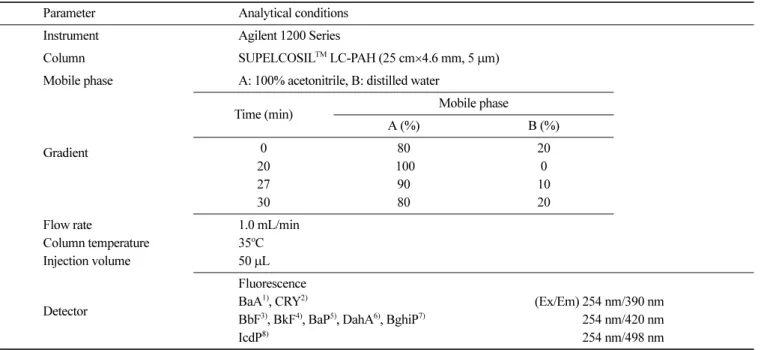
Table 1. Analytical condition of polycyclic aromatic hydrocarbons (PAHs) by HPLC-FLD Parameter Analytical conditions
Instrument Agilent 1200 Series
Column SUPELCOSILTM LC-PAH (25 cm×4.6 mm, 5 µm) Mobile phase A: 100% acetonitrile, B: distilled water
Gradient
Time (min) Mobile phase
A (%) B (%)
0 80 20
20 100 0
27 90 10 30 80 20
Flow rate 1.0 mL/min
Column temperature 35oC Injection volume 50 µL
Detector
Fluorescence
BaA1), CRY2) (Ex/Em) 254 nm/390 nm BbF3), BkF4), BaP5), DahA6), BghiP7) 254 nm/420 nm
IcdP8) 254 nm/498 nm
1)BaA: benzo(a)anthracene, 2)CRY: chrysene, 3)BbF: benzo(b)fluoranthene, 4)BkF: benzo(k)fluoranthene, 5)BaP: benzo(a)pyrene, 6)DahA: dibenzo(a,h)anthracene, 7)BghiP: benzo(g,h,i)perylene, 8)IcdP: indeno(1,2,3-c,d)pyrene
분 간격으로 열처리(활성탄 0.05%, 70oC)하였다. 모든 실험은 세 번 반복하여 측정하였다. PAHs 추출 활성탄 처리한 시료에서 PAHs를 추출하기 위하여 Kim(2009) 과 Jang 등(2014)의 방법을 변형시켜 적용하였다. 위 실험에서 활 성탄 처리한 시료 2 g을 취하여 60 ng/mL의 내부표준용액(3-메틸 콜란트렌) 1 mL를 첨가한 후 이소옥탄:사이클로헥산(1:1) 용액을 가하여 10 mL로 정용하였다. 아세토니트릴 5 mL로 미리 활성화 시킨 SDB-L 카트리지에 위 시험용액 2 mL를 취한 후 이소옥탄 :사이클로헥산(1:1)용액 20 mL을 가하여 지방성분을 제거하고 디 클로로메탄 12 mL로 용출하였다. 질소농축기(MG-2200, Eyela, Tokyo, Japan)를 이용하여 40oC에서 용출용액을 농축시킨 후 잔 류물을 아세토니트릴 1 mL로 용해시켜 0.45 µm syringe filter로 여과하여 기기분석에 사용하였다. 기기분석 조건 PAHs를 분석하기 위하여 고속액체크로마토그래피(HPLC)인 Table 2. The correlation coefficient, limit of detection (LOD), limit of quantification (LOQ) and coefficient of variation (CV) of polycyclic aromatic hydrocarbons (PAHs) by HPLC-FLD
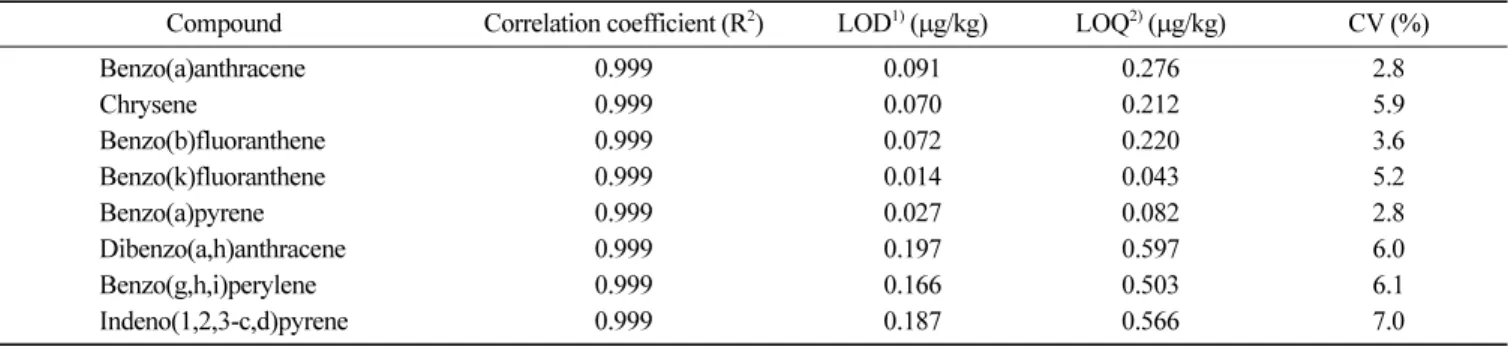
Compound Correlation coefficient (R2) LOD1) (µg/kg) LOQ2) (µg/kg) CV (%)
Benzo(a)anthracene 0.999 0.091 0.276 2.8 Chrysene 0.999 0.070 0.212 5.9 Benzo(b)fluoranthene 0.999 0.072 0.220 3.6 Benzo(k)fluoranthene 0.999 0.014 0.043 5.2 Benzo(a)pyrene 0.999 0.027 0.082 2.8 Dibenzo(a,h)anthracene 0.999 0.197 0.597 6.0 Benzo(g,h,i)perylene 0.999 0.166 0.503 6.1 Indeno(1,2,3-c,d)pyrene 0.999 0.187 0.566 7.0
1)LOD=3.3×(s/S), 2)LOQ=10×(s/S), s: standard deviation of the response, S: slop of the calibration curve
Fig. 1. Chromatograms of 8 kinds of polycyclic aromatic hydrocarbons (PAHs) standards (10µg/kg) according to wavelengths. BaA: benzo(a)anthracene, CRY: chrysene, BbF: benzo(b)fluoranthene, BkF: benzo(k)fluoranthene, BaP: benzo(a)pyrene, DahA: dibenzo(a,h)anthracene, BghiP: benzo(g,h,i)perylene, IcdP: indeno(1,2,3-c,d)pyrene
Agilent 1200 series (Agilent, Santa Clara, CA, USA)를 사용하였 다. 검출기는 fluorescence detector (G1321A, Agilent, Santa Clara, CA, USA), 컬럼은 SUPELCOSILTM LC-PAH (25 cm×4.6 mm, 5 µm)(Supelco, Bellefonte, PA, USA)를 사용하였다. 형광검출기의 여기파장 및 형광파장은 8종의 PAHs를 3그룹으로 나누어서 선 택하였고 예비실험을 통하여 PAHs 각 성분별 감도가 가장 높은 파장을 선택하여 분석하였다. PAHs를 분석하기 위한 기기조건은 Table 1과 같다. 분석법 검증 본 실험의 유효성 검증은 CODEX CAC/GL-71 가이드라인 (CODEX, 2009)에 따라 직선성(linearity), 검출한계(limit of detec-tion, LOD), 정량한계(limit of quantification, LOQ), 정확성(recov-ery) 및 정밀성(coefficient of variation, CV)으로 측정하였다. 직선 성은 표준용액의 농도가 1, 5, 10, 20, 40 µg/kg, 내부표준물질인 3-메틸콜란트렌의 최종농도가 10 µg/kg 되도록 아세토니트릴로 희 석한 후 형광검출기로 분석한 결과를 검량선으로 나타내었다. 정 확성은 예비실험을 통하여 8 PAHs 함량을 미리 측정한 콩기름 과 들기름에 표준물질의 최종농도가 5, 10, 20, 40 µg/kg 수준이 되도록 표준용액을 첨가한 후 회수율을 측정하여 구하였다.
결과 및 고찰
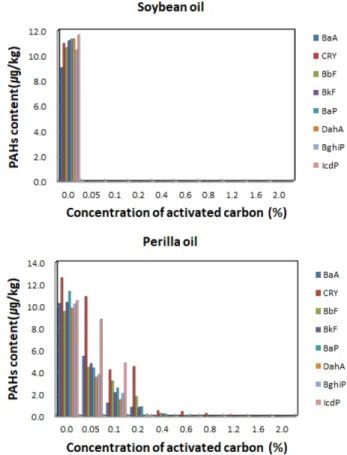
분석법 검증 8종의 PAHs 표준원액을 1, 5, 10, 20, 40 µg/kg 수준의 농도가 되도록 아세토니트릴로 희석하여 표준용액으로 사용하였고, 여기 에 내부표준물질인 3-메틸콜란트렌의 최종농도가 10 µg/kg 되도 록 주입한 후 형광검출기로 분석하여 검량선을 작성한 결과는 Table 2와 같다. 표준용액과 콩기름 공시험 시료의 크로마토그램 은 Fig. 1, 2와 같이 분석되었다. PAHs 8종 모두 상관계수가 0.999 이상으로 양호한 직선성을 나타내었다. 검출한계는 3.3×(s/ S), 정량한계는 10×(s/S) 계산식을 이용하여 측정하였고 s는 회귀 선(regression line)에서 절편의 표준편차이며 S는 검량선 기울기 의 평균값을 이용하였다. 검출한계와 정량한계는 각각 0.014-0.197, 0.043-0.597µg/kg 범위로 나타났고 변이계수(CV)로 나타낸 정밀 성은 7% 이하로 측정되었다. Roger(1997)에 의하면 변이계수가 15% 이하일 때 데이터에 대한 재현성이 양호한 것으로 보고하 고 있으므로 본 연구에서 HPLC-FLD에 의한 8종 PAHs의 LOD, LOQ의 재현성은 양호한 것으로 판단된다. 시료의 표준물질의 최 종농도가 5, 10, 20, 40 µg/kg가 되도록 표준용액을 주입한 후 회 수율을 측정하여 정확성을 나타낸 결과는 Table 3과 같다. 콩기 Fig. 2. Chromatograms of 8 kinds of polycyclic aromatic hydrocarbons (PAHs) according to wavelengths in soybean oil blank. BaA: benzo(a)anthracene, CRY: chrysene, BbF: benzo(b)fluoranthene, BkF: benzo(k)fluoranthene, BaP: benzo(a)pyrene, DahA: dibenzo(a,h)anthracene, BghiP: benzo(g,h,i)perylene, IcdP: indeno(1,2,3-c,d)pyrene름과 들기름에 대한 8종 PAHs의 회수율은 77.53-105.02% 범위로 나타났고 benzo(a)pyrene의 회수율이 94.38% 이상으로 8종의 PAHs 중 가장 높게 나타났다. 국제식품규격위원회(Codex Alimen-tarius Commission, CAC)에서 회수율 권장범위가 70-110%인 점 을 고려할 때 본 연구에서 8종의 PAHs 회수율은 양호한 것으로 판단된다. 활성탄 농도에 따른 PAHs 함량변화 공시험 시료 중 활성탄의 농도가 0.05, 0.1, 0.2, 0.4, 0.6, 0.8, 1.2, 1.6, 2.0% (w/w) 되도록 각각 첨가하여 70oC에서 30분 열처 리한 후 PAHs 함량을 분석한 결과, 콩기름과 들기름 모두 활성 탄의 농도가 높아질수록 8종 PAHs 함량이 모두 감소되는 경향 을 나타내었다(Fig. 3). 콩기름의 경우 활성탄 농도 0.05% 처리만 으로도 8종 PAHs가 불검출되는 효과를 나타내었고, 들기름은 0.4% 수준까지 첨가하였을 때 대부분 정량한계 이하로 떨어졌다. 이는 들기름의 독특한 맛과 향을 선호하는 소비자의 특성상, 들 기름이 정제의 가공공정을 거치지 않은 비정제유이므로 활성탄 처리에 의한 PAHs 흡착이 콩기름에 비하여 어려워졌기 때문인 것으로 생각되어진다. 활성탄 처리에 의한 PAHs의 감소는, 다공 성 구조를 가지는 활성탄 표면이 흡착제 역할을 하여 PAHs 성 분을 흡착하여 제거하였기 때문인 것으로 보인다. 활성탄 처리온도에 따른 PAHs 함량변화 공시험 시료에 첨가하는 활성탄의 농도를 0.05%로 고정시킨 후 처리온도를 30-90oC로 변화시키면서 30분간 열처리하였을 때 PAHs 함량변화를 나타낸 결과는 Table 4와 같다. 콩기름과 들기 름 모두 활성탄 처리온도가 높아질수록 PAHs 함량이 감소하였 으며, 콩기름의 경우 70oC에서 4종의 PAHs가 검출되지 않았고 80oC 이상의 온도에서는 대부분의 PAHs가 검출되지 않는 것으 로 보아 들기름보다 콩기름에서 PAHs 감소효과가 큰 것으로 나 타났다. 활성탄 처리시간에 따른 PAHs 함량변화 활성탄 농도 0.05%, 처리온도 70oC 조건에서 처리시간을 0-60 분으로 증가시켰을 때 콩기름과 들기름의 PAHs 함량이 모두 감 소하는 결과를 나타내었다(Fig. 4). 콩기름의 경우 10분 처리하였 을 때 4종의 PAHs가 검출되지 않았고, 들기름의 경우 콩기름보 다 감소정도가 낮았으나 8종의 PAHs 함량이 모두 감소되는 효 Table 3. Recovery of polycyclic aromatic hydrocarbons (PAHs)
by HPLC-FLD in soybean oil and perilla oil
Compound
Spiked conc. (µg/kg)
Recovery (%) Soybean oil Perilla oil
Benzo(a)anthracene 5 88.69±0.851) 85.12±1.20 10 83.04±0.34 91.29±1.34 20 83.42±2.01 94.52±4.92 40 85.96±0.90 85.78±1.19 Chrysene 5 88.12±1.85 80.01±0.83 10 80.82±0.52 91.19±1.04 20 86.82±1.33 88.48±1.45 40 77.53±0.50 85.79±0.65 Benzo(b)fluoranthene 5 100.94±3.53 100.44±3.78 10 96.01±3.08 85.01±0.74 20 93.75±2.27 89.10±0.53 40 95.11±1.74 90.10±0.76 Benzo(k)fluoranthene 5 100.65±3.45 88.50±4.40 10 89.37±1.33 84.53±2.63 20 94.74±1.70 84.77±1.02 40 91.91±1.09 85.62±0.82 Benzo(a)pyrene 5 105.02±1.86 104.22±3.16 10 94.38±2.64 97.77±3.39 20 101.02±1.79 99.62±0.86 40 104.65±2.12 100.81±0.76 Dibenzo(a,h)anthracene 5 93.91±4.12 81.79±4.98 10 86.40±1.64 88.87±4.27 20 88.13±6.69 82.57±1.65 40 87.27±2.25 82.27±0.78 Benzo(g,h,i)perylene 5 95.68±2.46 84.01±4.30 10 88.33±5.46 87.58±5.53 20 96.98±0.77 80.93±0.90 40 95.43±2.17 89.51±0.18 Indeno(1,2,3-c,d)pyrene 5 77.89±1.22 82.36±6.66 10 93.04±1.27 92.68±2.55 20 98.03±0.84 93.55±3.64 40 96.72±2.05 96.58±1.47 1)Mean±SD (standard deviation), n=3
Fig. 3. Decrease of polycyclic aromatic hydrocarbons (PAHs) contents after the addition of activated carbon in soybean oil and perilla oil. BaA: benzo(a)anthracene, CRY: chrysene, BbF: benzo(b)fluoranthene, BkF: benzo(k)fluoranthene, BaP: benzo(a)pyrene, DahA: dibenzo(a,h)anthracene, BghiP: benzo(g,h,i)perylene, IcdP: indeno(1,2,3-c,d)pyrene. Soybean oil and perilla oil were treated at 70oC for 30 min.
과가 나타났다. 들기름은 활성탄의 농도를 높여서 처리하면 PAHs 의 제거효과가 클 것으로 기대된다.
PAHs 저감화 위한 활성탄 처리조건 확립
유럽의 식품 중 PAHs 기준은 우리나라보다 강화되어 있어서 PAHs 개별성분 2 ppb 이하, heavy PAHs 8종의 총합 5 ppb 이하 로 규제하고 있다. 이 기준에 적합하기 위하여 콩기름은 활성탄 농도 0.05%, 60oC에서 20분 이상 처리할 때 가능한 것으로 나타 났고, 들기름은 활성탄 0.4%, 70oC, 30분 이상의 조건에서 처리 하였을 때 가능한 것으로 조사되었다.
요
약
콩기름과 들기름에 8종의 PAHs를 첨가하여 활성탄 농도, 처리 온도, 처리시간에 따른 PAHs 함량변화를 조사하였다. 콩기름과 들기름 모두 활성탄의 농도가 높을수록 PAHs 함량이 감소되었 고, 콩기름은 활성탄 0.05% 첨가만으로도 8종 PAHs가 모두 검 출되지 않는 효과를 나타내었으며 들기름은 0.4%까지 첨가하였 을 때 대부분 정량한계 이하로 감소되었다. 활성탄 처리온도가 높아질수록 콩기름과 들기름의 PAHs 함량이 감소되었고 콩기름 의 경우, 80oC 이상의 온도에서 대부분의 PAHs가 검출되지 않았 다. 활성탄 처리시간을 증가시켰을 때 콩기름과 들기름의 PAHs 함량이 감소되었고, 콩기름의 경우, 활성탄 농도 0.05%, 처리온 도 70oC 조건에서 10분 처리하였을 때 4종의 PAHs가 검출되지 않았다. 들기름은 콩기름과 동일한 조건으로 활성탄 처리하였을 때 PAHs 감소효과가 낮게 나타났다. 유지 종류별로 활성탄 처리 에 의한 PAHs 감소율은 다르게 나타났으나 감소효과는 탁월한 것으로 보아 본 연구를 산업적으로 적용시켜, 사용한 식용유지를 재활용할 수 있는 방안을 마련하는 근거가 될 것으로 기대된다. 또한 우리나라는 식용유지 중 벤조피렌 한 종류에만 기준이 설 Fig. 4. Changes of polycyclic aromatic hydrocarbons (PAHs)contents of soybean oil and perilla oil after the addition of activated carbon for different treatment time. BaA: benzo(a)anthracene, CRY: chrysene, BbF: benzo(b)fluoranthene, BkF: benzo(k)fluoranthene, BaP: benzo(a)pyrene, DahA: dibenzo(a,h)anthracene, BghiP: benzo(g,h,i)perylene, IcdP: indeno(1,2,3-c,d)pyrene. Soybean oil and perilla oil were treated with 0.05% (w/w) activated carbon at 70oC.
Table 4. Change of polycyclic aromatic hydrocarbons (PAHs) contents of soybean oil and perilla oil by activated carbon treatment temperature
Treatment temperature (oC)
PAHs content (µg/kg)
BaA1) CRY2) BbF3) BkF4) BaP5) DahA6) BghiP7) IcdP8)
Soy-bean oil11) Blank 10.83±0.139) 13.92±0.070 13.61±0.070 13.70±0.040 14.24±0.050 12.98±0.050 13.87±0.070 12.83±0.030 30 2.27±0.05 3.47±0.02 2.15±0.05 1.39±0.01 1.41±0.01 N.D. 4.97±0.06 4.85±0.04 40 1.07±0.05 3.06±0.04 0.77±0.01 1.54±0.03 1.01±0.05 N.D. 3.93±0.03 1.89±0.03 50 N.D.10) 0.83±0.01 0.92±0.01 0.83±0.01 1.14±0.07 N.D. 0.99±0.02 0.96±0.01 60 N.D. 0.77±0.01 0.57±0.01 0.85±0.01 0.70±0.01 N.D. 0.23±0.01 0.18 ±0.01 70 N.D. 0.51±0.01 0.52±0.01 N.D. 0.75±0.01 N.D. N.D. 0.09±0.01 80 N.D. 0.36±0.01 N.D. N.D. 0.54±0.01 N.D. N.D. N.D. 90 N.D. N.D. N.D. N.D. N.D. N.D. N.D. N.D. Perilla oil Blank 9.94±0.02 11.35±0.010 13.35±0.010 13.39±0.040 11.68±0.040 10.92±0.300 13.51±0.070 12.61±0.060 30 3.95±0.01 7.25±0.04 6.81±0.05 5.79±0.01 5.83±0.05 3.14±0.09 5.79±0.09 7.39±0.13 40 3.78±0.09 7.15±0.13 7.34±0.12 6.67±0.15 6.86±0.09 2.77±0.13 6.74±0.13 6.51±0.08 50 3.46±0.09 6.50±0.07 5.73±0.11 5.51±0.14 5.59±0.06 3.07±0.05 6.07±0.02 7.00±0.02 60 3.51±0.05 6.50±0.19 5.21±0.15 5.18±0.16 5.23±0.15 2.73±0.17 4.72±0.13 6.78±0.17 70 3.49±0.06 6.42±0.20 5.19±0.09 5.02±0.06 5.32±0.23 2.50±0.27 3.55±0.07 3.76±0.06 80 2.79±0.07 5.63±0.16 5.26±0.14 4.48±0.08 4.64±0.11 2.02±0.12 3.60±0.04 3.20±0.18 90 2.43±0.16 5.51±0.08 4.22±0.14 4.06±0.07 3.74±0.17 N.D. 3.38±0.09 2.85±0.11 1)BaA: benzo(a)anthracene, 2)CRY: chrysene, 3)BbF: benzo(b)fluoranthene, 4)BkF: benzo(k)fluoranthene, 5)BaP: benzo(a)pyrene, 6)DahA: dibenzo(a,h)anthracene, 7)BghiP: benzo(g,h,i)perylene, 8)IcdP: indeno(1,2,3-c,d)pyrene, 9)Mean±SD (standard deviation), n=3, 10)not detected, 11)Soybean oil and perilla oil were treated with 0.05%(w/w) activated carbon concentration for 30 min.
정되어 있어서 유럽에서와 같이 PAHs 총합 및 개별기준으로 설 정하여 규제를 강화시킬 필요가 있다. 그러므로 앞으로 식용유지 중 벤조피렌 뿐만 아니라 여러 종류의 PAHs에 대한 모니터링 분 석을 실시하여 규제강화를 위한 근거를 마련할 필요가 있다. 본 연구는 콩기름과 들기름에 활성탄 처리하여 PAHs를 감소시킴으 로써 식용유지에서 효과적으로 PAHs를 제거할 수 있는 최적조 건을 제시하였고, 식용유지 중 PAHs의 기준을 설정하는데 필요 한 근거자료로 사용할 수 있을 것으로 생각된다.
References
Asenni ED, Fischbach H. Trace polycyclic aromatic hydrocarbons analysis, the contribution of chemistry to food supplies. Interna-tional Union of Pure and Applied Chemistry, Butterworth, Lon-don, UK, 209-215 (1972)
Choi SK, Choe SB, Kang ST. Reduction of benzo(a)pyrene content in sesame oil by using adsorbents. J. Korean Soc. Food Sci. Nutr. 43: 564-569 (2014)
Chung SY, Sho YS, Park SK, Lee EJ, Suh JH, Choi WJ, Kim JS, Kim MH, Kwon KS, Lee JO, Kim HY, Lee CW. Concentrations of polycyclic aromatic hydrocarbons in vegetable oils and fats. Korean J. Food Sci. Technol. 36: 668-691 (2004)
CODEX Alimentarius Commission. Guidelines for the design and implementation of national regulatory food safety assurance gramme associated with the use of veterinary drugs in food pro-ducing animals, CAC/GL-71, Rome, Italy (2009)
EC. Opinion of the Scientific Committee on Food on the Risks to Human Health of Polycyclic Aromatic Hydrocarbons in Food. European Commission, Brussels, Belgium. (2002)
Hu S, Woo GJ, Choi D. Determination of benzo(a)pyrene in olive oil. Anal. Sci. Technol. 20: 170-175 (2007)
IARC. IARC Monographs on the Evaluation of Carcinogenic Risks to Humans. Vol. 92, International Agency for Research on Can-cer, Lyon, France (2006)
Jang MR, Hong MS, Jung SY, Choi BC, Lee KA, Kum JY, Kim IY,
Chae YZ. Analysis and risk assessment of benzo(a)pyrene in edi-ble oils. J. Food Hyg. Saf. 29: 141-145 (2014)
Kim MS. Determination of benzo(a)pyrene in sesame oils using solid phase extraction. Master Thesis. Dankook University, Jukjeon, Korea (2009)
Kim IS, Ahn MS, Jang DK. A study on the occurrence of benzo(a)pyrene in fats and oils by heat treatment (I). Korean J. Soc. Food Sci. 9: 323-328 (1993)
Kim HY, Song DS. Minimizing benzo(a)pyrene content in the manu-facturing of sesame oils and perilla oil. Korean J. Food Preserv. 15: 556-561 (2008)
Ledicia RS, Mercedes SGF, Elena MC, Jesus SG. Effect of toasting procedures on the levels of polycyclic aromatic hydrocarbons in toasted bread. Food Chem. 108: 607-615 (2008)
Moret S, Conte LS. Polycyclic aromatic hydrocarbons in edible fats and oils: occurrence and analytical methods. J. Chromatogr. 882: 245-253 (2000)
Pelkonene O, Nebert DW. Metabolism of polycyclic aromatic hydro-carbons: etiologic role in carcinogenesis. Pharmacol Rev. 34: 189-222 (1982)
Pulpin A, Toledo M. Benzo(a)pyrene in olive oils on the Brazilian market. Food Chem. 55: 185-188 (1996)
Roger C. Validation of chromatographic methods in biomedical anal-ysis viewpoint and discussion. J. Chromatogr. 689: 175-180 (1997)
Seo I, Nam H, Shin HS. Influence of polycyclic aromatic hydrocar-bons formation in sesame oils with different roasting conditions. Korean J. Food Sci. Technol. 41: 355-361 (2009)
Speer K, Steeg E, Horstmann P, Kuhn T, Montag A. Determination and distribution of polycyclic aromatic hydrocarbons in native vegetable oils, smoked fish products, mussels and oysters and bream from the river Elbe. J. High Res. Chromatogr. 13: 104-111 (1990)
Sung TK. Optimization of refining process for edible oils for the reduction of benzo(a)pyrene. PhD Dissertation. Hanyang Univer-sity, Seoul, Korea (2010)
WHO. Air Quality Guidelines. 2nd ed. WHO Regional office for Europe, Copenhagen, Denmark. pp. 1-24 (2000)