• 검색 결과가 없습니다.

Factors Affecting Pneumonia Occurring to Patients with Multiple Rib Fractures

N/A
N/A
Protected

Academic year: 2021

Share "Factors Affecting Pneumonia Occurring to Patients with Multiple Rib Fractures"

Copied!
5
0
0

로드 중.... (전체 텍스트 보기)

전체 글

(1)

http://dx.doi.org/10.5090/kjtcs.2013.46.2.130 ISSN: 2233-601X (Print) ISSN: 2093-6516 (Online)

Department of Thoracic and Cardiovascular Surgery, Samsung Changwon Hospital, Sungkyunkwan University School of Medicine Received: May 25, 2012, Revised: August 23, 2012, Accepted: August 24, 2012

Corresponding author: Joung Hun Byun, Department of Thoracic and Cardiovascular Surgery, Samsung Changwon Hospital, Sungkyunkwan University School of Medicine, 158 Paryong-ro, Masanhoewon-gu, Changwon 630-723, Korea

(Tel) 82-55-290-1151 (Fax) 82-55-290-6785 (E-mail) [email protected]

C

The Korean Society for Thoracic and Cardiovascular Surgery. 2013. All right reserved.

CC

This is an open access article distributed under the terms of the Creative Commons Attribution Non-Commercial License (http://creative- commons.org/licenses/by-nc/3.0) which permits unrestricted non-commercial use, distribution, and reproduction in any medium, provided the original work is properly cited.

Factors Affecting Pneumonia Occurring to Patients with Multiple Rib Fractures

Joung Hun Byun, M.D., Han Young Kim, M.D.

Background: Rib fractures are the most common type of thoracic trauma and cause other complications. We ex- plored the risk factors for pneumonia in patients with multiple rib fractures. Materials and Methods: Four hundred and eighteen patients who visited our hospital with multiple rib fractures between January 2002 and December 2008 were retrospectively reviewed. Chest X-rays and chest computed tomography were used to identify injury severity. Patients with only a single rib fracture or who were transferred to another hospital within 2 days were excluded. Results: There were 327 male patients (78%), and the median age was 53 years. The etiologies of the patients’ trauma included traffic accidents in 164 cases (39%), falls in 78 cases (19%), slipping and falling in 90 (22%), pedestrian accidents in 30 (7%), industrial accidents in 41 (10%), and assault in 15 (4%). The median number of rib fractures was 4.8. Pulmonary complications including flail chest (2.3%), lung contusion (22%), hemo- thorax (62%), pneumothorax (31%), and hemopneumothorax (20%) occurred. Chest tubes were inserted into the thoracic cavity in 216 cases (52%), and the median duration of chest tube insertion was 10.26 days. The Injury Severity Score (ISS) and rib score had a median of 15.27 and 6.9, respectively. Pneumonia occurred in 18 cases (4.3%). Of the total cases, 33% of the cases were managed in the intensive care unit (ICU), and the median du- ration of stay in the ICU was 7.74 days. Antibiotics were administered in 399 patients (95%) for a median of 10.53 days. Antibiotics were used for more than 6 days in 284 patients (68%). The factors affecting pneumonia in patients with multiple rib fractures in multivariate analysis included age (p=0.004), ISS (p<0.001), and rib score (p=0.038). The use of antibiotics was not associated with the occurrence of pneumonia (p=0.28). In-hospital mortal- ity was 5.3% (n=22). Conclusion: The factors affecting risk of pneumonia in patients with multiple rib fractures in- cluded age (p=0.004), ISS (p<0.001), and rib score (p=0.038). Elderly patients with multiple traumas have a high risk of pneumonia and should be treated accordingly.

Key words: 1. Trauma 2. Hemothorax

INTRODUCTION

Thoracic traumas account for 10% to 15% of all cases of trauma, and are the cause of death in 25% of all fatalities due to trauma [1,2]. Most thoracic traumas are caused by blunt trauma [3,4]. Rib fractures are a common, ranging

from 10% to 26% of all cases of thoracic trauma. Rib frac-

tures may be an indication of other injuries because many

patients with rib fractures due to blunt trauma also have oth-

er organ injuries [5-9]. In the present study we have identi-

fied the risk factors for pneumonia in patients with multiple

rib fractures.

(2)

MATERIALS AND METHODS 1) Study population

A total of 418 cases who were admitted to Samsung Changwon Hospital due to multiple rib fractures between January 2002 and December 2008. Their medical records were retrospectively reviewed. Chest X-ray and chest com- puted tomography were the main methods used for identify- ing the severity of the injury. The patients with stab injuries or a single rib fracture were excluded.

2) Patient characteristics

The patients’ median age was 53 years, and there were 327 (78%) male patients. The majority of the traumas were caused by traffic accidents (n=164, 39%).

3) Management

Most of the patients visited Samsung Changwon Hospital and were hospitalized. Chest tubes were not inserted into the thoracic cavity in the cases with small amounts of he- mopneumothorax; follow-up chest X-rays were performed.

Closed-tube thoracostomy was used to treat large amounts of hemopneumothorax. Thoracostomy was carried out according to the amount of blood initially obtained (>1,000 mL) and the amount that continued to drain (>200 mL/hr). Thora- costomy for posttraumatic pneumothorax was performed when persistent air leaks through the chest tube were present 7 days after hospitalization. Antibiotics were used for pa- tients who underwent chest tube insertion, had lung con- tusions, and other open injuries. Nonsteroidal anti-infla- mmatory analgesics or muscle relaxants were used to control pain. Narcotic analgesics were used to control severe pain that caused respiratory difficulties. The patients who had other severe injuries, respiratory difficulties, and hemody- namic changes were managed in the intensive care unit (ICU).

4) Definition

The Injury Severity Score (ISS) is an anatomical scoring system that provides an overall score for patients with multi- ple injuries. Each injury is assigned an Abbreviated Injury Scale (AIS) score and is allocated to one of the six body re-

gions: head, face, chest, abdomen, extremities (including pel- vis), and external. Only the highest AIS score in each body region was used. The most severely injured body regions had their score squared and then added together to produce the ISS [10]. A simple formula was used to obtain the rib frac- ture score: rib fracture score=(number of fractures×sides)+

age factor [11]. The criteria for pneumonia included fever above 38°C, pulmonary infiltration on simple chest X-ray, and pulmonary secretion and leukocytosis (>11,000/mm

3

).

5) Statistical analysis

The categorical variables are presented as frequencies and percentages, and were compared using the chi-squared test.

Continuous variables were compared using the Student’s un- paired t-test or the Mann-Whitney U-test, as appropriate.

The variables with a p-value ≤0.20 in univariate analysis (log rank test) were candidates for the multivariable models.

Multivariate analyses involved a backward elimination tech- nique and only variables with a p-value of <0.10 were used in the final model. Results were expressed as hazard ratios with 95% confidence intervals. A p-value of less than 0.05 was considered statistically significant. SPSS ver. 18.0 (SPSS Inc., Chicago, IL, USA) was used for statistical analysis.

RESULTS

The patients’ median age was 53 years, and there were 327 males (78%). The etiologies of the trauma included traffic ac- cidents in 164 cases (39%), falls in 78 cases (19%), slipping and falling in 90 cases (22%), pedestrian accidents in 30 cas- es (7%), industrial accidents in 41 cases (10%), and assault in 15 cases (4%). Of the total cases, 364 patients (87%) had unilateral rib fractures and 54 patients (13%) had bilateral rib fractures. The median number of rib fractures was 4.8 (Table 1).

Hemothorax was present in 259 patients (62%), and pneu- mothorax was present in 129 patients (31%). Hemopneumo- thorax was present in 83 patients (20%), and lung contusions were present in 92 patients (22%). The median ISS and rib score were 15.27 and 6.9, respectively (Table 2).

The frequency with which the overall complications took

(3)

Table 1. Characteristics of patients

Characteristic No. (%)

No. of patient Age (median, yr) Gender

Male Female Etiology

Traffic accident Fall-down Slip-down Pedestrian Industrial accident Assault

Laterality of rib fracture Unilateral

Bilateral

No. of rib fractures (median)

418 53

327 (78) 91 (22)

164 (39) 78 (18) 90 (22) 30 (7) 41 (10) 15 (4)

364 (87) 54 (13) 4.8

Table 2. Intrathoracic injuries, ISS, and rib score

Variable No. (%)

Hemothorax Pneumothorax Hemopneumothorax Lung contusion ISS (median) Rib score (median)

259 (62) 129 (31) 83 (20) 92 (22) 15.27 6.9 ISS, Injury Severity Score.

Table 3. Complications and outcomes

Variable No. (%)

Complications Pneumonia Acute renal failure Delayed pneumothorax Gastrointestinal bleeding Pulmonary embolism Delirium

Paralytic ileus Outcomes

Hospital days (median, day) Intensive care unit stay Duration (median, day) Ventilator

Duration (median, day) Chest tube

Duration (median, day) Antibiotics

Duration (median, day) Death

18 (4.3) 4 (1) 4 (1) 4 (1) 3 (0.7) 8 (2) 25 (6)

22.95 139 (33) 7.74 50 (12) 9.18 216 (52) 10.26 399 (95) 9.18 22 (5.3)

place was not high. There were 25 patients (6%) with para- lytic ileus, and 18 patients (4.3%) had pneumonia. Other complications included acute renal failure, gastrointestinal bleeding, and delirium. The median hospital stay was 22.95 days. One hundred and thirty-nine patients (33%) underwent treatment in the ICU, and the median ICU stay duration was 7.74 days. The patients underwent treatment in the ICU if they had respiratory insufficiency, bleeding, great vessel in- jury, or hemodynamic changes. Ventilator care was necessary for 50 patients (12%) with respiratory insufficiency or hemo- dynamic change, and the median ventilator care duration was 9.18 days. Flail chest was present in 10 patients, and ven- tilator care was necessary for 8 patients of them due to respi- ratory insufficiency or hemodynamic change. The other 2 pa- tients did not have respiratory insufficiency and were under

sufficient pain control. Closed-tube thoracostomy was used in

216 patients (52%) with large amounts of hemothorax or

pneumothorax for a median of 10.26 days. Closed-tube thor-

acostomy was not used in patients with small amounts of he-

mothorax or pneumothorax; however, closed-tube thoracotomy

or a pigtail catheter was used for persistent hemothorax or

pneumothorax. Antibiotics were administered to 399 patients

(95%); of these, 284 patients (68%) received antibiotics for

more than 6 days. Most of these patients had open injuries or

lung contusions, or had chest tubes inserted. The median du-

ration of antibiotic use was 9.18 days (Table 3). The in-hos-

pital mortality rate was calculated as 5.3% (n=22). The fac-

tors affecting risk of pneumonia included age (p=0.037), ISS

(p<0.001), rib score (p<0.001), duration of antibiotics use

(p=0.004), lung contusion (p<0.001), and combined injuries

(p=0.017) in univariate analyses. The factors affecting risk of

pneumonia included age (p=0.004), ISS (p<0.001), and rib

score (p=0.038) in multivariate analyses. The factors affecting

risk of death included ISS (p<0.001), rib score (p=0.001),

hemothorax (p<0.001), and combined injuries (p=0.008) in

univariate analyses. As shown in our study, the factors affect-

ing death had included ISS (p<0.001) in multivariable analy-

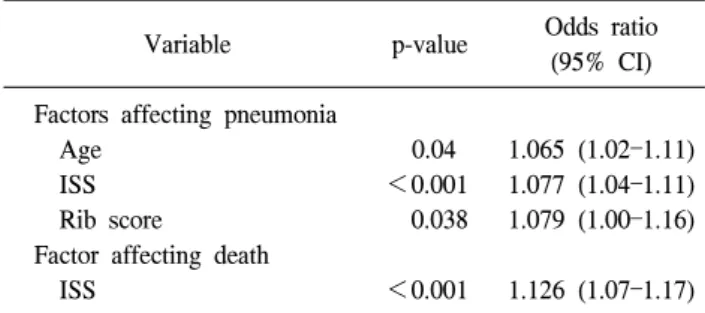
ses (Table 4).

(4)

Table 4. Multivariate analysis about factors affecting pneumonia and death

Variable p-value Odds ratio (95% CI) Factors affecting pneumonia

Age ISS Rib score

Factor affecting death ISS

0.04

<0.001 0.038

<0.001

1.065 (1.02–1.11) 1.077 (1.04–1.11) 1.079 (1.00–1.16)

1.126 (1.07–1.17) CI, confidence interval; ISS, Injury Severity Score.

DISCUSSION

Trauma incidence has increased due to rapid industrializa- tion, especially the incidence of chest trauma. Chest trauma has been reported to range between 10% and 15% [5]. The incidence of rib fractures due to trauma has been reported to range between 7% and 40% [1,2]. Various studies have showed an increase of mortality or morbidity in proportion to the numbers of rib fractures. When analyzing the relationship of morbidity and mortality to rib fractures, many variables in- cluding age, other thoracic injuries, and extrathoracic injuries must be considered. Therefore, we performed an analysis of the ISS and rib score.

The pulmonary complications included pneumothorax, he- mothorax, pneumonia, and lung contusion [1]. A first or sec- ond rib fracture can cause injuries to the great vessels, and a ninth or tenth rib fracture can cause injuries to the intra-ab- dominal organs. Ziegler and Agarwal [2] reported the lack of a correlation between the number of rib fractures and pulmo- nary complications. However, our study showed a correlation between the rib score and pneumonia, meaning the number of rib fractures and age are risk factors associated with pneumonia. The rib score is determined by the number of rib fractures and age.

Antibiotics were used for patients who had chest tubes, lung contusions, and other open injuries. We used the sec- ond-generation cephalosporin. Our study showed no correla- tion between the use of antibiotics and prophylaxis of pneu- monia for patients with lung contusions. We believe more re- search is needed on antibiotic usage, including the kind of

antibiotics used and the amount of time they should be administered. Pain relief is one of the important management items for patients with rib fractures. Pain relief will not only help remove pulmonary secretion, but it will also prevent lung collapse. In addition to those advantages, pain relief will also allow for early ambulation. Some of the pain relief methods include narcotics, anti-inflammatory analgesics, epi- dural analgesia, and intercostal blockade. We primarily used narcotics and anti-inflammatory analgesics for pain relief.

Holcomb et al. [10] and Wu et al. [11] reported that there were no differences between the morbidity and mortality rates of patients with rib fractures who did and did not receive epidural analgesia. However, Wisner [12] reported that epi- dural analgesia reduced the morbidity and mortality rate in patients with rib fractures. Though epidural analgesia has been rarely used in Samsung Changwon Hospital, we think it should be considered an effective pain relief method. Though we did not analyze the influence of pain relief for the pa- tients with rib fractures in our study, we believe that pain re- lief will reduce the incidence of pulmonary complications such as pneumonia. However, the intra-abdominal organ in- juries can be missed due to the early use of painkillers in pa- tients with multiple trauma, including rib fractures. Future studies are required to confirm the influence of pain relief in patients with rib fractures.

The mortality rate in Samsung Changwon Hospital was

5.3% (n=22). Most of the patients died of hypovolemia due

to bleeding and multiorgan failure. Five patients died of

pneumonia with other pulmonary complications. Most of the

massive bleeding occurred at the scene of the accident or be-

fore the patients arrived at the hospital. Previous studies

have reported that the mortality rate of patients with rib frac-

tures was 11% to 17%; however, recent studies have re-

ported a decrease in the mortality rate [1]. The development

of management systems would contribute to the decreases in

the mortality rate. We think the high mortality rate may be

due to the fact that patients with multiple severe injuries, in-

cluding rib fractures, have died prior to arrival at the

hospital. The rapid transfer and appropriate management of

injury patients are important, and elderly patients with multi-

ple injuries should be closely observed for the occurrence of

pneumonia.

(5)

CONCLUSION

We believe that the factors affecting pneumonia in patients with multiple rib fractures are age, ISS, and rib score. Due to the high incidence pneumonia during hospitalization for eld- erly patients, they should be closely observed. There are sev- eral limitations to this study. The data was collected retro- spectively and follow-up was not performed. Future studies are required to address the limitations of this study.

CONFLICT OF INTEREST

No potential conflict of interest relevant to this article was reported.

REFERENCES

1. Sirmali M, Turut H, Topcu S, et al. A comprehensive analy- sis of traumatic rib fractures: morbidity, mortality and management. Eur J Cardiothorac Surg 2003;24:133-8.

2. Ziegler DW, Agarwal NN. The morbidity and mortality of rib fractures. J Trauma 1994;37:975-9.

3. Karadayi S, Nadir A, Sahin E, Celik B, Arslan S, Kaptano- glu M. An analysis of 214 cases of rib fractures. Clinics

(Sao Paulo) 2011;66:449-51.

4. Yucel O, Sapmaz E, Caylak H, et al. Hastaneye yatirilmayi gerektiren toraks travmali 748 olgunun analizi. Gulhane Tip Dergisi 2009;51:86-90.

5. Baker SP, O’Neill B, Haddon W Jr, Long WB. The injury severity score: a method for describing patients with multi- ple injuries and evaluating emergency care. J Trauma 1974;

14:187-96.

6. Flagel BT, Luchette FA, Reed RL, et al. Half-a-dozen ribs:

the breakpoint for mortality. Surgery 2005;138:717-23.

7. Bergeron E, Lavoie A, Clas D, et al. Elderly trauma patients with rib fractures are at greater risk of death and pneumo- nia. J Trauma 2003;54:478-85.

8. Cameron P, Dziukas L, Hadj A, Clark P, Hooper S. Rib fractures in major trauma. Aust N Z J Surg 1996;66:530-4.

9. Easter A. Management of patients with multiple rib fractu- res. Am J Crit Care 2001;10:320-27.

10. Holcomb JB, McMullin NR, Kozar RA, Lygas MH, Moore FA. Morbidity from rib fractures increases after age 45. J Am Coll Surg 2003;196:549-55.

11. Wu CL, Jani ND, Perkins FM, Barquist E. Thoracic epi- dural analgesia versus intravenous patient-controlled an- algesia for the treatment of rib fracture pain after motor ve- hicle crash. J Trauma 1999;47:564-7.

12. Wisner DH. A stepwise logistic regression analysis of fac- tors affecting morbidity and mortality after thoracic trauma:

effect of epidural analgesia. J Trauma 1990;30:799-804.

수치

Table 2. Intrathoracic injuries, ISS, and rib score
Table 4. Multivariate analysis about factors affecting pneumonia  and death

참조

관련 문서

Drug-intoxicated patients were predominantly male, with the highest incidence of intoxication among patients above the seventh decade of age(21.5%) and the

The Incomplete diffuse type PVD found primarily in patients with diabetic retinopathy and retinal detachment and complete diifuse type PVD found primarily in patients

Factors influencing nurses' intention to care for patients with COVID-19: Focusing on positive psychological capital and nursing

Therefore, nurses should be responsible for the relations to resolve the needs of care between nurses and patients and through communication with the patients,

period was prolonged unavoidably, (3) by explaining the risk factors associated with the failure to patients honestly, and subsequently performing

The purpose of this study was to identify the frequency and related factors of advanced airway management for patients with cardiac arrest by the

High complication rate in locking plate fixation of lower periprosthetic distal femur fractures in patients with total knee arthroplasties.. Management and

The effect of the stress management program on the stress coping and perceived stress of the patients with finger replantation. Unpublished master's