Epidemio-entomological Surveys in Vector Mosquitoes of Japanese Encephalitis in Kyongbuk, Korea*
Chong Yoon Joo, M.D.
Department of Parasitology,
Keimyung University School of Medicine, Taegu, Korea
Abstract :
The seasonal prevalence and population dynamic of Culex tritaeniorhynchus (Cx. tritaeniorhynchus) in relation to the epidemic of Japanese encephalitis, and the epidemio-entomological surveys of this vector mosquito in Kyongbuk Province, Korea were made during the period of 15 years spanruing from 1984 to 1998. As in the general patterns of seasonal prevalence, Cx.tritaeniorhynchus was first collected between early and late June, and peaks in the population densities of Cx. tritaeniorhynchus, occurred during the period from late July in 1987 and 1994, early- to late-August in 1984-1986, 1990-1993 and 1995, and early- and mid-September in 1988, 1989 and 1996-1998. they showed a simple sharply pointed one-peak curve. There was a gradual decrease from mid- September, accompanied by with a very small number of them collected until late October or early November in every year, except 1990.
Cx. tritaeniorhynchus with nocturnal biting habits had two peaks in their daily activities, one soon after the sunset and the other during a few hours' period from 2-3 o'clock, although the relative numbers collected varied and the highest peak collection occurred at different time in a night. The total number of larval Cx.
tritaeniorhynchus in rice fields was the highest in mid-August, and its number progressively decreased in early September due to insecticides sprays. After late September, the larvae was rarely found until rice plants were harvested. The larval Cx. tritaeniorhynchus showed high resistance against five organophosphorus compounds. In the adult horizontal life table characteristics of Kyongsan colonies of Cx. tritaeniorhynchus under insectary conditions, life expectancy was 28.3 days for males and 59.8 days for females. The net reproductive rate was 7.8 days, and generation time was 25.6 days.
✽ A part of results in this paper has been presented at the annual meetings of Korean Society for Parasitology held on October 26-27, 1990 and October 28-29, 1993, and 9th Federation Meeting of Korean Basic Medical Scientists held on April 26-27, 2001.
Introduction
Culex tritaeniorhynchus Giles (Diptera:
Culicidae) has a number of problems encountered by medical and entomological scientists. The present study was undertaken as part of our continued investigation of the epidemiology and control of mosquito-borne diseases, since the species was found to be the main vector of Japanese encephalitis (JE) in Korea, Japan, China and South-Eastern Asia.
Sabin et al.〔1〕 first reported the isolation of JE virus from the American military personnels in Kunsan area, and also showed the presence of JE antibody among Korean residents in several areas, including Kunsan. After the Korean War, the Culex mosquitoes have been the primary target for many investigations in order to get more information or to control JE in Korea: Kono and Kim〔2〕summarized the epidemiological features of JE in Korea from 1949 to 1966; Kim〔 3〕
reported that the annual incidence of JE in 1982 was unusually high, a total of 1,197 caseswith a mortality rate of 3.1;
Joo and Wada〔4〕 studied the seasonal prevalence of vector mosquitoes of JE in Kyongbuk Province. The seasonal prevalence and population dynamics of Cx.
tritaeniorhynchus in relation to the epidemics of JE, and the ecology of these
vector mosquitoes in Kyongbuk Province
〔5〕, suggested that the population density of Cx. tritaeniorhynchus in the Province was decreasing over the seven-year period from 1984 to 1990.
This paper presents data obtained on seasonal variation and population density of adult and larval mosquitoes collected in Kyongbuk Province during 1984 and 1998, and on the number of reported JE cases during that period.
Materials and Methods
1. Surveyed areas:
Kyongbuk Province is situated in the southeast part of the Korean peninsula, having an area of 19,700 km2. Two areas were selected as vector mosquito survey stations (Fig. 1). The main survery area was Keimyung University training farm in Kyongsan county located about 15 km E.S.E. of Taegu City. The other area was the Agricultural research farm in Kyongbuk provincial office of Rural development, located in Dongho village, a northern district of Taegu city. The more detailed geographical conditions of surveyed areas were presented by Baik and Joo〔5〕.
2. Meteorological data:
Meteorological data for the period of Key Words : Culex tritaeniorhynchus, Horizontal life table, Japanese
encephalitis, Kyongbuk Province, Light trap, Population dynamics, Seasonal prevalence, Vector mosquito
the present survey was provided by the Taegu branch of the Korea Meteorological Ageny.
3. Light trap operation:
In order to observe the seasonal prevalence of the vector mosquito populations, light trap collections were performed as follows: A light trap was fixed 1.5 m above the ground at the trapping spots, including the piggery, the cow-shed and the house-dwelling, and operated from dusk to dawn on one-night per week schedules. Mosquitoes collected at each station were counted by species.
4. Indices of mosquito abundance:
In order to compare the annual abundance of Cx. tritaeniorhynchus, mean percent index (MPI) proposed by Maeda et al.〔6〕was used.
5. Collection of larvae:
In order to estimate the species and density of mosquito larvae and pupae, 30 fixed rice paddies were dipped from April to October at one week intervals in 1991- 1993. The dipper was 15 cm in diameter and 5 cm in depth with a wooden handle of 60 cm in length.
At the outset a collector stood at a point on the side of rice paddies, and took a dip on the water surface, which is thought to be the most favorable for the breeding of the larvae and pupae within the reach of the dipper. In each rice paddies, the dipping was made ten times which is suggested to be necessary to determine the distribution pattern of the
numbers of mosquito larvae in rice paddy
〔7〕. The total number of mosquito larvae in the study areas was estimated according to the methods described by Wada and Mogi〔8〕. Total nonumber (No.) in the study area at the median age of each stage in the area was the average No. per dip × 186 × total area with water in m²/mean period of the stage at the then temperature. Ten day average temperatures were used here in.
6. Resistance level for organophosphorus compounds:
In order to determine the insecticidal resistance, blood fed females of Cx.
tritaeniorhynchus were collected from human and animal shelters with an insect net or sucking tube and were transferred into the cages. The mosquitoes were allowed to oviposit in an insectary at 30±
1°C and of 70-80% relative humidity with 16 hours of illumination per day.
Approximately 300 first instars were reared in enamel pans measuring 50×40 cm filled to 2 cm depth of water and fed on crushed powders of laboratory mouse pellets and the adults were fed on sugar solution. Insecticidal resistance assy was the modified one from those described by Yasutomi and Takahashi〔9〕: Plase check for accuracy. Toxicities of five organophosphorus compounds were determined with fourth instar, and LC50 were calculated from the average of two replicates. From these data the regression of the probit mortality on log dosage was computed and the LC50
were obtained.
7. Life table characteristics of Cx.
tritaeniorhynchus:
In order to estimate the effects of mating and/or male-female association on the lifespan of adult Cx. tritaeniorhynchus, the longevity of adults was tested by comparing six groups of males and females. All experiments were repeated two times and conducted in an insectary in which the temperature and relative humidity were maintained at 27±1°C and 75±5%, respectively. A 16L:8D photoperiod was established with 40 watt fluorescent light and 1 hour simulated dusk and dawn
〔10〕. Adults were continuously offered 5.0% sucrose solution in flask with cotton wads, and the solution was changed every 5 days. Each morning, all dead individuals and egg rafts were removed and recorded.
The calculation procedures, formulae, and rationale used in this study followed the
methods described by Reisen et al.〔11〕
Results
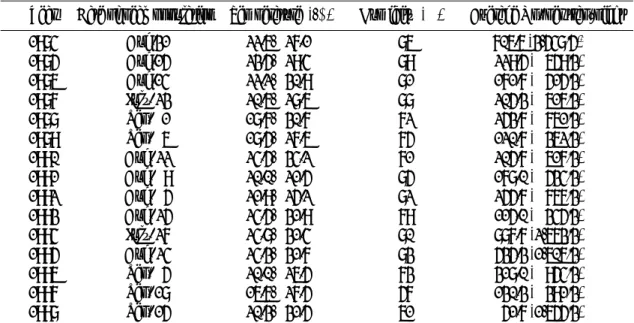
The earliest date when Cx. tritaeni- orhynchus were first collected by light traps, and the meteorological data at that time in Kyongsan county are shown in Table 1. During the period from 1984 to 1998, Cx. tritaeniorhynchus were collected first between the 3rd and 8th of June in 1987, 1988, 1991 and 1994, and in the mid- and late-June in another years. At that time, the air temperature ranged from 17.2 to 35.1°C, and relative humidity from 65 to 90%, The average number of Cx. tritaeniorynchus per trap- night ranged from 0.3 to 2.5.
The dates of peak population of Cx.
Year Earliest date Temperature (°…) Humidity (%) Average No. per trap-night Table 1. Fifteen-year observation of the earliest date, when Culex tritaeniorhynchus appeared in Kyongsan
county, Kyongbuk Province, together with meteorological data
1984 June 19 21.9°≠29.4 77 2.5 (5/2)*
1985 June 27 19.4°≠21.5 90 0.5 (1/2)
1986 June 12 12.0°≠28.8 65 0.3 (1/3)
1987 June 4 19.0°≠35.1 65 1.5 (3/2)
1988 June 8 23.2°≠29.6 83 0.3 (1/3)
1989 June 28 17.5°≠29.7 75 2.3 (7/3)
1990 June 21 18.7°≠28.8 82 1.0 (3/3)
1991 June 3 17.2°≠20.8 86 0.3 (1/3)
1992 June 17 17.4°≠26.0 71 0.3 (1/3)
1993 June 23 18.3°≠27.3 80 1.0 (3/3)
1994 June 8 18.8°≠26.4 74 0.3 (1/3)
1995 June 21 18.5°≠23.1 67 0.3 (1/3)
1996 June 13 19.2°≠29.4 71 0.7 (2/3)
1997 June 27 22.7°≠30.3 79 0.3 (1/3)
1998 June 23 20.0°≠28.8 69 0.3 (1/3)
* Number in parentheses means the total number of female /traps.
tritaeniorynchus and the meteorological data at that time are listed in Table 2.
The highest population density of Cx.
tritaeniorhynchus during 1984 and 1998 was observed in early-August to mid- September, and in the late July in 1987 and 1994. The air temperature was between 21.9 to 25.2˚C and humidity from 82 to 85%. The maximum numbers of Cx.
tritaeniorhynchus in 1984 and 1994 were 706.6 and 887.7 per trap-night, respectively. Subsequently, the number decreased markedly in 1989, 1993 and also in 1997, reaching a minimum of 120.7, 115.0 and 130.3 per trap-night, respectively.
Table 3 shows the dates when Cx.
tritaeniorhynchus were not collected in the surveyed area. Cx. tritaeniorhynchus were not found in the area between September 26 in and November 7 in 1990-
1996. The temperature of the air at that time ranged from 2.6 to 28.5˚C and humidity ranged from 54 to 83 %.
Table 4 summarizes the seasonal prevalence of Cx. tritaeniorhynchus collected by light traps. In general, Cx.
tritaeniorhynchus were collected in months every year, five months spenning from June to October, in every year in 1995, the average number of female Cx.
tritaeniorhynchus per trap-night in June was 0.2, increased to 21.8 in July, and reached its maximum number, 322.3 in August. In September the average number decreased to 92.8, to 2.5 in October, and none was collected in November. The general pattern of monthly changes of Cx.
tritaeniorhynchus per trap-night in other years was similar to those in 1995, but the patterns of monthly changes in 1990, 1993 and 1994 were dissimilar to those in
Year Date of peak population Temperature (°…) Humidity (%) Average No. per trap-night Table 2. Date of peak population of Culex triaeniorhynchus and meteorological data
1984 Aug.31 22.6°≠27.1 86 706.6 (3,548/5)*
1985 Aug.15 23.5°≠29.4 89 229.5 ( 659/3)
1986 Aug.14 22.2°≠30.9 81 171.7 ( 515/3)
1987 July. 23 20.6°≠28.6 88 205.3 ( 616/3)
1988 Sep. 1 18.7°≠30.7 72 253.7 ( 761/3)
1989 Sep. 6 18.5°≠27.6 75 120.7 ( 362/3)
1990 Aug. 22 24.5°≠34.2 71 205.7 ( 617/3)
1991 Aug. 9 20.0°≠21.5 85 178.0 ( 534/3)
1992 Aug. 5 21.9°≠25.2 82 255.7 ( 767/3)
1993 Aug. 25 24.5°≠31.9 79 115.0 ( 345/3)
1994 July. 27 24.8°≠31.4 80 887.7 (2,663/3)
1995 Aug. 24 24.3°≠31.7 83 535.3 (1,606/3)
1996 Sep. 5 20.0°≠26.5 73 318.0 ( 954/3)
1997 Sep. 18 16.6°≠27.5 57 130.3 ( 391/3)
1998 Sep. 15 20.3°≠31.5 61 51.7 (1,655/3)
* Number in parentheses means the total number of female per trap-night.
Year Date of peak population Temperature (°…) Humidity (%) Table 3. Date of disappearance of Culex triaeniorhynchus and meteorological data
1984 Oct. 6 8.0°≠22.9 67
1985 Oct.24 9.3°≠23.0 68
1986 Oct. 2 11.5°≠17.4 83
1987 Oct. 8 13.2°≠28.5 70
1988 Oct. 26 8.4°≠23.1 70
1989 Oct. 11 10.6°≠25.1 81
1990 Sep. 26 15.8°≠24.8 65
1991 Oct. 17 11.7°≠21.0 54
1992 Oct. 21 8.6°≠20.1 69
1993 Oct. 6 16.3°≠17.9 63
1994 Oct. 19 11.4°≠18.9 71
1995 Oct. 25 8.8°≠20.2 59
1996 Nov. 7 2.6°≠11.2 71
1997 Oct. 16 8.5°≠24.8 56
1998 Nov. 5 6.4°≠18.8 63
Fig. 1. Surveyed areas (●) in Kyungpook Province, Korea.
1995.
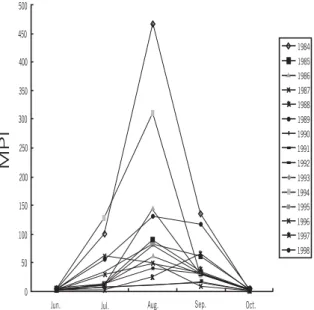
The results of relative abundance and MPI calculation for successive years since 1984 are shown in Table 5. and illustrated in
Fig. 2.
Such presentation is useful for indicting annual pattern of mosquito prevalence obtained from the data collected Year Average number of female mosquitoes per trap-night
March Apri May June July Aug. Sep. Oct. Nov.
Table 4. Seasonal prevalence of Culex triaeniorhynchus by the average numbers collected in each trap during fifteen years in Kyongsan county, Kyongbuk Province
1984 1985 1986 1987 1988 1989 1990 1991 1992 1993 1994 1995 1996 1997 1998
12,875 702.3
3,101 130.1
2,398 100.0
3,184 119.5
2,124 83.7
877 30.8
2,779 115.9
1,871 65.5
3,760 175.4
1,087 45.6
14,516 462.8
6,242 189.8
2,572 90.7
1,768 59.8
8,981 315.5
Year At the 3-stations located in suburban areas
Total No. collected Mean percent index Table 5. Relative abundance of Culex triaeniorhynchus population in successive years since 1984
1984 1985 1986 1987 1988 1989 1990 1991 1992 1993 1994 1995 1996 1997 1998
0 0 0 1.1 19.2 133.5 55.8 0.1 0
0 0 0 0.1 23.6 156.0 92.2 3.1 0
0 0 0 0.2 17.9 113.8 63.4 0.1 0
0 0 0 1.3 111.9 107.3 16.6 0.2 0
0 0 0 0.4 50.3 36.5 70.3 1.5 0
0 0 0 0.6 13.7 24.3 45.6 1.5 0
0 0 0 0.6 22.0 141.5 67.5 0 0
0 0 0 0.8 28.5 65.5 44.3 1.5 0
0 0 0 0.1 38.5 164.1 80.2 0.8 0
0 0 0 0.7 13.1 46.1 33.8 0 0
0 0 0 2.2 284.2 689.4 79.8 0 0
0 0 0 0.2 21.8 322.3 92.8 2.5 0
0 0 0 0.3 3.3 41.0 158.9 0.5 0
0 0 0 0.1 6.8 5.3 80.8 2.2 0
0 0 0 9.9 115.0 323.2 237.4 3.9 0
at several stations. It was found that the total number of Cx. tritaeniorhynchus progressively decreased during the 5-year
intervals. A marked decrease in MPI was obtained in 1989, 1993 and 1997.
Table 6 shows the numbers and
Year Piggery Cow-stall House-dwelling Subtotal
collected engorged collected engorged collected engorged collected engorged Table 6. Comparison of total and engorged number of Culex triaeniorhynchus collected by light traps at
piggery, cow-stall, and house-dwelling during fifteen years, 1984°≠1998
1984 1985 1986 1987 1988 1989 1990 1991 1992 1993 1994 1995 1996 1997 1998
7,413 4,056(54.7)* 4,087 1,590(38.9) 1,375 140 (10.2) 12,875 5,786 (44.9) 1,592 598 (37.6) 1,343 394 (29.3) 166 8 ( 4.8) 3,101 1,000 (32.2) 1,095 547 (50.0) 1,176 485 (41.5) 127 9 ( 7.1) 2,398 1,041 (43.4) 1,547 707 (45.7) 1,526 651 (42.7) 111 12 (10.8) 3,184 1,370 (43.0) 808 395 (48.9) 1,223 403 (33.0) 93 4 ( 4.3) 2,124 802 (37.8) 382 156 (40.8) 473 192 (40.6) 22 0 ( 0.0) 877 348 (39.7) 1,018 319 (31.3) 1,609 484 (30.1) 152 1 ( 0.7) 2,779 804 (28.9) 619 228 (36.8) 1,187 433 (36.5) 65 9 (13.8) 1,871 670 (35.8) 1,579 515 (32.6) 1,901 1,144 (60.2) 280 41 (14.6) 3,760 1,700 (45.2) 583 235 (40.3) 446 192 (43.0) 58 9 (15.5) 1,087 436 (40.1) 3,283 1,357 (41.3) 11.043 6,109 (55.3) 190 6 ( 3.2) 14,516 7,472 (51.5) 2,143 1,007 (47.0) 4,063 2,206 (54.2) 36 3 ( 8.3) 6,242 3,216 (51.5) 1,440 760 (52.8) 1,069 496 (46.4) 63 2 ( 3.2) 2,572 1,258 (48.9) 924 613 (66.3) 811 505 (62.3) 33 2 ( 6.1) 1,768 1,120 (63.3) 5,420 1,544 (28.5) 3,390 654 (19.3) 194 0 ( 0.0) 9,004 2,198 (24.4)
* The number in the parentheses means engorged percentage.
Fig. 2. Annual prevalence of Culex tritaeniorhynchus, as shown in mean percent index (MPI) calculated from the data of mosquito collection at 3 stations. Standard year : 1986.
percentages of engorged female Cx.
tritaeniorhynchus collected by light traps at three localities during fifteen years, ranging from 1984 to 1998. The overall
rates of engorgement, as calculated by dividing the number engorged with the total, which reflect the blood-sucking activity of Cx. tritaeniorhynchus in 1986
Year Jun. Jul. Aug. Sep. Oct.
Coll. Engorg. Coll. Engorg. Coll. Engorg. Coll. Engorg. Coll. Engorg.
Table 7. Monthly fluctuation of total and engorged number of Culex triaeniorhynchus collected by light trap (1984°≠1998)
1984 50 6 (12.0) 998 381 (38.2) 8,812 3798 (43.1) 3,012 1599 (53.1) 3 2 (66.7) 1985 1 0 260 98 (37.7) 1,872 632 (33.8) 922 261 (28.3) 46 9 (19.6) 1986 2 1 (50.0) 269 91 (33.8) 1,366 640 (46.9) 761 309 (40.6) 0 0 1987 16 0 1,679 582 (34.7) 1,288 710 (55.1) 199 78 (39.2) 2 0 1988 9 1 (11.1) 604 267 (44.2) 438 102 (23.3) 1,055 430 (40.8) 18 2 (11.1) 1989 7 0 151 55 (36.4) 291 109 (37.5) 410 182 (44.4) 18 2 (11.1) 1990 7 0 264 59 (22.3) 1,698 383 (22.6) 810 362 (44.7) 0 0 1991 9 0 314 116 (36.9) 982 223 (22.7) 544 322 (59.2) 22 9 (40.9) 1992 1 0 577 211 (36.6) 1,969 879 (44.6) 1,203 570 (47.4) 10 5 (50.0) 1993 10 7 (70.0) 118 23 (19.5) 553 228 (41.2) 406 178 (43.8) 0 0 1994 33 30 (90.9) 3,410 1656 (48.6) 10,341 5461 (52.8) 718 327 (45.5) 14 4 (28.6) 1995 2 0 262 168 (64.1) 4,834 2557 (52.8) 1,114 478 (42.9) 30 12 (40.0) 1996 3 0 40 7 (17.5) 615 271 (52.9) 1,907 978 (51.3) 7 2 (28.6) 1997 1 0 102 63 (61.8) 663 317 (47.8) 969 721 (74.4) 33 19 (57.6) 1998 138 58 (42.0) 1,380 397 (28.8) 3,878 844 (21.8) 3,561 893 (25.1) 47 6 (12.8)
Fig. 3. Total numbers of Culex tritaeniorhynchus collected by light trap at hourly interval at Kyungsan county.
were in the order of 50.0% on the piggery, 41.2% on the cow-stall, and 7.1% on human dwelling. The general patterns of engorgement rates in the other years were similar to those in 1986, but the overall rates of engorgement during the periods from 1992 to 1995 were dissimilar to those in 1986.
In Table 7, the monthly fluctuations in the blood-sucking rate of Cx. tritaeniorhynchus are listed according to the year studied.
The blood sucking rates varied greatly by different months every year. The rate was 17.5 to 64.1% in July, 21.8 to 55.1%
in August and 25.1 to 74.4% in September. Although the rate decreased in October, it was kept at 11.1-66.7%.
The total number of Cx. tritaeniorhynchus in each hour for all the successive
collections, their cumulative number and cumulative percentage distributions are shown in Table 8 and illustrated in Fig. 3.
As for the trend of nocturnal activity of Cx. tritaeniorhynchus, they became very active on darkenning, and their activety gradually decreasing towards midnight, but slightly increasing towards dawn.
The cumulative percentage distribution of the number of mosquitoes collected at hourly intervals derived from the grand total was on a rough sigmoid curve. From this figure, it is obvious that about 50.0
% of Cx. tritaeniorhynchus attacking pigs in a night can be collected before 23:00 p.m. or about 70.0% can be collected with seven hours' work from 20:00 p.m. to 03:00 a.m. Also, these results indicate that comparative studies of the mosquito Time of
collection
Cumulative (f-F)2
Freq** No % Z P F F
Table 8. Frequency distribution and cumulative percentage of Culex tritaeniorhynchus collected by light trap at hourly intervals at Kyongsan county (1991-1993)*
1700-1800 0 0 -1.85 0.0322 6.0858 6.0858
1800-1900 0 0 -1.52 0.0321 6.0669 6.0609
1900-2000 8 8 -1.18 0.0547 10.3383 0.5289
2000-2100 33 41 21.69 -0.84 0.0814 15.3846 20.1696
2100-2200 54 95 50.26 -0.50 0.1081 20.4309 55.1558
2200-2300 10 105 55.56 -0.16 0.1279 24.1731 8.3099
2300-2400 10 115 60.85 0.18 0.1350 25.1731 9.4342
2400-0100 14 129 68.25 0.52 0.1271 24.0219 4.1811
0100-0200 15 144 76.19 0.86 0.1066 20.1474 1.3120
0200-0300 13 157 83.07 1.20 0.0798 15.0822 0.2875
0300-0400 12 169 89.42 1.54 0.0533 10.0737 0.3683
0400-0500 10 179 94.71 1.87 0.0311 5.8779 2.8908
0500-0600 10 189 100.00 2.21 0.0171 2.2319 14.1735
0600- 0 0.0136 2.5704 2.5704
Total 189 1.000 189.000 131.5704
Note : Mean and standard deviation of the table were calculated from the frequency distribution by the class interval of an hour. Mean ± SD = 11:46 ± 2.95 hours; * Date reported by Joo and Kang [12]; **
Freq: Frequency.
population between different localities or by seasons are useful to save the labour of a collector.
The grand total of the number of mosquitoes collected in Kyongsan county in 3 nights was 189, and the mean time calculated from this data was 11:46 with standard deviation of 2.95 hours. The theoretical number per each hour expected from normal distribution were compared with the numbers observed, and the value of chi-square was 131.5338 with the degrees of freedom of 11 thus the probability being less than 0.005.
The results suggest that the biting rhythm of Cx. tritaeniorhynchus observed under this method takes a pattern significantly different from a normal frequency distribution.
Table 9 summarizes the age structure of immature stages of Cx. tritaeni- orhynchus and the seasonal prevalence of
the total number of larvae plus pupae in the survey areas. The highest larval density in cultivated fields was 876×
103on August 19, 1990. After the last part of September, the densities markedly decreased and the larvae and pupae of Cx.
tritaeniorhynchus were rarely found until rice plants were harvested. In fact, the general pattern of the seasonal prevalence in the surveyed areas was determined largely by the prevalence in cultivated fields. The total number reached at its yearly peak during the mid-August, 1990.
Table 10 shows Organophosphate resistance levels of larval Cx. tritaeni- orhychus reared for one generation in the laboratory, and the levels were compared with that of susceptible laboratory strain.
The larval Cx. tritaeniorhynchus showed a high resistance against 5 organophosphorus compounds. Among the compounds tested LC50 of temephos, diazinon, malathion and Date
L1 L2 L3 L4 Pupae
Total No. in the study area at the median age of each stage (×103)*
Table 9. Age structures of immature stages of Culex tritaeniorhychus in the study area (1990)**
Jul. 27 64 37 53 18 18
Aug. 2 67 50 44 36 18
Aug.10 10 375 284 157 24
Aug.19 380 289 172 35
Aug.23 15 25 17 3
Aug.30 48 19 12 7
Sep. 6 46 14 11 12 6
Sep.13 25 18 49 14 12
Sep.20 22 11 19 11 11
Total 282 919 774 449 134
* Average No. per dip × 186 × total area with water in m2/mean period of the stage at the then temperature.
Ten day average temperature was used here. ** Data reported by Baik and Joo [5].
fenitrothion against Cx. tritaeniorhynchus were 64.0 ppm, 38.0 ppm, 18.6 ppm and 10.8 ppm, respectively. The LC50 to diazinon and malathion were about 2,500 and 5,000 times higher than that of susceptible strain. Of the mosquitoes tested in 1990, the resistance levels and resistance ratios to diazinon were increased, but the ratios to malathion and fenthion were slightly decreased. No fluctuation was found in resistance levels toward fenitrothion and temephos.
Table 11 lists the biological and life table characteristics of Kyongsan stain Cx. tritaeniorhychus, and the present results compared were with those of Nagasaki and Taipei stains described by Reisen et al.〔11〕. The life expectancy of Cx. tritaenorhynchus in the present study was 28.33 days for males and 59.81 days for females, and was generally longer than Nagasaki and Taiwan strains reported by Reisen et al.〔11〕. The net reproductive rate was found to be 7.81% living female offspring/female per generation, and generation time was 25.6 days.
Discussion
The epidemio-entomological studies on the subject of JE and its vector mosquitoes have been carried out by many investigators in South-east-Asia, including China, Indonesia, Malaysia, Korea, Japan and Thailand. As a result, it has become clear that the infection cycle of JE virus is associated with Cx.
tritaeniorhynchus, and the amplifier domestic pigs. The fact that patients with JE are among the residents in Korea have been known for a long time, and a disease called "Summer encephalitis" or
"Encephalitis lethargica" before 1935 is now accepted to be nothing but Japanese encephalitis.
In the survey of the vector mosquitoes in Korea with a consideration of their importance as JE vector, Shin et al.〔13〕
found that Cx. tritaeniorhynchus was the most prevalent species, and next in order were An. sinensis and Ae. vexans nipponii, with Cx. pipiens pallens taking 4th place, and reported that the population Compound
LC50 R.R.* S.S.** LC50 R.R.
1987 1990
Table 10. Resistance levels and resistance ratios of larval Culex tritaeniorhychus exposed to 5 organophosphorus compounds for 24 hours
Diazionon 17.0 1,133 0.015 38.0 2,533
Malathion 20.8 5,200 0.0042 18.6 4,650
Fenitrothion 9.5 13,571 0.0007 10.8 15,429
Fenthion 3.3 2,357 0.0014 3.2 2,286
Temephos 61.8 79,231 0.0007 64.0 91,429
* Resistance ratio, Data reported by Department of Medical Entomology, NIH, Japan;**Data reported by Baik and Joo (1991).
density of Cx. tritaeniorhynchus by month were 0.1% in June, 8.2% in July, 55.2%
in August, 36.6% in September and 0.02% in October. Similar results in vector mosquitoes have also been obtained by Self et al.〔 14〕, Pae et al.〔 15〕, Frommer et al.〔16〕and Lee et al.〔17〕in some U.S. army Compounds, and by Joo and Wada〔4〕, Baik and Joo〔5〕, Joo and Kang〔12〕in Kyongbuk Province, Korea.
In the general patterns of seasonal prevalence, Cx. pipiens pallens was found to be active through out almost the entire season, showing irregular curves with
several peaks, while Cx. tritaeniorhynchus first appeared in mid-June and were trapped in large numbers from mid- August to early September, showing a sharply pointed one peak curve. As for An. sinensis, the trend of seasonal distribution was similar to that of Cx.
tritaeniorhynchus, but the earliest dates of appearance and disappearance differed from those of Cx. tritaeniorhynchus.
Monthly fluctuation in number of Cx.
tritaeniorhynchus and other species have earlierbeen reported however this is the first report on a complete year's collection Kyungsan, Korea Nagasaki, Japan Taipei, Taiwan Table 11. Comparison of biological and life table characteristics of Kyungsan strain of Culex tritaeniorhychus (1990)*
Generation in Laboratory 1 128 120
Siphonal index 8.41 7.40 7.61
Adult
wing lenght (mm) Male 2.70 3.11 2.71
Female 3.28 3.46 2.92
Fecundity
No. raft/cage 14.0 71.32 58.0
No. eggs/raft 188.9 172.8 142.8
Fertility
No. larvae/raft 143.0 121.0 130.5
Hatching (%) 75.7 70.2 91.4
Life table statistics
e1♂ 28.33 14.14 15.08
e2♀ 59.81 21.10 19.22
Ro 7.81 21.37 84.97
To 15.50 18.02 13.62
G 25.60 28.31 24.01
e1: Mean life expectancy at emergence in days; Ro: Net reprodutive rate: living females per female per generation
; G: Generation time in days; To: Age of mean cohort reproduction; * Data reported by Baik and Joo [5].
with one night per week schedules. It seems that the highest population of Cx.
tritaeniorhynchus was clearly observed during the period from late July to mid- September, when the temperature was between 16.6 and 34.2˚C and humidity 57- 89%. The earliest dates of appearance and disappearance in the present survey was the period from early June to late June and the period from late September to early November. The main factors contributing to the population dynamics of Cx. tritaeniorhynchuseach year seemed to be due to the changes in the rice culture system and/or rural environment such as water management of rice fields, high temperature and small precipitation, extensive uses of chemical insecticides in rice farming, livestock and natural enemies, and the reduction of rice fields by urbanization. Such consideration was also recognized by Mogi〔7,18〕Maeda et al.
〔6〕, Baik and Joo〔5〕, and Joo and Kang〔19〕.
The seasonal prevalence of Cx.
tritaeniorhynchus has been shown usually in the number of Cx. tritaeniorhynchus collected by a light trap, but the numbers were found to daily fluctuate. Therefore, the total or average numbers seem to be unsuited for comparison of the abundance of Cx. tritaeniorhynchus. Consequeutly, MPI, being calculated from the totals of vector mosquito collected at stations in comparison with those in a standard year, was used for the comparison of the annual abundance of vector mosquitoes. The results shown in Table 4 and Table 5 indicate that a marked decrease in MPI was obtained in 1989, 1993 and 1997,
accompanied with a decrease in the number of mosquitoes. These data are highly valuable, however were not used for further analysis of the JE epidemic.
However these data a showed remarkable decrease of Cx. tritaeniorhynchus in 5- year intervals, and this decreasing trend in of mosquito number number is likely to be the case not only in Kyongbuk Province, but also all over Korea, It is highly probable that the decrease of Cx.
tritaeniorhynchus is an important factor in the reduction of human JE cases in recent years. Although the main reasons for the decrease in population density of Cx. tritaeniorhynchus can not easily be explained, it has been suggested to be due to intermittent irrigation or early planting of rice plants, which made unsuitable conditions for breeding mosquito larvae, extensive used of chemical insecticides, and use of herbicides such as CNP (p- nitro-phenyl 2,4,6-trichlorophenyl) and NIP (nitrofen) for rice plant cultivations.
Furthermore, such factors as the decrease in rice field areas due to urbanization, improved water management, aerial application of agricultural chemicals, and modernized livestock breeding, have contributed to the reduction of larval vector populations.
As for the characteristics in the chronological biting rhythm of the vector mosquito species, Joo and Wada〔 4〕
reported that the hourly distribution of the female Cx. tritaeniorhynchus observed by the human-baited collections usually had two peaks, one between 21:00 and 22:00, and another between 24:00-01:00
on August 3-4, 1984. In a mosquito survey by light trap and human-baited traps through the night at hourly intervals, Joo and Kang〔19〕reported that An. sinensis appeared to be active throughout the whole night, but was more active during darkness after sunset to mid-night, andthe temperature at that time was between 26.9 and 30.1˚C and the humidity 67-76%.
In the present study, the nocturnal periodical activity of the female Cx.
tritaeniorhynchus was not always the same by collection method on the same night. Although the environmental factors such as temperature, light, humidity and wind-borne stimuli, are important in determining the attraction of mosquitoes, the present data can hardly be explained by the hourly changes of the factors because the meteorological conditions are considered nearly the same at least on the same night at the sites where the collection is made, Further works along this line are needed. Previous reports
〔5,13,19〕 together with the present observations clearly indicated that Cx.
tritaeniorhynchus with nocturnal biting habits had two peaks in their activities, one soon after the sunset and another during a few hours' period from 2-3 o'clock, although the relative numbers varied by the collections and the highest peak appeared at different time fo the night.
Cx. tritaeniorhynchus blood success observed in this study was sometimes a reflection of abundance of this species.
Abundance of Cx. tritaeniorhynchus
during 1984, 1987, 1992, 1994, and 1998 was greater than other years observed, and the same relationship held true for the number of engorged female mosquitoes collected in these years. However, monthly engorgement success was not always linked to overall mosquito abundance. In 1992, Cx. tritaeniorhynchus was most abundant in August, but engorgement of female Cx. tritaeni- orhynchus had the highest rate in September. The results of a monthly fluctuation of engorged number of Cx.
tritaeniorhynchus during the period from 1984 to 1998 indicated that blood feeding behaviour was significantly associated with rainfall, which raises the relative humidity, and relative humidity strongly influences mosquito flight and subsequent host-seeking behaviour. Such relationship between adult abundance and rainfall has also been recognized by Day and Curtis
〔20〕and Provost〔21〕 for Cx. nigripalpus, by Olson et al.〔22〕for Cx. tritaeniorhynchus and Cx. gelidus, and by Russel〔23〕 for Cx. annulirostris.
The immature stages of Cx. tritaeniorhynchus occur in a variety of habitats among which the most important is the rice paddies in Korea. The ecology of this species in various rural and suburban areas in Korea and other parts of the world have been studied by many investigators. Some of their results indicate that the seasonal fluctuation in the larval population densities in paddy water is markedly different from paddies to paddies in the same area and/or from year to year in the same paddies. In the present survey, the
total number of larval Cx. tritaeniorhynchus in rice paddies was the highest in mid- August, and its number progressively decreased in early September by insecticide sprays. After late September, densities markedly decreased, and larvae plus pupae of Cx. tritaeniorhynchus were rarely found until rice plants were harvested. The major factors to contribute to reproduction of Cx. tritaenio rhynchus were temperature, precipitation, water management of rice fields, availability of hosts, chemical insecticides and herbicides applied to rice fields, and natural enemies. Of those, the first two factors were responsible for the yearly change of population size, while the changes of mean population level was attributable to other four factors, which are controlled or influenced by human beings.
There is evidence that the widespread use of insecticides in agriculture has been responsible for the selection of resistant strain of vector mosquitoes in various rural and suburban areas in Korea and other parts of the world. Studies on insecticide resistance of vector mosquitoes in Korea have been carried out by many investigators. Some of their results indicates that the intensive use of insecticides and fungicides for the control of agricultural and/or medical pests, which transmits communicable diseases during the summer season, by government officials and by residents have greatly influenced the populations and resistance of the mosquitoes and arthropods of medical importance. In the present study, the larval Cx. tritaeniorhynchus showed
high resistance to diazinon, malathion, temephos and fenitrothion with LC50 values of 38.0 ppm, 18.6 ppm, 64.0 ppm and 10.8 ppm, respectively. Less resistance to fenthion was discovered in Cx. tritaeniorhynchus collected in Kyongsan county. Higher insecticide resistance to Cx. tritaeniorhynchus in this study suggests that it is probably due to different opportunity of contact to insecticides and fungicides.
Geographic variations among the life table characteristics for various species of mosquitoes have been studied by many investigators. As a result, a considerable amount of field and laboratory data can be found, related to the population dynamics, mating and biting rhythms, migratory habits of many species of mosquitoes. Reisen et al.〔11〕studied the geographic variation in the horizontal life table characteristics of 9 strains of Cx.
tritaeniorhynchus from southern and far eastern Asia. Also, Aslam et al.〔24〕
reported the influence of physiological age on the biting rhythm of Cx. tritaeniorhynchus.
In this study, the life expectancy at emergence of Cx. tritaeniorhynchus males was generally longer than Nagasaki and Taiwan strains of Cx. tritaeni orhynchus reported by Reisen et al.〔11〕, however similar to that of Cx. pipiens quinquefasciatus reported by Walter and Hacker〔25〕and of Ae. aegypti reported by Crovello and Hacker〔26〕. Finally, Cx. tritaeniorhynchus female life expectancy was in general similar to that of Cx. pipiens quinquefasciatus reported by Walter and Hacker〔25〕 and Gomez et al.〔27〕, and of Ae. aegypti reported by Crovello and Hacker〔26〕.
References
1. Sabin AB, Schlesinger RW, Ginderf DR, Matumoto M. Japanese B encephalitis in American soldiers in Korea. Am J Hyg 1947;46:356-75.
2. Kono R, Kim KH. Comparative epidemiological feature of Japanese encephalitis in the Republic of Korea, China (Taiwan) and Japan. Bull WHO 1969;40:263-77.
3. Kim KH. Recent epidemiological features of Japanese encephalitis in the Republic of Korea. Int J Zoon 1975;2:35-44.
4. Joo CY, Wada Y. Seasonal prevalence of the vector mosquitoes of Japanese encephalitis virus in Kyungpook Province, Korea. Korean J Parasit 1985;23:139-50.
5. Baik DH, Joo CY. Epidemio-entomological survey of Japanese encephalitis in Korea. Korean J Parasit 1991;29:67-85.
6. Maeda O, TakenoKuma K, Matsuyama Y.
Epidemiology studies on Japanese encephalitis in Kyoto city area, Japan I. Evidence for decrease of vector mosquitoes. Jap J Med Sci Biol 1978;31:27- 37.
7. Mogi M. Population studies on mosquitoes in the rice field area of Nagasaki, Japan, especially on Culex tritaeniorhynchus. Trop Med 1978;20:173- 263.
8. Wada Y, Mogi M. Efficiency of the dipper in collecting immature stages of Culex tritaeniorhynchus summorosus. Trop Med 1974;16:35-40.
9. Yasutomi K, Takahashi M. Insecticidal resistance of Culex tritaeniorhynchus (Diptera: Culicidae) in Japan Ⅱ. A country-wide survey of resistance of insecticides. J Med Entomol 1987;24:604-8.
10. Joo CY, Baik DH, Kim JB. Effects of mating or association of the sexes on longevity in Culex pipiens quinquefasciatus Say. Keimyung Univ Med
J 1988;7:81-90.
11. Reisen WK, Siddiqui TF, Aslam Y, Malik GM.
Geographic variation among the life table characteristics of Culex tritaeniorhynchus from Asia. Ann Entomol Soc Am 1979;72:700-9
12. Joo CY, Kang SB. Population dynamics in vector mosquitoes of Japanese encephalitis in Kyungpook, Korea. Keimyung Univ Med J 1994;13:313-27.
13. Shin HK, Hong HK, Lee KW, Yoon HS, Yoon YH, Ree HI. Studies on seasonal prevalence of mosquitoes throughout the country, with particular reference to Japanese encephalitis vector mosquitoes (in Korean). Rep NIH Korea 1971;8:109-15.
14. Self LS, Shin HK, Kim KH, Lee KW, Chow CY, Hong HK. Ecological studies on Culx tritaeniorhynchus as a vector of Japanese encephalitis. Bull WHO 1973;49:41-7.
15. Pae CM, Frommer RL, Chong CS, Endris RG, Lee TK. The distribution and abundance of mosquitoes collected from light traps in the Republic of Korea during 1974 and 1975, J Korean Med Assoc 1976;19:398-403.
16. Frommer RL, Pae CM, Lee TK. The distribution and abundance of adult mosquitoes collected from light traps in the Republic of Korea during 1977. J Korean Med Assoc 1979;22:373-81.
17. Lee KW, Gupta RK, Wildie JA. Collection of adult and larval mosquito in US army Compounds in the Republic of Korea during 1979-1983. Korean J Parasit 1984;22:102-8.
18. Mogi M. Mosquito problems and their solution in relation to paddy rice production. Prot Ecol 1984;7:219-40.
19. Joo CY, Kang GT. Epidemio-entomological survey on malarial vector mosquitoes in Kyongbuk, Korea.
Korean J Parasit 1992;30:329-40.
20. Day JF, Curtis GA. Influence of rainfall on Culex nigripalpus (Diptera: Culicidae) blood feeding
behaviour in Indian river county, Florida. Ann Entomol Soc Am 1989;82:32-7.
21. Provost MW. Mosquito flight and night relative humidity in Florida. Fla Sci 1973;36:217-25.
22. Olson JG, Stmosoedjono S, Lee VH, Ksiazk TG.
Correlation between population indices of Culex tritaeniorhynchus and Culex gelidus (Diptera:
Culicidae) and rainfall in Kapuk, Indonesia. J Med Entomol 1983;20:108-9.
23. Russell RC. Seasonal activity and abundance of the arbovirus vector Culex annulirostris Skuse near Echuca, Victoria, in the Murray Valley of southeastern Australia 1979-1985. Aust J Exp Biol Med Sci 1986;64:97-103.
24. Aslam Y, Reisen WK, Aslamkhan M. The influence
of physiological age on the biting rhythm of Culex tritaeniohynchus Giles (Diptera: Culicidae).
Southeast Asian J Trop Med Publ Hlth 1977;8:364-7.
25. Walter NM, Hacker CS. Variation in life table characteristics among three geographic strains of Culex pipiens quinquefasciatus. J Med Entomol 1974;11:541-50.
26. Crovello TJ, Hacker CS. Evolutionary strategies in life table characteristics among feral and urban strains of Aedes aegypti (L.). Evolution 1972;26:185-96.
27. Gomez C, Rabinovich JE. Machade-Allison CE.
Population analysis of Culex pipens fatigans Wied (Diptera: Culicidae) under laboratory conditions. J Med Entomol 1977;13:453-63.