I. Introduction
Smartphones, such as Android phones and iPhones, are “a new technology combining mobile communication and computers in a handheld device” [1]. With a simple touch of its keypad, users can perform a variety of tasks, from access- ing online information to staying connected to people from around the world [2]. They are making rapid changes to the delivery of healthcare [3-6]. Many people use smartphones as their primary means to access healthcare information and as useful tools for healthcare management [1,7]. Smartphone users can download numerous health applications (apps) with multiple functions, such as references or calculators [8].
These apps can help people manage their own health and wellness, promote healthy living, and gain access to informa-
Utilization and Content Evaluation of Mobile Applications for Pregnancy, Birth, and Child Care
Yeonkyu Lee, MSN, RN1, Mikyung Moon, PhD, RN2
1Department of Nursing, Gumi University, Gumi, Korea; 2College of Nursing, Kyungpook National University, Daegu, Korea
Objectives: The purpose of this study was to explore the use of mobile applications about pregnancy, birth, and child care among pregnant women and to review the characteristics, contents, and credibility of the applications used by these women.
Methods: This study was cross-sectional and was conducted using a survey method. One hundred and ninety-three pregnant women participated in this study. The questionnaire was developed to examine the pattern and reasons for pregnancy-related application usage. The 47 mobile apps used by participants were reviewed and categorized based on functions and develop- ers. The credibility of the information provided by the mobile applications was evaluated using a structured measurement.
Results: Fifty-five percent of the participants were using mobile apps related to pregnancy, birth, and/or child care. First-time mothers used the apps significantly more often than women who were pregnant for the second time. Women who had used a smartphone for a longer period of time were more likely to use apps related to pregnancy, birth, and/or child care. The most frequently-used information concerned signs of risk and disease during pregnancy. Experts’ quick opinions and Q&A for- mats related to diet and medication administration during pregnancy were the women’s most cited need for content in appli- cations. Information was the most common function of the apps. In the evaluation of information credibility, the ‘information source’ category had the lowest score. Conclusions: The results showed that applications related to pregnancy, birth, and child care have become an important information source for pregnant women. To fulfill the needs of users, credible applications related to pregnancy, birth, and child care should be developed and managed by qualified healthcare professionals.
Keywords: Mobile Applications, Pregnant Women, Smartphone, Birth, Child Care
Healthc Inform Res. 2016 April;22(2):73-80.
http://dx.doi.org/10.4258/hir.2016.22.2.73 pISSN 2093-3681 • eISSN 2093-369X
Submitted: January 18, 2016 Revised: March 7, 2016 Accepted: March 13, 2016 Corresponding Author Mikyung Moon, PhD, RN
College of Nursing, Research Institute of Nursing Science, Kyung- pook National University, 680 Gukchaebosang-ro, Jung-gu, Daegu 41994, Korea. Tel: +82-53-200-4793, E-mail: [email protected]
This is an Open Access article distributed under the terms of the Creative Com- mons Attribution Non-Commercial License (http://creativecommons.org/licenses/by- nc/4.0/) which permits unrestricted non-commercial use, distribution, and reproduc- tion in any medium, provided the original work is properly cited.
ⓒ 2016 The Korean Society of Medical Informatics Reviewed
January February March April May June July August September October November December
tion when and where they need it [9]. Given these trends, the market for healthcare apps is rapidly increasing. Indeed, more than 165,000 health apps are available in major app stores [10].
There are more pregnancy apps than any other health and fitness apps [11]. Childbearing women often seek informa- tion about their future or current pregnancies because they are inexperienced or desire to share their experiences with others; furthermore, they seek professional consultation and reassurance via instant connectivity [12]. To fulfill their needs, women use a variety of methods. In the past, expect- ant mothers might have obtained pregnancy-related infor- mation from others, such as midwives, doctors, friends, or relatives; however, nowadays, electronic media such as the Internet and television provide easy and convenient access to maternity information [12]. Recently, apps have become a new approach to providing maternity information that is readily accessible—literally at the touch of a button—at little or no cost and at any time and any place [11,13,14]. As a result, there is an increasing number of apps for pregnancy, birth, and child care; currently more than 1,000 such apps can be found in app stores [11].
Information and experience acquired during the childbear- ing period is critical for the future health of mothers and ba- bies. Misinformation derived from apps can cause unneces- sary worry or false reassurances, resulting in poor outcomes [11]. Because apps are becoming an increasingly important source of information during pregnancy, concerns about the quality of these apps are increasing. Some websites and mag- azines have introduced suitable apps for pregnant women [15-17]. Furthermore, app stores provide information such as the number of times an app has been downloaded and user reviews or scores to help people choose which apps to download. However, people often delete downloaded apps that they are dissatisfied with, and reviews are optional and subjective [18-20]. Moreover, app descriptions do not gener- ally contain advice or safety information to serve as tools for medical care, and the quality of these apps is not guaranteed [21,22]. As a result, the information from apps for pregnant women cannot be considered completely safe.
The most important aspects of an app for expectant moth- ers are that it should fulfill their needs and be trustworthy.
There is a concern that the quality of many apps in develop- ment is poor, given that many are not based on scientific knowledge of advanced care delivery [3]. Therefore, health professionals need to monitor the quality of information provided by pregnancy apps and identify women’s needs during the prenatal period. However, until now, no study has been conducted to explore the quality and user opinions
of pregnancy apps. Therefore, we explored the opinions of actual consumers regarding the use of apps for pregnancy, birth, and child care and reviewed the content and qual- ity of information provided by these apps. This study could be helpful in identifying appropriate pregnancy apps and monitoring the quality of these apps. It could also provide a baseline for developing qualified apps suited to the needs of pregnant women.
The purpose of this study was to determine pregnant wom- en’s opinions of apps for pregnancy, birth, and child care and to review the characteristics, content, and credibility of these apps.
II. Methods
This study was a cross-sectional survey. Data were collected from three maternity hospitals in Daegu during March 2014.
To be included, each participant had to (1) be a prenatal woman at least 8 weeks after confirmed pregnancy or a post- natal woman within 6 weeks of giving birth and regularly engaging in follow-up visits with an obstetrician, (2) own a smartphone, (3) understand the content of smartphone apps used, and (4) provide consent to participate in the study.
Two hundred and one women who visited the three mater- nity hospitals during the study period participated. Of these, 193 were included in the final analysis because 8 question- naires were incomplete. This number was sufficient for the predetermined sample size (n = 187), which was calculated using G*power 3.17 based on an effect size of 0.18, an alpha of 0.05, and a power of 0.80.
1. Measurements
1) Utilization of apps for pregnancy, birth, and child care A questionnaire was developed to examine participants’ us- age patterns of pregnancy apps and their reasons for using them. To guarantee questionnaire validity, the items were reviewed by two nursing professors. A preliminary test was conducted using 14 pregnant women who visited at an ob- stetric outpatient clinic in Daegu. Four items were subse- quently revised to ensure that the participants understood the questions. The final questionnaire consisted of 6 demo- graphic items, 6 items exploring participants’ general usage of smartphone apps, 12 items about pregnancy app usage, and four items exploring the opinions of non-users.
2) Credibility of mobile app information
A measure of the credibility of health information from healthcare websites was developed by Woo and Cho [23]. It was adopted and revised to systemically review the quality
of pregnancy app information. One obstetrics/gynecology (OB/GYN) physician, one nursing professor, one nursing in- formatics professor, and one clinical nurse practitioner were recruited to review the revised measure and ensure its valid- ity. The measure comprised 19 items on four subscales: 7 items for content components, 4 items for information clarity and protection, 5 items for content management, and 3 items for information source. All items were rated using a 5-point Likert scale, with higher scores indicating greater reliability of app information. Cronbach’s alpha was 0.72.
2. Procedure and Ethical Issues
The study was conducted after permission was received to collect data from each hospital nursing director. Once this permission was received, we contacted the unit mangers of the hospitals and explained the research protocol and purpose. No researchers were directly involved in the dis- tribution and collection of the survey questionnaire. The unit managers distributed the questionnaires and collected them upon completion. The nurse unit managers explained the purpose and contents of this study to participants as well as their right to confidentiality and privacy protection.
They also explained that participation in this research was entirely voluntary and that it would not influence the care they would receive during their hospital stay. If a participant wanted to drop out at any point, she could do so. A volun- tary informed consent was received before the participant continued with the survey.
3. Review of Apps for Pregnancy, Birth, and Child Care Using the names provided by survey participants, we sear- ched for apps in the Google Play Store (for Android apps) and the Apple App Store (for iOS apps) and then down- loaded them to a Samsung Galaxy Note, Samsung Nexus 7, Apple iPhone 5, and Apple iPad as applicable. When an app was found in both stores, the Android version was chosen.
Apps were evaluated for information credibility using a stan- dardized form developed by a researcher with a clinical and educational background in OB/GYN.
4. Data Analysis
Data were analyzed using SPSS ver. 21.0 (IBM, Armonk, NY, USA). Frequencies and chi-square tests were used to evaluate app usage patterns in relation to participant characteristics.
III. Results
1. Participant Characteristics
The mean participant age was 31.47 years (standard devia-
tion, 4.24; range, 20–49 years), and about half were aged 30 to 34 years. About 54% were primiparas. More participants were homemakers (67.9%) than employed (32.1%), and 63.7% had used a smartphone for more than three years.
Messenger apps were the most commonly used (56.0%).
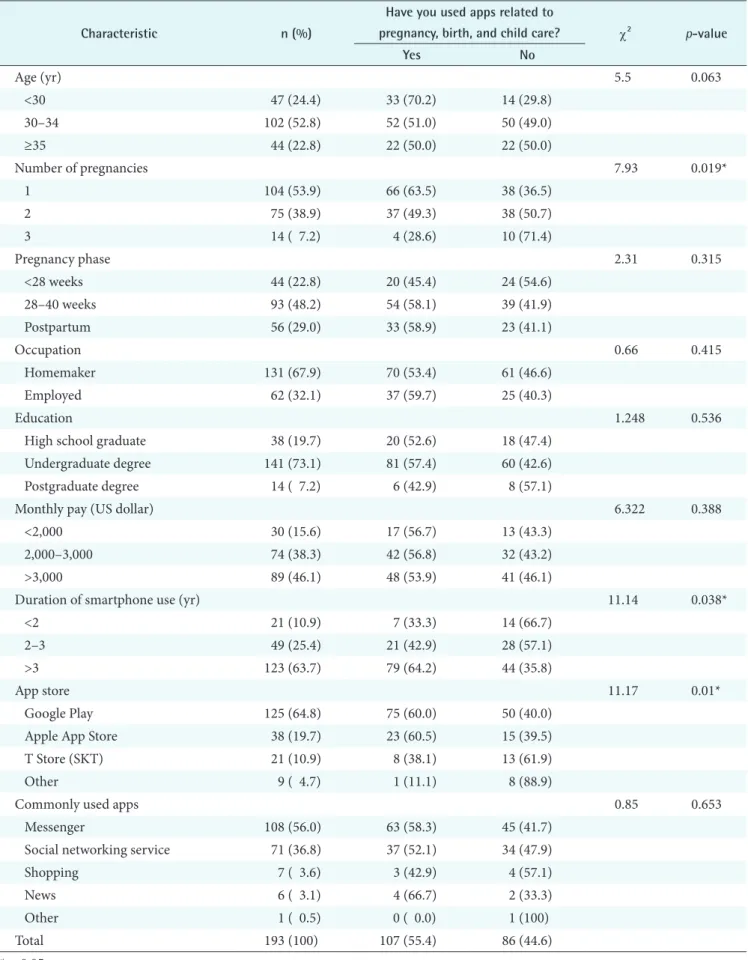
2. Usage of Apps for Pregnancy, Birth, and Child Care Table 1 shows participants’ use of apps for pregnancy, birth, and child care. More than half (55.4%, n = 107) had used such apps. Significantly more primiparas than multiparas used them (χ2 = 7.93; p = 0.019). Moreover, significantly more participants who reported long-term smartphone use than those who reported short-term use used these apps (χ2
= 11.14; p = 0.038). There were no differences in app use by age, pregnancy phase, occupation, education, or income.
However, compared to other age groups, meaningfully more women younger than 29 years old had used these apps (χ2 = 5.5; p = 0.063).
3. User Responses
Table 2 shows app choice and usage information. On aver- age, users downloaded 2.4 free and 0.69 paid apps and used them for 31.2 minutes per day. Most users chose to down- load an app after searching its contents themselves (n = 66, 61.7%). Most considered necessity (33.6%) as the reason for downloading the app. Convenience was also an important reason (29.5%). The information most frequently obtained from the apps were risk signs and diseases during pregnancy (16.8%), physical changes related to a normal pregnancy (16.0%), and prenatal education (14.6%).
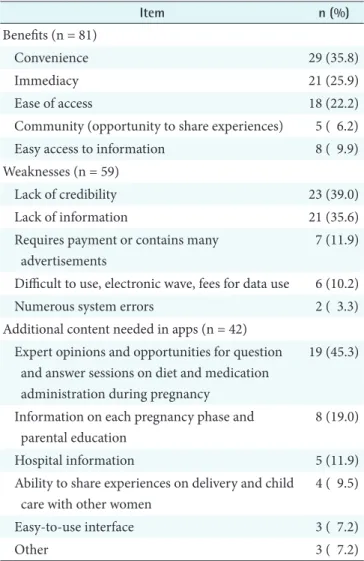
Table 3 shows users’ opinions of the benefits and weak- nesses of the apps. Most frequently cited benefits were ‘con- venience’ (35.8%), ‘immediacy’ (25.9%), and ‘ease of access’
(22.2%). The weakness most frequently cited was ‘lack of credibility’ (39.0%). In an open answer section addressing missing information, many participants (45.3%) expressed a need for expert opinions and opportunities for question and answer sessions on diet and medication administration dur- ing pregnancy.
4. Review of Apps for Pregnancy, Birth, and Child Care One-hundred eighty-one apps related to pregnancy, birth, and child care were identified from participant answers, but only 59 were unique. Additionally, 12 were excluded because they could not be found. The remainder were reviewed us- ing a structured measurement tool. Table 4 shows the top 5 apps (56.3% of all apps) used by participants. Saybebe was most commonly mentioned (n = 43, 25.7%). Most apps were available for both iOS and Android operating systems (n =
Table 1. Usage of apps related to pregnancy, birth, and child care in relation to demographic characteristics (n = 193)
Characteristic n (%)
Have you used apps related to
pregnancy, birth, and child care? χ2 p-value
Yes No
Age (yr) 5.5 0.063
<30 47 (24.4) 33 (70.2) 14 (29.8)
30–34 102 (52.8) 52 (51.0) 50 (49.0)
≥35 44 (22.8) 22 (50.0) 22 (50.0)
Number of pregnancies 7.93 0.019*
1 104 (53.9) 66 (63.5) 38 (36.5)
2 75 (38.9) 37 (49.3) 38 (50.7)
3 14 ( 7.2) 4 (28.6) 10 (71.4)
Pregnancy phase 2.31 0.315
<28 weeks 44 (22.8) 20 (45.4) 24 (54.6)
28–40 weeks 93 (48.2) 54 (58.1) 39 (41.9)
Postpartum 56 (29.0) 33 (58.9) 23 (41.1)
Occupation 0.66 0.415
Homemaker 131 (67.9) 70 (53.4) 61 (46.6)
Employed 62 (32.1) 37 (59.7) 25 (40.3)
Education 1.248 0.536
High school graduate 38 (19.7) 20 (52.6) 18 (47.4)
Undergraduate degree 141 (73.1) 81 (57.4) 60 (42.6)
Postgraduate degree 14 ( 7.2) 6 (42.9) 8 (57.1)
Monthly pay (US dollar) 6.322 0.388
<2,000 30 (15.6) 17 (56.7) 13 (43.3)
2,000–3,000 74 (38.3) 42 (56.8) 32 (43.2)
>3,000 89 (46.1) 48 (53.9) 41 (46.1)
Duration of smartphone use (yr) 11.14 0.038*
<2 21 (10.9) 7 (33.3) 14 (66.7)
2–3 49 (25.4) 21 (42.9) 28 (57.1)
>3 123 (63.7) 79 (64.2) 44 (35.8)
App store 11.17 0.01*
Google Play 125 (64.8) 75 (60.0) 50 (40.0)
Apple App Store 38 (19.7) 23 (60.5) 15 (39.5)
T Store (SKT) 21 (10.9) 8 (38.1) 13 (61.9)
Other 9 ( 4.7) 1 (11.1) 8 (88.9)
Commonly used apps 0.85 0.653
Messenger 108 (56.0) 63 (58.3) 45 (41.7)
Social networking service 71 (36.8) 37 (52.1) 34 (47.9)
Shopping 7 ( 3.6) 3 (42.9) 4 (57.1)
News 6 ( 3.1) 4 (66.7) 2 (33.3)
Other 1 ( 0.5) 0 ( 0.0) 1 (100)
Total 193 (100) 107 (55.4) 86 (44.6)
*p<0.05.
45, 95.7%) or were free (n = 46, 97.9%).
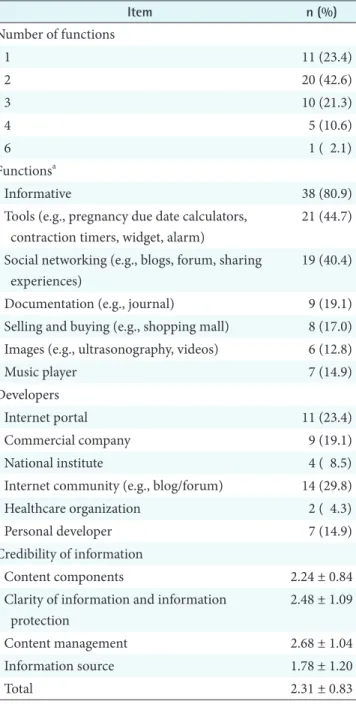
Table 5 shows the results of the review. Most apps had more than one function; 11 (23.4%) had only one function. The most common function was information (80.9%). Tools such as a pregnancy term calculator and alarm (44.7%) or social
networking services, such as blogging and forums (40.4%), were also common. Internet portals were the most prevalent type of developer (23.4%).
Information credibility was lowest (1.78 ± 1.2) as measured by the information source subscale and highest (2.68 ± 1.04) as measured by the content management subscale. The 2 items with the lowest scores were ‘clearly provides informa- tion source’ (1.73 of 5) in the information source subscale and ‘provides warnings about using information related to pregnancy, birth, and child care’ (1.35 of 5) in the content components subscale.
IV. Discussion
Mobile apps for pregnancy, childbirth, and child care are some of the most common healthcare apps used by women.
Because these apps have considerable potential in the health of women and infants, their content and quality should be monitored and managed by healthcare professionals. From Table 2. App usage information (n = 107)
Item n (%)
Number of free apps downloaded 2.4 ± 1.57 Number of paid apps downloaded 0.69 ± 2.21 Average usage per day (min) 31.2 ± 46.35 How apps were chosen
Searching content themselves 66 (61.7) Recommendations from others (e.g., friends,
family)
27 (25.2)
User scores or number of downloads 10 ( 9.3)
Other 4 ( 3.8)
Information source other than appsa
Internet website 95 (48.7)
Friends or neighbors 52 (26.7)
Lecture from hospital or community health center
17 ( 8.7)
Newspaper, magazine, TV 13 ( 6.7)
Parents or parents-in-law 13 ( 6.7)
Other 5 ( 2.5)
Reasons for downloading appsa
Necessity 91 (33.6)
Convenience 80 (29.5)
User evaluation 40 (14.8)
Operation 17 ( 6.5)
Price 16 ( 5.8)
App ranking 16 ( 5.8)
Other 11 ( 4.0)
Most frequently obtained information from apps
Risk signs and diseases during pregnancy 62 (16.8) Physical changes related to a normal pregnancy 59 (16.0)
Prenatal education 54 (14.6)
Breastfeeding and baby food 46 (12.5) How to cope when a baby is ill 41 (11.1)
Caring for a newborn 36 ( 9.8)
Self-management after deliverya 25 ( 6.8)
Vaccinationa 25 ( 6.8)
Othera 21 ( 5.6)
Values are presented as mean ± standard deviation or number (%).
aAllowed duplication.
Table 3. Perceived benefits and weaknesses by app users
Item n (%)
Benefits (n = 81)
Convenience 29 (35.8)
Immediacy 21 (25.9)
Ease of access 18 (22.2)
Community (opportunity to share experiences) 5 ( 6.2)
Easy access to information 8 ( 9.9)
Weaknesses (n = 59)
Lack of credibility 23 (39.0)
Lack of information 21 (35.6)
Requires payment or contains many advertisements
7 (11.9)
Difficult to use, electronic wave, fees for data use 6 (10.2)
Numerous system errors 2 ( 3.3)
Additional content needed in apps (n = 42) Expert opinions and opportunities for question and answer sessions on diet and medication administration during pregnancy
19 (45.3)
Information on each pregnancy phase and parental education
8 (19.0)
Hospital information 5 (11.9)
Ability to share experiences on delivery and child care with other women
4 ( 9.5)
Easy-to-use interface 3 ( 7.2)
Other 3 ( 7.2)
this perspective, this study was very meaningful because it identified the usage patterns and need for apps among child- bearing women, and it clarified issues surrounding app qual- ity. Our results could be the basis for developing appropriate apps suited to meeting the needs of women and for monitor- ing app quality.
Over half the smartphone users among our sample used at least one pregnancy app; furthermore, younger women with less experience with pregnancy tended to use more apps.
These findings are similar to those described in a mobile analytics report showing that 47% of all users of health apps used pregnancy apps [24]. They are also similar to those found in a recent study, which showed that younger people are more familiar with app use [25]. Similar to the findings obtained by Fleming et al. [12] in a qualitative study, pri- miparas tend to use more apps. They often feel anxiety about pregnancy (an unknown experience to them) and could feel relieved by using smartphone apps to address their fears about giving birth. This could help them realize that fears about becoming pregnant and expecting their first child are normal. This suggests that mobile apps could be appropriate tools for young expectant mothers.
Most users decided to download apps after searching their contents themselves. Furthermore, they considered neces- sity and convenience to be the most important factors before downloading an app. This suggests that users will not use a smartphone app simply because it is innovative or read- ily available. Instead, the app must be convenient and aid them in health-related tasks [26]. Most participants stated that they used apps to obtain information. However, despite advantages such as convenience, issues related to app cred- ibility were reported. This lack of credibility was of greatest concern to users, just as it was for health professionals in a previous study [9,27]. Although most women frequently used the apps to search for information, the credibility and
content of the apps were sometimes dissatisfying. Moreover, many participants reported that apps needed to offer ex- pert opinions and opportunities for Q&A sessions on diet and medications. This suggests that women want credible and professional information about their conditions from a health professional.
We reviewed 47 apps referred to by participants. Most had more than one function, the most common of which were information, social networking, and tools. Like Saybebe, the top-ranking medical app on the Google Play Top App Table 4. Top five most frequently used apps for pregnancy, birth,
and child care apps (n = 95)
Rank Name of app n (%)
1 Saybebe 43 (25.7)
2 Pregnancy, birth, and child care encyclopedia
12 ( 7.2)
3 My pregnancy today 11 ( 6.6)
4 40-week prenatal education helper 8 ( 4.8)
5 Mom’s Diary 7 ( 4.2)
5 Momsholic-baby 7 ( 4.2)
5 Contraction timer 7 ( 4.2)
Table 5. Review of pregnancy, birth, and child care apps used by participants (n = 47)
Item n (%)
Number of functions
1 11 (23.4)
2 20 (42.6)
3 10 (21.3)
4 5 (10.6)
6 1 ( 2.1)
Functionsa
Informative 38 (80.9)
Tools (e.g., pregnancy due date calculators, contraction timers, widget, alarm)
21 (44.7) Social networking (e.g., blogs, forum, sharing
experiences)
19 (40.4)
Documentation (e.g., journal) 9 (19.1)
Selling and buying (e.g., shopping mall) 8 (17.0) Images (e.g., ultrasonography, videos) 6 (12.8)
Music player 7 (14.9)
Developers
Internet portal 11 (23.4)
Commercial company 9 (19.1)
National institute 4 ( 8.5)
Internet community (e.g., blog/forum) 14 (29.8)
Healthcare organization 2 ( 4.3)
Personal developer 7 (14.9)
Credibility of information
Content components 2.24 ± 0.84
Clarity of information and information protection
2.48 ± 1.09
Content management 2.68 ± 1.04
Information source 1.78 ± 1.20
Total 2.31 ± 0.83
Values are presented as number (%) or mean ± standard deviation.
aAllowed duplication.
chart, the apps most commonly selected by participants had multiple functions. Although healthcare apps have recently begun to evolve in various ways, such as offering remote monitoring via wearable devices, the majority of women use apps with simple functions [5]. In particular, the informa- tion function was the most common, as was found in previ- ous studies. The study of Tripp et al. [11] showed that 40%
of reviewed apps had an informative function, and it can help reduce the need to visit the hospital, relieving anxiety by educating consumers and allowing them to understand their own conditions [6]. Interestingly, the social networking function was important for pregnant women. Anxiety arising from inexperience can be relieved by sharing of experiences with those in the same situation via electronic communica- tion. However, communication with health professionals using an app remains limited. If interactive communication with health professionals through mobile apps is enhanced, users could get more professional and useful health informa- tion quickly, thus improving their health.
Most tools included with apps were simple calculators for estimating date of birth or contraction timers; there were few advanced tools, such as those for fetal monitoring. Us- ers must be cautioned on the use of these tools because they could lead to unnecessary worry or false reassurance [11]. Healthcare apps are developed by a variety of institu- tions, from individuals to healthcare organizations. In this study, the most common sources of pregnancy apps were Internet portals or commercial sites rather than healthcare organizations. It is possible that some pregnancy apps were created for entertainment and were not approved or spon- sored by healthcare professionals. Similarly, the credibility of app information was lower than average. The credibility subscale with the highest score was content management, which involves providing updates and highlighting the pur- pose of the app (e.g., selling or information). In contrast, the information source subscale had the lowest score among the four credibility subscales. In other words, information provided about the app developers was highly credible, but the information sources for app content were not. A recent study similarly pointed out that the content and developers of an app often lacked authority [28]. Therefore, healthcare professionals should call attention to the dangers of misin- formation from non-professionals and uncertain informa- tion sources. The lack of appropriate caution on the use of these apps prompts the need for further discussion regarding regulatory measures in their development. The regulation of healthcare app monitoring by healthcare professionals should be considered.
In conclusion, the number of pregnancy apps is rapidly
increasing, and they are playing an ever more important role in the health of women and infants. This descriptive study explored the use of mobile apps for pregnancy, birth, and child care and reviewed the characteristics and content of those used by pregnant women. Credibility was evaluated for 47 apps used by study participants. We determined that apps have become an important information source for pregnant women. The quick provision of credible professional infor- mation is needed by users. The findings of this study indicate areas in which health professionals can concentrate when assessing app quality. The involvement of healthcare profes- sionals is needed to develop and operate suitable apps for pregnancy, birth, and child care.
Conflict of Interest
No potential conflict of interest relevant to this article was reported.
Acknowledgments
This article is a part of the first author’s thesis from Keimy- ung University.
References
1. Mosa AS, Yoo I, Sheets L. A systematic review of health- care applications for smartphones. BMC Med Inform Decis Mak 2012;12:67.
2. Smith A. US smartphone use in 2015 [Internet]. Wash- ington (DC): Pew Research Center; 2015 [cited at 2016 Jan 3]. Available from: http://www.pewinternet.
org/2015/04/01/us-smartphone-use-in-2015/.
3. Baig MM, GholamHosseini H, Connolly MJ. Mobile healthcare applications: system design review, criti- cal issues and challenges. Australas Phys Eng Sci Med 2015;38(1):23-38.
4. Greenspun H, Coughlin S. mHealth in an mWorld: how mobile technology is transforming health care. Wash- ington (DC): Deloitte Center for Health Solutions; 2012.
5. Gauntlett C, MacCarthy J, Tindall M, Buck S, Connery G. Patient apps for improved healthcare: from novelty to mainstream. Parsippany (NJ): IMS Institute for Health- care Informatics; 2013.
6. Moore J. The benefits of mobile apps for patients and providers. Br J Healthc Manag 2012;18(9):465-7.
7. Kratzke C, Cox C. Smartphone technology and apps:
rapidly changing health promotion. Int Electron J Health Educ 2012;15(1):72-82.
8. Hasman L. An introduction to consumer health apps for the iPhone. J Consum Health Internet 2011;15(4):322-9.
9. US Food and Drug Administration. Mobile medical applications [Internet]. Silver Spring (MD): Food and Drug Administration; 2015 [cited at 2015 Dec 22].
Available from: http://www.fda.gov/medicaldevices/
digitalhealth/mobilemedicalapplications/default.htm.
10. Terry K. Number of health apps soars, but use does not always follow [Internet]. New York (NY): Medscape;
2015 [cited at 2015 Dec 22]. Available from: http://www.
medscape.com/viewarticle/851226.
11. Tripp N, Hainey K, Liu A, Poulton A, Peek M, Kim J, et al. An emerging model of maternity care: smartphone, midwife, doctor? Women Birth 2014;27(1):64-7.
12. Fleming SE, Vandermause R, Shaw M. First-time moth- ers preparing for birthing in an electronic world: in- ternet and mobile phone technology. J Reprod Infant Psychol 2014;32(3):240-53.
13. Robinson F, Jones C. Women's engagement with mobile device applications in pregnancy and childbirth. Pract Midwife 2014;17(1):23-5.
14. Waring ME, Moore Simas TA, Xiao RS, Lombardini LM, Allison JJ, Rosal MC, et al. Pregnant women's inter- est in a website or mobile application for healthy gesta- tional weight gain. Sex Reprod Healthc 2014;5(4):182-4.
15. Effron L. Pregnant? Use your smartphone: 12 best pregnancy apps [Internet]. New York (NY): abcnews.
com; 2013 [cited at 2015 Dec 22]. Available from: http://
abcnews.go.com/Technology/pregnant-smartphone- 12-best-pregnancy-apps/story?id=18713241.
16. Good Daddy. Introduction for useful pregnancy, birth, and child care app [Internet]. Seoul: Samsung Fire &
Marine Insurance; 2015 [cited at 2015 Dec 28]. Avail- able from: http://gooddaddy.samsungfire.com/1158.
17. Menoni T. Top 9 pregnancy apps for the iPhone and iPod touch [Internet]. [place unknown]: about.com;
2014 [cited at 2016 Jan 2]. Available from: http://ipod.
about.com/od/bestiphoneapps/tp/Pregnancy-Apps-For- Iphone-And-Ipod-Touch.htm.
18. Cummings E, Borycki EM, Roehrer E. Issues and con- siderations for healthcare consumers using mobile ap- plications. Stud Health Technol Inform 2013;183:227-
31.
19. Stoyanov SR, Hides L, Kavanagh DJ, Zelenko O, Tjon- dronegoro D, Mani M. Mobile app rating scale: a new tool for assessing the quality of health mobile apps.
JMIR Mhealth Uhealth 2015;3(1):e27.
20. Kuehnhausen M, Frost VS. Trusting smartphone apps?
To install or not to install, that is the question. Proceed- ings of 2013 IEEE International Multi-Disciplinary Conference on Cognitive Methods in Situation Aware- ness and Decision Support (CogSIMA); 2013 Feb 25-28;
San Diego, CA. p. 30-37.
21. Boulos MN, Wheeler S, Tavares C, Jones R. How smart- phones are changing the face of mobile and participa- tory healthcare: an overview, with example from eCAA- LYX. Biomed Eng Online 2011;10:24.
22. Sama PR, Eapen ZJ, Weinfurt KP, Shah BR, Schulman KA. An evaluation of mobile health application tools.
JMIR Mhealth Uhealth 2014;2(2):e19.
23. Woo YW, Cho KW. A model for evaluating confidence and satisfaction of health information web-sites. J Korea Contents Assoc 2006;6(9):42-9.
24. Citrix. Citrix data shows mobile subscriber behavior on wireless networks challenges user perceptions [Internet].
Santa Clara (CA): Citrix; 2013 [cited at 2015 Dec 27].
Available from: https://www.citrix.com/news/announce- ments/feb-2013/citrix-data-shows-mobile-subscriber- behavior-on-wireless-network.html.
25. Research2guidance. Mobile health market report 2011–
2016. [place unknown]: research2guidance; 2012.
26. Consumer Health Information Corporation. Motivat- ing patients to use smartphone health apps [Internet].
McLean (VA): Consumer Health Information Corpora- tion; 2012 [cited at 2015 Dec 22]. Available from: http://
www.consumer-health.com/motivating-patients-to-use- smartphone-health-apps/.
27. Korea Ministry of Food and Drug Safety. Guideline for mobile medical app safety management. Cheongju:
Ministry of Food and Drug Safety; 2013.
28. Airth-Kindree N, Vandenbark RT. Mobile applications in nursing education and practice. Nurse Educ 2014;
39(4):166-9.