제2형 당뇨병 환자에서 혈청 아디포넥틴이 경동맥 죽상경화증의 진행에 미치는 영향
김철식·박주리·유성훈·강준구·류옥현·이성진·홍은경·김두만·유재명·임성희·최문기·유형준 한림대학교 의과대학 내과학교실 내분비내과
Received: 26 July 2011, Accepted: 14 December 2011 Corresponding author: Chul Sik Kim
Division of Endocrinology, Department of Internal Medicine, Hallym University Sacred Heart Hospital, 22 Gwanpyeong-ro 170 beon-gil, Dongan-gu, Anyang 431-796, Korea
Tel: +82-31-380-6061, Fax: +82-31-380-2269, E-mail: [email protected]
※ 본 연구는 2009년도 한국의학연구소 산학협동 연구비 보조에 의해 진행되었음.
Impact of Serum Adiponectin Concentration on Progression of Carotid Atherosclerosis in Patients with Type 2 Diabetes Mellitus
Chul Sik Kim, Ju Ri Park, Sung Hoon Yu, Jun Goo Kang, Ohk Hyun Ryu, Seong Jin Lee, Eun Gyung Hong, Doo-Man Kim, Jae Myung Yoo, Sung Hee Ihm, Moon Gi Choi, Hyung Joon Yoo
Division of Endocrinology, Department of Internal Medicine, Hallym University College of Medicine, Anyang, Korea
Background: Increased cardiovascular events, which is the leading cause of death in type 2 diabetic patients, are mainly caused by accelerated atherosclerosis. Adiponectin has been suggested as a risk factor for cardiovascular diseases in cross-sectional studies.
However, little is known about the impact of adiponectin on the progression of carotid atherosclerosis in type 2 diabetic patients.
This study was conducted to evaluate the impact of early adiponectin levels on the progression of carotid atherosclerosis.
Methods: From March 2009, 150 patients with type 2 diabetes were consecutively enrolled in our affiliated outpatient clinic. An- thropometric and biochemical data, including adiponectin levels, were measured in each participant. We measured the carotid intima-media thickness (CIMT) at baseline and at 1-year follow-up (n = 111). Then, we prospectively studied the relationship be- tween the serum adiponectin levels and the progression of CIMT for 1 year.
Results: Adiponectin levels negatively correlated with CIMT (r = -0.219, P = 0.015). Moreover, mean progression of CIMT was 0.016 ± 0.040 mm. However, there was no correlation between adiponectin levels and the progression of CIMT within 1-year fol- low-up period (r = -0.156, P = 0.080). Age (β = 0.556, P = 0.004), LDL cholesterol (β = 0.276, P = 0.042), and A1C (β = 0.309, P = 0.038) were found to be independent risk factors for CIMT. However, A1C (β = 0.311, P = 0.042) was found to be the only indepen- dent risk factor for the progression of CIMT.
Conclusion: In our study, adiponectin levels were negatively associated with CIMT. However, it did not affect the progression of CIMT at 1-year follow-up. Overall glycemic control is the most important factor in the progression of CIMT in patients with type 2 diabetes. (Endocrinol Metab 27:31-38, 2012)
Key Words: Adiponectin, Carotid atherosclerosis, Carotid intima media thickness, Type 2 diabetes mellitus
서 론
제2형당뇨병은진행된죽상경화증을특징으로하는데, 그발생 기전에는주로고혈당, 고혈압, 이상지질혈증및인슐린저항성등이 중요한역할을하는것으로알려져있으며[1] 최근에는제2형당뇨병
환자에서죽상경화증발생과관계된새로운위험요인들에대한많 은연구가진행되고있다[2].
경동맥초음파는경동맥의동맥경화를직접 영상으로관찰할수 있는중요한진단도구로이에의해측정된경동맥내중막두께(carotid
intima-media thickness, CIMT)는단면적연구에서심혈관질환의
This is an Open Access article distributed under the terms of the Creative Commons Attribution Non-Commercial License (http://creativecommons.org/licenses/by-nc/3.0/) which permits unrestricted non-commercial use, distribution, and reproduction in any medium, provided the original work is properly cited.
Copyright © 2012 Korean Endocrine Society
표식인자로서잘알려져있다[3,4]. 제2형당뇨병환자에서 CIMT에 영향을미치는요인으로는나이, 성별, 당뇨병유병기간, 총콜레스 테롤, 저밀도지단백(low density lipoprotein, LDL) 콜레스테롤, 고밀 도지단백(high density lipoprotein, HDL) 콜레스테롤, 수축기혈압, 체질량지수등으로알려져있다[5]. 또한 CIMT가심혈관질환의위험
인자에의해영향을받기도하지만일정기간동안의 CIMT의진행
이이후심혈관질환의발생과직접적인관계가있는것으로알려져
있다[6]. 제2형당뇨병환자를대상으로한전향적인연구에서 CIMT
의진행에미치는요인으로는혈당[7,8]과인슐린저항성[7], 그리고 혈소판활성도[9] 등이있다.
아디포넥틴은지방세포에서특이적으로발현되고분비되는아디 포사이토카인으로[10] 당대사및인슐린저항성에중요한역할을하 며[11] 비만환자와제2형당뇨병환자에서감소되어있고[12,13] 관상 동맥질환환자에서도그농도가낮은것으로알려져있다[14]. 최근 전향적연구에서아디포넥틴이대사증후군의발병에미치는영향이
증명이되어[15] 아디포넥틴의농도가감소되어있는경우대사증후
군및이와관련된죽상경화증을갖게될가능성이높다는것을시
사한다[16]. 최근여러연구에서아디포넥틴과 CIMT와의연관성이
보고되었으나[17-19] 초기아디포넥틴이 CIMT의진행에미치는영향 에대해서는아직잘알려지지않았다.
따라서본연구에서는제2형당뇨병환자에서초기혈청아디포넥 틴의농도가낮은경우죽상경화증의진행이심화시켜심혈관질환 의발생이증가시킬수있음을알아보고자하였다.
대상 및 방법
1. 연구 대상
2009년 3월부터본원내분비내과외래에방문한제2형당뇨병환 자 150명을연속적으로모집을하였다. 이들에게서 CIMT를측정하 였으며 1년이지난후해당검사를다시시행하였다. 최종분석은 1년 간격으로 2번의 CIMT 측정을한 111명을대상으로하였다.
당뇨병진단은 1985년도에정해진세계보건기구에 의한기준을
따랐다[20]. 제외기준은제1형당뇨병, 관상동맥질환, 뇌혈관질환, 말초혈관질환, 신기능저하(혈중 creatinine 수치가 2.0 mg/dL 이상으 로정의), 간기능장애(혈중 alanine aminotransferase 또는 aspartate aminotransferase가정상상한치의 3배이상인경우로정의), 부신피 질호르몬사용, 임신, 악성 종양이나심한감염상태, 쿠싱증후군, 말단비대증, 갑상선기능항진증, 갑상선기능저하증, 일차성고지질혈 증, 여성호르몬투여중, 그리고알코올중독및약물남용등이다. 또
한 CIMT의진행에유의한영향을미칠가능성이높은 thiazolidine-
dione 계통의약물을사용하는경우에도연구에서제외를하였다[7].
대상자에서고혈압의진단은수축기혈압 130 mmHg 이상, 또는
이완기혈압 80 mmHg 이상이거나고혈압약물복용중또는이들
의조합이있는경우로하였으며이상지질혈증은 LDL 콜레스테롤 이 100 mg/dL 이상, HDL 콜레스테롤이남자의경우 40 mg/dL 미만,
여자의경우 50 mg/dL 미만또는지질강하제를복용하는경우로하
였다. 또한신장병증은 24시간소변알부민배설이 30 mg 이상인경 우로, 망막병증은망막의미세혈관류, 망막출혈, 경성삼출물, 황반 부종, 면화반, 망막내미세혈관이상, 염주정맥중하나이상이있 는경우로진단하였다. 신경병증은양측하지에통증의존재, 이상감 각이있거나 감각기능검사(current perception threshold test)에서 양성소견이관찰되는경우로진단하였다. 이연구는본원임상시험 심사위원회의승인을 받았으며각각의환자에게서 서면 동의서를 받았다.
2. 신체검사
각환자에서키, 몸무게, 혈압을측정하였다. 혈압은앉은상태에 서심장높이에서혈압계를사용하여측정하였으며 2회측정치의 평균값을사용하였다. 또한키몸무게는가벼운복장을한상태에 서측정하였으며체질량지수는몸무게(kg)에키(m)를제곱한값으 로나누어계산하였다. 허리둘레는양발을약 30 cm 벌린자세에서 갈비뼈의가장아랫부분과장골능사이의가운데부위를줄자로측 정하였다.
3. 생화학적 검사
혈액검사는 10시간이상의금식후오전에측정을하였다. 당화혈 색소(A1c)는 high-performance liquid chromatography 원리를이용 한자동측정기(Variant II, Bio-Rad Laboratories, Hercules, CA, USA), 혈청혈당은 hexokinase 법을이용한자동측정기(Hitachi 747, Roche, Montclair, NJ, USA)로측정하였다. 또한 인슐린농도는 INS-IRMA kit (BioSource Europe SA, Nivelles, Belgium)를사용하여측정하였 으며, 총콜레스테롤및 HDL 콜레스테롤은직접효소법(Hitachi 747, Daiichi, Tokyo, Japan), 중성지방은효소비색법(Hitachi 747, Roche, Almere, Japan/Germany)을이용하여측정하였다. 또한 LDL 콜레스
테롤은 Friedewald 공식을 이용하여계산하였다. 인슐린저항성은
homeostasis model assessment method (HOMA-IR, 공복인슐린 [μU/mL] × 공복혈당[mmol/L]/22.5)를이용하여구하였다. 혈청아 디포넥틴은상용키트(AdiopMark, MESDIA, Seoul, Korea)의프로토 콜을따라 효소면역측정법(enzyme-linked immunosorbent assay,
ELISA)을이용하여측정하였다. 한편아디포넥틴측정의변이계수
는 4.7%이었다.
4. CIMT 측정
CIMT는동일검사자가 8 MHz 선형탐침(Sequoia C512, Siemens, Munich, Germany)을이용한 B-mode 초음파로측정을하였다. CIMT 는좌측과우측경동맥의종단면을따라총경동맥이내경동맥과외
경동맥으로분리되는분지점의 근위부에위치한총경동맥의원벽
(far wall)에서내중막두께가최고인지점을정하고이지점과이를
중심으로근위 10 mm, 원위 10 mm 위치에서내중막두께를측정
하였다. 측정의재현성을위하여계산한 CIMT 측정의일간변이계
수는 4.9%였다. CIMT 측정이예정된부위에석회화되고혈관의내
강내로돌출된병변인플라크(plaque)가있는경우에는플라크가
포함되지않은근위부에서측정하였다.
평균 CIMT는좌측과우측의 CIMT를측정값 6곳의평균으로구
하였으며 CIMT의진행(ΔCIMT)은 1년후측정한평균 CIMT 값에서
연구당시에시행한평균 CIMT 값을뺀값으로정하였으며ΔCIMT
가 0보다큰경우죽상경화증의진행으로간주하였다[9].
5. 통계
연속형변수자료는평균±표준편차로제시하였다. 자료중아디 포넥틴, 중성지방수치는정규분포를따르지않아자연로그로치환 한후통계자료로이용하였다. 연간 CIMT의진행을 -0.05 mm 이하, -0.04-0.00, 0.01-0.04, 0.05 mm 이상으로 4군으로나누어각군의생 화학적, 임상적특징을경향분석(linear by linear association test)을 통하여분석하였다. 또한 초기혈청 아디포넥틴농도와모집 당시
CIMT 값및ΔCIMT와의관계를알아보기위하여상관분석을시행
하였으며, 모집당시 CIMT 값및ΔCIMT에미치는요인을알아보기
위하여 다중다단계 회귀분석을 시행하였다. 자료의 통계분석은 SPSS for Windows version 11.5 (SPSS Inc., Chicago, IL, USA)를이 Table 1. Clinical and biochemical characteristics of the subjects according to progression of carotid intima-media thickness
Range of ΔCIMT (mm/yr) Group 1
~ -0.05 Group 2
-0.04 to 0.00 Group 3
0.01 to 0.04 Group 4
0.05~ P for trend
Number 14 28 36 33
Mean ΔCIMT (mm/yr) -0.052 ± 0.022 -0.011 ± 0.021 0.019 ± 0.027 0.063 ± 0.031 <0.001
Female (%) 35.7 39.3 36.1 39.4 0.892
Age (yr) 47.2 ± 9.8 50.6 ± 10.2 51.4 ± 10.7 53.9 ± 10.1 0.042
Duration of diabetes (yr) 3.3 ± 4.2 3.7 ± 4.9 5.4 ± 6.4 6.2 ± 6.0 0.071
Current smoker (%) 21.4 25 38.9 39.4 0.126
Body mass index (kg/m2) 25.1 ± 3.6 25.4 ± 3.5 25.6 ± 3.2 25.8 ± 3.2 0.412
Waist circumference (cm) 88.1 ± 9.8 90.1 ± 9.7 91.6 ± 9.6 91.7 ± 9.7 0.232
Hypertension (%) 64.3 75 77.8 78.8 0.522
Systolic blood pressure (mmHg) 126.1 ± 19.8 127.3 ± 17.9 128.5 ± 17.6 128.3 ± 17.8 0.609
Diastolic blood pressure (mmHg) 78.5 ± 12.8 78.9 ± 11.9 79 ± 10.9 78.8 ± 10.7 0.834
Hypercholesterolemia (%) 71.4 71.4 75 78.8 0.489
Total cholesterol (mg/dL) 170.1 ± 44.1 175.3 ± 43.4 180.1 ± 44.0 181.3 ± 42.6 0.408
HDL cholesterol (mg/dL) 48.1 ± 14.1 47.4 ± 13.7 47.5 ± 12.9 47.9 ± 13.0 0.862
Ln [triglyceride (mg/dL)] 4.79 ± 0.60 4.84 ± 0.58 4.85 ± 0.55 4.87 ± 0.56 0.563
LDL cholesterol (mg/dL) 93.5 ± 37.9 103.1 ± 36.7 107.1 ± 36.4 108.5 ± 36.8 0.111
A1c (%) 6.7 ± 1.5 7.3 ± 1.9 7.9 ± 1.9 8.4 ± 2.0 0.021
HOMA-IR 2.4 ± 2.0 2.5 ± 1.9 2.7 ± 1.9 2.8 ± 1.8 0.403
Nephropathy (%) 21.4 17.9 19.4 18.2 0.876
Retinopathy (%) 7.1 10.7 11.1 12.1 0.653
Neuropathy (%) 28.6 32.1 38.9 42.4 0.285
Ln (Adiponenctin [ng/mL]) 8.56 ± 0.78 8.62 ± 0.76 8.83 ± 0.71 8.88 ± 0.70 0.043
Medications Metformin (%)
Sulfonylurea or meglitinide (%) DPP4 inhibitors (%)
α-glucosidase inhibitors (%) Insulins (%)
Aspirin (%) β-blockers (%) Ca-blockers (%) RAS inhibitors (%) Statins (%)
92.9 41.7 50 7.1 7.1 57.1 0 28.6 28.6 64.3
85.7 46.2 28.6 7.1 3.6 53.6 3.6 25 42.9 64.3
86.1 41.7 38.9 11.1 5.6 52.8 2.8 22.2 47.2 72.2
87.9 48.5 39.4 9.1 6.1 51.6 3 24.2 45.5 75.8
0.799 0.797 0.954 0.725 0.919 0.738 0.719 0.758 0.348 0.289 Values are expressed as mean ± SD.
CIMT, carotid intima-media thickness; DPP4, dipeptidyl peptidase-4; HDL, high density lipoprotein; HOMA-IR, homeostatic model assessment for insulin resistance;
LDL, low-density lipoprotein; Ln, lymph node; RAS, renin angiotensin system.
용해시행하였으며 P 값이 0.05 미만인경우통계적으로유의하다 고판단하였다.
결 과
연구에참여한대상자들평균나이는약 51세, 당뇨병유병기간은 5년이었으며여성의비율은 37.8%였다. 참여대상자의약 76%에서 고혈압이동반되어있었으며 1/3정도는연구참여당시에도흡연을 하는중이었다. 대상자들의연구참여당시평균 A1c는 7.7%, 혈압은
128/79 mmHg이었고, HDL 콜레스테롤은 48 mg/dL, 중성지방은
147 mg/dL, LDL 콜레스테롤은 106 mg/dL이었다.
연구시작당시평균 CIMT는 0.773 mm이었으며 1년동안 0.016 mm 의유의한증가가있었다(P = 0.001). 대상자들을 CIMT의진행정
도에따라 네군으로구분하여분석한결과, 연간 CIMT의진행이
큰군일수록나이가많았으며, 혈당조절이불량한상태에있었고 아디포넥틴의농도는낮은것으로나타났다. 그외에 CIMT의진행 에따른대상자들의임상적특징및당뇨병과관련된생화학적특성
의유의한차이는관찰되지않았다(Table 1).
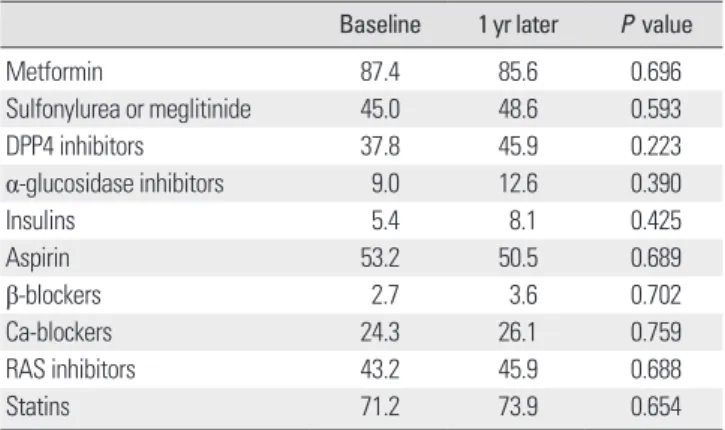
한편 1년동안의추적관찰동안대상자들에서의약물치료는거의 변화가없이일정하였으며모든환자들은정해진간격으로병원에 방문하였다. 연구시작당시환자들은약 90% 정도에서메트포민제 를사용중이었으며설폰우레아제는 45%, dipeptidyl peptidase-4
억제제는약 40% 복용중이었다. 또한인슐린제를투여중인대상
자는 5.4%로적었으며아스피린은약절반에서복용중이었다. 대상
자들이복용중인혈압약은레닌-안지오텐신계통(renin angioten-
sin system) 억제약물이가장많았으며다음으로 칼슘길항제였다.
또한대상자의 71.2%에서항콜레스테롤제인스타틴제를사용하고
있었다. 한편연구시작시점과 1년뒤추적관찰시점의약물치료비 율의유의한차이는없었다(Table 2).
연구시작시점에서아디포넥틴농도와 CIMT와유의한음의연관 성이있었다(r = -0.219, P = 0.015) (Fig. 1). 한편 CIMT은 1년동안 유의한증가가있었다(0.016 ± 0.040 mm, P = 0.001). 하지만초기 아디포넥틴농도와 CIMT의 1년동안의진행과는유의한관련은없 는것으로나타났다(r = -0.156, P = 0.080) (Fig. 2).
CIMT에어떠한요인이영향을미치는지를알아보기위한분석
에는 CIMT와연관이있는것으로알려져있는전통적인위험인자
인성별, 나이, 당뇨병유병기간, A1c, 혈압, 콜레스테롤농도, 체질량 지수, 인슐린저항성, 초기 CIMT 및아디포넥틴농도등을포함하였 다. 그결과나이(β= 0.556, P = 0.004), LDL 콜레스테롤(β= 0.276, P = 0.042) 및 A1c (β= 0.309, P = 0.038)가 CIMT에유의한영향을 미치는요인으로나타났다(Table 3). 한편 1년동안의 CIMT의진행 Table 2. Differences in medication use in 1 year
Baseline 1 yr later P value
Metformin 87.4 85.6 0.696
Sulfonylurea or meglitinide 45.0 48.6 0.593
DPP4 inhibitors 37.8 45.9 0.223
α-glucosidase inhibitors 9.0 12.6 0.390
Insulins 5.4 8.1 0.425
Aspirin 53.2 50.5 0.689
β-blockers 2.7 3.6 0.702
Ca-blockers 24.3 26.1 0.759
RAS inhibitors 43.2 45.9 0.688
Statins 71.2 73.9 0.654
Values are expressed as %.
DPP4, dipeptidyl peptidase- 4; RAS, renin angiotensin system.
Progression of CIMT (mm)
0.60 0.40 0.20 0.00 -0.20
-0.40
6.5 7.0 7.5 8.0 8.5 9.0 9.5 10.0 10.5 Log transformed adiponectin (ng/mL)
Fig. 2. Correlation between serum adiponectin concentration (log transformed) and progression of carotid artery intima-media thickness (CIMT) (r = -0.156, P = 0.080).
Baseline CIMT (mm)
1.40 1.20 1.00 0.80 0.60
0.40
6.5 7.0 7.5 8.0 8.5 9.0 9.5 10.0 10.5 Log transformed adiponectin (ng/mL)
Fig. 1. Correlation between serum adiponectin concentration (log transformed) and baseline carotid artery intima-media thickness (CIMT). (r = -0.219, P = 0.015).
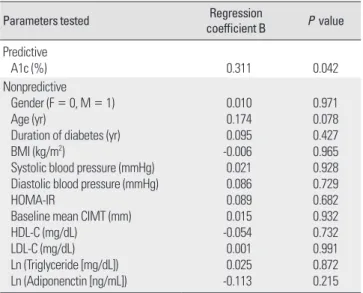
에영향을미치는요인으로는혈당조절상태만이유의한것으로나 타났다(A1c, β= 0.311, P = 0.042) (Table 4).
고 찰
본연구결과, 제2형당뇨병환자에서초기아디포넥틴농도가낮 을수록증가되어있는 CIMT를갖는것으로나타났으나, 초기아디포
넥틴농도가 1년동안의 CIMT의진행과는유의한관계가보이지않
는것으로나타났다. 한편단면적으로 CIMT에영향을미치는유의
한인자는나이와혈당및 LDL 콜레스테롤농도와같은전통적인
심혈관위험인자였으며특히 1년동안에 CIMT의진행에영향을끼 치는주요요인은혈당조절상태인것으로나타났다.
제2형당뇨병환자에서대혈관합병증인죽상경화증은매우흔하 고중대한만성합병증으로인슐린저항성과고혈당을대표로하는 당뇨병의대사장애와고혈압, 이상지질혈증및혈액응고장애등관
련인자의복합적작용에의하여발생한다[21]. 제2형당뇨병환자에
서죽상경화증을예방하기위하여 철저한혈당조절외에도더욱 낮은혈압, 콜레스테롤농도를유지할것을요구하고있다. 하지만철 저한조절에도불구하고제2형당뇨병환자의심혈관질환으로인한 사망률은당뇨병이없는사람들에비해 2-4배정도높은것으로알려 져있으며[22], 실제로제2형당뇨병환자의사망원인의 70-80%는심 혈관질환인것으로알려져있다[23].
지방세포에서특이적으로발현되고분비되는아디포넥틴은당대 사및인슐린저항성에중요한역할을 하며[11], 비만환자[12], 제2형
당뇨병환자[13] 및관상동맥질환환자[14] 등에서감소되어있다. 또
한아디포넥틴의농도가높은사람은그렇지않은경우보다심혈관
질환의발생을경험할확률이낮으며[24], 제2형당뇨병환자를대상
으로한전형적연구에서도기저아디포넥틴농도가낮은경우심혈 관계질환의발생이높은것으로알려져있다[25].
최근제2형당뇨병과같이심혈관질환의위험이높은군에서조 기죽상경화증을초기에찾아내기위하여 CIMT 측정이널리사용
되고있다. 경동맥초음파로특정되는 CIMT는죽상경화증을나타
내는지표로서각종심혈관질환의발생과밀접한관련이있는것으
로알려져있다[26-28]. 하지만이러한연관성은대부분단면적으로
실시된연구에서나타난결과이며전향적인연구에서 CIMT에영향
을미치는인자에대한연구는많이진행되어있지않다[5].
CIMT의진행과관련된연구를살펴보면 Hodis 등[6]의연구에서
CIMT의진행비율이 3배클경우이후 8.8년동안에관상동맥질환이 발생확률이 3배이상증가하는것으로나타났다. 또한 Lorenz 등[29]
의연구에서는연 0.1 mm의 CIMT 증가는심근경색의위험을 15%,
뇌졸중의위험을 18% 높이는것으로나타났다. 이러한결과는단면
적으로관찰한 CIMT 값외에 CIMT의변화값도심혈관질환의표지
자로이용될수있음을의미하며[30] 항혈소판치료를결정하는데
도움이될수도있다[31]. 한편 CIMT의진행에영향을미치는요인은
당뇨병, 흡연, 고혈압유무, 낮은 HDL 콜레스테롤, 높은 LDL 콜레스
테롤, 중성지방등이있으며[32], 제2형당뇨병환자를대상으로한
연구에서는혈당[7,8]과 HOMA-IR로측정된인슐린저항성[7], 그리고
혈소판활성도[9] 등이 CIMT의진행에미치는요인으로보인다.
최근여러연구에서아디포넥틴과 CIMT와의유의한음의연관성 이보고되었는데[17-19], 이러한항죽상동맥경화효과는아디포넥틴 Table 3. Multivariate logistic regression modeling for predictors of carotid ar-
tery intima-media thickness in type 2 diabetic patients
Parameters tested Regression
coefficient B P value Predictive
Age (yr) LDL-C (mg/dL) A1c (%)
0.556 0.276 0.309
0.004 0.042 0.038 Nonpredictive
Gender (F = 0; M = 1) Duration of diabetes (yr) BMI (kg/m2)
Systolic blood pressure (mmHg) Diastolic blood pressure (mmHg) HOMA-IR
HDL-C (mg/dL) Ln (Triglyceride [mg/dL]) Ln (Adiponenctin [ng/mL])
0.202 0.062 0.188 0.066 0.164 0.096 -0.051 0.045 -0.191
0.068 0.417 0.090 0.726 0.298 0.192 0.571 0.597 0.102 BMI, body mass index; HDL-C, high density lipoprotein cholesterol; HOMA-IR, homeostatic model assessment for insulin resistance; LDL-C, low density lipo- protein cholesterol; Ln, lymph node.
Table 4. Multivariate logistic regression modeling for predictors of progression of carotid artery intima-media thickness in type 2 diabetic patients
Parameters tested Regression
coefficient B P value Predictive
A1c (%) 0.311 0.042
Nonpredictive Gender (F = 0, M = 1) Age (yr)
Duration of diabetes (yr) BMI (kg/m2)
Systolic blood pressure (mmHg) Diastolic blood pressure (mmHg) HOMA-IR
Baseline mean CIMT (mm) HDL-C (mg/dL)
LDL-C (mg/dL) Ln (Triglyceride [mg/dL]) Ln (Adiponenctin [ng/mL])
0.010 0.174 0.095 -0.006 0.021 0.086 0.089 0.015 -0.054 0.001 0.025 -0.113
0.971 0.078 0.427 0.965 0.928 0.729 0.682 0.932 0.732 0.991 0.872 0.215 BMI, body mass index; CIMT, carotid artery intima-media thickness; HDL-C, high density lipoprotein cholesterol; HOMA-IR, homeostatic model assessment for insulin resistance; LDL-C, low density lipoprotein cholesterol; Ln, lymph node.
이염증유발물질및혈관유착물질을억제하고[33], 혈관평활근세 포의증식을억제하고대식세포제거수용체를하향조절하기때문
으로알려져있다[34]. 한편초기아디포넥틴이 CIMT의진행에미치
는영향에대해서는아직잘알려지지않았으나, 1,693명의청년을
대상으로한연구에서초기아디포넥틴농도와이후 6년동안 CIMT 의변화와는연관성이없는것으로나타났으나(r = -0.04, P = 0.11)
[35], 아디포넥틴의변화와 CIMT의변화와는유의한관련이있었다
(r = -0.07, P = 0.002). 하지만이연구에포함된대상자는죽상경화 증의가능성이낮은젊고건강한사람이라는제한점이 있다. 한편 혈액투석을하는대상자로한연구에서는 1년동안의고분자량아 디포넥틴/총아디포넥틴(high molecular adiponectin/total adipo- nectin)의변화량이 CIMT의진행을영향을미치는유의한요인(β= -0.075, P = 0.031)으로나타났다[36]. Nguyen 등[37]이젊은대상자 로한연구에서는 평균 2.4년동안에경동맥 팽대부위(bulb)에서 CIMT의진행이있는군의초기아디포넥틴농도가낮은것으로나 타났으나총경동맥및내경동맥의 CIMT에서는이러한결과가보이 지않았다. 한편폐경후여성을대상으로한연구에서는초기에낮 은아디포넥틴값을갖는군에서 CIMT의진행이크게나타났다[38].
이렇듯초기아디포넥틴농도와이후의 CIMT의진행과의연관성 은일정하게나타나지않아보인다. 예전연구에서는없었던제2형 당뇨병환자를대상으로시행한본연구에서단면적으로는아디포
넥틴농도가 CIMT와관계가있었으나 CIMT의진행과는연관이관
찰되지않았다. 이러한가능한이유로는 CIMT의진행을보기에는
1년의기간이좀적었거나또는여러당뇨병관련약물의사용이유
의한 CIMT의진행을억제하였을가능성도있다. 아니면제2형당뇨
병환자에서는고혈당과같이죽상경화증진행과관련된전통적인 요인이강력하게작용을하기때문에상대적으로죽상경화증진행 에아디포넥틴의기여가크게나타나지않았을수도있다.
한편본연구의제한점은우선단면분석이기때문에아디포넥틴
농도와 CIMT와의인과관계가불명확할수있다는점이다. 또한낮
은아디포넥틴농도가 CIMT의아디포넥틴중에서도생물학적활성 도가높아여러대사질환과의연관성이높은것으로알려진고분 자아디포넥틴농도를측정하지못한점을들수있다[39]. 또한본 연구에포함된대상자들이비교적당뇨병유병기간이적은환자들 이므로이론적으로이들의 CIMT의진행이저명하지않았을수도 있다는점과 1년동안의연구기간이 CIMT의진행을보기에는상대 적으로짧다는점이다. 마지막으로비록연구대상자들의 1년의연구 기간동안에약물치료의유의한차이가없었으나사용한약물의용 량의변화는파악하지못한점이다.
결론적으로본연구에서우리는아디포넥틴농도가단면적인분
석에서는 CIMT와유의한음의상관관계를보임을알았으나, 이후
CIMT의진행과는유의한관계가없음을알았다. 또한죽상경화증 과관련된기존의전통적인위험인자인나이, 혈당및 LDL 콜레스테
롤이 CIMT에유의한영향을미치며, 혈당조절상태가 CIMT의진행
에중요한영향을주는요인으로사료된다. 하지만이와관련된좀 더장기간의연구가필요할것으로사료된다.
요 약
배경:제2형당뇨병환자에서죽상경화증은중요한만성합병증으 로이에의한심혈관질환은당뇨병환자들의 주된사망 원인이다. 한편경동맥내중막두께(carotid intima-media thickness, CIMT)는 죽상경화증의지표로서심혈관질환의 발생과밀접한관련이있다. 하지만이러한연관성은대부분단면적으로실시된연구에서나타
난결과이며전향적인연구에서 CIMT의진행에영향을미치는요인
에대한연구는부족한상태이다. 본연구에서는제2형당뇨병환자 에서초기혈청아디포넥틴의농도가낮은경우죽상경화증의진행 이심화되어심혈관질환의발생이증가시킬수있음을알아보고자 하였다.
방법: 2009년 3월부터본원내분비내과외래에방문한제2형당뇨
병환자 150명을대상으로하였다. 내원당시신체검사와생화학적 검사를시행하였으며아디포넥틴농도를측정하였다. 또한 CIMT를 측정하였으며 1년이지난후다시시행하였다(n = 111명). 두번의 경동맥초음파검사에서 CIMT가증가한경우를경동맥죽상경화증 의진행으로간주하였다.
결과:내원당시측정한아디포넥틴농도와 CIMT와는유의한음 의상관관계가있었다(r = -0.219, P = 0.015). CIMT은 1년후에유의 한증가가있었다(0.016 ± 0.040 mm, P = 0.001). 하지만초기아디
포넥틴농도와1년동안 CIMT의진행과는유의한관계가발견되지않
았다(r = -0.156, P = 0.080). 한편단면적분석에서 CIMT에영향을 주는요인으로는나이(β= 0.556, P = 0.004), LDL 콜레스테롤(β= 0.276, P = 0.042), A1c (β= 0.309, P = 0.038) 등이있었으며, 1년동 안의 CIMT 진행에영향을주는요인은 A1c (β= 0.311, P = 0.042)로 나타났다.
결론:본연구에서단면적인분석에서는아디포넥틴농도와죽상 경화증과유의한관련이있었으나, 이후그진행에는영향을미치지 않는것으로생각된다. 또한 혈당조절상태가죽상경화증의진행에 가장영향을주는요인으로사료된다.
참고문헌
1. Wilson PW, Kannel WB, Silbershatz H, D’Agostino RB: Clustering of metabolic factors and coronary heart disease. Arch Intern Med 159:1104- 1109, 1999
2. Laakso M, Lehto S: Epidemiology of macrovascular disease in diabetes. Di- abetes Rev 5:294-315, 1997
3. Hu Y, Liu W, Huang R, Zhang X: Postchallenge plasma glucose excur-
sions, carotid intima-media thickness, and risk factors for atherosclerosis in Chinese population with type 2 diabetes. Atherosclerosis 210:302-306, 2010
4. Ho HC, Chen MF, Hwang JJ, Lee YT, Su TC: Intima-media thickness of lower-limb arteries associated with fasting and post-challenge plasma glu- cose levels. J Atheroscler Thromb 16:748-755, 2009
5. Yokoyama H, Katakami N, Yamasaki Y: Recent advances of intervention to inhibit progression of carotid intima-media thickness in patients with type 2 diabetes mellitus. Stroke 37:2420-2427, 2006
6. Hodis HN, Mack WJ, LaBree L, Selzer RH, Liu CR, Liu CH, Azen SP:
The role of carotid arterial intima-media thickness in predicting clinical coronary events. Ann Intern Med 128:262-269, 1998
7. Langenfeld MR, Forst T, Hohberg C, Kann P, Lubben G, Konrad T, Ful- lert SD, Sachara C, Pfutzner A: Pioglitazone decreases carotid intima-me- dia thickness independently of glycemic control in patients with type 2 diabetes mellitus: results from a controlled randomized study. Circulation 111:2525-2531, 2005
8. Katakami N, Yamasaki Y, Hayaishi-Okano R, Ohtoshi K, Kaneto H, Matsuhisa M, Kosugi K, Hori M: Metformin or gliclazide, rather than glibenclamide, attenuate progression of carotid intima-media thickness in subjects with type 2 diabetes. Diabetologia 47:1906-1913, 2004 9. Fateh-Moghadam S, Li Z, Ersel S, Reuter T, Htun P, Plockinger U, Bocksch
W, Dietz R, Gawaz M: Platelet degranulation is associated with progres- sion of intima-media thickness of the common carotid artery in patients with diabetes mellitus type 2. Arterioscler Thromb Vasc Biol 25:1299- 1303, 2005
10. Maeda K, Okubo K, Shimomura I, Funahashi T, Matsuzawa Y, Matsubara K: cDNA cloning and expression of a novel adipose specific collagen-like factor, apM1 (AdiPose Most abundant Gene transcript 1). Biochem Bio- phys Res Commun 221:286-289, 1996
11. Yamauchi T, Kamon J, Waki H, Terauchi Y, Kubota N, Hara K, Mori Y, Ide T, Murakami K, Tsuboyama-Kasaoka N, Ezaki O, Akanuma Y, Gavr- ilova O, Vinson C, Reitman ML, Kagechika H, Shudo K, Yoda M, Nakano Y, Tobe K, Nagai R, Kimura S, Tomita M, Froguel P, Kadowaki T: The fat-derived hormone adiponectin reverses insulin resistance associated with both lipoatrophy and obesity. Nat Med 7:941-946, 2001
12. Arita Y, Kihara S, Ouchi N, Takahashi M, Maeda K, Miyagawa J, Hotta K, Shimomura I, Nakamura T, Miyaoka K, Kuriyama H, Nishida M, Yamashita S, Okubo K, Matsubara K, Muraguchi M, Ohmoto Y, Funahashi T, Mat- suzawa Y: Paradoxical decrease of an adipose-specific protein, adiponectin, in obesity. Biochem Biophys Res Commun 257:79-83, 1999
13. Weyer C, Funahashi T, Tanaka S, Hotta K, Matsuzawa Y, Pratley RE, Tataranni PA: Hypoadiponectinemia in obesity and type 2 diabetes: close association with insulin resistance and hyperinsulinemia. J Clin Endocri- nol Metab 86:1930-1935, 2001
14. Kumada M, Kihara S, Sumitsuji S, Kawamoto T, Matsumoto S, Ouchi N, Arita Y, Okamoto Y, Shimomura I, Hiraoka H, Nakamura T, Funahashi T, Matsuzawa Y; Osaka CAD Study Group. Coronary artery disease: Associa- tion of hypoadiponectinemia with coronary artery disease in men. Arterio- scler Thromb Vasc Biol 23:85-89, 2003
15. Choi KM, Lee J, Lee KW, Seo JA, Oh JH, Kim SG, Kim NH, Choi DS, Baik SH: Serum adiponectin concentrations predict the developments of type 2 diabetes and the metabolic syndrome in elderly Koreans. Clin En- docrinol (Oxf) 61:75-80, 2004
16. Lim S, Jang HC: Clinical implication of adiponectin. Korean Diabetes J 32:85-97, 2008
17. Pilz S, Horejsi R, Möller R, Almer G, Scharnagl H, Stojakovic T, Dimi- trova R, Weihrauch G, Borkenstein M, Maerz W, Schauenstein K, Mang- ge H: Early atherosclerosis in obese juveniles is associated with low serum levels of adiponectin. J Clin Endocrinol Metab 90:4792-4796, 2005 18. Iglseder B, Mackevics V, Stadlmayer A, Tasch G, Ladurner G, Paulweber B:
Plasma adiponectin levels and sonographic phenotypes of subclinical carotid artery atherosclerosis: data from the SAPHIR Study. Stroke 36:2577-2582, 2005
19. Nilsson PM, Engström G, Hedblad B, Frystyk J, Persson MM, Berglund G, Flyvbjerg A: Plasma adiponectin levels in relation to carotid intima media thickness and markers of insulin resistance. Arterioscler Thromb Vasc Biol 26:2758-2762, 2006
20. World Health Organization: WHO Expert Committee on Diabetes Mel- litus. 2nd Report. Geneva, World Health Organization, 1980
21. Pyorala K, Laakso M, Uusitupa M: Diabetes and atherosclerosis: an epide- miologic view. Diabetes Metab Rev 3:463-524, 1987
22. Kannel WB, McGee DL: Diabetes and cardiovascular disease. The Fram- ingham study. JAMA 241:2035-2038, 1979
23. Kannel WB: Lipids, diabetes, and coronary heart disease: insights from the Framingham Study. Am Heart J 110:1100-1107, 1985
24. Pischon T, Girman CJ, Hotamisligil GS, Rifai N, Hu FB, Rimm EB: Plas- ma adiponectin levels and risk of myocardial infarction in men. JAMA 291:1730-1737, 2004
25. Lim S, Koo BK, Cho SW, Kihara S, Funahashi T, Cho YM, Kim SY, Lee HK, Shimomura I, Park KS: Association of adiponectin and resistin with cardiovascular events in Korean patients with type 2 diabetes: the Korean atherosclerosis study (KAS): a 42-month prospective study. Atherosclerosis 196:398-404, 2008
26. Handa N, Matsumoto M, Maeda H, Hougaku H, Ogawa S, Fukunaga R, Yoneda S, Kimura K, Kamada T: Ultrasonic evaluation of early carotid atherosclerosis. Stroke 21:1567-1572, 1990
27. Chambless LE, Folsom AR, Clegg LX, Sharrett AR, Shahar E, Nieto FJ, Rosamond WD, Evans G: Carotid wall thickness is predictive of incident clinical stroke: the Atherosclerosis Risk in Communities (ARIC) study.
Am J Epidemiol 151:478-487, 2000
28. Allan PL, Mowbray PI, Lee AJ, Fowkes FG: Relationship between carotid intima-media thickness and symptomatic and asymptomatic peripheral arterial disease. The Edinburgh Artery Study. Stroke 28:348-353, 1997 29. Lorenz MW, Markus HS, Bots ML, Rosvall M, Sitzer M: Prediction of clin-
ical cardiovascular events with carotid intima-media thickness: a systemat- ic review and meta-analysis. Circulation 115:459-467, 2007
30. Johnson HM, Douglas PS, Srinivasan SR, Bond MG, Tang R, Li S, Chen W, Berenson GS, Stein JH: Predictors of carotid intima-media thickness pro- gression in young adults: the Bogalusa Heart Study. Stroke 38:900-905, 2007
31. Hodis HN, Mack WJ: Risk factor assessment, treatment strategy and pre- vention of coronary artery disease: the need for a more rational approach. J Intern Med 236:111-113, 1994
32. Chambless LE, Folsom AR, Davis V, Sharrett R, Heiss G, Sorlie P, Szklo M, Howard G, Evans GW: Risk factors for progression of common carotid atherosclerosis: the Atherosclerosis Risk in Communities Study, 1987-1998.
Am J Epidemiol 155:38-47, 2002
33. Okamoto Y, Kihara S, Funahashi T, Matsuzawa Y, Libby P: Adiponectin: a key adipocytokine in metabolic syndrome. Clin Sci (Lond) 110:267-278, 2006
34. Yamauchi T, Nio Y, Maki T, Kobayashi M, Takazawa T, Iwabu M, Okada- Iwabu M, Kawamoto S, Kubota N, Kubota T, Ito Y, Kamon J, Tsuchida A, Kumagai K, Kozono H, Hada Y, Ogata H, Tokuyama K, Tsunoda M, Ide T, Murakami K, Awazawa M, Takamoto I, Froguel P, Hara K, Tobe K, Nagai R, Ueki K, Kadowaki T: Targeted disruption of AdipoR1 and Adi- poR2 causes abrogation of adiponectin binding and metabolic actions. Nat Med 13:332-339, 2007
35. Juonala M, Saarikoski LA, Viikari JS, Oikonen M, Lehtimäki T, Lyytikäinen LP, Huupponen R, Magnussen CG, Koskinen J, Laitinen T, Taittonen L, Kähönen M, Kivimäki M, Raitakari OT: A longitudinal analysis on asso- ciations of adiponectin levels with metabolic syndrome and carotid artery intima-media thickness. The Cardiovascular Risk in Young Finns Study.
Atherosclerosis 217:234-239, 2011
36. Tsushima M, Terayama Y, Momose A, Funyu T, Ohyama C: Progression of atherosclerosis in hemodialysis patients: effect of adiponectin on carotid in- tima media thickness. J Atheroscler Thromb 15:213-218, 2008 37. Nguyen QM, Toprak A, Xu JH, Srinivasan SR, Chen W, Berenson GS:
Progression of segment-specific carotid artery intima-media thickness in young adults (from the Bogalusa Heart Study). Am J Cardiol 107:114- 119, 2011
38. Stork S, Bots ML, Angerer P, von Schacky C, Grobbee DE, Angermann CE, Seufert J: Low levels of adiponectin predict worsening of arterial mor- phology and function. Atherosclerosis 194:e147-e153, 2007
39. Pajvani UB, Du X, Combs TP, Berg AH, Rajala MW, Schulthess T, Engel J, Brownlee M, Scherer PE: Structure-function studies of the adipocyte-se- creted hormone Acrp30/adiponectin. Implications fpr metabolic regulation and bioactivity. J Biol Chem 278:9073-9085, 2003