1. INTRODUCTION
Correlation Filters (CF), for example, some of the most popular correlations fitters such as MACH, MACE, and their alternative[1,2], applied outstanding to various pattern recognition. In CF methods, we can construct an array of frequency domain for catching the desired parts and deem- phasizing the undesired parts of training images to take changes in these images. For instance, face recognition is obtained by cross-correlating an in- put image with a filter and matching with the cor-
relation output. The images for testing will match the training images if we have a peak on the corre- lation plane. Fig. 1 presents the implementation of face recognition utilizing a CF and Fast Fourier Transforms (FFTs).
MACH filter is a type of correlation filter, which maximizes the correlation peak intensity like a re- sponse to the average training images. Another category of CF is MACE filters, which produce sharp correlations and offer excellent discrim- ination performance[3].
In this paper, we will develop a machine learning
Face Recognition using Correlation Filters and Support Vector Machine in Machine Learning Approach
Hoang Long†, Oh-Heum Kwon††, Suk-Hwan Lee†††, Ki-Ryong Kwon††††
ABSTRACT
Face recognition has gained significant notice because of its application in many businesses: security, healthcare, and marketing. In this paper, we will present the recognition method using the combination of correlation filters (CF) and Support Vector Machine (SVM). Firstly, we evaluate the performance and compared four different correlation filters: minimum average correlation energy (MACE), maximum average correlation height (MACH), unconstrained minimum average correlation energy (UMACE), and optimal-tradeoff (OT). Secondly, we propose the machine learning approach by using the OT correlation filter for features extraction and SVM for classification. The numerical results on National Cheng Kung University (NCKU) and Pointing’04 face database show that the proposed method OT-SVM gets higher accuracy in face recognition compared to other machine learning methods. Our approach doesn’t require graphics card to train the image. As a result, it could run well on a low hardware system like an embedded system.
Key words: correlation filters, MACE, MACH, UMACE, OT, SVM, machine learning, face recognition
※ Corresponding Author : Ki-Ryong Kwon, Address:
(48513) 45 Yongso-ro, Nam-gu, Busan, Pukyong National University, Daeyon campus, TEL : +82-51-629- 6257, FAX : +82-51-629-6230, E-mail : kiryongkwon@
gmail.com
Receipt date : Nov. 9, 2020, Revision date : Apr. 6, 2021 Approval date : Apr. 6, 2021
††Dept. of Artificial Intelligence Convergence, Pukyong National University
(E-mail : [email protected])
††Dept. of IT Convergence and Application Engineering, Pukyong National University
(E-mail : [email protected])
††††Dept. of Computer Engineering, Dong-A University (E-mail : [email protected])
††††Dept. of IT Convergence and Application Engineering, Pukyong National University
※ This research was supported by the Basic Science Research Program through the National Re-search Foundation of Korea(NRF) funded by the Ministry of Education (2020R1I1A306659411, 2020R1F1A1069124) and the Ministry of Trade, Industry, and Energy for its financial support of the project titled “the establishment of advanced marine industry open laboratory and devel- opment of realistic convergence content”.
method, based on OT correlation filters in face recognition. The paper will summarize the related work in section 2, then present the MACE, MACH, UMACE, OT filter, and their combination with SVM in section 3. We show experimental results in section 4 and give a conclusion in section 5.
2. RELATED WORKS
We have two states: accept and reject in the fa- cial security system, which are determined by the matching of a testing face with the face in the database. Correlation filters, such as the MACE fil- ter, can handle this assignment completely. Marios Savvides [4] used a database of the facial ex- pression from the lab of Advanced Multimedia Processing at CMU for performance evaluation of the MACE filter. Zhu et al. [5] introduced the fea- ture correlation filter (FCF), an extended version of the MACE filter in feature space, tests on CMU’s database. Another work on correlation filters is the MACH filter, which had been proposed by Nevel et al. [6], used for classifying the laser radar imagery. The MACH filter is also an efficient method to solve the problem in action recognition [7].
Random Forest (RF) based algorithm, which is an unsupervised machine learning method, is pop- ular in computer vision and in solving facial recognition. The author in [8] presented an im- proved random forest-based method for face rec- ognition by weighting the features when construct- ing tree predictors in the random forest. Several popular feature extraction methods have been used in [9,10] for face classification, such as Local Binary Patterns, Spatial Pyramid Based Local Descriptor and even Grey-scale intensity features.
In this paper, we first evaluate the facial recog- nition with four correlation filters: MACE, MACH, UMACE, and OT; then combine the OT with SVM to improve the recognition accuracy. We use the NCKU face database[11] and Pointing’04 face da- tabase[12] for testing because the CMU dataset is not free. Before moving to the next section, we re- view the ideal of SVM for solving classification problems. Fig. 2 shows two classification cases in SVM: linearly separable and non-linear separable.
For the first case, SVM will find the decision boun- dary (hyperplane) with the largest margin to sepa- rate between two classes[13]. We can overcome the second case with the kernel trick, which has three popular types: linear, polynomial, and Radial Fig. 1. Applying correlation filters in face recognition.
Based Function - RBF. We use the RBF kernel for the proposed method because Yekkehkhany et al.
indicate that the SVM with RBF gets higher clas- sification results[14].
3. DESIGN OF CORRELATION FILTERS – SUPPORT VECTOR MACHINE
3.1. MACE, MACH, UMACE, and OT filter design Assume that we have M training images, de- noted byxi (i =1,2,..., M), in which each image has thed1×d2dimension. Vector h represents the corre- lation filter in a spatial domain.
We can convert the image from the spatial do- main to the frequency domain by discrete Fourier transforms (DFT).Xi and H represent the 2D DFT of 2D images,xi, and the 2D filter, h, respectively.
The correlation result of the ith image and the filter is:
(1) where ⊗ represents the correlation operator;xi (p, q) represents theithimage; and (p, q) are pixel val- ues of the ithimage. We express the 2D DFT of the correlation functiongi byG. The MACE filter regulated the correlation plane's shape, gi (p, q).
We solve the minimization problem of the average correlation energy (ACE) of the correlation plane from images of the training set to manage the shape of the correlation output[15].
The ACE can be expressed as:
(2) Where diagonal matrix Di=XiX*i is the power spectral density, and diagonal matrix
is its mean from the training set.
The MACE filter is to minimize the ACE, so we find vector h that minimizesh✝ Dh with the con- dition X✝h = u. The solution can be described as:
(3) We have already obtained the formula for a MACE filter. The other filters are also mentioned in this section.
The MACH filter minimizes the variance of a correlation plane between images in the training set and maximizes the output of the average corre- lation at the origin. These filters are observed to be statistically optimally for at least the Gaussian noise assumption. As a result, MACH filters are regularly more distortion tolerant than MACE filters. The MACH filter in the frequency area is defined as:
(4) (5)
where, a d1×d2diagonal matrix, S, compares the similarity of the images in training set with the class mean; w is a column vector of Fourier co- efficients of the average training images;Ii and W are d1×d2 diagonal matrices which contain the Fig. 2. SVM: (a) linearly separable and (b) non-linear separable.
So far, we obtain the formula for the MACE, MACH, and UMACE filters. MACE is a particular instance of the well-known Synthetic Discriminant Function (SDF)[16]. The SDF filter has four in- consistent components, namely, output noise var- iance (ONV), average correlation height (ACH), average similarity measure (ASM), and average correlation energy (ACE). The ideal filter should reduce ONV, ACE, and ASM and increase ACH using optimal trade-off filters. The energy function is determined by equation 4[17].
(7) We minimize this function associated with one constraint, and the others are constant. The answer will be the optimal-tradeoff (OT) filter:
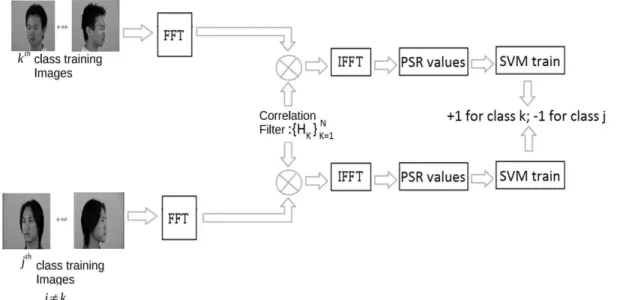
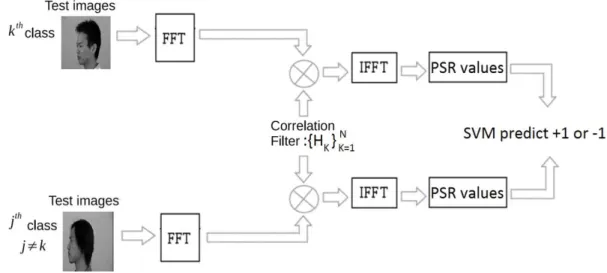
ages of the kthperson. We implement the Fourier transform for all training images of N classes and use the outcomes to design all the correlation filters hk(k=1, 2, …, N), which are multiplied by the out- put of each training image after taking the Fourier transform. The inverse Fourier transformed was applied to the output of each multiplication, and give the final result, which use to determine the correlation peak in the traditional correlation filter methods. In our method, we use the final results to calculate the peak to side-lobe ratio (PSR) val- ues, which are given by equation 7. The PSR val- ues will be the input feature vectors of the SVM for the training phase. The process in the testing phase is similar to the training one, except that the SVM will predict the class for PSR values, also
Fig. 3. The proposed method uses for the training set.
the class of each testing image. Each of the testing images in the dataset will create the 1xN feature vector because we have N correlation filters.
(9) where max(corr), mean(corr), and std(corr) are the maximum, mean, and the standard deviation of the correlation plane, respectively.
3. NUMERICAL RESULTS
The experiments run on an INTEL CPU i7 7700
with 32 GB RAM. First of all, we utilize the NCKU face database to estimate the performance of the correlation filters. We pick randomly 15 subjects from the database. There are 74 images in total for each subject, in which a half were generated by rotating the pain every 5 degrees from +90° (the right profile) to -90° (the left profile). Then, the authors in [10] use the commercial software in im- age processing for the horizontal flipping process on these existing 37 images to obtain the remaining 37 images. Fig. 5 is an example in the NCKU face database, pictures from 0° (frontal) to -90° (left Fig. 4. The proposed method uses for the testing set.
Fig. 5. The different views of one class in NCKU face database.
profile), obtained from this process.
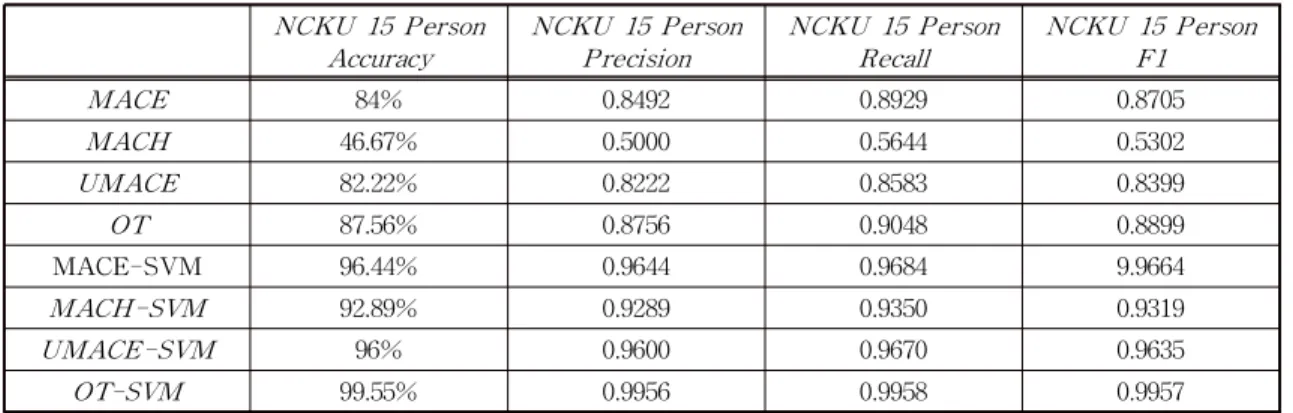
We take a training/testing split on the data using 59 images for training and 15 for testing with each subject. The training data will be 885 images and 225 for testing data with the whole dataset. As seen in table 1, the MACE filter yields an accuracy of 84.00%, while MACH and UMACE are 46.67%
and 82.22%, respectively. Fig. 6 shows the detailed result of the MACE filter. MACH filter gives the worst result. In contrast, the MACE filter classifies well for most of the classes, except for two groups.
Each person, 5 and 7 in group 1, has an accuracy
of 46.7%. Three persons in group 2 have the same accuracy of 66.7%.
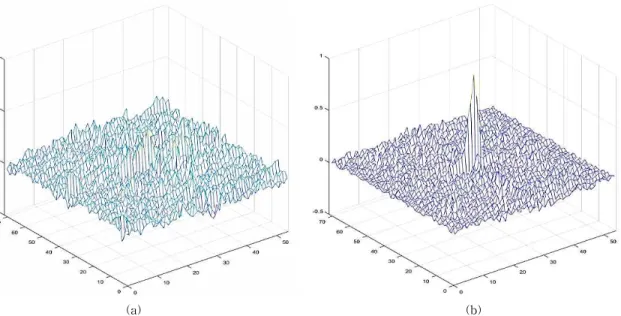
For each person in the dataset, for example, per- son A, we construct one correlation filter from 59 training images. For each testing image, we calcu- late the correlation output with the correlation filters. We have a peak on the correlation plane if the testing image is person A, and vice versa, as shown in Fig. 7.
So far, we have already compared the accuracy of four correlation filters: MACE, MACH, UMACE and OT. We evaluate the combination of the corre-
UMACE-SVM 96% 0.9600 0.9670 0.9635
OT-SVM 99.55% 0.9956 0.9958 0.9957
Fig. 6. The confusion matrix of MACE.
lation filters and SVM in face recognition in the next step. We use the correlation filters to calculate the PSR values, which use as input vector of SVM.
Firstly, we compare the proposed method with the original correlation filter, as seen in table 1. The proposed method improves the accuracy of 12.44%,
46.22%, 13.78%, and 11.99% when compared to tra- ditional filters MACE, MACH, UMACE, and OT, respectively (see table 1). All four filters get accu- racy over 90% when using SVM to classify ex- tracted features. Specifically, the OT-SVM got the highest accuracy of 99.55%. Fig. 8 gives the de-
(a) (b)
Fig. 7. The correlation peak shows how well the training and test images match: (a) No match and (b) Match.
Fig. 8. The confusion matrix of MACE-SVM.
tailed result of the MACE-SVM in face recognition.
The SVM-MACE has five classes under 100%
accuracy. The SVM-MACH got the lowest accu- racy at 92.89% but significantly improve with the original MACH (+46.22%).
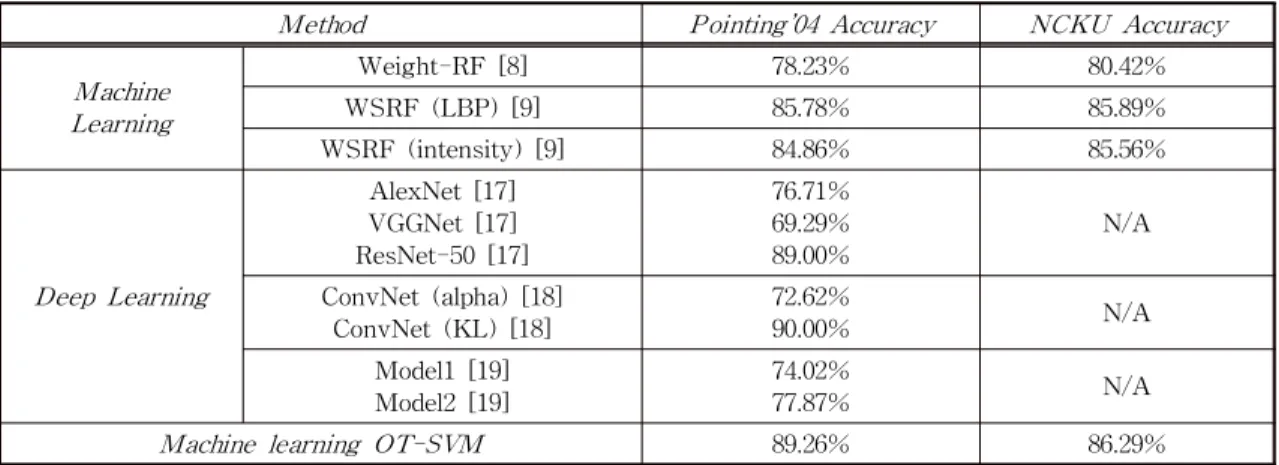
Secondly, we use both NCKU and Pointing’04 face database to compare the proposed method with other machine learning methods. For a fair observation, we split the face database the same way that the authors mention in [8-9]. Specifically, 10% of Pointing’04 images are testing. With NCKU, we use a subset containing the first 37 images of all subjects (see [8]), and one-third of them are testing set. We chose γ = 1 and α = β = 0.5 to create the optimal trade-off filter. The OT filter will ex- tract the features from images, and SVM classifies these features. OT-SVM increases the accuracy by 11.03% on Pointing’04 and 5.87% on NCKU when compare to other machine learning methods (see table 2).
Table 2 shows the result of several deep learning approaches on the Pointing’04 dataset. The deep learning approach in Reference [18] evaluates the Pointing’04 dataset with three different deep learn- ing architectures: AlexNet, VGGNet, and ResNet- 50. Reference [19] applies a specific convolutional neural network structure: ConvNets, using two loss functions: alpha divergence (alpha) and Kull- backLeibler (KL). Two different CNN models are
evaluated on the Pointing’04 dataset (see Reference [20]). OT-SVM is more accurate than other deep learning methods, except ConvNet (KL) method.
The ConvNet (KL) method requires a good GPU (an NVIDIA K40 GPU with 12GB memory), while a based-machine learning method such as OT- SVM runs well without the GPU.
5. CONCLUSION
Face recognition system is a computational technology that uses different algorithms that rec- ognize and then validate the recorded faces with facial images stored in the database. Face recog- nition is an essential topic in computer vision, and many researchers have researched this subject in various ways concerning many applications such as surveillance systems. This paper presents an application of machine learning and correlation fil- ters on face recognition. The OT filter obtains the features from images, and SVM classifies them.
Experimental results show that the OT-SVM method gives a higher accuracy compared to the traditional filters and other machine learning and deep learning methods. OT-SVM doesn’t require the GPU, and it could run well on limited hardware resources like embedded systems. For future work, we will integrate the proposed method with the embedded hardware and develop the full face rec- Model1 [19]
Model2 [19] 74.02%
77.87% N/A
Machine learning OT-SVM 89.26% 86.29%
ognition system.
REFERENCE
[ 1 ] Q.W. Shahid and A.N. Alvi, “Object Tracking using MACH Filter and Optical Flow in Cluttered Scenes and Variable Lighting Conditions,” World Academy of Science, Engineering and Technology, Vol. 60, pp.
709-712, 2009.
[ 2 ] M. David and L.Y. Yu, “Face Recognition Subject to Variations in Facial Expression, Illumination and Pose using Correlation Filters,”
Journal Computer Vision and Image Under- standing, Vol. 104, No. 1, pp. 1-15, 2006.
[ 3 ] G. Verma and A. Sinha, “Design of Advanced Correlation Filters for Finger Knuckle Print Authentication Systems,” Proceedings of In- ternational Conference on Computer Vision and Image Processing, pp. 47-56, 2017.
[ 4 ] M. Savvides, B.V. Kumar, and P. Khosla,
“Face Verification using Correlation Filters,”
P roceedings of the 3rd IEEE Automatic Identification Advanced Technologies, pp. 56- 61, 2002.
[ 5 ] X. Zhu, S. Liao, Z. Lei, R. Liu, and S.Z. Li,
“Feature Correlation Filter for Face Recogni- tion,”Proceedings of International Conference on Biometrics, pp. 77-86, 2007.
[ 6 ] A.J.V. Nevel and A. Mahalanobis, “Compar- ative Study of Maximum Average Correlation Height Filter Variants using Ladar Imagery,”
Optical Engineering, Vol. 42, No. 2, pp. 541- 551, 2003.
[ 7 ] J. Ahmed, S. Abbasi, and M.Z.Shaikh, “Fast Spatiotemporal MACH Filter for Action Re- cognition,” Machine vision and applications, Vol. 24, No. 5, pp. 909-918, 2013.
[ 8 ] R. Zhu, G. Sang, Y. Cai et al., “Head Pose Estimation with Improved Random Regres- sion Forests,”Proceedings of the 8th Chinese Conference on Biometric Recognition (CCBR
’13), pp. 457-465, 2013.
[ 9 ] S. Gaoli, H. Chen, and Q. Zhao, “Head Pose Estimation with Improved Random Regression Forests,”Mathematical Problems in Engineer- ing, Vol. 2015, 2015.
[10] K.T. Kim and J.Y. Choi, “Using Spatial Pyr- amid Based Local Descriptor for Face Recog- nition,”Journal of Korea Multimedia Society, Vol. 20, No. 5, pp. 758-768, 2017.
[11] The National Cheng Kung University Face Database, http://www.datatang.com/data/14866 (accessed March 10, 2020).
[12] Pointing’04 Database, http://www-prima.inri alpes.fr/perso/Gourier/Faces/HPDatabase.
html (accessed March 10, 2020).
[13] A. Géron,Hands-On Machine Learning with Scikit-Learn & TensorFlow, O’Reilly Media, Inc., CA 95472, USA, 2017.
[14] B. Yekkehkhany, A. Safari, S. Homayouni, and M. Hasanlou, “A Comparison Study of Different Kernel Functions for Svm-Based Classification of Multi-Temporal Polarimetry SAR Data,” International Archives of the Photogrammetry, Remote Sensing and Spatial Information Sciences, Vol. XL-2/W3, pp. 281- 285, 2014.
[15] A. Mahalanobis, B.V.K.V. Kumar, and D.
Casasent, “Minimum Average Correlation Energy Filters,”Applied Optics, Vol. 26, No.
17, pp. 3633-3640, 1987.
[16] B.V.K.V. Kumar, J.A. Fernandez, A. Rodriguez, and V.N. Boddeti, “Recent Advances in Correlation Filter Theory and Application,”
Proc. SPIE, Vol. 9094, pp. 909404, 2014.
[17] B.V.K.V. Kumar, D.W. Carlson, and A. Mahala- nobis, “Optimal Trade-off Synthetic Discri- minant Function Filters for Arbitrary Devices,”
Optics Letters, Vol. 19, pp. 1556-1558, 1994.
[18] Y. Wang, W. Liang, J. Shen, Y. Jia, and L.
F. Yu, “A Deep Coarse-to-fine Network for Head Pose Estimation from Synthetic Data,”
P attern Recognition, Vol. 94, pp. 196-206, 2019.
Hoang Long
He received his B.S. and M.S.
degrees in Electronics Engin- eering at the University of Technology, Ho Chi Minh City, Vietnam in 2007 and 2011, re- spectively. Since September 2018, he’s a Ph.D. student in the de- partment of Artificial Intelligence Convergence at Pukyong National University, Korea. His research in- terests include Signal Processing and Machine Learning.
Oh-Heum Kwon
He received the BS degree in computer engineering from Seoul National University in 1988, and the MS and PhD degrees in computer science from the Korea Advanced Institute of Science and Technology in 1991 and 1996, respectively. He is currently a professor in the Dept.
of IT Convergence and Applications Engineering at the Pukyong National University, Pusan, Republic of Korea. His research interests include design and anal- ysis of algorithms, medical image analysis, artificial intelligence, and machine learning.
and computer graphics.
Ki-Ryong Kwon
He received the B.S., M.S., and Ph.D. degrees in electronics en- gineering from Kyungpook National University in 1986, 1990, and 1994 respectively. He worked at Hyundai Motor Com- pany from 1986-1988 and at Pusan University of Foreign Language from 1996- 2006. He is currently the Dean of Engineering College as well as a professor in Department of IT Convert- gence and Application Engineering at the Pukyong National University. He has researched University of Minnesota in USA in 2000-2002 with Post-Doc. He was the President of Korea Multimedia Society in 2015-2016. His research interests are in the area of digital image processing, multimedia security, bio- informatics, and machine learning.