Received: June 12, 2018 Revised: August 8, 2018 Accepted: August 29, 2018
Address for Correspondence: Eun-Hee Yoo, Department of Obstetrics and Gynecology, Kyung Hee University Hospital at Gangdong, Kyung Hee University College of Medicine, 892 Dongnam-ro, Gangdong-gu, Seoul 05278, Korea
Tel: +82-2-440-6141, Fax: +82-2-440-6295, E-mail: [email protected]
Original Article
pISSN: 2288-6478, eISSN: 2288-6761 https://doi.org/10.6118/jmm.2018.24.3.163 Journal of Menopausal Medicine 2018;24:163-168
J MM
Introduction
Pelvic organ prolapse (POP) is the most common, caus- ing of hysterectomy among the postmenopausal women who have suffered from genitourinary syndrome of menopause.1 Current treatment for prolapse consists of surgery, con- servative management or “watchful waiting”. Mechanical interventions (such as pessaries) and lifestyle interventions (such as weight loss and avoiding placing strain on the pelvic floor) are both conservative management options. In addi- tion, pelvic floor muscle training aims to improve structural
support for pelvic organs through effective exercise of the pelvic floor muscles.2 And Acacia nilotica which is a plant contain tannins and steroids is reported to be effective in decreasing the pelvic prolapse, and improving the quality of life.3
Approximately 11% of women undergo surgery for POP or urinary incontinence during their lifetime.4 One of the most common complications of this surgery is postoperative uri- nary retention (POUR), with an overall rate ranging from 2.5% to 43% depending on the definition used.5~8
No valid conclusion regarding voiding dysfunction after
Predictors of Acute Postoperative Urinary Retention after Transvaginal Uterosacral Suspension Surgery
Eun-Joo Son1, Eunwook Joo1, Woo Yeon Hwang2, Mi Hyun Kang2, Hyun Jin Choi2, Eun-Hee Yoo1
1Department of Obstetrics and Gynecology, Kyung Hee University Hospital at Gangdong, Kyung Hee University College of Medicine, Seoul, Korea, 2Department of Obstetrics and Gynecology, Kyung Hee University Medical Center, Kyung Hee University College of Medicine, Seoul, Korea
Objectives: To investigate the rate of postoperative urinary retention (POUR) and identify the risk factors for this complication in women who underwent transvaginal uterosacral suspension surgery.
Methods: A retrospective chart review was conducted for 75 women who underwent transvaginal uterosacral suspension surgery with vaginal hysterectomy, repair of cystocele, and levator myorrhaphy with/without transobturator anti-incontinence surgery.
POUR was defined as a need for continuous intermittent catheterization on the third day subsequent to removal of the urethral indwelling catheter.
Results: Acute POUR was reported in 18 women (24.0%). Thirty-six of the 75 patients (48.0%) had undergone anti-incontinence surgery. Crude analysis revealed significant association between the following variables and the risk of POUR: hypertension, the lower average flow rate in the pressure-flow study (PFS), greater post-void residual (PVR) urine volume in PFS, and PVR >30% of the total bladder capacity (TBC) in PFS. In the logistic regression analysis, PVR >30% of the TBC in PFS was identified as the only significant predictor of POUR (odds ratio, 15.4; 95% confidence interval, 2.5-90.9; P = 0.003).
Conclusions: The PVR >30% of the TBC in PFS was identified as the only predictive factor of acute POUR in women who underwent transvaginal uterosacral suspension surgery. (J Menopausal Med 2018;24:163-168)
Key Words: Pelvic organ prolapse · Postoperative complications · Urination disorders
Journal of Menopausal Medicine 2018;24:163-168
J MM
prolapse surgery has been drawn from the data available owing to variations in defining and reporting voiding prob- lems. The cutoff level for urinary retention has not been de- fined by the International Continence Society (ICS). In clini- cal practice, it is usually defined as a 50 to 200 mL residual volume or >20% of the total bladder volume after voiding.
Other studies used the duration of postoperative urethral catheterization as a marker of the presence and severity of urinary retention. The existing evidence is not enough to demonstrate the superiority of any of the definitions.
Early identification and treatment of POUR can prevent further morbidity. However, unknown prolonged bladder distension may result in urinary tract infection (UTI), de- trusor dysfunction, and even damage to the surgical repair.9 The purpose of this study was to investigate the incidence of POUR and identify the risk factors of this complication in women who had undergone vaginal prolapse surgery.
Materials and Methods
This study included all the women who underwent trans- vaginal uterosacral suspension surgery for symptomatic POP by 1 operator between January 2013 and December 2015.
Their electronic medical records were reviewed retrospec- tively after obtaining Institutional Review Board approval.
We obtained data of baseline demographics, preopera- tive and postoperative POP-quantification measurements, operative time, estimated blood loss, length of hospital stay, and concomitant operative procedures. Urodynamic study (UDS) was performed for all the women prior to surgery by using the Solar Gold System (Medical Measurement Sys- tems, Dover, NH, USA) after the insertion of gauze packing for prolapse reduction. A multi-channel UDS consists of uroflowmetry, filling cystometry, pressure-flow study (PFS), and urethral pressure profilometry, in accordance with the standard protocol of the ICS recommendations. Preoperative urinalysis and culture were performed to rule out significant bacteriuria or cystitis. All UTIs were treated before surgery.
All the patients underwent hysterectomy. The small bowel was packed out of the operative field with a long gauze, and a Breisky-Navratil retractor was properly positioned to ex- pose the uterosacral ligaments (USLs). The USLs were then
bilaterally transfixed in their intermediate portion (at the level of or above the ischial spine plane), with monofilament long-term absorbable 0 sutures (polydioxanone sutures;
Ethicon Inc., Piscataway, NJ, USA). The USL sutures were then passed both anteriorly and posteriorly through the peritoneum, apex of the vaginal fascia, and vaginal mu- cosa. When anterior repair was performed, vesicovaginal fascia plication was performed before fascia transfixion with USL sutures. USL sutures were tightened to close both the peritoneum and vaginal cuff. Internal and external McCall stitches were placed for cul-de-sac obliteration routinely.
Levator plication was performed for repair of the rectocele and support of the vaginal vault. Diagnostic cystoscopy was performed after the USL suture to assess ureteral bilateral patency. Transobturator anti-incontinence surgery was de- cided on the basis of UDS. The indwelling urethral catheter was removed between 2 and 4 days postoperatively in con- sideration of the patient’s willingness.
Acute POUR was defined as the need for continuous in- termittent catheterization (CIC) on the third day subsequent to removal of the indwelling urethral catheter. CIC was per- formed when the post-void residual urine volume was >100 mL or more than one third of the total bladder volume for 2 consecutive times, within 2 days after urethral catheter re- moval. The patients without POUR served as the comparison group.
Statistical analysis was performed with SPSS Version 16.0 (SPSS Inc., Chicago, IL, USA). A univariate analysis was performed using the Mann Whitney U test, Pearson χ2 test and Wilcoxon signed rank test. A logistic regression analysis was performed to determine the significant parameters of acute POUR after transvaginal uterosacral suspension sur- gery. Statistical significance was defined as a P value of
<0.05.
Results
During the study, 75 patients underwent surgery for symptomatic POP. Eighteen women (24.0%) had POUR. In- dwelling of the urethral catheter was prolonged for a mean of 4.6 days (range, 2-6 days). The postoperative CIC was discontinued at a mean postoperative period of 6 days (range,
Journal of Menopausal Medicine 2018;24:163-168 Eun-Joo Son, et al. Acute Postoperative Urinary Retention
3-12 days).
The patients’ demographic and baseline characteristics are shown in Table 1. The mean age of the patients in the acute urinary retention group was 68.2 ± 6.5 years. Hypertension was found more often in the acute urinary retention group (77.8%) than in the non-urinary retention group (49.1%; P < 0.05). The remaining characteristics were similar between 2 groups.
The anatomical factors and surgical properties associated with POP are shown in Table 2. The preoperative prolapse stage was similar between 2 groups.
Table 3 presents the comparison of the preoperative UDS between the 2 groups. Post-void residual (PVR) urine vol- ume measured using uroflowmetry was greater in the acute urinary retention group than in the comparison group (74.5
± 96.7 mL vs. 38.8 ± 56.8 mL; P = 0.118). However, no statistically significant difference in peak or average flow rate was found between 2 groups. In the PFS, the average flow rate was significantly lower in the acute urinary reten- tion group (7.4 ± 4.4 mL/s vs. 9.6 ± 4.4 mL/s; P = 0.047).
Furthermore, PVR was greater in the acute urinary reten- tion group than in the non-retention group (180.1 ± 173.1 mL vs. 49.3 ± 78.4 mL; P = 0.001). No statistically signifi- cant difference in the proportion of patients who underwent anti-incontinence surgery was found between the 2 groups.
The comparison of preoperative voiding function defined in the UDS is shown in Table 4. PVR >30% of the total bladder capacity (TBC) in PFS was more prevalent in the acute urinary retention group (50.0%) than in the compari- son group (10.5%; P = 0.001). The other parameters includ- ing PVR >30% of the void volume on uroflowmetry did not show any statistically significant differences between the 2 groups.
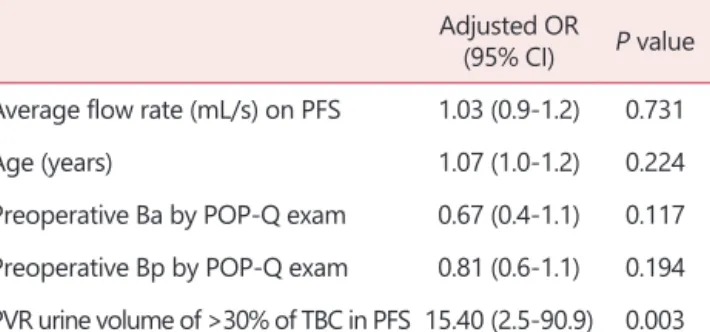
Table 5 shows the results of the multivariate logistic re- gression analysis for predicting the parameters of acute POUR. PVR >30% of the TBC in PFS was identified as a significant predictor of acute POUR after vaginal recon- structive surgery (odds ratio, 15.4; 95% confidence interval, 2.5-90.9; P = 0.003).
Table 1. Demographics of patients Acute urinary
retention (n = 18)
No urinary retention
(n = 57) P value
Age (years) 68.2 ± 6.5 68.9 ± 6.8 0.584
Vaginal parity 3.8 ± 1.9 3.4 ± 1.4 0.413
BMI (kg/m2) 25.9 ± 3.8 26.1 ± 3.2 0.654 Prior anti-incontinence
surgery 1 (5.6%) 3 (5.3%) 0.416
Hypertension 14 (77.8%) 28 (49.1%) 0.035
Diabetes mellitus 2 (11.1%) 9 (15.8%) 0.269 The data is presented as mean ± standard deviation or n (%) BMI: body mass index
Table 2. Preoperative pelvic organ prolapse quantification measurements
Acute urinary retention
(n = 18)
No urinary retention
(n = 57) P value Preoperative Ba
by POP-Q exam 3.4 ± 1.7 2.6 ± 1.5 0.125 Preoperative C
by POP-Q exam 1.8 ± 3.9 2.1 ± 3.8 0.407 Preoperative Bp
by POP-Q exam 0.9 ± 2.9 1.2 ± 2.1 0.166 The data is presented as mean ± standard deviation
POP-Q: pelvic organ prolapse quantification
Table 3. Urodynamic evaluation and associated surgical procedure Acute urinary
retention (n = 18)
No urinary retention
(n = 57) P value Uroflowmetry
Peak flow rate (mL/s) 12.9 ± 8.6 16.9 ± 9.7 0.129 Average flow rate (mL/s) 6.5 ± 4.1 8.0 ± 4.9 0.363 PVR urine volume (mL) 74.5 ± 96.7 38.8 ± 56.8 0.118 Pressure flow study
Peak flow rate (mL/s) 16.4 ± 7.0 19.9 ± 7.2 0.074 Average flow rate (mL/s) 7.4 ± 4.4 9.6 ± 4.4 0.047 PdetQmax (cm H2O) 31.3 ± 19.0 29.6 ± 17.5 0.724 PVR urine volume (mL) 180.1 ± 173.1 49.3 ± 78.4 0.001 Anti-incontinence surgery 6 (33.3%) 30 (52.6%) 0.184 The data is presented as mean ± standard deviation or n (%) PVR: post-void residual
Journal of Menopausal Medicine 2018;24:163-168
J MM
Discussion
This retrospective study aimed to demonstrate the inci- dence of acute POUR after surgery for POP and to identify risk factors associated with this complication. Acute urinary retention was found in 24% of the subjects, and PVR >30%
of the TBC in PFS was the significant factor that predicted increased risk of POUR.
The incidence of POUR in this study was consistent with those reported in the literature. Hakvoort et al.7 identified a POUR rate of 29% after vaginal POP repair where retention was defined as a PVR volume of >200 mL. Steinberg et al.10 identified a POUR rate of 34% after vaginal mesh procedures for POP where retention was defined as discharge from the hospital with an indwelling Foley catheter due to a failed voiding trial.
The clinical risk factors that affected POUR included age,
female sex, lower body mass index, previous incontinence surgery, advanced stage of prolapse and postoperative UTI.11,12 The intraoperative risk factors of POUR have been reported as spinal anesthesia, administration of >750 mL of intraoperative fluid, estimated blood loss >100 mL and postoperative opioid use.7,13,14 In addition, a correlation was suggested between the preoperative urodynamic parameters and POUR after prolapse surgery.15~17
The clinical usefulness of uroflowmetry has been ham- pered by the lack of absolute values for defining normal limits. These normal limits would need to be over a wide range of voided volumes, ideally in the form of nomograms.
Haylen et al.18 constructed a nomogram of peak and average flow rates on the respective voided volume, known as the Liverpool nomogram. Those with voiding dysfunction show a lower peak or average flow rate.
PVR urine is the volume of urine remaining in the bladder immediately after completion of micturition. A consistently high residual urine volume generally indicates increased outlet resistance, decreased bladder contractility, or both.
Absent PVR urine is compatible with normal urinary tract function, but can also exist in the presence of significant filling and storage disorders (incontinence) or with disorders of emptying in which the intravesical pressure is sufficient to overcome increased outlet resistance. What constitutes an abnormally high residual urine volume is not universally established. Previous investigators have empirically chosen volumes of 50 or 100 mL to indicate normal residual urine volumes. However, the residual urine volume is best stated only in the context of total voided volume. Normality should be described as a percentage of the total voided volume.
Table 4. Comparison of preoperative voiding function using different definitions
Acute urinary retention
(n = 18) No urinary retention
(n = 57) P value
Peak flow rate < 10 percentile of Liverpool nomogram of uroflowmetry 9 (50.0%) 24 (42.1%) 0.595 Average flow rate < 10 percentile of Liverpool nomogram of uroflowmety 9 (50.0%) 35 (61.4%) 0.422
≥Moderate obstruction in Blaivas-Groutz nomogram 6 (33.3%) 7 (12.3%) 0.069
PVR urine volume of >30% of total void volume on uroflowmetry 8 (44.4%) 11 (19.3%) 0.059
PVR urine volume of >30% of TBC in PFS 9 (50.0%) 6 (10.5%) 0.001
The data is presented as n (%)
PVR: post-void residual, TBC: total bladder capacity, PFS: pressure-flow study
Table 5. Multivariate logistic regression analysis of risk factors for acute postoperative urinary retention
Adjusted OR
(95% CI) P value Average flow rate (mL/s) on PFS 1.03 (0.9-1.2) 0.731
Age (years) 1.07 (1.0-1.2) 0.224
Preoperative Ba by POP-Q exam 0.67 (0.4-1.1) 0.117 Preoperative Bp by POP-Q exam 0.81 (0.6-1.1) 0.194 PVR urine volume of >30% of TBC in PFS 15.40 (2.5-90.9) 0.003 PFS: pressure-flow study, POP-Q: pelvic organ prolapse quanti- fication, PVR: post-void residual, TBC: total bladder capacity, OR:
odds ratio, CI: confidence interval
Journal of Menopausal Medicine 2018;24:163-168 Eun-Joo Son, et al. Acute Postoperative Urinary Retention
Most asymptomatic women should void spontaneously at least 80% of their total intravesical volume. Abnormal PVR is associated with older age, higher grade of vaginal prolapse and recurrent UTI.
The urodynamic diagnosis of bladder outlet obstruction (BOO) in women is not established contrary to that in men.
Even though the normal detrusor pressure at peak flow rate (PdetQmax) is poorly defined, a PdetQmax <10 cm H2O is considered hypotonic and is associated with voiding dys- function. Blavias-Groutz suggested a nomogram to diag- nose BOO in women, with a peak flow rate of <12 mL/sec on uroflowmetry and a PdetQmax of >30 cm H2O.19
In this study, the cutoff peak, and average flow rates, and PdetQmax for predicting POUR were determined by using the Liverpool nomogram and Blavias-Groutz BOO nomogram. In addition, the abnormal PVR that predicts POUR was determined in different clinical settings after uroflowmetry and pressure flow study. All these urodynamic parameters failed to predict POUR after transvaginal utero- sacral suspension surgery. Only PVR of more than 30% of the TBC after PFS was revealed as a significant risk factor for predicting acute POUR after transvaginal uterosacral suspension surgery. PVR in PFS after reduction of prolapse with gauze packing could reflect a similar condition as that in postoperative voiding.
The strength of our study was that we incorporated void- ing parameters of UDS and clinical factors to identify the predictors of acute POUR after uterosacral suspension sur- gery. However, our study also had a number of limitations.
As a result of the small number of patients, we could not exclude that a lack of statistical power may have impaired our results. In addition, we had no information about long- term voiding function after transvaginal uterosacral sus- pension surgery.
Our study revealed PVR after PFS with reduced prolapse with gauze packing was a strong predictor of acute POUR.
The women with >30% of residual urine volume of TBC in the UDS should be counseled about acute POUR before vag- inal prolapse surgery. In addition, this finding of our study can be applied to the clinical management of postoperative urethral catheterization after vaginal prolapse surgery. Fur- ther systemic approach for poor voiders who undergo vaginal prolapse surgery is needed.
Conflict of Interest
No potential conflict of interest relevant to this article was reported.
References
1. Kim HK, Kang SY, Chung YJ, Kim JH, Kim MR. The re- cent review of the genitourinary syndrome of menopause. J Menopausal Med 2015; 21: 65-71.
2. Hagen S, Stark D, Glazener C, Dickson S, Barry S, Elders A, et al. Individualised pelvic floor muscle training in women with pelvic organ prolapse (POPPY): a multicentre ran- domised controlled trial. Lancet 2014; 383: 796-806.
3. Roozbeh N, Darvish L. Acacia nilotica: New plant for help in pelvic organ prolapse. J Menopausal Med 2016; 22: 129- 30.
4. Olsen AL, Smith VJ, Bergstrom JO, Colling JC, Clark AL.
Epidemiology of surgically managed pelvic organ prolapse and urinary incontinence. Obstet Gynecol 1997; 89: 501-6.
5. Tammela T, Kontturi M, Lukkarinen O. Postoperative uri- nary retention. I. Incidence and predisposing factors. Scand J Urol Nephrol 1986; 20: 197-201.
6. Book NM, Novi B, Novi JM, Pulvino JQ. Postoperative voiding dysfunction following posterior colporrhaphy. Fe- male Pelvic Med Reconstr Surg 2012; 18: 32-4.
7. Hakvoort RA, Dijkgraaf MG, Burger MP, Emanuel MH, Roovers JP. Predicting short-term urinary retention after vaginal prolapse surgery. Neurourol Urodyn 2009; 28: 225- 8.
8. Dorflinger A, Monga A. Voiding dysfunction. Curr Opin Obstet Gynecol 2001; 13: 507-12.
9. Geller EJ. Prevention and management of postoperative urinary retention after urogynecologic surgery. Int J Wom- ens Health 2014; 6: 829-38.
10. Steinberg BJ, Finamore PS, Sastry DN, Holzberg AS, Caraballo R, Echols KT. Postoperative urinary retention following vaginal mesh procedures for the treatment of pel- vic organ prolapse. Int Urogynecol J 2010; 21: 1491-8.
11. Sokol AI, Jelovsek JE, Walters MD, Paraiso MF, Barber MD. Incidence and predictors of prolonged urinary retention after TVT with and without concurrent prolapse surgery.
Am J Obstet Gynecol 2005; 192: 1537-43.
12. Chae JY, Park GY, Kim JH, Kim HJ, Bae JH, Lee JG, et al. Points Aa and Ba are factors associated with preopera- tive voiding dysfunction in patients with cystocele. Eur J Obstet Gynecol Reprod Biol 2014; 174: 146-9.
Journal of Menopausal Medicine 2018;24:163-168
J MM
13. de Boer HD, Detriche O, Forget P. Opioid-related side ef- fects: Postoperative ileus, urinary retention, nausea and vomiting, and shivering. A review of the literature. Best Pract Res Clin Anaesthesiol 2017; 31: 499-504.
14. Keita H, Diouf E, Tubach F, Brouwer T, Dahmani S, Mantz J, et al. Predictive factors of early postoperative urinary re- tention in the postanesthesia care unit. Anesth Analg 2005;
101: 592-6.
15. Zhang L, Zhu L, Liang S, Xu T, Lang J. Short-term ef- fects on voiding function after mesh-related surgical repair of advanced pelvic organ prolapse. Menopause 2015; 22:
993-9.
16. Lo TS. One-year outcome of concurrent anterior and pos- terior transvaginal mesh surgery for treatment of advanced
urogenital prolapse: case series. J Minim Invasive Gynecol 2010; 17: 473-9.
17. Zhang L, Zhu L, Xu T, Liang S, Lang J. Postoperative voiding difficulty and mesh-related complications after To- tal Prolift System surgical repair for pelvic organ prolapse and predisposing factors. Menopause 2015; 22: 885-92.
18. Haylen BT, Ashby D, Sutherst JR, Frazer MI, West CR.
Maximum and average urine flow rates in normal male and female populations--the Liverpool nomograms. Br J Urol 1989; 64: 30-8.
19. Massolt ET, Groen J, Vierhout ME. Application of the Blai- vas-Groutz bladder outlet obstruction nomogram in women with urinary incontinence. Neurourol Urodyn 2005; 24:
237-42.