Abstract_As a multicultural society, the Republic of Korea is now entering into
‘Growth Transition’. Under these circumstances, this study attempted to ruminate current situations and form basic perceptions on a multicultural society for the fu- ture by summarizing and comparing government assistance trends and changes in a systematic and comprehensive manner from 2006 to 2017 and domestic multicultural society situations which have been examined in previous studies. For this, study investigated the current populations and characteristics of a domestic multicultural society and examined related laws and policies. Then, it analyzed their current situations, educational support channels and details, focusing on children from multicultural families. Then, it aimed to reconsider current problems and criti- cisms and contemplate ways to solve them by reviewing previous studies. In other words, to implement this kind of study, this study attempted to investigate changes in government policies for transition to a multicultural society. For this, the related data were analyzed based on the ‘first-(2008-2012) and 2nd (2013-2017)-stage Mul- ticultural Family Policy Master Planning and Promotion’ set by the Ministry of Gender Equality and Family. The above period includes the related polices such as support on married immigrant women’s settlements, assistance to multicultural families and their children and improvement of acceptance of multicultural families since the en- actment of the ‘Support for Multicultural Families Art’ in 2008. Furthermore, the 3rd- stage Multicultural Family Policy Master Planning and Promotion is set to ‘2018-2022’.
Since it is still in progress, this period has been excluded from the analysis. Based
본 연구는 한국연구재단, SCH 특수아동교육연구소(순천향대학) 후원으로 개최된 ‘2017 SECI Interna- tional Symposium’ 영문 발표 원고를 중심으로 최근 자료(2017·2019년)를 참조하여 재구성하였음.
# 본 연구를 위해 귀한 조언과 의견을 주신 심사위원 분들과 수고해 주신 학회 관계자 여러분께 감사드립 니다.
* U1 University, Associate professor, Learning Disability, [email protected]
** Daegu university, Professor, Department of Speech Language Pathology, [email protected]
A Study on Educational Support for Children from Multicultural Families
Park, Hye Sung* · Kim, Wha Soo**
1. Introduction: Objectives and South Korea’s Current Position toward Multicultural Society
In the 21st century, the Republic of Korea has entered into the era of multicul- tural society, and it now faces ‘Growth Transition’. Under these circumstances, it is needed to review and summarize the characteristics of a Korean multicultural soci- ety and national assistances for multicultural families, which haven’t been handled much in previous studies in a systematic and comprehensive manner. Therefore, this study investigated the current populations and characteristics of a domestic multicultural society and examined related laws and policies. Then, it analyzed their current situations, educational support channels and details, focusing on children from multicultural families. Then, it aimed to reconsider current problems and criticisms and contemplate ways to solve them by reviewing previous studies.
on the latest data from 2018 and 2019, however, this study targeted to compare and analyzed individual changes. This study also attempted to examine and analyze a trend in the policies of the Ministry of Education on children from multicultural families. For this, the period(2006-2017) was divided into the early-(2006-2008) and mid-(2009-2012) and recent/late-(2013-2017) stages based on the time of the implementation of educational support policies for children from multicultural families and their details. This study also summarized and suggested the early-stage ‘Edu- cational Support Policies for Children from Multicultural Families(2007)’, mid-stage
‘Educational Advancement Plan for Children from Multicultural Families(2012)’ and recent ‘Master Support Policies for Children from Multicultural Families(2016)’, which reflect the policies of the Ministry of Education.
Keywords_ Multicultural families and children, Multicultural society, Educational Sup- port and Policy
Population and Characteristics of Multicultural Society
Today’s Korean society is a multicultural society. It had family formation by Korean women and U.S. soldiers after the tragic Korean War, foreign workers and their families immigrating actively into Korea as low-wage labor force in the 1980s, marriage immigrants who increased rapidly in number due to marrying with rural males from the late 1990s to 2000s as well as different kinds of natural- ized citizens(including North Korean defectors), and their children that consist the multicultural society(Kim 2015; Kim 2011; Chun 2018). That is, individuals with different nationalities, ethnicities, and cultures other than South Korea who formed multicultural families created today’s multicultural society in Korea. This meets the current trend of the world in the 21st century where immigrants are increasing due to various factors such as labor immigration, family immigration, and humanitarian immigration(Bennett 2007). However, they have formed multicultural nations that have different characteristics from labor immigrants and their family members for the existence and survival of a nation and traditional nations for immigration(U.S., Canada, Australia, and European nations) related to colonial rule.
According to 2015 Nationwide Multicultural Family Status Research by the Ministry of Gender Equality and Family(2016), there are 278,036 households of multicultural family in Korea, which is 1.3% of the entire households and more than triple of 2006, which is when attention started to be paid to identifying the actual status of multicultural families(Moon 2016). Also, the National Statistical Office(KOSIS) shows that households of marriage immigrants/naturalized citizens took up more than 63%, and nearly half of marriage immigrants and naturalized households have had a stable life in Korean society for more than 10 years. In ad- dition, the survey result by the Ministry of Justice from the National Statistical Office(KOSIS 2017) shows the total population of individual foreigners, not in terms of foreigner population-household, living in Korea was 1.89 million people (1.14 million registered people) as of 2015, which was 3.7% of the entire registered population(51,529, 338).
Among the entire foreign resident population, the proportion of foreign immi- grant workers was the highest at 35%(600,000 people) as of May 2015, followed by the number of marriage immigrants and naturalized citizens which was 14%
(240,000), and their children took up 12%(210,000)(Bae & Jeong 2016). This means more than 1 household per 10 households in Korea is a multicultural fam- ily, 4 out of 100 people are foreigners, and international marriage immigrants and foreign immigrant workers take up a huge proportion of Korea’s multicultural so- ciety. Also, Korea is a nation with the highest number of foreigners increased since 2000s among 29 OECD nations. When compared with the immigrant statistics data of major OECD nations(Kim 2015), in Korea, the percentage of foreigner population(did not acquire Korean nationality) has consistently taken up 1% of the entire population since 2004 and 2% since 2008 until recently.
This is slightly higher than the percentage of foreigner population in Japan, and it is projected that 5.5% of the entire population will be foreigners in the 2020s(Choi 2017).
2. The Point(Body)
Before reviewing South Korea’s transition into a multicultural society focusing on changes in national policies, this study analyzed the related data based on the
‘first-(2008-2012) and 2nd(2013-2017)-stage Multicultural Family Policy Master Planning and Promotion’ set by the Ministry of Gender Equality and Family. The above period includes the related polices such as support on married immigrant women’s settlements, assistance to multicultural families and their children and improvement of acceptance of multicultural families since the enactment of the
‘Support for Multicultural Families Art’ in 2008. Furthermore, the 3rd-stage Multicultural Family Policy Master Planning and Promotion is set to ‘2018-2022’.
Since it is still in progress, this period has been excluded from the analysis. Based on the latest data from 2018 and 2019, however, this study targeted to compare and
analyzed individual changes.
To examine and analyze a trend in the policies of the Ministry of Education on children from multicultural families, this study divided the period(2006-2017) in Table 1 into the early- (2006-2008) and mid- (2009-2012) and recent/late- (2013- 2017) stages based on the time of the implementation of educational support poli- cies for children from multicultural families and their details. This study also sum- marized and suggested the early-stage ‘Educational Support Policies for Children from Multicultural Families(2007)’, mid-stage ‘Educational Advancement Plan for Children from Multicultural Families(2012)’ and recent ‘Master Support Policies for Children from Multicultural Families(2016)’, which reflect the policies of the Ministry of Education.
1) Flow and Details of Multicultural-related Laws and Policy Formation in Korea
The term multi-culture, which refers to the coexistence and diversification of society with groups or individuals having different ethnic, racial, religious, and cul- tural identities within a certain social group, was first used in Canada in 1970(Bae
& Jeong 2016). It has been spread throughout the world and now indicates today’s social phenomenon. In a current Korean society, however, multi-culture has a limited meaning. More specifically, families with a handicapped, aged or sexual- minority member are not categorized as ‘multicultural families’. From the South Korean context, the term ‘multi-culture (multi-race)’ has a narrow meaning, which has been used since the inflow of immigrants (Koo Jung-hwa, Park Yoon-gyeong, Sul Gyu-joo 2010). In fact, it differs from the ideal and philosophical meanings which have recently been expanded across the country under various categories in- cluding disability, age, gender, hierarchy and sexuality. To define the phenomenon and independent characteristics of Korea as a multicultural society, the Ministry of Justice from different government agencies created the Immigration Administra- tive Research Committee in August 2004 and arranged the basic direction and
execution system of foreigner policy in December 2005. Then in November 2006, it decided on the ‘Basic Laws of Foreigner Treatment in Korea’ and enacted the law in May 2007. Also, the Ministry of Gender Equality and Family, one of the key multicultural-related agencies, finalized the basic direction of social integration with mixed blood and immigrants as well as the social integration support measure for marriage immigrant families in the national task meeting in April 2006. It had a public legislation hearing for the enactment of multicultural family support law in 2007, and passed the ‘Multicultural Family Support Law’ on March 21st,2008.
These two agencies for multicultural families formed and ran related laws and poli- cies by under each of their principles of ‘Immigration Policy versus Family Policy’, and 7 other related departments1(Ministry of Health, Welfare, & Family Affairs, Ministry of Education, Ministry of Culture and Sports, Ministry of Labor, Min- istry of Food, Agriculture, Forestry, and Fisheries, Ministry of Public Administra- tion & Security, and the Ministry of Reunification) as well as the Prime Minister’s Office developed and implemented policies related to multicultural families and children.(E.g. Prime Minister’s Office formed Foreigner Policy Committee and ar- ranged the basic direction and execution system of foreigner policy in 2006; Min- istry of Health, Welfare, & Family Affairs enacted ‘Multicultural Family Support Law’ in 2008; Ministry of Public Administration & Security arranged ‘Standard Regulation for Residing Foreigner Support’ in October 2006 and laid the foun- dation for local governments to support residing foreigners; Ministry of Labor enacted the ‘Law regarding Foreigner Employment’ in August 2003; Ministry of Reunification enacted ‘North Korean Defector Protection and Settlement Support Law’ in 1997 and ran alternative schools for the adolescents of Saeteomin, etc.)(Lee 2009; Bae & Jeong 2016; Moon 2016).
As a result, while the initial multicultural-related support policy focused on mar- riage immigrants’ Korean language acquisition and cultural adaptation for them to
1 Department names were changed and reorganized according to the government administrations (E.g. ‘Ministry of Health, Welfare, and Family’ related to the Multicultural Family Support Law was changed into the ‘Ministry of Health and Welfare’, and the ‘Ministry of Gender Equality’ was changed into ‘Ministry of Gender Equality and Family’ on March 19th, 2010).
Table 1. Policies and projects related to multicultural families/children by province (2006- 2017).
Details 2006
• Social integration support plans for female marriage im- migrants and mixed-blood immigrants
• Multicultural family support center(21 nationwide) # cur-
rently 217 nationwide • Announced and imple-
mented the educational support measure/ plans for the children of multi- cultural families (2006, 2007, 2008) 2007
• Adopt visit-support educational project for the children of marriage immigrants
• Saeteomin youth education support/Ministry of Education(Education Office, schools)
2008 • Enacted the ‘Multicultural Family Support Law (3. 21)’
• Customized support for multicultural families by the stages of life cycle
2009 • Installed the Multicultural Family Policy Committee
• Conducted 2009 Nationwide Multicultural Family Status Survey (1st, complete survey)
• Announced &
• implemented
• educational
• support plans for
• students of
• multicultural families (2009, 2010, 2011, 2012)
2010
• Established the 1st MulticulturalFamilyPolicy Basic Plan (2010-2012)
• /Multicultural Family Policy Committee
• -Vision: ‘Realize a mature nation in the world toward an open multicultural society’
• Free childcare for the infants/toddlers of multicultural families
• Adopted the visit dental treatment centers for multicul- tural families
• Multicultural language instructor
• Adopted portal website ‘Danuri’
2011
• Revised the ‘Multicultural Family Support Law (expand- ed the target to naturalized families, a policy encompass- ing the generation of Ju-young Jeong immigrants and children; includes youths and children born abroad)
• Childcare and language development support for the children of multicultural families
• Adopted Motherland/fatherland’s language acquisition support ‘Gifted Language Class’
• Support service for ‘good parents education’ and ‘chil- dren’s emotions and life’
• Executed Global Bridge project (to find the talent of multi- cultural children and cultivate their competence) 2012 • Established the 2nd MulticulturalFamilyPolicy Basic Plan
(2013-2017)
2012
• / Multicultural Family Policy Committee
• -Vision: ‘Lively Multicultural Family, Society for All of Us’
• (Goal: ‘Strengthen the capabilities of multicultural fami- lies as the growth engine of society’)
• Conducted 2012 Nationwide Multicultural Family Status Survey (2nd,samplesurvey)
• Visiting parental education to provide childcare informa- tion by the stages of lifecycle
• Announced the Ad- vancement Plans for Multicultural Students (3.12 Parents & teach- ers’ meeting)
2013 • language development support service
• Adopted the visiting care service
• Decided on the revised bill of enforcement or- dinance for elementa- ry/middle/high educa- tion law to support the educational support for multicultural students (10.22)
-Ran education level review committee &
special classes; laid basis for multicultural language instructors
2014
• Arranged multicultural family policy presentation plan (1.15) - 7 related agencies
• Executed a project to create an environment for bilingual families
• Customized education and counseling support for chil- dren of disbanded multicultural families
• Enacted the ‘Act on the Protection and Improvement of Cultural Diversity (5. 2)’
• Announced & Imple- mented Multicultural educational support plan
2015 • 2015 Nationwide Multicultural Family Status Survey(3rd, sample survey)
• Ran multicultural kindergartens
• Announced & imple- mented the educa- tional support plan for multicultural students (2015, 2016, # An- nounced in 2017)
2016
• Plan to inspect and manage the comprehensive mea- sure to support the children of multicultural families as well as similar/overlapping parts of multicultural family policy (Deliberated and announced in March)
• Multicultural family growth support program “Versatile”
• Ran a portal website for multicultural educational contents (Multicultural Educational Center ‘Nuri House’
www.nime.or.kr)
• Announced a delibera- tion plan to review &
manage the compre- hensive measure to support the children of multicultural families (3. 9)
adapt into their life in Korea, recently the policy direction has changed into educa- tional and employment support for multicultural families and their children(Moon 2016; Kim 2016; Park 2014; Chun 2018).
The details of policies (including laws) and projects related to multicultural fami- lies/children by province for the last 11 years(2006-2017), the era of multicultural society formation in Korea, are as in <Table 1>.
2017
• The 3rd-stage Multicultural Family Policy Master Plan
‘2018-2022’ established in April 2017; public hearing held on November 9 (Ministry of Gender Equality and Family)
• - Five categories set with a goal of ‘Non-discriminated Multicultural Society and Inclusion of Multicultural Families’ (support on multicultural families’ settlement, expansion of married immigrants’ participation in social and economic activities, support on the stable growth of children from multicultural families and enhancement of their competence, improvement of the acceptance of mutual respect-based multicultural family, reinforcement of the promotion system for operating multicultural family policies)
• The Multicultural Educa- tion Support Plan 2017 announced (Jan. 13) - Reinforcement of cus-
tomized education for children from multicul- tural families Custom- ized multicultural - Improvement in school
faculty’s understanding of multi-culture (prepa- ration from pre-service teachers, multicultural education teachers &
professional consul- tants, career consulta- tion teacher, training for low-performing students)
- Establishment of the grounds for promotion of multicultural educa- tion (support on active cooperation with related bureaus - the Ministry of Gender Equality and Family, Ministry of Justice and Ministry of Culture, Sports and Tourism)
# Reorganized based on Bu-kyeom Moon(2016)’s table(the notes on the right were presented by the Min- istry of Education)
2) Present of the Education of Multicultural Children(Status and Problem Analysis)
(1) Status of the Children of Multicultural Families(Population and Characteristics)
Currently, the number of the children of multicultural families under age 18 is about 200,000 based on the number(197,550) of foreign residents’ children in 2015 by the Ministry of Government Administration and Home Affairs that the National Statistical Office(KOSIS) renewed on November 29th,2016. In addition, according to the Status Nationwide Multicultural Families by the Ministry of Gender Equality and Family 1.02 child and the number of multicultural students attending elementary, middle, and high school is 99,000(1.68% of the entire stu- dent population) as of 2016, which was about 100,000 (reported by the Ministry of Education 2017. 1. 13). This means that the percentage of multicultural students in 2015 increased from 1.36% of the entire number of schooling students(6,088,827) (GED Statistics by Educational Development Institute 2016; Eun-hyeon Seong, requoted in 2017), showing that the percentage of multicultural students has been continuously increasing since it exceeded 1% in 2014 (Ministry of Education 2015;
2016; 2017). According to the 2019(February) data from the Ministry of Educa- tion, the number of children from multicultural families exceeded 120,000 in 2018, accounting for 2.2% of total students. For the past five years since 2014, it has increased by more than 10,000 annually(Ministry of Education 2018; 2019).
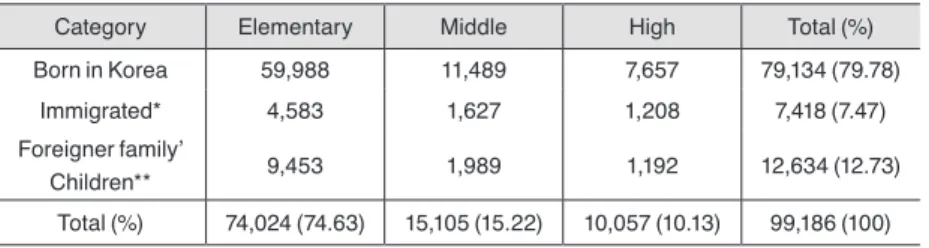
According to the 2016 status report by the Ministry of Education, the ratio of multicultural students born in Korea was the highest at 79.78%, followed by the children of foreigner families at 12.73%, and the children of immigrant families were 7.47%. Also, the population of students attending elementary school was the highest at 74.63%, followed by 15.22% middle school and high school 10.13%.
In terms of their parents’ nationality, Chinese(ethnic Koreans included) were the highest at 33.7%, followed by Vietnamese 24.2%, Japanese 13.0%, and Filipinos 12.6%; the percentage of ethnic Asian parents was the highest and the percent-
age of other nations was 16.5%. When compared to the data of the Ministry of Education(2019) dated April 2018, the trend remained the same except for the case that Vietnamese was higher than Japanese in terms of the former nationality of a parent of the children from multicultural families. Further more, according to the Foreigner Resident Status(November 2015) by the Ministry of Government Administration and Home Affairs, the number of pre-schooling children under age 6 was 116,600 among children of multicultural families, indicating that popula- tion of school-age children will continue to rise, more than 8 times from the mid- 2000s, expecting to move upward at the same time(Ministry of Education 2017).
In addition, the recent characteristics analysis(Ministry of Education 2016) shows that multicultural children’s study suspension rate is 1.01%, which is a bit higher than entire students’ study suspension rate(0.83%)(2015 Basic Education Statis- tics, Ministry of Education). About 58% of the children of multicultural families above age 15 and below 24 who can be engaged in economic activities are still students, but 1 out of 5 has been identified as ‘NEET’s who is not engaged in any- thing such as studies, career, or job training – children of mid-immigrants take up 32.9% according to the raw data analysis of the research on multicultural families status(Ministry of Gender Equality and Family 2012).
As stated above, this study analyzed the time(2016) when the development and promotion of the 2nd-stage(2013-2017) Multicultural Family Policy Master Plan
Table 2. 2016 Schooling Status of Children of Multicultural Families
Category Elementary Middle High Total (%)
Born in Korea 59,988 11,489 7,657 79,134 (79.78)
Immigrated* 4,583 1,627 1,208 7,418 (7.47)
Foreigner family’
Children** 9,453 1,989 1,192 12,634 (12.73)
Total (%) 74,024 (74.63) 15,105 (15.22) 10,057 (10.13) 99,186 (100)
# Based on the data reported by the Ministry of Education(2017. 1. 17)
* When a married immigrant remarries a Korean and brings her child from her homeland; a child born between a Korean and a married immigrant is raised in the immigrant’s homeland and bought back to the Republic of Korea; etc.; ** A child born between foreign national’s mom and dad
were completed and compared changes by referring to current statistics of the Ministry of Education. <Table 2> is a summary of the current composition and the schooling status of the children of multicultural families based on the data pro- vided by the Ministry of Education in January 2017. <Table 3> reveals recent policy announcements of the Ministry of Education(2019).
(2) Educational Support and Status for the Children of Multicultural Families: Related-policy and support system
As seen in the aforementioned explanations and tables, support policy for mul- ticultural families in Korea started in mid-2000s as an effort to change the overall paradigm of foreigner policy and promote the balance of national interest and the guarantee of human rights. In 2006, the 16th Korean president Roh Moo-hyun’s policy advisory committee arranged a ‘Support Plan for Social Integration of Fe- male Marriage Immigrants, Mixed-bloods, and Immigrants’, and ‘Basic Direction and Execution System of Foreigner Policy’ was formulated by the Foreigner Policy Committee of Office of Prime Minister, which became the basis. Their key were Table 3. 2018 Statistics on Students from Multicultural Families
Type Category
International marriage Family Foreigner Family Total Born in Korea Immigrated Foreigner
Family’ C.
School Divided into
Elementary 76,201 5,046 11,869 93,116
Middle 13,617 1,933 2,577 18,127
High 8,445 1,341 1,183 10,969
Parent’s Country of Birth
China* 26,681 3,905 9,136 39,722
Vietnam 34,012 1,187 369 35,568
Philippines 13,156 663 274 14,093
Japan 9,308 893 162 10,363
Other** 15,106 1,672 5,688 22,466
Total 98,263 8,320 15,629 122,212
# Unit: persons, %; source: Educational statistics (as of April 1, 2018)
* Korean-Chinese included; ** Other countries such as Thailand, Indonesia, Central Asia, USA and Russia
followed by the laws, policies, and support projects for multicultural families and their children: ‘Basic Law of Foreigner Treatment in Korea(2007)’ by the Ministry of Justice; ‘Educational Support Policy for Children(students) of Multicultural Families(1st)(2006, 2007, 2008)’; and ‘Multicultural Family Support Law(2008)’
by the Ministry of Health and Welfare; policy cooperation by the Ministry of Gender Equality and Family —transferred works related to multicultural families, adolescents, and children in March 2013 and carried out 1st and2nd ‘Multicultural Family Policy’ in 2010·2017; and ‘North Korean Defector Protection and Settle- ment Support Law’(1997) for North Korean defectors(Saeteomin) by the Ministry of Reunification(Lee 2009; Jung 2008; Park 2014).
Among them, the Ministry of Education(formerly Ministry of Education and Human Resources Development and Ministry of Education, Science, & Technol- ogy) created and executed ‘Educational Support Measure for the Children of Mul- ticultural Families’ in May 2016. Through this it became in charge of the school education support or multicultural education2 support for multicultural families’
children, but it had to receive cooperation or have discussions and connections with the Ministry of Health and Welfare and the Ministry of Culture, Sports, and Tourism rather than being independent. This system was established and organized when the 17th president Lee Myung-bak’s administration presented the second
‘2009-2012 Educational Support Plan for Children of Multicultural Families’ to improve and implement the educational support for the children of multicultural families. That is, the Ministry of Education formulated a learning support plan for multicultural children, teaching ability cultivation for kindergarten/ school educa- tion and the parents of multicultural families, and a plan for multicultural educa- tional policy. The ministry delivered them to each city and province’s education offices, which established and executed action plans that would meet the regional characteristics, and reported them to the Ministry of Education.
In response, the education offices of cities and provinces instructed and support- ed details plans of implementation that would meet the regional characteristics of
2 Called ‘multicultural education’ overall.
each education office’s jurisdiction, and schools carried out student-oriented educa- tion and gave counseling support to parents, reporting the results to the education offices. The education offices of cities and provinces reported the detailed results of each region to the Ministry of Education. Under this execution, the Ministry of Education had to mutually cooperate with the Ministry of Health and Welfare, which was in charge of infant-toddler care and the social integration/adjustment/
education of married immigrants, and the Ministry of Culture and Sport(formerly the Ministry of Culture, Tourism, and Sports), which was in charge of cultural and art education support for multicultural families and their children. In addition, the education offices of each city and province and unit ‘school’ educational insti- tutions had to organize multicultural education-related experts and programs by cooperating with local governments, which are called ‘local multicultural support institutions’, multicultural family support centers, provincial cultural centers, and regional HRD centers through the system at that time(Mu-young Lee 2009).
As examined previously, major support policy for multicultural families and their children were started in the middle of the 16th presidential(Roh Moo-hyun) administration(2003.2-2008.2) and were succeeded and applied by the 17th presi- dential (Lee Myung-bak) administration(2008.2-2013.2). However, the duties of Ministry of Gender Equality and Family3 that oversaw works related to multicul- tural families(including children) during Roh Moo-hyun’s administration were transferred to the Ministry of Health, Welfare, and Family Affairs during Lee Myung-bak’s administration. Then, the names of Ministry of Health and Welfare and the Ministry of Gender Equality were changed into the Ministry of Health and Welfare and the Ministry of Gender Equality and Family respectively due to reorganization on March 19th, 2010 of the same government, so the works were transferred to the Ministry of Gender Equality and Family’ which established and executed the‘1st and2nd(2010-2017) Multicultural Family Policy’(The 2nd Multicul- tural Family Policy’ in 2013-2017 was executed by the 18th president Park Geun-
3 The name was changed from the Ministry of Gender Equality in the mid-Roh Mu-hyeon’s adminis- tration, 2005.6.23.
hye’s administration).
Amidst this trend, the support for multicultural families and children can be said to be inefficient and have confused itself(Park 2017; Lee 2016). In 2012, the second half of President Lee Myung-bak’s administration, ‘The Plan to Advance Education for Multicultural Students’ was announced, bringing a new atmosphere to the policy and project implementation, but it confused the details and overall ex- ecution of ‘Education Support Measure for the Children of Multicultural Families’
carried out by the Ministry of Education. As a response, the government held the 12th ‘Multicultural Family Policy Committee’4 on Wednesday, March 9th, 2016 at the Government Complex- Seoul under the supervision of Prime Minister Hwang Kyo-ahn. It evaluated and presented ‘Comprehensive Support Measure for Chil- dren of Multicultural Families’ and the ‘Plan for Evaluating Similar Multicultural Family Policy’(reported by the Ministry of Education, 2016.3.9). It is an effort by the government to succeed the achievements of past 10 years and to prepare the next 10 years, making the related support and educational duties for multicultural children efficient at the same time, after the joint formulation of the support mea- sure for multicultural families’ social integration. It connotes the establishment of child support measures by growth stage and continuous efforts by the government to create a bit more mature multicultural society.
In particular, the Ministry of Gender Equality and Family, which handles mul- ticultural policies established the 3rd-stage Multicultural Family Policy Master Plan(2018-2022) in April 2017 and held public hearing on November 9. As stated in Table 1, the government authority set five categories and explored policy assign- ments with a goal of ‘Non-discriminated Multicultural Society and Inclusion of Multicultural Families’ (press release by the Ministry of Gender Equality and Fam- ily, Nov. 8, 2017). In other words, considering changed policy environments such as long-term settlement of married immigrants, formation of diverse family types and
4 Attended by 11 government committee members (Ministers of Education, Judicial Affairs, Minister for the Cabinet Office, Vice-Ministers of the Future Planning, Foreign Affairs, Government Adminis- tration and Home Affairs, Welfare, and Labor, Assistant Secretary of the Food, Agriculture, Forestry, and Fisheries), and 7 private committee members.
entry of children from multicultural families into school, Korean government set directions for the protection of immigrant women’s human rights, reinforcement of support on the stable settlement of multicultural families, support on the improve- ment of academic competence for children from multicultural families and sup- port on their participation on activities. Under these circumstances, the Ministry of Gender Equality and Family unveiled a vision of ‘A Society of Gender Equality Respecting Diversities’ in its 2019 press release (Ministry of Gender Equality and Family, December 20, 2018). Under the categories of ‘Realization of Society Re- specting Family Diversities’ and ‘Formation of Local Communities Protecting and Helping the Youth’, the government continues to support current trends by playing a key role in reflecting the local characteristics of multicultural family support cen- ters and providing mental and psychological consultation to the adolescents from multicultural families.
(3) Comparison of Educational Support Basis and Details for Children of Multicultural Families: Focusing on the policy contents by the Ministry of Education
Due to its departmental nature, the Ministry of Education is in the center of educational support for the children of multicultural families. In Korea, multicul- tural family is a general term referring to people with different ethnic and cultural background from Koreans. However, ‘People’s Coalition for Healthy Families’
consisting of 30 civic organizations suggested replacing the existing discriminative terms such as mixed-blood children and families of international marriage with
‘multicultural family’ in December 2003(Lee 2009; the Encyclopedia of Korean Culture 2017). Since then, the term has been widely used and narrowed to usually refer a form of family consisting of the parents(one parent is Korean) and the chil- dren of ‘international marriage families living in Korea’. This is the same in ‘multi- cultural family’ as a mixed term. A ‘multicultural family’ can be in various types—
depending on the immigration purpose or nationality status—, so their children can also have various characteristics. However, multicultural families or types of
multicultural families in Korea have been divided into the ‘families of international marriage’, ‘families of foreign workers’, and ‘Saeteomin families(families of North Korean defectors)’; thus their children5 have been subject to educational support considered by government agencies such as the Ministry of Education. More than 50% of the students(children) of multicultural families attend schools in the capital area or metropolitan cities. The number was 9,389 in 2009 according to the official totaling by the Ministry of Education, which increased to nearly 50,000 in 2012, and in 2016, 2018 most recently, the number reached about 100,000 and 122,000.
(Ministry of Education 2012; 2015; 2017; 2019). This is a fast and continuous increase of the multicultural student population which is in contrary to the fast decrease—about 18,000 of regular school-age population every year. Amidst this, the Ministry of Education (government) continuously announced support plans or measures to carry out the educational support policy for multicultural children while experiencing confusion and mistakes in implementation.
To identify the key policy flow and details by the Ministry of Education for children(students) of multicultural families, this researchers considered the es- tablishment and implementation period of the ‘1st and 2nd Multicultural Family Policy’(based on the basic period classification criteria) and the overall content of
<Table 1> mentioned previously. After, the researcher divided the past 11 years of the actual implementation of the support policy for children from multicultural families into 3, 4 and 5 years, dividing the policy implementation period and de- tails into Early (2006-2008), Middle (2009-2012), and Recent Late(2013-2017).
Finally, the researcher organized the key details of the early ‘Educational Support Measure for the Children of Multicultural Families(2007)’ ‘An Educational Ad- vancement Plan for Multicultural Students(2012)’ in the middle period, and the recent ‘Comprehensive Support Measure for Children of Multicultural Families (2016)’, which reflect the policies of the Ministry of Education during these three
5 The number of children of other refugee families(approved families) is about 29 as of October 2013, a very small number(Chungbuk Education Office 2014), and the number of North Korean refugee residents was 26,000 according to the recent total(2014). However, the number of their children as of January 2007 is around 1,000(10.5% of entire Saeteomin), which is relatively a very small population.
periods, in <Table 4>.
As seen in <Table 4>, the early educational support policy was too broad and not specified emphasizing on language and learning support for early adaptation in terms of the entire context of immigrant families, mainly around three policy items. It emphasized on efforts to decide on a mid and long-term direction while checking the initial performance as well as development activities such as research or project to develop the educational foundation for multicultural students. The policy sought to implement multicultural education in schools to present aware- ness for regular students as well. Unlike this, however, the middle policy presented 6 items(areas), carrying out more specific policies for multicultural students.
Especially, Korean language proficiency presentation for multicultural students’
smooth entry and adaptation into public education and ‘preliminary schools’ for their adjustment into the Korean society were spread nationwide. In addition, Korean language curriculum and the expanded use of university students’ mentor- ing system were efforts and implementations to improve the quality of educational support service given to multicultural students’. Moreover, to dispel the perception that the service benefit was biased to multicultural students, bilingual education was given to both Korean national students and multicultural students and ‘multi- cultural education(Benette 2007)’ was applied to all students. Finally, the spread of multicultural-friendly environment(e.g., ‘Global Leading School’ => ‘Multicultural Education-oriented School’ in the later period and the development of multicultur- al-friendly textbooks, etc.) can be seen as a further advanced policy implementa- tion. However, increasing related professional personnel(bilingual instructors) and teachers as well as strengthening their capabilities are still at an elementary stage, which just started drawing the policy attention. It is also necessary to improve and expand strengthening the competence of multicultural students further. In particu- lar, besides the Global Bridge Project that became an issue, career exploration for multicultural students, policy implementation for school entrance guide, and the joint strengthening of parents and children’s capabilities were still poor and lacking.
In this flow, the system of delivering the educational support policy for children
Table 4. Key policy details on multicultural children for each support period by the Ministry of Education
Cat- egory
Early Middle Recent/Late
Educational Support Plan for the Students of Multicultural Fami-
lies (2007)
Educational Advancement Plan for Multicultural Stu-
dents (2012)
Comprehensive Support Measure for the Children of Multicultural
Families (2016)
Key Policy Details
• Built the educational foundation to give comprehensive sup- port for the children of multicultural families students
• -Strengthened the cooperation between multicultural educa- tional support-related agencies and the Education Office.
• -Created and ran
‘Multicultural Support Meetings’ for each city and province.
• -Developed profes- sional research for multicultural educa- tional support: Ran the Central Multi- cultural Educational Center.
• School-centered cus- tomized educational support
• -Support to improve the Korean learning abilities of the stu- dents of multicultural families.
• -Support to establish the self-identity of the students of multicul- tural families.
• Preliminary schools/
multicultural coordinators to support entry into public education for multicultural students
• -3 preliminary
schools(teach Korean lan- guage and culture) (Seoul, Busan, and Gwangju) à 26 schools nationwide
• -Assigned multicultural coordinators to Education Offices: School entrance support (found & support- ed multicultural students outside school in coop- eration with the Lifelong Education Institution)
• Adopted Korean language curriculum (KSL) and im- proved the basic education guide
• -Established Korean language education in elementary, middle, and high schools; developed and distributed standard Korean textbooks and diagnosis tools
• -Expanded 1:1 university student mentoring respon- sible for guiding basic education to middle and high schools; adopted an online mentoring system
• Strengthened customized support for each growth cycle
- (Infants/toddlers): Increased the size of project for language, basic learning support, & bilingual fam- ily environment
* Multicultural kindergartens:
(2015) 30 → (2016) 60
** Households participating in the bilingual family environment creation project : (2015) 5,660 → (2016) More than 8,000
• - (School-age): Executed ‘Versatile Program’ (ran by 81 multicultural family support centers), expanded University Student Mentoring (improved school adaptation and basic educational level), devel- oped/distributed subcurriculum textbooks (math, science, etc.) &
expanded support programs such as Global Bridge Program, career guide, connections with job train- ing institutions, etc. (2015 high schools students à 2016 middle and high school students)
• - (Adolescence): Supported multicultural students to enter job training and the labor market without discrimination and built multicultural bilingual human re- sources (used to find and recom- mend excellent human resources) and select talented students with foreign language skills (fostered trade marketing experts and
Key Policy Details
• -Multicultural under- standing educational support for regular students.
• System presentation and performance spread
• -Built a multicultural educational project evaluation system for each school and region.
• -Spread the finding of excellent multicultural education cases in each region.
• -Conducted a re- search on the middle and long-term direc- tion of multicultural educational policy.
• -Strengthened support through creative experi- ence activities
• Strengthened bilingual education for multicultural students and regular stu- dents to learn together
• -Strengthened afterschool and vacation/ weekend bilingual educational pro- grams
• -Increased the number of bilingual instructors to nurture by stages (120 teachers à 1200 teachers in 2015)
• -Continuously improved the quality of bilingual education (adopted inten- sive training for bilingual instructors, diversified the personnel pool)
• -Developed bilingual textbooks by levels, developed/distributed EBS programs
• Strengthened the career/
school guide for multicul- tural students
• -Ran a job education alternative school named
‘Dasom School’ to support the exploration of various job opportunities (Seoul, Chungbuk, and Incheon areas); ran job training courses through consign- ment (cooking and beauty, etc.); supported tuition and practicum fees
• -Expanded the Global Bridge Project to support multicultural students to
promoted the employment of multicultural youths in overseas offices).
- Created service requirement to respond to the increase of multicultural military personnel.
(Researched announced plans on multicultural military service, had an open military base event and an army experience camp to improve the understanding of military)
• Support for children of mid-immi- grated multicultural families
• - (Entry support): Expanded the public education entry support through connection with informa- tion (Immigration Office—City / Provincial Education Office), Transfer process support (Educa- tional Level Deliberation Commit- tee) & Early Adaptation Programs (24 in 2015 → 33 in 2016)
• - (Academic support): Expanded early adjustment support (prelimi- nary multicultura schools: l00 in 2015 à 110 in 2016) & expanded the support service for mid-immi- grated children outside school;
Ran ‘Rainbow School’ (full-time/
summer school) ‘15 17/1 → ‘16 22/22
• - (Career support): Executed the
‘Find My Job’ program’ & Re- viewed the system to encourage the children of mid-immigrated children to participate in the Suc- cessful Employment Package.
• Support for the children of multicul- tural families in foreign residential districts
• Developed a customized regional multicultural educational model/
and the Multicultural Family Support Policy caused confusion as well and be- came inefficient due to overlapping and similar parts. In response, on January 15th 2014, the joint efforts by 7 government agencies created the ‘Multicultural Family Policy Announcement Plan’ reflecting the presentation on the inefficient operation
grow into global human resources (2 fields, 4 universities à 4 fields, 7 universities)
• Creaated a multicultural- friendly school environment
• -Nurtured 150 global- leading schools: 120 base schools + 30 intensive support schools opened
• -Expanded the special multicultural screening in teachers’ education schools (20 students)
• -Strengthened teachers’
multicultural educational capabilities
• Strengthened support for regular students and par- ents
• -Developed/distributed multicultural-friendly text- books, activated various educational programs
• -Expanded the institu- tions of lifelong education programs for multicultural parents
• -Activated parents club.
provided service through city/pro- vincial education offices
• -Strengthened afterschool care service, provided all educational information in multiple languages in connection with the Multicultur- al Family Support Service Center (282 translators/interpreters, sup- port for 11 languages)
• Created a growth environment respecting diversity
• - (Regular citizens): Opened an online educational support system for multicultural under- standing (www.danurischool.kr) in March 2016 -> Provided custom- ized contents for support targets
• - (Teachers): Improved the un- derstanding of childcare teachers and school teachers à More than 2 hours in all job/qualification training courses
• - (Children/adolescents): Created a healthy peer culture with cultural diversity education (expanded the operation of multicultural- focusing schools/implemented;
150 schools in 2015 à 180 schools in 2016); developed materials/
textbooks for cultural diversity education; expanded multicultur- alsentimentimprovement program (23 schools à 30 schools)
# Organized based on the previous research (Mu-young Lee 2009) and related reports by the Ministry of Education.
so far, which also positively influenced policy implementation by the Ministry of Education’(E.g. ‘Bilingual Education’ by the Ministry of Education was applied to all students; ‘University Student Mentoring’ was improved to give learning support in schools and public facilities; the Ministry of Education’s operation of ‘Multicul- tural Kindergarten’ and the Ministry of Gender Equality and Family’s language development support service were connected; and ‘Bilingual Speech Contest’ was transferred solely to the Ministry of Education). Around these changes, the educa- tional policy and implementation details for multicultural students in the later pe- riod must be continuously reviewed and developed further, as seen in the table, but they are becoming much more specified, effective, and practical. It is especially very encouraging to note that the execution and provision of educational policy and ser- vice were developed and improved to be customized for the lifecycle stages accord- ing to students’ growth, and changes were made to meet the multicultural children population and their characteristics(E.g., Types of the children of mid-immigrated multicultural families, or characteristics such as residence and study suspension, etc.).
3. The Conclusion & Introspection for the Future:
Difficulties and Plans related to Educational Support for the Children of Multicultural Families
As described above, this study summarized and compared current domestic mul- ticultural society situations and government assistance trends and changes from 2006 to 2017 in a systematic and comprehensive manner. In addition, it investi- gated and summarized the policies of the Ministry of Education on the children from multicultural families, considering changed policy environments (e.g., long- term settlement of married immigrants, gradual increase in the number of children from multicultural families entering into school.
Under these circumstances, let’s review previous studies by examining final poli-
cies and their direction and a flow of their changes according to the time of promo- tion for multicultural education support policies. In addition, this study examines the problems and difficulties which have taken place as South Korea evolves into a multicultural society and maters to be considered for the future.
During the early policy period around 2006 when there was heightening atten- tion toward multiculturalism in the Korean society and the nationwide paradigm switch, multicultural education policy and the overall multicultural policy were as quite abstract and the policy delivery and execution system were also inefficient.
Lee(2009)’s basic research on the support status and service for multicultural families also show that there is a weak cooperation network among the central government, local governments, and civic organizations, carrying out the support sporadically and poorly. He also pointed out the various school-life condition and abilities of the children of multicultural families as well as guarantee of learning right(education right) for the children of illegal foreign workers, claiming to prevent educational alienation, human resources development, multicultural understand- ing education for social integration, and open-mind improvement education. In addition, Seo(2007)’s study on Korean language education support plan suggested user-centered diversity, practicality, economicality, phased, division of work and co- operation, and multi-lingual approach as principles of education for multicultural families and their children.
In 2010, the middle policy period when the 1st basic multicultural family policy plan was established and executed, the central government and local governments came up with and implemented measures to encourage the children of multicul- tural families(students) to become the main members of society and improve the awareness of regular students and the mainstream members of society toward multiculturalism. More various policy assignments were carried out during this period, and there were many more studies related to education policy and support.
Among them, Kim(2011) and Choi(2012) pointed out that there were differences in the educational support state by the types of multicultural families. They espe- cially claimed to improve laws and regulations and arrange policies that can take
social responsibility for the children of North Korean defector families, children of illegal foreign workers, and children of Koreans living in Korea—immigrated children(#See footnote 3) of remarried foreign immigrants. They also reconfirmed the actual learning ability state of the children of multicultural families and teach- ers’ awareness, reported the differences from the existing bias seen through onsite study on field officials(teachers and employees of multicultural centers). Moreover, they sought policy directions and suggested ways for improvement by examining the factual survey data on multicultural children performed by the Ministry of Gender Equality and Family and comparing them with overseas cases. In addition, Oh(2012) attempted at phased understanding and review on multicultural family support policy until 2011, proposing and describing the followings in various ways as a policy execution prospect in terms of educational environment according to there view result: reform of elementary, middle, and university curriculum, expan- sion of multicultural education, expansion of school education support, strengthen- ing of parents’ competence and use of it as resources, and the development of family support frame and the necessity of teachers’ education according to the joint study between government departments and academia. Furthermore, several experts diagnosed policy progress and attempted at drawing policy assignments based on the analysis results of the 2012 National Multicultural Family Status Survey(2nd), in May and December 2012 that had a multicultural forum by the Ministry of Gender Equality and Family. Here, the impressive parts were: population change status identified by Jeong(2013), Yang(2013), and Kim(2013) of the National Youth Policy Institute, child support problems and policy support detail suggestions (e.g.
necessity of and support for the efforts to improve pride as the children of multi- cultural families, support for sociality development through the smooth friendship building of increased adolescence, relationship improvement policy of school life and language problem for the children of mid-immigration, and the building of information system for child-rears, etc.). Especially, researchers Yang(2013) and Kim(2013) are considered to have made a very keen criticism on policy executor- centered polish formulation based on stereotype and the lack of onsite monitoring
on policy execution, and the problem of unilateral support targets, all of which that this researcher also agreed. This part was reflected on the policy improvement trend of the later period.
Recently, in May 2016, an international academic conference in connection with the multicultural family forum called ‘Shedding New Light on Multicultural Family and Children Policy’ was held by the Korean Multicultural Academic So- ciety, sponsored by the Ministry of Gender Equality and Family and the Korean Institute for Health Family. This period refers to the late stage for the analysis of the multicultural education policy promotion. Policy implementation-related topics of Canada, U.K., and Hong Kong and the current multicultural status and issues of Korea were presented and discussed. Also, after the Ministry of Education an- nounced in March 2016 ‘Multicultural Family Policy Improvement Plan’(jointly by related agencies) of January 2014, it announced the deliberation details of the ‘Plan to Manage and Inspect the Similar and Overlapping Parts of Multicultural Family Policy’, which were reviews on major implementation details, through a report. Ac- cording to the implementation results of a year on the report, positive adjustments have been made and carried out in 5 similar·overlapping parts(Korean language education, bilingual education, visiting education, call center integration and con- nection, self-gatherings). From here, bilingual education and visiting education were directly related to the policy assignments of the Ministry of Education. In ad- dition, based on the results of 2nd National Multicultural Family Status Survey in 2015, the Ministry of Education(2016a) drew the statistical analysis results on mul- ticultural children—mainly about the characteristics of children; the ministry even announced a s pecified ‘Comprehensive Support Measure for the Children of Mul- ticultural Families’, consisting of 4 major assignments as presented in <Table 4>.
Comprehensively, during the recent(late-stage) period for multicultural education policies, the government largely focused on targeting children for the first time in response to the growth and changes of the children of multicultural family, and are making efforts to implement support policies by the stages of growth. In addition, the reflection of support for mid-immigration children(in terms of entry, academ-
ics, and employment) or adolescence, which have been pointed out as poor or prob- lematic, on the policy by specifically dividing it, or pursuing the substantiality of multicultural education in schools for each target beyond achieving the acceptance of multiculturalism(Lopez 2017; Chun 2018) are evaluated as truly effective im- provements. However, education policy(running multicultural kindergartens, etc.) during this period is still very weak, considering the necessity of innovative policy attention by the government for multicultural infants and young children, pointed out by Moon(2016), effectiveness of education in this period(Barnet 2013; Moon requoted in 2016), and the potential school-age population at about 57%. Also, the policy must still be more specific and detailed and support manuals must be made by an accurate status or onsite survey, beyond the existing abstract bias, while hav- ing the education support policy meet the type characteristics and diversifications of the beneficiary children(Kim 2015; Lee 2015). Moreover, there should be policies for continued efforts to support teachers and related support personnel, who are fac- ing role burden and uncertainties on multicultural children’s education, to resolve difficulties(Nam & Jang 2016). Furthermore, educational policy attention toward the subjects of special education or gifted children education is required, while summarizing the research(Lee 2017; Park & Kim 2014; Shin 2017; Son 2017; Sung 2017) discussions on them to be referred to, as they have recently started drawing attention but their roles are being sought after by related experts. Especially, ac- curate population survey has not been made until 2015 on disabled multicultural children(Choi 2017), who are expected to have huge hardships—the percentage of registered disabled multicultural children was suggested to be 5.7%(6,572) from the 2009 complete survey(Park 2014). Given this issue, the followings are required:
accurate status survey is made, data are presented, related officials are preemptively assigned by government agencies, and educational support policies are made based on active studies and cooperation.
Considering to recent data from the Ministry of Education(2017-2019), it appears that these findings from these previous studies are a process to solve problems and make improvements(e.g., improvement of the laws relating to language and basic
academic achievements and support through increase in the number of preschools for multicultural families from 60 to 160; professional consulting demonstration project & expansion of customized support by the type of students from multicul- tural families and their lifecycle(entry, adaptation, development); improvement in school faculty’s understanding of multi-culture; educational support from the pre- service teacher stage; support on teacher research association activities by city/prov- ince; establishment of the grounds for the promotion of multicultural education;
information linkage with the Ministry of Justice). Finally, onsite monitoring on whether the current educational policies are carried out efficiently and flexibly by the central government(Ministry of Education) through sub-regions and schools, while pursuing the same goal, must be made(Park 2017). Other assignments to per- form are policy formulation reflecting objective achievements, budget investment, and efforts to build an easier and efficient comprehensive information sharing system for information and achievements related to multicultural policy(including education and parents).
In sum, children from multicultural family have been primarily supported by the Ministry of Education. Specifically, support on adaptation of married immi- grants’ children to their school, promotion of cultural education, enhancement of teacher competency and Korean language & culture education program have been promoted. However, as mentioned by Park Jin-soo in his study(2017), regarding multicultural families and their children-related policies and their executions, the Immigration Policy Committee holds a regular meeting annually under the control of the Minister or Vice Minister. After all, it just plays a consultative organization’s role. In other words, a well-organized coordinating body(control tower) which can plan, supervise and execute practical and professional policies is absent. As a result, redundancy and inefficient control of some projects in government bureaus and local authorities have been big problems along with the absence of the related departments(professional departments only found in Ansan-si and Jeollabuk-do) and shortage of professional staff. Furthermore, activities and projects in public and private sectors have been supported by the central and local governments and reli-
gious groups. Then, assistance policies have been promoted and budgeted in a less efficient manner.
In Taiwan, for example, educational assistances for multicultural families are im- plemented systematically by dividing them into 76 steps. This system differs from the case that such education is given more than 20 hours through a public lifelong education center. For this, the Ministry of Education(Taiwan) has developed and distributed tens of different textbooks and course guidelines for instructors(Hwang Il-song, Yoon Yeo-heung 2007; Park Jin-soo 2017 re-quoted). Considering their effective efforts, this system could be a good example. Along with some problems mentioned above, Lee Ji-won(2016) also pointed out an inefficient policy imple- mentation system in Korean-language education policies for children from multi- cultural families, lack of reflection on current status of multicultural families and absence of educational professionalism. He mentioned the clarification of the pur- poses and goals of Korean language education as the first step to set an improve- ment direction. Lee Hyo-sook(2015) and Kim Hui-jae(2015) also studied current status of children from multicultural families and improvement of multicultural education policies. They insisted that there should be changes in assimilation poli- cies and support systems and integration of policies and assistances. In particular, from the context of special education, they said that considering difficulty in school among children from multicultural families, ‘individualized education’ considering their personal capabilities could be an option. Then, they proposed various sugges- tions such as specialization of alternative school, promotion of vocational school and educational program(including parents)(Chun 2018) for formation of desirable ego-identity.
As described above, this study examined problems and solutions in current edu- cational support policies for children from multicultural families and their imple- mentation. In addition, it investigated previous studies on educational(or welfare) support policies for children(students) from multicultural families and their imple- mentation.
This study is similar to a study written by Noh, Gi-ho(2011) in terms of the
topic(‘Educational Support Policies for Multicultural Families and their Children’) and its descriptions. Specifically, Noh, Gi-ho directly handled current South Ko- rea’s educational support policies for children from multicultural families and their problems and suggested four aspects to be improved: i) students from multicultural families, ii) parents from multicultural families, iii) school, iv) education support for the general public(including regular students). In addition, this study confirmed, analyzed and summarized key assignments under such four categories. However, this study differs from his study(2011) which analyzed educational support policies for immigrant parents’ and foreign workers’ children from 2006 to 2010(5 years) based on the data from the related bureaus such as the Ministry of Education, Of- fice of Education and schools. In other words, this study attempted to review and summarize South Korea’s multicultural education and related policies for children from multicultural families from a long-term perspective and analysis period. In other words, it is different from a study by Lee, Min-gyeong(2010) who discussed the support policies for children from multicultural families(2006-2009) from the Ministry of Education, Science and Technology under five discourses(culture- based discourse, paternalistic discourse, global human resources discourse, identity discourse, human rights discourse). With the above characteristics and differ- ences, this has the following limitations: Failed to examine national educational policies and their implementation directions for the realization of basic education rights(including sociopolitical rights) for children from multicultural families(Na Dal Sook 2017; Noh Ki-Ho 2013; Bae Sang-Sik & Jang Heun-Sung 2014); unable to examine the characteristics or limitations of South Korea’s support policies for children from multicultural families from the perspective of charity; failed to have a more critical view on multicultural laws.
Entering into a multicultural era, the Republic of Korea has implemented mul- ticultural family-related polices for over a decade. It is anticipated that this study would be helpful in reviewing current policies and setting a new direction for better future.
Co rrespondence: Kim, Wha Soo(Professor, Department of Speech Language Pathology)(whasoolang@
hanmail.net, phone: 010-3211-4300)
교신저자: 김화수(대구대학교 언어치료학과 교수)([email protected], 전화: 010-3211-4300)
2019.11.01 접수, 2019.11.25 심사, 2019.12.16 게재확정
Reference
Bae, S., Jeong, J., 2016, A Study on Policy Stream Model Using the Multi-cultural Family Support Law, Journal of Korea Institute of Information, Electronics, and Communica- tion Technology, 9(2), 213-222.
Bae, S., Jang, H., 2014, The Multicultural Education Policies of Canada and It’s Implications of Moral Education, Korean Elementary Moral Education Society, 0(44), 181-214.
Bennett, C. I., 2007, Comprehensive multicultural education: Theory and practice (6th ed.), New York, NY: Pearson Educaton.
Choi, K., 2012, Education Right of Children in Multicultural Families of Korea, Public Law Journal, 13(1), 307-339.
Choi, S., 2017, Measures of support for Multicultural disabled children: For the purpose of achieving education for everyone(EFA), 2017 Autumn Annual Conference of Korea So- ciety for Early Childhood Education, Seoul: Soon Chun Hyang University(Guro Herb Center).
Chun J., 2018, The effects of acculturation attitude of parents from multicultural families on the self-esteem of their adolescent, Multicultural Education Studies, 11(3), 121-146.
Jung, H., 2015, A Study on the Change and Assignment of Multicultural Families in the Second National Multicultural Family Survey, 4th Multicultural Family Forum:Seoul: A Study on the Change of Multicultural Family Diagnostics and Policy Tasks through the Analysis of the Actual Condition of Multicultural Families in the Second Nationwide Countries, Foreign Exchange Bank(Head Office Main Auditorium).
Jung, S., 2008, A Study on the Basic rights of ‘Migration Child’, Legal research, Seoul : Korea Legislation Research Institute, 34, 309-345.
Kim, B., 2011, A Study on the Direction of Education Support for Multicultural Families, The collection of education writings, 48(2), 43-57.